










In This Article (7 sections)
China’s $3.9 Trillion Power Grid Expansion Plan and Its Importance for AI Infrastructure
China is building one of the world’s most consequential electricity systems, with implications extending beyond renewable energy into artificial intelligence, advanced manufacturing, and national technological competitiveness. The country’s enormous power grid expansion, western renewable energy resources, ultra high voltage transmission network, direct electricity supply arrangements, and rapidly expanding data centre sector are increasingly becoming part of a coordinated infrastructure strategy that could significantly influence the cost of AI computing.
The headline $3.9 trillion power grid plan requires an important distinction. The approximately $3.9 trillion figure represents a BloombergNEF estimate of China’s potential electricity grid investment requirements through 2049, rather than a single officially approved government spending package. The estimate covers long distance transmission, energy storage, and other infrastructure needed to support a much larger electricity system.
China’s more concrete near term commitment comes from State Grid Corporation of China, which announced approximately 4 trillion yuan, equivalent to roughly $574 billion, in fixed asset investment between 2026 and 2030. According to Reuters, this represents approximately 40% more spending than during the preceding five year period. The programme includes long distance electricity transmission, distribution network improvements, microgrids, renewable integration, and infrastructure designed to accommodate rising electricity consumption.
National grid planning also calls for electricity transfer capacity between western and eastern China to exceed 420 gigawatts by 2030, alongside approximately 40 GW of additional capacity for balancing electricity supplies between provinces. State Grid expects electricity transfer capacity across provincial and regional boundaries to increase by approximately 30% compared with levels at the end of 2025.
These investments are particularly important for artificial intelligence because producing electricity and delivering it reliably to computing facilities are separate challenges. A province may possess enormous solar and wind resources without having sufficient transmission capacity, substations, distribution infrastructure, or storage to make that electricity consistently available to distant data centres.
China’s electricity demand is increasing because several major economic transformations are occurring simultaneously. Manufacturing is becoming more electrified, electric vehicles are expanding, industrial production processes are changing, and AI data centres are creating additional electricity requirements. At the same time, renewable generation is growing rapidly, requiring substantial investment to connect geographically distant energy resources with major consumption centres.
Much of China’s strongest wind and solar potential is concentrated in western and northern regions, including Inner Mongolia, Xinjiang, Gansu, and Qinghai. These locations are far from many of the country’s largest coastal cities and industrial centres. Consequently, China must expand transmission capacity while improving local electricity networks and developing systems capable of balancing fluctuations in renewable generation.
The scale of renewable development is already extraordinary. Climate Action Tracker estimated that China’s combined installed wind and solar capacity reached approximately 1,840 GW during 2025. However, coal remains a substantial component of the country’s electricity system, and additional coal projects continue to be developed. China’s energy transformation therefore involves restructuring a vast electricity network rather than immediately replacing every fossil fuel source.
This expansion has made the national grid an increasingly important industrial asset. Reliable electricity transmission determines whether inexpensive power can support aluminium production, battery manufacturing, electric transportation, advanced industrial facilities, or AI computing. The country’s electricity investments are therefore closely connected to its broader economic and technological ambitions.
One of the most important technologies supporting this transformation is ultra high voltage transmission, commonly known as UHV. These systems transmit enormous quantities of electricity across long distances at extremely high voltages, reducing proportional transmission losses compared with conventional systems operating at lower voltages.
China plans another substantial wave of UHV construction during the 2026 to 2030 period. State Grid intends to develop 15 additional UHV transmission lines, supporting national plans to expand electricity transfers between energy producing regions and major consumption centres.
Individual projects demonstrate the scale of this infrastructure. The Ningxia to Hunan UHV transmission project, for example, has been reported as extending approximately 1,616 kilometres and providing around 8 GW of electricity transfer capacity. Such projects allow remote renewable and thermal power stations to supply electricity to industrial and population centres located hundreds or thousands of kilometres away.
Research examining China’s UHV network has found that long distance electricity transmission can improve renewable energy utilisation and influence the composition of regional electricity supplies. Although these transmission systems cannot eliminate every instance of congestion or renewable curtailment, they are essential for connecting China’s enormous generation resources with growing electricity demand.
For AI infrastructure, expanding UHV capacity creates two opportunities. China can transmit electricity generated in western regions to established computing centres in the east, or it can locate more data centres near inexpensive western electricity resources and transmit the resulting information through digital networks. Its broader infrastructure strategy incorporates elements of both approaches.
State Grid Corporation of China plays a central role in making these arrangements possible. Its investment programme is designed to strengthen transmission and distribution networks, increase electricity transfer capacity, and accommodate rapidly expanding renewable generation. China’s State owned Assets Supervision and Administration Commission reported that State Grid invested approximately 75.7 billion yuan in fixed assets during an early 2026 period, representing an increase of around 80.6% compared with the previous year.
Although State Grid does not develop AI models, its infrastructure decisions can significantly influence where AI computing facilities are built, how quickly they receive electricity connections, and which generation resources can supply them economically. Large computing campuses require dependable electricity connections capable of supporting enormous continuous loads, making grid development an essential component of AI infrastructure planning.
China’s grid transformation also addresses a major challenge associated with renewable energy expansion: electricity curtailment. Curtailment occurs when wind or solar generators must reduce production because the electricity system cannot absorb, store, or transmit all the available output.
Reuters reported that during the first half of 2025, China’s solar curtailment rate reached approximately 6.6%, compared with 3.9% previously, while wind curtailment increased to around 5.7% from 3%. The problem was considerably more severe in certain western regions, with Tibet recording wind and solar curtailment rates exceeding 30% and Qinghai experiencing solar curtailment of approximately 15.2%.
These differences demonstrate that renewable generation capacity alone does not guarantee usable electricity. Regions with extensive solar and wind resources may generate more power than local consumers require, while distant industrial centres continue demanding additional supply. Without transmission, storage, or nearby electricity consumption, some renewable generation must be reduced.
China has responded by expanding transmission networks, encouraging direct renewable electricity transactions, and introducing greater flexibility into electricity markets. Policymakers have also accepted higher curtailment thresholds in certain circumstances as renewable capacity expands. However, Wood Mackenzie has warned that curtailment exceeding 5% could affect renewable project revenues across numerous provinces, increasing the importance of transmission expansion, electricity purchase agreements, storage, and virtual power plants.
AI data centres could help address part of this problem by creating substantial electricity demand in regions with abundant renewable generation. Computing facilities located near renewable energy projects can consume electricity that might otherwise encounter transmission constraints, potentially improving the economic value of local power production.
However, curtailed electricity should not automatically be described as free electricity. AI facilities still require dependable supply, substantial capital investment, reliable network connections, backup arrangements, and sufficiently high computing utilisation to operate economically.
The environmental implications of China’s grid expansion are also significant. Better transmission infrastructure can allow more renewable electricity to reach consumption centres, potentially reducing reliance on fossil fuel generation and lowering renewable curtailment. Nevertheless, China continues expanding coal capacity alongside renewable installations. Reporting on 2024 indicated that approximately 94.5 GW of new coal power construction began during that year.
Large infrastructure projects also require considerable quantities of land, steel, concrete, minerals, and manufactured equipment. Transmission corridors, substations, storage facilities, and data centres all have environmental impacts. The overall benefits will therefore depend on how effectively the infrastructure enables lower emission electricity to replace fossil generation throughout its operating life.
China has set a target for non fossil energy sources to provide approximately half of national electricity generation by 2030. If achieved, this would create a more favourable electricity mix for industries seeking lower carbon energy, including artificial intelligence computing.
However, renewable energy availability does not automatically make a data centre carbon free. Facilities operating continuously must still obtain power when sunlight or wind is unavailable, potentially requiring storage, transmission, dispatchable generation, or other balancing resources.
China’s long term electricity strategy consequently depends on integrating renewable generation, transmission, storage, electricity markets, and large industrial consumers into a reliable national system.
How China’s Power Grid Expansion Could Lower AI Data Centre Costs and Increase Computing Capacity
China’s rapidly expanding data centre sector demonstrates how electricity infrastructure and artificial intelligence development are becoming increasingly connected. AI facilities require large, reliable power supplies, and electricity costs can substantially influence the economics of training and operating advanced models.
Financial Times reporting in October 2026 estimated that China already possessed approximately 24 GW of data centre capacity, with another 50 GW under development. The same reporting identified Ulanqab in Inner Mongolia as an important example of the country’s western computing expansion, with 89 data centres either constructed or planned.
Ulanqab has attracted investment partly because of inexpensive land, relatively affordable electricity, and climatic conditions that can reduce cooling requirements. These advantages illustrate why data centre developers are increasingly considering locations outside China’s traditional coastal technology centres.
Western Inner Mongolia also benefits from distinctive electricity arrangements, including an independent regional grid and opportunities for direct connections between generating facilities and large electricity consumers. Such arrangements can reduce certain supply costs and network constraints, making the region attractive for power intensive computing.
China’s broader strategy involves locating suitable computing workloads closer to regions where electricity is abundant rather than transmitting every unit of western electricity to eastern cities. This approach is consistent with the country’s Eastern Data, Western Compute initiative, which aims to connect national computing requirements with western energy resources.
Different AI workloads have different geographic requirements. Large model training tasks can often operate in remote locations because the computing process does not necessarily require immediate interaction with millions of users. By contrast, consumer applications requiring extremely low response times may benefit from infrastructure located closer to major population centres.
China can therefore distribute computing facilities according to their operational requirements:
- Large AI training clusters: These can benefit from western locations offering inexpensive electricity, land, and substantial generating capacity.
- Consumer AI inference: Applications requiring rapid responses may remain closer to major cities and network exchange points.
- Scientific and industrial computing: Certain workloads can operate in locations where affordable power and substantial computing resources are available.
- Flexible computing operations: Some tasks may be scheduled around electricity availability, potentially improving renewable energy utilisation.
- Cloud infrastructure: Facilities supporting national computing services can be distributed across regions according to cost, connectivity, and customer requirements.
The government has also encouraged arrangements allowing data centres and industrial facilities to obtain electricity directly from renewable generators. In June 2026, Chinese authorities promoted direct green electricity connections for large consumers, including data centres and industrial parks.
These arrangements can create dependable demand for renewable generation while reducing exposure to certain electricity network constraints. They may also help developers manage costs more effectively by establishing direct supply relationships with generating facilities.
China has additionally explored a larger national computing infrastructure programme. Reuters reported in June 2026 that officials were preparing a plan potentially involving approximately 2 trillion yuan, equivalent to $295 billion, over five years for a nationwide data centre network with substantial emphasis on domestic technology.
Because the proposal was still being prepared when reported, the figure should not be interpreted as a final approved government budget. Nevertheless, it illustrates the scale of China’s ambitions to connect electricity development with domestic computing infrastructure.
The central economic opportunity is to convert abundant electricity, inexpensive land, and large scale construction capacity into useful computation. However, success also depends on advanced semiconductor availability, network performance, equipment efficiency, and whether constructed data centres attract enough workloads to justify their investment.
Electricity costs are particularly important because large AI computing clusters can consume enormous quantities of power throughout their operating lives. Stronger transmission and distribution infrastructure can improve access to cheaper generation, reduce regional electricity bottlenecks, and support more competitive supply arrangements.
Certain Chinese provinces have introduced additional financial incentives to attract AI infrastructure. Financial Times reporting in late 2025 indicated that Gansu, Guizhou, and Inner Mongolia were offering electricity subsidies that could reduce costs by approximately 50% for qualifying data centres using domestically produced AI chips.
Reports placed some subsidised Chinese industrial electricity prices at approximately $0.056 per kilowatt hour, compared with around $0.091 per kilowatt hour for average American industrial electricity at the time.
These figures should not be interpreted as universal national data centre tariffs. Electricity prices vary by province, provider, contract, and eligibility requirements. Similarly, major American technology companies frequently negotiate specialised electricity agreements rather than paying published average industrial rates.
Chinese electricity subsidies also serve another purpose: reducing the operating cost disadvantage associated with certain domestically manufactured AI processors. Some Chinese chips have been reported to consume more electricity than leading Nvidia hardware when performing comparable computing tasks.
Cheaper electricity can partially compensate for this difference, but it does not eliminate the importance of semiconductor efficiency. The relevant measure is the total cost required to perform a useful amount of computation, not simply the electricity price.
A computing cluster with cheaper electricity may still face higher overall costs if it requires more processors, consumes more energy per calculation, or experiences lower utilisation. Software compatibility, networking, memory performance, and hardware reliability also affect computing economics.
China’s AI electricity strategy must therefore be understood as an attempt to reduce one major category of operating expenses while addressing broader technological limitations.
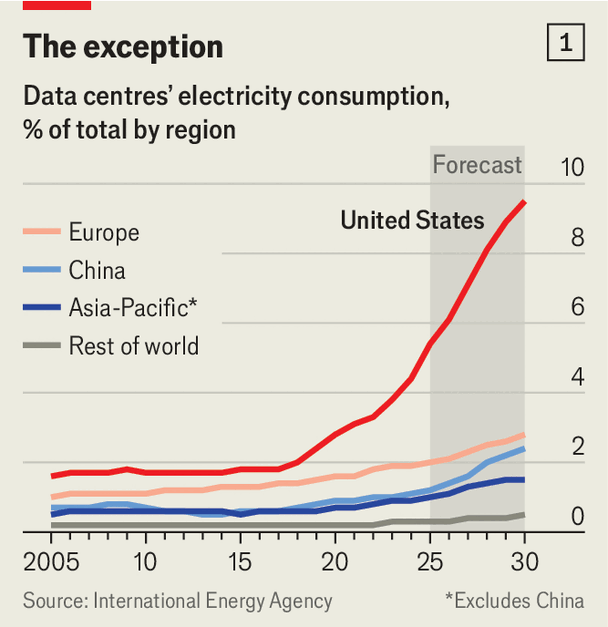
Demand projections illustrate why this issue matters. Wood Mackenzie projected in August 2026 that Chinese data centre electricity consumption could reach approximately 774 terawatt hours by 2030, representing nearly four times consumption over its relevant forecast period. Its longer term modelling suggested that data centres might eventually account for as much as 17% of national electricity consumption by 2060.
Other projections are substantially lower. Rystad Energy analysis published in 2026 estimated that Chinese data centre electricity demand could reach approximately 289 TWh by 2030.
The difference between these forecasts demonstrates considerable uncertainty surrounding the sector’s future electricity requirements. Analysts may use different definitions of data centres, AI workloads, facility utilisation, hardware efficiency, and the proportion of announced projects expected to become operational.
Current consumption is nevertheless increasing. The China Electricity Council reported that electricity consumption by internet data services had exceeded 60 billion kilowatt hours during 2026 by mid September, representing approximately 40% annual growth.
Such developments create difficult planning decisions. Insufficient investment in electricity infrastructure could restrict computing expansion, while excessive construction could produce expensive assets that remain underused.
China’s western data centre development has already encountered concerns about utilisation and latency. Some facilities located far from major technology markets may struggle to attract enough customers or efficiently support applications requiring rapid network responses.
The country’s electricity expansion therefore needs to be coordinated with actual computing demand rather than the number of proposed facilities alone.
China and the United States possess different advantages in this increasingly important infrastructure competition. China’s strengths include enormous electricity production, rapid construction, large state directed infrastructure programmes, and extensive western regions offering inexpensive land and renewable resources.
Reuters Breakingviews noted that China generated more than 10,000 TWh of electricity in 2024, exceeding American production by more than two times. This substantial generating capacity provides a foundation for expanding electricity intensive industries, including AI computing.
The United States, however, benefits from advanced AI accelerators, established hyperscale technology companies, leading software ecosystems, and significant frontier model development capabilities.
American data centre expansion is increasingly encountering electricity infrastructure challenges, including transmission congestion, lengthy grid connection processes, and limitations in available generation. Rising electricity consumption from AI, conventional data centres, and other industrial activities is expected to place additional pressure on the system.
American technology companies are responding through long term electricity agreements, renewable projects, natural gas infrastructure, and nuclear energy investments. In October 2026, Google reached a multibillion dollar arrangement involving nuclear power plant upgrades intended partly to support increasing electricity demand.
These developments demonstrate that both countries recognise electricity infrastructure as an increasingly important component of technological competitiveness.
China’s potential advantage comes from combining affordable regional electricity, direct supply arrangements, transmission investment, and coordinated computing development. America’s advantages remain closely connected to advanced processors, software, and frontier AI research.
Cheap electricity could become especially valuable if Chinese semiconductor capabilities continue improving. A country capable of operating large numbers of processors at lower electricity costs may compensate for some differences in individual chip performance.
Nevertheless, electricity alone cannot determine the outcome of international AI competition. Semiconductor manufacturing, memory bandwidth, networking, software efficiency, algorithms, investment capital, research talent, and access to advanced hardware remain essential.
The ability to combine these resources efficiently will determine whether China’s enormous electricity investments translate into sustained advantages in useful AI computation.
China’s Power Grid Investment Timeline, Environmental Challenges, and Future AI Competitiveness
China’s electricity transformation is unfolding across several overlapping investment periods. The most concrete near term phase extends from 2026 through 2030, when State Grid Corporation of China plans approximately 4 trillion yuan in fixed asset investment and national electricity planning calls for major increases in transmission capacity.
During this period, the country intends to expand interregional electricity connections, construct additional UHV transmission lines, strengthen local distribution systems, and improve its ability to integrate renewable generation.
The broader BloombergNEF estimate of approximately $3.9 trillion extends through 2049, reflecting the much longer process of adapting China’s electricity system to rising demand, greater renewable generation, energy storage, industrial electrification, and emerging computing requirements.
The investment timeline can be understood through several major developments:
- 2026 to 2030: State Grid plans approximately 4 trillion yuan in fixed asset investment, including transmission and distribution upgrades.
- By 2030: National planning aims for western to eastern electricity transfer capacity exceeding 420 GW, alongside approximately 40 GW of additional interprovincial balancing capacity.
- During the current five year investment period: State Grid plans 15 additional UHV transmission lines to strengthen long distance electricity delivery.
- Through 2049: BloombergNEF estimates that China’s cumulative electricity grid investment requirements could approach $3.9 trillion.
- Beyond 2030: Continued industrial electrification, renewable expansion, and data centre growth are expected to require further transmission, storage, and electricity management improvements.
Implementing these programmes presents substantial challenges. Renewable generating facilities can often be constructed more quickly than long distance transmission lines, potentially creating temporary mismatches between electricity production and delivery capacity.
Similarly, data centres may be announced and built before sufficient advanced computing hardware becomes available. A facility with reliable electricity and extensive cooling infrastructure cannot deliver its intended economic benefits if it lacks processors or customers.
Semiconductor supply is particularly important. Financial Times reporting in October 2026 indicated that China’s data centre construction was progressing rapidly while access to advanced AI chips remained constrained by American export restrictions and domestic manufacturing limitations.
These restrictions affect the relationship between physical infrastructure and useful computing capacity. Although China can construct enormous computing campuses and provide inexpensive electricity, its ability to operate them efficiently depends on obtaining sufficient advanced hardware and developing competitive domestic alternatives.
Regional differences also create challenges. Western provinces offer substantial renewable resources and comparatively inexpensive land, but they are geographically distant from major coastal technology centres. This distance can complicate networking, customer access, and applications requiring extremely low latency.
Electricity grid stability presents another difficulty. Wind and solar generation fluctuate with weather conditions, while AI data centres require dependable electricity. China must therefore combine renewable generation with storage, transmission, dispatchable power sources, and flexible electricity markets.
The environmental outcome of this infrastructure expansion will depend on how effectively these systems work together. A larger grid could reduce renewable curtailment and allow cleaner electricity to displace fossil fuel generation. However, the construction of power lines, substations, storage facilities, and data centres requires substantial materials and energy.
AI also introduces the possibility that cheaper electricity will encourage additional computing demand. Even if individual computing tasks become more energy efficient, total electricity consumption could continue rising as more models are trained and deployed.
Consequently, reducing the environmental impact of AI requires attention to both electricity consumption per unit of computation and the total scale of computing activity.
China’s rapidly growing renewable fleet could support a greater proportion of AI infrastructure over time, particularly where data centres are located near large renewable projects or have access to direct electricity supply arrangements.
However, continuous operations require reliable power during periods of low renewable output. Storage, interregional transmission, and dispatchable generation will remain important components of the electricity system.
The country’s long term environmental performance will therefore depend on whether cleaner electricity increasingly replaces fossil generation rather than simply supporting additional demand.
China also faces the challenge of preventing redundant infrastructure investment. If regional governments and developers construct more data centres than customers require, expensive computing campuses and supporting electricity assets may remain underutilised.
This possibility is particularly relevant because the country’s announced data centre pipeline substantially exceeds its existing capacity. Effective planning will require coordination between electricity providers, computing operators, equipment manufacturers, and regional authorities.
The same principle applies to transmission investment. New power lines must connect areas with economically useful generation to locations where demand exists, while local distribution networks need sufficient capacity to accommodate large facilities.
These constraints demonstrate that the success of China’s electricity strategy cannot be measured solely through spending totals, installed renewable capacity, or the number of completed data centres.
More meaningful indicators include how much electricity reaches productive users, how effectively renewable generation is utilised, the operating costs of computing facilities, and the amount of useful computation delivered by installed hardware.
China’s enormous electricity system could become a significant competitive asset if domestic AI processors continue improving and computing infrastructure is developed efficiently.
The country already possesses substantial electricity production, expanding renewable generation, extensive transmission infrastructure, and regions capable of supporting large computing campuses at relatively low operating costs.
However, these advantages must be combined with competitive semiconductor technology, reliable networking, software development, and sufficient demand to maintain high facility utilisation.
The United States faces a different combination of opportunities and constraints. Its strengths in advanced accelerators, leading AI companies, and software infrastructure remain substantial, while growing electricity requirements are creating additional pressure on power generation and transmission systems.
The international AI competition will therefore depend on how effectively both countries combine energy, semiconductors, capital, algorithms, research capabilities, and computing infrastructure.
China’s estimated $3.9 trillion grid investment requirement illustrates the enormous scale of the infrastructure needed to support future electricity demand. Its confirmed 4 trillion yuan State Grid programme provides a more immediate indication of the resources being committed to transmission, distribution, and renewable integration.
Together with plans for additional UHV lines, expanding western computing hubs, and growing domestic semiconductor development, these investments could make electricity infrastructure an increasingly important foundation of China’s artificial intelligence industry.
The central question is not whether China will continue building substantial electricity infrastructure, because that expansion is already underway. The more important question is whether the country can integrate its electricity resources, computing facilities, and semiconductor capabilities efficiently enough to produce globally competitive AI services at sustainable costs.
If China succeeds in combining abundant electricity with advanced domestic computing technology and high infrastructure utilisation, its power grid could become as strategically important to its AI ambitions as semiconductor manufacturing.

Frequently Asked Questions (FAQs)
- Is China really spending $3.9 trillion on one power grid project?
No. The approximately $3.9 trillion figure comes from a BloombergNEF estimate of China’s potential electricity grid investment requirements through 2049. It represents the projected cost of developing and upgrading infrastructure over several decades rather than a single officially approved government project. China’s more concrete near term commitment is State Grid Corporation of China’s planned 4 trillion yuan investment programme for 2026 to 2030, equivalent to approximately $574 billion. - How could China’s power grid investment lower AI data centre electricity costs?
Expanding transmission and distribution infrastructure can make it easier for data centres to access inexpensive electricity generated in regions with abundant energy resources. Stronger networks can reduce congestion, support direct renewable electricity connections, and improve supply reliability. Some western Chinese provinces also offer cheaper land and electricity subsidies for qualifying computing facilities. Together, these advantages could reduce operating expenses, although total computing costs still depend on hardware efficiency, networking, and facility utilisation. - What is renewable energy curtailment in China?
Renewable energy curtailment occurs when available wind or solar electricity cannot be fully used because local demand, transmission capacity, or storage is insufficient. Generators must then reduce production even when weather conditions would otherwise allow them to generate more electricity. During the first half of 2025, China’s solar curtailment reached approximately 6.6%, while wind curtailment was around 5.7%. Some western regions experienced considerably higher rates, demonstrating the need for additional transmission infrastructure and nearby electricity consumers. - Can AI data centres use electricity that would otherwise be curtailed?
Yes, AI data centres can potentially consume electricity that might otherwise remain unused because of local transmission constraints. Locating computing facilities near large renewable energy projects creates additional demand in regions where electricity is abundant. Certain flexible computing tasks may also be scheduled around periods of high renewable generation. However, data centres generally require reliable electricity throughout the day, meaning they still need storage, grid connections, backup arrangements, or other balancing resources when renewable output declines. - Why is China’s UHV network important for AI?
China’s ultra high voltage transmission network allows enormous quantities of electricity to travel long distances between generating regions and major consumption centres. This infrastructure helps connect western renewable resources with industrial and computing demand elsewhere in the country. For AI, the network can improve electricity availability, reduce regional supply bottlenecks, and support large computing campuses. It also complements the strategy of locating some data centres directly in western regions where electricity is comparatively inexpensive. - How much electricity could Chinese data centres consume by 2030?
Forecasts differ substantially because analysts use different assumptions about AI expansion, facility utilisation, hardware efficiency, and the number of planned data centres that will actually become operational. Wood Mackenzie projected approximately 774 terawatt hours of Chinese data centre electricity consumption by 2030, while Rystad Energy published a considerably lower estimate of around 289 TWh. Both forecasts nevertheless indicate that data centres could become increasingly important electricity consumers, requiring substantial investment in generation, transmission, and distribution infrastructure. - Is electricity cheaper for AI data centres in China than in the United States?
Electricity can be cheaper in certain Chinese regions, particularly where abundant generation, direct supply arrangements, or government subsidies reduce operating expenses. Reports have cited qualifying Chinese data centre electricity prices of approximately 5.6 US cents per kilowatt hour, compared with average American industrial electricity prices of around 9.1 cents at the time. However, these figures are not universal national tariffs. Large operators in both countries may negotiate specialised agreements, and actual costs depend on location, contract terms, reliability requirements, and available incentives. - Does cheaper Chinese electricity compensate for less efficient AI chips?
Cheaper electricity can offset part of the operating cost disadvantage associated with less efficient AI processors, but it cannot eliminate every performance difference. Some domestically produced Chinese accelerators have reportedly required more electricity than leading Nvidia products for comparable computing workloads. Lower electricity prices can make operating these processors more affordable, particularly in large facilities running continuously. However, total computing costs also depend on processor performance, memory capacity, software compatibility, networking efficiency, and the number of chips needed to complete a task. - Could renewable energy eventually power most of China’s AI infrastructure?
Renewable electricity could supply an increasingly large proportion of China’s AI infrastructure as the country’s solar, wind, transmission, and storage capacity expands. China aims for non fossil sources to provide approximately half of national electricity generation by 2030, potentially creating a cleaner electricity mix for computing facilities. However, data centres require dependable power even when renewable output is limited. Achieving high renewable usage will therefore depend on energy storage, stronger electricity networks, flexible power markets, and other generation sources capable of maintaining continuous supply. - Could power infrastructure determine whether China overtakes the US in AI?
Power infrastructure could significantly influence international AI competitiveness, but electricity availability alone cannot determine which country develops the strongest AI capabilities. China benefits from enormous electricity production, relatively inexpensive western power resources, rapid infrastructure construction, and substantial grid investment. The United States maintains important advantages in advanced AI accelerators, software ecosystems, and frontier model development. Future competitiveness will depend on how effectively each country combines electricity, semiconductor technology, research expertise, investment capital, algorithms, and reliable computing infrastructure.
Conclusion
China’s enormous power grid expansion could reshape the economics of artificial intelligence infrastructure. The widely cited $3.9 trillion figure is a BloombergNEF estimate of long term grid investment requirements through 2049, not a single official Chinese spending programme. The confirmed commitment remains substantial, with State Grid planning approximately 4 trillion yuan, or $574 billion, in investment from 2026 to 2030, alongside major increases in electricity transmission capacity.
China is also expanding data centres in regions offering inexpensive electricity, affordable land and favourable cooling conditions. Direct renewable electricity connections and ultra high voltage transmission could reduce energy costs and improve renewable utilisation. Approximately 24 GW of Chinese data centre capacity is already operating, with another 50 GW reportedly under development.
However, cheaper electricity does not automatically guarantee an AI advantage. Semiconductor shortages, chip efficiency, transmission constraints, data centre utilisation and continued reliance on coal remain significant challenges. China’s success will depend on how effectively it integrates energy infrastructure with advanced computing technology.
The broader implication is that electricity infrastructure is becoming a critical factor in global AI competitiveness. China’s investments in generation, transmission, storage and computing could provide a substantial long term advantage if the country successfully converts abundant electricity into affordable, reliable AI computing capacity.
Sources and Citations
- Reuters, January 15, 2026, State Grid investment programme : Reports State Grid’s planned investment of 4 trillion yuan between 2026 and 2030. It covers improvements to electricity distribution and a planned 30% increase in transmission between provinces and regions from the end of 2025. Reuters
Citation: China’s power grid investments to surge to record $574 billion in 2026–2030. (Reuters) - Bloomberg, October 2026, long term grid investment estimate : Coverage citing this report attributes the approximately $3.9 trillion investment requirement through 2049 to BloombergNEF. This projection is separate from State Grid’s five year programme. The original Bloomberg page could not be opened for direct verification. Digg
Citation: China’s AI Dominance Hinges on Harnessing Its Energy Advantage. (Bloomberg) - Financial Times, October 8, 2026, China’s data centre expansion : Reports approximately 24 GW of operational capacity and another 50 GW announced or under construction, citing SemiAnalysis. It examines Inner Mongolia’s advantages, including inexpensive electricity, available land and conditions that reduce cooling costs. ft.com
Citation: China races to build data centres in bid for AI supremacy. (Financial Times) - Wood Mackenzie, August 25, 2026, electricity demand forecast : Forecasts that China’s data centres will consume 774 TWh of electricity by 2030, approximately 6% of national consumption. The analysis discusses AI workloads, western computing hubs and closer coordination between computing infrastructure and renewable electricity supplies. Wood Mackenzie
Citation: China’s AI boom to drive data centre power demand to 774 TWh by 2030. (Wood Mackenzie) - Rystad Energy, 2026, data centre capacity and power demand : Projects approximately 60 GW of Chinese data centre capacity and 289 TWh of annual electricity consumption by 2030, based on announced projects. This is a separate forecast from Wood Mackenzie’s estimate and should retain its own attribution. rystadenergy.com
Citation: China’s data center capacity set to top 60 GW by 2030, driving a doubling of power demand. (Rystad Energy) - Reuters, November 3, 2025, renewable energy curtailment : Combines Wood Mackenzie’s curtailment forecasts with reported provincial statistics from China’s renewable electricity monitoring centre. It explains how transmission constraints and excess generation can reduce renewable output and affect investment returns. Reuters
Citation: China’s renewable curtailment to present revenue risks in next decade, Wood Mackenzie says. (Reuters) - Reuters, June 22, 2026, direct renewable electricity connections : Examines efforts to supply AI data centres directly with renewable electricity. It covers practical obstacles, including unpredictable peak demand, reliability requirements and grid operators’ concerns about recovering infrastructure costs. Reuters
Citation: China’s push for green power use in AI projects faces hurdles, experts say. (Reuters) - Reuters, March 3, 2026, ultra high voltage transmission expansion : Reports plans to commission 15 additional ultra high voltage transmission lines between 2026 and 2030. The article connects these projects with transferring electricity over long distances, increasing transmission capacity and reducing renewable curtailment. Reuters
Citation: China to build 15 more ultra high voltage power lines over next five years. (Reuters) - Financial Times, November 2025, electricity subsidies and domestic AI chips : Reports electricity discounts for selected data centres using Chinese processors and explains how these incentives offset higher power consumption. It also compares electricity costs in subsidised Chinese regions with American industrial electricity prices. ft.com
Citation: China offers tech giants cheap power to boost domestic AI chips. (Financial Times) - Reuters, November 4, 2025, reporting on the Financial Times subsidy investigation : Summarises the reported subsidies, including electricity bill reductions of up to half for some major data centres. Reuters explicitly attributes these findings to the Financial Times and states that it could not independently confirm the report. Reuters
Citation: China offers tech giants cheap power to boost domestic AI chips, FT reports. (Reuters)
Recommended
- The Witcher 3, Another Crab’s Treasure and 3 More Games Leave Xbox Game Pass in August 2026
- Sam and Max Save the World: Complete Guide and Walkthrough
- Denshattack! 3D Arcade and Platformer in Which Your Avatar Performs Flips, Tricks, and Grinds Aboard a Train in a Colorful, Dystopian Japan
- XBOX paid more than the development costs of S.T.A.L.K.E.R. 2: Heart of Chornobyl to make it a temporary exclusive
- Northward Official Reveal Trailer: Everything We Know so Far About Gameplay, Story, Release Date, and Latest Updates
- Christopher Nolan’s the Odyssey and Why It’s OK Everyone Sounds Like Your Next-Door Neighbor: the Accent Debate Explained
- Infinity Ward Co-Founder Claims Activision Pressured Call of Duty Developers To Make Game About Iran Invading Israel
- A Quiet Place: Part III Cast Update: Jack O’Connell Joins as Emily Blunt and Cillian Murphy Return
- Unreal Engine 5.8 Is Out Today With Big Optimization Improvements and Mesh Terrain
- Turok: Origins Delayed to Spring 2027 for PC, PS5, Xbox Series X|S and Switch 2



































































































