




In This Article (8 sections)
Russian Game Development Employment Recovery and Workforce Trends
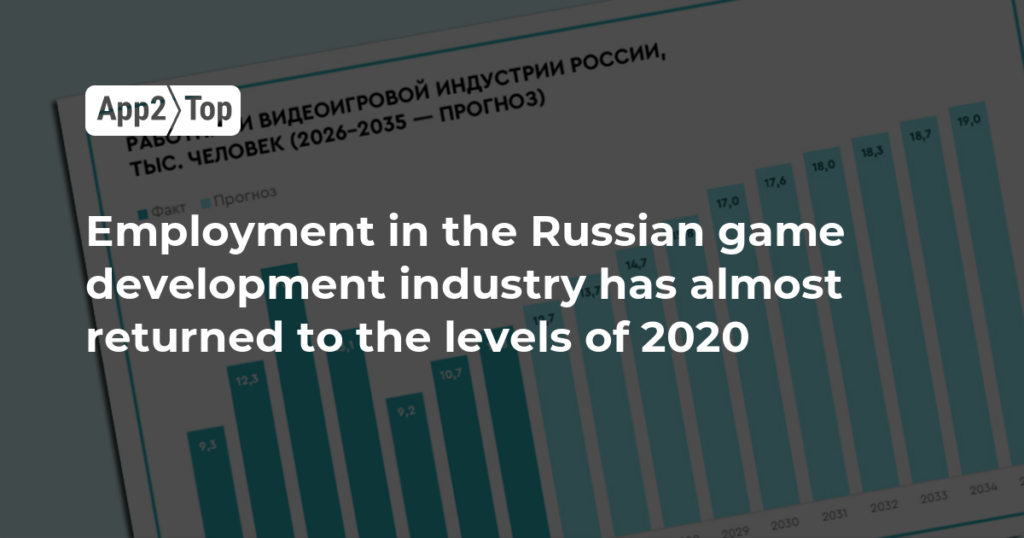
Employment in the Russian game development industry rose by 11% in 2025 to a reported 11,800 workers, bringing the Russian game development workforce close to its 2020 level of 12,300. The figures were presented by Moscow’s Creative Industries Agency at a September 29, 2026 press conference and describe employment during 2025 rather than a completed assessment of 2026. The recovery is significant, but the comparison year matters. Against 2020, the Russian game workforce is only 500 people smaller, meaning it has recovered to approximately 95.9% of that earlier total. Against the much higher workforce reported before the sharp contraction beginning in 2022, however, the remaining gap is considerably larger.
The scale of the downturn explains why returning near 2020 levels should not be confused with fully reversing the Russian game industry’s losses. Employment reportedly fell from 17,000 to 13,100 in 2022, a decline of approximately 22.9%, and then dropped to 9,200 in 2023, a further reduction of roughly 29.8%. Across those two declines, the Russian game workforce lost 7,800 positions, equivalent to about 45.9% of the starting total. Corporate restructuring formed part of this broader period of change. Wargaming announced in 2022 that it was leaving Russia and Belarus and transferred its local live-games business to Lesta Studio’s management, with Lesta no longer affiliated with Wargaming.
That demonstrates a major organizational shift, but the available figures do not establish how much of the national employment decline resulted from that decision or how losses were divided among relocation, layoffs, closures, career changes, or changes in statistical coverage.
From the reported 2023 trough of 9,200 to the 2025 total of 11,800, Russian game employment increased by 2,600 workers, representing growth of approximately 28.3%. That recovered only about one-third of the preceding numerical loss. Using the reported 11% annual growth rate, the 2024 workforce can be estimated at roughly 10,600, although that is a back-calculation from rounded figures rather than a separately published exact total.
Broader business revenue also increased, with coverage of the agency’s findings placing Russian gaming-company revenue at 206.7 billion rubles in 2025 compared with 177.8 billion in 2024, an increase of approximately 16.3% in nominal terms. Developers and publishers accounted for 106.6 billion rubles of the later total. These figures indicate expansion in the measures reported, but they do not reveal how much Russian game hiring came from established employers, startups, returning specialists, or contractors moving into formal employment.
The findings are attributed to Moscow’s Creative Industries Agency, or AKI, which operates under the Moscow Department of Culture. Reporting from different publications should therefore not be mistaken for multiple independent workforce censuses. The available summaries also do not provide a complete methodological appendix explaining issues such as contractor treatment, part-time employment, or Russian-founded companies registered abroad. Separate research has raised broader classification concerns, with the Agency for Strategic Initiatives discussing in 2025 the difficulty of identifying Russian game development businesses accurately in official statistics. AKI and ASI are different organizations, and their work should not be conflated. For historical comparisons to remain meaningful, the population and definitions used should ideally remain consistent from year to year.
Russia’s 2025 Russian game employment growth also occurred against a difficult international backdrop. Computerra reported a 6% global employment decline for the same period, creating a 17 percentage point difference from Russia’s reported 11% growth. That does not mean Russian workers had a 17% greater chance of finding employment or that the domestic industry was proportionally more productive.
International evidence nevertheless confirms widespread labor pressure, with GDC’s 2026 State of the Game Industry survey reporting that 28% of more than 2,300 respondents had been laid off during the previous two years and half said their current or most recent employer had conducted layoffs during the previous 12 months. Layoff incidence and net employment change measure different things, so the safest conclusion is that Russia’s reported Russian game rebuilding took place while employment conditions remained difficult across the wider industry.
Russian Game Industry Roles, Education, and Company Growth
The workforce composition shows the importance of several distinct disciplines. Artists and animators together accounted for approximately one-third of reported employment, while game designers represented 21% and programmers 16%. These categories describe different production responsibilities rather than competing measures of importance. Art roles in the Russian game industry can involve characters, environments, vehicles and other visual assets while also requiring engine integration, collaboration and adherence to production schedules.
Game designers focus more directly on rules, mechanics and player experience, while Russian game programmers implement interactions, solve technical problems, fix defects and optimize systems. In practice, these roles depend heavily on one another because a strong Russian game design still has to fit technical constraints, while technically correct implementation may require revision if it does not create the intended experience.
The occupational percentages do not reveal which specialisms are currently hardest to recruit, best paid, or most accessible to junior applicants in the Russian game industry. The combined art category, for example, does not show whether demand is stronger for concept artists, animators, technical artists, environment artists, or character specialists. Likewise, the design and programming shares do not indicate seniority distribution across the Russian game sector.
For career planning, the more useful lesson is that applicants should demonstrate competence relevant to a specific role while also showing they can collaborate across discipline boundaries. A portfolio for an artist working in the Russian game industry can explain how an asset moved from concept to an implemented game-ready result, while a designer can show the reasoning and iteration behind a mechanic and a programmer can demonstrate a reliable implementation and how technical problems were solved.
Approximately 80% of workers in the reported industry had higher education, but that statistic should not be interpreted as proof that every employer requires a degree or that those qualifications were specifically in Russian game development. Formal study and demonstrated project work answer different questions. A qualification can show structured learning, while a playable project, implemented asset, or tested system can demonstrate how that knowledge was applied. HSE University’s Interactive Media and Digital Industries master’s program and HSE Game Lab provide one example of project-based education in which students develop computer and tabletop game projects, but that activity does not establish a particular graduate employment rate in the Russian game industry.
The agency reported 623 gaming companies in Russia during 2025, including approximately 500 developers and publishers. The distinction matters because the broader category also includes businesses involved in engines and hardware, esports, distribution, and technical operation. The headline total therefore should not be treated as a list of 623 Russian game studios making original games, and dividing the development workforce by all 623 companies would not provide a reliable average studio size because the organizational and employment populations do not align cleanly.
The total Russian game company count was reported as 2.2 times its 2019 level, which mathematically corresponds to approximately 120% growth rather than a 220% increase. Applying that rounded multiplier to the 2025 figure implies an earlier base of around 283 businesses, but that should not be presented as an independently measured exact 2019 total. More Russian game companies can coexist with fewer workers than at a previous employment peak if the market contains a larger number of small teams. Company formation and employment recovery therefore measure different aspects of the industry, and long-term analysis would benefit from additional indicators such as business survival, repeat releases, sustained payrolls, and whether small studios grow into stable employers.
Russian Game Releases, Financing Challenges and Industry Sustainability
AKI’s reported figures included 9,200 game releases in 2025, with almost all placed below a $1 million budget and only two in the $1 million to $50 million range, including Steel Balalaika’s Broken Arrow. That release total requires caution because the available summary does not explain platform distribution, how multiple versions are counted, or how unique commercial projects are distinguished. It should not be interpreted as evidence that Russia produced 9,200 large premium games in one year. Budget ranges should also not be converted into exact project costs because placing a title within a band does not reveal where inside that range its expenditure actually fell.
Broken Arrow provides a concrete example of a longer production cycle. Slitherine confirmed its release on June 19, 2025, while tracing the project’s public history to 2020 and its publishing partnership to 2021. Development work also continued beyond launch, with plans covering improvements and fixes related to areas such as artificial intelligence, missions, and connectivity. This illustrates why release counts alone cannot establish the health of the workforce. Sustainable employment depends not only on bringing projects to market, but on financing development before launch, supporting games afterward, and securing enough revenue or investment to move teams into subsequent productions.
Financing remains one of the clearer weaknesses in the recovery. A June 2026 Kommersant report on an Igroprom survey of more than 100 company representatives said more than 70% identified funding as a major development challenge, while 77.5% wanted assistance with marketing and market entry. The respondents were predominantly senior decision-makers rather than a representative sample of all workers, but their answers highlight problems that can directly affect employment stability. A studio may have an experienced team and promising project while still struggling to retain staff if funding does not arrive in time to cover production between milestones.
The same reporting discussed obstacles involving international payments and access to services, although those constraints should not be generalized to every Russian developer. ASI’s 2025 recommendations separately emphasized workforce skills, support for independent studios, technology, and international promotion. Together, these findings suggest that workforce growth depends on more than simply increasing headcount. Studios need financing continuity, market access, project management, and the ability to keep experienced workers between releases.
Measurement gaps also limit what can be concluded from the headline recovery. The available statistics do not provide detailed information about salaries, contract length, employee retention, junior hiring, seniority, or the proportion of temporary versus permanent positions. A larger workforce can still be fragile if experienced employees leave frequently or if jobs depend heavily on one project milestone. A stronger assessment would therefore examine whether companies can retain specialists, develop new entrants, complete projects, and maintain teams after those projects ship.
Russian Game Development Employment Outlook and Career Implications
The Creative Industries Agency projects that the Russian game development workforce could reach 19,000 workers by 2035. Compared with the reported 2025 base of 11,800, that target would require a net increase of 7,200 people, or approximately 61%. Spread evenly across ten years as compound growth, the implied annual rate would be around 4.9%. That calculation simply expresses the distance between the published starting point and target and should not be mistaken for an additional agency forecast.
The difference between the recent 11% annual increase and the longer-term implied growth rate is important. Reaching 19,000 workers would not require employment to continue growing by 11% every year, while one particularly strong year does not guarantee that the target will ultimately be reached. The gap also should not be described as 7,200 guaranteed future vacancies. Net workforce growth measures the difference between arrivals and departures, while gross hiring can be much larger if employers must also replace people who leave.
Progress toward the 2035 target would be more convincing if several measures improved together. Employment growth is one indicator, but retention, active employers, successful project completion, financing continuity and business survival would provide a stronger picture of whether the underlying production base is becoming more durable. The same principle applies to the 2025 recovery. Reaching approximately 95.9% of the 2020 workforce is encouraging, but it does not establish that the mix of experience, skills, international relationships, and financial stability has returned to its earlier condition.
For people considering careers in Russian game development, the recovery is therefore an encouraging aggregate signal rather than a guarantee about individual opportunities. Games require a wide range of functions, including production, art, animation, design, technical art, programming, audio, quality assurance, and supporting business roles. Applicants should avoid treating game development as one uniform career path and instead prepare evidence relevant to the specific work they want to perform.
Employer evaluation matters just as much as personal preparation. A useful discussion with a potential employer should establish the project’s current stage, expected responsibilities, available supervision, funding situation and whether the position depends on a short production milestone or a longer business plan. A growing national workforce can create more opportunities overall, but the quality of any individual position still depends on the company, project, contract, and fit between the applicant’s skills and the work required.
The strongest interpretation of Russia’s game-development recovery is therefore measured optimism. Employment is moving upward, company activity has expanded, and the workforce is close to its 2020 level, but the industry has not simply returned to its earlier state. Financing, retention, project sustainability, measurement quality and the continuing gap from the higher pre-contraction workforce all remain important when judging whether the rebuilding phase can develop into durable long-term growth.
Frequently Asked Questions (FAQs)
- How many people worked in Russian game development in 2025?
The reported workforce was 11,800 people in 2025, representing annual growth of 11%. The figures were presented publicly in September 2026, but that is only the publication date. The employment total itself refers to the previous year, so it should not be described as a completed 2026 workforce count. - Has employment fully returned to its 2020 level?
Not yet. The reported 2020 workforce was 12,300, compared with 11,800 in 2025. That leaves a difference of 500 workers, meaning the 2025 total was about 4.1% below the 2020 benchmark. Describing employment as nearly recovered is therefore more accurate than saying the earlier level has already been fully restored. - Does reaching the 2020 benchmark mean reversing the entire downturn?
No. The industry had a higher workforce before the sharp contraction beginning in 2022, so returning close to the 2020 figure would not recover all of the later losses. Based on the historical series, the 2025 workforce remained about 30.6% below that higher starting point. The choice of comparison year therefore changes how strong the recovery appears. - How much employment growth occurred after the 2023 low?
Employment rose from 9,200 workers in 2023 to 11,800 in 2025, an increase of 2,600 people or approximately 28.3%. That is a meaningful rebound, but it followed a very large earlier contraction. As a result, the percentage increase does not mean the workforce recovered every position that had previously been lost. - Does the reported growth mean there are 11,800 vacancies?
No. The 11,800 figure describes people already working in the industry, not open positions. Employment totals, advertised vacancies and future hiring plans are separate measures. A growing workforce can indicate stronger hiring activity overall, but the published figure does not reveal how many jobs were available at any particular time. - Which skills matter for game-art careers?
Relevant skills depend on the specific art role, but the supplied material highlights artistic fundamentals, 3D production, working with game engines, collaboration and organization. A strong portfolio should show work relevant to the role being targeted and make the applicant’s own contribution clear, especially on team projects. Showing how an asset moved from concept to a functioning in-game result can be more informative than presenting finished images alone. - Does the education statistic make a degree compulsory?
No. The finding that around 80% of the reported workforce had higher education describes the people already employed in the industry. It does not establish a universal hiring rule requiring every applicant to hold a degree. Individual employers can set different requirements, and practical work such as playable projects, implemented assets or technical demonstrations can also show relevant ability. - Why is the company count different from the studio count?
Because the reported gaming ecosystem includes more than companies directly developing and publishing games. It also covers activities such as distribution, esports, technology, engines, hardware and technical services. That is why the broader total of gaming companies should not be treated as though every listed business is an original game-development studio. - What could prevent employment growth from continuing?
Financing problems, weak market access and difficulties sustaining projects between development milestones could all limit future hiring and retention. A 2026 industry survey found substantial demand for help with funding, marketing and market entry among participating companies. Even studios with capable teams can struggle to maintain employment if financing and project schedules do not align. - Is the 2035 workforce target guaranteed?
No. The projected workforce of 19,000 by 2035 is a forward-looking target rather than a guaranteed result. Reaching it would depend on factors such as financing, business survival, successful releases, worker retention and continued industry growth. The implied long-term growth path should therefore not be treated as a promise to create a fixed number of jobs every year.

Conclusion
Employment in the Russian game development industry has almost returned to the levels of 2020, but the significance lies in the distinction between rebuilding and full restoration. The published series supports a recovery from the 2023 low while also showing a substantial remaining gap against the higher pre-decline workforce. app2top.com
The next test is durability. More employees and more businesses become stronger evidence of recovery when accompanied by stable financing, completed projects, retained expertise, and opportunities for new entrants.
For developers and jobseekers, the appropriate response is neither to dismiss the improvement nor to assume that headline growth removes employment risk. The figures justify renewed attention to the sector; decisions about careers and business expansion still require evidence at the employer and project level.
Sources and Citations
- pp2Top — “Employment in the Russian game development industry has almost returned to the levels of 2020” — September 30, 2026
App2Top source article - App2Top — “In 2025, Russian game companies earned 206.7 billion rubles” — September 30, 2026
App2Top source article - GDC — “GDC 2026 State of the Game Industry Reveals Impact of Layoffs, Generative AI, and More”
GDC 2026 State of the Game Industry - Wargaming — “Wargaming and Frag Lab Announce Development of a New Next-Gen F2P MMO Shooter Built with Amazon Game Tech”
Wargaming announcement - Slitherine — Broken Arrow official product page
Broken Arrow official page - Slitherine — “Broken Arrow | Pre-order and release date announced” — April 28, 2025
Slitherine release announcement - Slitherine — “Broken Arrow: Major Update” — July 31, 2026
Slitherine July 2026 update - Education and occupational guidance
- HSE University — Master’s Programme in Interactive Media and Digital Industries
HSE University program - HSE University — Interactive Media and Digital Industries admissions/program information
HSE University admissions page - ScreenSkills — “Build your games portfolio”
ScreenSkills games portfolio guide - ScreenSkills — Engine programmer in the games industry
ScreenSkills engine programmer guide - ScreenSkills — Gameplay programmer in the games industry
ScreenSkills gameplay programmer guide - ScreenSkills — Generalist programmer in the games industry
ScreenSkills generalist programmer guide
Recommendations
- Can you control a camera in Blender with game controllers?
- Ved: Recure – Official Demo Launch Trailer: Steam Demo, Gameplay Breakdown, and Release Date Updates
- Resident Evil Code Veronica Remake Announcement Rumors Explained
- Unigine 2.21 Is Out: What’s New in the Real-Time 3D Engine — Animation Graph, AI Workflow, Performance
- Captain America’s Marvel Rivals Summer Skin Explained: Why the New Costume Went Viral
- Silent Hill: Townfall ESRB Rating Explained. Release Date Clues, Platforms, Story Details & Latest Updates
- The Full Timeline of My Hero Academia: Chronological Order of Seasons, Arcs, Movies, and the Final Season (Complete 2026 Watch Order)
- World Creator 2026.4 Released: New Free Community Edition, Features, Performance Boosts & What’s New
- Xbox Clarifies Halo: Campaign Evolved Won’t Require PS Plus for PS5 Splitscreen After Backlash
- Overwatch Hero 51 Revealed: Sierra Is the New DPS (And It’s Not Frankie)



































































































