










In This Article (6 sections)
Microsoft Links ConnectWise Cloud Backup Compromise to Storm-0940 and ARTEX
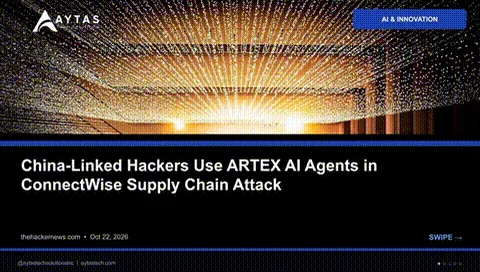
On October 21, 2026, Microsoft attributed the ConnectWise supply chain compromise to Storm-0940, a China state aligned threat actor that used ARTEX to accelerate cloud attacks. Microsoft said its own corporate systems, products and services were not compromised. ConnectWise acknowledged unauthorized access to credentials associated with its Cloud Backup service, formerly known as SkyKick. The incident highlights how attackers can exploit authority already granted to legitimate business applications without first compromising individual employee accounts. For Microsoft 365 customers, assessing the consequences requires examining application identities, permissions, credentials and authentication activity alongside conventional user sign-in records.
Storm-0940 was documented before the October 2026 campaign. Microsoft’s October 2024 research described the actor as active since at least 2021, with government organizations, law firms, defense related institutions and think tanks among its historical targets. That earlier investigation connected the group’s activity to credentials obtained through CovertNetwork-1658, infrastructure built from compromised devices. Researchers observed stolen credentials being used shortly after acquisition, supporting Microsoft’s assessment of a close operational relationship between the relevant operators. These findings provide context for the actor’s use of compromised credentials, but they do not establish that the same infrastructure or techniques caused the later ConnectWise intrusion.
Microsoft identified ARTEX as an agentic AI framework used to accelerate cloud operations. A publicly available English translation of its technical materials describes a Go backend, a Next.js interface and cooperating agents that organize findings and testing activity. Its architecture includes planning, shared task tracking and structured representations of discovered information, allowing work to continue across several stages. The distinction from a conventional chatbot is the connection between reasoning and action: an agentic workflow can receive tool output, interpret the results, select another operation and evaluate what happens afterward. Information gathered during one stage can therefore influence subsequent activity without requiring a separate manual decision at every transition.
The framework’s capabilities nevertheless depend on more than the language model. External tools, credentials, network access and permissions determine which operations are technically possible, even when the model can identify a useful next step. Microsoft reported instances in which ARTEX assisted activity progressed from initial targeting to privileged cloud access in less than three hours. That finding illustrates how automated coordination can compress the time spent gathering information, interpreting results and deciding what to examine next. It does not establish that every attempt succeeded or followed the same timetable. Invalid credentials, insufficient permissions and defensive controls can still prevent access, while valid credentials and extensive authority may allow an operation to advance quickly.
Research on other agentic security systems provides context without establishing a connection to this campaign. PentestMCP, a separate research project, describes scanning, service identification, resource enumeration and support for later testing stages within customizable agent workflows. Its relevance is that familiar security tools can be coordinated through a larger automated process; it was not identified as part of the Storm-0940 activity. Zscaler’s separate investigation also reported that ARTEX’s original developer moved the project to closed source after its abuse became public. Previously downloaded versions and forks could remain available, so the change would not necessarily remove existing copies from circulation.
Attribution must remain separate from tool availability and capability. Storm-0940 is Microsoft’s designation for a cluster of malicious activity, rather than the public name of a registered organization. Describing it as China aligned does not identify every participant or establish a publicly documented chain of command for each intrusion. Similarly, a developer’s nationality, a tool’s interface language or the use of ARTEX does not independently identify its operators. Publicly available frameworks can be used by unrelated actors. The reported campaign therefore connects a previously documented threat actor with a framework that can accelerate operations, while leaving the outcome of each attempted intrusion dependent on the credentials, permissions and controls within the targeted environment.

Application Credential Abuse, Failed Password Spraying and Cloud Persistence
The reported downstream mechanism involved unauthorized use of a legitimate ConnectWise application identity and its existing authorization, rather than distribution of a malicious software update. Todyl observed application authentication into monitored Microsoft 365 tenants from infrastructure unrelated to the backup provider, indicating that the activity used the application’s permissions rather than an employee’s interactive session.
This makes the supplier relationship central to the incident: customers had authorized an external service to perform backup or management tasks, and compromised credentials could allow an attacker to attempt access through that established connection. However, the downstream mechanism does not explain the original vendor intrusion. ConnectWise said it was working with outside specialists to determine how the unauthorized access began and establish its scope, so the available reporting does not support naming a particular vulnerability or initial intrusion method.
Microsoft’s application model helps explain why the same compromised relationship can produce different outcomes across customers. A multitenant application has a shared application identity and a local representation, called a service principal, within each customer directory. The tenant is the organization’s identity and administration boundary, rather than a single mailbox or employee account. The service principal connects the application to permissions granted within that environment, so different customers may authorize different operations. Some targeted tenants may not contain the relevant service principal at all. Consequently, neither the legitimacy of the vendor application nor its presence in another organization establishes what authority it holds in a particular customer environment.
OAuth permissions determine which resources and operations an application can access after authentication. Depending on configuration, these may involve messages, files, directory information or administrative functions. ConnectWise’s product documentation describes Cloud Backup protection across OneDrive, SharePoint, Outlook and Exchange, illustrating why a backup service may require access to several categories of organizational information. This concentration of permissions supports useful business functions but creates potential exposure if the credentials exercising that authority are obtained by an unauthorized party. Available permissions still do not establish that every permitted operation occurred. Investigators must distinguish what an application could do from what the records show it actually attempted or completed.
The application access involved Microsoft’s client credentials flow, which allows software to authenticate using its own supported credentials during background operations. Such credentials may include a secret, a certificate based credential or another supported mechanism, after which the requested resource evaluates whether the application is authorized to perform the operation. An application ID names the software identity but is not itself a secret proving control over it. Knowing that public identifier alone does not provide access.
Microsoft also documents that workload identities cannot complete multifactor authentication in the same manner as a person, meaning protections for employee sign-ins do not automatically address software credential abuse. Todyl specifically warned that revoking user sessions did not terminate the application access it observed. Resetting employee passwords or revoking their sessions may therefore leave the separate application credentials unaffected.
Microsoft reported authentication attempts against more than 2,250 Microsoft 365 tenants following the unauthorized credential access. This measures the campaign’s targeting reach, not the number of confirmed compromises or data theft incidents. Huntress observed unsuccessful attempts against some tenants where the relevant service principal was absent, providing a concrete example of why the target population could exceed the number of environments in which the credentials could obtain access. Repeated attempts against one tenant also do not represent additional organizations. Figures from Microsoft, Huntress, Todyl and other providers should not automatically be added together because their customer populations and observation periods may overlap, and their counts may refer to different units, including authentication events, accounts or unique tenants.
Microsoft separately documented extensive password spraying against employee accounts between October 10 and 14, 2026. That dataset contained more than 151,000 failed sign-ins targeting 327 accounts across eight organizations, with activity peaking at approximately 2,900 failed authentication attempts per minute. Microsoft found no successful authentication, token issuance, Microsoft Graph activity or directory changes associated with that specific set of attempts. These findings must remain separate from the application credential abuse connected to the supplier compromise. The unsuccessful password spraying does not explain the application access observed elsewhere, and the broader incident should not be described as though every authentication method produced the same result.
Password spraying generally involves trying a limited selection of passwords across multiple accounts instead of concentrating many guesses on one user. Microsoft’s investigation guidance emphasizes suspicious source addresses, unfamiliar sign-in patterns and related authentication activity. Even unsuccessful attempts can reveal which accounts were targeted, whether controls caused account lockouts and how the activity changed over time. They can also help distinguish a failed password based approach from another access route that produced different results. However, a large volume of failed events does not establish that a password was correctly guessed or that an authenticated session was obtained.
Observed outcomes also differed between customer environments. Todyl reported successful application sign-ins in monitored environments without associated directory changes. Huntress, by contrast, documented one customer environment in which a ConnectWise application obtained an elevated directory role and added credentials to other applications. The latter finding illustrates how access through one trusted identity can create additional authentication routes, but it should not be generalized to every targeted tenant. MITRE ATT&CK recognizes the addition of attacker controlled cloud credentials as a persistence technique. If such credentials remain in place, disabling only the original compromised application may leave other access methods available, making it necessary to follow changes across the affected directory objects.
These findings require a sequence of evidence rather than a single compromise label. Targeting identifies where attempts were directed; successful authentication establishes that an identity was accepted; permission records describe available authority; and audit or activity records can show subsequent operations. Configuration changes, information access and information transfer require their own supporting evidence. A successful sign-in alone does not prove data theft, while the absence of a recorded directory change does not independently establish that no information was accessed. Connecting the initiating identity, affected resources, operation results and timing provides a clearer account of what occurred and whether additional means of access were created.

Investigating ConnectWise Credential Abuse With Microsoft Entra and Defender
An investigation begins by identifying the correct Microsoft 365 tenant and the relevant ConnectWise application identities. The company’s technical guide covers seven identities, including Cloud Backup and related Cloud Management integrations. Older installations may retain SkyKick display names, making application identifiers more reliable than names alone when searching historical records. ConnectWise identifies Cloud Backup through the application ID 506e08f9-6e9a-4da4-942b-a099a03644ae. Investigators should also record the corresponding service principal Object ID, which identifies the application’s local representation within the customer tenant. The guide recommends reviewing activity from October 13, 2026, onward and extending the search to October 1 where historical records permit, helping establish whether suspicious activity preceded a later detection or public disclosure.
The available investigation period depends on retained and previously exported records. Microsoft Entra’s standard audit and sign-in log retention is seven days with Free licensing and 30 days with P1 or P2. Records exported earlier may remain available in another monitoring system, but upgrading a license does not restore history that has already expired. Microsoft Graph activity collection also begins when its diagnostic category is enabled, so requests from an earlier period may not have been recorded. These limitations should be documented before interpreting an empty search, since missing events may reflect incomplete collection or expired history rather than an absence of activity.
Within the Microsoft Entra admin center, the relevant records are available under Entra ID, then Monitoring & health. Sign-in logs provide authentication evidence, while Audit logs record configuration changes and other directory operations. Microsoft identifies Reports Reader as the least privileged role for accessing the relevant activity logs. Service principal sign-in records are particularly important because they describe applications authenticating through their own credentials, rather than ordinary employee sessions. Microsoft also notes that matching service principal events may be aggregated into one displayed row. Grouped results should therefore be expanded before visible rows are treated as the total number of attempts, and successful and failed authentications should be examined separately.
Relevant authentication fields include the application identity, requested resource, source IP address, timestamp and available event identifiers. Together, these details help determine whether an event matches expected application behavior and whether further operations followed. ConnectWise published three IP addresses as investigation references, but cautioned against limiting the review to them. The affected application identities, historical window and surrounding authentication patterns remain important because activity involving other infrastructure could otherwise be overlooked. The published addresses are:
144.172.64.128144.172.64.99144.172.64.60
After authentication records have been reviewed, Microsoft Entra audit logs can help establish whether unexpected directory changes occurred. Relevant details include the initiating actor, target object, operation result and, where available, previous and updated property values. These fields help distinguish an attempted change from a completed operation and support investigation of newly added credentials, altered permissions or elevated roles. A suspicious sign-in followed by a credential addition deserves scrutiny, but the timing, initiating identity and business purpose must still be checked against authorized administration. Microsoft Graph activity logs can add records of requests processed for the tenant and support analysis or export to external monitoring systems where collection was configured.
Correlating sign-in, audit and Graph records can help reconstruct the progression from authentication to subsequent cloud activity. Permission records explain what an identity was authorized to do, while operation results help determine which actions actually occurred. Microsoft also identified two relevant Defender alerts, covering unusual Graph behavior and a potentially consequential application privilege change. Their presence provides a reason to examine the underlying activity, but neither alert independently establishes the complete scope of an incident or whether every associated operation was unauthorized:
- “Unusual Microsoft Graph activity associated with Compromised ConnectWise Application”
- “Application self-assigned Global Administrator role”
Microsoft Defender for Cloud Apps also supports app governance policies based on application activity or permissions, including predefined and customizable policies. Where supported, administrators can review policy conditions and configure particular alerts to trigger automatic application disabling. App governance can additionally show changes in uploads and downloads involving resources such as files or email. Unexpected data volume may justify further investigation, especially when it follows suspicious authentication or permission changes, but legitimate applications can also transfer substantial amounts of information. Timestamps, initiating identities, affected resources and approved business activity are therefore necessary to distinguish suspicious behavior from normal operations.
Detection coverage depends on the products, policies and logging capabilities deployed within each organization. The absence of a particular Defender alert does not establish that the associated behavior was impossible, and an empty log search means only that no matching events were returned under the selected conditions and available records.
Investigators should document those limits while following any additional credentials, permissions or application changes beyond the original ConnectWise identity. Vendor service restoration and customer remediation are separate tasks: restoring the backup service does not by itself establish that a customer’s cloud configuration is unchanged or that no information was accessed. The assessment must connect authentication, available authority, completed actions and any evidence of information access or transfer within that specific tenant.

Frequently Asked Questions (FAQs)
- What is the Storm-0940 ARTEX attack?
The Storm-0940 ARTEX attack refers to a cloud intrusion campaign attributed by Microsoft to Storm-0940, a China-state-aligned threat actor. The campaign involved the misuse of trusted application credentials associated with ConnectWise Cloud Backup, alongside the use of ARTEX to accelerate certain attack activities. Microsoft reported authentication attempts against more than 2,250 tenants, but that figure represents targeting rather than confirmed compromise. Each organization must be investigated separately to determine whether authentication succeeded, permissions were misused, or sensitive information was accessed. - Is ARTEX itself a large language model?
No. ARTEX is an agentic AI framework that coordinates large language models, software agents, and external security tools rather than functioning as a standalone language model. Its architecture includes planning, task management, and mechanisms for organizing information gathered during security testing. Its practical capabilities depend on the tools, credentials, permissions, and network access available to it. - Were all targeted tenants confirmed to have lost data?
No. Microsoft’s reported figure of more than 2,250 targeted tenants does not mean every organization experienced a successful intrusion or data loss. Targeting, successful authentication, unauthorized configuration changes, and data theft are separate findings that require different evidence. Some attempts may have failed, while others may have succeeded without leading to confirmed data access. - Does changing employee passwords remove application access?
Not necessarily. Applications can authenticate to Microsoft 365 using credentials separate from employee passwords, such as application secrets or certificates. Resetting an employee password or revoking user sessions does not automatically invalidate credentials belonging to a software application. When application credential abuse is suspected, responders must examine the affected application identity, its permissions, and any unauthorized credentials or grants. - Which Entra sign-in category is relevant?
Service principal sign-ins are particularly relevant because they record applications authenticating with their own credentials rather than through an employee’s interactive session. Investigators should review successful and failed events, source addresses, timestamps, requested resources, and application identifiers. Audit logs should also be examined for suspicious configuration or permission changes. - Can a tenant remain exposed after the original credential is revoked?
Yes. Revoking the original compromised credential may stop access through that specific method, but an attacker may have established additional persistence. This can include adding credentials to other applications, granting new permissions, or assigning elevated roles. Investigators therefore need to review application identities, newly added credentials, permission grants, and role changes before concluding that access has been fully contained. - Can enabling logging now reveal all earlier activity?
No. Enabling Microsoft Graph activity logging only begins collecting relevant information from that point onward. It does not recreate activity that occurred before logging was enabled. Existing Microsoft Entra sign-in and audit records are also subject to retention limits, so expired records may be unavailable unless they were previously exported to another monitoring or storage system. - Does a suspicious source address prove every associated event was malicious?
No. A suspicious IP address is an important investigative indicator, but it does not independently prove the purpose or outcome of every event associated with it. Security teams should review the application identity, authentication result, requested resource, timestamp, and surrounding administrative activity before drawing conclusions. Activity from an address not included in published indicators should also not automatically be considered safe. - What can Microsoft Graph activity logs contribute?
Microsoft Graph activity logs can help investigators understand how applications interacted with Microsoft 365 resources after authentication. When properly configured, they can show Graph API requests processed for a tenant and help correlate suspicious authentication with subsequent activity. Their usefulness depends on whether collection was enabled during the relevant period and whether the records remain available. - What should an incident review record before closure?
An incident review should document affected application identities, the investigation period, permissions examined, authentication results, suspicious activity, configuration changes, unauthorized credentials or grants, containment actions, and completed remediation. It should also record missing logs or other evidence gaps that limit what investigators can conclude. The final review should clearly distinguish confirmed findings from unresolved questions or assumptions.

Conclusion
The Storm-0940 ARTEX attack shows why cloud investigations must follow software identities as carefully as human accounts. A familiar application name is only the starting point. Its credentials, permissions, and subsequent actions determine the security significance of its activity.
For affected organizations, the priority is a documented review of their own environment. Authentication evidence, directory changes, application behavior, and available resource records must be assessed together.
The same precision should guide reporting. Attempts are not confirmed compromises, available permissions are not proof of exercised access, and missing evidence is not automatic proof of safety. Keeping those distinctions intact produces a clearer account of the incident and a stronger basis for remediation.
The lasting defensive task is to make trusted application access understandable, observable, and controllable before the next urgent investigation begins.
Sources and Citations
- Microsoft Security Blog, October 31, 2024: Analyzes Storm-0940 activity involving password spray attacks, compromised accounts and the abuse of credentials obtained through the CovertNetwork-1658 infrastructure.
https://www.microsoft.com/en-us/security/blog/2024/10/31/chinese-threat-actor-storm-0940-uses-credentials-from-password-spray-attacks-from-a-covert-network/ - ConnectWise Trust Center: Provides official security notices, incident communications and customer guidance for ConnectWise products and services.
https://www.connectwise.com/company/trust - ConnectWise Security Advisories: Provides vendor security bulletins, vulnerability information, product advisories and remediation guidance relevant to customer investigations.
https://www.connectwise.com/company/trust/security-bulletins - Microsoft Learn, Microsoft Entra Service Principals: Explains enterprise applications, application identities, service principals and the permissions that determine how applications access tenant resources.
https://learn.microsoft.com/en-us/entra/identity-platform/app-objects-and-service-principals - Microsoft Learn, Microsoft Entra Sign-In Logs: Documents authentication records, application sign-ins and investigation methods for identifying suspicious access involving users and service principals.
https://learn.microsoft.com/en-us/entra/identity/monitoring-health/concept-sign-ins - Microsoft Learn, Microsoft Entra Audit Logs: Explains how administrators can investigate changes to applications, permissions, identities and tenant configuration.
https://learn.microsoft.com/en-us/entra/identity/monitoring-health/concept-audit-logs - Microsoft Learn, Microsoft Entra Data Retention: Documents the retention periods and export options for identity logs, providing context for the evidence available during incident investigations.
https://learn.microsoft.com/en-us/entra/identity/monitoring-health/reference-reports-data-retention - Microsoft Learn, Microsoft Entra Emergency Access Accounts: Provides guidance for maintaining emergency administrative access and reducing the risk of losing control of a tenant during identity security incidents.
https://learn.microsoft.com/en-us/entra/identity/role-based-access-control/security-emergency-access - MITRE ATT&CK, Account Manipulation: Documents techniques used to modify accounts and permissions for persistence, including activity involving cloud identities and privileged access.
https://attack.mitre.org/techniques/T1098/ - MITRE ATT&CK, Additional Cloud Credentials: Explains how attackers may add credentials to cloud accounts or applications to maintain access after initial compromise.
https://attack.mitre.org/techniques/T1098/001/ - Huntress Security Research: Provides incident investigations, threat intelligence and technical research concerning compromised identities, application authentication and activity in managed customer environments.
https://www.huntress.com/blog - Todyl Security Research: Provides threat research and incident response analysis covering enterprise security, identity abuse and suspicious activity across customer environments.
https://www.todyl.com/blog - Zscaler ThreatLabz: Provides technical research on malicious infrastructure, attack frameworks, cloud threats and enterprise intrusion campaigns.
https://www.zscaler.com/blogs/security-research
Recommendations
- Slay The Spire 2 Is Absolutely Crushing It With 400,000 Concurrent Players And A 97 Percent Positive Rating On Steam
- Where to Stream Every LEGO Movie Online in 2026 (Updated Streaming Guide by Country)
- Dungeons & Dragons and Magic Teams Move to Unionize at Wizards of the Coast
- Kena: Scars of Kosmora Revealed as Bridge of Spirits Sequel With First Gameplay Trailer — Release Window, Story, and Gameplay Details
- Shiva Baby Leaving Netflix: Why Rachel Sennott’s 77 – Minute Anxiety Thriller Is a Must Watch Breakout Before It Disappears
- WoW Forever Beta Passes 1 Million Characters Ahead of Launch
- Sony Adds Destiny 2: the Final Shape and Legacy Collection to PlayStation Plus Extra and Premium on the Same Day the Game Receives Its Final Major Update
- Esri Releases CityEngine 2026: New Features, Python 3, Street Editing & Everything You Need to Know
- HBO’s Baldur’s Gate 3 TV Series: Everything We Know (Release Date, Cast, Plot, Craig Mazin)
- GTA V Free PS5 and Xbox Series Upgrade for PS4 and Xbox One Players



































































































