










In This Article (8 sections)
Why Bully Was Difficult for Rockstar to Define and How Its Gameplay Found an Identity
Dan Houser’s recollections about Bully challenge the assumption that the game’s personality was obvious throughout development. Rockstar had extensive experience building open-world games, but moving from adult crime stories to a boarding-school setting meant reconsidering what players would actually do. Cars, guns, and criminal power structures could not simply be replaced with smaller equivalents. The project needed activities appropriate to a teenager’s world that could remain varied, mischievous, understandable, and rewarding over many hours.
That problem was larger than choosing a setting. A school supplies recognizable locations, characters, conflicts, and routines, but those elements only become a game when they create meaningful interactions. A classroom is simply a place until attending lessons, skipping them, gaining rewards, and dealing with consequences become connected systems. Houser remembered uncertainty about whether Bully would develop into a satisfying experience, followed by a much stronger result as its individual features began supporting one another.
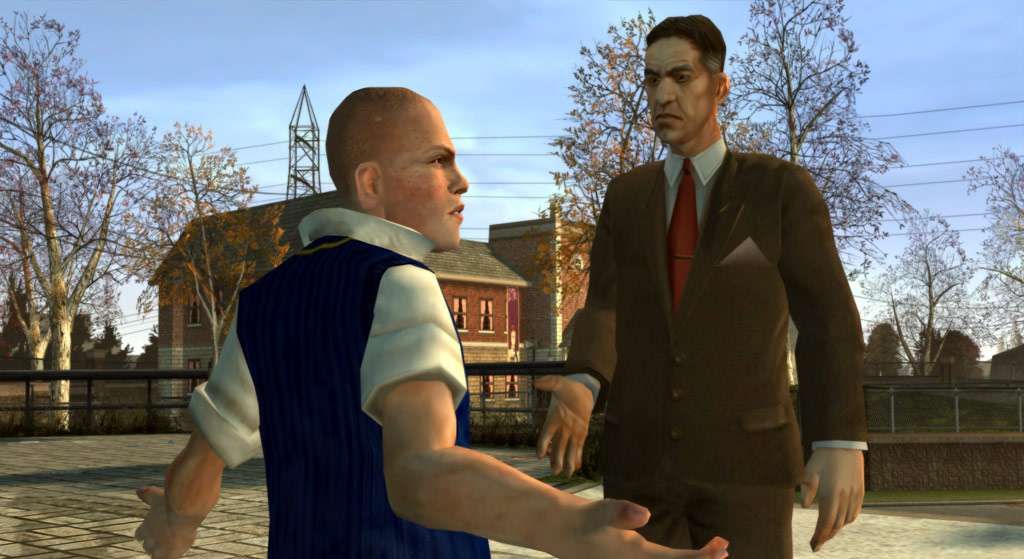
The central design challenge was finding a different form of power. In Grand Theft Auto, power might come through money, weapons, vehicles, or territory. In Bully, it could involve social standing, confidence, knowledge, the ability to navigate authority, or knowing how to escape an intimidating situation. This smaller scale still needed to feel consequential to Jimmy Hopkins and the player.
School schedules and lessons became especially important because they connected the setting directly to progression. GameSpot’s original walkthrough describes two daily class periods beginning at 9 a.m. and 1 p.m., with attendance providing useful rewards. The original curriculum included Chemistry, English, Art, Gym, Shop, and Photography, while Scholarship Edition later expanded the available subjects. Keeping those versions separate is important when describing the original 2006 release.
The timetable also created tension between freedom and restriction. Total freedom could weaken the school premise because an institution is defined partly by rules, while excessive restriction could undermine an open-world game. A schedule gives the player something to obey, ignore, or exploit. Authority gives movement through the environment consequences, while social groups give conflicts meaning beyond anonymous confrontation.
Houser’s remembered “Kick Me” prank provides a smaller example of the same breakthrough. A note placed on another character’s back could prompt a second non-player character to kick them, creating humor through a chain of social reactions. Its importance was not that one prank solved the entire project, but that it demonstrated how modest interactions could feel entertaining when they matched the scale and logic of school life.
The broader lesson is that Bully did not become distinctive merely by removing cars and guns from GTA. It reorganized Rockstar’s open-world ideas around a different stage of life. Destinations, interruptions, authority, rivalry, exploration, and consequences remained important, but their meaning changed because Jimmy was a teenager navigating school rather than an adult criminal navigating a city.
Bullworth Academy, Writing, and the Collaborative Development of Bully
Bully launched for PlayStation 2 in North America on October 17, 2006, following 15-year-old Jimmy Hopkins through life at the fictional Bullworth Academy. Take-Two’s original launch announcement establishes those basic details, while Houser’s later account provides insight into how uncertain the project could feel before those systems came together.
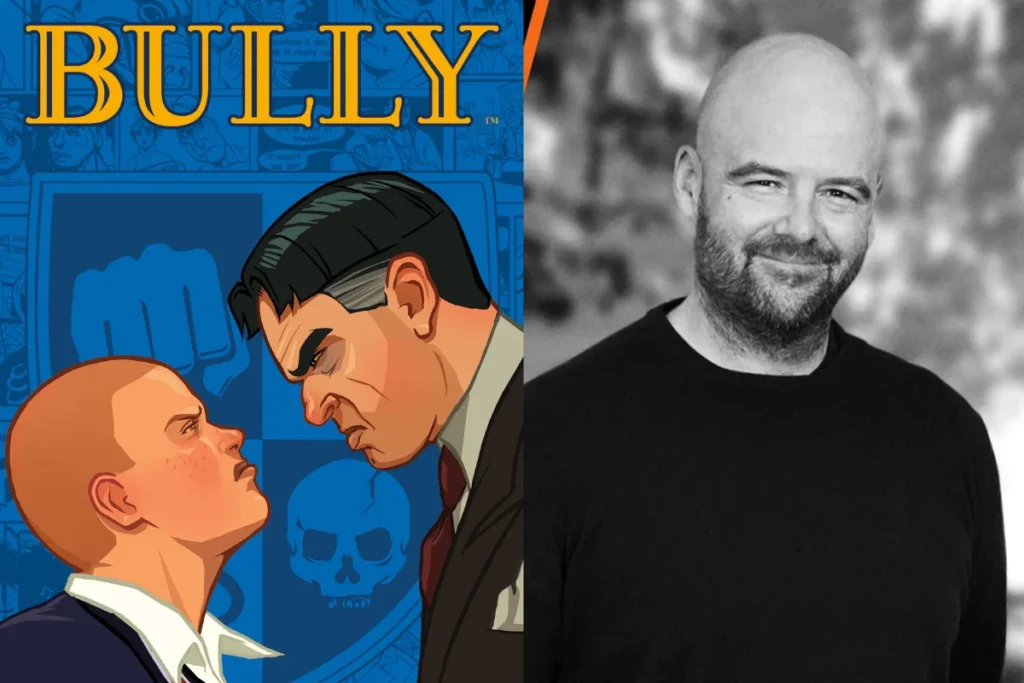
Dan Houser was an important creative figure, but he was not the game’s sole creator. The original PlayStation 2 credits list Dan Houser and Jacob Krarup as writers, with Michael Skupa and Sergei Kuprejanov among those credited in design leadership alongside separate production, art, and technical teams. That collaborative structure matters because one retrospective interview cannot explain every activity, interaction, or production decision involved in a large game.
Writing was particularly important because Bullworth needed to feel like an institution rather than merely a location. Characters, dialogue, missions, and social groups had to reinforce the environment players experienced during ordinary play. An authority figure becomes more meaningful when the player also encounters the rules that person enforces, while a hostile student becomes more memorable when their presence changes how a familiar corridor or area feels.
Bullworth’s design supports this through several overlapping forms of power. Institutional authority, physical intimidation, popularity, wealth, and knowledge exist close together, allowing conflict to emerge without requiring a huge geographical map. The school’s different groups and their attitudes toward Jimmy also give repeated locations a social meaning that changes according to who is present and what the player has done.
Familiarity becomes an advantage in this type of world. A corridor can feel different depending on the time of day or the students nearby. A classroom can be both a destination and a source of progression. A space associated with one social group can create expectations before a confrontation even begins. The world gains importance through relationships, routines, and rules rather than geographic scale alone.
Houser described Bully as coming together late, but that should be treated as a retrospective judgment rather than a precise production timetable. The published remarks do not establish one exact date when the game became coherent or identify a complete set of final changes responsible for that improvement. A more useful interpretation is that previously separate systems began reinforcing one another more effectively.
He also credited the development team for delivering a strong final game despite the difficulties and recalled changes during production, including staff moving from New York as the project improved. His comments praised the design contribution behind systems such as schedules and lessons without identifying every individual responsible for specific features in the published passage.
Separate developer recollections have described a stressful and unsettled production environment. Those accounts add context but remain distinct from Houser’s own testimony. Recognizing the team’s achievement does not require romanticizing difficult working conditions. The final identity of Bully emerged from work across many disciplines, including systems design, writing, character behavior, visual consistency, progression, and the communication of consequences to the player.
Bully’s Controversy, Marketing Problems, and Rockstar’s Reputation After Hot Coffee
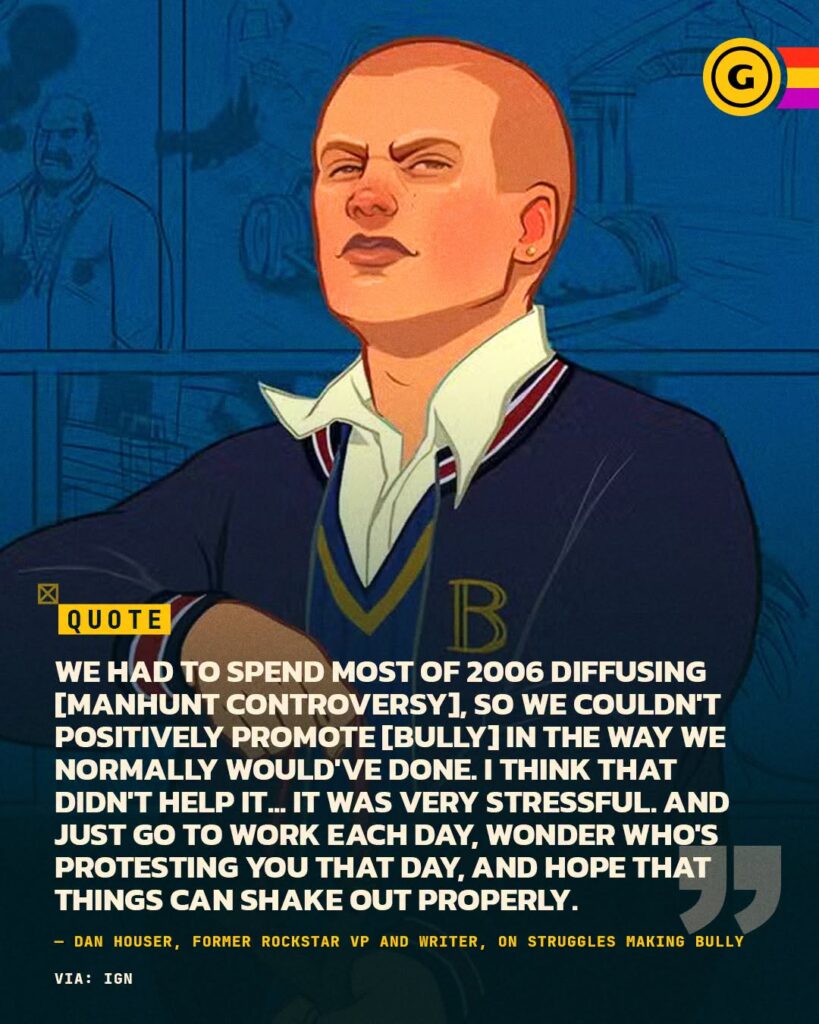
Bully faced significant criticism before many people had the opportunity to play it. The title itself encouraged some observers to assume the game celebrated bullying, and Rockstar’s existing reputation intensified that suspicion. Houser remembered the company struggling to promote the game positively while simultaneously dealing with objections and concerns about whether retailers would carry it.
This created a problem separate from the internal design challenge. Better gameplay could not immediately undo assumptions formed before release, while better marketing could not determine whether everyday school activities were actually enjoyable. Bully therefore needed both a convincing internal identity and a credible explanation of what the game was.
The distinction between depiction and endorsement became central to the public discussion. Jimmy is not portrayed as an ideal student. Rockstar’s official description calls him mischievous, emphasizes his troubled school history, and places him in conflicts involving bullies and dishonest authority figures. The original PlayStation 2 release received an ESRB Teen rating, with descriptors including crude humor, language, sexual themes, alcohol and tobacco use, and violence. Those classifications provide a more specific account of the game’s content than assumptions based only on Rockstar’s reputation.
The European release also appeared under the title Canis Canem Edit. Contemporary coverage discussed the regional naming decision amid the controversy, although the existence of a different title does not by itself establish every reason behind the commercial or creative decision.
Public objections also had practical consequences. In October 2006, The Register reported that DSG would not stock Canis Canem Edit through several of its retail operations because the company considered the title incompatible with its family-friendly image. That demonstrates that the controversy extended beyond commentary into distribution decisions, even though the available evidence does not establish a precise number of lost sales.
Marketing became more difficult because Rockstar had to spend time explaining what the game was not instead of focusing entirely on what made it appealing. A campaign has limited opportunities to establish characters, humor, atmosphere, and gameplay. When part of that effort must be devoted to defending a misunderstood premise, the promotional burden becomes heavier.
The Hot Coffee controversy surrounding Grand Theft Auto: San Andreas added further pressure. The Federal Trade Commission said the game contained disabled sexual material accessible through external modifications. The ESRB changed the affected edition’s rating from Mature to Adults Only, retailers removed copies, and Rockstar and Take-Two later released a revised Mature-rated edition without that content. The original Hot Coffee program became publicly available in June 2005, with the rating change following in July, while regulatory proceedings continued into 2006.
Bully did not contain the same material or undergo the same rating process. Its Teen classification was a separate decision about a separate game. The relevance of Hot Coffee is reputational. Rockstar entered Bully’s launch period while already facing questions about content disclosure, classification, and trust, making public assurances about an unfamiliar school-based game harder to communicate.
Houser’s broader concern was therefore not simply that controversy existed. It was that the company had to explain the game through an environment in which some people had already decided what a Rockstar school game must represent before seeing how the finished systems, story, and tone actually worked.
How Bully Became Distinctive and Why Bully 2 Never Materialized
Bully ultimately became distinctive because its open-world structure was shaped by the specificity of school life rather than merely decorated with a school setting. Rules, embarrassment, rivalry, authority, favoritism, social groups, lessons, and the desire for respect gave ordinary situations a scale appropriate to Jimmy’s circumstances. The game did not need to threaten an entire city to make an objective feel meaningful. It needed to establish why that objective mattered to a teenager and give the player an engaging way to pursue it.
This familiarity also created room for humor. Players could recognize ordinary social situations while enjoying exaggerated interactive versions of them. A prank, an intimidating student, a lesson, or the challenge of getting somewhere on time could generate tension or satisfaction because the world made those events meaningful.
That coherence explains why the setting itself became central to the experience. Bullworth Academy was not merely a backdrop for missions. Its routines, spaces, social hierarchy, and authority structures shaped what the player did and how those actions felt. Later versions preserved that identity, including Rockstar’s 2016 Anniversary Edition, which brought material from the original game and Scholarship Edition to mobile devices.
Houser’s comments about Bully 2 came separately from his October 2026 reflections on the first game. At a Los Angeles Comic Con appearance reported in September 2025, he cited “bandwidth issues” and the limited capacity of a relatively small senior creative and leadership group as reasons a sequel never materialized.
That explanation focuses on organizational capacity rather than public controversy surrounding the original. Having a large workforce does not eliminate limits on the people responsible for major creative direction, supervision, and high-level decision-making. Houser also referred to similar challenges in managing multiple projects at Absurd Ventures, using that comparison to illustrate the type of leadership constraint he meant rather than suggesting the two companies operated identically.
His remarks do not provide a complete history of every proposed Bully 2 concept, internal experiment, or production attempt. They also do not support the claim that protests against the original directly caused the absence of a sequel. The explanation he supplied was about priorities, leadership capacity, and competing demands.
The larger story of Bully is therefore one of an uncertain project gradually developing a clear identity through systems suited to its setting. Rockstar’s experience with GTA helped provide open-world knowledge, but it could not automatically answer what made school life entertaining to play. Bullworth’s schedules, social groups, pranks, lessons, authority, and small-scale conflicts eventually supplied that answer.
Houser’s recollections are revealing precisely because the finished game can make those choices seem inevitable in hindsight. They were not. Bully became one of Rockstar’s most recognizable games because a broader development team turned a difficult premise into a coherent interactive world, while overcoming both internal uncertainty and an unusually hostile public environment.
Frequently Asked Questions (FAQs)
- What did Dan Houser reveal about Rockstar’s struggle to make Bully?
Houser recalled that Bully spent part of development without a completely clear identity and that there were doubts about whether its individual ideas would come together into a satisfying game. The challenge was made harder by public controversy surrounding the project before release. He said the game became much more convincing later in production and ultimately credited the development team with turning the uncertain concept into a strong finished experience. - Who developed the original Bully?
Rockstar Vancouver developed the original PlayStation 2 version of Bully. Take-Two’s launch announcement identifies the studio and records the North American retail release date as October 17, 2006. The project involved a broader collaborative team covering writing, design, art, production, technology, and other disciplines rather than being shaped by one individual. - Was Dan Houser Bully’s only writer?
No. The original game credits both Dan Houser and Jacob Krarup as writers. The wider production also included separate leadership and contributors across design, art, technology, and production. Houser’s later recollections are therefore useful for understanding the project’s creative direction, but they should not be treated as a complete account of every system or decision made during development. - Why was adapting GTA’s formula difficult?
Bully changed the scale and context of Rockstar’s open-world design. A teenage student could not simply be given the same kinds of activities associated with GTA’s adult criminal protagonists. The developers needed interactions that made sense in a school environment, including classes, social rivalries, pranks, authority figures, and smaller personal conflicts, while still giving the player enough freedom to make the world feel open and responsive. - Why were lessons important to Bully?
Lessons helped connect the school setting directly to gameplay and progression. Attending classes could provide useful rewards, while the timetable gave the player recurring decisions about whether to follow the school’s routine or pursue other activities. This made Bullworth feel more like an institution with expectations rather than simply an open-world map decorated to look like a school. - What was the significance of the “Kick Me” prank?
Houser remembered a demonstration in which placing a note on another character’s back caused a second non-player character to react. The importance of the example was not the prank itself but what it demonstrated about Bully’s emerging identity. A small, familiar school interaction could become entertaining when the world responded dynamically, showing that the game did not need GTA-sized spectacle to create memorable moments. - Was Bully rated Mature in the United States?
No. The original PlayStation 2 release received an ESRB Teen rating. Its descriptors included violence, language, crude humor, sexual themes, and alcohol and tobacco use. The Teen rating is important because public discussion before release sometimes treated the game through assumptions based on Rockstar’s reputation rather than the actual classification assigned to Bully. - Was Hot Coffee part of Bully?
No. Hot Coffee concerned disabled sexual content in Grand Theft Auto: San Andreas that could be accessed through external modifications. Its connection to Bully is indirect. The controversy created additional regulatory and reputational pressure for Rockstar and Take-Two during the period before Bully launched, making public explanations about the new game more difficult. - Why was Bully called Canis Canem Edit in Europe?
The original European release used the title Canis Canem Edit instead of Bully. Contemporary reporting discussed the regional name change during a period when the game was facing objections and controversy. However, the existence of the alternate title alone does not establish every commercial, legal, or creative reason behind the decision, so those motives should not be overstated without further evidence. - Why did Bully 2 never happen?
Houser later cited limited organizational bandwidth and the demands placed on a relatively small group of senior creative and leadership staff. His explanation suggests that interest in a sequel was not enough by itself because Rockstar also had to decide where its leadership, resources, and attention could realistically be committed. His comments focus on competing priorities and management capacity rather than identifying one specific design problem or public controversy as the reason the sequel did not materialize.

Conclusion
Dan Houser’s account of Bully shows why a memorable premise is only the starting point for creating a distinctive game. Rockstar had to discover how its open-world design philosophy could work within the smaller, more restrictive world of a boarding school, where schedules, lessons, social groups, authority figures, and appropriately scaled mischief needed to become meaningful gameplay rather than background decoration.
The finished game demonstrates a broader design principle: scale matters less than context. A prank, a missed class, an encounter with a rival student, or a race across campus can feel significant when the world gives those actions clear consequences. Bullworth Academy works because its characters, routines, rules, and activities reinforce one another, allowing a relatively contained setting to support variety and player freedom.
Bully’s development history also benefits from separating different kinds of evidence. Houser’s recollections describe creative uncertainty and the difficulty of promoting the game amid controversy. Contemporary reporting documents public objections and retail resistance, while official material confirms the release, development studio, classification, and core premise. His later explanation for Bully 2 addresses a separate problem entirely: whether Rockstar had enough senior creative bandwidth to sustain another major project.
Taken together, those accounts present Bully as a collaborative achievement shaped by experimentation, uncertainty, and competing pressures. Its identity emerged when Rockstar stopped treating the school as merely an unusual setting and instead made school life itself the foundation of the open world.
Sources and Citations
- IGN, October 13, 2026, “GTA Co-Creator Dan Houser on How 9/11 and a ‘Kick Me’ Sticker Changed Rockstar Games Forever.” IGN’s retrospective interview with Dan Houser covers his career at Rockstar and specifically identifies the “Kick Me” sticker interaction as a breakthrough moment during Bully’s development. The interview also provides first-hand context for how Rockstar struggled to define Bully’s school-scale gameplay before its systems began to work together. Open Video
Watch the IGN Dan Houser interview - Simon Cardy, IGN, October 13, 2026, “Dan Houser Reveals Rockstar’s Struggle to Make Bully.” Cardy’s report reproduces Houser’s comments that development was difficult, the game was “in trouble” for part of production, and Rockstar struggled with what the project should become once cars and guns were removed from its familiar GTA-style formula. Houser also discusses schedules, lessons, the “Kick Me” prank, pre-release controversy, retailer concerns, and the difficulty of positively marketing the game during the aftermath of Hot Coffee. VSG
Dan Houser Reveals Rockstar’s Struggle to Make Bully - Take-Two Interactive, October 17, 2006, “Rockstar Games Announces Bully Available Now for PlayStation 2.” Take-Two’s official launch announcement confirms that Rockstar Vancouver developed Bully, that it launched in North American retail stores on October 17, 2006, and that the story follows 15-year-old Jimmy Hopkins at Bullworth Academy. It also records the original U.S. MSRP of $39.99 and the game’s Teen rating. Take-Two Interactive
Rockstar Games Announces Bully Available Now for PlayStation 2 - Rockstar Games, Bully: Scholarship Edition: Rockstar’s official product description establishes the schoolyard premise, Jimmy Hopkins’ troubled history, Bullworth Academy’s social hierarchy, teachers, bullies, pranks and the objective of navigating the school year. It is a useful first-party source for the game’s setting and tone, although Scholarship Edition should be distinguished from the original 2006 PS2 release when discussing specific classes or content additions. Rockstar Store
Bully: Scholarship Edition Official Rockstar Store Page - Entertainment Software Rating Board, Bully: The ESRB’s official record confirms that the original PlayStation 2 version received a T for Teen rating. Its content descriptors are Crude Humor, Language, Sexual Themes, Use of Alcohol and Tobacco, and Violence, supporting the article’s distinction between Bully’s actual classification and assumptions generated by Rockstar’s reputation before launch. ESRB Ratings
Bully ESRB Rating Record - Federal Trade Commission, June 8, 2006, “Makers of Grand Theft Auto: San Andreas Settle FTC Charges.” The FTC documents the Hot Coffee controversy, explaining that disabled sexual content remained on San Andreas discs and could be accessed through external modifications. The ESRB subsequently changed the affected game’s rating from Mature to Adults Only, many retailers removed it, and Take-Two and Rockstar later issued a revised Mature-rated edition without the disputed material. This provides primary-source context for the regulatory and reputational pressure Rockstar was facing in the period leading into Bully’s launch. Federal Trade Commission
FTC: Makers of Grand Theft Auto San Andreas Settle Charges - GameSpot, “Bully Walkthrough.” GameSpot’s original guide documents Jimmy’s daily school routine, classes, social groups and open-world activities. It covers subjects including English, Chemistry, Art and Gym, along with class rewards, missions, school schedules and the way classroom progression is integrated into Bullworth’s broader gameplay systems. GameSpot
GameSpot Bully Walkthrough - The Register, October 18, 2006, “UK Retail Giant Canes Canis Canem Edit.” Contemporary reporting confirms that UK retailer DSG refused to stock Canis Canem Edit, the European title for Bully, through outlets including PC World, Currys Digital and Dixons.co.uk. DSG said the game was inappropriate for its “family-friendly image,” providing concrete evidence that the controversy surrounding Bully affected retail distribution as well as public discussion. theregister
UK Retail Giant Canes Canis Canem Edit - GameSpot, September 29, 2025, “Former Rockstar VP Talks GTA 6, Explains Why Bully 2 Never Happened.” GameSpot reports Houser’s Los Angeles Comic Con comments explaining that “bandwidth issues” contributed to Bully 2 never materializing. He specifically pointed to the limits of a relatively small senior creative and leadership team trying to support multiple major projects, making this a stronger source than theories blaming the original game’s controversy for the missing sequel. GameSpot
Former Rockstar VP Talks GTA 6, Explains Why Bully 2 Never Happened - MobyGames, Bully PlayStation 2 Credits: The archived PS2 credits confirm Dan Houser and Jacob Krarup as the game’s writers, with Michael Skupa and Sergei Kuprejanov credited for Design Direction. They also list Jeronimo Barrera and Steve Martin in production and hundreds of additional contributors, supporting the article’s point that Bully was a collaborative production rather than the work of one individual. MobyGames
Bully PlayStation 2 Credits on MobyGames
Recommendations
- Vivian Kubrick Debunks Eyes Wide Shut Deleted Scenes Theory
- Battlefield 6 2026 Roadmap: More Maps, “Legendary” Battlefield 4 & Battlefield 3 Remakes, and Wake Island’s Return
- Apple TV’s Widow’s Bay is the First Breakout TV Hit of 2026: Why Everyone is Talking About the Horror Comedy
- Pitchify Launches New Service to Connect Developers and Publishers: How Pitch Direct Works
- Pokémon Pokopia Bubbly Basin DLC Release: Date, New Pokémon, and Everything You Need to Know
- Nordic Game 2026 (NG26 Spring): Dates, Venue, Passes, Speakers, Expo & Awards in Malmö
- Subnautica 2 Early Access Roadmap: Co-Op Updates, Sprinting, and More
- Virtua Fighter 6 Leak Explained
- The Future of 3D Modeling: Insights on AI Advancements
- GTA 6 is Already Outselling Everything Else: Why Pre-Orders Are Dominating Gaming



































































































