





In This Article (8 sections)
How 9/11 Changed GTA 3 During Its Final Weeks of Development
The September 11 attacks occurred during the final weeks before Grand Theft Auto III’s release, placing Rockstar in the unusual position of preparing a violent crime game set in a fictional American metropolis while its New York office was dealing directly with the disruption caused by the attacks. GTA 3 eventually launched for PlayStation 2 on October 22, 2001, only 41 days after September 11. Historical reporting identified October 3 as the earlier planned release date, meaning the attacks occurred just 22 days before the intended launch and the eventual release followed 19 days later than originally planned.
Dan Houser’s recollections describe the consequences as practical, emotional, and creative, but considerably narrower than some later accounts have suggested. In his 2011 Edge interview, he identified several specific changes: Rockstar altered police vehicle colours, changed an aircraft’s route, removed one mission that referenced terrorists, and edited selected pedestrian and radio dialogue. He characterized the resulting game as only approximately “1% different,” a broad description intended to emphasize the limited scale of the revisions rather than a literal calculation of altered missions, code, or script pages.
The compressed timetable is important when assessing claims about massive last-minute reconstruction. Changing a visual element, editing dialogue, adjusting a scripted flight path, or removing an individual mission can fit within the schedule of a game approaching completion. Claims that Rockstar completely rebuilt Liberty City, replaced large sections of the campaign, or fundamentally reconstructed the game during those final weeks would require much stronger evidence.
Rockstar’s New York location also shaped the response. Houser explained that roadblocks prevented the New York staff from entering their office for five days, while the development team in Scotland was able to continue working. This distinction matters because GTA 3 involved DMA Design, later Rockstar North, in Scotland alongside Rockstar’s publishing operation in New York. Development could continue in one location while essential publishing and production work elsewhere was interrupted.
That operational disruption also helps explain the release delay. Historical reporting places the planned launch on October 3 and the final release on October 22, but Houser attributed much of the delay to the inability of the New York staff to access their workplace rather than to an extensive emergency redesign of the game. The balanced account therefore includes both factors: specific content was reconsidered, while ordinary production and publishing work was also disrupted.
The broader concern was how fictional imagery could suddenly acquire associations its creators had never intended. An aircraft passing close to a skyscraper or explosive imagery on packaging could be interpreted very differently after September 11 than when those elements were originally created. Rockstar could therefore preserve GTA 3’s overall identity while removing or adjusting details that had become painfully specific.
This context should not be expanded into unsupported claims about individual developers’ experiences or losses. The documented point is sufficient: the attacks directly disrupted Rockstar’s New York operation and changed how the company assessed certain elements of a game that was only weeks from release.

Confirmed GTA 3 Gameplay Changes and the Myths Around Cut Content
The confirmed post-September 11 gameplay revisions in GTA 3 fall into several relatively narrow categories: police vehicle appearance, one background aircraft route, one mission containing a terrorism reference, and selected ambient dialogue. These changes in GTA 3 should remain separate because evidence for one does not automatically establish broader alterations elsewhere in the game.
Houser explained that Rockstar changed the police cars in GTA 3 so they would no longer look identical to New York Police Department vehicles. The earlier blue-and-white appearance associated with the NYPD was replaced by the familiar black-and-white treatment seen in the released GTA 3. The purpose was visual distancing rather than removal of the police system itself. Pursuits, law enforcement mechanics, and Liberty City’s broader New York influence remained intact in GTA 3.
The aircraft adjustment in GTA 3 was similarly limited. Houser described changing a plane’s flight path so it would not appear to fly into or behind a skyscraper. The issue was how the background movement appeared from the player’s viewpoint in GTA 3. Two objects might occupy separate positions in three-dimensional space while briefly appearing to intersect on screen, creating an image that had acquired a much more disturbing association after September 11.
That account does not establish that Rockstar removed a completed mission involving a commercial airliner from GTA 3 or dismantled a broader flying system. It should also be kept separate from discussion of the Dodo in GTA 3. A scripted aircraft moving through the city background and an aircraft accessible to the player are different design issues, and evidence concerning one should not automatically be transferred to the other in GTA 3.
Rockstar also removed one GTA 3 mission because it referenced terrorists. Houser and Rockstar’s later retrospective both identify the removal and its reason, but neither supplies enough information to reconstruct the mission completely. A mission in GTA 3 can reference terrorism in dialogue, character motivation, or another narrative context without requiring the player to perform a terrorist attack. Describing the removed GTA 3 content as a direct recreation of September 11 therefore goes beyond the evidence.
The same caution applies to claims that an entire GTA 3 character storyline was removed because of the attacks. Darkel is the clearest example. Houser said the character had been cut months before GTA 3’s release and that his associated missions were never completed. Rockstar’s later character-focused retrospective similarly explained that Darkel did not fit well alongside the other GTA 3 characters and that his missions did not meet the quality of the rest of the game.
Leftover references in GTA 3 game files therefore do not establish that a substantial Darkel storyline was removed after September 11. A surviving name or unused asset proves that something existed during GTA 3’s development, but it does not by itself establish when it was abandoned, why it was removed, or how complete it ever became.
The Dodo in GTA 3 has attracted similar speculation. Rockstar rejected the idea that its unusual handling proved a conventional flying system had been removed because of September 11. Again, the existence of an awkward or limited feature in GTA 3 does not establish the history sometimes attached to it.
The larger GTA 3 development history also shows why every cut feature should not be attributed to one event. Houser’s 2011 GameSpot interview described longstanding challenges involving three-dimensional freedom, story structure, and the relationship between narrative and gameplay in GTA 3. Unfinished material can disappear because of experimentation, pacing, technical constraints, quality concerns, or changing creative priorities.
Rockstar’s description of GTA 3 as roughly “1% different” after the attacks is therefore most useful as an indication of continuity. The released GTA 3 was still fundamentally the project the team had been building before September 11, with targeted changes made to material in GTA 3 that had suddenly acquired new associations.
Why GTA 3’S North American Cover Changed and Became a Series Trademark
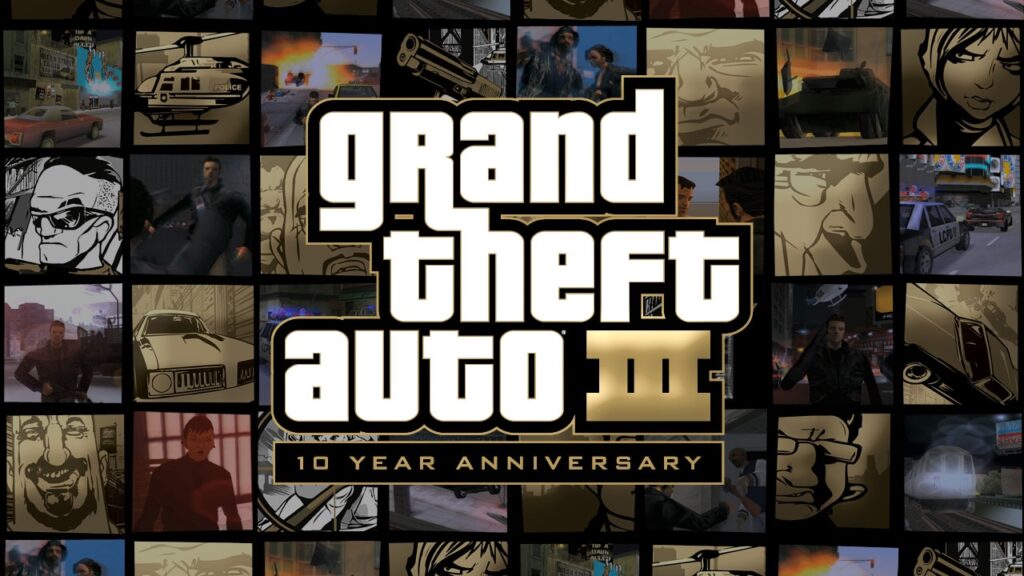
The most consequential visible change may have been the North American packaging. Rockstar’s official anniversary material identified the US cover as the largest alteration made after September 11. The previously intended artwork was considered too raw for the moment, while the original design was still used for the European release.
That regional difference is important. Rockstar did not erase the earlier artwork from every market. European players could still encounter the original cover, while North American customers received the segmented collage design that later became closely associated with Grand Theft Auto.
Houser’s 2026 recollection emphasized imagery involving burning buildings as part of the reason the original American packaging suddenly felt inappropriate. A game cover presented a distinct problem because it would appear in advertising, on store shelves, and in public spaces without the fictional context surrounding an image encountered during gameplay. Reconsidering that presentation did not require abandoning GTA 3’s criminal premise or substantially changing its story.
The replacement organized illustrated characters, vehicles, and other subjects into separate panels. That mosaic format subsequently became one of the series’ most recognizable visual conventions. Its usefulness comes from balancing variety with consistency. Individual panels can showcase different characters, vehicles, environments, and moods without forcing everything into a single continuous illustration, while the overall composition remains recognizable from one release to another.
The long-term importance of the layout should not be mistaken for evidence that Rockstar created it in 2001 as a complete visual strategy for every future GTA game. A design created in response to an immediate problem can later prove adaptable enough to become a franchise convention.
There is also a documented disagreement over how quickly the replacement was created. Houser recalled Stephen Bliss producing the new segmented design in approximately two evenings. Bliss later disputed the familiar shorthand that it was assembled overnight, telling Power Up Gaming that he had roughly a week for the replacement and that the earlier painted cover had taken around six months to create.
Bliss described extracting suitable material from existing artwork and reorganizing it into the grid. Creative Bloq highlighted the difference between his account and Houser’s recollection. These versions can potentially reflect different understandings of the active assembly period, overall deadline, or work inherited from the previous illustration, but the available evidence does not conclusively reconcile them.
The responsible account therefore preserves both perspectives. Houser remembers an extremely short turnaround, while Bliss describes approximately a week to create the new composition using material developed during a much longer earlier art process.
Bliss also rejected the claim that the grid was inspired by posters for The Thomas Crown Affair. That proposed influence should therefore remain disputed rather than being repeated as established history.
What is clear is that a packaging decision made under extraordinary circumstances had consequences extending far beyond GTA 3 itself. The replacement American cover solved an immediate presentation problem and eventually supplied a visual framework that could be repeatedly adapted across later Grand Theft Auto releases.
What GTA 3’S Post-9/11 Changes Actually Mean for Its Development Legacy
GTA 3’s post-September 11 history is most accurately understood as a series of targeted adjustments made to a largely completed project rather than a wholesale rebuilding of the game. Police car colours changed, one aircraft route was modified, a mission referencing terrorists was removed, selected dialogue was edited, and the North American cover was replaced. At the same time, Rockstar’s New York office experienced direct operational disruption that contributed to the short release delay.
This distinction matters because GTA 3’s development history has accumulated myths around abandoned characters, aircraft, missions, and supposed large-scale rewrites. The strongest evidence supports neither the claim that September 11 had almost no effect nor the opposite claim that the attacks transformed the entire game. The project remained recognizably intact while specific material was reconsidered because its cultural meaning had changed abruptly.
Rockstar’s retrospective emphasizes the features that ultimately defined the release: a three-dimensional city, unprecedented freedom, cinematic storytelling, radio stations, and an open-world structure that allowed players to experience Liberty City in ways unavailable in the earlier games. Those qualities were not created during the final weeks after September 11.
The post-attack revisions nevertheless remain historically significant because they show how external events can reshape the presentation of a creative work even when its underlying design remains stable. An image, phrase, colour scheme, or background detail can acquire a meaning that did not exist when it was first created, forcing developers to reconsider whether preserving it still serves the intended experience.
The cover provides the clearest long-term example. A regional redesign made in response to a specific moment eventually became part of Grand Theft Auto’s visual identity. That is a substantial legacy without requiring the exaggerated claim that September 11 created the series’ entire artistic direction.
The disagreement between Houser and Bliss over the cover’s production timeline also illustrates why development history benefits from multiple firsthand accounts. Houser provides the perspective of Rockstar’s leadership and the wider release context, while Bliss adds the artist’s recollection of the actual design process. Where those memories differ, the uncertainty should remain visible rather than being resolved through assumption.
Ultimately, the available evidence presents a more interesting history than the mythology. GTA 3 was close to completion when September 11 forced Rockstar to reconsider specific content, packaging, and imagery while its New York operation was directly disrupted. The game that launched on October 22 remained overwhelmingly the same project, but several carefully chosen changes, particularly the North American cover redesign, became lasting parts of Grand Theft Auto history.

Frequently Asked Questions (FAQs)
- What did Dan Houser say about how 9/11 changed GTA 3?
Houser described a limited set of changes made during the final weeks before release, including altered police vehicle colours, a revised aircraft route, the removal of one mission referencing terrorists, and edits to selected pedestrian and radio dialogue. He also connected the replacement North American cover to the attacks. His overall account presents GTA 3 as largely intact, with targeted revisions rather than a complete redesign of the game. - When was GTA 3 released after September 11?
Grand Theft Auto III launched on PlayStation 2 on October 22, 2001, which was 41 days after the September 11 attacks. Historical reporting indicates that an earlier October 3 release had been planned, meaning the eventual launch arrived 19 days later. Rockstar still lists October 22 as the original release date. - Did Rockstar remove most of GTA 3’s story?
No. Rockstar’s own retrospective characterization does not support the idea of a major story rewrite. The company described the released game as approximately one percent different because of the post-9/11 changes. That figure should be treated as a broad estimate emphasizing the limited scale of the revisions rather than as a precise technical measurement of altered missions, dialogue, or code. - Why were GTA 3’s police car colours changed?
Houser said Rockstar changed the police cars because their earlier blue-and-white appearance made them look too similar to New York Police Department vehicles. The released black-and-white design created more visual distance between Liberty City’s fictional police force and the real NYPD while leaving the underlying police and pursuit systems intact. - Did Rockstar remove a mission involving terrorists?
Yes. Rockstar and Houser both confirmed that one mission was removed because it referenced terrorists. However, the surviving statements do not provide a complete description of that mission’s objectives, characters, or scenario. Claims that it recreated September 11 or involved a specific terrorist attack therefore require evidence beyond the confirmed statement that terrorism was referenced. - Was Darkel cut because of September 11?
No, according to Houser’s account. He said Darkel had been removed months before the game’s release and that the associated missions were never completed. Surviving references to Darkel in development material therefore show that the character once existed in the project, but they do not establish that his storyline was removed as a direct response to September 11. - Was the Dodo’s normal flight removed after 9/11?
Rockstar rejected the theory that the Dodo had originally been intended as a conventional fully functional aircraft whose normal flight was removed because of September 11. Its limited handling should therefore be treated separately from the confirmed change to a scripted background plane’s route. Evidence about one aircraft does not automatically explain the other. - Was GTA 3’s original cover removed everywhere?
No. Rockstar described the packaging change as applying to the American release, while the earlier artwork continued to appear on the European version. This means both covers are part of GTA 3’s documented release history. The familiar segmented collage became associated particularly strongly with the North American edition and later influenced the series’ broader visual identity. - Did Stephen Bliss create the replacement cover in two evenings?
The exact timeframe is disputed. Houser recalled Stephen Bliss assembling the replacement design in approximately two evenings, while Bliss later said he had roughly a week to produce it and reused material from artwork that had taken much longer to create. Both accounts connect the redesign to September 11, but they differ over how quickly the final composition was assembled. - Why does GTA 3’s cover redesign still matter?
The replacement cover introduced the segmented composition that later became one of Grand Theft Auto’s most recognizable visual conventions. By placing different characters, vehicles, and scenes into separate panels, the design could communicate variety while maintaining a consistent overall identity. What began as a response to an immediate packaging problem ultimately became a format reused and adapted across later entries in the series.
Conclusion
Dan Houser’s account of how September 11 affected GTA 3 presents a nearly completed game undergoing targeted revisions while Rockstar’s New York operation was dealing with an extraordinary real-world crisis. The established changes include altered police car colours, a revised aircraft route, selected dialogue edits, the removal of one mission referencing terrorists, and a redesigned North American cover rather than a wholesale rebuilding of the game.
The most important historical distinction is between the limited scale of the in-game revisions and the much larger legacy of the packaging change. GTA 3 remained fundamentally the same project, yet the replacement American cover introduced a segmented visual style that went on to become one of Grand Theft Auto’s most recognizable design conventions.
Accuracy also depends on preserving the limits of the evidence. Rockstar’s approximate “1% different” description is not a technical audit, confirmation that a mission referenced terrorists does not reveal its full contents, and the exact production timeline for the replacement cover remains disputed between Houser’s and Stephen Bliss’s recollections.
That uncertainty does not weaken the story. It makes the history more precise. GTA 3’s post-9/11 development is significant because it shows how a major external event can reshape selected details and presentation without fundamentally changing the work itself, while one of those last-minute decisions ultimately leaves a lasting mark on the identity of an entire series.
Sources and Citations
- Source: Rockstar Games, “Grand Theft Auto III: Your Questions Answered, Part Two”: Rockstar’s official explanation of the post-9/11 changes to GTA III, including the limited in-game revisions, regional packaging changes, and clarification of rumors about removed content.
Citation: Rockstar Games, “Grand Theft Auto III: Your Questions Answered – Part Two (9/11, The ‘Ghost Town’, The Dodo and Other Mysteries),” January 5, 2012. Rockstar Newswire. - Source: Rockstar Games, “Grand Theft Auto III: Your Questions Answered, Part One”: Official background on Claude, Darkel, and other characters, including Rockstar’s explanation that Darkel’s missions were cut well before 9/11.
Citation: Rockstar Games, “Grand Theft Auto III: Your Questions Answered – Part One (Claude, Darkel & Other Characters).” Rockstar Newswire. - Source: Eurogamer article preserved in Steam’s news archive: Reports on Dan Houser’s comments to Edge about the post-9/11 changes and the game’s release delay. The Steam archive preserves the article under the headline “How 9/11 changed Grand Theft Auto 3.”
Citation: “How 9/11 changed Grand Theft Auto 3,” November 18, 2011. Steam News Archive. - Source: MCV/DEVELOP, “How 9/11 Affected the Grand Theft Auto Legacy”: Additional reporting on Houser’s account of the revisions, the brief release delay, workplace disruption near Ground Zero, and the rumors surrounding Darkel.
Citation: MCV Staff, “How 9/11 affected the Grand Theft Auto legacy,” November 18, 2011. MCV/DEVELOP. - Source: GameSpot, “Dan Houser Opens Up About Grand Theft Auto III”: Direct interview offering broader development context, including the game’s early reception, narrative design, and the team’s approach to creating an open-world experience.
Citation: Shaun McInnis, “Dan Houser Opens Up About Grand Theft Auto III,” GameSpot, October 21, 2011. GameSpot. - Source: Meristation, “Dan Houser Explains How 9/11 Changed GTA 3’s Cover Art”: Reports on Houser’s 2026 comments about the original cover art, the redesign, and how the iconic panelled cover style emerged following 9/11.
Citation: Meristation, “Dan Houser explains how 9/11 changed GTA 3’s cover art,” October 2026. Meristation. - Source: Creative Bloq, “GTA 3’s Original Cover Was Axed After 9/11, and Its Artist Disputes the Story”: Coverage of the conflicting accounts from Dan Houser and artist Stephen Bliss about when the original cover was due and how quickly the replacement was created.
Citation: Creative Bloq, “GTA 3’s original cover was axed after 9/11, and its artist disputes the story,” October 14, 2026. Creative Bloq. - Source: Power Up Gaming, “GTA’s Famous 9/11 Box Art Story Just Got a Major Clarification”: Reproduces Stephen Bliss’s account of the redesign, including his description of the original cover’s long production and the roughly one-week window for the replacement.
Citation: Chris Mawson, “GTA’s Famous 9/11 Box Art Story Just Got a Major Clarification,” Power Up Gaming, September 10, 2026. Power Up Gaming. - Source: Rockstar Games, “Grand Theft Auto III” and “Grand Theft Auto: The Trilogy – The Definitive Edition Now Available”: Official game information and retrospective context for GTA III and its later release in The Definitive Edition trilogy.
Citation: Rockstar Games, “Grand Theft Auto III”; Rockstar Games, “Grand Theft Auto: The Trilogy – The Definitive Edition Now Available”.
Recommendations
- MTG Secret Lair Chaos Vault Zeta Set Launch Disaster Explained
- Call of Duty 2026 Xbox Game Pass Rumor: Will Microsoft Skip a Day-One Release?
- Starseeker: Astroneer Expeditions Guide – Co-op Gameplay, Missions, Planets, and Station Systems Explained
- How Do I Set Up Multiple Cameras in Blender?
- Gnomon Workshop Battle-Worn Titan Photoshop Tutorial Guide
- Mixtape Won’t Be Delisted Due to Expired Music Licenses, Publisher Confirms Official Statement
- Game of Thrones: Kingsroad, Exploring the Development, Unreal Engine Integration, and Gameplay Features
- Mistfall Hunter Surpasses 100,000 Players in Just 8 Hours
- P.O.N. Co-Op Horror Game Surpasses 800,000 Wishlists: Release Info, Gameplay Details, and What to Expect
- Matt Berry Cast in A Minecraft Movie Squared as Fans Predict Herobrine Appearance



































































































