








In This Article (10 sections)
What Death Game Mode is and How it Changes Echoes of Aincrad
Echoes of Aincrad: Death Game Mode Explained, Unlock Guide, and Survival Tips focuses on the game’s most punishing rule set: an optional permadeath modifier where defeat deletes the associated Death Game save. There is no ordinary retry, no return to the last checkpoint after death, and no second chance for that character. The mode is designed to recreate the tension central to Sword Art Online’s original Aincrad premise, where preparation, judgment, combat execution, equipment choices, and partner management all determine whether the adventure continues.
Death Game Mode should not be confused with the game’s four combat difficulty settings. Echoes of Aincrad includes Story, Normal, Hard, and Very Hard difficulties, while Death Game Mode is a separate modifier that can be combined with any of them. A player can choose Story difficulty with permadeath for a more accessible but still high-stakes run, or Very Hard with permadeath for the greatest practical risk. The developers have emphasized that Death Game Mode changes the consequence of failure rather than simply increasing enemy statistics.
The mode deletes its save data when the player character is defeated. Bandai Namco describes it as a high-stakes experience with no retries and no second chances. Its purpose is not only to make combat feel harder, but to make every encounter matter. A mistake that would normally cost time can instead erase the entire progress attached to that Death Game character.
This changes how players evaluate ordinary decisions. In a standard playthrough, testing an unfamiliar enemy, entering a boss fight underprepared, or trying an unproven weapon may be a manageable setback. In Death Game Mode, those same decisions can end the run. Exploration becomes a careful process of identifying safe routes, activating Safety Areas, learning enemy placement, preserving healing supplies, and deciding when returning to town is smarter than pressing forward.
Death Game Mode does not remove the game’s normal character-building systems. Players still earn levels, allocate Growth Points, improve weapons, configure EX-MODs, choose Sword Skills, select partners, and manage consumables. The difference is that every system becomes part of a survival plan. A defensive stat allocation that might seem cautious in a standard save can protect many hours of progress in a permadeath run. An unenhanced weapon, depleted Item Pouch, poorly matched partner, or exhausted Stamina bar can become a run-ending liability.
Echoes of Aincrad is also a quest-based action RPG rather than an open-world game. The development team has said the main experience was not designed as a repeated-retry high-difficulty action RPG. Death Game Mode overlays permanent consequences onto that structure while remaining independent of the chosen combat difficulty.
This guide reflects the official rules and launch information available through July 15, 2026, including the version 1.0.3 day-one update. That update adjusted every weapon category, Sword Skills, Combination Skills, Support Skills, enemy parameters, dodge behavior, invincibility timing, and weapon MOD balance. Because launch balance can change, the safest recommendations focus on durable principles rather than claiming that one specific weapon drop or skill combination will always be superior.

How Permadeath, Save Deletion, Unlocking, and Fresh Death Game Runs Work
Permadeath activates when the player character is defeated during a Death Game playthrough. Once that happens, the Death Game save is deleted instead of returning to an earlier checkpoint. The official description is direct: if the adventure ends, the save data ends with it. There is no conventional retry option that restores the character immediately before the fatal encounter.
This does not mean the game deletes progress every time the application closes. Death Game Mode can preserve a living character between sessions. A player can leave normally, return to the title screen intentionally, and resume later. The permanent-death rule is tied to in-game defeat, not the ordinary act of stopping a play session. Unexpected interruptions such as power loss are also specifically protected from being treated as a death.
The key distinction is between saving and surviving. A preserved save allows the player to resume a living Death Game character, but it is not a reloadable insurance policy after death. Once the character is defeated, that run’s stored progress is removed.
Yes, Death Game Mode deletes the save file associated with the defeated Death Game character. It does not simply reduce experience, remove carried currency, or send the character back to a previous Safety Area. The defining penalty is deletion of that run’s save data.
That deletion does not erase every Echoes of Aincrad save on the system. The game supports multiple save slots, and available documentation states that Death Game Mode is used with the second or third slot. A defeat on a Death Game character affects the corresponding Death Game save rather than unrelated standard-mode characters in other slots.
This slot separation is important for preparation. A player can keep a completed or progressing standard save while creating a separate Death Game character. The standard character can be used to learn bosses, test weapon categories, study dungeon layouts, and practice partner tactics without placing the permadeath run at risk.
Players should not treat local backups, cloud synchronization, or forced shutdowns as intended Death Game mechanics. The official design is built around accepting the deletion caused by in-game defeat. Attempting to bypass that consequence undermines the central rule of the mode and may also create synchronization conflicts depending on the platform. The supported approach is to protect the character through preparation and play.
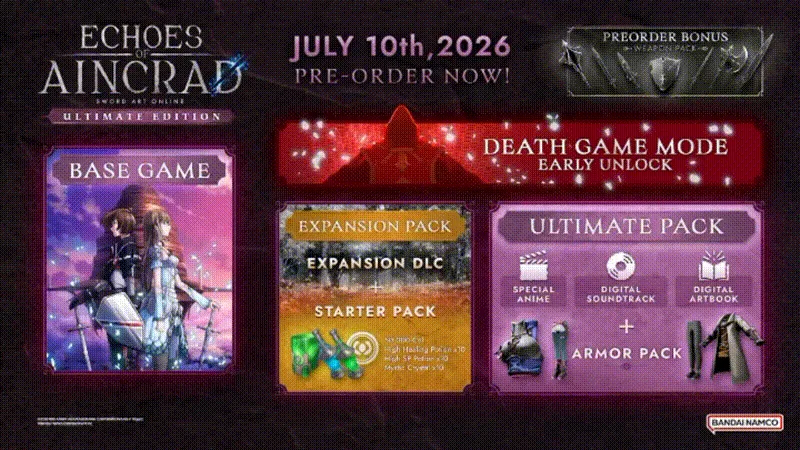
The standard unlock method is to complete the game. Bandai Namco states that Death Game Mode becomes available after the main game has been completed. Once unlocked, it can be selected while creating an eligible new save file. The Deluxe Edition and Ultimate Edition include Death Game Mode Early Unlock. Owners of either edition do not need to finish an initial standard playthrough before gaining access to the mode. This early unlock does not provide extra lives or reduce the deletion penalty. It simply makes the modifier available sooner.
After Death Game Mode is available, the player must create a second or later save rather than converting the active first save. Published information indicates that Echoes of Aincrad supports three save slots and restricts Death Game Mode to slots two and three. The correct process is to unlock the mode, open the save-selection interface, create a fresh character in an eligible slot, and choose Death Game Mode during that character’s initial setup.
Transferred demo data requires special attention. Bandai Namco’s transfer guide states that a save carried over from the demo cannot be switched to Death Game Mode. Even after the mode has been unlocked, it must be selected while creating a second or subsequent save. Demo progress can continue in standard mode, but it does not become a permadeath character.
Death Game Mode can be played from the beginning of a fresh character’s journey when the early unlock is available through the Deluxe or Ultimate Edition. It is not applied halfway through an existing character’s adventure. A Standard Edition owner can also play a complete beginning-to-ending Death Game run, but only after finishing the game once and unlocking the mode normally. That player then creates a fresh save in the second or third slot, starting the story again with permadeath active from the beginning.
The selected combat difficulty remains separate from the permadeath modifier. A first Death Game character does not have to use Hard or Very Hard. Story difficulty with Death Game Mode is valid for players who want the tension of permanent loss without maximizing enemy pressure, while Normal difficulty offers a more balanced starting point for players already comfortable with the controls and early combat systems.

What Death, Quitting, Interruptions, and Difficulty Choices Mean in Death Game Mode
When the player character is defeated in Death Game Mode, the journey ends and its save data is deleted. The player cannot select a normal retry and return to the moment before death. Continuing requires creating another Death Game character and beginning a new run. This rule makes boss entrances especially dangerous. Official gameplay guidance explains that players cannot retreat once a boss battle begins. A boss barrier turns preparation into a final decision: after crossing it, the encounter continues until the fight is resolved. Entering without full healing resources, upgraded equipment, a compatible partner, or knowledge of the boss’s attacks creates avoidable risk for the entire save.
Ordinary enemy groups can be just as dangerous when poorly managed. Monsters may respawn, and fleeing without controlling the surrounding population can allow enemies to accumulate. Free Mode can also cause a partner to attack a different target, potentially drawing attention from an unintended group. In a standard playthrough, this may create a temporary setback. In Death Game Mode, it can permanently end the character.
The safest response to a near-fatal encounter is not to assume the character is ready for the next fight. Low healing inventory, depleted support resources, an unsuitable loadout, or uncertainty about the next area are all reasons to retreat to a Safety Area or return to town. Death Game success depends as much on knowing when to stop as knowing how to win.
Exiting Echoes of Aincrad normally does not trigger Death Game deletion. Intentionally returning to the title screen is also safe. Bandai Namco distinguishes these actions from in-game defeat, allowing players to end a session without sacrificing the character. “Safe” in this context means the Death Game file is not erased merely because the player quits, although players should still use the game’s normal exit process rather than assuming every recent action has been recorded.
There are also important in-game retreat tools. At a Safety Area or Warp Terminal, the player can select Transfer and return to town, suspending the current quest while keeping the items and Col obtained up to that point. This is especially valuable when supplies are low, equipment needs adjustment, or the character needs more preparation before continuing.
Return to Checkpoint can move the player back to a previously visited Safety Area during field quests, but it is unavailable during dungeon quests. That limitation matters before entering a dungeon with inadequate supplies. Once inside, the character may not have the same emergency travel options available in an outdoor field quest.
Unexpected interruptions are not supposed to activate permadeath deletion. Bandai Namco specifically states that interruptions such as power loss will not erase a Death Game journey. Deletion is intended to occur because of in-game defeat, not because electricity fails or the application closes unexpectedly.
A crash should therefore not be treated as the equivalent of character death. However, the official assurance concerns protection from Death Game deletion. It should not be read as a guarantee against every possible technical issue, damaged storage device, or platform-level save corruption. Those are separate technical problems rather than intended permadeath mechanics.
Players should install current updates before beginning a serious run. Version 1.0.3 introduced balance changes and fixed issues including character motion freezes, stuck enemies, and other minor bugs. The patch also added the full demo save-transfer function and adjusted movement behavior, enemy parameters, weapons, skills, and MODs. A stable installation, adequate free storage, and orderly exits are sensible precautions. On PC, the official requirements state that the game must be installed on an SSD.
Death Game Mode is also different from a standard non-permadeath playthrough. In this comparison, “Normal Mode” means a standard save, not the separately named Normal difficulty setting. A standard save remains available after ordinary defeat, while a Death Game save is deleted when the character’s adventure ends.
Combat difficulty remains a separate choice. Echoes of Aincrad offers Story, Normal, Hard, and Very Hard settings. Story is designed for players who want to experience the narrative with relatively modest action demands. Normal balances story and combat. Hard requires more consistent use of dodging, guarding, stat allocation, and equipment enhancement. Very Hard expects extensive system knowledge, preparation, item use, and repeated mastery of encounters.
Death Game Mode can be combined with any of those settings. A Story Death Game run may have more forgiving combat numbers than a Very Hard standard run, but the Story Death Game character still faces permanent deletion after defeat. A Very Hard standard character can face tougher immediate combat while retaining the ability to continue after failure.
Standard mode is better for experimentation. It allows players to study boss patterns, test unfamiliar weapons, learn dungeon traps, explore partner combinations, and determine how much preparation each quest requires. Death Game Mode is better treated as an examination of knowledge already acquired. Although early-unlock editions allow a first-playthrough Death Game, the developers originally intended the mode to be attempted after clearing the story.

Rewards, Builds, Weapons, Skills, and Partner Tactics for Survival
As of the launch-week documentation available through July 15, 2026, Bandai Namco has not announced exclusive weapons, armor, increased experience, special loot tables, a unique ending, or a completion reward reserved specifically for Death Game Mode. The official Death Game material presents the mode as an immersive challenge built around tension and commitment rather than a reward-farming system.
The published list of 52 trophies and achievements does not include an objective explicitly described as completing Death Game Mode. A trophy named “Those Who Transcend Death” may appear related to permadeath at first glance, but its listed requirement is to defeat the Tezca Death Wielder, not to finish a Death Game playthrough.
Players should treat the mode’s primary rewards as personal accomplishment, suspense, immersion, and proof of mastery. It is not currently supported by evidence as the most efficient path for obtaining equipment, levels, Col, or achievements. Future patches or downloadable content could add rewards, challenges, or achievements, but until an official update says otherwise, claims about unique endings, guaranteed rare drops, or secret completion equipment should be treated as unconfirmed.
The safest all-purpose Death Game build uses a sword and shield, invests meaningfully in Vitality and Endurance, and then raises the offensive stat that matches the chosen weapon and Sword Skills. Sword and shield provides both offensive and defensive tools, while Vitality supports Health Points and Endurance supports Stamina. For beginners, this gives more ways to survive an imperfect dodge or unexpected attack than a fully offense-focused setup.
There is no responsible universal stat ratio that applies to every sword. Damage is influenced by Strength, Dexterity, Agility, or Intelligence depending on the equipped weapon and skill. Players should inspect the scaling of the actual equipment they intend to use, invest in the relevant damage stat, and avoid spreading Growth Points evenly across offensive attributes that provide little value to the chosen loadout.
A strong survival build should not ignore Mind. Official guidance associates Mind with the effectiveness of SP-related abilities. Because Sword Skills consume SP quickly, a build that depends heavily on special attacks may gain practical value from Mind. The correct amount depends on the selected skills, weapon behavior, and how often the player can attack without becoming exposed.
A mace-and-shield build is another defensible option. Maces are designed to break defenses, stagger enemies, and knock them down. Instead of winning through maximum attack speed, this build creates safer windows for the player and partner to deal damage. Its slower rhythm still requires careful timing, but the shield and control potential make it more forgiving than most unshielded heavy weapons.
A rapier-and-shield build suits players comfortable with spacing and counters. The rapier combines reach, chained attacks, and counter-oriented play while retaining shield access. Its reach can help punish openings without standing as close as a dagger user, although overcommitting to long attack chains remains dangerous.
Two-handed swords and two-handed axes offer powerful offense but are higher-risk choices for a first Death Game clear. Neither can use a shield. The two-handed axe is slower and can leave the user exposed after a mistimed attack, while the two-handed sword relies on heavy or charged offense and changes evasive movement to a roll. These weapons can be effective for experienced players, but their commitment windows make unfamiliar bosses less forgiving.
Daggers provide speed and ranged blade throws but have shorter melee reach, lower average damage, and no shield access. A skilled player may benefit from their mobility, but a dagger build often demands more consistent positioning and evasion than a shield-based setup. For a permadeath beginner, survivability and control are usually more valuable than theoretical speed.
EX-MOD selection should support the survival plan. Effects that reduce Stamina cost, improve dependable normal attacks, or strengthen the behavior used most often are more reliable than effects that matter only in rare ideal scenarios. Weapons of the same category can be synthesized to combine as many as four EX-MODs, allowing a build to become increasingly specialized.
Sword and shield is the best general recommendation for a first Death Game attempt because it offers the broadest defensive margin. It provides guarding, standard evasive options, balanced offense, and access to a large weapon-proficiency path. It may not deal the highest damage in every situation, but permadeath rewards repeatable safety more than occasional maximum damage.
Echoes of Aincrad permits up to three equipped Sword Skills. A survival-focused loadout should cover multiple combat needs rather than filling every slot with slow maximum-damage attacks. One skill should have relatively low commitment for ordinary openings. Another should support control, counterplay, guard breaking, or a similar defensive purpose. The final slot can hold a stronger finisher for knockdowns, staggers, partner setups, and long boss recovery animations.
Sword Skills rapidly consume SP and can leave the player vulnerable. They should be used after confirmed openings rather than as an attempt to interrupt every enemy action. Reliable opportunities include a completed enemy combo, a successful dodge, a parry, a guard break, a stagger, or a partner-created opening.
Reversal Slash, parries, dodges, and guarded defense are fundamental survival tools during boss encounters. The goal is not to use every offensive resource the moment it becomes available. The goal is to avoid fatal damage while gradually creating high-confidence opportunities.
Weapon enhancement is at least as important as weapon rarity. Dropped weapons begin unenhanced, and a higher-class weapon may perform worse than a properly upgraded lower-class weapon. Players should visit the blacksmith, improve weapon parameters, and configure EX-MODs before using a promising drop in a dangerous quest.
Changing weapon categories also requires planning because weapons can be changed only between quests in the Town of Beginnings. A player should not enter a dungeon expecting to replace an unsuitable weapon midway through the mission. The chosen weapon, skills, partner, and consumable pouch should be finalized before departure.
AI partners are active survival tools rather than passive damage bonuses. Each partner has a fighting style, Support Skills, and Combination Skills. Support Skills may provide healing, defensive buffs, offensive buffs, or other assistance, while Combination Skills become available after sufficient damage has been dealt. The partner’s available abilities can be previewed during quest preparation.
Switch Mode directs the partner toward the enemy currently locked by the player and creates a controlled exchange of initiative. After attacking, the player can perform a step or roll to trigger a Switch when the “Switch Standby” indicator is available. This allows the partner to take over pressure while the player repositions, restores resources, or waits for a safer opening. Switch Mode can also split an enemy’s attention between the two characters.
Switch Mode has another defensive benefit: it restores partner Concentration. Concentration is depleted during prolonged Free Mode use, and lower Concentration reduces the partner’s chance of successfully guarding or dodging. Returning to Switch Mode is therefore not only a targeting choice, but a way to restore the partner’s defensive reliability.
Free Mode makes the partner more aggressive and generally prioritizes enemies the player is not targeting. It is useful when surrounded, when two targets must be managed at once, or when the partner can safely eliminate weaker enemies. However, prolonged Free Mode tires the partner and lowers Concentration. It can also cause unintended engagements if the partner moves toward an enemy group the player intended to avoid.
A safe Death Game pattern is to use Free Mode briefly when multiple known enemies must be separated, then return to Switch Mode before Concentration becomes dangerously low. Against a single boss, Switch Mode usually provides better control because both characters coordinate around one locked target and can exchange aggro deliberately.
Partner selection should cover the player’s weaknesses. A defensive sword-and-shield character may benefit from healing or offensive support, while a high-damage character may need defensive buffs or emergency recovery. A melee build with limited safe attack windows benefits from a partner capable of drawing attention and creating time to heal.
Support Skills should be activated before the situation becomes desperate. Waiting until the character is one hit from death increases the risk of interruption, poor partner positioning, or delayed execution. Defensive buffs and healing are most valuable when they prevent a crisis instead of serving as a final gamble.
Combination Skills should be reserved for meaningful openings. Their value is greater during a boss stagger, guard break, or vulnerable phase than during an ordinary moment when the enemy may move out of range. Using partner damage during a confirmed opportunity also shortens the fight, reducing the number of attacks the player must survive.

Beginner Survival Tips for Echoes of Aincrad Death Game Mode
A beginner should learn the full combat system on a standard save before risking a long permadeath run. The developers originally intended Death Game Mode for players who had already cleared the story, even though Deluxe and Ultimate owners can access it early. A standard run reveals enemy patterns, boss barriers, dungeon layouts, progression requirements, and equipment systems that are difficult to understand safely through permadeath experimentation.
Players determined to begin with Death Game Mode should consider Story difficulty first. Death Game Mode still remains active, so defeat deletes the save, but Story difficulty lowers the immediate action demands compared with Hard or Very Hard. Normal difficulty is the better choice for players who already understand guarding, dodging, Stamina management, and weapon scaling.
Every unexplored area should be mapped methodically. Activating a Safety Area or Warp Terminal reveals the surrounding map and its points of interest. These locations also provide retreat and recovery opportunities. Skipping them to save time creates unnecessary danger because the player may later need a checkpoint, healing-crystal replenishment, or a route back to town.
Healing Crystals should not be treated as the only recovery source. Their uses are replenished at Safety Areas, while consumable healing items can extend survival between those locations. Before each quest, the Item Pouch should be checked and refilled. At the Main Terminal, stored consumables can be restocked from the Chest up to the pouch’s carrying capacity.
Returning to town is a survival decision, not a failure. A Safety Area or Warp Terminal can be used to suspend a quest while keeping acquired items and Col. When supplies are low, equipment is underperforming, or a boss lies ahead, the rational choice is to return, upgrade, restock, and re-enter prepared.
Never cross a boss barrier merely to see what is inside. Official guidance states that retreat is unavailable after a boss battle begins. The player should arrive with replenished Healing Crystals, a complete Item Pouch, upgraded equipment, the correct three Sword Skills, a suitable partner, and a clear plan for managing Stamina and SP.
Stamina should always be treated as a defensive reserve. An attack sequence that empties the bar may prevent the player from dodging or guarding the next action. Ending a combo early and keeping enough Stamina for one or two emergency responses is generally safer than gaining a small amount of extra damage.
SP should be managed with the same discipline. Sword Skills are powerful, but using all available SP against an enemy that is still active can leave the player without a finisher when a genuine stagger or knockdown occurs. Special attacks should be tied to observed openings rather than used automatically.
Fight one controlled group at a time. Monsters can respawn, and large groups create overlapping attacks that are harder to read than a single powerful enemy. Free Mode should be monitored closely because a partner may prioritize an enemy the player is not targeting. Switch Mode provides better control when an accidental pull could become fatal.
Study enemy reach before committing to a full combo. Different enemies have distinct attack ranges and behaviors, and the official starter guide recommends observing new foes. A safe first exchange can reveal whether an attack tracks, strikes multiple times, has a delayed follow-up, or leaves a punishable recovery period.
Use a wider camera distance during dangerous combat. The Medium or Far camera settings provide a broader view of enemies and battlefield conditions. In Death Game Mode, awareness of an off-screen attacker can be more valuable than the intensity of a close camera.
Upgrade equipment whenever Cardinal Rank increases. Cardinal Rank affects available merchant items and blacksmith options, while surrounding monsters increase in difficulty to a degree as rank rises. Partners also improve with Cardinal Rank. A character who advances the story but leaves Growth Points unspent and weapons unenhanced may become relatively weaker despite unlocking new content.
Do not judge a weapon only by class or rarity. Dropped weapons are unenhanced, and an upgraded lower-class weapon can outperform an unenhanced higher-class one. Test the weapon safely, inspect its scaling and EX-MODs, improve it at the blacksmith, and only then take it into a mission capable of ending the run.
Use Force Relocation when terrain causes the character to become stuck. The option is available through Settings, Gameplay Settings, and Force Relocation. Official guidance also advises caution around extremely high locations and deep-water terrain, where unintended behavior may occur. Permadeath players gain nothing by testing hazardous traversal methods that are not required by the quest.
Most importantly, stop playing when concentration declines. Fatigue encourages missed telegraphs, greedy attacks, forgotten restocks, and poor partner commands. Because a Death Game save may represent many hours of progress, ending a session normally is safer than continuing through avoidable lapses. Normal exits and intentional returns to the title screen do not trigger deletion.

Is Echoes of Aincrad Death Game Mode Worth Playing?
Death Game Mode is worth playing for players who enjoy meaningful consequences, disciplined character building, and the tension of protecting a single uninterrupted adventure. It creates a close mechanical parallel to the danger associated with Aincrad in Sword Art Online, where every battle must be approached as an event that could end the journey.
The mode is especially appropriate after completing the game once. Knowledge of boss patterns, enemy groups, dungeon traps, progression thresholds, partner behavior, and equipment scaling turns the second playthrough into a test of mastery rather than a blind gamble. This matches the developers’ original intention for the mode.
It may not be worthwhile for players who dislike losing long-term progress, need freedom to experiment, or want to experience the story without persistent anxiety. Standard mode already offers Story, Normal, Hard, and Very Hard settings, so players can seek greater combat difficulty without accepting save deletion.
The absence of a confirmed exclusive completion reward also matters. Players should choose Death Game Mode because the rules themselves sound compelling, not because they expect unique equipment or a required achievement. Its value is experiential: survival creates stronger attachment to the character, every upgrade feels consequential, and reaching a new area carries genuine relief.
The most balanced entry point is a separate Death Game save on Story or Normal difficulty, supported by prior practice on a standard character. Players who complete that run can later increase the difficulty. Beginning immediately on Very Hard with no encounter knowledge is possible, but it combines the harshest practical combat demands with permanent deletion and leaves little room for learning.

Frequently Asked Questions (FAQs)
- Is Death Game Mode a separate difficulty setting?
No. Death Game Mode is a permadeath modifier rather than one of the four combat difficulty settings. It can be combined with Story, Normal, Hard, or Very Hard difficulty. The chosen difficulty affects combat pressure, while Death Game Mode changes what happens when the character is defeated. - How do Standard Edition owners unlock Death Game Mode?
Standard Edition owners unlock Death Game Mode by completing the game. After that completion unlock, they can create a fresh eligible save and activate Death Game Mode at the beginning of that character’s playthrough. The mode is not permanently exclusive to higher editions. - Do the Deluxe and Ultimate Editions include Death Game Mode?
Yes. Both the Deluxe Edition and Ultimate Edition include Death Game Mode Early Unlock. This gives access to the mode before completing the game, but it does not change the rules of permadeath. A defeated Death Game character still loses the associated save. - Can an existing character be converted to Death Game Mode?
No. Death Game Mode is intended to be chosen while creating a fresh eligible save. Bandai Namco specifically confirms that transferred demo save data cannot be switched to Death Game Mode. Existing standard progress can continue separately, but the permadeath run must be created as its own save. - Which save slots support Death Game Mode?
Available documentation states that Echoes of Aincrad supports three save slots and that Death Game Mode can be activated on the second and third slots. The official demo-transfer guide also describes it as an option for a second or subsequent save, not as a conversion for the first active save. - Does dying delete every character on the account?
No. The deletion applies to the defeated Death Game save. A standard character or another independent save slot is not described as being deleted along with it. This allows players to keep a normal save for learning, testing, and preparation while maintaining a separate Death Game run. - Can a player safely return to the title screen?
Yes. Bandai Namco states that intentional returns to the title screen and normal exits do not delete the Death Game save. The character can be resumed later as long as the run has not ended through in-game defeat. - Will a power outage activate permadeath?
No. Unexpected interruptions such as power loss are specifically identified as events that will not erase the journey. Permadeath is intended to be tied to in-game defeat, not technical interruption. Players should still maintain a stable setup and install current updates to reduce avoidable technical problems. - Is there a trophy for completing Death Game Mode?
No published trophy or achievement in the 52-item list is explicitly described as requiring a Death Game completion. “Those Who Transcend Death” may sound related, but it is awarded for defeating the Tezca Death Wielder rather than finishing the permadeath mode. - What is the safest beginner setup for Death Game Mode?
A practical beginner setup is Story or Normal difficulty, sword and shield, meaningful investment in Vitality and Endurance, an offensive stat matched to the chosen weapon’s scaling, Stamina-focused EX-MODs, and a partner with healing or defensive support. This is not the only viable build, but it gives a larger margin for surviving mistakes than an unshielded maximum-damage setup.
Conclusion
Echoes of Aincrad Death Game Mode transforms an ordinary action-RPG defeat into the permanent conclusion of a character’s journey. When the player dies, the associated Death Game save is deleted, and there is no standard retry. Normal exits, intentional returns to the title screen, and unexpected interruptions such as power loss do not trigger that deletion.
Standard Edition owners unlock the mode by completing the game, while Deluxe and Ultimate Edition owners receive early access. In either case, Death Game Mode must be selected for an eligible fresh save, with current documentation placing those characters in the second or third save slot. Demo-transferred characters cannot be converted.
The strongest survival strategy is not maximum damage at any cost. It is a combination of upgraded equipment, appropriate stat scaling, adequate Vitality and Endurance, controlled Stamina and SP use, careful partner commands, complete consumable preparation, methodical map activation, and a willingness to retreat before conditions become dangerous. Sword and shield offers the safest general foundation, while mace and shield or rapier and shield provide effective alternatives for players familiar with their timing.
For players seeking immersion and meaningful consequences, Echoes of Aincrad: Death Game Mode Explained ultimately comes down to one principle: survival is a sequence of controlled decisions. Every boss entrance, Sword Skill, equipment change, partner command, and decision to continue must be evaluated against the value of the entire save. That pressure is the mode’s real reward and the reason it offers one of the closest mechanical interpretations of Aincrad’s original life-or-death tension.
Sources and Citations
- Bandai Namco Entertainment Europe, Take on a Make-or-Break Challenge: Death Game Mode in Echoes of Aincrad (Bandai Namco Europe)
https://en.bandainamcoent.eu/sword-art-online/news/take-make-or-break-challenge-death-game-mode-echoes-of-aincrad - Bandai Namco Entertainment Europe, Echoes of Aincrad: A Guide to Aincrad (Bandai Namco Europe)
https://en.bandainamcoent.eu/sword-art-online/news/echoes-of-aincrad-guide-aincrad - Bandai Namco Entertainment Europe, Echoes of Aincrad: Starter Guide (Bandai Namco Europe)
https://en.bandainamcoent.eu/sword-art-online/news/echoes-of-aincrad-starter-guide - Bandai Namco Entertainment Europe, Echoes of Aincrad: Gameplay Mechanics Explained (Bandai Namco Europe)
https://en.bandainamcoent.eu/sword-art-online/news/echoes-of-aincrad-gameplay-mechanics-explained - Bandai Namco Entertainment Europe, Echoes of Aincrad: How to Transfer Savedata From Demo (Bandai Namco Europe)
https://en.bandainamcoent.eu/sword-art-online/news/echoes-of-aincrad-how-transfer-savedata-demo - Bandai Namco Entertainment Europe, Echoes of Aincrad Official Game Page (Bandai Namco Europe)
https://en.bandainamcoent.eu/sword-art-online/echoes-of-aincrad - Bandai Namco Entertainment Europe, Echoes of Aincrad Official Store and Edition Page (Bandai Namco Europe)
https://en.bandainamcoent.eu/sword-art-online/echoes-of-aincrad/shop-now - Bandai Namco Entertainment, Echoes of Aincrad: Day One Patch, Update File Version 1.0.3 (Bandai Namco Europe)
https://en.bandainamcoent.eu/sword-art-online/news/echoes-of-aincrad-day-1-patch-update-file-ver-103 - Automaton West, Echoes of Aincrad Death Game Mode Developer Interview (AUTOMATON)
https://automaton-media.com/en/news/sword-art-online-echoes-of-aincrad-comes-with-a-death-game-mode-that-deletes-your-save-data-when-you-die-but-its-not-a-soulslike-devs-say/ - RPG Site, Echoes of Aincrad Death Game Mode Save-Slot Report (RPG Site)
https://www.rpgsite.net/news/19793-echoes-aincrads-death-game-mode-will-actually-delete-your-save-file-when-you-die - Steam, Echoes of Aincrad Official Store Listing (Steam Store)
https://store.steampowered.com/app/2244210/Echoes_of_Aincrad/ - Steam Community, Echoes of Aincrad Global Achievements and Full 52-Achievement List (Steam Community)
https://steamcommunity.com/stats/2244210/achievements - Exophase, Echoes of Aincrad Full 52-Trophy List (Exophase)
https://www.exophase.com/game/echoes-of-aincrad-psn/trophies/ - TrueAchievements, Those Who Transcend Death Achievement: Defeat the Tezca Death Wielder (TrueAchievements)
https://www.trueachievements.com/a648807/those-who-transcend-death-achievement
Recommendations
- Devil May Cry’s Dante – Complete Character Guide and Breakdown
- Master Healer Kale with Useless Party Explained: Gameplay, Skills, Incremental Healing Mechanics, and Strategy Guide
- Frostpunk 2 – A Comprehensive Guide to Gameplay, Strategy, and Future Content
- Sony Banned The Jesus Game Right Before Easter: Why “Jesus Simulator” Was Delisted From the PlayStation Store
- Aliens: Fireteam Elite 2 Specialist Class Guide, Abilities, Builds, Unlocks & Full Breakdown (2026 Update)
- Wuthering Waves Official Yangyang Xuanling Combat Trailer Breakdown
- Brazilian Court Orders Xbox to Restore Hacked Account and Pay Damages
- Widow’s Bay Season 2 Confirmed by Apple Before the Finale
- Blender Camera Management for Creative Studios and Production Pipelines: Best Add-Ons and Workflows for Advertising, Interactive Media, and Virtual Production
- Marvel Studios Lays Off Staff Across Departments: Visual Development Team Among the Most Affected



































































































