







In This Article (9 sections)
Master Healer Kale with Useless Party Overview and Incremental RPG Concept
Master Healer Kale with Useless Party is a short incremental role-playing experience built around a deceptively simple but strategically deep premise: the player controls Kale, a dedicated healer, who must sustain a dysfunctional and underperforming party through escalating battles, dungeon encounters, and boss fights. Unlike traditional RPGs where damage dealers define combat pacing, this game shifts the entire design philosophy toward survivability, healing optimization, and long-term incremental growth. The core concept revolves around compounding healing power over time, where each encounter contributes to permanent upgrades that gradually transform Kale from a basic support unit into an overwhelming sustain engine capable of carrying even the most ineffective party members.
The “useless party” design is intentional and forms the backbone of both humor and difficulty. Party members often behave unpredictably, take unnecessary damage, or fail to contribute meaningful offensive output, forcing the healer role to become the central pillar of progression. This inversion of RPG norms creates a unique gameplay loop where survival is more important than victory speed, and where efficiency in healing becomes the primary success metric rather than raw damage output.
Master Healer Kale with Useless Party blends incremental RPG mechanics with light idle strategy elements, but it leans more heavily toward active incremental progression. The game continuously rewards players even during slower or failed runs by converting healing actions, damage mitigated, and survival duration into permanent progression points. These points feed into a layered upgrade system that gradually unlocks stronger healing abilities, passive regeneration bonuses, and party-wide buffs.
Although some mechanics continue to function passively, such as auto-healing triggers and regeneration auras, the game still requires consistent player interaction to optimize skill usage and upgrade paths. This hybrid structure ensures that progression never fully stops while maintaining engagement through tactical decisions and long-term planning. The incremental nature is especially visible in the exponential scaling of healing output, where early-game limitations eventually evolve into near-infinite sustain loops in later stages.

Story, Kale, and the Useless Party Setup
The narrative of Master Healer Kale with Useless Party takes place in a fractured fantasy realm where adventuring parties are assembled through random allocation from a failing guild system rather than through careful synergy. This system produces mismatched teams that rarely function effectively in combat, and Kale, a young healer with unexplained potential, is assigned to one of the worst-performing parties in the guild’s history. The setup gives the game its comedic foundation while also creating the mechanical reason Kale must become the true center of the party.
The world itself is filled with collapsing dungeons, unstable mana zones, and corrupted monsters that scale unpredictably. As the party progresses deeper into these dangerous environments, the story reveals that healing magic is not merely restorative. It is tied to the fundamental structure of life energy in the world. Kale’s abilities begin evolving beyond standard healing, hinting at an ancient system of regeneration magic that can reshape party dynamics entirely. Despite the comedic framing of a useless party, the setting gradually becomes more serious as survival grows more difficult and Kale’s role shifts from simple support to existential stabilizer of the group.
Kale is the central protagonist and the only consistently reliable member of the party. Unlike traditional healer archetypes, he is designed as a scaling support engine whose power increases dramatically through sustained healing output rather than offensive capability. His uniqueness lies in an adaptive healing system that evolves based on damage patterns observed during combat. Each time Kale heals a specific type of damage, such as physical bursts, poison effects, or magical corruption, his skill affinity toward that damage type increases permanently.
This creates a layered specialization system where no two players develop Kale in exactly the same way. Over time, he becomes capable of preemptively countering damage types before they fully resolve, turning healing into a predictive mechanic rather than purely reactive support. His personality also shifts through narrative progression, moving from anxious novice healer to highly composed survival strategist as the difficulty increases.
The rest of the party is intentionally unoptimized, serving as both comedic relief and mechanical challenge. Each member has exaggerated flaws that force reliance on healing support rather than balanced combat roles. One character may deal high damage but consistently misposition, another may tank effectively but attract excessive enemy attention, while another may specialize in random buffs that provide inconsistent value. These party members are not meant to be controlled in detail, which reinforces the healer-centric design philosophy. Instead, they act as chaotic variables that shape each encounter unpredictably. As progression continues, players can slightly mitigate these weaknesses through upgrades and passive buffs, but the core identity of the party remains unstable throughout the game.
Healing System, Skill Progression, and Best Build Paths
The healing system in Master Healer Kale with Useless Party is built on layered mechanics that include direct healing, regenerative fields, delayed healing triggers, and overflow conversion. Direct healing restores immediate health to party members, but it also generates healing momentum, a resource that increases future healing efficiency. This turns every recovery action into part of a broader scaling loop, giving players a reason to think about healing rhythm, timing, and efficiency instead of simply reacting whenever health drops.
Regenerative fields provide sustained healing over time and are especially useful during prolonged encounters. Delayed healing triggers store excess healing output and release it during critical health thresholds, effectively acting as a safety net during burst damage phases. One of the most important mechanics is overflow conversion, where healing that exceeds maximum health becomes temporary shields or permanent stat boosts depending on skill configuration. This ensures healing is never wasted and always contributes to long-term progression or survivability.
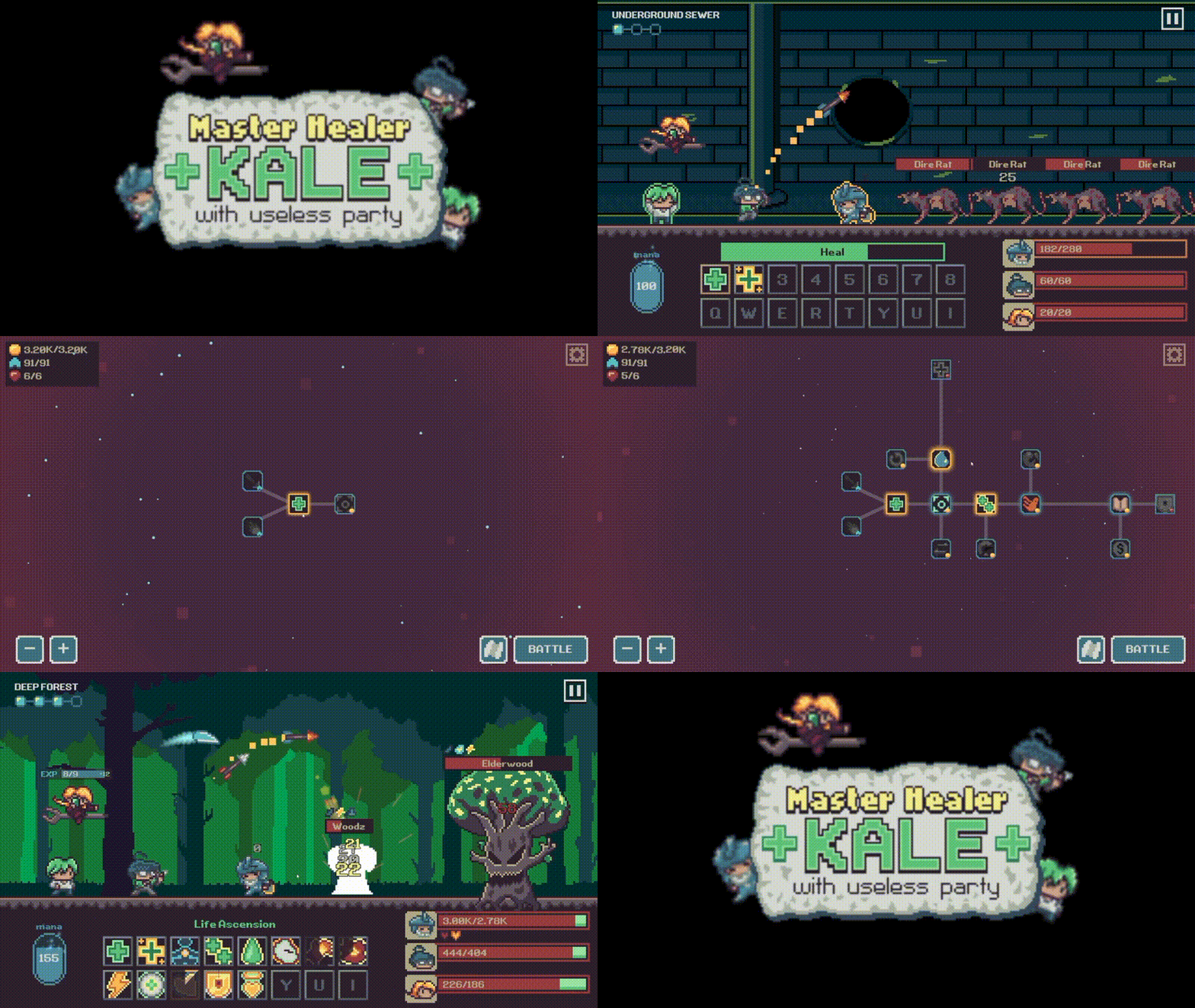
The skill tree is extensive, offering more than 200 upgrades across multiple branches of healing specialization, party enhancement, mana efficiency, and defensive augmentation. The structure is nonlinear, allowing players to create highly customized healing styles. Some branches focus on raw healing power, while others emphasize cooldown reduction, multi-target healing distribution, or conversion of overhealing into offensive buffs.
Advanced nodes introduce hybrid mechanics such as healing that scales with damage taken or abilities that trigger automatically when party members fall below critical thresholds. The incremental nature of the game ensures that each upgrade feels meaningful, especially in early and mid progression stages where small numerical increases can significantly affect survival rates. In later stages, synergy between multiple upgrade paths becomes essential for sustaining high-level encounters.
Effective builds depend heavily on balancing immediate survivability with long-term scaling potential. One of the strongest approaches focuses on regeneration stacking, where continuous healing effects are amplified through passive bonuses and duration extensions. This build excels in prolonged dungeon runs where attrition is the main threat. Another viable approach is burst-response healing, which prioritizes instant recovery and emergency shielding, making it especially effective in boss fights with high damage spikes and unpredictable attack patterns. A hybrid scaling build combines both approaches, gradually shifting from reactive healing in early game to passive regeneration dominance in late game, reflecting the game’s incremental structure and ensuring consistent performance across all stages of progression.

Combat Strategy, Party Survival, and Boss Progression
Combat in Master Healer Kale with Useless Party operates on a semi-auto battler system where party members act independently while Kale’s healing decisions determine overall survival. Enemies scale in difficulty over time, introducing mechanics such as damage over time fields, multi-hit combos, and debuff stacking. Because the party behaves unpredictably, players cannot rely on fixed rotations. They must constantly adapt to unstable party behavior, enemy pressure, and changing damage patterns.
Strategic decision-making revolves around timing healing abilities, managing mana efficiency, and predicting incoming damage waves. Auto-battler elements allow basic actions to occur without constant input, but advanced players can override or enhance actions through skill activation. This makes high-level play a blend of automation and manual optimization, where success depends on knowing when to let passive systems work and when to intervene directly.
Keeping the party alive efficiently requires proactive healing, resource management, and upgrade prioritization. Efficiency is achieved by minimizing overhealing waste while maximizing healing momentum generation. Positioning effects also play a subtle role, as some abilities distribute healing unevenly depending on party formation. Managing cooldown cycles is critical, especially during boss encounters where sustained damage pressure can overwhelm unprepared healing setups.
The most efficient strategy involves maintaining constant regeneration effects while reserving burst healing abilities for emergencies. This balance keeps the party stable during chaotic combat sequences and prevents players from spending high-value healing tools too early. Since the party cannot be fully controlled, players must learn to stabilize mistakes rather than prevent them completely.
Boss fights represent major progression milestones in Master Healer Kale with Useless Party. Each boss introduces unique mechanics that challenge healing systems in different ways, including anti-healing debuffs, damage reflection phases, and staggered burst attacks. Dungeon progression follows a layered structure where each floor increases difficulty while introducing new environmental hazards. These hazards often interact directly with healing mechanics, forcing players to adjust their builds and timing continuously. Success in boss encounters depends heavily on preparation, including optimized skill builds, resource reserves, and understanding damage patterns. Failure still contributes to incremental progression, ensuring that each attempt strengthens future runs.
Pixel Art Design, Short Progression, and Replay Value
The visual design of Master Healer Kale with Useless Party is built around retro-inspired pixel art with modern readability enhancements. Character animations are intentionally expressive, emphasizing exaggerated damage reactions and healing effects. These animations help communicate party instability, incoming danger, and the impact of Kale’s growing healing power without overwhelming the screen or obscuring combat information.
Visual feedback is closely tied to gameplay. Healing surges, stress conditions, and combat states are represented through readable animation and effects, helping players understand the pace of battle even when party members are acting independently. Color palettes shift gradually as progression advances, moving from muted tones in early stages to more vibrant, saturated effects as Kale’s abilities scale into higher tiers of healing mastery. This progression gives the game a visible sense of growth alongside its numerical upgrades.
Master Healer Kale with Useless Party is designed as a short incremental experience rather than an endlessly expanding RPG. The core progression arc is structured to deliver meaningful growth within a condensed timeframe, focusing on rapid scaling rather than long-term grind. This design ensures that players experience the full evolution of Kale’s healing potential without excessive repetition.
The game compresses incremental mechanics into a tight progression loop where every session contributes significantly to overall advancement. That shorter length also enhances replayability, encouraging experimentation with different builds and party interactions across multiple runs. Instead of stretching progression indefinitely, the game gives players a focused arc that rewards optimization and repeated experimentation.
Replay value is driven by build diversity, randomized party behavior, and evolving enemy scaling. Each run presents different challenges because party performance and encounter patterns remain variable. Challenge modes introduce modifiers such as reduced healing efficiency, increased enemy aggression, or restricted skill usage, significantly increasing difficulty while offering enhanced progression rewards. Endgame progression focuses on optimization rather than expansion, encouraging players to refine healing efficiency, minimize downtime, and achieve near-perfect survival loops in high-difficulty environments.

Frequently Asked Questions (FAQs)
- What is Master Healer Kale with Useless Party about?
Master Healer Kale with Useless Party focuses on controlling Kale, a healer who must sustain an unreliable and underperforming party through incremental progression and evolving combat challenges. The game reverses the usual RPG structure by making healing, survival, and support optimization more important than damage output. Kale gradually becomes strong enough to carry the group through increasingly dangerous dungeons, boss fights, and enemy encounters. - Is Master Healer Kale with Useless Party an idle game or an incremental RPG?
The game is primarily an incremental RPG with light idle mechanics rather than a fully idle game. Some systems, such as auto-healing triggers and regeneration auras, continue functioning passively, but optimal play requires active decision-making. Players need to manage upgrades, time healing abilities, respond to damage patterns, and refine build paths to keep the party alive efficiently. - What makes Kale unique as a healer?
Kale is unique because his healing abilities scale through usage and adapt to the types of damage he repeatedly heals. If he frequently heals physical bursts, poison effects, or magical corruption, his affinity toward those damage types increases permanently. This lets him gradually specialize based on actual combat conditions and eventually counter certain damage patterns before they fully resolve. - Why are the party members called useless?
The party members are intentionally flawed and unpredictable, which is central to the game’s humor and challenge. They may misposition, attract too much enemy attention, fail to provide consistent damage, or use random buffs with uneven value. Their instability forces the player to rely on Kale’s healing strategies rather than on balanced party synergy. - How does the healing system work?
The healing system combines direct healing, regeneration effects, overflow conversion, and delayed healing triggers. Direct healing restores immediate health and builds healing momentum, while regeneration effects provide steady recovery over time. Overflow healing can become temporary shields or stat boosts, and delayed triggers release stored healing when party members reach critical health thresholds. - How many upgrades are in the skill progression system?
Skill progression includes more than 200 upgrades across multiple branches, allowing deep customization of healing style, efficiency, and defensive support. Players can invest in raw healing power, cooldown reduction, multi-target healing, mana efficiency, overhealing conversion, automatic emergency effects, and party-wide defensive improvements. The nonlinear structure allows different players to shape Kale in different ways. - What are the best healing builds?
Effective builds often combine regeneration stacking and burst healing strategies. Regeneration stacking is strong during long dungeon runs where sustained damage and attrition are the main threats. Burst-response healing works better against bosses or enemies that create sudden damage spikes. A hybrid build can begin with reactive healing and gradually shift toward passive regeneration dominance as progression advances. - How does combat work in Master Healer Kale with Useless Party?
Combat operates on a semi-auto battler system where party members act independently while Kale’s healing decisions heavily influence survival. Basic actions occur automatically, but players can optimize outcomes through healing timing, mana management, skill activation, and upgrade choices. Since party behavior is unstable, combat depends on adaptation rather than fixed rotations. - What makes boss fights difficult?
Boss fights introduce unique mechanics such as anti-healing effects, burst damage phases, damage reflection, debuff stacking, and environmental hazards that directly test advanced healing strategies. Players must prepare with optimized builds, resource reserves, and knowledge of damage patterns. Even failed attempts still contribute to incremental progression, helping future runs become stronger. - Does Master Healer Kale with Useless Party have replay value?
Yes, the game offers replay value through build experimentation, randomized party behavior, challenge modes, and optimization of healing efficiency across multiple incremental runs. Different upgrade paths can produce different healing styles, while challenge modifiers such as reduced healing efficiency or increased enemy aggression create new survival problems. Endgame progression focuses on refining sustain loops and reaching near-perfect party survival under harder conditions.

Conclusion
Master Healer Kale with Useless Party delivers a distinctive incremental RPG experience centered entirely around healing mastery and survival optimization. By placing a single healer at the core of a chaotic and unreliable party, the game redefines traditional RPG structure and transforms support mechanics into the primary driver of progression. Its layered healing systems, extensive skill trees, and unpredictable combat encounters create a deeply strategic environment where every decision contributes to long-term scaling.
The combination of short-form incremental design and complex upgrade systems ensures that each playthrough feels meaningful while still encouraging replayability. Through evolving mechanics, adaptive healing systems, and escalating challenges, the game establishes itself as a focused exploration of support-role gameplay in an incremental format.
Sources and Citations
- Kirk III, W. J. (2005). Design Patterns of Successful Role-Playing Games.
https://danielrparente.wordpress.com/wp-content/uploads/2013/01/rpg_design_patterns_9_26_05.pdf - Game Design Skills. RPG Game Design: Mechanics, Progression, and Systems.
https://gamedesignskills.com/game-design/rpg/ - Incremental Game. Wikipedia.
https://en.wikipedia.org/wiki/Incremental_game - Game Developer. Lessons of My First Incremental Game.
https://www.gamedeveloper.com/design/lessons-of-my-first-incremental-game - Stone Story RPG. Wikipedia.
https://en.wikipedia.org/wiki/Stone_Story_RPG.
Recommended
- A GTA-Style Game Is Coming To Fortnite: Grand Heist City Release Date, Gameplay, Map, And Everything We Know
- Jurassic Park Star Sam Neill Shares Positive Health Update After Cancer-Free Diagnosis and Experimental Treatment Success
- Marathon Pushes Players To Be More Friendly In New Update: C.A.R.R.I. Protocol, Commendations, and Mercy Kit Explained
- Pokémon Champions Mobile Release on June 17: Launch Time, Crossplay, and What’s New
- The Winter Olympics Featured a Mortal Kombat Figure Skating Routine: What Happened and Why it Went Viral
- Modern Warfare 4 DMZ Returns as Extraction Shooter Battles Arc Raiders and Marathon for Genre Dominance
- Spyder Games Files Lawsuit over Fortnite Creative “Stealing Brainrots” Copying Roblox Hit “Steal a Brainrot”
- Silent Hill: Townfall Explained, 1996 Setting, Simon Ordell Story, St. Amelia Island & Fog Mystery Breakdown
- Chinese Esports Host Accused of Blackface Following On-Stream Stunt at Naraka: Bladepoint NBPL 2026
- Blender 3D vs Cinema 4D: The Ultimate 2025 Comparison Guide for 3D Artists



































































































