










In This Article (7 sections)
Defender of the Crown: The Legend Returns Overview, Release Date, and Core Gameplay
Defender of the Crown: The Legend Returns is a modern return to Cinemaware’s 1986 medieval strategy adventure. Black Tower Basement is developing the new release and Nordcurrent Labs is publishing it. The core fantasy remains the struggle to conquer England by controlling territories, raising armies, attacking castles, and defeating competing lords.
The original became distinctive because it combined strategic map decisions with cinematic action scenes rather than remaining exclusively on a conventional turn based battlefield. The Legend Returns deliberately retains that mixed identity. The developers describe it as a combination of strategy, adventure, and tactical gameplay, while medieval events and minigames remain part of the experience.
The package contains three interpretations of that concept instead of forcing every player into one redesign. This is essential to understanding the project: it is not simply “Defender of the Crown with HD graphics,” because one mode preserves the old game, another modernises it, and a third introduces an entirely different roguelite strategy framework.
Defender of the Crown: The Legend Returns is scheduled for August 13, 2026. The confirmed platforms are PlayStation 5, Xbox Series X|S, Nintendo Switch, and PC, with the PC version listed for Steam and GOG. Steam identifies Black Tower Basement as developer and Nordcurrent Labs as publisher, while the PlayStation Store independently lists August 13 as the PS5 release date. These separate storefront listings reinforce the announced multiplatform schedule.
As of August 12, 2026, the game is still immediately pre release, so claims about final balancing, post launch patches, or review consensus should not be treated as established facts. The developers have, however, said they intend to support the game after launch with bug fixes, performance improvements, and other technical updates.
The basic gameplay loop combines territorial strategy with action oriented medieval scenarios. Players choose a Saxon lord, develop their position on the strategic map, build military strength, attack territories, and participate in events such as castle assaults, raids, jousting, and sword fighting. Character choice also matters, as each Saxon lord begins with different strengths, weaknesses, and territories. The developers recommend Wilfred of Ivanhoe as a relatively forgiving starting choice because of his balanced abilities and starting position, while the other lords encourage different approaches.

Defender of the Crown: The Legend Returns Conquest, Armies, Castle Sieges, and Game Modes
The campaign in Defender of the Crown: The Legend Returns revolves around conquering territories while preventing rival lords from becoming dominant. Armies are used to defend existing holdings and attack neighboring provinces, continuing the turn-based structure of the original game. However, successful conquest requires more than attacking every available territory. Players must consider army strength, castle defenses, relationships between Saxon and Norman lords, and the risk of expanding too quickly. An unsuccessful offensive can weaken an army and leave previously secured land vulnerable.
The political situation changes according to the selected mode. In Classic Mode, the Saxon lords initially act as allies. They do not attack the player and allow movement through their territories, creating a temporary period of cooperation. This ends when the first Norman castle falls, after which every lord begins competing for the crown. Former allies can then become rivals, making later territorial decisions more dangerous.
Kingdom Mode places greater importance on travel and route planning. Time passes while players move across England, and some locations or opportunities can disappear as the months advance. Players must decide which encounters and rewards are worth pursuing before they become unavailable. Since choosing one destination may prevent access to another, efficient movement becomes part of the wider campaign strategy.
Army management remains connected to the series’ combination of large-scale planning and direct medieval action. Players raise forces, move armies, defend provinces, and challenge rival lords, but they also participate personally in jousts, sword fights, and castle assaults. This shift between strategic decisions and action sequences preserves one of the original game’s defining features.
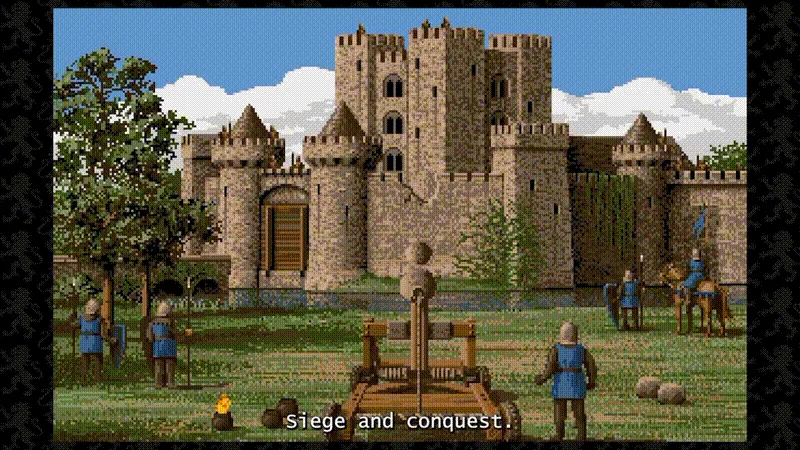
Castle sieges remain among the most recognizable parts of the campaign. In Retro and Classic Modes, players are encouraged to begin with a siege and bring enough catapults to weaken the defenders before launching the final assault. Proper preparation can reduce troop losses, making a fortified castle a different challenge from an ordinary province. Players who attack without sufficient equipment or manpower risk wasting valuable forces.
Kingdom Mode offers more flexibility during castle assaults. Players can attempt to storm a castle immediately or complete a preliminary siege to weaken its defenses. An immediate attack may save time and preserve access to another opportunity, but proper preparation improves the chance of victory and can reduce unnecessary losses. The decision reflects the mode’s wider balance between speed, risk, and long-term survival.
The package includes three game modes designed around preservation, modernization, and replayability:
- Retro Mode: This is the closest version to the 1986 Amiga original. It preserves the original campaign structure, story, pacing, action scenes, music, and audiovisual identity while adding selected quality-of-life improvements. The developers describe it as near-authentic rather than completely identical because some deliberate accessibility and convenience changes remain.
- Classic Mode: This modernizes the original campaign with updated graphics, redesigned menus, refined controls, improved music, and smoother supporting systems. It retains the familiar political structure, territorial conquest, castle warfare, and temporary alliance between the Saxon lords. It is the most suitable option for players who want the traditional campaign without the original 1986 presentation.
- Kingdom Mode: This introduces a roguelite deck-building structure with dice-based tactical combat, procedurally selected content, unlockable abilities, multiple difficulty levels, and changing events. The overall map remains recognizable, but encounters, rewards, route decisions, and points of interest can differ between runs.
Kingdom Mode’s randomized content makes each campaign less predictable. The best route may change depending on which events and rewards appear, while time-sensitive travel means pursuing one objective can cause another to disappear. Players must adapt their strategy instead of following the same sequence during every attempt.
Precious Dice provide an additional progression system within Kingdom Mode. Different dice produce different effects during the Tactical and Clash phases of combat. Completing scenarios, particularly on higher difficulties, unlocks stronger options for later runs. This gives players a reason to continue playing even when individual journeys contain temporary choices and changing encounters.
Each mode serves a different audience. Retro Mode prioritizes historical preservation, Classic Mode rebuilds the familiar experience with modern presentation and controls, and Kingdom Mode expands the formula through randomized events, tactical dice combat, progression systems, and changing routes. Despite these differences, territorial conquest, army building, political rivalry, and castle warfare remain central throughout Defender of the Crown: The Legend Returns.

Defender of the Crown: The Legend Returns Improvements, Remake Status, PC Requirements, and Steam Deck Support
Defender of the Crown: The Legend Returns introduces modernized controls, a redesigned interface, improved balance, cleaner systems, and several quality-of-life changes across its three modes. Classic Mode receives the most substantial visual and mechanical update, rebuilding the graphics, controls, interface, music, and supporting systems for modern players rather than simply enlarging the original assets. Retro Mode takes a lighter approach by preserving the identity and presentation of the 1986 Amiga game while adding selected conveniences.
Kingdom Mode expands the package beyond a conventional remaster. It introduces a roguelite deck-building structure, dice-based combat, unlockable abilities, randomized events, changing rewards, and progression across several difficulty levels. These systems were not part of the original release and substantially change how campaigns are played and repeated.
Because of this three-mode structure, Defender of the Crown: The Legend Returns does not fit neatly into a single remake or remaster category. The developers describe it as a new iteration that preserves the original game’s world and spirit while adding modern visuals, expanded content, and new gameplay systems. Retro Mode functions as a preservation-focused remaster, Classic Mode is closer to a modern reimagining of the Amiga campaign, and Kingdom Mode is an original expansion of the formula. The most accurate description is therefore a new franchise iteration containing a preserved classic experience, a modernized reworking, and a substantially different new mode.
The official PC requirements are modest, with both configurations requiring a 64-bit version of Windows 10 or Windows 11, 8 GB of RAM, and 1 GB of storage:
- Minimum: Intel Core i5-3330 or AMD FX-4300 processor, Nvidia GeForce GTX 650 or AMD Radeon HD 7790 graphics card, 8 GB of RAM, and 1 GB of available storage.
- Recommended: Intel Core i5-7500 or AMD Ryzen 3 1200 processor, Nvidia GeForce GTX 950 or AMD Radeon RX 460 graphics card, 8 GB of RAM, and 1 GB of available storage.
Steam Deck support is planned for launch, although this does not guarantee that the game will immediately receive Valve’s official Verified rating. Verification is handled separately by Valve and may not be completed by release, even when the developer has designed the game to run on the handheld.

Frequently Asked Questions (FAQs)
- What are the minimum PC requirements for Defender of the Crown: The Legend Returns?
Steam lists Windows 10 or Windows 11 in 64 bit, an Intel Core i5 3330 or AMD FX 4300 processor, 8 GB of RAM, an Nvidia GeForce GTX 650 or AMD Radeon HD 7790 graphics card, and 1 GB of available storage as the minimum requirements. These specifications are relatively modest, meaning the game does not require a particularly powerful modern gaming PC to meet its listed minimum hardware requirements. - When does Defender of the Crown: The Legend Returns release?
Defender of the Crown: The Legend Returns is scheduled to release on August 13, 2026. As of August 12, 2026, the game is still immediately pre release, so final balancing, post launch updates, and review consensus should not yet be treated as established facts. - What platforms will Defender of the Crown: The Legend Returns be available on?
The game will be available on PC through Steam and GOG, as well as PlayStation 5, Xbox Series X|S, and Nintendo Switch. Steam lists Black Tower Basement as the developer and Nordcurrent Labs as the publisher, while the PlayStation Store also lists August 13 as the PS5 release date. - How many game modes are included?
Defender of the Crown: The Legend Returns includes three principal modes: Retro Mode, Classic Mode, and Kingdom Mode. Each mode approaches the original concept differently, with Retro focused on preservation, Classic focused on modernising the original campaign, and Kingdom introducing a substantially different roguelite strategy experience. - What is Retro Mode?
Retro Mode is a near authentic preservation of the 1986 Amiga game with selected quality of life improvements. It retains the original narrative driven story, music, turn structure, action scenes, pacing, and overall presentation, allowing players to experience the classic while benefiting from some modern conveniences. - What is Classic Mode?
Classic Mode modernises the traditional campaign while preserving its underlying story and structure. It introduces a new visual identity along with improved controls, an updated user interface, smoother systems, and enhanced music, making it the option for players who want the original Defender of the Crown experience presented in a more modern form. - What is Kingdom Mode?
Kingdom Mode is a new roguelite deck builder featuring dice based tactical combat, randomised events and rewards, unlockable abilities, and multiple difficulty levels. Its Tactical and Clash combat phases use special Precious Dice with different effects, while completing scenarios can unlock stronger options for future runs. - Does Defender of the Crown: The Legend Returns still have castle sieges and jousting?
Yes. The new game retains the medieval action identity of Defender of the Crown, including jousting, sword fighting, territorial warfare, and castle sieges. Castle assaults still involve strategic preparation, with the developers recommending sieges and sufficient catapults in Retro and Classic Modes to weaken defenders before the final attack. - Is Defender of the Crown: The Legend Returns a remake?
The developer describes it as a new iteration rather than restricting it to a simple remake or remaster label. Retro Mode preserves the original experience, Classic Mode modernises the traditional campaign, and Kingdom Mode introduces a new roguelite deck building structure, making the complete package a combination of preservation, modernisation, and new content. - Will Defender of the Crown: The Legend Returns support Steam Deck?
The developers say Steam Deck support is planned at launch. However, launch support does not automatically mean the game will have received Steam’s official Verified designation, and the developers noted that the verification process is controlled by Valve.

Conclusion
Defender of the Crown: The Legend Returns is designed to serve two audiences at once: players who want a faithful route back to the influential 1986 Amiga game and players who expect a more modern strategy experience. Its solution is to avoid forcing one philosophy across the entire package. Retro Mode focuses on preservation, Classic Mode modernises the established campaign and Kingdom Mode introduces an extensive roguelite reinterpretation.
The underlying Defender of the Crown identity remains recognisable. Territorial conquest, army building, castles, jousting, sword fighting and the political struggle among Saxon and Norman rivals continue to form the thematic and mechanical foundation.
Kingdom Mode is what most clearly expands the project beyond nostalgia. Dice-based tactical phases, unlockable Precious Dice, randomised events, changing opportunities, different difficulty levels and roguelite progression create reasons to return after completing the more structured Retro or Classic campaigns.
With its August 13, 2026 launch scheduled across PC, PS5, Xbox Series X|S and Nintendo Switch, Defender of the Crown: The Legend Returns is best understood not as one replacement for the Amiga original, but as three approaches to the same legacy packaged together: preservation, modernisation and reinvention.
Sources and Citations
- Steam — Defender of the Crown: The Legend Returns (Official Store Page)
- Confirms Black Tower Basement as developer, Nordcurrent Labs as publisher, the August 13, 2026 release date, game modes, and PC information.
- Steam Store Page
- Steam Community — Official Developer Posts
- GOG — Defender of the Crown: The Legend Returns (Official Product Page)
- Covers the rebuilt/remastered presentation, Retro Mode, Classic Mode, Kingdom Mode, modernized systems, and quality-of-life improvements.
- GOG Product Page
- GOG — Coming Soon: Defender of the Crown: The Legend Returns (Official Announcement)
- Official GOG announcement describing the game as rebuilt for modern platforms and remastered, with a sharper, cleaner experience.
- GOG Announcement
- Gematsu — Defender of the Crown: The Legend Returns launches August 13
- Confirms the August 13, 2026 release across PlayStation 5, Xbox Series, Nintendo Switch, and PC via Steam and GOG. It also summarizes Retro, Classic, and Kingdom modes.
- Gematsu Release-Date Report
- GamesRadar — Everything Announced at the Future Games Show Summer Showcase 2026
- Covers Defender of the Crown: The Legend Returns as one of the showcased classic remakes.
- GamesRadar Future Games Show Coverage
- MobyGames — Defender of the Crown (1986)
- Historical entry for the original Defender of the Crown, including its November 1986 Amiga release and platform history.
- MobyGames Historical Entry
- Original Defender of the Crown Amiga Manual
- The preserved manual provides primary-source background on the four Saxon characters, turn structure, armies, castles, raiding, jousting, and other mechanics from the 1986 game.
- Defender of the Crown Amiga Manual
- Retro Commodore — Defender of the Crown (1986) Manual Archive
- Provides a scanned English PDF of the original Cinemaware/Master Designer Defender of the Crown manual.
- Amiga Manual Archive
Recommendations
- Fire Emblem: Fortune’s Weave Hits Switch 2 on September 17
- Headshot 3 Official Launch Character Creator: What’s New in Character Creator 5 (CC5)
- Solarpunk: Where to Get Silicon (Best Sources and Farming Routes)
- Battlefield 6 Takes Home Game of the Year at UKIE Video Game Awards 2026
- CoD: Black Ops 7 And Warzone Season 2 Reloaded Release Date And Details (Start Time, New Maps, Weapons, Zombies, Warzone Updates)
- When is PS6 Coming Out, How Much Will the PS6 Cost, and Will PS6 Be Backwards Compatible? (2026 Update)
- Esoteric Ebb Explained: What Happens When Dungeons & Dragons Meets Disco Elysium?
- Developers With Foreign Legal Entities May Be Allowed to Include Games in the Russian Software Registry: Requirements, VAT Benefits, and What Changes in 2026
- Stranger than Heaven: Official Cities Overview Trailer Breakdown, All Cities Explained, Release Date, Story Details, and Everything We Know
- Event Habitat Dex and Pokédex List in Pokémon Pokopia



































































































