











In This Article (8 sections)
Why Barclays Downgraded Dell and Why the Stock Fell 11%
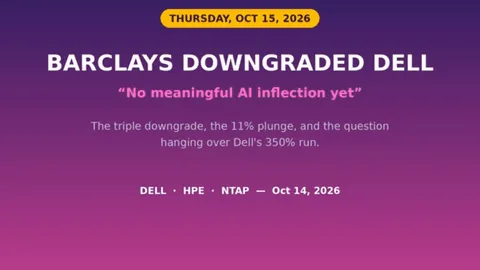
Dell shares fell sharply after Barclays downgraded the company from Overweight to Equal Weight, challenging expectations that enterprise AI adoption would continue supporting the stock’s exceptional rally. The initial double-digit decline occurred on October 14, 2026, when Reuters reported Dell down 11.4% during a broader technology selloff. The Nasdaq also fell as inflation data increased concern about interest rates, meaning Dell’s decline reflected both company-specific doubts and an unfavorable market backdrop. The downgrade mattered because investors were reassessing not whether Dell benefits from AI, but whether the scale and timing of that benefit justify the valuation already reflected in the shares.
Barclays analyst Tim Long lowered the rating after a rally that had pushed Dell shares more than 300% higher during 2026. A large rise of that kind increases the importance of future expectations because investors may already be pricing in strong demand, continued earnings growth, and further upside from AI infrastructure. Under those conditions, good results alone may not be enough to support further gains. The company may need to exceed an increasingly optimistic baseline. The selloff therefore illustrated the difference between a strong business opportunity and an attractive stock price at a particular valuation.
Barclays also reduced its Dell price target from $603 to $574, a decline of roughly 4.8%. The smaller target cut compared with the much larger one-day stock decline shows that markets can react more strongly to a change in the reasoning behind a recommendation than to the numerical price target itself. A price target depends on assumptions about earnings, valuation multiples, and future conditions, and none of those assumptions is guaranteed. If investors decide that future earnings deserve a lower multiple, a share price can fall even while the underlying company continues growing.
The bank’s core concern centered on the absence of what it considered a meaningful enterprise AI inflection. In this context, that phrase refers to a broad acceleration in spending by ordinary businesses moving AI from trials into repeatable production deployments that generate sustained purchases of servers, storage, networking, and related infrastructure. Barclays was not arguing that AI infrastructure demand had disappeared. Demand from cloud providers, specialist operators, and frontier AI companies can remain very strong while adoption across the wider corporate market develops more slowly.
The distinction matters because a small number of very large infrastructure projects can generate significant revenue without proving that thousands of enterprises are simultaneously beginning similar investment programs. Stronger evidence of a broad adoption cycle would include repeat purchases, expanding customer participation, and production workloads replacing experiments. Barclays’ downgrade shifted the debate from whether AI creates demand to whether that demand is spreading widely and quickly enough to justify the expectations built into hardware-company valuations.

Memory Pricing, Dell AI Server Growth, and the Quality of Revenue
Barclays argued that part of the strength in enterprise hardware revenue reflected higher memory prices being passed through to customers rather than a dramatic increase in unit demand. Revenue depends on both the number of systems sold and the average selling price, so a company can report strong growth even if shipment volumes remain relatively stable. A hypothetical supplier selling 100 systems at $10,000 each generates $1 million, while selling the same 100 systems at $12,000 produces $1.2 million. That 20% revenue increase is real, but it comes from price rather than higher unit volume.
This distinction does not make the revenue artificial. Dell still delivers hardware and collects payment, but price-driven growth can behave differently from growth supported by an expanding customer base or more frequent deployments. It also does not automatically translate into equivalent profit growth because higher selling prices may simply reflect higher component costs. An extra dollar of revenue associated with a more expensive memory component does not necessarily create an extra dollar of profit. Investors therefore need to examine price, volume, product mix, and margin together.
Memory normalization creates the reverse risk. If higher component prices boosted the prior year’s revenue, stable or falling memory prices can remove that contribution even when unit demand remains healthy. Barclays expected revenue growth to slow partly for this reason. A slowdown does not necessarily mean Dell’s revenue will fall, only that the percentage increase may become smaller. After a period of rapid expansion, maintaining the same growth rate requires increasingly large absolute gains.
Falling memory prices could also create benefits. Lower system costs may improve affordability and encourage customers to buy additional capacity or accelerate projects that were previously too expensive. The effect on margins may depend on how quickly selling prices adjust relative to procurement costs. If component costs fall faster than customer pricing, Dell could temporarily retain some benefit, while aggressive competition could pass most savings through to buyers. Inventory purchased at older prices adds another layer because existing systems may have to compete with newer, lower-cost configurations.
Dell’s own financial results provide important counterevidence to a purely pessimistic interpretation. For fiscal 2027’s second quarter, the company reported $16.4 billion in AI-optimized server revenue, up 100% year over year. It also disclosed $60.9 billion in quarterly AI server orders and a $95 billion backlog. These figures show substantial commercial activity, but they represent different stages of the sales process. Orders reflect booked business, backlog reflects orders waiting to be fulfilled, and revenue reflects sales recognized under accounting rules, so they should not be added together as if they were all completed revenue.
Profitability remains a separate question. Barclays reportedly estimated AI server operating margins at about 5%, which should not be confused with the margin of Dell’s entire Infrastructure Solutions Group. A low-margin business can still generate substantial operating profit when revenue is very large, but the economics remain sensitive to pricing, configuration, competition, service obligations, and execution. The value of Dell’s AI growth therefore depends not only on how much hardware it sells, but also on the earnings and cash flow generated from those sales.
The difference between enterprise AI spending and Dell AI server demand also matters. Corporate AI budgets can include software subscriptions, cloud services, consulting, cybersecurity, data preparation, and internal development, only some of which becomes direct purchases of Dell hardware. Barclays estimated that businesses typically allocate about 5% of IT budgets to AI and that around one-quarter of enterprise AI spending goes toward hardware. Under those assumptions, AI hardware would represent roughly 1.25% of total IT spending, although that is an illustrative calculation based on the bank’s estimates rather than an independent universal statistic.
A company with a $100 million IT budget would therefore allocate about $5 million to AI and $1.25 million to AI hardware under the same assumptions. Actual spending can differ substantially by industry, workload, and deployment model. Businesses that rent infrastructure through cloud providers may increase AI spending without purchasing their own servers. The central question for Dell is how much of growing AI investment becomes addressable hardware demand and whether that share expands consistently across a broader set of customers.
Enterprise AI Adoption, Management Optimism, and Industry-Wide Concerns
Michael Dell has presented a more optimistic view of the long-term opportunity. Reporting on his CNBC comments described his expectation that AI infrastructure demand would continue exceeding supply through 2030, while also emphasizing that enterprise adoption remained at an early stage. That outlook does not necessarily contradict Barclays’ argument. Management is focused on the size of the long-term opportunity, while the bank is questioning the current pace of adoption and whether the stock already reflects too much future success.
An early-stage market can provide significant long-term upside while producing uneven quarterly performance. Businesses may delay AI projects because of data readiness, organizational change, integration requirements, security concerns, or uncertainty about financial returns. Those barriers can slow spending even when executives believe AI will eventually become important. The key question is how quickly experiments turn into repeatable production workloads that require sustained infrastructure investment. Management optimism becomes more persuasive when supported by broader customer participation, recurring orders, and measurable profitability.
Barclays’ simultaneous downgrades of Hewlett Packard Enterprise and NetApp show that its concern extended beyond Dell. The bank reduced both companies to Equal Weight from Overweight, pointing to valuation and uncertainty about enterprise AI spending. This broader action suggests an industry-level thesis rather than a judgment based only on Dell’s execution. Hardware suppliers exposed to corporate technology budgets can face similar pressures when spending cycles accelerate or slow.
The three companies still have different product mixes, customers, and economics, so they should not be treated as identical. Shared weakness across several suppliers could indicate common budget pressures, while divergent performance may reveal differences in market share, product strength, or customer exposure. The industry comparison is useful precisely because it helps separate macro conditions from company-specific performance. Dell may benefit from the same spending cycle as peers while still outperforming or underperforming them based on execution.
Valuation remains central because a strong industry does not automatically make every hardware stock attractive at every price. Investors focused on Dell as a traditional infrastructure supplier may apply different valuation assumptions from those viewing it as a major beneficiary of a multi-year AI buildout. Both approaches need to be tested against actual margins, cash flow, competitive differentiation, and capital requirements. The extraordinary 2026 stock rally made this debate more important because more favorable assumptions were already embedded in the share price.
Dell’s operating expense trends also influence the earnings outlook. Barclays estimated that the operating expense ratio could decline from 15.6% in fiscal 2024 to approximately 8% in fiscal 2027. A lower ratio can improve earnings because revenue grows faster than expenses, but it does not necessarily mean total operating costs are falling in absolute terms. A company spending $10 billion on $100 billion of revenue has a 10% expense ratio, while spending $12 billion on $150 billion of revenue lowers the ratio to 8% even though absolute spending rises.
That distinction matters when discussing cost cuts and efficiency. A lower expense ratio can result from productivity improvements, spending discipline, stronger revenue growth, or changes in business mix. Sustainable earnings depend on maintaining enough investment in engineering, sales, implementation, and customer support to remain competitive. If revenue growth normalizes, extracting further operating leverage may become more difficult. Investors therefore need to distinguish repeatable efficiency gains from benefits that depend primarily on unusually rapid top-line expansion.

What Investors Should Watch in Dell’s Next Earnings Report
Dell’s next earnings report will provide a clearer test of the competing explanations for its growth. Investors should examine revenue, AI server orders, backlog conversion, margins, and cash flow together rather than focusing on one headline figure. Strong orders matter most when they turn into delivered systems and are replaced by new demand. Backlog becomes more valuable when fulfillment schedules are credible and customers continue ordering after existing commitments are shipped. This can help distinguish a durable cycle from a temporary surge.
Customer breadth will also be important. A growing number of enterprises placing repeat orders would support the case that AI adoption is spreading beyond a small group of large infrastructure buyers. Large aggregate figures can look impressive while concealing concentration in a few major customers. Broader participation would provide stronger evidence that Dell is benefiting from an enterprise-wide adoption cycle rather than a limited set of exceptional projects. Repeat orders would also suggest that customers are moving beyond experiments toward sustained deployment.
Management commentary on memory prices should help clarify the quality of revenue growth. Investors will want to know how much revenue comes from higher component costs, richer configurations, shipment growth, or stronger demand. Growth supported by several drivers may prove more durable than growth heavily dependent on one temporary pricing factor. Falling component prices could reduce reported revenue while improving affordability, making volume and margin disclosures especially important. The interaction between price and demand will be more informative than either measure alone.
Cash generation deserves equal attention because accounting earnings and cash receipts can diverge. Inventory levels, customer financing, payment terms, and working capital can all affect how quickly reported sales turn into cash. Strong revenue growth accompanied by weak cash generation could raise different questions from growth supported by improving cash flow. The economics of Dell’s AI server business will be easier to assess when revenue, margin, and cash conversion move in a consistent direction. This is particularly important in a hardware business with large procurement and inventory requirements.
Dell’s published outlook calls for fiscal third-quarter revenue of $49 billion and non-GAAP diluted earnings per share of $6.50. These are guidance figures rather than completed results or guarantees. Investors should compare actual performance with those expectations while also examining whether management raises, maintains, or lowers its outlook for subsequent periods. The magnitude and source of any earnings surprise will matter because markets may have become accustomed to repeated upside during Dell’s rally.
The most useful evidence will come from whether Dell can sustain profitable growth as the effects of memory pricing change. If enterprise demand broadens, backlog continues converting, repeat orders remain strong, and margins hold, that would strengthen management’s long-term AI thesis. If growth slows mainly because pricing normalizes while unit demand remains healthy, the business could still be performing well even if reported revenue growth moderates. If both pricing support and demand weaken, Barclays’ concerns would gain more weight.
The key issue is therefore not whether Dell benefits from AI infrastructure spending, which its current orders and revenue already demonstrate. The more difficult question is whether that demand can remain broad, recurring, and profitable enough to support the expectations embedded in the stock after its extraordinary rally. Future earnings reports will help separate temporary pricing effects from genuine enterprise adoption. That distinction will determine whether Dell’s AI growth story remains compelling even as the valuation debate becomes more demanding.

Frequently Asked Questions (FAQs)
- Why did Dell stock fall approximately 11%?
Dell shares fell sharply after Barclays downgraded the company from Overweight to Equal Weight and questioned whether enterprise AI adoption was progressing quickly enough to justify the valuation after a major rally. The downgrade challenged expectations that strong AI-related hardware demand would continue translating into exceptional growth. Broader technology-sector selling also made the market environment less supportive, with inflation concerns and interest-rate expectations weighing on valuations. The decline therefore reflected both Dell-specific worries and a weaker trading backdrop. It should not be interpreted as proof that customer demand suddenly disappeared, but rather as investors reassessing how much future growth was already priced into the shares. - Did the initial selloff happen on October 14 or October 15?
The initial downgrade and double-digit selloff occurred on October 14, 2026. Reuters reported that Dell fell about 11.4% during that session, while additional coverage published on October 15 continued discussing the downgrade and its implications. That distinction matters because the publication date of a follow-up article is not necessarily the same as the date when the market first reacted. Mixing the two dates can make it appear that the decline happened a day later than it actually did. The clearest timeline is that Barclays issued the downgrade on October 14, with broader reporting continuing on October 15. - What does Equal Weight mean for Dell stock?
Equal Weight is a more neutral rating within Barclays’ research framework. It generally means the analyst sees less reason to expect Dell to outperform comparable stocks from its current valuation, even if the company itself continues to grow. The rating does not mean Barclays expects the shares to remain perfectly flat or move exactly in line with a particular index. It reflects a judgment about the balance between future business prospects and the price investors are currently paying for those prospects. In Dell’s case, the downgrade suggested that further outperformance would require stronger evidence of durable growth or more attractive valuation conditions. - Does Barclays believe AI server demand is nonexistent?
No. Barclays’ reported concern was about the breadth, timing, and durability of enterprise AI adoption rather than the existence of AI server demand itself. Large cloud providers, specialist infrastructure companies, and other major buyers can still generate substantial demand for accelerated servers. The question is whether that activity is spreading widely enough across ordinary enterprises to support a sustained hardware investment cycle. A few large deployments can produce impressive revenue without proving that the broader corporate market is investing at the same pace. Barclays’ argument therefore focuses on whether enterprise demand is broadening enough to support the expectations already built into hardware valuations. - Why are memory prices relevant to Dell revenue?
Memory prices matter because higher component costs can raise the selling price of complete systems when those costs are passed on to customers. Dell can therefore report higher revenue even if it ships roughly the same number of servers, simply because each system costs more. This makes it important to separate growth caused by higher prices from growth caused by additional unit demand or richer system configurations. Price-driven revenue is still real revenue, but its durability may differ from growth generated by a steadily expanding customer base. Investors therefore need to examine selling prices, shipment volume, product mix, and underlying demand together. - Would lower memory prices necessarily reduce Dell’s profits?
No. Lower memory prices can affect revenue and profitability in different ways. Falling component costs may reduce the price Dell charges for a system, which could slow reported revenue growth, but those same lower costs may improve margins or make systems more affordable to customers. Cheaper systems could also encourage buyers to purchase additional capacity or accelerate projects that were previously too expensive. The final profit effect depends on competitive pricing, inventory costs, contracts, product mix, and how quickly customer prices adjust after procurement costs change. - Is AI server backlog the same as revenue?
No. Backlog represents customer orders that have been booked but have not yet been fulfilled and recognized as revenue. It can provide visibility into potential future business, but it is not equivalent to completed sales. Investors still need to consider when those systems will ship, whether customer commitments remain intact, and what margins Dell earns when the orders are delivered. Cash collection also matters because recognized revenue and actual cash receipts can occur on different timelines. A large backlog is therefore encouraging evidence of demand, but its value depends on successful and profitable conversion. - Why can Dell shares fall while earnings increase?
Stock prices reflect expectations about future earnings as well as the earnings already reported. A company can increase profits and still see its share price fall if investors expected even faster growth or decide that the stock deserves a lower valuation multiple. For example, rising earnings can be outweighed by a decline in the price-to-earnings multiple investors are willing to pay. This is especially relevant after a large stock rally because more optimistic assumptions may already be embedded in the price. Dell can therefore perform well operationally while the market becomes less willing to pay as much for each dollar of expected future earnings. - Does enterprise AI spending always lead to hardware purchases?
No. Enterprise AI budgets can be spent on many different categories, including cloud services, software subscriptions, consulting, cybersecurity, data preparation, and model access. A company can increase its AI spending substantially without buying its own Dell servers if it runs workloads through cloud providers or hosted applications. Other companies may choose to build private infrastructure and purchase accelerated systems directly. The amount of enterprise AI spending that becomes addressable hardware revenue therefore depends on how customers choose to deploy their workloads. Total AI budget growth and direct server demand are related, but they are not the same measurement. - What evidence would strengthen the case for sustained Dell growth?
A broader and more repeatable pattern of demand would provide stronger evidence than one period of exceptionally large orders. Investors would want to see more customers placing repeat purchases, backlog converting reliably into shipments, and completed orders being replaced by new business. Stable or improving margins would show that Dell is not generating growth only by selling large amounts of low-margin hardware. Strong cash collection would also indicate that reported earnings are translating into economic value. Clear disclosures separating price effects, shipment growth, product configuration, and customer breadth would make it easier to determine whether Dell’s expansion reflects durable enterprise AI deployment rather than temporary component pricing or a small number of unusually large projects.

Conclusion
Dell’s roughly 11% decline after the Barclays downgrade highlights a broader debate over how much of the company’s recent hardware growth comes from durable enterprise AI adoption versus higher component pricing and elevated expectations. Revenue growth driven by more expensive memory can still be meaningful, but investors also need to examine shipment trends, customer breadth, margins, backlog conversion, and cash generation to understand the quality of that growth.
Barclays’ caution and Michael Dell’s more optimistic outlook ultimately point to the same test: whether AI infrastructure demand broadens into recurring production deployments across a wider customer base. Strong repeat orders and dependable profitability would support the long-term growth case, while heavier reliance on pricing effects would justify a more cautious view. The next phase will depend on whether Dell can convert its current AI momentum into sustained earnings and cash flow strong enough to support the expectations created by its earlier rally.
Sources and Citations
- Reuters, October 14, 2026: Reports Dell’s decline within the broader technology selloff following stronger inflation data and increased interest-rate concerns.
https://www.reuters.com/business/sp-500-dow-futures-rise-ahead-big-bank-results-cpi-data-2026-10-14/ - The Fly via TipRanks, October 14, 2026: Documents Barclays’ downgrade from Overweight to Equal Weight and the reduction in Dell’s price target.
https://www.tipranks.com/news/the-fly/dell-technologies-downgraded-to-equal-weight-from-overweight-at-barclays-thefly-news - Investing.com, Barclays downgrades Dell stock after sharp rally: Summarizes the bank’s valuation concerns, memory-price thesis, AI server estimates, and operating expense analysis.
https://ng.investing.com/news/stock-market-news/barclays-downgrades-dell-stock-after-sharp-rally-2736523 - Dell Technologies, Second Quarter Fiscal 2027 Financial Results: Provides the company’s reported AI server revenue, orders, backlog, and financial guidance.
https://investors.delltechnologies.com/news-events/press-releases/detail/1653/dell-technologies-delivers-second-quarter-fiscal-2027-financial-results - CNBC, October 14, 2026, reproduced by HUE Legacy Ventures: Explains the enterprise AI timing concerns and Barclays’ estimates concerning business AI budgets and hardware allocations.
https://huelv.com/newsroom/23137-dell-stock-plunges-11-leading-data-center-sell-off-as-fears-mount-about - Benzinga, October 14, 2026: Covers Michael Dell’s outlook for AI infrastructure demand and the early stages of enterprise adoption.
https://www.benzinga.com/markets/tech/26/10/62364730/why-is-dell-technologies-stock-sinking-wednesday - Investor’s Business Daily, October 14, 2026: Reports the coordinated Barclays downgrades affecting Dell, Hewlett Packard Enterprise, and NetApp.
https://www.investors.com/news/technology/hpe-dell-netapp-barclays-downgrade-enterprise-ai-trends/ - GuruFocus, October 15, 2026: Discusses the continuation of selling after the downgrade and the distinction between component pricing and underlying infrastructure demand.
https://www.gurufocus.com/news/9126036/dell-stock-nosedives-after-barclays-downgrade
Recommendations
- Capcom Gamescom 2026 Lineup Revealed: Mega Man, Dragon’s Dogma 2 and More Games to Watch
- Jurassic World Evolution 3 Titanosaurus Trailer Breakdown & Details
- Pokémon Legends Z-A Mega Dimension Romance Avec Purrloin Side Mission Walkthrough
- Control Resonant PC Gaming Show Appearance Confirmed, Release Details, Gameplay Changes, and Story Explained
- Activision Blizzard Microtransactions Face Italian Investigation in 2026
- Nova Roma – Official Early Access Launch Trailer Reveals Roman City Builder Gameplay, Features, and Early Access Details
- After Falling Big, Nintendo Stock Soars 10% After Pokémon Pokopia Releases and Sells Out
- Just Days Before the Oscars, Netflix Closes Deal for Maggie Kang and Chris Appelhans to Return for KPop Demon Hunters 2
- Devil May Cry Showrunner Says Season 2 Is Like The Dark Knight Leap From Batman Begins
- Zelda: Ocarina of Time remake (Forest Temple 100% walkthrough)



































































































