




In This Article (9 sections)
Disney’s Hexed Trailer Raises Questions About TikTok-Friendly Center Framing
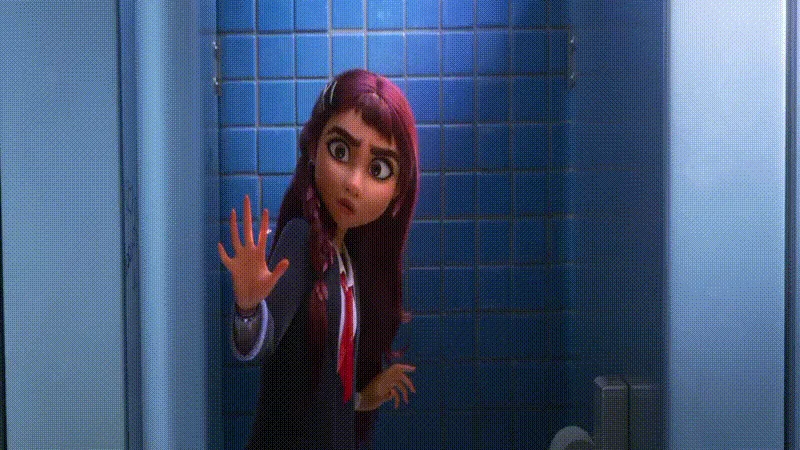
Disney released the first teaser trailer for Hexed on June 16, 2026, introducing Billie, her cautious mother Alice, and the hidden witch realm of Hexe, but within two days the discussion had shifted from the movie’s magical premise to its visual composition. The Latest Disney Trailer Has Fans Concerned About How TikTok Has Shaped The Company’s Movies, as several fans have pointed out that, rather than making creative use of all the space within the frame, the movie seems deliberately staged to keep the focus in the center of the screen.
The concern is that Disney may be protecting a narrow central portion of the widescreen image so promotional clips, fan edits, reaction videos, and character montages can be converted into the 9:16 format used by TikTok and Instagram Reels without losing important visual information. A fan-created vertical crop of the Hexed trailer helped the argument spread because most of the teaser reportedly remained understandable even after large portions of both sides were removed.
The comparison began because the teaser repeatedly places its most important characters, faces, movements, and magical effects near the vertical centerline of the image; instead of relying heavily on asymmetrical compositions, distant corner placement, or action spread across the full width of the screen, many shots remain readable when attention is restricted to the middle. That matters because TikTok recommends a vertical 9:16 format for in-feed advertising, while Instagram also treats 9:16 as the natural full-screen format for Reels.
A conventional horizontal movie frame is dramatically wider than that, so converting it into full-screen vertical video normally requires an editor to crop away most of the left and right sides, reposition the image from shot to shot, or accept empty space around the original frame.
TikTok’s current advertising specifications explicitly recommend 9:16 vertical video and provide safe-zone guidance intended to keep important content away from areas covered by captions and interface elements. The Hexed discussion is therefore not simply about whether Billie happens to stand in the middle of a few shots; fans are asking whether the teaser demonstrates a systematic “center-safe” strategy in which key information is positioned inside a narrow zone that can survive both a theatrical landscape presentation and a phone-oriented vertical crop.
The trailer frequently uses the type of center-dominant composition that adapts well to TikTok, but describing it as “TikTok-style” requires qualification, because center framing is not a visual language invented by social media and can be found throughout silent cinema, classical animation, television, portrait photography, music videos, advertising, and carefully symmetrical filmmaking.
What makes the Hexed teaser notable is the apparent frequency of the technique: Billie is commonly presented as the unquestionable focal point, with her face or body located close to the center, and supporting characters and magical objects are also often arranged around the same axis. Even when the environments are broad and colorful, the principal information tends not to depend on the far edges of the frame.
That is exactly what a vertical editor needs, since a narrow central crop can retain Billie’s expressions, the main source of action, and much of the dialogue staging, while shots that place one character on the left and another on the right are much harder to adapt because a 9:16 crop may preserve only one participant.
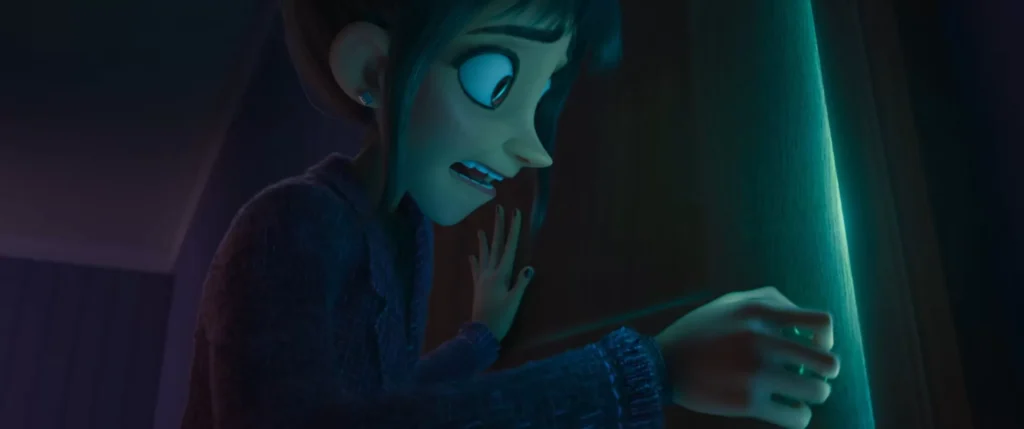
Likewise, a composition that uses an empty side of the frame to create suspense, imbalance, or dramatic anticipation loses its intended effect when that space is removed. The available evidence supports a careful conclusion: the Hexed trailer is unusually compatible with a vertical center crop, but Disney has not publicly confirmed that social-media conversion determined the movie’s composition. Kotaku’s June 18, 2026 coverage collected several of these reactions and highlighted the theory that central framing could make official marketing clips and unofficial fan edits easier to circulate on TikTok and Instagram, while also emphasizing that the theory remains an interpretation of the trailer rather than a confirmed explanation from Disney.

Why Hexed’s Centered Composition May Serve Story, Clarity, and Social Media
There are several plausible explanations for why Hexed characters are positioned in the center of the screen, and more than one may be true. First, Hexed is a character-driven coming-of-age story, so centering Billie immediately identifies her as the emotional anchor. The technique can communicate that she feels scrutinized, isolated, overwhelmed, or caught between an ordinary suburban life and the magical realm where she begins to understand herself; a centralized character surrounded by an unfamiliar environment can appear powerful in one scene and vulnerable in another.
Second, centered compositions offer clarity. Animated fantasy trailers introduce unfamiliar characters, locations, magical rules, jokes, and action in rapid succession, and keeping the focal point stable helps an audience process new visual information quickly, especially in a teaser where shots may last only a second or two. Third, symmetry can support the design of a magical world, because doors, corridors, portals, ceremonial spaces, spell effects, and architectural reveals often lend themselves naturally to central composition, and a character placed in the middle of such imagery may reinforce the sense that she is entering a carefully ordered or ritualistic realm.
Fourth, center placement makes images easier to repurpose. A marketing department can derive landscape trailers, vertical advertisements, square posts, thumbnails, reaction clips, and short character videos from the same material with fewer manual adjustments. The American Society of Cinematographers has documented how contemporary productions may be required to protect 16:9, 9:16, and 1:1 formats simultaneously, sometimes forcing filmmakers into difficult compositional compromises.
None of these explanations excludes the others: a shot can be emotionally appropriate, visually attractive, and commercially convenient at the same time. There is no public evidence that Hexed was designed primarily for vertical video. Disney describes it as a theatrical animated feature and has repeatedly promoted its exclusive cinema release, with the official Walt Disney Animation Studios page listing a November 25, 2026 release date in the United States and Disney’s UK press materials listing November 27 for British cinemas. No director, cinematographer, layout artist, production designer, editor, or Disney executive has publicly stated that the feature was composed around a TikTok crop.
Without production documents, interviews, framing charts, or testimony from the creative team, claims about deliberate vertical-video design remain speculative. It is nevertheless reasonable to assume that Disney needs vertical promotional assets, because major entertainment campaigns operate across TikTok, Instagram, YouTube Shorts, mobile advertisements, streaming interfaces, television, websites, and theater screens. Preparing a movie for those environments does not necessarily mean sacrificing its theatrical composition. A studio can produce alternate edits, pan across a wide master, reframe individual shots, reposition graphics, or render dedicated social-media versions.
The central question is not whether Disney markets movies vertically; it almost certainly does, because the platforms themselves favor that format. The unresolved issue is whether social-media deliverables influenced the original staging of Hexed rather than merely its promotional editing. TikTok and Instagram Reels have changed the promotional life of a movie: a trailer no longer exists only as a horizontal video shown before another film, broadcast on television, or embedded on a website, but is divided into reaction moments, dialogue clips, character introductions, memes, musical edits, influencer collaborations, six-second hooks, and short vertical advertisements.
TikTok officially recommends 9:16 video for in-feed advertising, and Meta likewise recommends 9:16 for full-screen Reels while advising advertisers to keep essential elements away from interface-covered edges. These requirements encourage strong central focal points, close faces, readable gestures, uncomplicated backgrounds, and compositions that remain clear beneath captions and platform controls. For movie marketers, vertical compatibility can reduce time and cost, because a clip containing one centrally placed character may be converted automatically, while a complex widescreen shot containing multiple points of interest may require extensive pan-and-scan work, animated camera moves within the crop, editorial substitutions, or a separate render.
The influence can also operate indirectly: filmmakers know that certain scenes will become trailers, clips, GIFs, thumbnails, and fan edits, so even without a formal instruction to “frame for TikTok,” awareness of modern distribution may affect shot selection. Marketing teams may also favor center-safe footage when assembling teasers, which can create the impression that the entire movie uses the same visual strategy even when the feature contains more varied compositions. This is why a trailer must be evaluated as both a sample of a film and a specially constructed advertisement, because shots chosen for promotional clarity may not reflect the full range of the finished movie.
How Vertical Video, Center Framing, and Crop Tests Shape the Hexed Debate
The suspicion that Disney movies are being made easier to crop for TikTok is largely based on geometry. A full-screen 9:16 version made from a 16:9 source preserves only a narrow portion of the original width. Using equal image height as a simplified example, a 16:9 frame has a width of approximately 1.78 units, while a 9:16 frame has a width of about 0.56 units. A centered vertical crop therefore retains only about 31.6 percent of the original horizontal width, while approximately 68.4 percent is removed, split between the left and right sides. That is a severe crop.
If a shot still communicates its characters, action, setting, and emotional meaning after more than two-thirds of its width disappears, the essential content must already be concentrated near the center. This does not prove that the shot was designed for TikTok, but it explains why viewers notice a pattern when dozens of shots survive the same treatment. Fans also understand the value of unofficial promotion, since character edits, romantic montages, humorous clips, lip-sync videos, and fan-made compilations can circulate without direct payment from the studio.
A movie whose shots are easy to crop gives creators more usable material, which may increase the likelihood of recognizable scenes spreading through recommendation algorithms. The concern is that artistic composition could gradually become subordinate to extractability. Instead of asking how the full screen can communicate relationships, distance, scale, tension, or environmental detail, a production might begin by asking whether the scene remains legible inside a narrow phone-shaped window. That possibility, rather than center framing by itself, is what has generated criticism.
Center framing is a compositional method in which the principal subject or point of attention is placed on or near the central axis of the image. The subject does not have to be mathematically centered; what matters is that the viewer’s eye is directed toward the middle and that the scene’s essential information is not dependent on the outer edges.
The technique differs from the rule of thirds, which divides an image into a three-by-three grid and often places important subjects near one of the intersecting lines. Rule-of-thirds framing creates asymmetry and can leave purposeful negative space in the direction a character is looking or moving, while center framing tends to feel more direct, stable, iconic, formal, confrontational, or symmetrical.
In animation, center framing can be especially useful because every element is deliberately constructed. Layout artists can guide the eye through lighting, color, scale, movement, depth, architecture, and character poses, allowing a centered figure to be surrounded by visual activity without losing prominence. Center framing is not inherently simplistic; it can produce memorable images and sophisticated visual patterns. The problem arises only when it becomes an inflexible safety requirement that prevents filmmakers from using the width of the frame, because a movie composed entirely around a narrow center-safe column may lose some of the spatial possibilities that distinguish widescreen cinema from phone video.
The vertical crop test discussed online involved converting the horizontal Hexed teaser into the 9:16 format associated with TikTok and Instagram Reels. Rather than creatively reframing every shot, the editor placed a narrow crop over the center and examined whether the characters, actions, and story information remained visible.
According to the fan post cited by Kotaku, only about three shots failed to maintain a centered focal point, and most of the trailer reportedly remained understandable in the vertical version. That result gave the debate a concrete visual demonstration: viewers did not have to rely only on an impression that the characters seemed centered, because they could see that the trailer continued to function after most of its horizontal space was removed.
A useful crop test asks several questions: does the principal character remain visible, are facial expressions preserved, can the viewer identify who is speaking, does an important object enter from outside the crop, are two characters separated so widely that one disappears, is the setting still understandable, and does the composition retain its intended emotional balance? The test has important limitations, however.
A teaser contains selected footage rather than every shot in the movie, trailer editors may deliberately choose close-ups and centrally staged moments because they communicate quickly, the social-media crop may omit background details that are not necessary to understand the advertisement but are important to the finished film’s artistry, and successful cropping demonstrates compatibility, not intent. It cannot reveal who made the framing decisions or why.

Disney Hexed Comparisons Show Why Vertical-Safe Framing Worries Fans
The comparison with DreamWorks Animation’s Forgotten Island became influential because both are original animated fantasy adventures scheduled for theatrical release in 2026. The argument circulating online is that the Forgotten Island trailer displays a broader variety of compositions, including shots that use more of the horizontal frame, while Hexed repeatedly brings essential action back to the center. Kotaku highlighted this contrast as evidence that contemporary animated trailers do not all need to follow the same center-safe pattern.
DreamWorks describes Forgotten Island as the story of lifelong friends Jo and Raissa, who enter the mythological island of Nakali and risk losing the memories of their friendship. It is written and directed by Joel Crawford and Januel Mercado and is scheduled for September 25, 2026. The films also have different dramatic requirements: Forgotten Island focuses on two friends, so two-shots, separation within the frame, shared eyelines, and visual distance may be central to its storytelling, while Hexed introduces one primary heroine whose discovery of her identity and magical abilities may naturally encourage more single-character focal points.
A trailer comparison cannot establish that one feature has superior cinematography, but it can illustrate the concern. When a movie uses foreground objects, off-center faces, distant figures, wide environments, and multiple areas of interest, a vertical crop becomes visibly destructive. When nearly every shot remains readable in a narrow center column, viewers are more likely to suspect that cross-platform use influenced the design. A similar criticism was made about Pixar’s Elio, the 2025 science-fiction film about a lonely child who is transported to an interplanetary organization.
Pixar’s official description emphasizes Elio’s desire to leave Earth and find a place where he is accepted, which provides a narrative reason for compositions that isolate or centralize him. After the Hexed teaser appeared, commentators revisited Elio and argued that many of its characters and action beats were also positioned near the center. Kotaku noted this comparison and reported the fan theory that the approach may have made Elio easier to convert into influencer-oriented clips and vertical edits. Once again, there is no confirmed evidence that Pixar composed Elio for TikTok.
The Communiverse has circular architecture, portal-like spaces, centralized screens, formal meeting arrangements, and a protagonist whose emotional isolation is central to the story, all of which can produce symmetrical or centered images for entirely cinematic reasons. The important point is cumulative perception. When viewers detect similar center-safe staging across multiple films associated with Disney, they may interpret it as a studio trend rather than an isolated artistic choice. Whether that perception is accurate will require broader shot analysis, production interviews, and examination of complete movies rather than trailers alone.
Widescreen composition allows filmmakers to control relationships across horizontal space: two people can occupy opposite sides of the frame, making physical distance express emotional conflict; a character can look into empty space, creating expectation or unease; an approaching threat can remain unnoticed at the edge; a landscape can dwarf a small figure; and foreground and background action can unfold simultaneously. A rigid vertical-safe requirement reduces those options.
Wide group arrangements may be compressed toward the middle, characters who would normally occupy complementary thirds may be stacked behind one another, negative space may be treated as disposable because it will disappear in social versions, background storytelling near the edges may be avoided, and large environments may become decorative surroundings rather than active parts of the composition. Cropping can also change meaning: removing empty space in front of a character can make a shot feel cramped, eliminating the visual distance between two people can weaken a scene about separation, cutting off a foreground object may destroy depth, and excluding a reaction at the edge can alter a joke or emotional beat.
Multi-format production does not have to produce these problems, because cinematographers and animation teams can create alternative compositions, use separate cameras, reposition characters for social renders, or maintain additional image area around a primary theatrical frame. The ASC has described professional workflows that protect several aspect ratios while preserving sufficient resolution for each delivery. The artistic danger appears when all formats are treated as equally authoritative during original staging, because a theatrical feature may then inherit the limitations of the narrowest destination. TikTok-friendly framing can hurt the movie theater experience, but it does not automatically do so.
A centered subject can look magnificent on a theater screen, symmetry becomes more imposing at large scale, and a central figure can command attention across an enormous image. Motion, lighting, depth, sound, color, lens choice, performance, and editing remain capable of creating a rich theatrical experience even when the focal point is central. The risk is repetition. If every conversation, action sequence, emotional close-up, environment reveal, and comedic exchange protects the same narrow central zone, the widescreen canvas may begin to feel underused. Audiences are paying to see a large image, and that image offers possibilities unavailable on a phone; treating its sides as expendable can make the theatrical composition feel less immersive or less expressive.
The Hexed teaser is not sufficient evidence that the final film will have this problem. Trailers favor instant clarity and recognizable faces, and the feature may contain wide establishing shots, complex group staging, lateral movement, environmental storytelling, and compositions that would not survive a vertical crop. The most reasonable position is to reserve judgment until the complete movie can be examined, because the trailer raises a valid compositional question but does not establish that the theatrical experience has been compromised.
What Hexed Is, When It Releases, and How Animators Can Test Multi-Format Framing
Hexed follows Billie, an impulsive and unconventional teenage girl who accidentally unleashes magical abilities. The event pulls her away from suburbia and into Hexe, a vast hidden realm of witches, where she must work with her cautious mother, Alice, while uncovering family mysteries that may change the magical world. Walt Disney Animation Studios lists the United States release date as November 25, 2026, while Disney’s UK release is scheduled for November 27, 2026.
Hailee Steinfeld voices Billie, Rashida Jones voices Alice, Tracey Ullman plays Ms. Quill, an enchanted feather quill pen, and Stephen Fry voices Elias Quire, a magical journal. Disney identifies the film as Walt Disney Animation Studios’ 65th animated feature. The latest official credits name Fawn Veerasunthorn and Jason Hand as directors, Josie Trinidad as co-director, and Roy Conli and Yvett Merino as producers. Older reports may contain different information because the project changed after its original announcement. At Destination D23 in August 2025, Disney described the protagonist as an awkward teenage boy and credited Josie Trinidad and Jason Hand as directors, with Roy Conli and Juan Pablo Reyes Lancaster-Jones producing.
Disney’s April and June 2026 materials introduced Billie and provided the updated creative credits, so those later official sources should be treated as current. The View Keeper is a third-party Blender camera-management add-on, not a confirmed part of Disney’s production pipeline, and there is no evidence that the Hexed team used it. It is relevant because it demonstrates how independent animators and smaller studios can test the exact multi-format problem at the center of the controversy.
The add-on allows a Blender user to save multiple camera positions, viewing angles, focal lengths, depth-of-field settings, resolutions, aspect ratios, file formats, and output configurations. Its product documentation specifically describes rendering landscape, portrait, and square formats from managed camera records, including 16:9 and 9:16 outputs. An animator could establish a primary 16:9 composition, save it, and then create a 9:16 version using the same scene.
By switching between the two views, the artist could immediately see whether a face is cut off, a supporting character disappears, a prop leaves the frame, or a wide action beat becomes confusing. The artist could then decide whether to accept a center crop, reposition the camera, modify character staging, or render a dedicated vertical version. Blender itself also provides safe-area and center-cut guides intended to help creators protect content for screens with different aspect ratios.
Such guides make cross-format testing possible without forcing the original composition to remain permanently centered. The preferable workflow is usually to preserve the strongest composition for each destination, and a tool like The View Keeper can help an animator compare formats and create alternate renders rather than weakening every shot so one compromise version fits all screens.
Frequently Asked Questions (FAQs)
- Was Disney’s Hexed officially made for TikTok?
No. Disney has not stated that Hexed was composed for TikTok, Instagram Reels, or any other vertical-video platform. The theory is based on the trailer’s frequent center framing and its ability to survive a narrow 9:16 crop, but that only shows that the teaser is compatible with vertical editing. It does not prove that Disney instructed the filmmakers to stage the movie around social media. - Why does the Hexed trailer look easy to crop vertically?
Many shots place Billie, supporting characters, faces, and major actions near the center of the frame. When the sides are removed for a vertical version, the main subject often remains visible and the basic story information can still be understood. That center-heavy staging is what made fans notice how well the teaser appears to work in a phone-shaped format. - What is a 9:16 vertical crop?
A 9:16 image is taller than it is wide and is commonly used for full-screen phone video on platforms such as TikTok and Instagram Reels. Converting 16:9 widescreen footage into 9:16 without adding borders requires most of the horizontal image to be removed, leaving only a narrow section of the original frame. - Does successful vertical cropping prove Disney planned the framing for social media?
No. It proves compatibility, not intent. Center framing may result from storytelling, trailer selection, symmetry, character emphasis, marketing needs, or a combination of factors. To prove deliberate social-media planning, there would need to be stronger evidence from production materials or statements from the creative team. - Is center framing considered bad cinematography?
No. Center framing is a long-established technique that can create symmetry, intensity, clarity, comedy, vulnerability, or iconic imagery. It is used across film, animation, photography, music videos, and advertising. It becomes limiting only when it is used mechanically or prevents meaningful use of the wider frame. - How is the Forgotten Island trailer different from the Hexed trailer?
The comparison circulating among fans argues that Forgotten Island uses a wider range of compositions and makes more frequent use of horizontal screen space. A vertical crop would therefore remove more important information from some of its shots, while the Hexed teaser reportedly remains readable more often when cropped down the center. - Did Pixar’s Elio receive the same criticism?
Yes. Some viewers argued that Elio also placed much of its action near the center and was unusually compatible with vertical clips. Pixar did not confirm that this was done for social-media marketing, and the film’s story and setting also provide cinematic reasons for centered or symmetrical compositions. - When will Disney’s Hexed be released?
Walt Disney Animation Studios lists November 25, 2026 as the United States theatrical release date. Disney’s UK press materials list November 27, 2026 for British cinemas, so the exact date depends on the market. - Who voices the main characters in Hexed?
Hailee Steinfeld voices Billie, Rashida Jones voices Alice, Tracey Ullman voices Ms. Quill, and Stephen Fry voices Elias Quire. Billie is the teenage protagonist, Alice is her cautious mother, Ms. Quill is an enchanted feather quill pen, and Elias Quire is a magical journal. - What would prove that Hexed was intentionally designed for vertical video?
Stronger evidence would include statements from the directors or layout team, production framing charts, instructions to protect a 9:16 center area, behind-the-scenes demonstrations, or consistent center-safe composition throughout the complete movie rather than only its teaser. A trailer crop test can raise a useful question, but it cannot prove intent on its own.

Conclusion
The Hexed trailer controversy reflects a larger change in how movies are created, promoted, watched, and recirculated. A theatrical animated film is no longer experienced only as a complete widescreen work. It is also broken into vertical advertisements, fan edits, memes, reactions, character clips, and algorithmically distributed fragments.
The teaser undeniably contains extensive center framing, and the fan-made vertical crop demonstrates that much of it remains readable in 9:16. That makes the TikTok theory understandable. It does not prove that Disney ordered the film to be composed around social media.
The decisive distinction is between center framing as an artistic tool and center-safe framing as a commercial restriction. The first can be expressive and cinematic. The second may reduce the visual possibilities of widescreen storytelling when applied too rigidly. Until Hexed reaches theaters on November 25, 2026, the trailer should be treated as evidence of a noteworthy pattern, not a final verdict on the movie or its filmmakers.
Sources and Citations
- Walt Disney Animation Studios – Official Feature Film Page (film overview, premise, U.S. release date)
https://movies.disney.com/ - Disney UK Press – June 16, 2026 Press Release (cast, creative team, UK release date, Disney Animation’s 65th feature)
https://press.disney.co.uk/news/first-trailer-and-poster-for-disneys-hexed-an-all-new-magical-animated-adventure-now-available - D23 – Destination D23 Coverage (early production announcements and development updates)
https://d23.com/ - Disney – CinemaCon 2026 Coverage (updated production details and presentation)
https://thewaltdisneycompany.com/ - Kotaku – June 18, 2026 (fan reactions, vertical crop discussion, Forgotten Island and Elio comparisons)
https://kotaku.com/ - TikTok for Business – Official Advertising Specifications (vertical video formats and aspect ratios)
https://ads.tiktok.com/business/help/article/video-specifications - American Society of Cinematographers – Multi-Format Framing Discussion
https://theasc.com/ - Blender Manual – Safe Areas Documentation
https://docs.blender.org/manual/en/latest/render/cameras.html#safe-areas - The View Keeper – Official Product Documentation
https://theviewkeeper.com/docs/
Recommended
- Medieval: Chronicles Deep Strategic Gameplay and Gruesome Combat Explained
- New Ghost in the Shell Anime Finally Has a Streaming Date on Prime Video
- We Were Here Tomorrow Official Steam Demo Release Date Trailer: Everything We Know
- CD Projekt RED Admits Some Fans May Never Trust the Studio Again After Cyberpunk 2077
- The Outer Worlds Spacer’s Choice Edition Free Upgrade Issues Explained: Delisting, DLC Requirements, and Player Backlash
- How Games Create Realistic Mirrors Without Path Tracing
- DC Reveals Ambitious Lineup of Comics for Pride Month 2026: Justice League: Dream Girls, Galaxy, Dreamer, and More
- Kusan: City of Wolves: Official Release Date Trailer, Gameplay, Platforms, Demo, and Everything We Know (2026 Update)
- Bethesda Acknowledges Starfield PS5 Crashes, Hotfix Coming Soon: What Players Need to Know



































































































