








In This Article (9 sections)
Enginefall Turns a Snowpiercer-Like Train Society into a Survival Shooter
Snowpiercer’s Whole Shtick Makes For An Interesting Shooter, that’s what Enginefall feels like, and it makes for one of the more interesting shooters because its setting is not merely a backdrop. Instead of placing another survival shooter in a conventional abandoned city or open wilderness, developer Red Rover Interactive has built Enginefall around colossal trains that function as moving cities, class systems, battlegrounds, and sources of valuable resources.
Players begin near the neglected rear of a Titan Train and attempt to advance through increasingly dangerous carriages toward the luxurious front, where the potential rewards become more valuable but the risks increase through hostile non-player characters, environmental hazards, limited resources, and other human players who may become allies or enemies. Survivors can extract to a Dagger Shuttle, improve their equipment, develop a mobile home, and eventually work toward commanding a much larger player-owned train.
That combination makes Enginefall difficult to describe with one familiar genre label, because it contains first-person shooting, survival crafting, base construction, PvPvE encounters, extraction mechanics, persistent progression, social deception, and large-scale train warfare, while its strongest identity comes from making every system part of a moving, socially divided rail world. Enginefall is a first-person, player-driven crafting shooter set after a civilizational collapse, where humanity’s remaining industrial society survives aboard enormous Titan Trains divided by class: poverty and danger are concentrated toward the rear, while wealth, security, advanced equipment, and political power occupy the front.
Players assume the role of Freerailers who raid these moving societies from smaller Dagger Shuttles. The Snowpiercer comparison comes from this physical expression of class inequality, since in both concepts the train is a compressed civilization in which a person’s position is reflected by the carriage they occupy.
Enginefall is not presented as an official Snowpiercer adaptation; the comparison describes the thematic and structural resemblance rather than a licensed relationship. Where Snowpiercer uses the journey through a train primarily as a social and political narrative, Enginefall turns it into an interactive survival sandbox in which players can construct bases inside carriages, craft equipment, ambush competitors, form temporary alliances, extract valuable materials, or attempt to seize the role of Conductor.
The result is more than “Snowpiercer with guns,” because the class-divided train supplies the game’s geography, difficulty curve, economic hierarchy, and central conflict. Advancing toward First Class is simultaneously physical progression, social rebellion, and a search for better loot. Enginefall converts the journey from the tail to the engine into contested first-person combat spaces, where every carriage can act as a room in a large, continuously changing dungeon. Narrow corridors create dangerous sightlines, doors become natural choke points, ladders and upper decks introduce vertical routes, and openings between cars provide opportunities for escapes or ambushes.
Unlike a conventional linear shooter, however, advancing is not always the best decision: a player who has collected rare components may return to extraction rather than risk everything on another carriage, a poorly equipped crew may build a temporary base and gather nearby resources, and a stronger group may hunt the current Conductor or attempt to control a valuable crafting area. Because players enter an active Titan Train rather than an isolated story mission, another survivor encountered in a corridor has no predetermined role. That person may offer resources, help defeat hostile characters, pretend to cooperate, steal unattended supplies, or attack without warning.
Red Rover describes Enginefall as a social multiplayer sandbox built around both conflict and cooperation, while developer comments indicate that Titan Train sessions can be joined while already underway and can backfill as other participants leave. The train therefore provides a natural explanation for escalating difficulty: better weapons, armor, resources, and facilities are located deeper inside a defended moving city, and reaching them requires preparation and risk.

Enginefall’s Crafting, Combat, Extraction, and PvPvE Structure
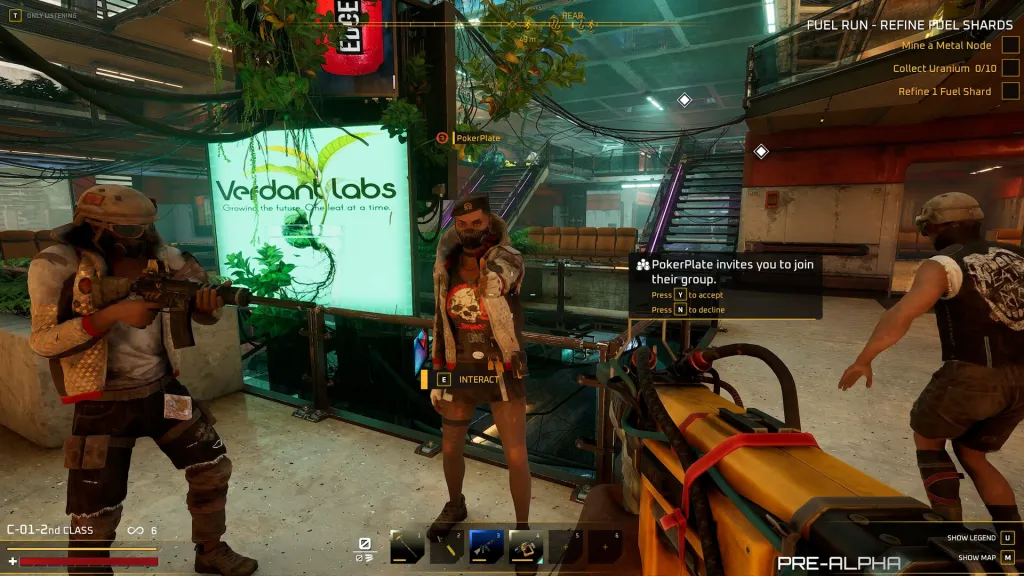
A typical Enginefall expedition begins from a Dagger Shuttle or an entry point near the rear of a Titan Train. Players arrive with limited equipment, search containers and resource dispensers, obtain materials, and begin crafting the tools needed to survive. Early objectives may include producing weapons, obtaining armor, establishing a respawn location, or building a compact base in a defensible carriage, while exploration gradually becomes more dangerous through hostile non-player characters, other Freerailers, locked sections, environmental hazards, and increasingly valuable resources.
Weapons and equipment matter, but progression also depends on schematics. In the June 2026 systems described by the developer, advanced equipment and structures require both the appropriate schematic and the necessary materials, and schematics can be discovered, traded, generated through research, or printed through progression systems aboard the Dagger.
Combat is only one part of the decision-making process, because players must continually decide what to carry, what to use, what to hide, and what to secure. A valuable component is not truly useful for long-term progression if its owner dies before protecting or extracting it. Enginefall provides more than one way to preserve rewards: players can return to an extraction point and call their Dagger, ending the expedition with the items they carry out, or they can use a Skyhook terminal in designated cargo areas to secure selected items during a raid.
A Skyhook extraction requires a defensive countdown, and nearby opponents can attempt to steal the deposit before collection, but once the Skyhook successfully retrieves those items, they are protected and can later be claimed from the player’s Dagger. This loop connects all three pillars: crafting makes deeper exploration possible, combat determines who controls valuable spaces, and extraction converts temporary success into persistent progress. Enginefall is therefore a hybrid, although the developer has characterized its core as closer to a PvP survival-crafting game than to a conventional extraction shooter.
It includes recognizable extraction mechanics, such as entering a dangerous session, collecting resources, risking carried equipment, and escaping with persistent rewards, but it also gives players opportunities to establish bases, create respawn points, research technology, share infrastructure, and influence a broader connected rail world. The game is not designed as a sequence of brief, self-contained matches in which every player has the same objective, and developers have compared the role of extraction to a structure that controls session length and supports progression while emphasizing the social and construction systems associated with games such as Rust. It is also not intended to be a last-player-standing battle royale.
One player might consider a raid successful after securing a rare schematic, another might build a base or gather enough fuel for Dagger upgrades, a solo player may extract after a profitable thirty-minute scavenging run, and an organized group may attempt to overthrow the Conductor. The most accurate description is a first-person PvPvE survival-crafting shooter organized through extraction-style expeditions.
PvPvE means that human players and computer-controlled threats occupy the same environment, so an expedition can involve fighting hostile inhabitants, avoiding environmental dangers, negotiating with strangers, defending a base, and competing with rival crews during the same journey. The PvE side prevents the train from becoming an empty arena, with hostile characters guarding important areas and actively hunting players during Titan Train raids.
The PvP side introduces uncertainty that scripted enemies cannot reproduce, since another crew can observe where a player is building, intercept an extraction, contest a resource dispenser, attack during an NPC encounter, or wait near a route leading to First Class. Players may cooperate, but nothing guarantees that an alliance will survive once valuable loot appears.
Titan Train raids are active environments rather than traditional matches assembled around a fixed group at a single starting time, and developer explanations indicate that participants may join a train already in progress and replace players who have departed. Enginefall also avoids indefinite offline raiding, as the developer has said the Dagger becomes non-raidable after the last member leaves, while attacks against occupied Daggers remain part of online play.
Titan Trains, Loot, Schematics, Skyhooks, and Base Building in Enginefall
Titan Trains are the foundation of Enginefall’s world. They are not ordinary locomotives enlarged for spectacle, but moving settlements with residential areas, industrial facilities, security systems, social divisions, and political leadership. Official lore describes them as the backbone of the surviving Grid and as cities organized by class.
The tail is the natural starting point for a raid, containing poorer spaces, improvised infrastructure, accessible materials, and opportunities for under-equipped players to establish themselves. Moving forward leads through more valuable and more heavily defended carriages, with official descriptions contrasting the toxic lower regions of Third Class with First Class gardens and elite areas near the front. This arrangement allows the train to function as an organic progression map: the rear supports scavenging and early crafting, middle sections create conflict over industrial resources, research opportunities, cargo, and defensible bases, and the front contains higher-tier rewards and the authority of the Conductor.
Reaching the command carriage is not simply a matter of walking through every door. The official Conductor guide describes a process involving access to Carriage C00, a crafted Breacher for locked doors, entry into the Control Room, and registration as the new Conductor. A successful Conductor gains access to major advantages, including the ability to craft high-tier weapons and armor, produce Fuel Cores, print a keycard, and communicate across the train. Titan Trains are also temporary in an important sense, as developer comments describe different train types remaining active for variable periods before a catastrophic Enginefall forces evacuation. That deadline prevents a single raid from continuing indefinitely and creates a final rush to escape.
Enginefall’s economy depends on the difference between finding an item and permanently securing it. A player may discover valuable materials, weapons, schematics, Fuel Cores, or components during a raid, but carrying them creates risk; the deeper that player advances, the greater the possible reward and the longer the route back to safety. Basic resources can be gathered from searchable containers and resource nodes, while some resource dispensers produce Mini-Nodes that must be physically broken with the correct tools, taking time and potentially revealing a player’s location. Schematics add another layer to the loot hierarchy, because having raw materials is not necessarily enough to produce advanced equipment.
A player may also need a weapon, armor, or building schematic, and schematics held in the character-bound cloud inventory can be accessed from active Base Cores and relevant crafting benches, making researched knowledge more persistent than unsecured physical cargo. The Skyhook creates a strategic compromise between continuing a raid and immediately leaving: a player can deposit selected valuables, activate the system, and defend the terminal until retrieval.
Rivals can interfere during the countdown, but a successful pickup makes the deposited items safe from death or theft. The system uses tokens associated with class registration, and official playtest information states that the Skyhook is disabled once the final Enginefall emergency begins.
Rewards then support persistent progression aboard the Dagger, including research, storage, construction, and future expeditions. Crafting is central rather than optional, as players use scavenged resources and schematics to create weapons, armor, tools, defensive structures, and facilities. Bases can be established inside Titan Train carriages, giving players storage, crafting access, and a location from which to recover after death. In a June 2026 playtest update, Red Rover described a Mini Base as a compact one-by-one structure containing a Base Core, a PIN-protected door, a crafting station, and a bedroll.
Players could expand its walls and maintain up to three bedroll-based respawn locations, with a fourth replacing the oldest. The system intentionally preserves physical risk, because there is no universal magical container that instantly transfers ordinary loot between distant bases. Equipment generally must be carried through the train, making relocation and resupply dangerous.
Base placement is likely to matter as much as base design, since a hidden room near the tail may be safer but far from valuable resources, while a fortified position in a central industrial carriage provides better access while attracting more attention. Crafting also connects raids to long-term Dagger progression, with research stations converting Data into schematics and Dagger technology systems using energy and fuel to unlock or print additional designs.

Solo Play, Co-Op, Death, Extraction, and Raid Pressure in Enginefall
Enginefall supports both solo entry and cooperative play, although the dangers of its world will affect those experiences differently. The official description states that players can begin at the tail alone or with friends, and Steam lists both online cooperative play and online PvP.
A solo player has fewer people to defend a base, watch multiple routes, carry supplies, recover momentum after an ambush, or protect a Skyhook deposit, so solo play may reward caution, mobility, concealment, and selective objectives.
A lone Freerailer does not need to conquer the entire train; securing a schematic or several valuable resources and extracting early can still produce meaningful progress. Groups can divide responsibilities, with one player gathering materials while another watches a corridor, and a crew can coordinate ranged fire, shields, close-range weapons, breaching tools, and construction. Groups are also better positioned to defend a Conductor attempt or survive a Dagger-to-Dagger boarding action.
During a May 2026 developer question-and-answer session, Red Rover said the current squad limit was three players, while as many as six people could share a Dagger Shuttle. The studio also noted that these numbers could change and that larger clan systems were being considered for future development, so those figures should be treated as the structure of the current development phase rather than final limits. Temporary cooperation with strangers further complicates the solo-versus-group distinction, since a solo player can negotiate an alliance inside a Titan Train without permanently joining another crew, although such agreements remain vulnerable to betrayal. Enginefall’s most compelling encounters are likely to occur when PvP and PvE pressures overlap.
Fighting an NPC in isolation is predictable, but fighting that same enemy while another player watches from an upper level changes the situation completely. Shooting may expose a position, injuries can encourage an ambush, and expended ammunition can make the next confrontation more difficult. Train architecture intensifies these interactions: narrow carriages limit flanking routes, but connected decks, ladders, maintenance spaces, rooftops, and grappling equipment can create alternative approaches. PvE threats also affect diplomacy, because two crews that would normally fight may cooperate against a heavily defended carriage, only to face a new conflict once the defenders are defeated and the loot must be divided.
The Conductor objective can reorganize an entire raid, since a successful player gains access to important crafting and production benefits, giving others a reason to challenge that control. Even players who do not intend to become Conductor may exploit the conflict by scavenging abandoned bases or extracting while powerful crews fight near the front. The final Enginefall event adds another shared pressure. When a Titan Train approaches catastrophic failure, all remaining players must reconsider their goals, and long-term territorial control becomes less valuable than escape. Old enemies may race for the same extraction point, while overloaded survivors must decide whether to abandon equipment to improve their chances of getting out.
Death in Enginefall is designed to be costly without automatically erasing every form of progression. Players can establish bedrolls or cots that operate as respawn locations during a Titan Train expedition, and the current Mini Base design supports multiple bedroll points, although the number is limited. Developer explanations also refer to limited respawns as one of the systems that gives each run a meaningful endpoint.
Unsecured equipment carried during the raid remains exposed to loss and theft, making the location of a respawn point important. Returning from a distant bedroll may give opponents enough time to take valuable supplies, occupy a base, or leave the area, and repeated deaths can exhaust a player’s ability to continue effectively. Certain forms of progression are safer: schematics stored in the character-bound cloud inventory remain accessible through active Base Cores and appropriate crafting stations, while items successfully collected through the Skyhook are protected and can be claimed later from the Dagger.
A conventional extraction requires reaching an extraction area and calling the Dagger Shuttle. Successfully leaving turns the resources and equipment carried out of the Titan Train into persistent assets that can support research, storage, Dagger construction, and later expeditions. Extraction is therefore not merely the end of a match, but the bridge between a temporary raid and long-term development.
Daggers, Player-Owned Trains, Combat Feel, Release Plans, and PC Requirements
The Dagger Shuttle is a smaller rail vehicle used by Freerailers to reach, leave, and operate around Titan Trains. Enginefall’s lore describes Daggers as former service or supply craft capable of traveling on a parallel shuttle gauge and docking with the larger trains, and stolen and modified Daggers become homes for players living outside the Titan Train class system.
In gameplay terms, the Dagger is a mobile progression hub that provides storage, research, crafting support, customization, and a place from which players can prepare for expeditions. Red Rover’s June 2026 development updates describe the Dagger as a shared crew base with communal functions and customizable construction space, while the studio’s roadmap identifies deeper Dagger progression and expanded Dagger battles as systems that will continue developing.
Daggers are not intended to be completely separate safe menus. When their occupants are online, player shuttles can encounter one another in Dagger-versus-Dagger combat, with crews able to grapple, board, and raid an enemy vessel.
The developer has said that an unoccupied Dagger becomes non-raidable after its final player leaves, preventing the persistent offline destruction common in some survival games. Long-term ambition extends beyond upgrading the Dagger, as official material describes a progression path toward a player-owned Marauder Train equipped with facilities such as workshops, bunk rooms, and gun decks. Some of these larger systems remain part of the development roadmap rather than the complete June 2026 test build, so their final scale and implementation may change.
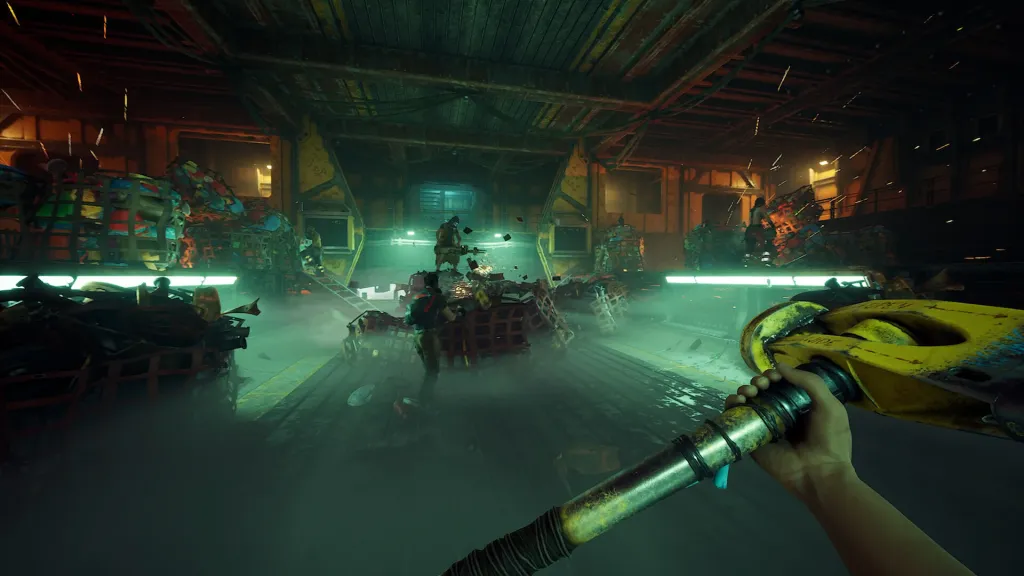
Enginefall’s first-person combat benefits from an unusually strong environmental concept, because firearms, melee weapons, explosives, grappling equipment, shields, and improvised tools all have potential uses inside confined train carriages. A long-range weapon may dominate an open upper deck but become awkward in a narrow room, a sledgehammer or shield can be valuable during close-quarters fighting, and a grappling device can provide access to high ground or an emergency escape route.
Official footage and updates have shown guns, bombs, heavy melee weapons, grappling equipment, and a Riot Shield capable of blocking bullets and melee attacks. Whether the gunplay is already good enough for a final recommendation is less certain because Enginefall remains in development. A PC Gamer hands-on report based on a 2025 pre-release build praised the potential of the train setting but found the shooting light and insufficiently responsive, while also reporting delayed melee feedback and technical issues such as hitching and unstable movement.
Those criticisms concerned an unfinished build and should not automatically be treated as a verdict on the eventual release. A separate June 2026 hands-on preview was considerably more positive about the overall loop, weapon variety, environmental threats, and extraction structure, suggesting that Enginefall’s concept is already appealing while moment-to-moment polish remains the area requiring careful evaluation.
Enginefall is officially planned for release in 2026, but Red Rover Interactive has not announced a specific launch date. During its May 2026 developer question-and-answer session, the studio said it was still considering the precise timing later in the year, and Steam continues to list the release window simply as 2026. As of June 18, 2026, Enginefall’s Steam Next Fest demo is scheduled to remain available through June 22. The current public build represents an early version of the Connected Rail World and includes Titan Train variations, early Dagger and character progression, Dagger bases, and Dagger-versus-Dagger activity.
The official roadmap includes more trains, carriages, weapons, items, construction pieces, social tools, factions, progression features, biomes, persistent Titan systems, and player-owned trains. The announced launch platform is PC, while Red Rover has said it is investigating console versions after launch, though PlayStation 5 and Xbox Series X|S editions have not been confirmed for a specific date.
Steam lists the preliminary minimum PC requirements as a 64-bit version of Windows 10, an Intel Core i7-8700K or AMD Ryzen 7 2700X processor, 16 GB of RAM, an NVIDIA GeForce GTX 1080 or AMD Radeon RX 5700 graphics card, DirectX 12, and a broadband internet connection, with an SSD strongly recommended. The preliminary recommended requirements are a 64-bit version of Windows 10, an Intel Core i7-10700 or AMD Ryzen 7 5800X processor, 32 GB of RAM, an NVIDIA GeForce RTX 3080 Ti or AMD Radeon RX 6900 XT graphics card, DirectX 12, broadband internet, and an SSD. Steam warns that these requirements are not final, and no definitive storage-capacity figure is currently provided.
Frequently Asked Questions (FAQs)
- Is Enginefall an official Snowpiercer game?
No. Enginefall has not been announced as a licensed Snowpiercer adaptation. The comparison comes from its similar use of a class-divided train, with deprivation near the tail and wealth and authority toward the front. Enginefall builds its own post-collapse setting, technology, factions, survival systems, and player-driven progression around that premise. - What type of game is Enginefall?
Enginefall is a first-person PvPvE survival-crafting shooter with extraction mechanics. Players raid Titan Trains, gather resources, craft equipment, build bases, fight NPCs and human opponents, and extract to a persistent Dagger Shuttle. The developer considers survival crafting and social PvP central to the experience rather than treating the game as a standard extraction shooter. - Is Enginefall PvP only?
No. Enginefall combines PvP and PvE. Human players can attack, cooperate, negotiate, or betray one another, while hostile NPCs and environmental dangers create additional pressure. The interaction between those threats is intended to make each raid unpredictable, especially when player conflict overlaps with defended train sections or extraction attempts. - Can Enginefall be played solo?
Yes. The official description says players can begin alone or with friends. Solo players will likely need to choose objectives carefully because they have fewer people to protect bases, defend extractions, carry supplies, and monitor multiple routes. Temporary cooperation with strangers may also help a solo player survive without joining a permanent group, though betrayal remains possible. - How many players can join an Enginefall squad?
During a May 2026 developer question-and-answer session, Red Rover said the current squad limit was three, while up to six players could share a Dagger Shuttle. The developer also warned that these numbers may change as testing continues, so they should not be considered permanent final-release limits. - What is the Dagger Shuttle in Enginefall?
The Dagger is a smaller rail craft that serves as a player or crew’s mobile home and progression hub. Players use it to reach Titan Trains, store selected resources, conduct research, customize facilities, prepare for expeditions, and extract from raids. Occupied Daggers can also participate in boarding and Dagger-versus-Dagger combat. - What is the Skyhook system?
The Skyhook allows players to secure selected loot without immediately ending a raid. A player deposits items at an eligible terminal and must defend the area during a countdown. Opponents can steal the deposit before collection, but successfully retrieved items become safe and can later be claimed aboard the Dagger. - What happens when a Titan Train reaches Enginefall?
Enginefall is the catastrophic end phase of a Titan Train’s active life. The event forces surviving players to evacuate rather than remain indefinitely. Train duration can vary, and the developer has said an Enginefall may also be triggered when population becomes too low. The Skyhook is disabled during this emergency, making final extraction more urgent. - Is Enginefall coming to PlayStation or Xbox?
Enginefall is currently announced for PC at launch. Red Rover has said it is investigating console releases after the PC version, but it has not confirmed a PlayStation 5 or Xbox Series X|S release date. For now, PC is the only confirmed launch platform. - When will Enginefall be released?
Enginefall is planned for 2026, but there is no exact release date as of June 18, 2026. The game remains in active development, and its Steam page warns that elements such as system requirements are still subject to change.
Conclusion
Snowpiercer’s Whole Shtick Makes For An Interesting Shooter, that’s what Enginefall feels like, and it makes for one of the more interesting shooters because every major mechanic supports the central idea of surviving aboard a class-divided moving city. The tail-to-First-Class journey creates a readable difficulty curve. Crafting gives players the tools to advance. PvPvE encounters make every carriage socially unpredictable. Extraction turns temporary victories into persistent progress, while the Dagger and planned player-owned trains provide long-term goals beyond a single raid.
Enginefall’s greatest strength is the way its setting connects systems that might otherwise feel unrelated. Base construction matters because space on the train is contested. Loot matters because it must be physically secured. The Conductor matters because the position provides real industrial and military benefits. The Enginefall disaster matters because no crew can occupy a Titan Train forever.
The game is still unfinished, and its final quality will depend heavily on combat responsiveness, server performance, balancing, AI, progression pacing, and the delivery of its wider roadmap. Even with those uncertainties, Enginefall already stands apart from the many shooters built around familiar military, zombie, or abandoned-city settings. By turning a Snowpiercer-like social train into a survival sandbox, it has found a premise capable of generating both mechanical tension and memorable player stories.
Sources and Citations
- Enginefall. Official Website. Titan Trains, Progression, Crafting, Multiplayer, Dagger Shuttles and Player Owned Trains.
https://www.enginefall.com/ - Steam. Enginefall Official Store Page. Release Window, Developer, Publisher, Multiplayer and PC Requirements.
https://store.steampowered.com/app/2653900/Enginefall/ - Red Rover Interactive. Official Enginefall News and Development Updates.
https://www.enginefall.com/news - Red Rover Interactive. Enginefall Steam Next Fest Demo and Connected Rail World Development Updates.
https://store.steampowered.com/news/app/2653900/ - Red Rover Interactive. Enginefall Developer Q&A. Squad Size, Daggers, Respawns, Platforms and Titan Trains.
https://www.enginefall.com/news - Steam Community. Enginefall Official Development Announcements. Skyhook, Schematics, Research, Bases and Defensive Equipment.
https://steamcommunity.com/app/2653900/allnews/ - Enginefall. Official Conductor Guide. Control Carriage, Restricted Doors, Conductor Progression and Extraction.
https://www.enginefall.com/news - PC Gamer. Enginefall Hands On Preview and Gameplay Impressions.
https://www.pcgamer.com/games/survival-crafting/enginefall/ - Insider Gaming. Enginefall Preview and Hands On Coverage.
https://insider-gaming.com/tag/enginefall/
Recommendations
- Exclusive Vehicles, Guns, and More: Everything in the GTA 6 Ultimate Edition
- 007 First Light Gameplay on Steam Machine: Performance, Features, and SteamOS Experience
- Samson: a Tyndalston Story New Game Might Scratch that GTA 6 Itch with Its Brutal Debt-Driven Open World Crime Gameplay
- The Best SSDs for PS5 in 2026: Top NVMe M.2 Picks That Meet Sony’s Requirements
- Aliens: Fireteam Elite 2 Announced, Release Date, 4-Player Co-Op, New Xenomorphs, and Everything We Know
- BAAI DisCo Repo-To-Skill Turns 1,000 GitHub Repos Into 5,000 AI Skills
- Sony INZONE M10S II Review: Latest 720Hz Gaming Monitor for Competitive Esports
- Psychedelic Games Secures $3.5M for Golden Tides, a Pirate-Themed “Adventure MOBA” With Open-Sea Combat and No Lanes
- Judas Game Development Update Explained
- What Are Speed Skills in Forza Horizon 6?



































































































