





In This Article (7 sections)
NVIDIA DLSS 4.5 Ray Reconstruction Launches at GeForce On
NVIDIA used its GeForce On presentation on August 25, 2026 to release DLSS 4.5 Ray Reconstruction, bringing the company’s second generation transformer architecture to the Ray Reconstruction component of its DLSS suite. The GeForce On Community Update was scheduled for 8 a.m. Pacific Time, 4 p.m. GMT and 5 p.m. CET as part of NVIDIA’s Gamescom 2026 coverage, with the presentation focused on upcoming RTX games and GeForce technologies. The release confirmed earlier expectations that NVIDIA could make DLSS 4.5 Ray Reconstruction available during the August 25 stream, with the company announcing that the new model could be accessed immediately through an NVIDIA App update.
The release was not a completely unannounced surprise. NVIDIA had already confirmed at Computex 2026 that DLSS 4.5 Ray Reconstruction would arrive in August, but it had not provided the August 25 release date well in advance. During GeForce On, NVIDIA revealed that users could begin accessing the technology immediately by opting into Early Access releases in the NVIDIA App, while a regular release was planned for September. NVIDIA described DLSS 4.5 Ray Reconstruction as the next major upgrade to the technology and said the new model improves ray traced and path traced image quality across GeForce RTX hardware.
The update completed a transition that had started earlier in 2026. DLSS 4.5 Super Resolution had already moved to NVIDIA’s second generation transformer technology, while Ray Reconstruction continued using its previous model. This meant that enabling Ray Reconstruction in supported games prevented the combined reconstruction pipeline from fully benefiting from the newest DLSS 4.5 Super Resolution architecture. Independent technical analysis from TechSpot found that the August update effectively closes that gap by moving Ray Reconstruction’s integrated upscaling and denoising process to the newer transformer architecture.
Ray Reconstruction handles one of the most difficult parts of modern ray traced rendering by rebuilding a stable, detailed image from the relatively limited number of rays that games can calculate in real time. DLSS 4.5 does more than simply sharpen that reconstructed image. NVIDIA says the updated model processes more parameters, offers greater compute capability, was trained using a larger dataset and has improved access to spatial, temporal and game engine information. Independent testing published around the Gamescom release also found substantial reductions in ghosting, boiling, smearing and unstable detail without a major performance penalty in most tested configurations.
The Gamescom timing also gave NVIDIA an opportunity to demonstrate the updated technology alongside existing titles and upcoming RTX releases. During the same presentation, the company highlighted games including 007 First Light, CONTROL Resonant and Gears of War: E-Day, alongside several other titles receiving DLSS, ray tracing or path tracing features.

DLSS 4.5 Ray Reconstruction Availability, RTX Support, Setup and Compatible Games
DLSS 4.5 Ray Reconstruction debuted on August 25, 2026, as an NVIDIA App-delivered override rather than requiring every supported game to receive an individual patch immediately. NVIDIA initially instructed users to open Settings, select About and opt into Early Access releases, with a standard NVIDIA App release planned for September. The company later included the feature in NVIDIA App 11.0.9, making it available through the normal application release channel. This delivery method allows compatible games to use newer NVIDIA-provided models without waiting for developers to rebuild and redistribute the entire game. The title still needs to support Ray Reconstruction and NVIDIA’s override mechanism, but the model itself can be updated through the application.
The technology supports every generation of GeForce RTX GPU, including RTX 20 Series cards based on Turing, RTX 30 Series based on Ampere, RTX 40 Series based on Ada Lovelace and RTX 50 Series based on Blackwell. This distinction matters because other technologies grouped under the DLSS branding can have stricter hardware requirements. Some frame generation features are limited to newer GPU generations, while an RTX 20 Series owner can still use the updated Ray Reconstruction model in a compatible game. However, support across all RTX generations does not guarantee the same practical experience on every graphics card. Path tracing remains extremely demanding, so older GPUs can struggle with the underlying workload even when Ray Reconstruction itself is supported.
To enable DLSS 4.5 Ray Reconstruction, update the NVIDIA App and install GeForce Game Ready Driver 580.88 WHQL or newer. The original August 25 release required the Early Access application build, while NVIDIA App 11.0.9 incorporated the feature into the normal release. After updating, open the Graphics section and select the supported game you want to configure, or use Global Settings to apply compatible overrides more broadly. Under Driver Settings, locate “DLSS Override – Model Presets” and change the control to Custom. Open the Ray Reconstruction setting, select Recommended or Preset F and choose Apply. Preset F corresponds to the new DLSS 4.5 Ray Reconstruction model in supported titles.
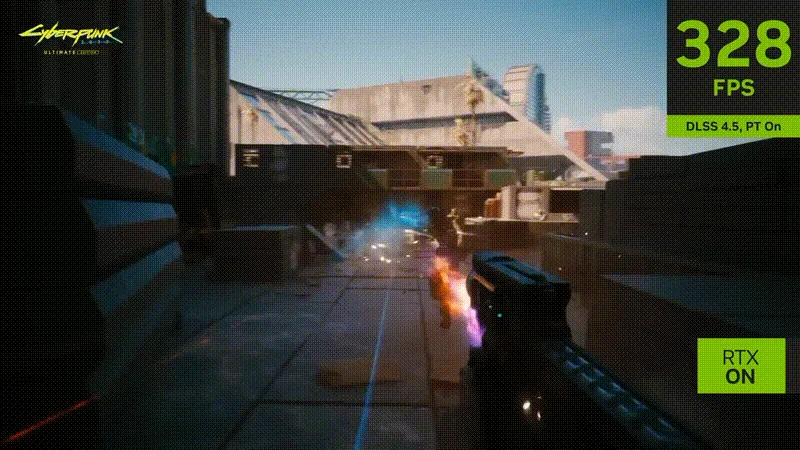
The game itself must still be configured to use the required ray-traced or path-traced effects because Ray Reconstruction does not independently enable path tracing. In Cyberpunk 2077, for example, the game’s graphics settings determine which ray tracing workload is rendered, while the NVIDIA App override determines which compatible reconstruction model is used. NVIDIA’s official App override is generally preferable to manually replacing DLL files or forcing unsupported configurations because NVIDIA validates titles included in the override system. Unofficial methods can sometimes function, but compatibility and image quality problems are less predictable.
At its August 25 Gamescom release, NVIDIA said the new Ray Reconstruction model could be applied to 30 games through the NVIDIA App. The supported titles were:
- Alan Wake 2
- EVERSPACE 2
- NTE (Neverness to Everness)
- Avatar: Frontiers of Pandora
- F1 25
- Portal with RTX
- Backrooms: Escape Together
- FBC: Firebreak
- PRAGMATA
- Call of Duty: Black Ops 7
- Half-Life 2 RTX
- Resident Evil Requiem
- Crimson Desert
- Hogwarts Legacy
- Samson
- Cyberpunk 2077
- I Am Jesus Christ
- Star Wars Outlaws
- Death Relives
- Incursion Red River
- Subliminal
- Directive 8020
- Indiana Jones and the Great Circle
- Sword of Justice
- DOOM: The Dark Ages
- Marvel’s Spider-Man 2
- The First Descendant
- Enlisted
- NARAKA: BLADEPOINT
- War Thunder
NVIDIA also said developers could integrate DLSS 4.5 Ray Reconstruction directly through game updates, so the NVIDIA App override list was never intended to represent the permanent limit of support. The technology has also been added to NVIDIA RTX Remix. On August 25, NVIDIA announced that RTX Remix modders could use the new model, allowing path-traced remasters and community projects to select Preset F through the Remix graphics controls. This broader deployment approach allows NVIDIA to improve reconstruction in existing games while developers integrate the same technology directly into future releases.

DLSS 4.5 Ray Reconstruction Model Changes, Image Quality and Performance
DLSS Ray Reconstruction is an AI-based neural rendering technology designed to replace multiple traditional hand-tuned denoisers used by ray-traced games. Real-time ray tracing and path tracing cannot normally cast enough rays per pixel to produce a completely clean image through brute-force rendering because doing so at modern resolutions and real-time frame rates would be prohibitively expensive on current gaming hardware. Games therefore calculate a limited number of ray samples and use denoising techniques to estimate what the completed lighting, reflections, shadows and indirect lighting should look like. Traditional denoisers can produce strong results, but reconstruction becomes more difficult when objects move, lighting changes rapidly or fine geometry crosses the frame.
NVIDIA’s approach replaces those separate denoisers with an AI network trained on NVIDIA supercomputers. The company says the system examines spatial information, temporal information, motion data and engine-provided pixel samples to determine how missing image information should be reconstructed. Ray Reconstruction and Super Resolution are integrated so reconstruction and upscaling can be handled together rather than operating as completely separate processes. The objective is not to increase the physical number of rays traced by the game, but to extract more accurate visual information from the ray samples and engine data already available.
The largest architectural change in DLSS 4.5 Ray Reconstruction is NVIDIA’s second-generation transformer model. NVIDIA says it provides 35 percent more compute capability while processing 20 percent more parameters than the previous Ray Reconstruction model, while still being designed to maintain broadly similar performance. It was also trained using a larger dataset, providing more examples of how high-quality images should be reconstructed. Transformer models can evaluate relationships between information across an image and through time, which matters because a reflection, shadow or indirect lighting effect cannot always be reconstructed correctly from one isolated pixel. Its appearance can depend on nearby geometry, lighting information, motion vectors and samples from previous frames.
NVIDIA describes the second-generation model as having deeper spatial awareness and making more intelligent use of engine sampling and motion information. Its goals include improved lighting accuracy, temporal stability and fine detail while the camera or objects are moving. DLSS 4.5 also gives developers more precise control over temporal accumulation, which combines information from multiple frames to improve reconstruction quality. Too little historical information can leave visible noise, while excessive reliance on previous frames can cause ghosting or trails. Finer controls allow developers to determine how aggressively the model retains earlier information and when that information should be discarded.
The architectural update also removes a limitation present earlier in 2026. TechSpot reported that Ray Reconstruction previously contained its own older upscaling component, preventing players from simultaneously receiving the complete image quality characteristics of DLSS 4.5 Super Resolution and Ray Reconstruction. With DLSS 4.5 Ray Reconstruction, the integrated upscaling portion now uses the newer transformer generation as well. DLSS 4 had improved on the original DLSS 3.5 implementation, but its Ray Reconstruction pipeline did not contain the same second-generation transformer technology introduced with DLSS 4.5 Super Resolution. The new version therefore updates both denoising and integrated reconstruction, bringing improved spatial awareness, revised temporal behavior, a larger training dataset and more sophisticated handling of game engine information.
NVIDIA’s main argument for DLSS 4.5 Ray Reconstruction is improved image quality rather than additional frames per second. A denoiser can make an image appear cleaner simply by smoothing uncertain information, but excessive smoothing removes fine detail along with noise. The challenge is distinguishing legitimate scene information from artifacts caused by insufficient ray samples. Independent testing suggests the new model is better at balancing those requirements, particularly on wet roads, polished floors, metal, glass and moving water, where reflections contain large amounts of high-frequency information. TechSpot found improved sharpness, foliage reconstruction, disocclusion handling and ray-traced reflections in several tested games, alongside substantial reductions in unstable boiling artifacts.
These improvements are often easier to notice in motion than in static screenshots. The previous model could produce a convincing image after several stable frames but become less reliable as the camera moved or lighting changed rapidly. DLSS 4.5 is designed to reach the correct reconstructed image more quickly while carrying less inaccurate historical information into subsequent frames. However, the improvement is not universal. ComputerBase found the new model generally better overall, while some individual scenes still favored the previous version for particular reflection or lighting details. Its assessment was that many of the largest improvements address specific problem areas rather than dramatically transforming every image. Occasional flicker, noise and reconstruction errors also remain in especially difficult scenes.
Reduced ghosting is one of the most visible benefits of the revised temporal behavior. Ghosting occurs when information from earlier frames remains visible after an object or camera moves, producing translucent trails behind characters, afterimages on reflective floors or residual lighting that takes too long to disappear.
TechSpot found that ghost trails visible in Alan Wake 2 with the earlier implementation were substantially reduced under DLSS 4.5, while boiling and unstable surfaces were also reduced in games including Marvel’s Spider-Man 2 and Crimson Desert. PC Gamer similarly reported improved stability in Cyberpunk 2077 and Alan Wake 2, with some Cyberpunk textures resolving more quickly after movement and an Alan Wake 2 character sequence showing a major reduction in trails. These artifacts were reduced rather than eliminated, so the update does not make every path-traced frame equivalent to a fully sampled offline render.
Reconstruction quality becomes increasingly important as games move from selected ray-traced effects toward broader path-traced rendering. Traditional ray tracing may use rays only for effects such as reflections or shadows, while path tracing attempts to model a much larger portion of scene illumination through ray interactions. That can provide more physically consistent lighting but dramatically increases the computational workload. Because developers still have a limited ray budget, path-traced games rely heavily on intelligent reconstruction, giving the denoiser considerable influence over the final image. Better reconstruction can make reflections appear higher resolution, improve shadow stability, preserve texture detail and allow lighting changes to settle more quickly without requiring games to trace substantially more rays.
NVIDIA highlighted several examples when announcing the technology. Indiana Jones and the Great Circle showed cleaner particle effects and reduced snow ghosting, PRAGMATA responded more quickly and accurately to changing laser illumination, and Alan Wake 2 preserved fine CRT television static with greater clarity and stability. These examples illustrate the problems an advanced temporal and spatial reconstruction model is intended to address, including rapidly changing lighting, particles, fine stochastic detail and high-frequency textures. The improvements concern how the available rendering information is interpreted, rather than removing the underlying cost of producing ray-traced lighting.
Cyberpunk 2077 and Alan Wake 2 are particularly useful demonstrations because both are established showcases for demanding ray tracing and path tracing. Cyberpunk combines complex urban lighting, reflective surfaces, neon illumination and rapid changes in scene brightness. Alongside PC Gamer’s findings on faster texture resolution, ComputerBase found that the new model handled rapidly changing reflected lighting more effectively in several scenes. However, it also documented cases where the previous version reproduced individual lighting details better, showing why reconstruction quality should be judged across multiple scenes rather than through a single screenshot.
Alan Wake 2 presents a different challenge, combining extensive path tracing with dark environments, moving characters and difficult indirect lighting. Beyond NVIDIA’s CRT television demonstration, independent testing found sharper imagery and significantly reduced ghost trails or boiling in some movement-heavy sequences. Neither game becomes artifact-free, but both expose reconstruction weaknesses aggressively, making them useful stress tests for the second-generation transformer model. Their results support a meaningful reduction in common Ray Reconstruction weaknesses rather than a claim of perfect reconstruction.
The performance results generally support NVIDIA’s goal of improving image quality without introducing a significant additional GPU cost. TechSpot benchmarked five games and reported that DLSS 4.5 Preset F was within roughly one frame per second of DLSS 4 Preset D in the large majority of its tests. It also found relatively small differences in the new model’s performance cost across newer and older RTX generations. On RTX 30 and RTX 20 hardware, the impact was much smaller than the penalties sometimes associated with DLSS 4.5 Super Resolution on those architectures, making Ray Reconstruction’s behavior an important distinction from the broader DLSS feature set.
Performance is not identical in every game or rendering mode. ComputerBase recorded a small difference in Hogwarts Legacy at 4K on an RTX 5090, where DLSS 4.5 Ray Reconstruction ran around two percent slower in average frame rate while producing essentially identical one percent low results. Cyberpunk 2077 also scaled differently depending on the selected DLSS quality setting.
TechSpot found that Preset F could be slightly faster than the older model in some higher-quality modes but somewhat slower in lower-resolution Performance modes. The broader result is that switching to DLSS 4.5 does not produce a consistent large frame-rate penalty. That should not be confused with the cost of path tracing itself, which remains demanding because the GPU must still generate the underlying ray information before reconstruction can improve the final image.

Frequently Asked Questions
- Is DLSS 4.5 Ray Reconstruction better than DLSS 4 Ray Reconstruction?
In most tested situations, yes. DLSS 4.5 generally delivers better temporal stability, sharper fine details, cleaner reflections and reduced ghosting while keeping performance close to the previous Ray Reconstruction model. However, improvements can vary between games and individual scenes, and some difficult visual elements can still produce artifacts. It is therefore a meaningful upgrade rather than a flawless solution to every reconstruction problem. - Did NVIDIA release DLSS 4.5 Ray Reconstruction on August 25, 2026?
Yes. NVIDIA announced during its Gamescom 2026 GeForce On update on August 25 that DLSS 4.5 Ray Reconstruction was available immediately. The first release arrived through an Early Access version of the NVIDIA App, allowing supported users to access the updated model without waiting for individual game patches. NVIDIA also said a regular NVIDIA App release would follow in September. - Was DLSS 4.5 Ray Reconstruction completely unannounced before the GeForce On stream?
No. NVIDIA had already revealed at Computex 2026 that DLSS 4.5 Ray Reconstruction was planned for an August release. What changed during the August 25 GeForce On event was that NVIDIA confirmed the new model was available that same day. This made the release feel like a same day drop, even though the underlying technology and its August launch window were already known. - What is Preset F in DLSS 4.5 Ray Reconstruction?
Preset F is the NVIDIA App model preset associated with the updated DLSS 4.5 Ray Reconstruction model. For compatible games, users can choose it through the DLSS Override Model Presets setting in the NVIDIA App. NVIDIA also provides a Recommended option, which can automatically choose the model it considers most suitable rather than requiring users to select Preset F manually. - Does DLSS 4.5 Ray Reconstruction work on RTX 20 Series graphics cards?
Yes. DLSS 4.5 Ray Reconstruction supports all GeForce RTX generations, meaning RTX 20, RTX 30, RTX 40 and RTX 50 Series graphics cards can use the technology in compatible games. This should not be confused with other DLSS features such as certain forms of Frame Generation, which can have stricter GPU generation requirements. - Does DLSS 4.5 Ray Reconstruction increase FPS?
Its main purpose is improving reconstructed image quality rather than generating additional frames. Independent testing found performance generally remained very close to the previous Ray Reconstruction model, with small differences depending on the game, scene and DLSS quality setting. Some situations can be slightly faster or slower, but testing has not shown a major or consistent performance penalty from using the newer model. - Does DLSS 4.5 Ray Reconstruction remove ghosting completely?
No. DLSS 4.5 can noticeably reduce ghosting, boiling and other temporal artifacts, particularly when objects, lighting or reflections are changing between frames. However, demanding ray traced and path traced scenes can still expose residual artifacts. Testing from PC Gamer and TechSpot showed meaningful improvements, but neither indicated that ghosting or temporal reconstruction problems had been eliminated entirely. - Does Cyberpunk 2077 support DLSS 4.5 Ray Reconstruction?
Yes. Cyberpunk 2077 was included among the games NVIDIA listed as compatible with the updated Ray Reconstruction model through the NVIDIA App. Independent testing found improvements in areas such as temporal stability, lighting reconstruction and the speed at which certain texture and scene details become clear. These improvements can be especially noticeable in demanding ray traced and path traced scenes. - Does Alan Wake 2 support DLSS 4.5 Ray Reconstruction?
Yes. Alan Wake 2 was one of NVIDIA’s main demonstrations for DLSS 4.5 Ray Reconstruction. NVIDIA specifically highlighted improvements to difficult effects such as CRT static, while independent testing reported sharper reconstruction and reductions in ghosting and boiling in several scenes. The game therefore serves as one of the clearer examples of the new model’s image quality improvements. - When does 007 First Light get DLSS 4.5 Ray Reconstruction?
NVIDIA and IO Interactive announced that the 007 First Light update featuring path tracing and DLSS 4.5 Ray Reconstruction will release on September 15, 2026. The update is intended to bring the newer reconstruction model alongside the game’s path tracing features, giving supported RTX users access to the improved image reconstruction technology.

Conclusion
NVIDIA GeForce On on August 25, 2026 delivered the release that had been anticipated since Computex: DLSS 4.5 Ray Reconstruction. Although NVIDIA had already confirmed that the technology was coming in August, the company used its Gamescom 2026 presentation to make the second-generation transformer model immediately available through the NVIDIA App, effectively turning the GeForce On broadcast into the launch moment.
The most important advancement is not a new frame-generation multiplier or a dramatic increase in raw FPS. DLSS 4.5 Ray Reconstruction targets the quality and stability of the ray-traced image itself. NVIDIA’s second-generation transformer processes more parameters, uses an expanded training dataset, improves spatial and temporal analysis, and gives developers better control over temporal accumulation while remaining available across every generation of GeForce RTX graphics hardware.
Independent testing broadly supports NVIDIA’s central claims. Cyberpunk 2077, Alan Wake 2, Hogwarts Legacy and other demanding titles show improvements in ghosting, surface stability, reflection detail, lighting response and image sharpness. The gains vary by game and scene, and path tracing still produces difficult reconstruction problems, but DLSS 4.5 generally improves image quality without introducing a significant performance penalty compared with the preceding Ray Reconstruction model.
The launch also demonstrated why the NVIDIA App has become increasingly important to DLSS deployment. Rather than forcing players to wait for individual game patches, NVIDIA can distribute validated model upgrades through DLSS Overrides for supported titles. Approximately 30 games were compatible through the app at the August 25 release, with developer-integrated support expected to expand further.
007 First Light provides the next major example. Its September 15, 2026 PC update is scheduled to add path tracing together with DLSS 4.5 Ray Reconstruction, showing how NVIDIA intends the technology to support increasingly complex real-time lighting workloads.
The NVIDIA On stream August 25 2026 may shadowdrop DLSS 4.5 with Ray Reconstruction speculation therefore ended with a confirmed release. More accurately, NVIDIA did not surprise-announce the existence of DLSS 4.5 Ray Reconstruction; it shadowdropped its availability after previously promising an August launch. For GeForce RTX players using ray tracing or path tracing, the result is a broadly compatible reconstruction upgrade focused on clearer motion, reduced ghosting and more stable lighting rather than simply another method of generating additional frames.
Sources and Citation
- NVIDIA, Andrew Burnes, official Ray Reconstruction release announcement: Published August 25, 2026. Confirms the second-generation transformer model, NVIDIA’s claims of 35% more compute capability and 20% more processed parameters, and the 30-game NVIDIA App compatibility list. It provides installation instructions and explains selecting Recommended or Preset F through the Ray Reconstruction override. The initial release used the App’s Early Access channel, with a standard release announced for September. The percentage figures describe the model, not a promised 35% increase in gaming frame rates. (NVIDIA)
Citation: DLSS 4.5 Ray Reconstruction Available Now: Gamescom Release Details and Supported Games - NVIDIA, Andrew Burnes, official Gamescom roundup: Published August 25, 2026. Places the Ray Reconstruction release within NVIDIA’s broader Gamescom announcements, including 007 First Light’s September 15 path-tracing and DLSS 4.5 Ray Reconstruction update, CONTROL Resonant’s path-tracing presentation, Gears of War: E-Day’s RTX Mega Geometry integration, and RTX Remix improvements. This is the appropriate companion reference for the Gamescom announcements, rather than treating every announced game integration as immediately available on August 25. (NVIDIA)
Citation: DLSS 4.5 Ray Reconstruction Released: NVIDIA’s Gamescom 2026 Announcements - NVIDIA, Andrew Burnes and Henry Lin, official Computex announcement: Published May 31, 2026. Establishes that DLSS 4.5 Ray Reconstruction had already been announced before Gamescom and was scheduled for August. It introduces the revised model and planned NVIDIA App distribution, supporting the distinction between the earlier technology announcement and its August release. The Computex article listed 27 compatible games at that stage, while the August 25 release article subsequently listed 30. (NVIDIA)
Citation: DLSS 4.5 Ray Reconstruction Announced; Over 1000 RTX Games & Apps Available Now - NVIDIA, official App 11.0.9 release highlights: The “What’s New in NVIDIA App 11.0.9” section explicitly lists DLSS 4.5 Ray Reconstruction support for GeForce RTX GPUs. It documents activation through Graphics → Program Settings → Driver Settings → DLSS Override – Model Presets → Recommended. This verifies the application-version support and the documented controls. The page is a rolling release-history reference and does not supply a clear publication date for that individual section. (NVIDIA)
Citation: NVIDIA App Updates and Release Highlights: Version 11.0.9 - IO Interactive, official 007 First Light Steam announcements: “Path Tracing is On The Way!”, dated August 26, 2026, announces the September 15 update. The follow-up, “Together with NVIDIA, Path Tracing is Live!”, dated September 15, confirms its release. Both are readable in the game’s official Steam Community news feed. These establish the developer’s path-tracing timetable, while NVIDIA’s Gamescom announcement explicitly confirms DLSS 4.5 Ray Reconstruction as part of the same update. The link below points to the official feed containing the posts, not an individual article permalink. (Steam Community)
Citation: 007 First Light: Official Steam Announcements and Path-Tracing Update Posts - TechSpot, Tim Schiesser, independent image-quality and performance testing: Published August 26, 2026. Examines reconstructed detail, ghosting, boiling artifacts, lighting stability, and performance across multiple games. Its benchmarks found the new and previous Ray Reconstruction models generally performing within approximately one frame per second, with additional checks on older RTX hardware. The review reports substantial visual improvements but also discusses remaining weaknesses, including occasional excessive sharpening and reduced effectiveness at very low internal rendering resolutions. These are comparisons between Ray Reconstruction models, not evidence that enabling path tracing itself carries no performance cost. (TechSpot)
Citation: The Best DLSS 4.5 Update Yet: Ray Reconstruction - PC Gamer, Dave James, firsthand visual analysis: Published August 25, 2026. Compares scenes in Resident Evil Requiem, Cyberpunk 2077, and Alan Wake 2, finding improvements in temporal stability, detail recovery, and distracting trails or surface noise. It also identifies remaining artifacts, including problems around a moving character’s feet in Alan Wake 2. This supports describing the update as an image-quality improvement without claiming that path-traced rendering is now free of reconstruction errors. (PC Gamer)
Citation: DLSS 4.5 Ray Reconstruction is a definite improvement but path traced fidelity is still not a 100% solved issue - ComputerBase, Wolfgang Andermahr, independent multi-game testing: Published August 25, 2026. Tests image quality and performance across five games, providing a more restrained assessment than TechSpot’s review. Its conclusion describes modest, scene-dependent improvements, occasional regressions, and situations where additional recovered detail can introduce more shimmering. Performance remained practically similar, with declines of no more than 3% in the tested games. This is particularly useful for qualifying claims that every scene improves equally or that the update eliminates all visual artifacts. (ComputerBase)
Citation: DLSS 4.5 Ray Reconstruction im Test: Die Grafikqualität macht einen Sprung nach vorne
Citation: ComputerBase: Image-Quality and Performance Conclusions
Recommendations
- How to Get the Kokiri Sword and Deku Shield in Kokiri Forest in Zelda Ocarina of Time
- 99 Nights in the Forest Film Confirmed: Everything We Know About the 20th Century Studios Movie
- Original Sonic Games Return on New Sega Genesis Cartridges for $100 Each
- Schneider Electric Buying Cognite for $3.1B: What it Means for Industrial AI
- Grow Garden 2 Gear Guide: How to Get and Use All Gear
- Epic Games Acquires Meshcapade: What the Deal Means for Fortnite, Unreal Engine, and MetaHuman
- Terra Invicta: Dark Skies Official DLC Release Date Trailer Reveals New Scenarios and Launch Details
- Darkest Dungeon Dev Says They’ll Never AI-Clone Wayne June’s Iconic Narrator Voice: What Red Hook Said, Why it Matters, and What Comes Next
- PlayStation Pricing Is On Trial Again: Why Sony Is Fighting to Keep 30‑Percent PlayStation Store Fees
- Do You Need Nintendo Switch Online To Play Pokemon Champions? 2026 Answer and What You Actually Need



































































































