








In This Article (8 sections)
DreamX Architecture, Universal Latent Actions, and 300× Video Token Compression
DreamX is a framework for learning reusable action representations from video, introduced in a November 3, 2026 research paper by researchers affiliated with KAIST and NVIDIA. Its central idea is to extract compact latent actions that describe how a scene changes over time without immediately tying those changes to the commands of one specific robot. The representation is intended to bridge human demonstrations, robot movements, and different visual environments while reducing dependence on appearance and embodiment.
That makes DreamX relevant to a long-standing robotics problem: useful human demonstrations are abundant, but they rarely come with the joint commands and control labels required for direct robot supervision. A shared latent action space provides an intermediate representation that can connect observation, representation learning, and physical control.
The word “universal” refers to the intended transferability of those latent actions across embodiments, scenes, and action formats. It should not be read as evidence that DreamX can represent every possible behavior or control every robot without adaptation. The paper instead presents several forms of evidence showing that the same learned representation can support action classification, robot trajectory recovery, video transfer, human-to-robot motion transfer, and downstream robot policy learning. These uses test different properties of the representation. Recognizing an action, reproducing its motion structure, and converting it into executable robot commands are related but distinct problems.
DreamX builds on Cosmos-Predict2.5 2B, a pretrained video diffusion transformer. The researchers use knowledge already learned by that video model about objects, scenes, and temporal change rather than learning every aspect of motion from the demonstration datasets alone. DreamX uses the backbone in two complementary ways: an encoder extracts latent actions from observed video, while a decoder reconstructs future video conditioned on those actions and an initial frame. Separate rank-16 LoRA modules are used for the encoder and decoder, while the pretrained backbone weights remain frozen during adaptation. The reported setup uses 480 × 640 video and 78,000 training steps.
The pretraining data contains roughly 2,190 hours of human and robot video drawn from six datasets. Human demonstrations account for 469 hours, while robot footage includes sources such as Bridge, DROID, AgiBot, and a bimanual YAM dataset. Human clips can contribute through the video reconstruction objective even when robot action labels are unavailable. Robot demonstrations provide additional action supervision where those labels exist. This lets the system use large amounts of visual motion data without requiring every human clip to be paired with an equivalent robot trajectory.
A latent action is a learned numerical representation rather than a natural-language command or direct motor instruction. It can encode aspects of direction, temporal order, contact, and object movement while attempting to avoid unnecessary dependence on features such as clothing, background texture, or robot appearance. The usefulness of the representation is judged by what other parts of the system can recover from it. DreamX tests whether latent actions support high-level classification, robot end-effector prediction, video generation, and physical control. This makes the representation a reusable interface between visual observation and several downstream outputs.
The headline compression comes from DreamX’s use of learnable query tokens. Four query tokens are assigned to each latent video frame and interact with the video backbone’s internal features through attention. Their outputs become the latent action representation for that frame. The paper compares those four action tokens with 1,200 spatial video tokens associated with the same latent frame, producing a reported 300× reduction in token count. Expressed another way, the latent action representation uses about 0.33% as many tokens as the compared video representation at that stage.
The four tokens should not be confused with four scalar values or four discrete action labels. Each token is a multidimensional learned vector with substantial representational capacity. A latent video frame is also an internal autoencoder representation rather than every raw frame in the original recording. The paper states that clips containing five to 29 original frames correspond to two to eight latent frames, meaning one clip can produce as many as 32 latent action tokens. The method therefore compresses motion information at the representation level rather than reducing an entire video to four numbers.
The 300× figure is specifically a token-count comparison, not a claim that a video file becomes 300 times smaller or that training and inference become 300 times faster. The decoder still receives an initial frame, and the pretrained model already contains substantial knowledge about appearance and plausible visual structure. Much of the information required to reconstruct the scene therefore exists outside the four action tokens. The practical value of the compression is that downstream models can predict a much smaller action representation instead of synthesizing full future video. Actual runtime improvements must be measured separately in the complete policy.
Appearance-Invariant Motion, Cross-Embodiment Transfer, and Any-to-Any Video Generation
DreamX attempts to separate motion from appearance by giving the decoder different sources for those two kinds of information. The initial frame supplies the visual context of the target scene, while the latent actions provide information about how that scene should change. During reconstruction, the latent action representation replaces text conditioning, encouraging the compact tokens to focus on dynamics rather than duplicating visual details that are already available from the starting image. The pretrained video model also contributes its existing knowledge about how realistic scenes evolve. This arrangement encourages appearance invariance without mathematically guaranteeing that appearance information is removed completely.
The researchers test that interpretation by changing the latent actions while keeping the initial frame and sampling noise fixed. Perturbing the actions disrupts the reconstructed manipulation, while replacing them with zeros largely suppresses motion. The surrounding visual scene remains comparatively stable. Attention visualizations also show query tokens concentrating on moving hands and robot grippers involved in interactions. These results support the idea that the learned tokens capture action-relevant information, although transfer results and quantitative benchmarks provide stronger evidence than visualization alone.
Appearance invariance matters because a robot-learning system becomes less reusable when incidental visual details become tightly entangled with the action. A movement demonstrated on one tabletop can become difficult to transfer if the model treats lighting, robot color, background texture, or the demonstrator’s clothing as essential features. A useful latent representation should preserve movement structure while allowing those details to change. At the same time, not all environmental information should disappear. Object location, geometry, contact conditions, and reachability can determine whether the same motion is physically possible.
DreamX uses that shared representation to connect human and robot demonstrations. Human footage usually lacks machine-readable joint commands, while robot data can include joint positions, gripper commands, and other hardware-specific measurements. Both types of video contribute to reconstruction training, while an auxiliary action branch learns robot control outputs where labels are available. The shared latent space therefore becomes the common interface rather than a universal joint-command format. A downstream decoder can interpret the same motion representation according to the state and action space of a particular robot.
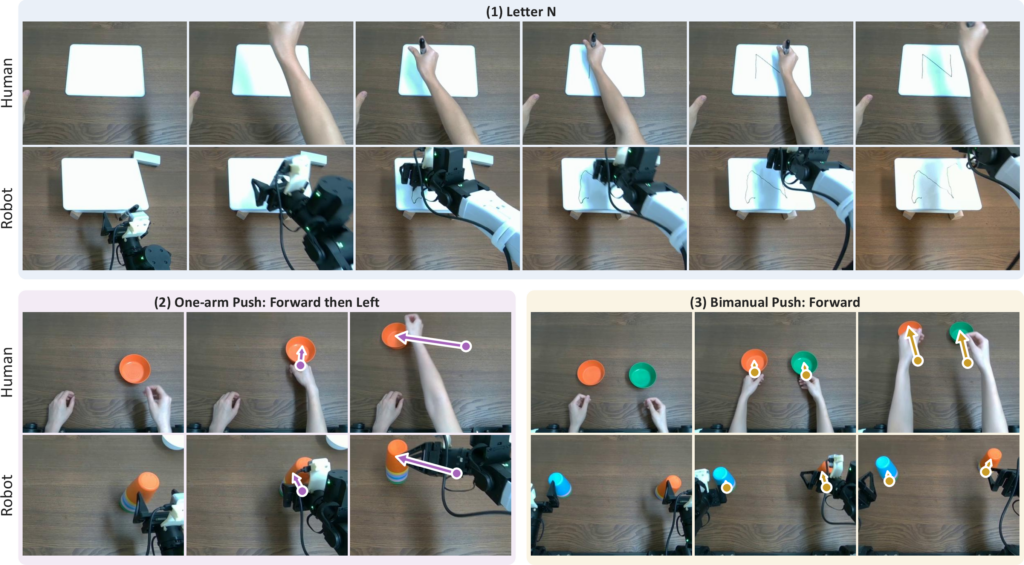
Cross-embodiment transfer is demonstrated physically using human source videos and a bimanual YAM robot. The system extracts latent actions from a human demonstration and decodes them into robot commands using the robot’s initial proprioceptive state. Reported examples include reproducing the stroke structure of the letter “N,” following a forward-then-left pushing sequence, and transferring coordinated bimanual movements to corresponding robot arms. The physical robot uses a 14-dimensional action space consisting of six joint positions and one gripper command for each arm. These experiments demonstrate that human-observed motion can be converted into executable robot trajectories under the evaluated conditions.
The physical demonstrations remain open-loop, meaning the robot does not use visual feedback to correct the trajectory during execution. This is an important limitation because real manipulation can diverge from the demonstration when objects shift, contact occurs unexpectedly, or friction differs. The results establish that movement structure can transfer into robot commands in the tested examples. They do not establish robust closed-loop correction in changing physical conditions. Feedback-based execution remains a separate challenge.
DreamX also evaluates transfer entirely in video space. The encoder extracts actions from a source demonstration, while the decoder receives an initial frame from a different target environment. The generated continuation is expected to preserve the target actor and scene while following the motion of the source. The paper shows examples involving the same robot across environments, different robot embodiments, human-to-robot transfer, and a broader example using DAVIS footage. The procedure therefore separates the source of motion from the source of visual appearance.
The paper describes this flexibility as “any-to-any video transfer.” The workflow is consistent across examples: encode the source video into latent actions, provide a target initial image, and generate a new sequence. The phrase should be understood as describing the framework and the demonstrated transfer combinations rather than guaranteeing success for every arbitrary source and target pair. Large differences in geometry, movement scale, visibility, and physical feasibility remain relevant. A generated video can also look plausible without proving that the same movement could be executed successfully by a physical robot.
Zero-shot transfer has a similarly specific meaning in the paper. It refers to applying the learned representation to a new source-target pairing without additional training for that particular pairing. DreamX itself has already undergone substantial pretraining and adaptation, and its broader training includes robot demonstrations. In the HumanAndRobot quantitative evaluation, the system receives a human source video and the initial frame from its paired robot recording, while the remaining robot frames are used only as evaluation references. They are not paired training targets for that specific correspondence.
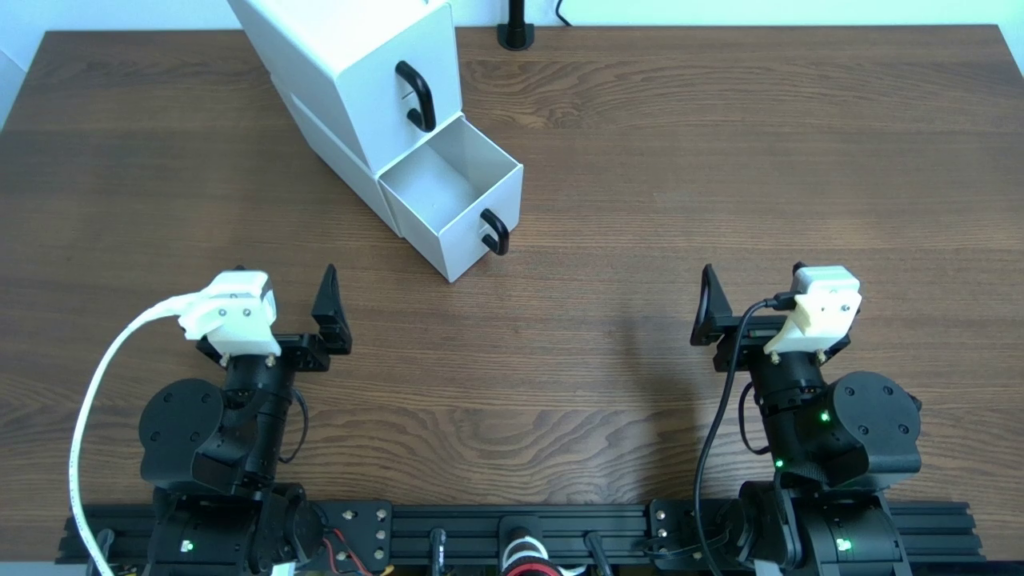
On the 1,008 HumanAndRobot clips spanning 21 tasks, DreamX reports an FVD of 57.44, LPIPS of 0.179, PSNR of 26.52, and SSIM of 0.917. It outperforms AdaWorld and VideoWorld2 on all four reported metrics in that comparison. These results measure generated video quality and similarity, not physical task-completion rates. The physical transfer demonstrations provide a separate form of evidence, while the downstream drawer-closing policy is trained specifically for its task. Keeping these experimental tracks separate prevents the zero-shot result from being interpreted as a claim that the entire robotics system operates without prior robot data or task learning.
LARY-Bench Results, Compact Robot Policies, and the 19.1× Inference Speedup
DreamX evaluates its latent action representation on LARY-Bench, which tests whether visual representations retain information useful for both high-level action understanding and low-level robot control. The broader benchmark contains more than one million videos and 151 action categories. In DreamX’s reported comparison with latent action baselines, average normalized action regression error improves from DiLA’s 0.38 to 0.17. Average action classification accuracy rises from 62.25% to 69.67%, a gain of 7.42 percentage points. The results suggest that the compact action representation retains useful information about both semantic action identity and detailed robot movement.
The reported regression scores are 0.15 on CALVIN, 0.05 on VLABench, 0.26 on RoboCOIN, and 0.22 on AgiBotWorld-Beta. The representation models are frozen during evaluation, and a common attentive probe is trained on top. For video-based models, intervening frames are recovered from the source datasets using benchmark metadata. The resulting numbers therefore measure the usefulness of the frozen representation under that specific evaluation protocol. They should not be interpreted as autonomous robot task-completion rates.
DreamX also tests a compressed FAE-32 variant. The full latent action token initially has 2,048 feature dimensions, and a learned variational bottleneck reduces each token to 32 dimensions while preserving the same token layout. For a 32-token input, the representation changes from 32 × 2,048 features to 32 × 32 compact codes. This feature-width compression is distinct from the earlier reduction from 1,200 video tokens to four action tokens per latent frame. The two stages therefore reduce different aspects of the representation.
Despite the additional compression, FAE-32 remains competitive in the reported benchmark. It achieves an average regression error of 0.22 and classification accuracy of 67.15%. Those results are weaker than the uncompressed DreamX representation but still outperform the other latent action baselines included in the paper’s comparison. The result suggests that much of the useful action information survives substantial compression. The state-of-the-art claim should remain limited to the compared latent action models rather than being generalized to every representation on LARY’s broader leaderboard.
The downstream policy experiment shows why the compact codes may be useful operationally. Instead of predicting full future video during control, the DreamX policy predicts latent action codes from the current observation and instruction. A separate diffusion transformer action head then generates low-level robot actions. Human videos can supervise latent-code prediction, while robot demonstrations provide additional supervision for physical commands. This structure allows human demonstrations to contribute to policy learning without requiring every human clip to contain robot action labels.
In the drawer-closing experiment, DreamX reports an inference latency of 1,474 milliseconds per policy call. Mimic-Video requires 28,226 milliseconds under the reported comparison, giving DreamX a 19.1× speed advantage. This result is separate from the 300× token-count compression and should not be conflated with it. The 300× figure describes representation size at one stage, while 19.1× is an observed end-to-end policy inference comparison in a particular task. The difference shows why token compression and measured runtime need to be reported independently.
DreamX also reports an average subgoal success rate of 96.7% in the drawer-closing study, compared with 50.0% for the baseline. The score averages reaching and pushing completion across three drawer configurations. The study uses 45 training trajectories and ten evaluation trials per configuration. Those numbers make the result meaningful within the experiment but not a general reliability rate for robotics. Performance on one manipulation task cannot establish how the same policy would behave across unrelated tasks, hardware, or environmental conditions.
The reported 1.47-second policy latency should also be interpreted in context. It is substantially faster than the Mimic-Video baseline, but a single latency figure does not determine whether the system meets the control-frequency requirements of every robot. Different tasks may require much faster feedback, while slower manipulation can tolerate longer planning intervals. The compact latent representation creates an opportunity to reduce computation, but deployment suitability depends on the complete control loop. Efficiency gains should therefore remain tied to the hardware, policy architecture, and task under which they were measured.

DreamX Limitations, Physical Robot Evidence, and Future Robotics Applications
DreamX presents evidence across representation learning, generated video transfer, physical robot trajectories, and downstream policy learning, but each experiment has a defined scope. The physical transfer demonstrations focus on writing, pushing, and coordinated bimanual movements using one YAM robot platform. The downstream real-world policy study focuses on drawer closing with 45 training trajectories and ten trials for each of three test configurations. These experiments establish that the approach works in several controlled settings. They do not show that the same representation can immediately solve arbitrary manipulation tasks or operate unchanged across every robot.
The open-loop nature of the physical action-transfer demonstrations is one of the clearest limitations. The robot executes decoded trajectories without using visual feedback to correct itself after unexpected changes. A trajectory can preserve the structure of a human demonstration yet still fail when an object shifts, a gripper contacts the surface differently, or the environment does not exactly match the expected geometry. Closed-loop control would require continuously incorporating new observations and adjusting the plan. The reported experiments do not establish that capability.
Video itself also leaves some physical information ambiguous. Visible movement does not uniquely determine force, friction, hidden contact, object weight, or every constraint relevant to manipulation. Two motions can look similar on camera while requiring different force profiles or contact strategies. DreamX’s representation captures useful visual dynamics, but the reported demonstrations do not show that it resolves every physical ambiguity inherent in video-only observation. Richer sensing and feedback could therefore become important for extending the approach beyond visually predictable tasks.
The transfer experiments also distinguish visual plausibility from executable control. A decoder can generate a convincing video in which motion appears to fit a new robot or environment, but that does not prove that the trajectory respects the real hardware’s limits or succeeds when executed. Physical policies need to account for embodiment-specific state, workspace constraints, contact, and dynamics. DreamX addresses this by using robot-specific decoders and action supervision, but broader hardware evaluation would be needed to establish how reusable the latent representation remains across substantially different platforms.
Potential applications include learning reusable movement representations from large collections of human demonstrations, combining supervision across otherwise incompatible robot datasets, and reducing the computational cost of policies that would otherwise need to predict full future video. The framework could also make human video more useful as a training signal by giving policies a compact intermediate target before low-level robot commands are produced. These possibilities follow directly from the design and experimental results. They should still be understood as research directions rather than established deployment outcomes.
The compact representation may be particularly valuable when future-video prediction is more expensive than the control task requires. Predicting every visual detail of an entire scene can consume substantial computation even when the policy mainly needs information about motion and interaction. DreamX suggests that some of this burden can be shifted into a smaller action space while the pretrained model retains broader visual knowledge. The 19.1× inference comparison provides one concrete example of that potential. Wider testing would be needed to determine how consistently the efficiency advantage carries across tasks.
Independent reproduction will also be important. As of November 4, 2026, the official project page lists the code release as forthcoming. Public code would allow other researchers to verify the reported compression, reproduce the benchmark protocol, test additional embodiments, and examine failure cases under different camera views or physical conditions. It would also make it easier to determine how sensitive the representation is to the selected video backbone, datasets, LoRA configuration, and bottleneck size. These questions will help establish whether the method’s advantages are specific to the reported configuration or more broadly transferable.
The strongest interpretation of DreamX is therefore not that four tokens can universally control robots, but that a pretrained video model can be repurposed to produce a compact intermediate representation with useful action structure. The paper shows that those representations can support recognition, video transfer, human-to-robot trajectory generation, and a more efficient downstream policy under the tested conditions. Its remaining challenges concern feedback, physical ambiguity, broader hardware generalization, and reproducibility. Addressing those areas will determine how far universal latent action learning can move from an effective research representation toward a practical foundation for robot learning.
Frequently Asked Questions (FAQs)
- What is DreamX?
DreamX is a research framework for learning compact action representations from video using a pretrained video diffusion model. Instead of converting every observed movement directly into commands for one specific robot, it first encodes the motion into latent actions that can be reused across different settings. Those representations are evaluated for action understanding, video motion transfer, human-to-robot movement transfer, and downstream robot policy learning. The goal is to capture movement structure in a form that is less tied to the appearance of the actor or scene. DreamX is therefore best understood as an intermediate action representation system rather than a complete general-purpose robot controller. - Who developed DreamX?
The DreamX paper lists Jisoo Kim, Chaehyun Kim, Junsu Kim, Jiho Park, Seongchan Kim, Eunbeen Hong, Soowon Son, Fu-En Yang, and Seungryong Kim as authors. The institutional affiliations given in the paper are KAIST and NVIDIA. The first arXiv version was submitted on November 3, 2026. The work combines video representation learning, generative modeling, and robotics experiments. Those affiliations and publication details describe the research team behind the reported results rather than a commercial product release. - Does DreamX compress an entire video into four tokens?
No. DreamX uses four latent action tokens for each latent video frame, not four tokens for the entire source video. The reported training clips can contain between two and eight latent frames, meaning a clip can produce as many as 32 latent action tokens. These tokens summarize action-relevant information rather than storing every pixel, texture, background detail, or appearance feature from the recording. The initial frame and the pretrained video model provide additional visual information during reconstruction. The four-token figure should therefore be understood as per-latent-frame action compression. - Does 300× compression mean 300× faster inference?
No. The 300× figure compares 1,200 video tokens with four latent action tokens at a particular stage of the representation. It is a token-count reduction, not a direct measurement of total runtime, memory use, or end-to-end computational cost. DreamX reports a separate downstream inference comparison in which its policy runs 19.1 times faster than Mimic-Video in the tested drawer-closing setup. Reported latency falls from 28,226 milliseconds to 1,474 milliseconds per policy call. These are two different results and should not be treated as interchangeable. - Which video model does DreamX use?
DreamX uses Cosmos-Predict2.5 2B as its pretrained video diffusion backbone. The framework adds separate rank-16 LoRA modules for the encoder and decoder while keeping the original pretrained backbone weights frozen during latent action pretraining. The encoder extracts compact action information from observed video, while the decoder uses those actions with an initial frame to reconstruct or generate future video. This setup allows DreamX to reuse temporal knowledge already present in the video model. It also means the framework is adapting an existing model rather than training the full video backbone from scratch. - Does DreamX need paired human and robot demonstrations?
No, the reported training method does not require a matched human demonstration and robot demonstration for every example. Human and robot footage can come from separate datasets, and both can contribute to the video reconstruction objective. When robot action labels are available, DreamX also uses them to help connect the learned latent representation with executable control. This removes the need for one-to-one human-robot pairing while still making use of robot supervision. The method therefore should not be described as learning robot control entirely without robot data. - Can DreamX generate real robot commands?
Yes. The paper demonstrates converting latent actions extracted from human videos into commands that are executed by a bimanual YAM robot. Reported examples include reproducing the stroke structure of the letter “N,” pushing in a forward-then-left sequence, and transferring coordinated bimanual movement. The robot action space contains joint positions and gripper commands for both arms. However, these physical transfer demonstrations are open-loop, meaning the robot follows the generated trajectory without continuously using visual feedback to correct mistakes. They show executable transfer under the tested conditions rather than fully adaptive closed-loop manipulation. - What does DreamX’s LARY-Bench result show?
The LARY-Bench results show that DreamX’s learned representations retain information useful for both action classification and low-level robot action regression. The paper reports an average normalized regression error of 0.17 and an average classification accuracy of 69.67% in its comparison. These results outperform the latent action baselines included in the reported evaluation. The benchmark freezes the representation and trains a common probe on top, so it evaluates the quality of the learned features rather than full autonomous robot behavior. A strong LARY-Bench score should therefore not be interpreted as a physical task-completion rate. - Is DreamX trained only on human video?
No. DreamX pretraining combines human demonstrations with robot footage across six datasets. The reported data totals roughly 2,190 hours, with 469 hours coming from human demonstrations and the remainder including robot sources such as Bridge, DROID, AgiBot, and a bimanual YAM dataset. Human videos can contribute through reconstruction even when they do not contain robot action labels. Robot demonstrations provide additional supervision where low-level actions are available. The downstream robot policy experiments also rely on robot demonstrations. - Is DreamX ready for unrestricted deployment?
The paper does not establish that. DreamX shows promising results on representation benchmarks, generated video transfer, controlled physical demonstrations, and a drawer-closing policy experiment. However, the physical transfer examples use one robot platform and are open-loop, while the downstream policy study covers a relatively narrow manipulation task. Broader evidence would still be needed for unfamiliar hardware, longer-horizon tasks, changing environments, unexpected contact, and recovery after execution errors. Independent reproduction and testing under more varied real-world conditions would also help determine how broadly the reported advantages generalize.
Conclusion
DreamX shows that a pretrained video diffusion model can contribute more to robot learning than generated imagery alone. Its internal temporal features can be reshaped into compact latent actions that connect human demonstrations, robot movements, and different visual environments without requiring every behavior to be represented immediately as robot-specific commands. The reported benchmark results, cross-embodiment demonstrations, video-transfer experiments, and downstream policy study together suggest that these representations preserve useful information about motion while reducing dependence on appearance. That makes DreamX relevant to a broader research goal: extracting reusable action knowledge from the large amount of video data already available.
The headline efficiency results describe two separate achievements and should remain distinct. The reported 300× compression compares 1,200 video tokens with four latent action tokens for each latent video frame, showing how much smaller the action-focused representation can be at that stage. The 19.1× inference improvement comes from a separate drawer-closing policy experiment in which DreamX predicts compact latent codes instead of generating full future video, reducing latency from 28,226 milliseconds to 1,474 milliseconds per policy call in the tested setup. These results support the value of compact action representations, but neither figure establishes universal robot capability, general real-time performance, or equivalent gains across every task and hardware configuration.
The larger implication is that knowledge acquired during video-generation pretraining may provide a useful foundation for learning actions rather than requiring robotics systems to build every representation from robot demonstrations alone. DreamX offers evidence that human video can contribute to this process while robot data supplies the supervision needed to connect latent motion with executable control. Its current limitations, including open-loop physical transfer, narrow real-world tasks, and testing on a limited set of robot embodiments, define the next questions rather than erase the reported progress. Independent reproduction, feedback-driven control, broader hardware experiments, and more varied physical environments will determine whether universal latent action learning can develop from a promising research representation into a broadly reusable foundation for robot behavior.
Sources and Citations
- Kim et al., November 3, 2026 — “DreamX: Video Diffusion Model is a Universal Latent Action Learner”: Original research paper explaining DreamX’s architecture, latent-action compression, benchmark results, cross-embodiment transfer, and robot experiments.
- Source: arXiv — DreamX
- Citation: Kim, J., Kim, C., Kim, J., et al. (2026). DreamX: Video Diffusion Model is a Universal Latent Action Learner. arXiv:2611.05377. alphaXiv
- KAIST and NVIDIA — DreamX Project Page: Official project page presenting the research team, methodology, demonstrations, results, and code-release information.
- Source: DreamX — KAIST Computer Vision Lab
- Citation: Kim, J., Kim, C., Kim, J., et al. (2026). DreamX: Video Diffusion Model is a Universal Latent Action Learner. KAIST and NVIDIA research project. cvlab-kaist.github.io
- Nie et al., April 13, 2026 — “LARY: A Latent Action Representation Yielding Benchmark for Generalizable Vision-to-Action Alignment”: Original paper introducing the LARY benchmark, its evaluation methodology, dataset, and latent-action assessment across semantic recognition and robotic control.
- Source: arXiv — LARY
- Citation: Nie, D., Chen, F., Lv, Q., Kuang, J., Li, X., Cao, X., & Cai, X. (2026). LARY: A Latent Action Representation Yielding Benchmark for Generalizable Vision-to-Action Alignment. arXiv:2604.11689. ofia-docs.france-ioi.org+1
- Meituan — LARY-Bench Project Page: Official benchmark resource providing dataset information, evaluation tasks, model leaderboard, experimental findings, and research citation details.
- Source: LARY-Bench — Meituan
- Citation: Meituan LongCat Research Team. (2026). LARY: A Latent Action Representation Yielding Benchmark for Generalizable Vision-to-Action Alignment — LARY-Bench. meituan-l
Recommendations
- How do I make the camera move along a curve in Blender?
- You’ll Be Able to Use Your Fortnite Skins in Other Games With Unreal Engine 6
- Witchspire: How to Get Coins Fast (Best Money Methods and Early Routes)
- Windrose: 17 Minutes of Early Access Pirate-Survival Gameplay Reveals Open-World Combat, Ships, and Co-Op Adventure
- How to Export Metahuman to Maya and Back: Complete Workflow for Unreal Engine and Autodesk Maya
- Sony Continues Crackdown on Shovelware Games as Major Publisher Ends PlayStation Journey Amid Store Purge
- Tech Boss at Sony-Owned Bluepoint Says PlayStation Is Pulling Back From PC Because of Valve’s Steam Machine and Steam Deck
- After Resident Evil Movie Trailer Sparks Complaints, Lore Master Calls for Calm
- Hamlet: 13 Movies Based on Shakespeare’s Greatest Tragedy Ranked from Classic to Modern Adaptations
- Top 10 Marvel Rivals Mods (Best Skins, FPS Boost & Character Mods Guide 2026)



































































































