











In This Article (7 sections)
Edge0-145B On-Device AI Model Release, Architecture, Memory Optimization, and Laptop Performance
Edge0 has released a 145 billion parameter on-device AI model capable of exceeding 80 tokens per second with a reported peak memory footprint of 29GB on a compatible laptop. Edge0-145B represents an ambitious development in locally hosted artificial intelligence, challenging the assumption that language models exceeding 100 billion parameters necessarily require enterprise servers, multiple graphics processing units, or continuous access to cloud infrastructure. Released alongside Edge0-120B on November 13, 2026, the model combines a latent mixture of experts architecture, native low precision training, specialized inference scheduling, speculative decoding, and intelligent memory management. These technologies are designed to make advanced coding, reasoning, instruction following, and autonomous AI agent workloads more accessible on consumer hardware.
Edge0 published its introductory announcement on November 12, while its official GitHub release history records November 13 as the release date for both checkpoints. The models were derived from Qwen3.8-Flash-Next and represent an expansion of Edge0’s earlier work on device native artificial intelligence. Its previous model family included Edge0-35B-A3B and Edge0-8B-A1B, which explored methods of operating sparse language models within smaller active memory budgets. Following its initial public model release on September 8, 2026, Edge0 published research concerning SSD expert streaming, expanded its platform specific inference engines, and introduced the unified edge0-infer framework on November 4. The latest releases extend these developments toward more demanding computational workloads.
Running a conventional dense model containing 145 billion parameters on a personal computer presents substantial challenges. Even if every parameter were uniformly stored at four bit precision, the weights alone would theoretically occupy approximately 72.5GB before accounting for quantization metadata, runtime buffers, attention caches, and other computational requirements. Edge0 addresses this problem through conditional computation, allowing different components of its neural network to activate according to the information being processed. Although Edge0-145B contains approximately 145 billion total parameters, only around 10.12 billion are activated for each processed token. This represents approximately 7% of its total parameter count, substantially reducing computational requirements compared with an equivalently sized dense model.
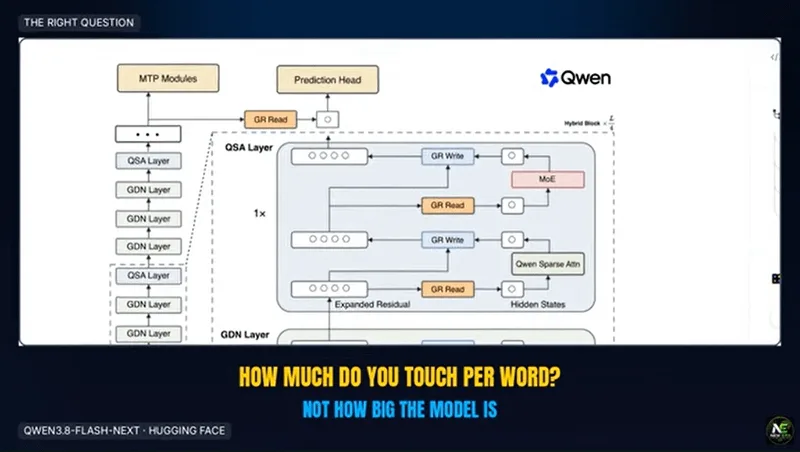
Edge0’s latent mixture of experts architecture extends conventional sparse computation by reducing the dimensionality of information processed within its expert network. The model contains 48 layers, with 512 routed experts available within each applicable expert layer. Its routing system selects 10 experts for individual tokens, while an additional shared expert contributes to computation. The underlying network maintains a representation width of 2,560 dimensions outside the compressed expert processing stage. Edge0-145B reduces the relevant expert representation to 1,792 dimensions, while Edge0-120B uses a narrower representation of 1,280 dimensions. Projection operations transform information into the smaller latent space before expert processing and subsequently restore it to the wider model representation.
| Architecture Specification | Edge0-145B |
|---|---|
| Total parameters | Approximately 145 billion |
| Active parameters per token | Approximately 10.12 billion |
| Model layers | 48 |
| Routed experts per applicable layer | 512 |
| Selected experts per token | 10 |
| Shared experts | 1 |
| Main representation width | 2,560 dimensions |
| Latent expert width | 1,792 dimensions |
| Nominal context window | 256,000 tokens |
| Available expert weight formats | Q3_K and NVFP4 |
| Inference engine | edge0-strata |
Smaller expert representations reduce the amount of information transferred during inference, allowing more experts to fit into available memory caches. The architecture also incorporates hybrid attention mechanisms, a memory mapped n-gram embedding component, and multiple token prediction capabilities that support speculative decoding. Rather than completing every stage of token generation independently, speculative decoding allows a prediction component to propose upcoming tokens that the main network subsequently verifies. Together, these techniques address several bottlenecks affecting local AI, including computational demand, memory capacity, weight transfers, and output generation speed.
SSD streaming provides another important component of Edge0’s memory optimization strategy. Frequently accessed experts can remain within graphics memory or system RAM, while less frequently required components remain on storage until needed. Edge0’s September 2026 research, The Other Half of the Memory Wall: Serving 35B MoEs from SSD with Trained Routing Prediction, examined how predicting upcoming expert requirements could allow storage retrieval to begin before the corresponding computation occurs. The earlier research demonstrated a 35 billion parameter model operating at approximately 20 tokens per second with 3GiB of peak active memory on a machine equipped with 24GB of memory. These results concern the earlier model rather than Edge0-145B.
The latest edge0-strata inference engine coordinates computational operations and data movement across available hardware resources. Its --mmap-experts option enables access to expert weights stored on an SSD, while additional configuration options control expert residency and system memory caching. Maintaining different expert sets in system memory and graphics memory can reduce unnecessary duplication and accommodate more model components. Nevertheless, even fast NVMe storage generally provides lower bandwidth and higher access latency than GPU memory. Performance depends on how effectively the runtime anticipates demand, reuses cached experts, and overlaps storage operations with computation. Edge0 manages these bottlenecks rather than eliminating them entirely.
The reported 80 tokens per second and 29GB peak memory demonstration must also be distinguished from the model’s complete storage requirements. Edge0-145B’s published Q3_K weights occupy approximately 40.81GiB, while its NVFP4 edition occupies approximately 47.79GiB. Additional packaged assets and memory mapped data can increase total storage requirements. The headline performance therefore does not establish that every parameter fits into 29GB of physical memory or that every laptop with comparable RAM can reproduce the result. Edge0’s achievement is enabling inference without requiring all model parameters to occupy the same memory tier simultaneously.
Updated performance measurements illustrate how generation speed varies considerably according to hardware and available memory.
| Hardware Configuration | Chat Decoding | Agent Decoding |
|---|---|---|
| NVIDIA RTX 5090 D, 24GB VRAM | 99.7 tokens/sec | 121.2 tokens/sec |
| NVIDIA RTX 4090, 24GB VRAM | 69.9 tokens/sec | 91.7 tokens/sec |
| Constrained 16GiB VRAM and 20GiB RAM | 36.8 tokens/sec | 44.9 tokens/sec |
| Constrained 12GiB VRAM and 20GiB RAM | 22.4 tokens/sec | 23.5 tokens/sec |
| Apple M2 Ultra | 60.9 tokens/sec | 57.0 tokens/sec |
These developer reported Q3_K benchmarks demonstrate the potential for relatively fast local inference while establishing that throughput decreases significantly under more restrictive memory conditions. Users should also distinguish prompt processing, which measures how quickly existing input is processed, from decoding, which measures output generation speed. Autonomous agent task completion additionally depends on file operations, external commands, tool execution, reasoning length, and verification procedures. The original laptop demonstration remains a specific reported result rather than a universally established performance guarantee.

Edge0-145B Hardware Requirements, Q3_K and NVFP4 Quantization, Benchmark Results, and Model Comparisons
Edge0-145B requires compatible computing hardware, sufficient storage capacity, and an inference environment capable of executing its specialized architecture. On Windows and Linux, the officially documented deployment path uses an NVIDIA graphics processor with CUDA 13 support. Apple Silicon systems use Apple’s Metal computing framework. Edge0 has not established a universal minimum specification guaranteeing acceptable performance across every workload. Its constrained memory benchmarks demonstrate possible operating configurations but should not automatically be interpreted as definitive minimum system requirements.
Graphics memory is particularly important because keeping frequently accessed experts within VRAM reduces dependence on slower transfers from system memory and storage. System RAM provides additional capacity for model data, runtime allocations, and cached experts, while insufficient RAM can increase reliance on SSD streaming. Fast NVMe storage is generally more suitable than a mechanical hard drive for frequent random access. Users must also allocate storage for the operating system, auxiliary model assets, inference software, and projects being processed. Laptop cooling and sustained thermal performance can further influence throughput during extended inference sessions.
Apple Silicon computers use unified memory, allowing the CPU and GPU to share the same physical memory pool. This differs from conventional systems equipped with discrete graphics cards, although the available memory must still accommodate the operating system, model, and other applications. Edge0 reports 60.9 tokens per second during chat decoding and 57.0 tokens per second during agent decoding on an Apple M2 Ultra.
However, the M2 Ultra is a workstation class processor rather than a conventional MacBook chip. Apple laptops with lower memory bandwidth, fewer GPU cores, or smaller memory capacities may deliver substantially different results. Earlier Edge0 models also support mobile platforms and additional inference backends, but this does not establish official smartphone, CPU, or Vulkan support for Edge0-145B.
Quantization plays an important role in reducing the resources required to operate Edge0’s latest models. The technique lowers the numerical precision used to represent neural network parameters, reducing weight storage and memory bandwidth requirements. Edge0 distributes its latest checkpoints in Q3_K and NVFP4 expert weight formats. Its Q3_K implementation uses mixed precision rather than storing every parameter uniformly at three bits. Gate and up projection matrices use Q3_K representations, while down projection matrices use IQ4_NL. NVFP4 is NVIDIA’s four bit floating point format, designed to support efficient low precision AI computation on compatible hardware.
Edge0 states that its latest models underwent post training with native four bit operation in mind, rather than simply converting an unchanged high precision model after training. This approach can help reduce degradation associated with lowering numerical precision. The smaller Q3_K format can provide advantages when memory capacity and data transfers are major bottlenecks. On the RTX 5090 D, Edge0 reports higher chat and agent generation speeds for Q3_K than for NVFP4. However, its RTX Spark N1X results demonstrate that NVFP4 can achieve better throughput in certain configurations. Practical performance therefore depends on the interaction between quantization, hardware support, memory bandwidth, kernel implementation, and inference scheduling.
Edge0-145B and Edge0-120B belong to the same model family but offer different balances between capacity, hardware requirements, and inference speed.
| Specification | Edge0-145B | Edge0-120B |
|---|---|---|
| Total parameters | 145 billion | 120 billion |
| Active parameters per token | 10.12 billion | 8.64 billion |
| Layers | 48 | 48 |
| Routed experts per applicable layer | 512 | 512 |
| Latent expert width | 1,792 | 1,280 |
| Nominal context window | 256,000 tokens | 256,000 tokens |
| Q3_K weight size | 40.81GiB | 27.98GiB |
| NVFP4 weight size | 47.79GiB | 32.96GiB |
| RTX 5090 D chat decoding | 99.7 tokens/sec | 130.2 tokens/sec |
| RTX 5090 D agent decoding | 121.2 tokens/sec | 144.6 tokens/sec |
| 16GiB VRAM and 20GiB RAM chat decoding | 36.8 tokens/sec | 62.4 tokens/sec |
| 16GiB VRAM and 20GiB RAM agent decoding | 44.9 tokens/sec | 73.3 tokens/sec |
Edge0-120B’s narrower expert representations decrease the amount of information transferred during inference, reducing storage requirements and improving generation speeds across several documented configurations. Edge0-145B generally achieves stronger software engineering results, although the smaller model performs slightly better in certain evaluations. The larger checkpoint is particularly relevant to demanding coding and reasoning tasks, while Edge0-120B offers an alternative for users prioritizing lower memory pressure and faster generation. Both support a nominal context window of 256,000 tokens, although operating at maximum context introduces additional hardware and runtime requirements.
Edge0’s published evaluations compare its models against DeepSeek-V4-Flash-0731, Qwen3.8-Flash-Next, Qwen3.8-27B, and Claude Opus 4.6 operating at its maximum evaluation configuration. The results cover software engineering, terminal based agent tasks, long context reasoning, instruction following, and advanced scientific knowledge.
| Benchmark | Edge0-145B | Edge0-120B | DeepSeek-V4-Flash-0731 | Qwen3.8-Flash-Next | Claude Opus 4.6 |
|---|---|---|---|---|---|
| DeepSWE 1.1 | 64.6 | 51.3 | 54.4 | 58.7 | Not specified |
| Terminal-Bench 2.1 | 86.5 | 75.3 | 82.7 | 83.3 | 78.2 |
| AA-LCR | 79.3 | 81.0 | Not specified | Not specified | Not specified |
| IFBench | 80.6 | Not specified | Not specified | 81.3 | Not specified |
| GPQA-Diamond | 90.4 | Not specified | 90.8 | 91.7 | 91.3 |
| Humanity’s Last Exam | 35.4 | Not specified | Not specified | Not specified | 40.0 |
Edge0-145B’s strongest comparative results appear in software engineering and terminal based evaluations. Its Terminal-Bench 2.1 score of 86.5 is particularly relevant to developers interested in autonomous agents capable of interpreting instructions, interacting with files, executing commands, and verifying task completion. Its DeepSWE 1.1 score of 64.6 also exceeds the reported results for DeepSeek-V4-Flash-0731 and Qwen3.8-Flash-Next. However, the model does not outperform competitors across every evaluation. Claude Opus 4.6 achieves a higher Humanity’s Last Exam score, while Qwen3.8-Flash-Next records stronger GPQA-Diamond and IFBench results. Edge0-120B also achieves a slightly higher AA-LCR score, demonstrating that increasing model size does not automatically improve every capability.
These comparisons originate from Edge0, and differences in evaluation settings, agent harnesses, reasoning budgets, and software environments can influence the results. The company has also demonstrated practical workloads involving software development, video production, three dimensional environments, and printed circuit board design. Such demonstrations illustrate the model’s potential as a tool using agent, although successful generation does not guarantee professional reliability. Developers should evaluate task completion rates, error frequency, resource consumption, and required human intervention alongside generation speed. Edge0’s distinctive advantage is its specialized local deployment architecture rather than universal superiority over every competing language model.

How to Download and Install Edge0-145B, Commercial Licensing, Offline Coding, Privacy, and the Future of Local AI
Edge0-145B is distributed through Hugging Face, with its official inference framework, desktop application, and deployment documentation available through the Edge0 GitHub repository. Users can choose between the Edge0/Edge0-145B-q3k and Edge0/Edge0-145B-NVFP4 checkpoints. Before downloading either version, developers should examine the complete repository contents, storage requirements, supported hardware, and licensing conditions. The official Edge0 Chat desktop application provides an accessible installation method for supported Windows and Apple Silicon macOS computers.
To install Edge0-145B through the desktop application, follow these steps:
- Obtain Edge0 Chat from the project’s official GitHub Releases section.
- Install the application on a compatible operating system.
- Open the Models section and select the desired Edge0 checkpoint.
- Download the required model files or import an existing model directory.
- Allow the application to load the checkpoint.
- Begin using the local conversational interface.
Developers requiring greater control can use the command line deployment method. Obtain the official Edge0 source repository and build the edge0-infer interface and edge0-strata engine according to the relevant operating system instructions. NVIDIA systems require the appropriate CUDA environment, while Apple Silicon deployments use Metal. With the Hugging Face command line client installed, the Q3_K checkpoint can be downloaded using:
hf download Edge0/Edge0-145B-q3k --local-dir Edge0-145B-q3kThe NVFP4 checkpoint can be downloaded using:
hf download Edge0/Edge0-145B-NVFP4 --local-dir Edge0-145B-NVFP4After downloading the checkpoint, retain its original configuration and directory structure. The inference interface uses information contained in model.json to identify and configure the appropriate engine. Once the required software components have been built, an interactive conversation can be started using:
edge0-infer chat --model /path/to/Edge0-145B-q3kAlternatively, developers can launch a local inference server using:
edge0-infer serve --model /path/to/Edge0-145B-q3kThese commands assume that the executable is available through the system’s PATH. Otherwise, developers must specify its actual build location. The inference server provides interfaces compatible with established OpenAI style and Anthropic style API formats, allowing compatible applications to communicate with the locally operated model. Generic installation suggestions from model hosting platforms should not automatically be interpreted as confirmation that unrelated inference engines support Edge0’s specialized architecture.
Licensing is another important consideration because Edge0’s inference software and model weights operate under different terms. The inference framework is distributed under the Apache License 2.0, while the underlying Strata software retains its applicable MIT license. These permissive software licenses generally allow modification, redistribution, and commercial development subject to their respective conditions. However, the model weights are governed by the Edge0 Community Model License 1.0 and applicable upstream Qwen Community License 1.0 requirements.
| Activity | Model Licensing Status |
|---|---|
| Personal use | Permitted under applicable conditions |
| Research and modification | Permitted under applicable conditions |
| Noncommercial sharing | Permitted under applicable conditions |
| Internal business use | Permitted under applicable conditions |
| Commercial use of generated outputs | Permitted under applicable conditions |
| Selling or commercially bundling the model | Separate written permission required |
| Operating a commercial model service | Separate written permission required |
| Independent commercial coding or office assistants | Separate written permission required |
Permission to use generated outputs commercially does not automatically grant permission to redistribute the model commercially or operate a paid inference service. The upstream Qwen licensing requirements also remain applicable because Edge0’s checkpoints were derived from Qwen3.8-Flash-Next. Businesses should review the current LICENSE and NOTICE files before developing commercial products around the model. Although the inference framework is available under permissive open source licenses, the commercial restrictions on its downloadable weights mean Edge0-145B should not be described as unrestricted open source AI.
Local deployment offers several advantages beyond computational performance. Developers can process proprietary software, technical documentation, unpublished research, and confidential business information directly on their computers, reducing dependence on external inference providers. Once the necessary software and model files have been installed, core text generation can operate without internet connectivity. Locally hosted inference also avoids an external model provider charge for every generated token, although users must still account for hardware acquisition, electricity consumption, storage, maintenance, and operational expenses.
Autonomous AI agents represent another important application. When connected to appropriate development tools, Edge0-145B can potentially examine project files, generate code, execute tests, analyze errors, and revise proposed solutions. Its long context capabilities may help agents maintain awareness of extensive project histories and technical requirements. However, local operation does not automatically guarantee privacy or security. Connected applications may transmit information through telemetry, remote plugins, or external APIs, while poorly configured inference servers and logs can expose sensitive material. Appropriate access controls, isolated execution environments, backups, human approval, and conventional software testing remain important.
Edge0-145B reflects a broader movement toward distributing artificial intelligence capabilities across cloud infrastructure, personal computers, and increasingly capable edge devices. Its architectural optimizations demonstrate that total parameter count does not necessarily dictate rigid hardware requirements. Improvements in memory bandwidth, storage performance, sparse computation, and inference scheduling could influence future laptop designs and encourage more advanced local assistants within software development, creative applications, and enterprise productivity systems.
Nevertheless, locally operated models do not eliminate the need for cloud computing. Data centers remain important for training advanced models, handling large numbers of simultaneous users, delivering centralized updates, and supporting demanding workloads that individual devices cannot efficiently reproduce. Hybrid environments could allow local models to handle confidential information, routine tasks, and offline operations while transferring more computationally demanding requests to cloud infrastructure. Accessible installation tools, automatic hardware detection, and efficient runtime configuration will be important in determining whether sophisticated local AI becomes practical beyond specialist development and research environments.

Frequently Asked Questions (FAQs)
- What is Edge0-145B?
Edge0-145B is a 145 billion parameter language model designed for local artificial intelligence inference on compatible consumer hardware. Its latent mixture of experts architecture activates approximately 10.12 billion parameters per token, reducing computational requirements. Combined with quantization, speculative decoding, and specialized memory management, the model supports advanced coding, reasoning, instruction following, and autonomous agent workloads. - When was Edge0-145B released?
Edge0 published its introductory announcement on November 12, 2026, while the official GitHub release history records November 13 as the release date for both Edge0-145B and Edge0-120B. The release followed the introduction of the unified edge0-infer framework on November 4 and expanded Edge0’s earlier work on smaller device native language models. - Can Edge0-145B run with only 29GB of memory?
Edge0 reported a compatible laptop demonstration achieving more than 80 tokens per second with 29GB of peak memory usage. However, this represents a particular configuration rather than a universal minimum requirement. The model’s actual memory requirements depend on graphics memory, system RAM, quantization, storage performance, context length, and runtime configuration. Its complete weight files also exceed 29GB. - How fast is Edge0-145B?
Edge0 reports 99.7 tokens per second during chat decoding and 121.2 tokens per second during agent decoding using Q3_K weights on an NVIDIA RTX 5090 D with 24GB of VRAM. An RTX 4090 achieves lower reported speeds of 69.9 and 91.7 tokens per second, respectively. More restrictive memory configurations can reduce throughput considerably. - Can Edge0-145B run without an internet connection?
Yes. Once the required model weights, inference software, and supporting assets have been downloaded and installed, Edge0-145B can perform core inference offline. This allows developers to generate code, analyze documents, and interact with the model without depending on an external inference service. However, web browsing, remote APIs, and network dependent agent tools may still require internet access. - Does Edge0-145B support Apple Silicon Macs?
Yes. Edge0’s current inference framework supports Apple Silicon systems through Metal. Its published M2 Ultra benchmark reports 60.9 tokens per second during chat decoding and 57.0 tokens per second during agent decoding. However, performance varies according to processor capabilities, available unified memory, memory bandwidth, thermal conditions, and runtime configuration. These figures should not be treated as representative of every MacBook. - What is the difference between Edge0-145B and Edge0-120B?
Edge0-145B contains approximately 145 billion parameters, with 10.12 billion active per token, while Edge0-120B contains approximately 120 billion parameters, with 8.64 billion active. The larger model generally achieves stronger software engineering benchmark results. Edge0-120B uses narrower expert representations, requires less storage, and delivers higher generation speeds across several documented hardware configurations. - Is Edge0-145B better than Claude Opus 4.6?
Edge0-145B achieves stronger results in certain developer reported evaluations, including Terminal-Bench 2.1, where it scores 86.5 compared with Claude Opus 4.6’s 78.2. However, Claude achieves higher scores in other evaluations, including Humanity’s Last Exam. Edge0’s additional advantage is its ability to operate locally, although neither model can be declared universally superior based solely on these benchmarks. - Is Edge0-145B free for commercial use?
Edge0 permits certain commercial activities, including internal business use and commercial use of generated outputs, subject to applicable license conditions. However, selling or commercially bundling the model, operating a commercial inference service, and offering independent commercial coding or office assistants require separate written authorization. Developers must also comply with the applicable upstream Qwen licensing requirements. - Where can Edge0-145B be downloaded?
The official Edge0-145B checkpoints are available through Hugging Face under the Edge0/Edge0-145B-q3k and Edge0/Edge0-145B-NVFP4 repositories. The inference framework, desktop application, deployment instructions, and technical documentation are available through the official Edge0 GitHub repository. Users should select the appropriate checkpoint according to their hardware capabilities, available storage, performance requirements, and intended licensing use.

Conclusion
Edge0-145B demonstrates how latent mixture of experts architecture, low precision training, SSD streaming, and speculative decoding can make advanced artificial intelligence more accessible on consumer hardware. Its reported performance of over 80 tokens per second with 29GB of peak memory highlights the potential of local inference, although actual performance depends on hardware, quantization, and runtime configuration. Its commercial licensing restrictions also distinguish the downloadable model weights from the permissively licensed inference framework.
With applications ranging from offline coding and private document analysis to autonomous AI agents and creative workflows, Edge0-145B represents a significant advancement in local artificial intelligence. Although cloud computing remains essential for demanding workloads, continued improvements in architectural efficiency and memory management could make sophisticated AI capabilities increasingly accessible on personal computers.
Sources and Citations
- Edge0, November 12, 2026, Introducing Edge0-145B: Frontier AI Capabilities on Your Own Computer: Confirms model specifications, local inference capabilities, performance demonstrations and deployment options.
https://edge0.ai/blog/introducing-edge0-145b-frontier-ai-capabilities-on-your-own-computer - Edge0, Official GitHub Repository: Documents model architecture, release history, supported platforms and installation procedures.
https://github.com/Edge0-AI/Edge0 - Edge0, Edge0-145B and Edge0-120B Technical Documentation: Explains expert compression, quantization, inference benchmarks and hardware requirements.
https://github.com/Edge0-AI/Edge0/blob/main/docs/models/edge0-145b.md - Hugging Face, Edge0-145B-q3k: Documents model parameters, weight sizes, quantization, benchmarks and licensing conditions.
https://huggingface.co/Edge0/Edge0-145B-q3k - Hugging Face, Edge0-120B-NVFP4: Provides comparative model specifications, memory requirements and inference performance.
https://huggingface.co/Edge0/Edge0-120B-NVFP4 - Yu Lin, Yiming Wang, Runyuan Cai, Hanze Liu and Xiaodong Zeng, September 16, 2026, The Other Half of the Memory Wall: Serving 35B MoEs from SSD with Trained Routing Prediction: Explains SSD streaming, predictive expert routing and memory-efficient MoE inference.
https://arxiv.org/abs/2609.18063
Recommendations
- BOMBANANA! Launches on PC: Release Date, Three-Monkey Roles, and Bomb-Defusal Gameplay
- What Time Does Black Ops 7 Season 5 Start in Your Time Zone?
- Fortnite Chapter 7 Mini Season Fortune Treasure Hours Schedule: Event Times, Dates, Rewards and Bonuses
- Jensen Huang Return Petition Follows 88% Support in Nvidia Employee Poll
- Fortnite will reveal the identity of masked character Captain X at a December 5 live event
- AION 2 Is Betting on Scale, Customization, and Faction Warfare for Its Global Launch
- Solarpunk Floating Islands Survival Crafting Game Guide: Build, Farm, and Explore Cozy Sky Worlds With Friends or Solo
- Furyball: Rogue Revenge, Official Gameplay Reveal Trailer Breakdown, Release Details, and Everything We Know so Far
- Jensen Huang’s Exit Blows a Hole in a $500 Billion Nvidia-Backed AI Financing Push With Wall Street Banks
- Senate Banking chair Tim Scott summons Jensen Huang and Howard Lutnick and threatens subpoenas



































































































