











In This Article (8 sections)
Embodied AI AIR: AIR’s Factory Debut and What the Reliability Results Measure
Swiss company Embodied AI unveiled AIR, its first factory humanoid, at Humanoid Europe 2026 in Munich on November 6. The 98% reliability figure publicized alongside the launch came from a separate two-arm industrial cell performing a cable-handling task. That customer evaluation exceeded a consumer electronics manufacturer’s 90% target by eight percentage points. AIR and the cell use the same underlying AI software, but they have different hardware configurations. Embodied AI has not published an equivalent reliability figure for the wheeled humanoid. AIR is undergoing manufacturer trials, with CE marking planned for 2027.
Co-founder and CEO Francesco Stella presented AIR at the event, which ran on November 5 and 6 under the Europe to China Humanoid Robot and Physical AI Summit banner. Its program covered dexterous manipulation, industrial supply chains, safety, and commercial applications. Look AI Ventures, an investor in Embodied AI, confirmed the unveiling date and identified AIR as the company’s first humanoid. Embodied AI said it developed the platform in nine months, building on earlier work involving compliant arms and AI software. The launch introduced the hardware while manufacturer testing and planning for larger-scale production were already underway. A public unveiling, a customer trial, and sustained operation across production shifts nevertheless represent different stages of readiness.
Embodied AI supplied the data behind the 98% result and described the unnamed customer as a leading consumer electronics manufacturer. Public accounts identify the task and the industrial cell used, but provide no detailed protocol, attempt count, testing duration, or explanation of how retries and operator assistance were recorded. A first-attempt completion rate measures how frequently a process runs cleanly. A completion rate that includes retries can help establish how many parts ultimately pass the station after recovery. Those measurements answer different operational questions. The published evidence therefore supports using the company’s term, “reliability,” for that specific evaluation without redefining it as another performance measure.
Manufacturing Outlook reported that the customer evaluated five funded robotics startups. According to Embodied AI, competing systems failed to meet the manufacturer’s performance targets. The available coverage did not include a customer-published, vendor-by-vendor comparison. Embodied AI also did not attribute its margin above the target to one hardware feature, a specific training change, or a disclosed number of demonstrations. The result describes the combined performance of its industrial cell and software against one customer benchmark.
Cable handling helps explain why such an evaluation can be demanding. A cable changes shape when grasped, lifted, or pulled, whereas moving one end of a rigid component moves the whole object more predictably. Its free end can sag or rotate, and contact with a fixture can alter its path. Two arms may help by controlling different points, with one holding a section steady while the other adjusts the free end. That illustrates the potential value of two-handed manipulation without establishing the sequence used in the customer’s test.
Look AI Ventures separately reports an average task success rate of 95% across paid pilots with large manufacturers, including consumer electronics and automotive and industrial technology customers. That account concerns a broader set of deployments than the single cable-handling evaluation. It provides insufficient detail about the tasks and averaging method to treat 95% as a measured AIR success rate.
Greater Geneva Bern area, the regional investment promotion agency, reported that Embodied AI had signed contracts with major manufacturers and that some were testing AIR. Rocking Robots noted that the launch information did not name those AIR customers or disclose how many units were in trials. As of November 16, the public record therefore supported describing the humanoid as undergoing manufacturer testing.
AIR-specific trials would need to establish performance across successive shifts and under the conditions of each installation. Uptime measures how long a system is available, while throughput measures how many acceptable units it produces within a given period. A high task completion rate can still be insufficient if the process takes longer than the production line allows. Accepted parts, output per hour, changeover time, and minutes of operator assistance would provide a more complete picture. AIR’s mobility adds further questions about repeated positioning at workstations and the effect of travel time on production.
AIR’s Hardware, Manufacturing Tasks, and EPFL Research
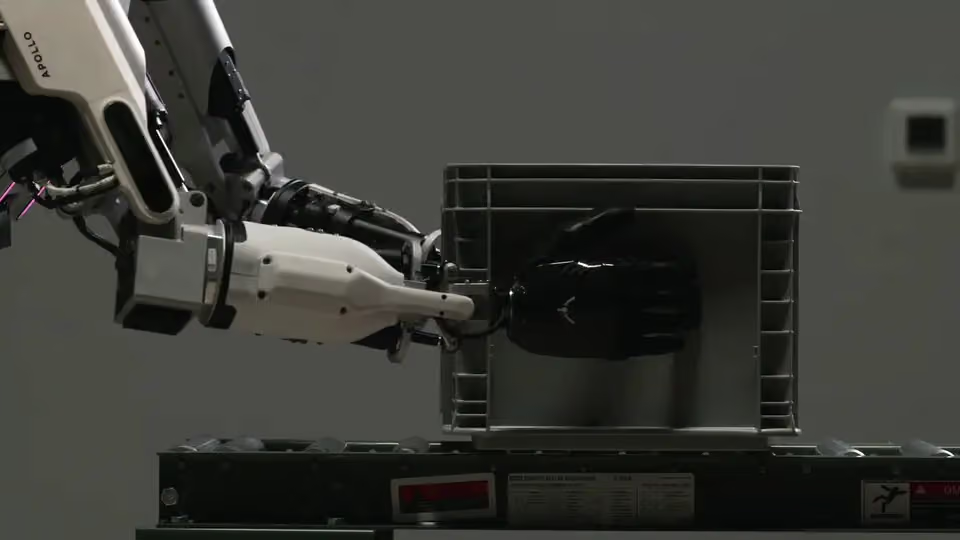
Embodied AI is a spinout from the Swiss Federal Institute of Technology Lausanne, or EPFL. Stella founded the company with CTO Kai Junge and COO Max Polzin. Its website identifies the humanoid platform as AIR01. A humanlike torso and two arms perform manipulation tasks, while a wheeled base moves the robot into position. The two-arm arrangement can support operations in which one object must remain steady while another is moved. During parts preparation, for example, one arm could stabilize a container while the other retrieves a component, with the exact movements determined by the station, tooling, and training.
Embodied AI chose wheels primarily for work on level industrial floors. The base provides mobility between suitable positions and a stable platform while the arms reach, grip, or align parts. Its upper-body arrangement is intended to fit workstations already organized around human reach and access. Narrow aisles, thresholds, ramps, and factory traffic can still limit where it operates. Positioning beside a bench also needs to support precise alignment with the fixture or workpiece. The launch coverage explains the design rationale but provides no public performance figures for those particular conditions.
AIR’s intended operations include picking, placing, plugging, and working with tools. Embodied AI also names kitting, packaging, and support for surface-mount technology, or SMT, in its flexible manufacturing materials. Kitting means gathering the correct components into a set for a downstream operation. Packaging may require arranging parts or materials in a specified orientation. SMT support concerns work around electronics assembly processes that mount components onto circuit boards. These applications can involve different fixtures, quality requirements, component sequences, and degrees of physical variation. Whether AIR can perform them efficiently depends on the station’s reach, tooling, access, and cycle-time requirements.
The company’s separate two-arm cells are advertised for applications including cable handling, automatic phone charging, and SMT splicing. A configurable cell can be built around a particular operation, while AIR adds mobility for changing workflows. Both product types use Embodied AI’s software. Their shared software connects the company’s manipulation work across its lineup without making their performance interchangeable. The industrial cell evaluation provides evidence for one cable-handling application, while AIR’s task-by-task trial results remain to be published.
AIR houses its motors, gearboxes, and electronics in the torso, with tendons transmitting motion to the arms. The arrangement is similar in principle to a biological tendon carrying force from a muscle to another part of the body. Moving heavier components away from the arm joints reduces the mass carried by the moving arms. Embodied AI also says the arms are designed to yield on contact. Engineers describe that ability to give or deflect under load as compliance. In manufacturing, controlled flexibility can help accommodate small differences in part placement or contact with a fixture.
The arm design grew from Stella’s EPFL doctoral research, presented in his thesis, Design of robotic physical intelligence. That work examined how mechanical structure contributes to robot behavior, covering soft manipulators, locomotion, and the joint design of hardware and control. EPFL recognized it with the 2026 ABB Award for contributions to soft robotic modelling, control, and actuation, including applications to physical systems.
Research involving Stella explored a tendon-driven manipulator capable of controlling stiffness at the point of contact in different directions. A connector insertion task illustrates the principle: the robot may need a steady push along the insertion direction while allowing small sideways adjustments. Junge’s EPFL doctoral work examined compliant hands interacting with objects of varying geometry and material properties. Embodied AI combines that research into physical interaction with an industrial deployment approach based on operator demonstrations.
How AIR Learns, Uses Human Supervision, and Transfers Skills
AIR begins a new assignment under teleoperation, with a person controlling it remotely. The operator performs the task through the robot, and Embodied AI records those demonstrations for training. The company describes this process as imitation learning. The software uses examples of the operator’s work to learn how to select movements for the assigned job. Embodied AI also says its control system uses a vision-language model to coordinate smaller task policies that run on the robot.
Collecting demonstrations at the workstation lets training capture the environment in which AIR will operate. An operator could show how to approach a part when a tray is slightly displaced, coordinate the arms while repositioning an object, or handle an unusual orientation. Those examples illustrate why recordings across actual production conditions can cover more variation than demonstrations made under one ideal arrangement. Teleoperation may let AIR contribute to a shift while training data is collected, but that output still includes the human operator’s work. Once the robot begins operating autonomously, a manufacturer can separately measure unassisted cycles and the frequency of human intervention.
Embodied AI says AIR can typically progress from remote operation to autonomous execution of a defined factory task within about a month. That estimate can include the demonstration period and subsequent training. It describes the initial transition for an assigned job, leaving sustained performance across shifts, batches, fixtures, and changeovers to further assessment. A picking task using consistent trays may produce many similar examples in one shift, while an operation with occasional changeovers may need longer to capture representative conditions. The company has not published enough AIR trial data to establish learning times by task or the number of demonstrations typically required.
A factory’s definition of readiness also affects how that timeline should be understood. Completing an ordinary cycle is one milestone, while handling the variation encountered throughout production is another. A site may judge acceptance through the proportion of acceptable parts, cycle time, or the number of assists required during a shift. After training, operators remain available to supervise and respond to situations outside the learned routine. Unusual tray loading, a jammed component, or an object entering the work area could require guidance or recovery, although these are illustrative examples rather than events from a published AIR trial log.
The duration of an intervention can matter as much as its frequency. Correcting a slightly misaligned component may take seconds, while freeing material trapped in a fixture could take considerably longer. Recording both the number of takeovers and the time spent resolving them would help a manufacturer understand staffing requirements. It would also show whether AIR can resume independently once an operator restores the station to a workable condition. Embodied AI has not disclosed a fixed intervention rate or a robots-per-operator supervision ratio.
Embodied AI says a skill learned by one robot can be transferred to another. The benefit is clearest when stations use matching parts, fixtures, and assembly sequences. Under sufficiently similar conditions, the transferred skill can give the receiving robot a starting point and reduce initial demonstration work. Small differences in fixture position, camera glare, or gripper configuration can still require validation against the second station’s output and quality requirements. Public reporting provides no comparison between learning a task from scratch and validating a transferred skill at another station or plant. The company’s stated deployment process includes a site assessment and a pilot measured against customer requirements.

Collaborative Safety and AIR’s CE Marking Plans
Embodied AI says AIR was designed with reference to ISO/TS 15066:2016. The International Organization for Standardization describes this as a technical specification for collaborative industrial robot systems and their work environments. It supplements guidance on collaborative operation in ISO 10218-1 and ISO 10218-2. AIR incorporates lightweight arms, compliant joints, and a soft exterior to support work near people. Operating without a safety cage is a design objective, with the suitability of each application dependent on its installation and safeguards.
Moving mass and contact conditions remain important even with compliant arms. A lighter arm generally carries less kinetic energy than a heavier arm moving at the same speed. A held tool or workpiece adds mass and can change the consequences of contact, particularly if it is heavy or sharp-edged.
An open bench also presents different hazards from a narrow space where a worker could become trapped between moving equipment and a fixed surface. Assessment must therefore consider the robot, payload, movement, tooling, and surrounding workstation together. The industrial cell’s 98% task reliability result does not establish safety performance, which would require evidence concerning matters such as contact forces and the complete system’s response to a person entering its working area.
Embodied AI plans CE marking for AIR in 2027, a timeline reported by Thomasnet alongside the company’s collaborative-design claims. The plan coincides with the general application of the EU Machinery Regulation, Regulation (EU) 2023/1230, from January 20, 2027. Some provisions have separate application dates. The applicable conformity procedure depends on the product and its classification under the regulation. The launch sources provide a target date but no completed EU declaration of conformity for AIR.
For machinery covered by the regulation, the manufacturer must prepare the relevant technical documentation and complete the applicable conformity assessment. That process must demonstrate conformity with the relevant essential health and safety requirements. The manufacturer then draws up an EU declaration of conformity and affixes the CE marking. Documentation must be considered in relation to the particular model or configuration it covers. Its scope also matters when AIR is integrated with factory tools or equipment, making the complete application part of the assessment of deployment readiness.

Frequently Asked Questions (FAQs)
- When and where did Embodied AI unveil the AIR humanoid robot?
Embodied AI unveiled AIR on November 6, 2026, at Humanoid Europe in Munich, Germany. CEO and co-founder Francesco Stella presented the robot. The event ran on November 5 and 6 under the Europe to China Humanoid Robot and Physical AI Summit banner. Its program covered industrial applications, dexterous manipulation, supply chains, and safety. Look AI Ventures, an investor in Embodied AI, confirmed the unveiling and identified AIR as the company’s first humanoid platform. - Did the AIR humanoid achieve 98% reliability?
Embodied AI has not published an equivalent 98% reliability result for AIR. The figure came from a cable-handling proof of concept using the company’s separate two-arm industrial cell. AIR shares the same underlying AI software, but its mobile hardware introduces different operating conditions. Shared software does not establish identical performance across the two platforms. AIR would need its own task-specific measurements to support an equivalent reliability claim. - How far above the target was the cable-handling result?
The manufacturer’s target was 90%, and Embodied AI reported 98%, a difference of eight percentage points. The result concerned one cable-handling evaluation performed by the industrial cell. Embodied AI supplied the figure but did not publicly identify the consumer electronics customer. It also did not publish a detailed protocol explaining the number of attempts or how retries and human assistance were counted. Those details would be needed to make a meaningful comparison with another system’s reported results. - Which factory jobs is AIR designed to do?
AIR is intended for picking, placing, plugging, and working with tools at manufacturing stations. Embodied AI also lists kitting, packaging, and support for electronics assembly among its flexible manufacturing applications. Kitting gathers the required components for a downstream operation, while packaging can involve arranging parts in a specified orientation. Each task has its own requirements for reach, tooling, quality, and cycle time. These are intended applications, with AIR-specific performance results still to be published. - Why does AIR have wheels?
AIR’s wheeled base is designed for movement and stability on level factory floors. Stable positioning helps its arms reach, grip, and align components at a workstation. Its humanoid characteristics come from the torso and two-arm layout, which suit many stations organized around human access. Narrow aisles, ramps, thresholds, and traffic can still affect where the robot can operate. Its suitability therefore depends on the factory layout and the precise positions required for each task. - What makes AIR’s robot arms tendon-driven?
AIR’s motors, gearboxes, and electronics sit in its torso. Tendons transmit motion from the drive mechanisms to the arms. This arrangement reduces the mass carried by the arms as they move. The arms are also designed to be compliant, meaning they can yield or deflect under load. Their behavior during a task still depends on the object or tool being held and the movement being performed. - Can AIR learn a factory task in one month?
Embodied AI says AIR can typically progress from remote operation to autonomous execution of a defined task in about a month. That estimate includes collecting demonstrations from a human operator and training the system to perform the assigned work. Handling variation across shifts, part batches, and fixtures can require further assessment. Operators remain available to help with unfamiliar situations after autonomous operation begins. The company has not published a task-by-task breakdown of learning times or typical demonstration counts. - Can AIR work beside people without a safety cage?
Working beside people without a cage is AIR’s design objective. Embodied AI cites ISO/TS 15066:2016 and incorporates lightweight arms, compliant joints, and a soft exterior. Whether a particular installation can operate collaboratively depends on its task, tools, workpieces, and layout. Heavy or sharp objects and spaces where a person could become trapped change the hazards involved. A site-specific assessment determines whether shared operation is suitable and which safeguards are needed. - Are manufacturers already testing AIR?
Yes, Embodied AI says manufacturers are testing the humanoid. Greater Geneva Bern area reported that the company had signed contracts with major manufacturers and that some were trialing AIR. Public launch information did not identify the AIR trial customers or disclose the number of units involved. Those trials could establish output, part quality, changeover time, and the amount of operator assistance required. Such results would help distinguish a successful demonstration from dependable operation across successive production shifts. - When does Embodied AI expect AIR to carry CE marking?
Embodied AI is targeting CE marking for AIR in 2027. It has not announced a specific completion date. The launch materials also did not include a completed EU declaration of conformity. Before applying the marking, the manufacturer must prepare the relevant technical documentation and complete the applicable conformity assessment. The 2027 announcement therefore describes a planned milestone, with subsequent documentation needed to establish conformity for the particular model or configuration covered.

Conclusion
Embodied AI’s AIR combines a wheeled base and tendon-driven arms to tackle repetitive factory work that still requires dexterity when parts shift or workflows change. Its training process begins with remote human operation, and the company says a defined task can typically move to autonomous execution within about a month, with operators available for exceptions.
The reported 98% reliability result belongs to a separate two-arm industrial cell that exceeded a customer’s 90% target on one cable-handling task. Although AIR shares that cell’s underlying AI software, its manufacturer trials must establish performance on the humanoid’s own hardware. Consistent task completion, sustained output, and the frequency and duration of human assistance will reveal how effectively it works across production shifts. That evidence, together with progress toward the planned 2027 CE marking, will give manufacturers a clearer basis for evaluating AIR’s readiness for wider deployment.
Sources and Citations
- Embodied AI, November 6, 2026: Embodied AI’s launch announcement says AIR was developed in nine months and unveiled at Humanoid Europe 2026. The company also reports that its underlying AI technology achieved 98% reliability against a 90% customer target in a cable-handling proof of concept using a separate two-arm industrial cell, rather than AIR itself. Morningstar
Embodied AI – AIR Launch Announcement via Morningstar/Business Wire - Embodied AI, AIR01 and Industrial Robotics Product Information: The company’s official website identifies AIR01 as its humanoid platform for manufacturing and complex manipulation. It also lists Flex02 and HELIX, describing the company’s broader physical-AI and tendon-driven manipulation technology. embodiedai.ch
Embodied AI – Official Product Website - Humanoid Europe, 2026 Programme and Agenda: The official event program confirms that Humanoid Europe 2026 was held in Munich on November 5–6, 2026 as the Europe–China Humanoid Robot & Physical AI Summit. Sessions covered embodied AI, dexterous manipulation, mass production, safety, supply chains, and commercial applications. Humanoid Europe 2026
Humanoid Europe 2026 – Programme and Agenda - Look AI Ventures, November 10, 2026: Investor Look AI Ventures confirms that Embodied AI unveiled AIR in Munich on November 6 and identifies it as the company’s first humanoid robot. The investor reports an average 95% task success rate across paid pilots, describes AIR’s teleoperation-to-autonomy workflow, and says CE marking is planned for 2027. Look AI Ventures
Look AI Ventures – Embodied AI Unveils AIR - Rocking Robots, November 10, 2026: Reporting distinguishes AIR from the industrial cell that generated the 98% cable-handling result. It confirms AIR’s wheeled base, tendon-driven arms, manufacturer testing, approximately one-month transition from teleoperation to autonomous task execution, and planned 2027 CE marking. Rockingrobots
Rocking Robots – AIR Factory Trials - Manufacturing Outlook, November 6, 2026: Manufacturing Outlook reports that a consumer-electronics manufacturer evaluated five funded robotics startups on a cable-handling task and that Embodied AI reported 98% reliability against a 90% target. It explicitly notes that the result came from the company’s existing industrial cell rather than AIR, while also tracing AIR’s tendon-driven design to Francesco Stella’s EPFL research. Manufacturing Outlook
Manufacturing Outlook – Embodied AI Factory Robot - Thomasnet, November 11, 2026: Thomasnet describes AIR’s tendon-driven architecture, lightweight arms, wheeled mobility, collaborative design, and planned operation around manufacturing employees. It also reports that the robot was designed with reference to ISO/TS 15066:2016 and that CE marking is planned for 2027. Thomasnet
Thomasnet – Embodied AI AIR Humanoid Robots - Greater Geneva Bern Area, November 9, 2026: The Swiss regional investment agency reports that AIR is being tested by manufacturers and that Embodied AI has signed contracts with major manufacturers worldwide. It describes the robot’s wheeled base, tendon-driven lightweight arms, teleoperation training process, and the separate industrial-cell test that achieved 98% reliability. ggba.swiss
Greater Geneva Bern Area – Embodied AI Unveils AIR - International Organization for Standardization, ISO/TS 15066:2016: ISO defines ISO/TS 15066:2016 as a technical specification covering safety requirements for collaborative industrial robot systems and their work environments. It supplements the collaborative-operation requirements and guidance in ISO 10218-1 and ISO 10218-2. ISO
ISO – ISO/TS 15066:2016 Collaborative Robots - EUR-Lex, Regulation (EU) 2023/1230: The official EU machinery regulation establishes health and safety requirements for machinery and related products and covers conformity-assessment requirements associated with placing machinery on the EU market. The current consolidated text confirms that the regulation generally applies from January 20, 2027. EUR-Lex
EUR-Lex – Regulation (EU) 2023/1230 - EUR-Lex, Machinery Safety Requirements: EUR-Lex’s official summary explains the machinery regulation and confirms its general application from January 20, 2027, while noting that specific provisions have earlier application dates. EUR-Lex
EUR-Lex – Machinery Safety Requirements - EPFL, November 13, 2026: EPFL records Francesco Stella as the recipient of the 2026 Asea Brown Boveri Ltd. (ABB) Award for his thesis Design of robotic physical intelligence. EPFL credits his work with contributions to soft-robot modeling, control, actuation, and deployment on real-world physical systems. actu.epfl.ch
EPFL – 2026 ABB Award: Francesco Stella - EPFL, “Prescribing Cartesian Stiffness of Soft Robots by Co-Optimization of Shape and Segment-Level Stiffness”: Research involving Francesco Stella presents a tendon-driven soft manipulator with variable-stiffness segments. The work demonstrates how a robot can vary end-effector stiffness in different directions to support interaction tasks requiring some directions to remain compliant while others remain firm. EPFL Graph Search
EPFL – Prescribing Cartesian Stiffness of Soft Robots - EPFL, “Experimental Assessment, Design, and Control of Compliance in Dexterous Robotic Hands”: Kai Christian Junge’s 2025 doctoral research examines compliant manipulation, dexterous robotic hands, teleoperation, interaction forces, and imitation-learning data collection. The thesis describes robotic hands designed to handle objects with differing geometry and material properties while using compliance to improve robustness. EPFL Graph Search
EPFL – Kai Junge’s Dexterous Robotic Hands Research
Recommendations
- Subnautica 2 Early Access Roadmap: Co-Op Updates, Sprinting, and More
- Virtua Fighter 6 Leak Explained
- Best Gaming Headsets for 2026: Top Wireless, Wired, PC, PS5, and Xbox Picks
- Take-Two CEO Comments on Roblox and GTA Explained
- All characters and color variations in Mario Tennis Fever: Full roster, unlocks, and alternate colors
- Assassin’s Creed Black Flag Remake
- How to Make a 3D VTuber Avatar: The Complete Guide for Beginners and Content Creators
- Farm to Table Grow Your Own Food & Make Fine Dishes in Cozy Restaurant Simulator: Complete Gameplay Guide
- Don’t Fret Hits All the Right Notes for a Frightening Survival-Horror Experience
- Assassin’s Creed Black Flag Resynced Post-Game Support Teased Ahead of GTA 6



































































































