






In This Article (8 sections)
Empulse Release Date, Early Access Plans, Titanfall Inspiration, and 6v6 Movement Combat
Empulse is a fast-paced 6v6 movement shooter from 1047 Games, the studio behind Splitgate, and its combination of wall-running, grappling, vertical combat, high-speed traversal, and player-controlled mechs has naturally drawn comparisons to Titanfall. The similarity is intentional rather than accidental. 1047 Games has openly acknowledged the influence of Respawn Entertainment’s Titanfall series, particularly its emphasis on expressive movement, arcade-style FPS skill, vertical routes, and momentum-driven combat.
The game’s central idea is that movement should function as part of the player’s offensive toolkit rather than simply as a way to travel between firefights. Empulse lets players wall-run, grapple, use Holojumps, slide through the environment, pilot mechs, and deploy P.A.I.N.T. Bombs across the vertical streets of Freehold, a post-utopian city built around fast traversal. Players who learn to chain these mechanics efficiently are expected to gain an advantage over those who approach matches like a conventional grounded shooter.
That philosophy explains why Empulse is attracting Titanfall fans while still trying to establish its own identity. Titanfall remains closely associated with fluid movement and mech combat, but Empulse changes several parts of that formula. Its matches are structured around 6v6 arena combat, mechs are connected to shared map control rather than simply serving as personal rewards, and P.A.I.N.T. Bombs allow players to modify surfaces and influence how movement routes function during a fight.
The major features defining Empulse include:
- 6v6 online multiplayer battles
- Forward and backward wall-running
- Grapple-based movement
- Holojumps
- Sliding and momentum chaining
- Player-controllable mechs
- Map-based mech objectives
- Surface-altering P.A.I.N.T. Bombs
- Vertical maps built around movement routes
- A futuristic post-utopian setting called Freehold
These systems make the Titanfall comparison useful without making Empulse a direct copy. The broader goal appears to be serving players who miss the speed and mechanical freedom of movement-focused shooters while adding systems specific to 1047 Games’ design approach. P.A.I.N.T. Bombs, contested mechs, and the arena-based structure give matches a different strategic rhythm even when the underlying fantasy of moving quickly through vertical environments feels familiar.
Empulse is scheduled to launch into Early Access on June 24, 2026. Steam lists 24 Jun, 2026 as the planned release date, with 1047 Games acting as both developer and publisher. The official Empulse site also places the Early Access launch in 2026 and lists Steam, PlayStation, and Xbox storefronts.
Reported Early Access platforms include:
- PC
- PlayStation 5
- Xbox Series X/S
A PC demo was also made available ahead of launch, giving players an opportunity to experience the movement and combat systems before the Early Access release. This platform strategy shows that 1047 Games is not treating Empulse as a PC-only multiplayer experiment. Console players are part of the launch plan from the beginning, positioning the game as a broader cross-platform movement shooter.
The Early Access period is expected to last approximately 9 to 12 months, although 1047 Games has said that timing may change depending on player feedback and development needs. Rather than committing to a rigid roadmap, the studio plans to use community response to guide how Empulse evolves during development.
Areas expected to be refined or expanded during Early Access include:
- Movement tuning
- Map design and refinement
- Weapon balance
- Mech balance
- Additional maps
- Additional modes
- New weapons
- New mechs
- Stability improvements
- Future gameplay features
This flexible development approach is particularly relevant for a movement shooter because small balance changes can significantly affect the entire game. If wall-running provides too much advantage, grounded combat could become less meaningful. If mechs are too powerful, ordinary pilot gameplay may feel secondary whenever one is active. If mechs are too weak, fighting over them may stop feeling important. P.A.I.N.T. Bombs create a similar challenge because giving players too much freedom to alter surfaces could make maps difficult to read, while weak effects could cause one of the game’s most distinctive mechanics to become irrelevant.
Early Access gives 1047 Games an opportunity to test those relationships with a live player base rather than relying entirely on internal balancing. Movement routes, map geometry, mech strength, weapon handling, and surface manipulation all need to work together if Empulse is going to deliver the responsive, skill-heavy combat its design promises.
That development philosophy also fits 1047 Games’ existing reputation. Splitgate was built around changing how players think about space through portals, and Empulse follows a similar broader idea even though the specific mechanics are different. Instead of teleporting between positions, players are expected to manipulate momentum, height, routes, and surfaces while fighting for control of a vertical battlefield.
Empulse therefore enters Early Access as a movement shooter clearly inspired by Titanfall but structured around its own systems. The wall-running, grappling, mechs, and high-speed combat provide the familiar foundation, while 6v6 arena battles, contested mech objectives, P.A.I.N.T. Bombs, and Freehold’s vertical design give 1047 Games room to create something distinct. The June 24, 2026 Early Access launch will be the first major test of whether those ideas can develop into a balanced multiplayer shooter capable of satisfying players who have been waiting for another FPS built around speed, momentum, and expressive movement.

Empulse Movement, Mechs, Titanfall Comparisons, and Freehold Map Design
Empulse is built around fast, chained movement where traversal is part of combat rather than simply a way to move between firefights. Its movement toolkit includes forward and backward wall-running, a grapple hook, Holojumps, jetpacks, and P.A.I.N.T. Bombs, giving players multiple ways to maintain momentum across Freehold’s vertical districts. The strongest movement sequences are likely to come from combining several of these tools rather than relying on one mechanic at a time.
Wall-running allows players to turn vertical surfaces into alternative combat routes. Instead of remaining on the ground, players can attack from elevated positions, escape along walls, or quickly change direction while maintaining pressure. The ability to wall-run both forward and backward expands those possibilities because movement does not have to follow a single direction. A skilled player could use a wall to retreat from danger, bait an enemy into chasing, reverse momentum, or stay mobile while continuing an engagement.
The grapple hook adds both movement and offensive utility. Players can use it to build speed, swing around cover, connect quickly into wall-runs, or reposition across gaps. It can also be used directly against enemies by hooking them and pulling them into range for a one-hit melee attack. That makes the grapple more than a traversal shortcut. It creates opportunities for aggressive close-range plays while still supporting the wider movement system.
Holojumps and jetpacks help extend these movement chains by launching players into the air and keeping momentum alive between different routes. Combined with wall-running, grappling, sliding, and P.A.I.N.T. boosts, they create a system where stopping can become a disadvantage. Players who learn how different movement tools connect may be able to cross sections of Freehold without returning to ordinary ground movement for long periods.
P.A.I.N.T. Bombs add another layer because they can change how surfaces and encounters behave. The available types include Jump, Speed, Explosive, Heal, and Sticky P.A.I.N.T. Bombs, allowing players to manipulate routes and fights rather than simply navigating whatever map geometry already exists. A surface can become a launch point, speed route, hazard, recovery area, or trap depending on which P.A.I.N.T. effect is applied.
This environmental manipulation is one of the clearest ways Empulse separates itself from Titanfall despite the obvious similarities between the two games. Both emphasize wall-running, grappling, vertical maps, fast FPS combat, and the fantasy of fighting alongside powerful mechs. Both also treat the environment as part of the player’s movement kit rather than as a static backdrop.
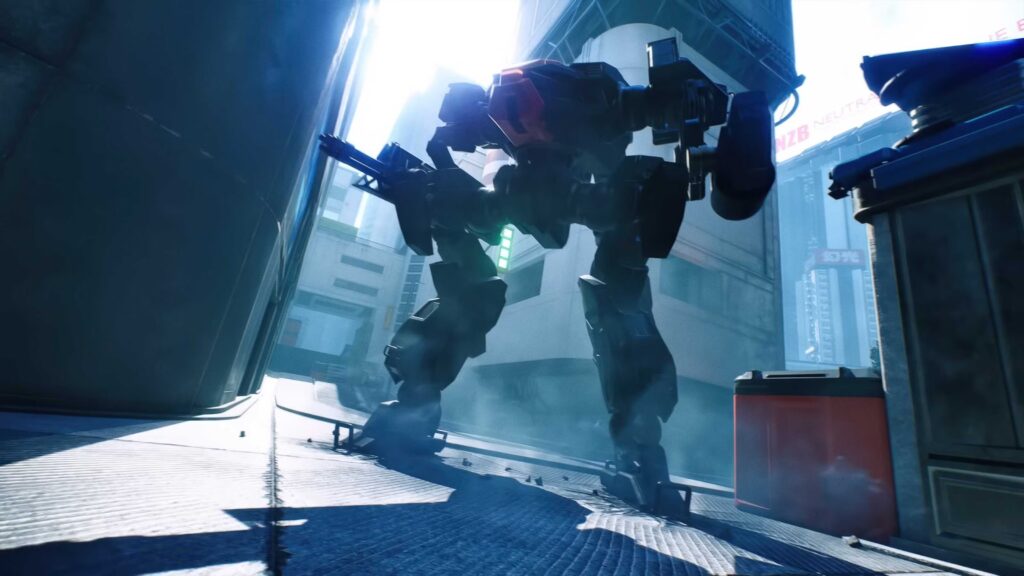
The biggest difference is how mechs enter a match. Titanfall allows individual players to earn and call down Titans through personal match progression. Empulse instead turns mechs into contested mid-map objectives. Two mechs spawn in the center of the map during a round, forcing both teams to fight for control. Whichever side claims them gains a major power advantage.
This changes the strategic role of mechs considerably. Rather than being a reward that every player eventually expects to receive, they become shared objectives that can influence the entire team’s decisions. Players may need to contest the spawn directly, defend approach routes, delay the opposing team, or choose whether another objective is more important. Mech control therefore resembles classic arena-shooter power-item control more than Titanfall’s individual Titan meter.
The comparison to fighting over a rocket launcher in classic Halo captures the intended idea. The difference is that this particular power weapon can walk, has a large health pool, and comes with its own set of offensive, defensive, and movement abilities. Once a team controls a mech, the balance of the fight can shift quickly.
Empulse mechs are equipped with several tools:
- Ramping chaingun for sustained fire
- Rockets for heavier ranged damage
- Heavy melee for close encounters
- Deployable bubble shield for defense and area control
- Charge jump that can lead into a shockwave slam
- Dash for repositioning despite the mech’s size
This gives mechs enough flexibility to do more than absorb damage. They can suppress opponents, punish exposed players, control important areas, withstand coordinated attacks, and move more aggressively than their size might suggest. Because access is limited and contested, securing one can become a defining moment in a match.
That structure also creates an important distinction between Empulse and Titanfall. Titanfall’s battlefield includes pilots, Titans, and, in some modes, AI soldiers, creating larger-scale chaos. Empulse appears more focused on compact 6v6 arena combat, where every individual player and objective decision carries greater weight. The smaller team structure may make matches easier to read competitively, but it also increases the importance of balance because losing control of a major objective such as the mechs could have an immediate effect on the entire team.
P.A.I.N.T. Bombs further separate the two games because Empulse lets players alter movement and combat surfaces during a match. Titanfall provides maps designed around movement, but players generally interact with the routes that already exist. Empulse gives them tools that can temporarily change how those routes function, adding a tactical environmental layer to the movement-shooter formula.
All of these systems depend heavily on Freehold, the futuristic city where Empulse takes place. Freehold is described as a post-utopian environment filled with vertical streets and districts deliberately constructed around wall-running, grappling, Holojumps, and P.A.I.N.T. Bomb interactions. The idea of a post-utopian city suggests a place once associated with technological progress or social perfection that has since become shaped by instability and combat.
That setting is particularly important for a movement shooter because map architecture directly determines how expressive traversal can become. A slower tactical shooter can rely heavily on flat corridors, lanes, and conventional cover. Empulse needs walls, elevated routes, gaps, launch points, angled surfaces, open spaces, and vertical sightlines that allow players to maintain momentum.
Freehold’s streets and districts therefore function as gameplay systems rather than decorative environments. Players are expected to think in multiple directions at once, considering what is above, below, behind, and across from them. A route that appears unreachable through ordinary movement may become possible through a wall-run connected to a grapple swing and then a Holojump. An ordinary-looking section of ground may become strategically valuable once a P.A.I.N.T. Bomb changes its properties.
That makes map knowledge a major part of the long-term skill ceiling. Learning basic routes may be enough to survive early matches, but experienced players could gain an advantage by understanding which walls preserve momentum, where grapple angles work best, which surfaces are ideal for P.A.I.N.T. effects, and how to approach the contested mech spawns without exposing themselves.
The result is a movement system where individual mechanics are designed to feed into one another. Wall-running creates alternative paths, grappling preserves or redirects momentum, Holojumps and jetpacks keep players airborne, P.A.I.N.T. Bombs modify the environment, and mechs introduce shared objectives capable of changing the flow of a round. While the Titanfall comparison is unavoidable because of the movement and mech fantasy, Empulse is building its own identity around contested mech control, 6v6 arena structure, environmental manipulation, and a Freehold map design intended to reward players who can turn the entire city into part of their combat toolkit.

Empulse Movement, P.A.I.N.T. Bombs, 6V6 Strategy, and Combat Loadouts
Mastering Empulse begins with understanding that speed only becomes an advantage when it is controlled. Moving quickly without a clear purpose can make a player easier to predict, track, or punish, while deliberate momentum creates new firing angles, breaks enemy expectations, helps escape unfavorable fights, and allows engagements to begin on better terms. The movement system is therefore built around chaining abilities together rather than treating wall-runs, grapples, Holojumps, slides, and P.A.I.N.T. effects as separate tools.
Steam’s gameplay description emphasizes combinations such as grappling into a wall-run, swinging into a Holojump, and sliding across Speed P.A.I.N.T. These transitions are important because the strongest routes are likely to be those that preserve momentum from one action into the next. Players should think less about individual movement buttons and more about how each mechanic can create the setup for another.
Height control is another major part of movement mastery. Wall-running above an opponent, launching through a Holojump, or grappling around elevated cover changes the enemy’s aiming angle and can create brief positional advantages. Remaining airborne for too long may also become predictable, however, so effective movement is likely to depend on changing elevation rather than simply trying to stay above everyone. Moving between ground level, walls, rooftops, and aerial routes can make a player considerably harder to track.
Route creativity becomes even more important because Freehold’s surfaces can be altered with P.A.I.N.T. Bombs. Steam identifies five types:
- Jump P.A.I.N.T.
- Speed P.A.I.N.T.
- Explosive P.A.I.N.T.
- Heal P.A.I.N.T.
- Sticky P.A.I.N.T.
Jump P.A.I.N.T. appears designed to create launch opportunities that can help players reach high ground, dodge threats, surprise defenders, or continue a movement chain. Speed P.A.I.N.T. appears focused on accelerating travel across affected surfaces, making it useful for fast rotations, aggressive pushes, chases, or escapes.
Explosive P.A.I.N.T. adds a more direct offensive element and may be useful for creating dangerous areas around objectives or punishing enemies moving through particular routes. Heal P.A.I.N.T. can potentially support defensive positions, recovery paths, and team survival, while Sticky P.A.I.N.T. may interfere with enemy movement by slowing, trapping, or otherwise disrupting momentum. The exact behavior of these effects may continue to evolve during Early Access, but their broader purpose is clear: they allow players to reshape how a fight moves through the environment.
That makes P.A.I.N.T. Bombs more than conventional equipment. In many shooters, movement skill is mostly about mechanical execution within a fixed map. Empulse adds another tactical layer by allowing players to modify surfaces before or during an engagement. A well-placed P.A.I.N.T. Bomb can create a new flank, help teammates push, deny an approach, support recovery, or change the conditions around a contested mech spawn.
Winning 6v6 matches will therefore likely require more than individual movement skill. Objective timing, team coordination, route control, and mech positioning all matter because every player represents a significant portion of the team. One player taking an ineffective route, wasting important utility, or ignoring a major objective can create a noticeable disadvantage.
One of the most important team priorities is controlling the middle of the map before mechs appear. Because mechs spawn as contested objectives, teams benefit from preparing the surrounding area rather than reacting only after the machines arrive. Useful preparation can include controlling nearby routes, watching vertical entrances, placing P.A.I.N.T. effects in advance, and forcing opponents away from favorable positions.
Moving in connected pairs or small groups can also create stronger results than constantly chasing isolated duels. Empulse rewards individual mechanics, but coordinated players can trade damage, collapse on targets, and secure objectives more consistently. Grapple routes, wall-runs, and Holojumps are therefore most effective when they contribute to team pressure rather than simply producing flashy movement.
Players also need to respect how many directions an attack can come from. Traditional FPS habits such as holding one horizontal angle may become less reliable when opponents can approach from rooftops, walls, altered surfaces, launch points, and aerial routes. Constant awareness of vertical movement and audio cues is likely to be essential, especially around important objectives.
P.A.I.N.T. Bombs should also be used before a fight has already collapsed. Their greatest value may come from shaping an engagement early:
- Speed surfaces can enable a fast team push.
- Heal surfaces can strengthen a defensive hold.
- Explosive surfaces can deny a route or choke point.
- Jump surfaces can create unexpected attack angles.
- Sticky surfaces may interfere with enemy movement before they reach an objective.
Waiting until the team is already overwhelmed can reduce these tools to emergency reactions rather than deliberate tactical advantages.
Weapons and loadouts add another layer to this movement-focused combat system. Empulse remains in Early Access, so weapon balance and available loadouts may change, but Steam confirms broader progression through weapons, account leveling, challenges, events, and unlockable content. This suggests weapon selection is part of a longer progression structure rather than being limited entirely to temporary pickups during a match.
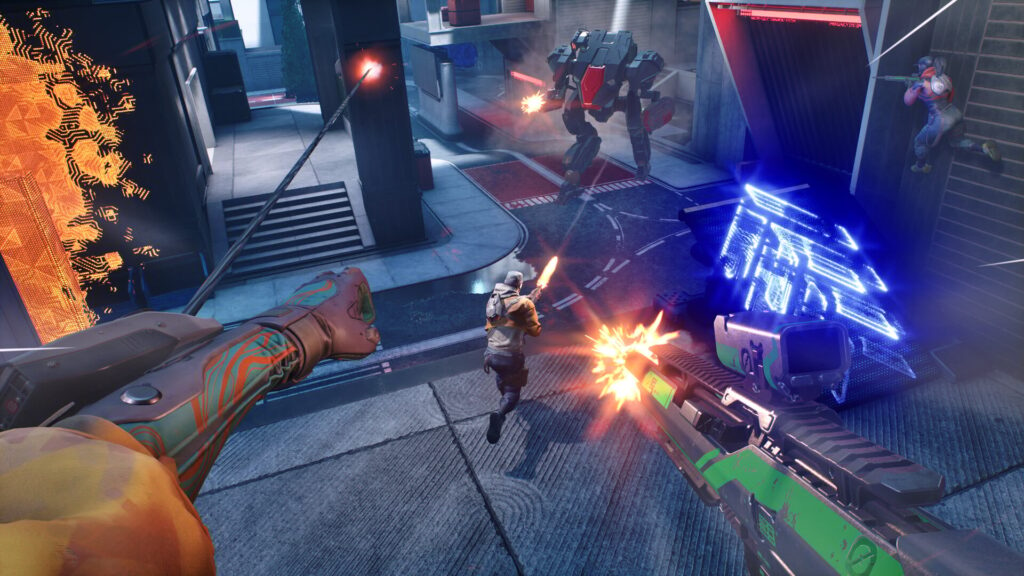
Pilot combat appears to combine conventional FPS gunplay with constant movement-based repositioning. Gameplay coverage has shown players firing while wall-running, sliding underneath mechs, and fighting at high speed, meaning weapon responsiveness and readable damage feedback are particularly important. A weapon that works well while standing still may feel completely different when used during grapples, wall-runs, slides, or aerial transitions.
The most effective pilot loadouts will therefore likely depend on movement style. Aggressive players may prefer weapons suited to close-range grapple attacks and rapid flanks. Others may favor mid-range weapons that remain accurate while maintaining wall pressure, while objective-focused players could build around team support and P.A.I.N.T.-based positioning.
Mech combat is more clearly defined through the currently described equipment. A claimed mech can use:
- Ramping chaingun for sustained pressure
- Rockets for heavier ranged attacks
- Heavy melee against nearby opponents
- Bubble shield for defense and space control
- Charge jump with shockwave slam for aggressive entry
- Dash for repositioning
This gives mechs several battlefield roles rather than turning them into slow damage sponges. The chaingun can pressure exposed routes, rockets can punish targets caught in the open, melee can clear nearby enemies, and the bubble shield can secure or defend important space. The charge jump and dash also help the machine reposition despite its larger size.
For pilots, the main skill gap may ultimately come from combining accurate shooting with uninterrupted movement. Being able to maintain aim while wall-running, grappling, launching, or sliding could separate experienced players from those who rely only on raw speed. Empulse’s combat system is therefore built around the idea that movement, weapons, utility, and objectives should constantly interact, with the most effective players using Freehold itself as part of their loadout.
Why Titanfall Fans Are Watching Empulse, from 6V6 Multiplayer to PC Requirements and Early Access
Empulse is attracting attention from Titanfall fans because few modern shooters combine wall-running, grappling, vertical combat, fast gunplay, and mech warfare in the same way. Titanfall 2 remains highly regarded for making movement feel fluid and expressive, and Empulse is entering that space at a time when many FPS players still want a multiplayer shooter built around momentum and mechanical freedom rather than slower tactical positioning. 1047 Games has described Empulse as an answer to players asking for more movement, more verticality, and more ways to express themselves during combat, which directly addresses the qualities many Titanfall fans have been missing.
The appeal extends beyond Titanfall nostalgia. Empulse also recalls the faster, more chaotic energy of older arena shooters, with frantic gunfights, wall-running, and giant mech encounters creating a style closer to Xbox 360-era arcade FPS design than many contemporary shooters. 1047 Games already demonstrated with Splitgate that it understands how unusual traversal mechanics can completely change how players think about maps and positioning. Empulse replaces Splitgate’s portals with wall-runs, grapples, P.A.I.N.T. surfaces, vertical movement, and contested mechs, but the underlying philosophy remains similar: movement should fundamentally change how players interact with space.
Its multiplayer structure is built around 6v6 team combat, with Early Access confirmed to include multiple maps and modes, a ranked playlist, challenges, weapon progression, account leveling, and events. Not every mode has been fully detailed, but the presence of ranked play shows that 1047 Games intends to support competitive matchmaking from the beginning rather than treating it as a later addition.
Mech control is expected to remain an important strategic layer across matches. Because mechs appear as contested objectives instead of personal rewards, teams must decide when to rotate toward the center, when to hold surrounding routes, when to sacrifice another position, and when to commit resources to securing them. Even when individual game modes have different objectives, the presence of mechs can create a recurring battle over map control and timing.
Team coordination becomes particularly important because movement shooters can quickly become chaotic when every player operates independently. Empulse gives coordinated groups several ways to combine their abilities. One teammate could create a Speed P.A.I.N.T. route, another could grapple into high ground to pressure defenders, and a mech pilot could advance while teammates cover routes that enemies might use to counter the machine. Wall-runs, Holojumps, surface manipulation, and mech pressure therefore become more effective when they contribute to a shared team plan rather than isolated individual plays.
Ranked multiplayer could become a major part of Empulse’s long-term appeal if its competitive systems remain readable and balanced. A movement-heavy ranked shooter depends heavily on responsive hit registration, understandable maps, fair matchmaking, objective incentives, stable networking, and effective anti-cheat protection. Steam lists RedKard kernel-level anti-cheat, alongside online PvP and cross-platform multiplayer support.
Empulse’s PC system requirements are relatively accessible for a modern competitive shooter. The listed minimum requirements are:
- Operating system: Windows 10 64-bit
- CPU: Intel Core i3-6100, Intel Core i5-2500K, or AMD Ryzen 3 1200
- Memory: 8 GB RAM
- GPU: NVIDIA GeForce GTX 960 or AMD Radeon RX 470
- DirectX: DirectX 11
- Internet: Broadband connection required
The recommended specifications increase the target moderately:
- Operating system: Windows 10 or Windows 11 64-bit
- CPU: Intel Core i5-6600K, Intel Core i7-4770, or AMD Ryzen 5 1400
- Memory: 12 GB RAM
- GPU: NVIDIA GeForce GTX 1060 or AMD Radeon RX 580
- DirectX: DirectX 11
- Internet: Broadband connection required
These requirements suggest that 1047 Games is targeting a broad hardware range rather than designing Empulse only for high-end PCs. That matters because rapid movement places more pressure on frame rate, input latency, and visual clarity than slower shooters. Players need to track opponents accurately while they wall-run, grapple, launch through the air, and fight around mechs, so inconsistent performance could directly undermine the game’s strongest mechanics.
The planned PS5 and Xbox Series X|S versions also suggest that scalability is part of the development approach. Console players will expect responsive controls, clear visuals, and smooth performance, while the relatively modest GTX 960 minimum and GTX 1060 recommended PC targets indicate that older systems may still be able to participate without sacrificing the competitive readability the game requires.
Whether Empulse ultimately becomes a spiritual successor to Titanfall will depend on how well these systems work together. It already contains many of the elements that make the comparison attractive: fast movement, wall-running, grappling, vertical maps, mechs, and a developer experienced with movement-focused FPS design. However, its strongest opportunity is not to copy Titanfall directly. Empulse is building a different identity around 6v6 arena combat, contested mech spawns, Freehold’s vertical districts, and the ability to reshape surfaces with P.A.I.N.T. Bombs.
Those differences also create the game’s biggest balancing challenges. If mechs are too dominant, pilot movement could become secondary whenever one appears. If pilots can eliminate them too easily, fighting over mech spawns may lose its importance. P.A.I.N.T. Bombs create a similar problem: if surface manipulation is too powerful, matches could become difficult to read, but if the effects are too weak, one of Empulse’s most distinctive mechanics may feel unnecessary.
Early Access will therefore be particularly important for refining the relationship between pilots, mechs, weapons, movement, map design, and P.A.I.N.T. effects. 1047 Games plans to expand the game with additional maps, weapons, modes, mechs, and alternate playstyles based on community feedback. If that process produces balanced systems and a steady flow of new content, Empulse could develop the loyal player base that movement shooters often depend on while establishing itself as more than a Titanfall-inspired nostalgia project.

Frequently Asked Questions (FAQs)
- What is Empulse?
Empulse is a fast-paced 6v6 movement shooter developed by 1047 Games. Its combat revolves around advanced traversal and momentum, using wall-running, grappling, Holojumps, P.A.I.N.T. Bombs, and player-controllable mechs. Matches take place across the futuristic environment of Freehold, where vertical map design is intended to make movement part of the combat itself. - Why is Empulse being compared to Titanfall?
The comparison comes from Empulse’s emphasis on fast traversal, vertical combat, wall-running, grappling, and powerful mechs. These are all features strongly associated with Titanfall’s movement-focused FPS design. 1047 Games has also acknowledged Titanfall as a direct inspiration, although Empulse introduces its own systems such as contested mechs and P.A.I.N.T. Bombs. - When is Empulse coming out?
Empulse is scheduled to enter Early Access on June 24, 2026. Steam lists 24 Jun, 2026 as the planned release date, marking the beginning of a development period in which additional content and balance changes can continue based on player feedback. - What platforms will Empulse be available on?
Empulse is listed for Steam, PlayStation, and Xbox. Reports specifically identify PC, PlayStation 5, and Xbox Series X/S as the platforms associated with the Early Access release. - Does Empulse have mechs?
Yes. Player-controllable mechs are one of Empulse’s major gameplay features. They appear as contested objectives in the middle of the map, forcing both teams to fight for control. Securing a mech can provide a major power advantage and potentially change the momentum of a match. - How are Empulse mechs different from Titanfall Titans?
Titanfall generally allows players to earn and call down their own Titans through individual match progression. Empulse takes a different approach by spawning mechs as shared mid-map objectives. Both teams must compete for access, turning mech control into a team-wide strategic objective instead of a personal reward. - What are P.A.I.N.T. Bombs in Empulse?
P.A.I.N.T. Bombs are tactical tools that can alter surfaces and influence both movement and combat. Steam lists Jump, Speed, Explosive, Heal, and Sticky P.A.I.N.T. Bombs. Depending on the type used, they can create movement opportunities, support teammates, disrupt enemies, or change how players approach particular areas of the map. - Will Empulse have ranked play?
Yes. Steam states that the Early Access version will include several maps and modes along with a ranked playlist. Ranked play is intended to support more competitive 6v6 matches alongside the game’s broader multiplayer progression and events. - What are the minimum PC requirements for Empulse?
The minimum specifications include Windows 10 64-bit, 8 GB RAM, and either an Intel Core i3-6100, Intel Core i5-2500K, or AMD Ryzen 3 1200 processor. For graphics, the minimum requirement is an NVIDIA GeForce GTX 960 or AMD Radeon RX 470. - Can Empulse become the next Titanfall?
Empulse has the potential to become a spiritual successor if its movement, mechs, maps, combat balance, and post-launch development come together successfully. It already shares several qualities Titanfall fans value, but its long-term identity will depend on how well 1047 Games develops its own systems, maintains performance, expands content, and builds sustained player support.
Conclusion
Empulse is one of the most interesting new FPS projects of 2026 because it directly targets a space that many players believe has been underserved for years. It is not a slow tactical shooter, not a battle royale, and not a hero shooter built around ability cooldowns alone. It is a 6v6 movement shooter where speed, verticality, momentum, and mech control define the match.
The Titanfall comparison is unavoidable, but Empulse has enough original ideas to stand apart. Its contested mech system changes the way teams fight for power. Its P.A.I.N.T. Bombs add a surface-altering layer to movement and combat. Its Freehold setting gives the game a vertical playground built around chaining mechanics together. Its Early Access model gives 1047 Games a chance to refine the game with direct community feedback.
Empulse, In the vein of Titanfall, this 6v6 shooter, focused on movement and mechs, plunges us into the heart of fast-paced battles against other online players, but its future will depend on execution. If 1047 Games can balance pilots and mechs, keep movement expressive without making combat unreadable, support ranked play, and deliver steady updates, Empulse could become the movement shooter that Titanfall fans have been waiting for.
Sources and Citations
- Empulse Official Website
https://playempulse.com/ - Steam
https://store.steampowered.com/app/4323990/EMPULSE/ - Game Informer
https://gameinformer.com/2026/06/02/empulse-is-a-6v6-titanfall-2-like-fps-from-the-splitgate-devs - PC Gamer
https://www.pcgamer.com/gaming-industry/events-conferences/every-game-trailer-and-announcement-in-the-pc-gaming-show-2026/ - Games.GG
https://games.gg/news/empulse-early-access-launch-june-24/
Recommendations
- DC Reveals Ambitious Lineup of Comics for Pride Month 2026: Justice League: Dream Girls, Galaxy, Dreamer, and More
- How to Monetize Mobile Games: Proven Strategies for 2026
- The Binding Of Isaac: Rebirth Breaks Steam Records In 2026: Why The 2014 Indie Remake Is Bigger Than Ever
- Savannah Guthrie to Host Wordle Game Show from Jimmy Fallon and the New York Times
- Animal Use Protocol Official “Run, Run, Run” Teaser Trailer Breakdown: Story, Gameplay, Platforms, and Everything Confirmed so Far
- Dreamlight Valley Mythic Muses Vase Guide: How to Get the Secret Vase, All Muse Locations, and Crafting Steps Explained
- Invincible VS DLC 1 Launch Trailer Breakdown: New Fighters, Release Date, Gameplay Updates, and Season 1 Details Explained
- Warner Bros. Wants Bradley Cooper to Write, Direct, and Star in the Ocean’s Eleven Prequel
- Mewgenics: All the Joy of Breeding a Cat Army Without the Food and Kitty Litter Bills
- Toy Story 5 Trailer Teases Woody’s Big Return: Trailer Breakdown, Lilypad Villain, Cast & Release Date



































































































