






In This Article (7 sections)
Ferine VFX Breakdown, Black Jaguar Concept Development, and EDI’s Anatomical Modeling Process
Ferine VFX breakdown footage reveals an unusual acting decision at the center of Andrea Corsini’s horror film. A black jaguar enters a house and confronts Irene, played by Carolyn Bracken. Although the animal possesses the physical strength to overpower her, the most consequential moment occurs when it decides to retreat. This encounter explains why EDI Effetti Digitali Italiani spent several months studying feline anatomy, refining the creature’s facial features, and determining how its dark coat should respond to light. The visual effects team needed to create more than a convincing predator. Its behavior had to communicate a recognizable emotional response to another character, despite the animal never physically appearing alongside Bracken during filming.
Under VFX supervisor Gaia Bussolati, EDI developed the jaguar using an existing digital tiger model as a starting point before modifying its anatomical structure and simulating the tissues beneath its short fur. Real animal observations, physical references, and material samples collected during filming contributed to the creature’s development. EDI subsequently released two videos documenting the production process, both available through Sky.
The longer making of video runs for six minutes and 14 seconds, featuring Corsini and the visual effects team discussing concept development, anatomical modeling, facial expressions, and lighting. The shorter breakdown runs for one minute and 52 seconds, concentrating on the visual progression from skeleton and muscles to the finished creature. EDI also published its crew interview on LinkedIn, accompanied by a transcript explaining several stages of production.
Creating a digital jaguar gave Corsini precise control over its movements, gaze, posture, and reactions. Ferine follows Irene, a wealthy art collector whose response to tragedy reveals increasingly violent instincts. Caroline Goodall portrays Dama, a trafficker in exotic predators searching for an escaped animal who becomes fascinated by Irene. The confrontation inside the house requires the jaguar to respond convincingly to Irene rather than simply behave like a threatening animal. Corsini and producer Giorgia Priolo explained to Ciak that their research involved documentaries and visits to a zoo in the province of Bergamo. Studying real predators helped the director understand their size, movement, physical presence, and reactions to their surroundings.
The earliest concept for the predator involved a puma, but Bussolati explained that the production eventually selected a black jaguar as the creature’s dramatic requirements became clearer. Its heavier build provided a more imposing presence opposite Irene, while its dark coat allowed the filmmakers to control how much of its body remained visible in different lighting conditions. Art director Claudio Capellini collaborated with Corsini on key concept images that established the film’s visual identity.
According to the production team, the jaguar received more advance visual planning than almost any other element of the film. These illustrations helped determine the creature’s scale relative to Irene, the direction of its gaze, and how much of its anatomy could disappear into shadow without compromising the clarity of the encounter.
Finding suitable photographic references for black jaguars presented additional challenges. Bussolati explained that the team experimented with AI generated reference imagery during development, alongside studying photographs, documentaries, and real animals. These generated references formed part of the research process rather than replacing the modeling, rigging, animation, simulation, and lighting work required to produce the finished creature. Once the production settled on a jaguar, EDI reused a digital tiger model developed for previous work. The artists subsequently modified its skeleton, anatomy, and proportions until the resulting animal exhibited the physical characteristics associated with a jaguar rather than those of a tiger.
Jaguars possess broad heads, prominent cheeks, powerful square jaws, and muscular limbs. Accurately reproducing these characteristics was particularly important because the animal’s dark fur could obscure recognizable coat markings. Its silhouette needed to communicate the correct species even when viewers could see relatively little surface detail. The relationship between the head, chest, shoulders, and forelegs therefore became essential to establishing the animal’s identity. Facial proportions also needed to remain convincing from different camera angles, ensuring that the cheeks maintained their volume when the jaguar turned its head. Reusing the tiger model provided an existing foundation, but the artists relied on jaguar anatomy to determine how the final creature should appear and move.
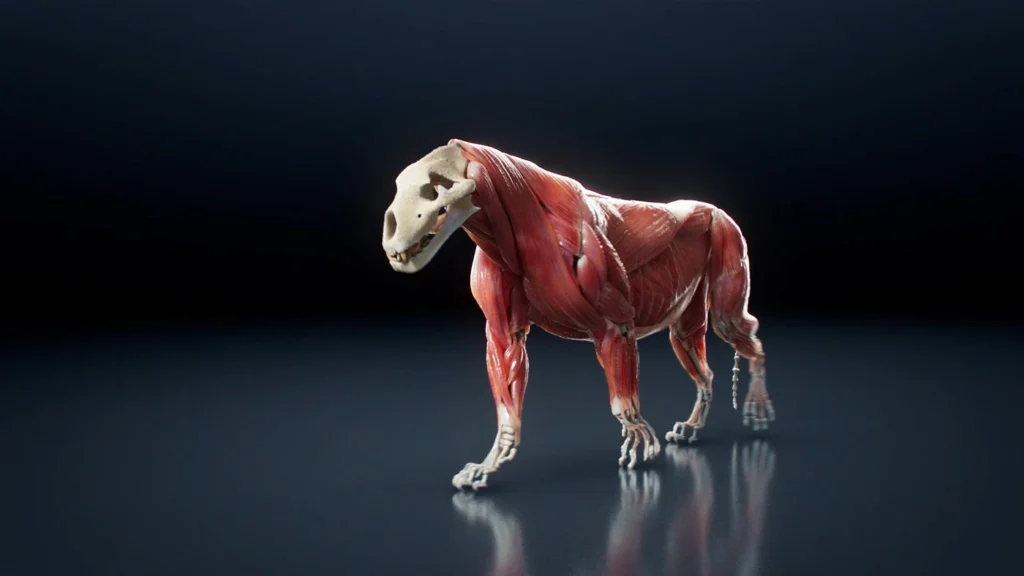
The shorter Ferine VFX breakdown demonstrates the principal stages of the creature’s construction:
- Skeletal structure: Established limb proportions, joint positions, and the underlying framework responsible for the jaguar’s movement.
- Muscle development: Added anatomical volume and defined how the creature’s body changed shape during movement.
- Connective tissue simulation: Introduced the interaction between muscles, fascia, fat, and skin.
- Surface modeling: Refined visible anatomical features, including facial folds, cheeks, and the muzzle.
- Character rigging: Provided controls for posing and animating the animal.
- Fur grooming: Established hair length, direction, density, and variations across the body.
- Shading and lighting: Determined how the coat, eyes, mouth, and other surfaces responded to light.
- Final compositing: Integrated the digital animal into the filmed environments and its interactions with Carolyn Bracken.
The relationship between the skeleton and muscle structure played an important role in communicating the jaguar’s physical weight. A planted forepaw establishes contact with the ground, but the movement of the body above it determines whether the creature appears to possess convincing mass. If the chest moves forward without corresponding changes in the shoulder, an otherwise accurate stride can appear weightless. EDI’s artists wanted sufficient control over muscle movement to preserve anatomical credibility while determining how strongly particular movements should register at different camera distances. This approach allowed the creature’s physical construction to support its performance rather than functioning solely as a demonstration of anatomical accuracy.
Jaguar Rigging, Tissue Simulation, Facial Expressions, and Interaction With Carolyn Bracken
EDI’s longer making of video includes footage of the jaguar’s character rig inside Autodesk Maya for Ferine. Giovanni Martini is credited as a rigger on the project, with the rig providing the controls necessary to pose the creature and animate its movements over time in Ferine. While modeling determines the appearance and physical structure of the animal, rigging allows animators to control how it moves within a scene. The distinction becomes particularly important during facial and bodily reactions in Ferine. An animator can determine when the jaguar turns its head toward Irene, how quickly the movement occurs, how long its gaze remains fixed, and how much of its body follows the change in direction.
Subtle differences in timing can significantly influence how an audience interprets the same physical movement in Ferine. A jaguar that shifts its feet before turning its head might appear to have already decided to leave. Alternatively, allowing its gaze to linger before moving its body can make the retreat appear to be a response to Irene’s behavior. These decisions illustrate why a convincing digital animal requires more than anatomically accurate locomotion. EDI needed to synchronize the creature’s performance with Bracken’s filmed reactions in Ferine, ensuring that the encounter communicated a meaningful relationship between the characters rather than appearing as two independent performances combined within the same frame.
The team also simulated several anatomical layers beneath the jaguar’s surface in Ferine, including muscles, fascia, fat, and skin. Fascia is connective tissue associated with structures beneath the skin, while fat provides softer volume over the more defined shapes of bones and muscles. Simulating these layers helps determine how strongly underlying movements should influence the visible surface. Without sufficient softness, every muscle boundary could appear excessively pronounced, giving the Ferine creature an unnatural anatomical appearance. Conversely, too much smoothing could remove the movement necessary to communicate muscular strength and physical weight. EDI needed to achieve a balance between these extremes.
This balance was especially important because jaguars possess relatively short fur. A longer coat could conceal some anatomical transitions between the shoulders, rib cage, and limbs, while the Ferine creature’s short hair closely follows its underlying body structure. Consequently, the behavior of simulated fat and connective tissue influenced the final appearance of the coat in Ferine. When the animal raised a foreleg or shifted its weight, changes beneath the skin needed to remain visible without making the surface look rigid or excessively muscular. The interaction between anatomical simulation and fur became an essential part of creating believable feline movement for Ferine.
Facial modeling received particular attention because Ferine introduces the jaguar through a close view of its face. Modeling supervisor Nicolò Granese identified the muzzle as an area where the artists deliberately adjusted wrinkles and volumes. The shape of the lips, fullness around the whiskers, and depth of folds beside the nose can influence whether an animal appears aggressive, alert, or relaxed. Excessively pronounced wrinkles might make the Ferine jaguar appear permanently threatening even during moments requiring a more restrained expression. The artists therefore needed facial details that maintained the creature’s physical identity while allowing its emotional presentation to change through movement and lighting.
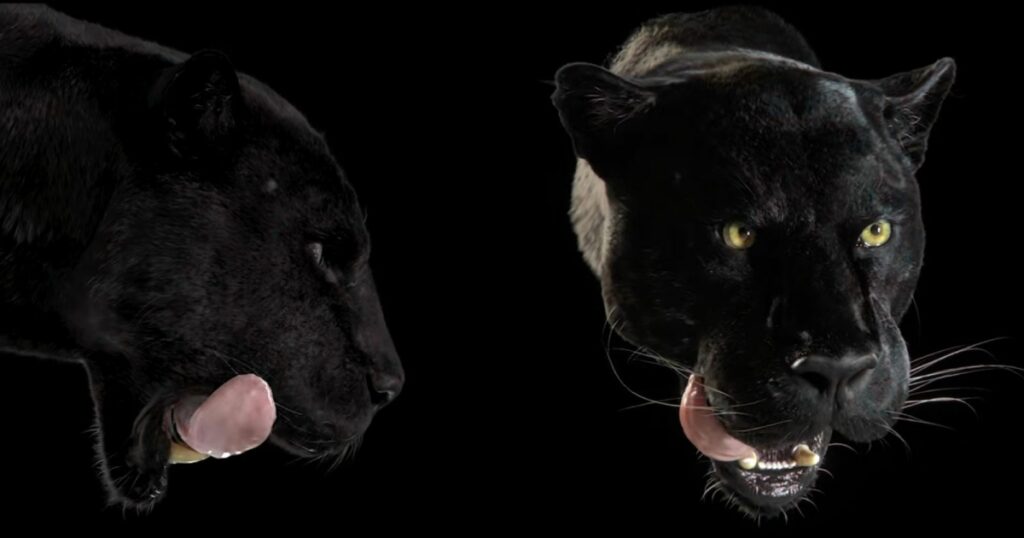
The mouth and eyes introduced additional challenges because their surfaces respond differently to light than fur. EDI devoted considerable attention to the teeth and saliva, which can produce sharp reflections within an otherwise dark mouth in Ferine. The eyes also received specialized treatment, including tools intended to reproduce caustics, which are concentrations of light created through reflection or refraction. These effects help the eyes retain a convincing appearance as the animal or its surrounding light sources move. Together, the soft fur, wet mouth surfaces, and responsive eyes create distinct material qualities that remain important during close views of the Ferine creature.
The confrontation between Irene and the jaguar represents the most important application of these technical developments in Ferine. Bussolati described the encounter as a turning point during which Irene recognizes her own strength. Bracken communicates that realization through her facial expression and posture, while the animal’s response provides visible evidence of her changing relationship with it. For the retreat to carry dramatic significance in Ferine, the jaguar must first appear capable of attacking. Its eventual decision to yield ground then becomes meaningful because the audience understands its physical power and recognizes that its behavior has changed in response to Irene.
Several practical references helped establish this interaction during filming:
- Physical dummy: Provided a reference for the jaguar’s size, head height, physical position, and relationship to Bracken within the frame.
- Parkour performer: Stood in for the predator during parts of filming, providing a moving presence that Bracken could react to.
- Live action photography: Established the camera perspective, environment, actor performance, and lighting conditions that the digital creature needed to match.
- Animal research: Supplied references for realistic feline posture, movement, weight distribution, and reactions.
- Early creature tests: Allowed the team to evaluate locomotion and anatomical behavior before integrating the jaguar into finished scenes.
The physical dummy had originally been conceived for a lighter colored animal, but it remained useful for establishing scale and composition after the production selected a black jaguar. The parkour performer provided a different form of reference by introducing movement and timing into the filmed encounter. Together, these practical elements helped Bracken maintain a convincing eyeline and respond to the space the digital animal would eventually occupy. EDI could subsequently position and animate the jaguar according to the encounter already established during filming, connecting the actress’s performance with the creature’s reactions during postproduction.

Black Jaguar Fur Grooming, Custom Shaders, Practical Lighting References, and Final VFX Compositing
Recreating the jaguar’s short black fur was one of the most demanding aspects of the Ferine visual effects project. EDI credits Luca Rossoni as the creature’s groomer, responsible for establishing how individual hairs and groups of hairs lay across the animal’s surface. Grooming involves controlling hair length, density, orientation, and changes in direction across different anatomical regions. Although real jaguars possess relatively short and stiff coats, their fur must still appear sufficiently soft to distinguish the animal from a painted sculpture. Small adjustments can have a substantial effect because the coat closely follows the underlying bone structure and muscular contours.
The cheek and muzzle illustrate the importance of precise grooming. Excessively dense hair along the outer edge of the cheek could make the head appear wider than the underlying anatomical model. Similarly, hair arranged too uniformly across the muzzle could obscure the transition between the snout and cheek. These differences become particularly noticeable under moving light because groups of hairs facing a light source reflect it differently from neighboring areas. Grooming decisions therefore influence both the perceived shape of the creature and the way its surface responds to illumination. Evaluating the groom through animated lighting tests provides information that a still image cannot communicate.
The black coat created additional difficulties during Ferine’s darker sequences. A dark animal standing against a similarly dark background offers limited visual separation, but simply increasing its overall brightness could make the fur appear gray or suggest that the creature occupies different lighting conditions from its surroundings. EDI reconstructed the lighting from the live action set before introducing additional digital light sources intended to reveal specific reflections across the jaguar’s body. This gave the artists greater control over which anatomical features remained visible without unnecessarily illuminating the entire creature.
Lighting also supported the dramatic requirements of individual scenes. A narrow highlight along the cheek could establish that the jaguar had turned its head while leaving the opposite side of its face almost entirely concealed. A reflection travelling across its back could communicate movement before the audience could clearly see its feet. In a forest sequence, partial visibility could help establish uncertainty about the creature’s position. During its confrontation with Irene, however, the direction of its gaze needed to remain sufficiently clear for viewers to understand the interaction. These choices had to complement cinematographer Fabrizio La Palombara’s photography, which received Fantasia’s 2026 Cheval Noir award for cinematography.
EDI developed a custom fur shader to achieve the appropriate appearance of the jaguar’s coat. A shader determines how a digital material responds to light, including how strongly it reflects illumination and how those reflections appear across its surface. The artists encountered challenges at opposite ends of the adjustment. Insufficient reflection made the creature’s shape difficult to distinguish, while excessive reflection produced an undesirable metallic appearance. The intended result was a dark coat with a natural sheen that followed the orientation of the hairs and changed as either the animal or surrounding lights moved.
The difference between fur and a smooth surface becomes particularly apparent across curved areas such as the shoulders. A polished material can produce a continuous, sharply defined reflection, whereas fur consists of numerous fibers facing slightly different directions. Their combined response creates highlights that can soften, spread, or break apart according to the underlying anatomy and hair orientation. Achieving this behavior required coordination between grooming, shading, and lighting. The groom established the direction of the hairs, the shader determined their response to illumination, and the lighting artists selected which contours should become visible within individual shots.
To support these decisions, EDI introduced small balls of differently colored fur known as gremlies during filming. On set VFX supervisor Gianluca Dainese used these samples to document how the existing lighting affected furry surfaces, particularly within darker environments where the digital animal would be added later. Their rounded shape allowed a single reference image to capture directly illuminated fibers, gradual transitions into shadow, and narrow highlights appearing around the outer edges. These practical recordings provided the postproduction team with evidence of how real fur responded to the actual photographic conditions.
The fur samples were photographed alongside color charts, giving the artists two complementary forms of visual reference. Color charts contain known colors and neutral tones that help establish how exposure and lighting affect recorded values. Fur samples provide additional information about individual fibers, tiny shadows, directional reflections, and material response. If a black fur sample appeared unexpectedly bright while the darker chart patches also appeared lighter, artists could investigate the overall exposure. If the chart appeared consistent while only particular fibers became brighter, the localized reflection was more likely to represent a natural material response that needed to be reproduced digitally.
The early creature tests and finished composites illustrate how these technical processes contributed to the final performance. Against a neutral gray background, viewers can easily follow the movement of the paws, shoulders, back, and head. The exposed skeletal and muscular passes help explain the anatomical causes of these movements. Once the fur is applied and the creature enters the darker filmed environment, many of those details become less obvious. The finished shot must nevertheless preserve enough movement and reflected light for the audience to recognize the animal’s weight, direction, and behavior.
EDI Effetti Digitali Italiani’s work on Ferine demonstrates how anatomical modeling, tissue simulation, character animation, fur grooming, and practical lighting references can contribute to a convincing digital creature. The finished jaguar reflects months of coordinated artistic and technical development.
Ultimately, the creature’s success depends on its performance opposite Carolyn Bracken. By making the predator’s strength, attention, and eventual retreat believable, EDI transformed an anatomically detailed digital asset into an essential participant in the film’s storytelling.
Frequently Asked Questions (FAQs)
- Is the black jaguar in Ferine real?
No. The jaguar appearing in the finished feature film is entirely computer generated by EDI Effetti Digitali Italiani. The artists studied real animals, documentaries, and photographic references while using practical stand ins during filming. Its final anatomy, movements, facial expressions, fur, and lighting were created through digital visual effects. - Who supervised the jaguar visual effects?
Gaia Bussolati supervised the visual effects for EDI Effetti Digitali Italiani, with Marco Russo and Francesca Granatino credited as VFX producers. The project involved specialists responsible for anatomical modeling, character rigging, animation, tissue simulation, grooming, shading, on set supervision, and compositing. - Which Ferine does the breakdown cover?
The breakdown covers Andrea Corsini’s feature film starring Carolyn Bracken and Caroline Goodall, released in Italian cinemas on November 5, 2026. Corsini previously directed a short film with the same title, which screened at Venice Critics’ Week in 2019 and subsequently formed the basis for the feature. - Why do accounts of the production mention a puma and a tiger?
The puma was initially considered for the predator’s role before the filmmakers selected a black jaguar. The tiger was an existing digital creature developed by EDI that provided a starting point for construction. Artists subsequently modified its skeletal structure, proportions, and anatomical features to reproduce the characteristics of a jaguar. - Can real black jaguars still have spots?
Yes. Black jaguars retain the characteristic rosette markings associated with the species. Melanism produces darker pigmentation that can make these patterns difficult to distinguish, particularly under limited lighting. Suitable illumination can reveal the markings, making photographs captured under different conditions useful references for creature artists. - What software is identifiable in the Ferine VFX breakdown?
Autodesk Maya is visibly featured during the demonstration of the jaguar’s character rig. Its controls allow animators to pose the creature and adjust its movements. The production also involved specialized processes for tissue simulation, fur grooming, material shading, and eye effects, although the breakdown does not identify every software package used. - What did Carolyn Bracken act opposite on set?
The production used a physical dummy to establish the jaguar’s size, position, and relationship to Bracken within the camera frame. A parkour performer also stood in for the creature during parts of filming. These references helped establish realistic eyelines, movement timing, and spatial relationships before EDI added the digital animal. - Did EDI use artificial intelligence during development?
Yes. VFX supervisor Gaia Bussolati described experimenting with AI generated reference imagery while researching black jaguars. However, this was one component of a broader reference process involving real animals, documentaries, existing digital models, and practical fur samples. The finished creature was produced through detailed modeling, rigging, animation, simulation, grooming, and compositing. - How long did EDI work on the jaguar?
EDI described several months of development involving anatomical refinement, movement tests, facial modeling, tissue simulation, and fur development. Andrea Corsini and producer Giorgia Priolo also discussed the broader production effort with Ciak, which reported that approximately 50 professionals contributed to the film’s visual effects work. - Which version of the breakdown shows the anatomy most clearly?
The one minute and 52 second breakdown provides the clearest visual comparison between the jaguar’s skeleton, muscles, skin, and finished fur. The longer six minute and 14 second making of video offers more detailed explanations from the production team, covering anatomical decisions, facial modeling, lighting challenges, and practical references collected during filming.

Conclusion
EDI Effetti Digitali Italiani’s work on Ferine demonstrates how anatomical modeling, tissue simulation, fur grooming, and lighting contribute to a convincing digital creature. The jaguar’s realistic movements and carefully controlled expressions allow its confrontation with Irene to carry genuine dramatic significance.
From adapting an existing tiger model to photographing physical fur samples, EDI combined detailed digital techniques with practical references. The finished jaguar demonstrates how technical precision can support visual storytelling and believable character performances.
Sources and Citations
- EDI Effetti Digitali Italiani, Ferine Project and Black Jaguar Making Of: Official production credits and technical resources covering concept development, anatomical modeling, rigging, tissue simulation, grooming, shading, and lighting.
- Citation: EDI Effetti Digitali Italiani
- Sky Video and Sky TG24, November 9, 2026: Visual-effects breakdowns and interviews documenting the jaguar’s construction, facial refinement, movement tests, night lighting, and its confrontation with Irene.
- Ciak Magazine, December 2, 2025, and Media Key, November 9, 2026: Filmmaker interviews discussing animal research, practical stand-ins, the change from a puma to a jaguar, and experiments with AI-generated reference imagery.
- Citation: Ciak Magazine · Media Key
- CG Channel, November 12, 2026, and 80 Level: Technical reporting covering the Autodesk Maya rig, reused tiger model, facial sculpting, connective tissue simulation, custom fur shader, and practical lighting references.
- Citation: CG Channel · 80 Level
- Fantasia International Film Festival, 2026: Official festival information documenting the cinematography award presented to Fabrizio La Palombara and the score award presented to Pino Donaggio.
- Citation: Fantasia International Film Festival
- International Society for Endangered Cats Canada, Wētā FX, Marschner and Colleagues, and Calibrite: Scientific and technical references covering jaguar anatomy, coat markings, digital tissue simulation, hair light scattering, and color chart calibration.
- Citation: [International Society for Endangered Cats Canada](https://www wildcatconservation.org/) · Wētā FX · Marschner et al. – Research Publications · Calibrite
Recommendations
- Understanding PixelHair: A Comprehensive Guide to Realistic 3D Hair Assets
- Game of Thrones: War for Westeros Delayed to Early 2027
- Nintendo Won’t Reimburse Buyers for U.S. Customs Duties
- Corsair Cove Challenges Players to Build a Pirate Empire and Defeat the Crown
- Runware Sonic Pods: $1B Interest and the 48-Hour Deployment Claim
- Leon Could Be 70 and Still Be a Great Character, Resident Evil Requiem Director Koshi Nakanishi Says
- Thief Designer Says Immersive Sim Audience Is Too Small for AAA Games
- Final Fantasy VII Revelation Premium Edition: Price, Early Access & DLC
- NUS and Tencent Player-1 Trains Game AI on Synthetic Experience
- Parkasaurus Guide: Build the Ultimate Relaxed Dinosaur Park



































































































