










In This Article (9 sections)
Football Manager 27 Tactical Effectiveness Explained: Understanding, Player Ability, Buy-In, and Opposition Information
Football Manager 27 introduces Tactical Effectiveness as a way to understand why a tactic that looks convincing on the tactics screen can break down on the pitch. A defender might know where the manager wants the ball played but lack the composure to make the pass under pressure. A striker might have the stamina to lead an aggressive press while the midfield behind him leaves an easy route out.
The same disappointing result can have different causes, and each calls for a different response. Tactical Effectiveness expands on the Tactical Familiarity system from previous Football Manager games by examining how well the selected players can carry out the manager’s ideas and how well the team has prepared for its next opponent.
Sports Interactive identifies four components within the system: Tactical Understanding, Player Ability, Player Buy-In, and Next Match Information. Together, they connect the tactics screen to decisions about training, recruitment, selection, dressing room management, and opposition scouting. When a capable squad underperforms, the interface can help narrow down where to look. If players are unclear about their pressing responsibilities, a focused training session may address the problem. If they understand the press but consistently lack the pace or stamina to sustain it, selection and role assignments deserve closer attention. The distinction matters because changing formation after every poor performance can give the squad more to learn while leaving the original weakness in place.
Tactical Understanding measures how well players recognise their responsibilities and how those responsibilities fit together. It covers passing style, defensive organisation, pressing behaviour, positional structure, and movement as possession changes. Consider a forward instructed to close down an opposition centre back. The forward needs to recognise when to go, a teammate has to block the obvious passing lane, and the midfield must move close enough to support them. If only the forward reacts, the opposition may escape pressure with a simple pass. Training can improve this coordination by rehearsing the actions the tactic actually requires. That is especially important when introducing a formation, integrating several signings, or asking familiar players to move differently in one phase of play.
Player Ability assesses whether the selected footballers possess the technical, mental, and physical qualities to perform those actions. A defender building from the back needs the first touch to control the ball, the judgement to identify an available teammate, and the passing ability to find them. Understanding the intended passing pattern will only take that player so far if an opponent closes them down.
The same applies at the other end. A striker can recognise the moment to press and still struggle to repeat the run throughout a match. When assessing the lineup, compare the demands of the role with the attributes of the player occupying it. A less celebrated teammate with the right combination of qualities may make the system work more reliably.
Player Buy-In reflects the squad’s willingness to support the manager’s approach. Results can suffer even when players understand a tactic and have the ability to execute it. An inexperienced manager arriving at a prestigious club may need time to establish credibility, while a manager associated with proactive attacking football may encounter different expectations when asking the same squad to defend conservatively.
Sports Interactive has explained that managerial tendencies can influence those reactions. The Dynamics area helps put them in context by showing the squad hierarchy, established social groups, and influential players. Fair decisions about playing time, appropriate praise, realistic promises, and consistent handling of dissatisfaction all affect the environment in which players are being asked to accept a tactical change.
Next Match Information measures how much the club knows about its upcoming opponent. Familiar domestic rivals may already be well understood, while an unfamiliar cup or international opponent can demand more preparation. Scouts and performance analysts can identify how a team builds attacks, where it presses, which spaces it leaves during transitions, and whether it is vulnerable at set pieces.
Their value depends on assigning the relevant responsibilities and reviewing the reports before selecting a response. An opponent whose full backs advance together may leave space for wide attackers after a turnover. A narrow defensive shape presents a different opportunity, since maintaining width may draw defenders away from the middle. Such details can be particularly valuable in a promotion battle, a knockout tie, or a fixture against stronger opposition.
These four components are easier to interpret once the team has a clear footballing identity. Decide how the squad can realistically progress the ball, create chances, defend space, and react to losing possession. A physically strong side with limited composure in defence might have a credible route to goal through direct passes and support around a forward.
Technically accomplished defenders and intelligent midfielders may give another side the option to build patiently. Use training, recruitment, and opposition reports to strengthen that approach, then check the indicators against competitive performances. Injuries, individual errors, opposition quality, and finishing can still decide a match. A single defeat offers much less reason to rebuild a tactic than the same weakness appearing across several fixtures.
Football Manager 27 Tactical Complexity, Tactical Understanding, and Training Schedules
Tactical Complexity reflects the demands created by the formation, team instructions, positional movements, and individual roles. An aggressive counterpress, coordinated rotations, and different attacking and defensive shapes can work together, but each adds decisions that players must make correctly and quickly. A manager taking charge of a new club should be able to identify what each instruction achieves. Does it give a defender a passing option, create a chance, protect space behind an attack, or help the team press together? If several instructions ask the same players to move in conflicting directions, adding detail can make the tactic less coherent. A sophisticated approach earns its place when the squad can use it to solve a recognisable problem.
The available players, coaches, and training time determine how much complexity is practical. A semi-professional side training only a few times between fixtures might get more out of a compact defence, direct passing, and clear forward movement. An elite squad may have the technical quality and preparation time for patient possession, coordinated high pressing, and rotations between positions.
At a new club, one approach is to establish a reliable attacking and defensive shape, then introduce additional demands as weaknesses become apparent. A manager can also commit to a more ambitious system immediately, accepting that performances may fluctuate while players learn and recruitment improves the squad. The distinction is between what the tactic could eventually achieve and what the current lineup can deliver on Saturday.
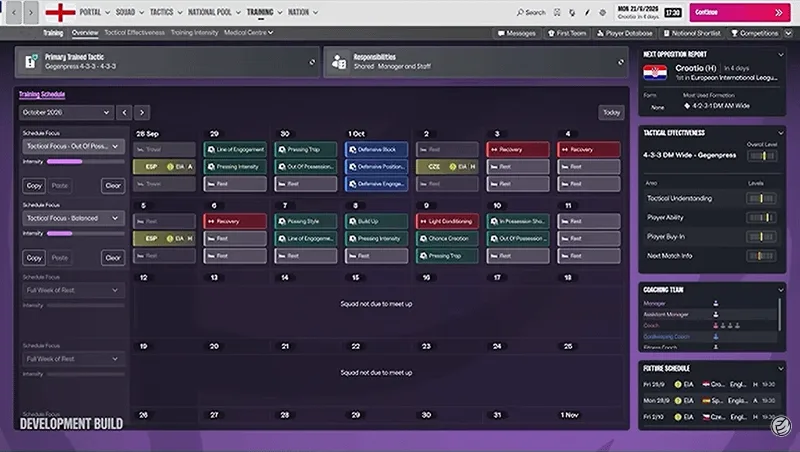
FM27 includes dedicated Tactical Understanding sessions for Passing Style, Build Up, Chance Creation, In Possession Shape, Line of Engagement, Pressing Intensity, Pressing Trap, and Out Of Possession Shape. Choose the session that corresponds to the recurring difficulty. A team unable to move possession beyond its defenders may need work on passing relationships and build up.
A team whose forwards press while the midfield stays deep may need to rehearse its line of engagement and defensive shape. Set the formation used most often as the primary trained tactic. An alternative is easier to maintain when it preserves familiar principles. A possession based 4-3-3 and a more conservative 4-2-3-1 can share passing patterns, midfield relationships, and defensive expectations even though the starting positions change.
Coaching quality and assignments also affect the squad’s preparation. There is no established number of sessions that guarantees complete Tactical Understanding. A settled squad learning a modest adjustment has a different task from several new signings learning an unfamiliar system. Football Manager 27 replaces the previous training Units system with categories including Tactical Understanding, Match Preparation, Footballing Development, Physical and Recovery, and Extra-Curricular sessions. Training is available through the main navigation bar, and schedules can be replicated to avoid rebuilding similar weeks manually. Before repeating a schedule, check the upcoming fixtures, who played the previous match, and which tactical problems still need attention. A useful week of training can become an excessive one when a second fixture is added.
The following schedules illustrate how preparation can change across the season.
- Preseason. Combine physical conditioning with introductory tactical work in the opening weeks, then give more time to attacking coordination, defensive organisation, and match preparation as competitive fixtures approach. Friendlies show whether the instructions work together. Watch who offers the first pass out of defence, whether the midfield supports the press, and how new signings respond when possession changes. These observations can guide the next sessions. Monitor recovery and injury risk as well, since carrying an unnecessarily heavy conditioning workload into the opening fixture can undermine otherwise sound preparation.
- One match per week. After a Saturday fixture, Sunday can be used for recovery, with rest or lighter activity on Monday according to player condition. Tuesday and Wednesday offer room for Tactical Understanding, individual development, and work on weaknesses from the previous game. Thursday can concentrate on the next opponent, while Friday is better suited to lighter preparation that preserves match readiness. The content of those sessions should reflect the team. A possession side struggling to escape its own third needs a different week from one regularly exposing its defence after both full backs advance.
- Two matches per week. With fixtures on Wednesday and Saturday, recovery and targeted match preparation take priority over a long list of physical or tactical objectives. Players completing full matches may need reduced workloads, while substitutes and unused squad members can have different conditioning needs. Identify the most important challenge in the next fixture and prepare for that. Trying to cover every opposition threat between matches can leave the regular starters too tired to execute the press, make recovery runs, or maintain concentration. Rotation and individual workload adjustments help preserve those capabilities.
- Lower league and semi-professional schedules. Limited sessions make it difficult to teach several unrelated systems at once. Prioritise the responsibilities that matter most to the club’s style, such as defensive spacing, passing options, and preparation for the next opponent. A team that relies on direct play needs to understand who receives the first ball and who supports the next action. Reproducing an elite club’s schedule offers little benefit if the players lack the time or technical qualities to carry out the work. Judge the schedule by what improves on the pitch and the condition in which players reach matchday.
Match Preparation offers more immediate work through Press Avoidance, Ball Progression, Final Third, Defensive Block, Defensive Positioning, Defensive Engagement, and set piece sessions. An opposition report describing an aggressive press gives the manager a reason to rehearse escaping the first line of pressure.
Against a deep block, final third movement and patient chance creation may be more valuable. Defensive positioning can take precedence against opponents with superior attackers, while set pieces provide another route to goal for teams struggling to create from open play. Select the challenge most likely to influence the fixture and give it enough attention to be useful. A schedule filled with a little work on every conceivable threat leaves limited time for the team’s own football.
Best Football Manager 27 Formations, Tactical Styles, and In-Possession and Out-of-Possession Systems
The best formation for a Football Manager 27 squad depends on what its players can do in possession, how they defend, and how comfortably they move between the two. Two teams shown as a 4-3-3 can play very different football. One might push both full backs forward and ask its midfield to protect the space behind them. Another might keep one full back deeper, allow a midfielder to advance, and progress through a different passing route. Start by considering who provides width, who connects midfield to attack, who protects the centre, and where the first pass can go after possession is recovered. Five familiar formations offer different answers to those questions.
- 4-3-3. A defensive midfielder can protect the centre backs while the other two midfielders provide passing options, carry play forward, and support attacks. Wide forwards can stretch the opposition or move inside when a full back supplies width. The shape suits possession football, coordinated pressing, and controlled attacking transitions, particularly when the midfield is mobile and the defenders are comfortable receiving the ball. Its main risk appears when both full backs advance and the midfield also moves beyond possession. A turnover can then leave the centre backs isolated, so establish who stays in a position to protect them.
- 4-2-3-1. Two deeper midfielders give the defence passing options and can protect it when wider players advance. The attacking midfielder links those players to the striker and wide forwards, making this a useful structure for a creative player who finds space between the opposition’s midfield and defence. The shape can also become compact without the ball. Its balance depends on what the deeper pair actually do. If both move forward while the full backs overlap and the attacking players stay high, the team can lose its short passing support and expose the centre in the same move.
- 4-4-2. Two strikers can occupy the opposition centre backs, attack crosses, and compete for second balls. Wide midfielders provide outlets in possession and can recover into a disciplined defensive line. These relatively straightforward relationships suit direct football and counterattacks, particularly when the forwards complement each other. The central pair can struggle against opponents playing three midfielders, however. Watch whether a striker helps screen a central passing lane or a wide midfielder moves inside when needed. Without that support, opponents can repeatedly play through the middle even when the two banks of four look well organised.
- 3-4-3. Three central defenders provide a base for progressing possession, particularly when some are comfortable passing from deeper positions. Wing backs can supply the attacking width and then recover to form a defensive line of five. This gives the forwards freedom to occupy more advanced areas, but the distance a wing back has to cover can be substantial. Stamina, mobility, positional awareness, and support from nearby teammates all matter. Check who protects the channel when a wing back is caught high and how quickly the team can reorganise before the opposition exploits that space.
- 5-3-2. Three centre backs and a compact midfield offer central protection against stronger opponents, while two forwards give the team potential outlets after a recovery. Wing backs can provide width when possession is secure or join a counterattack when space opens. The system can suit a squad with several reliable centre backs and hardworking midfielders. Its weakness emerges when the entire team retreats so far that the forwards cannot receive a pass with support. A sound defensive shape buys time, but the ability to retain or advance the next ball determines whether the opposition can sustain pressure.
FM27’s established tactical styles include Gegenpress, Control Possession, Tiki-Taka, Vertical Tiki-Taka, Wing Play, Route One, Fluid Counter-Attack, Direct Counter-Attack, Catenaccio, and Park the Bus. Managers can also build a custom system. Gegenpress asks players to coordinate their pressure and react quickly after losing the ball, which places considerable demands on work rate and physical condition. Possession styles need reliable passing relationships, good movement, and players who remain composed under pressure. A direct or counterattacking approach can suit a side that rarely controls possession against stronger opponents, provided it has someone capable of receiving the first pass and teammates ready to support the attack. A familiar preset still needs to be judged against the squad asked to use it.
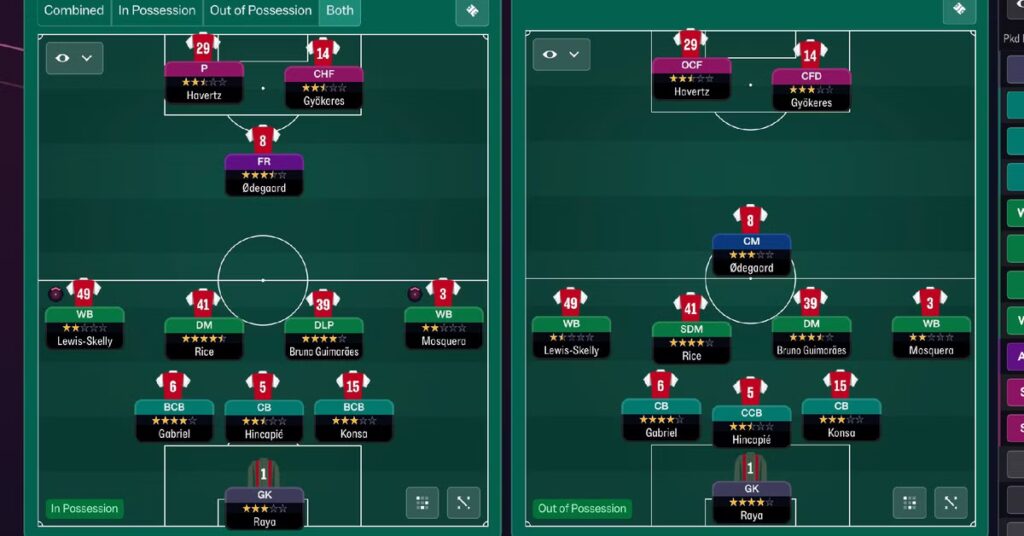
The separate in-possession and out-of-possession formations, introduced in FM26 and retained in FM27, allow a manager to specify how the team attacks and defends. A side might attack in a 4-3-3 and defend in a 4-1-4-1, with the wide attackers dropping into midfield and a holding player protecting the defence. Another could keep three players deeper during possession before returning to a more conventional defensive block. Separate roles for the two phases replaced the previous attack, support, and defend duty structure. A creative midfielder can therefore progress the ball in possession and screen the defence without it, while a wide attacker can occupy an advanced position during attacks and recover deeper when the opponent has the ball.
The transition between the two shapes is where an ambitious idea can break down. A full back moving into midfield, an inverted wide player, or a midfielder operating across several lines may have considerable ground to recover after a turnover. Use the formation views and tactical visualisation tools to examine where each player finishes an attack and how far they must travel to defend.
Rest defence describes the positioning of players behind and around the ball while their team attacks. Keeping a midfielder close enough to screen a forward pass, or asking one wide defender to stay deeper, can protect the centre backs without withdrawing every attacking option. The aim is to have enough cover at the moment possession changes, before everyone has had time to regain their defensive positions.
Finally, consider how the roles combine across the pitch. Several creative players moving into the same pocket can crowd one another, while too many cautious players can leave the ball carrier with nobody running ahead. A high defensive line places a premium on recovery speed, anticipation, and positioning. A deeper block may rely more heavily on concentration, aerial ability, and organisation. The goalkeeper’s distribution should suit the way the team builds, the midfield needs a balance of retention, progression, creativity, and cover, and the attackers need complementary routes to goal. Movement behind the defence, passing combinations, crosses, and direct deliveries are useful only if someone is positioned to take advantage of them.

FM27 Player Ability, Tactical Recruitment, Squad Selection, and Dressing Room Commitment
Recruitment in Football Manager 27 starts with identifying the actions a signing will need to perform. A club looking for a centre back to play through pressure has a different requirement from one defending deep and dealing with crosses. Both candidates may be accomplished central defenders, but their attributes can make them suitable for different jobs. Scouting information about tactical fit gives managers a way to look beyond reputation, overall ability, and familiarity with a position. That is particularly valuable on a restricted budget, where a comparatively inexpensive player who fits the system can contribute immediately. Over several transfer windows, recruiting more than one suitable option for an important role also makes injuries, suspensions, and rotation less disruptive.
For a possession system, assess passing, first touch, technique, and dribbling alongside anticipation, decisions, composure, concentration, positioning, and teamwork. A defender who receives the ball near their own penalty area must control it, recognise the pressure, and find the appropriate teammate before the route closes. A player with good passing but limited composure may still struggle in that situation. The goalkeeper also needs the distribution skills required by the chosen build up, and midfielders must offer angles that make a short pass practical. Training can improve the group’s understanding of these movements. Recruitment determines whether the players involved can execute them consistently when opponents challenge the first or second pass.
For a pressing system, look across the entire team. Stamina, work rate, teamwork, anticipation, acceleration, and mobility all contribute to sustained pressure. A striker with excellent finishing may still struggle to lead the press if repeated runs exhaust them. A wide attacker may produce impressive attacking numbers while leaving a full back with an easy escape pass whenever possession changes. Further back, defenders need enough recovery speed and positional awareness to deal with opponents who bypass the first line. Assess what each player does on both sides of the ball. The press depends as much on the players closing the next option and covering exposed space as it does on the forward making the initial run.
For a counterattacking or direct system, follow the move from recovery to chance creation. Defenders must stay organised through periods of opposition possession, midfielders need to recognise the opportunity for an early forward pass, and attackers require the anticipation and movement to exploit space.
Pace and acceleration are valuable, but several fast forwards can remain isolated if nobody can deliver the ball or support the next action. A physically strong striker who can receive a longer pass and bring a teammate into play may offer a different route out. When comparing targets, consider which part of the transition currently fails. Adding another runner has limited value if the team already makes good runs but repeatedly loses the first pass forward.
Separate attacking and defensive shapes make role suitability especially important. A gifted attacking midfielder might be the squad’s best chance creator but struggle when asked to cover a large area without possession. The manager can narrow that player’s defensive responsibility, change the surrounding midfield to provide cover, or select a more balanced teammate for a particularly demanding fixture. Similar decisions apply to full backs moving into midfield, wide attackers defending deep positions, and central midfielders expected to cover several lines. A player’s natural position tells only part of the story. Look at the actual runs, recovery distances, and decisions required in each phase before concluding that a signing or selection fits the tactic.
Check Tactical Effectiveness with the intended starting eleven selected. Community observations have highlighted the value of reviewing the actual lineup, especially when fatigue, injury, or a congested schedule forces several changes. Feedback for the strongest side may tell a different story from the team that will play the next match. A replacement might be comfortable in the same nominal position yet lack the starter’s passing range, recovery speed, or understanding with the player alongside them. An adjustment to a nearby role can preserve the main system while making the replacement’s task manageable. Squad depth is more useful when the manager understands which responsibilities can carry over and which need to change.
Personality and adaptability deserve attention alongside attributes. Scouting information can indicate how readily a signing might settle or whether their expectations could conflict with the existing squad. Even a good personality assessment leaves work to do. New players must learn their teammates’ movements, establish relationships, and gain enough competitive experience to coordinate under pressure. Bringing in several talented players at once can therefore create difficulties for both Tactical Understanding and Player Buy-In. The Dynamics area is useful during that transition. A respected team leader can influence how others respond to a change, while unresolved frustration over promises or playing time can spread beyond the individual involved.
Dressing room commitment is easier to maintain through everyday decisions than to rebuild after a poor run. Give appropriate feedback on training and performances, manage playing time consistently, and make promises that the club can realistically honour. For lower league managers, that same realism applies to tactical ambition. If the available defenders and midfielders cannot reliably play through pressure, a simpler structure can make better use of their current strengths while recruitment gradually improves the options. As suitable players arrive and understanding grows, introduce the more demanding instructions they make possible. The club can work towards an ambitious style without asking the present squad to perform tasks it has neither the personnel nor the preparation time to master.

Football Manager 27 Matchday Tactical Adjustments, Common Mistakes, and How to Improve Performance
Effective matchday management starts by identifying a pattern. Conceding from an individual error or an outstanding finish gives relatively little information about the overall tactic. Seeing the same defender lose possession in the same area three times tells the manager where to look. Use match footage, player positions, passing patterns, and statistics together to establish what happens before the problem. Is the defender short of options, receiving in a difficult position, or attempting a pass beyond their technical ability? Each explanation points towards a different adjustment. Changing mentality, formation, passing, and pressing all at once makes it harder to judge which decision addressed the weakness and which introduced another.
Against aggressive opposition pressing, examine the options available to the goalkeeper, defenders, and midfielders before the ball is lost. If the opposition repeatedly closes the usual short route, bringing a midfielder closer or changing an attacker’s movement may create an alternative passing angle. More direct distribution can bypass the first pressing line, particularly when a forward can receive the delivery and bring support into play. Follow what happens to the next ball, however. Clearing the initial pressure achieves little if an isolated striker immediately loses possession and the opposition begins another attack. A useful adjustment gives the team a realistic way to sustain the move after escaping its own third.
Against a deep defensive block, focus on the quality of chances. A narrow opponent can concede possession and allow plenty of shots while protecting the most dangerous central spaces. Check whether wide players are stretching the defence, whether anyone moves between its lines, and whether a supporting midfielder offers a passing angle the defenders must react to.
An adjustment to width, a different run from midfield, or a creative substitute can give the opposition a new decision to make. If the team is already taking numerous shots from poor positions, greater patience may help more than raising the attacking mentality. The purpose of the change is to create a better opportunity, not simply to reach the same crowded area sooner.
When conceding repeated counterattacks, rewind to the team’s positions before it lost the ball. If attacks repeatedly develop down one flank, an advanced full back may need cover or a more conservative responsibility. If opponents play directly through midfield, retaining a screening player behind the attack may close that route. Balls played behind the centre backs raise a different question about the defensive line, the pace of the opposition forwards, and the defenders’ ability to recover. Identify which route the opponent keeps exploiting before reducing the team’s attacking commitment. Improving rest defence may require one player to hold a better position while the rest continue making the runs that create chances.
When protecting a lead, consider whether the system has stopped working or the players are simply tiring. A fatigued midfielder may arrive late to pressure the ball, and a wide player who previously tracked back may no longer complete the recovery run. Fresh legs can restore the original structure more effectively than several changes of instruction.
Tempo, mentality, and pressing intensity can also be adjusted to suit the remaining time and the quality of the opponent. Preserve a credible outlet wherever possible. If every forward drops deep and nobody can retain a clearance, the opposition can sustain pressure with little concern about the space it leaves behind. A rehearsed alternative tactic is particularly useful when defending a narrow advantage against stronger opposition.
Match statistics help distinguish these situations when interpreted alongside the action. Expected goals and shot locations can explain why a large shot count has produced few convincing opportunities. Possession and passing patterns can show that the team controls the ball while struggling to advance it. Equally, a healthy share of possession can disguise the quality of the chances conceded whenever an attack breaks down. Footage helps explain why those numbers look the way they do. Check which player lacked support, where a passing lane opened, or how an opponent found space behind the defence. The most useful evidence is a pattern that appears in both the numbers and the movement on the pitch.
Several common Tactical Effectiveness mistakes begin well before kickoff. Managers can introduce too much complexity on arrival, select players by reputation, delegate training without checking the schedule, or train so intensely that a well prepared side lacks the energy to perform. Frequent changes to the primary tactic can add new learning demands without resolving the existing problem.
Ignoring dissatisfaction in the dressing room can undermine commitment just as readily as unclear instructions can undermine coordination. The rating itself also needs context. A squad can execute a poor plan competently, and a low rating alone gives little basis for dismissing a formation that is producing sound performances. Some early FM27 reviews raised concerns that low Tactical Effectiveness could produce exaggerated behaviour on the pitch, and future updates may affect how the system behaves.
When improvement stalls, use the weakest component to choose a specific intervention. Low Tactical Understanding points towards the primary tactic, coaching assignments, and relevant training sessions. A Player Ability concern calls for a look at the selected eleven, their roles in both phases, and the qualities missing from the squad. Weak Player Buy-In makes conversations, playing time, promises, and influential relationships worth examining. Limited Next Match Information calls for a review of scouting and analytical responsibilities. If those areas look reasonable but the squad still struggles with its movements, simplify the instructions creating the greatest difficulty. Change one identifiable problem at a time and watch whether the corresponding passage of play improves.
Across a full season, Tactical Effectiveness is most useful when it connects what the manager sees on matchday to what happens between fixtures. A recurring turnover can shape next week’s training, influence the selection for the return fixture, or reveal the passing quality to prioritise in the transfer market. Keeping the team’s core principles familiar makes those decisions easier to evaluate. The tactic can then develop with the squad, retaining the movements that work and adding complexity where the players have the ability, understanding, and preparation to use it.

Frequently Asked Questions (FAQs)
- What is Tactical Effectiveness in Football Manager 27?
Tactical Effectiveness shows how well your squad can carry out your game plan. It expands on Tactical Familiarity from earlier editions by tracking four things. Tactical Understanding measures how well players know their jobs. Player Ability assesses whether they have the attributes those jobs require. Player Buy-In reflects their commitment to your approach, and Next Match Information covers what you know about the opposition. These indicators help explain performance, though even a well-prepared side can lose. - How do you increase Tactical Effectiveness quickly in FM27?
Start with the weakest indicator. If players struggle to understand their roles, train the relevant part of the tactic and remove unnecessary instructions. If ability is the issue, select players whose attributes suit the job. Low buy-in points to dressing room relationships, while gaps in Next Match Information call for better opposition scouting. Make one focused adjustment at a time so you can judge its effect without asking the squad to relearn the whole system. - What is the best formation for Tactical Effectiveness in Football Manager 27?
Choose a shape your players can use comfortably with and without the ball. A 4-3-3 suits possession and pressing when you have mobile midfielders and strong wide attackers. A 4-2-3-1 offers midfield protection behind the attack, while a 4-4-2 gives a more direct side clear defensive and attacking roles. A 3-4-3 or 5-3-2 can work just as well if your squad has players suited to those responsibilities. - Does Tactical Complexity reduce Tactical Effectiveness in FM27?
It can when the demands exceed what your players can learn or execute. Coordinated position changes, aggressive pressing, and specialised roles require preparation, which can be difficult for clubs with limited coaching staff or training time. A technically capable squad that understands those movements can use them to create attacking options or cover space defensively. Each extra instruction should solve a problem and give the players involved a job they can carry out. - How long does Tactical Understanding take to improve in FM27?
Sports Interactive has given no fixed number of sessions or weeks. Progress depends on coaching quality, available training time, the complexity of the tactic, and how consistently you use it. New signings and players learning unfamiliar roles may take longer. Use Tactical Understanding sessions to work on specific issues, such as building from the back, pressing, or holding defensive shape, then follow the indicator to see how the squad is progressing. - Does changing tactics reduce effectiveness in Football Manager 27?
A change can reduce effectiveness if it introduces unfamiliar responsibilities. Moving from a compact defensive shape to a system built around possession and aggressive pressing changes where players receive the ball, when they move, and who they press. A smaller adjustment can improve performance if it gives a player a more suitable role. Training an alternative formation with similar passing and pressing principles also makes it easier to switch when a match calls for it. - How do you improve Player Buy-In in FM27?
Be consistent about playing time, praise strong performances, and make promises you can keep. Pay attention to the squad hierarchy and social groups, since influential players can shape how their teammates respond to your decisions. Players may also consider how closely a new tactic fits the managerial style they associate with you. When recruiting, weigh personality and adaptability alongside technical ability, particularly if several new players are joining at once. - Does opposition scouting improve Tactical Effectiveness in Football Manager 27?
Yes. Opposition scouting improves Next Match Information by giving your team a clearer picture of the upcoming opponent. Assign scouts and analysts early enough to report on pressing patterns, defensive shape, and vulnerabilities during transitions or set pieces. A report might highlight a set piece worth practising or influence your team selection. That gives the scouting a practical purpose without requiring a new formation for every fixture. - Why do new signings have low Tactical Effectiveness in FM27?
New players need time to learn their teammates’ movements and what you expect when possession changes. A signing can understand the instructions yet lack an attribute the role demands. Equally, a capable player may still be building trust with the squad and manager. Check role suitability first, then use focused training, consistent selection, and competitive minutes to help the player settle. Recruiting for adaptability can also ease that transition. - Can lower-league teams achieve high Tactical Effectiveness in Football Manager 27?
Yes. A smaller club can achieve high Tactical Effectiveness with a system its players understand and can execute. Start with a clear defensive shape, passing instructions suited to the squad, and defined attacking roles. Use limited training time on recurring weaknesses, recruit players who fit those roles, and keep the dressing room behind your approach. Opposition reports can then help you prepare for specific threats, especially against technically stronger teams.
Conclusion
Football Manager 27 introduces a more comprehensive approach to tactical management by connecting footballing philosophy with player suitability, training, managerial leadership and opposition preparation. The Tactical Effectiveness system encourages managers to look beyond formations and individual instructions when evaluating their team’s performances. Tactical Understanding, Player Ability, Player Buy-In and Next Match Information provide valuable insights into the different challenges that can prevent a team from executing its intended approach. Together, these mechanics make developing a successful football club a more interconnected and demanding process.
The most effective approach to FM27 involves establishing a tactical identity that reflects the strengths of the available squad. Managers should use training to address weaknesses, recruit players who complement their footballing philosophy and maintain positive relationships throughout the dressing room. Tactical Complexity should be introduced carefully, particularly when managing inexperienced players or clubs with limited coaching resources. Separate in-possession and out-of-possession formations create additional opportunities for tactical innovation, but their effectiveness depends on sensible positional responsibilities and coordinated transitions.
Ultimately, achieving strong Tactical Effectiveness in Football Manager 27 requires patience, consistency and adaptability. Managers who understand the relationship between preparation, player quality and collective commitment are better positioned to develop teams capable of delivering sustainable performances. Whether competing for promotion from the lower leagues, rebuilding a struggling professional club or challenging for continental trophies, success depends on creating a system that players understand, possess the ability to execute and remain committed to supporting throughout the season.
Sources and Citations
- Sports Interactive, October 9, 2026 – “FM27: Training and Tactical Effectiveness”: Official developer deep dive explaining the redesigned training system, the four Tactical Effectiveness components, Tactical Complexity and match preparation.
- Sports Interactive – “Tactical Effectiveness: Understanding FM27’s Key New Feature”: Official explanation of Tactical Understanding, Player Ability, Player Buy-In, opposition knowledge and practical management considerations.
- FM Scout – “FM27 Tactical Effectiveness: How to Improve It”: Guide examining effectiveness indicators, tactical training, player suitability, recruitment and changes to the training interface.
- Sports Interactive – “In Possession, Out of Possession: FM26’s New Tactical Evolution”: Official documentation of the dual-formation system, redesigned player roles and tactical visualisation tools retained in FM27.
- All Things How, November 23, 2026 – “FM27 Training Guide”: Detailed guide covering training categories, schedule presets, tactical understanding sessions, match preparation and individual training intensity.
- Citation: FM27 Training Guide
- All Things How, November 18, 2026 – “How Tactics Work in FM27”: Guide to tactical styles, formations, player roles, mentalities and phase-specific team instructions.
- Citation: How Tactics Work in FM27
- GameTruth, November 10, 2026 – “Football Manager 27 Tactical Effectiveness and Training Guide”: Practical examination of effectiveness gauges, squad selection and tactical preparation.
- FootballGPT – “FM27 Training: Sessions, Schedules and Match Preparation”: Reference covering weekly training structures, recovery management and tactical preparation.
- Citation: FM27 Training – FootballGPT
- Touchline FM, November 8, 2026 – “FM27 Team Training Guide”: Practical recommendations for balancing tactical preparation, recovery and player development across different fixture schedules.
- Citation: FM27 Team Training Guide
- AssMan.AI, November 7, 2026 – “FM27 Tactics: What Changed from FM26”: Comparative examination of tactical formations, player roles, instructions and features retained from the previous Football Manager release.
- Citation: FM27 Tactics: What’s Changed
- PC Gamer – “Football Manager 27 Review”: Independent assessment of Tactical Effectiveness, management feedback, match-engine behaviour and practical limitations of the new system.
- Citation: Football Manager 27 Review – PC Gamer
- Football Manager Games Community, November 3, 2026 – “Tactical Effectiveness and Starting Eleven Selection”: Community discussion of squad rotation, starting-eleven selection and how the Tactical Effectiveness screen reflects the selected players and primary tactical training.
Recommendations
- Switch 2 Just Received A Massive Upgrade For Playing Switch 1 Games — Handheld Mode Boost Explained
- Mark Darrah Warns CD Projekt Red May Need 15–20M Game Sales
- Solarpunk: Where to Get Food and Water in a Sustainable Off-Grid Future (Complete Survival & Systems Guide)
- Chained Echoes on PS Plus September 2026: Dates, Tiers and How to Claim
- New God of War Game Just Shadow Dropped: See Kratos as a Spartan Warrior in Surprise 2D Action Game Sons of Sparta
- Mouse: P.I. for Hire Sales Update 2026 Sales Performance, Revenue Insights, and Market Growth Analysis
- Romestead: How To Find Tin And Make Bronze – Complete Crafting Guide
- Pilgway Releases 3DCoat 2026 and 3DCoatTextura 2026 With GPU Node-Based Texturing
- How to Create Hair Cards in Blender for Game-Ready Characters: Complete Workflow Guide
- Best Blender Addons for Hobbyists: 15 Must-Have Tools for Faster Modeling, Animation, and Renders



































































































