
Brandon Sanderson has added his voice to one of film fandom’s most enduring debates, and he did it from a position that carries unusual weight. As one of modern fantasy’s biggest authors and someone actively thinking about adaptation, Sanderson recently used Intentionally Blank Episode 253 to argue that Peter Jackson’s The Lord of the Rings is the greatest movie trilogy ever made. The podcast’s official description frames the episode as a showdown over the best film trilogy of all time, and secondary coverage of the conversation reports that The Lord of the Rings came out on top.
Where Brandon Sanderson ranked The Lord of the Rings as the best movie trilogy
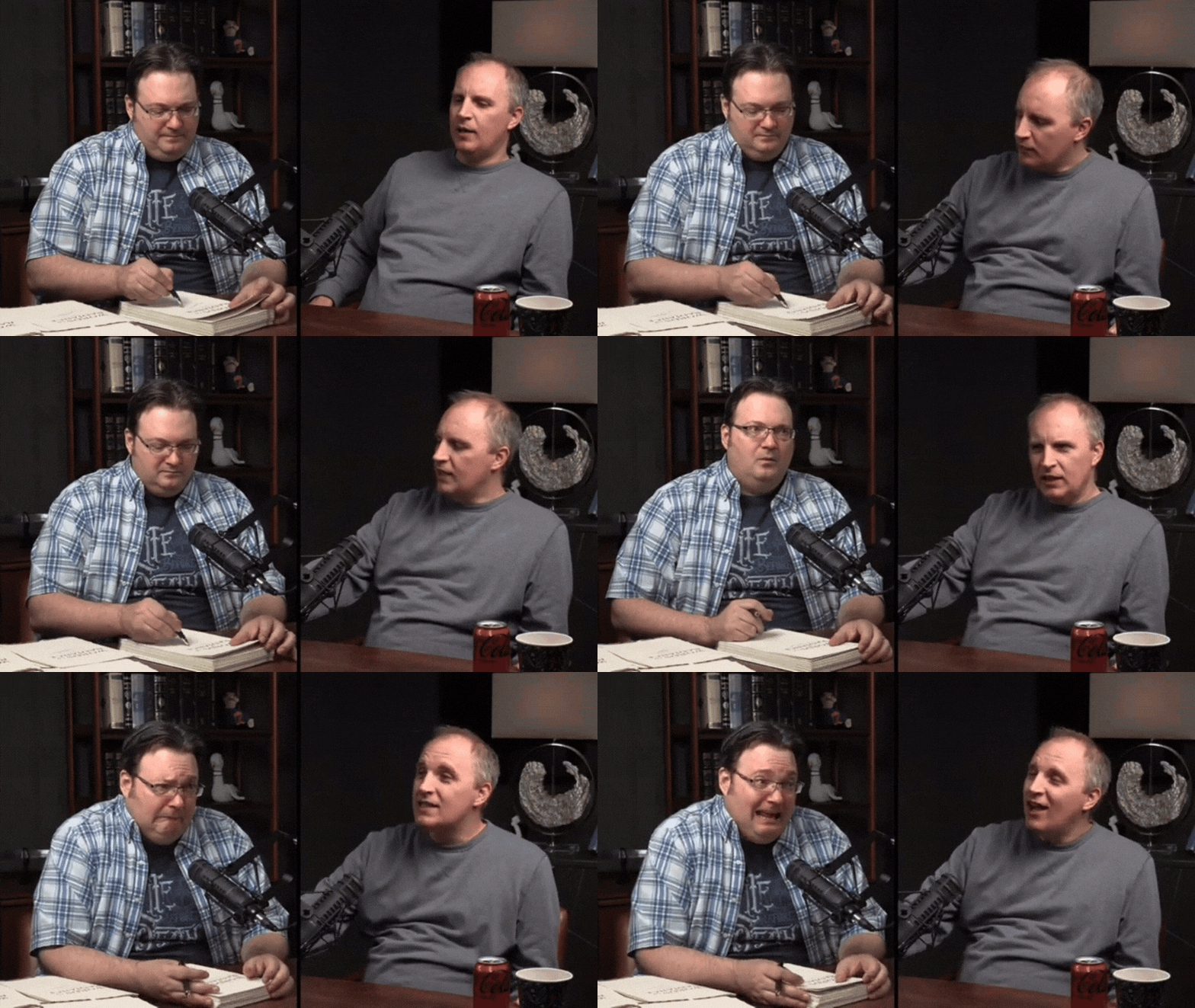
Sanderson made the call on Intentionally Blank Episode 253, the recent podcast/video episode released through Brandon Sanderson’s official channels and podcast feeds. The Apple Podcasts listing describes it as Brandon Sanderson and Dan Wells diving back into the “Hollywood Thunderdome” to decide the greatest movie trilogy of all time, and reporting on the episode says The Lord of the Rings finished in first place.
Intentionally Blank Episode 253 “best movie trilogy” discussion recap
The official episode description makes clear that Sanderson and Dan Wells were not casually shouting out favorites. They were comparing major trilogy contenders head to head, with the public description specifically naming Star Wars, Iron Man, Back to the Future, and more. The episode runs 43 minutes on Apple Podcasts, which tells you this was a focused ranking conversation rather than an offhand aside. By the end of that process, The Lord of the Rings was the trilogy Sanderson backed as the overall winner.
Brandon Sanderson’s criteria for the greatest movie trilogy of all time
Sanderson’s reasoning, as reported from the episode, centers on cohesion, intention, adaptation quality, and sustained excellence across all three films. His praise was not just that Jackson’s movies are beloved or influential. He stressed that the trilogy works as a unified whole, that it was built with a three-film structure in mind, and that the filmmakers took extraordinary source material without fumbling it. In other words, his standard for the best trilogy is not one great first movie followed by diminishing returns, but three entries that feel architected toward a single destination.
“Made knowing it would be a trilogy” — why that matters to Brandon Sanderson
This point is central to Sanderson’s argument because it gets at one of the biggest weaknesses in many famous franchises: they were not originally constructed as complete three-part film arcs. The Lord of the Rings was different. The American Film Institute notes that the three films were shot simultaneously and released in consecutive Decembers from 2001 through 2003, which gave the project an unusual level of formal unity. For Sanderson, that matters because the trilogy feels designed, not accidentally assembled. It has setup, escalation, and payoff that behave like parts of a single cinematic work rather than three separate commercial follow-ups.
“Lord of the Rings is cheating” — Brandon Sanderson’s source material argument
Sanderson’s so-called “cheating” comment is actually a compliment with a caveat. His point was that The Lord of the Rings began with one of fantasy’s most important source texts, which is an advantage many trilogies do not have. But he also argued that having great source material is not enough by itself. Plenty of adaptations start with beloved books and still miss the mark onscreen. In Sanderson’s view, Jackson’s team had the gift of Tolkien, but the real achievement was that they did not waste it. They converted literary prestige into a film trilogy that still works at blockbuster scale.
Brandon Sanderson on Peter Jackson improving parts of Tolkien’s story
One of the most interesting parts of Sanderson’s take is that he does not treat fidelity as the highest possible virtue. According to reporting on the episode, he had recently reread the books and concluded that Jackson improved some moments for film. That fits with Sanderson’s broader, publicly stated adaptation philosophy: in a 2025 interview with Polygon, he said an adaptation should be free to adapt, change, and even improve material for a different medium. That perspective helps explain why he can love Tolkien deeply while still arguing that Jackson made certain sequences stronger as cinema.
Sam and Frodo scene differences Brandon Sanderson says work better in the movies
The specific example Sanderson highlighted was the Sam-and-Frodo stretch where Sam leaves and the emotional split between the two characters becomes more pronounced. His view, as reported, is that the movie version lands with stronger narrative force. That does not mean the films are “truer” than Tolkien in a literary sense. It means the screenplay reshapes the emotional low point in a way that sharpens the drama for film audiences. Sanderson seems to value that kind of adaptation choice because it intensifies the stakes without losing the heart of the relationship that defines the journey.
Helm’s Deep changes Brandon Sanderson praises in The Two Towers
Sanderson also singled out Helm’s Deep, saying the movie version is stronger than what is on the page. That is a revealing choice because Helm’s Deep is one of the clearest examples of Jackson expanding a sequence into major event cinema while keeping it connected to character and theme. For Sanderson, this is not empty spectacle. It is evidence that a filmmaker can take Tolkien’s material and translate it into a more forceful visual and dramatic form. In his framing, Jackson’s The Two Towers does not merely illustrate the book’s battle; it reworks it into one of the trilogy’s defining cinematic peaks.
Brandon Sanderson and Dan Wells best film trilogy rankings list
The publicly available episode description confirms that Sanderson and Wells were weighing The Lord of the Rings against trilogies such as Star Wars, Iron Man, and Back to the Future, with “more” contenders also in the mix. What public reporting clearly establishes is the final result: The Lord of the Rings took the top position. The larger point of their ranking exercise was not just to build a neat list for social media, but to test which trilogy best withstands scrutiny when you judge planning, consistency, adaptation strength, and ending quality all at once. By Sanderson’s standards, Jackson’s trilogy beat the field.
Lord of the Rings trilogy vs other top trilogies (how Sanderson compares them)
Based on the criteria Sanderson emphasized, The Lord of the Rings has an edge over trilogies that were created one film at a time or that contain a visibly weaker third entry. That is especially important in debates involving Star Wars, superhero trilogies, or other franchises whose final installments divide audiences more sharply.
Sanderson’s framework favors complete design over improvisation and consistency over one-film brilliance. In that sense, his argument is not only that The Lord of the Rings is great. It is that it clears a harder bar than most competitors because all three films sustain the standard while closing the story convincingly. That comparison is an inference from the reasoning he states in the episode and the contenders named in the official description.
Why The Hobbit trilogy is often ranked below The Lord of the Rings
Even within Peter Jackson’s own Middle-earth filmography, the original trilogy still looks stronger by most consensus measures. Rotten Tomatoes currently lists the three Lord of the Rings films at 91%, 95%, and 94% with the trilogy occupying the top spots in its Middle-earth ranking, while The Hobbit entries sit lower at 64%, 74%, and 59%. That gap does not prove everything, but it reflects why many viewers place The Hobbit below The Lord of the Rings: the earlier trilogy is seen as tighter, more emotionally resonant, and more consistently acclaimed. Secondary coverage of Sanderson’s recent comments also notes that later Middle-earth entries have struggled to match the original trilogy’s reception.
Brandon Sanderson’s broader take on Tolkien adaptations and modern storytelling
Sanderson’s broader position seems to be that Tolkien adaptation succeeds when filmmakers preserve the spirit of the material while being confident enough to reshape form, pacing, and emphasis for screen storytelling. That aligns his recent Lord of the Rings comments with his wider adaptation philosophy: he has argued publicly that screen versions should be allowed to change and improve material for a new medium. In the Episode 253 comments, that philosophy becomes concrete. Jackson earns Sanderson’s respect not because he copied Tolkien line for line, but because he understood where modern film grammar could intensify scenes without breaking the core of Middle-earth.
Why The Lord of the Rings trilogy still holds up decades later
The simplest answer is that the trilogy still performs across almost every measure people use to define cinematic longevity. The Return of the King won all 11 Oscars for which it was nominated, including Best Picture, while the Academy notes that Fellowship also won major craft awards and AFI placed The Fellowship of the Ring at No. 50 on its 10th-anniversary list of the greatest American films. Critically, the three films still rank near the top of Rotten Tomatoes’ Middle-earth guide. Commercially and culturally, the trilogy’s 2026 extended-edition return to theaters was positioned by Fathom and Warner Bros. as a major 25th-anniversary event, with Variety reporting record presales for the franchise at Fathom.
The Lord of the Rings theatrical vs extended editions debate
This debate persists because both versions have a legitimate claim. Warner Bros. and Fathom continue to market the Extended Editions as premium event versions of the trilogy, and the 2026 theatrical rerelease specifically centered those cuts. At the same time, criticism of the Extended Editions has long existed because more material does not automatically mean better pacing. A useful way to frame the debate is this: the theatrical cuts are often praised for discipline and momentum, while the extended cuts are prized for world-building density and character texture. Which version is “best” depends on whether a viewer prioritizes narrative economy or maximal immersion in Middle-earth.
Upcoming Lord of the Rings movies and how they may affect the original trilogy’s legacy
The original trilogy’s legacy is secure, but new films will inevitably reshape how the wider Middle-earth screen franchise is discussed. Warner Bros. and New Line said in 2023 that multiple new Lord of the Rings films were coming, and a 2024 Warner Bros. press release said the studio was reuniting with Peter Jackson, Fran Walsh, and Philippa Boyens for new live-action films beginning with The Lord of the Rings: The Hunt for Gollum.
That movie is currently dated for December 17, 2027, and recent reporting says it will feature a younger, recast Aragorn. On top of that, Variety reported in March 2026 that Stephen Colbert and his son are developing another new Lord of the Rings movie. If those projects succeed, they may broaden Middle-earth’s cinematic future; if they stumble, they are more likely to make Jackson’s original trilogy look even more untouchable by comparison.
Frequently Asked Questions (FAQs)
- Why did Brandon Sanderson call The Lord of the Rings the greatest trilogy?
He praised its cohesion, planned three-film structure, strong adaptation quality, and consistent excellence across all three movies. - Where did Brandon Sanderson share this opinion?
He shared it on Intentionally Blank Episode 253, where he and Dan Wells debated the greatest movie trilogy of all time. - What makes The Lord of the Rings trilogy stand out structurally?
The films were shot simultaneously and designed as a unified story, giving them rare narrative consistency and payoff. - What does Sanderson mean by “made knowing it would be a trilogy”?
He means the films were planned from the start as a complete arc, unlike many trilogies that evolve film-by-film. - Why did Sanderson say The Lord of the Rings is “cheating”?
He acknowledged the advantage of adapting J. R. R. Tolkien’s legendary source material, while emphasizing that the films still executed it exceptionally well. - Did Sanderson think the movies improved on the books?
Yes, he believes certain scenes were adapted more effectively for film, enhancing emotional and cinematic impact. - Which scenes did Sanderson highlight as improved?
He pointed to the Sam and Frodo emotional split and the Helm’s Deep battle as stronger in the films. - How does Peter Jackson’s direction contribute to the trilogy’s success?
Jackson balanced fidelity with smart adaptation choices, translating the story into powerful cinematic moments. - How does The Lord of the Rings compare to other trilogies?
Sanderson argues it surpasses others due to its consistent quality, strong ending, and cohesive design. - Why does the trilogy still hold up today?
Its awards success, critical acclaim, and enduring cultural impact continue to reinforce its legacy as a top-tier cinematic achievement.
Conclusion
The Lord of the Rings film trilogy remains a benchmark for what a movie trilogy can achieve when vision, planning, and execution align. Brandon Sanderson’s perspective reinforces a widely held belief: greatness in a trilogy is not about one standout film, but about delivering a complete, cohesive journey from beginning to end.
The trilogy’s strength lies in its intentional design, emotional depth, and ability to adapt complex source material into a cinematic format without losing its core identity. By Sanderson’s criteria—consistency, structure, and adaptation quality—it clears a higher bar than most competitors.
Even decades later, the trilogy continues to define the standard for fantasy filmmaking and trilogy storytelling, proving that careful planning and respect for both story and medium can create something timeless.
Sources and Citations
- Apple Podcasts – Intentionally Blank Episode 253 (Apple Podcasts)
- Dagens.com – Coverage of Brandon Sanderson’s LOTR comments (Dagens.com)
- Rotten Tomatoes – LOTR and Hobbit trilogy scores(Rotten Tomatoes)
- Academy Awards (Oscars) – LOTR awards history(Oscars)
- Warner Bros. – Extended editions and theatrical releases(warnerbros.com)
- Motion Picture Association – Upcoming LOTR films info(Motion Picture Association)
- Polygon – Brandon Sanderson on adaptation philosophy (Polygon)
Recommended
- Pickmon Accused Of Being A Pokemon Rip-Off, But It’s Worse Than That: Full Controversy Explained
- Forza Horizon 6 Releases Zoomed Out Image of Full Japan Map — Fans Are Trying to Figure Out How Big It Really Is
- ULTIMATE WHITE FOX GUIDE MARVEL RIVALS: Abilities, Combos, Team Comps, and Season 7 Tips
- Photoshop Beta Gets a New Tool That Transforms 2D Objects Into 3D Images: Rotate Object Explained
- Every Marvel & DC Voice Actor in INVINCIBLE: Full Cast Crossover Guide
- MetaHuman Creatures: Crafting Non-Human Characters with Unreal Engine’s MetaHuman Framework