








In This Article (7 sections)
Hillthorn Demo 2026: A Wordless Mystery on a Secluded Mountain
Hillthorn Demo 2026 introduces a detective adventure in which a missing person investigation unfolds through cards rather than conventional dialogue. Developed by Fool Moon and Finnegan Motors and published by Raw Fury, the game asks players to interpret evidence, choose investigative actions, and decide which leads deserve their limited time. A free Steam demo is available, while the full game’s Steam listing gives a planned release window of November 2026. As of October 14, the reviewed official materials do not specify a release day.
The case takes place around a secluded mountain and a community that is reluctant to welcome outsiders. Raw Fury’s description establishes a missing child, dangerous trails, and inhabitants who are not eager to share information. In 80 Level’s October 6 impressions, the investigation begins with a mother whose daughter disappeared after hiking with her boyfriend. The mother suspects him, but suspicion is the starting point of the inquiry, not confirmation of guilt. A July developer overview identifies the missing pair as Olivia and Jeremiah.
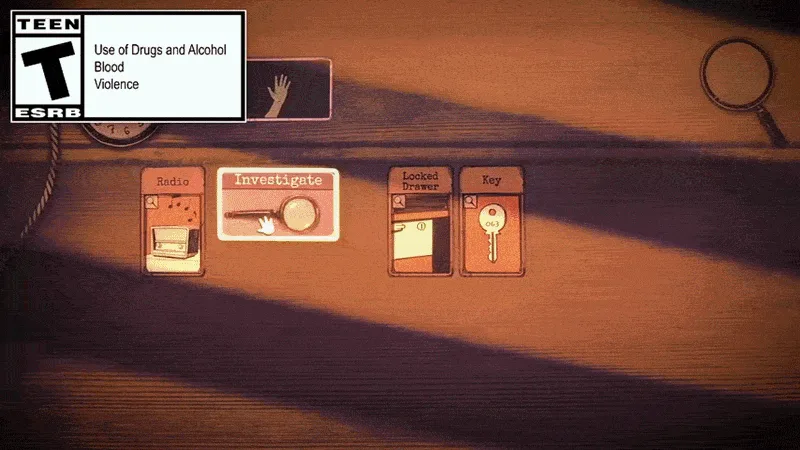
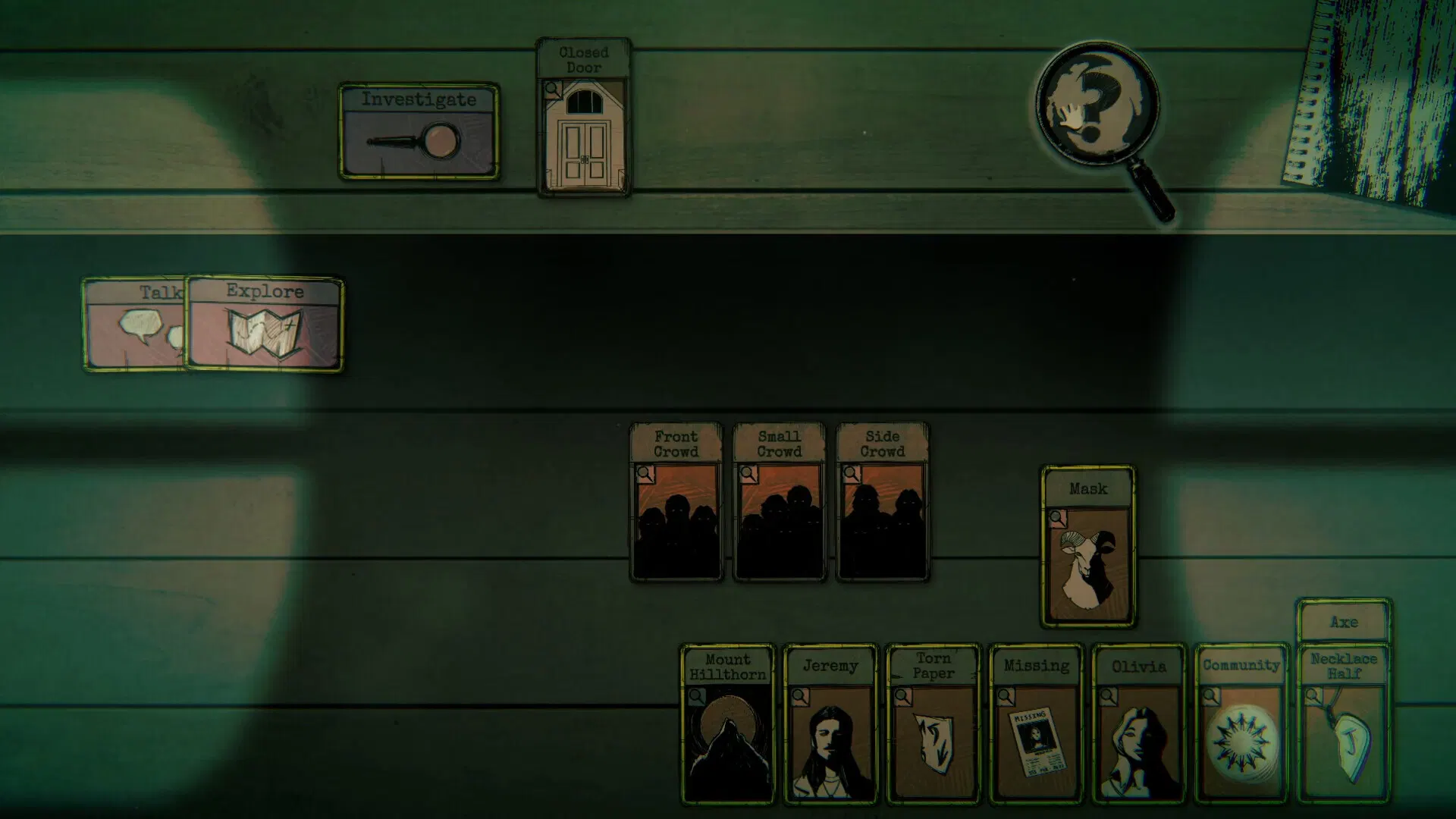
The wordless description needs an important distinction: Hillthorn does not remove every written word from the screen. Cards can carry labels such as Talk, Explore, Doubts, and Nervous. What disappears is the usual exchange of dialogue lines explaining exactly what a character thinks or knows. Instead, the player interprets cards and their relationships. This makes the interface part of the storytelling, because an emotional response or an investigative concept can carry information that another detective game might express through a conversation.
That approach creates an interesting distinction between collecting evidence and understanding it. A card representing nervousness is not automatically proof of wrongdoing. It could justify another question, suggest a connection worth testing, or reveal that an interaction produced an unexpected response. The practical challenge is to avoid treating an interpretation as a settled fact. Hillthorn’s premise therefore encourages a detective’s habit of separating what has actually been discovered from what merely seems plausible.
The art direction is designed around the challenge of making those small images readable. In an August developer interview, artist Tara described influences including Victorian portrait photography and Robert Valley’s use of shadow and contrast. Some cards were simplified between the prototype and later artwork so their meaning would be clearer. Distinguishing related ideas such as suspicion and paranoia was identified as a particular challenge, showing that the illustrations need to communicate concepts as well as establish atmosphere.
Wordless also does not mean silent. A September music interview describes a soundtrack combining analog synthesizers, tenor saxophone, and vocals, with singer Romy Allaire contributing to important moments. Composer Antoine explained that rhythmic disruption and reversed effects help express the game’s unusual relationship with time. The resulting approach gives sound a narrative role without relying on spoken exchanges to explain the investigation.
The demo is an introduction rather than a complete version of the investigation. Its official description promises a selection of locations and puzzles alongside an overview of the central gameplay loop. This makes it useful for learning how the investigation works, but not for judging every eventual ending or the full campaign’s length. A limited selection of locations does not establish a fixed completion time. Players who experiment with different combinations may spend their sessions differently.
There is also a distinction between the demo’s history and the publisher’s announcement. Steam dates the demo to February 19, 2026, while Raw Fury announced its involvement with Hillthorn on July 9. The project therefore had a playable public history before that summer announcement. The developer’s older itch.io prototype page directs players toward the Steam demo, making Steam the relevant destination for the more recently updated build rather than an assumption that an old prototype represents the current experience.
Language information has changed during development. An August 19 demo update added eleven languages, while the current Steam language panel lists thirteen, including English, French, German, Japanese, Korean, Simplified Chinese, Brazilian Portuguese, Indonesian, Italian, Polish, Russian, and two Spanish variants. The older Demo Facts paragraph still mentions only English and French. The later update explains that discrepancy, and it also demonstrates why “no dialogue” does not mean localization is unnecessary: brief labels still need to communicate precise meanings.
For players checking compatibility, the main game’s Windows listing specifies Windows 10 with a 64 bit processor, a dual core 2.4 GHz CPU, 4 GB of memory, and an Nvidia GeForce GTX 950 or AMD Radeon RX 570. Minimum storage is listed as 1 GB, rising to 2 GB in the recommended specification. Steam also provides macOS and Linux requirements, although a Linux listing should not be treated as confirmation of Steam Deck verification. An August announcement also confirmed Nintendo Switch, iOS, and Android versions of the full game, but the demo discussed here is the Steam version.
Despite its abstract presentation, Hillthorn is not presented as a story for all ages. The developer’s content description identifies references to drugs, violence, alcohol, and suicide, communicated through card artwork. Its atmosphere and subject matter are therefore worth considering alongside its puzzle mechanics. The official feature list also states that the game uses no generative AI, a production disclosure that is separate from the question of how its cards and investigative systems function.

How Hillthorn’s Cards, Time Loop, and Demo Updates Work
Hillthorn’s basic interaction is to combine an action with a relevant clue, character, or concept. Investigating, exploring, and talking are ways of testing the information available to you. Rather than approaching every card as an attack or a resource for a combat deck, it is more useful to treat the board as a collection of possible questions. What can be examined? Who might respond to this subject? Which discovery creates a reason to visit somewhere else?
The developer’s prototype description explicitly allows players to organize their thoughts freely on the board. A sensible approach is to keep related evidence near the people or locations it concerns, while separating unresolved possibilities from connections already tested. This is a suggested organizational habit, not a claim that placing cards beside each other automatically solves a puzzle. A readable workspace can help you remember what you were investigating before a new discovery redirected your attention.
The resemblance to Cultist Simulator is more than a comparison invented by players. Responding to comments on the prototype page, the developer acknowledged Weather Factory’s games as an inspiration, and 80 Level also drew that comparison. Even so, Hillthorn’s central premise is a missing person case. Recognizing a familiar style of card interaction should not lead players to assume that the two games have identical rules, progression systems, or objectives.
A useful way to approach the opening investigation is to give each experiment a purpose:
- Identify the question you are testing before combining cards, rather than trying every available pairing without a reason.
- Treat emotional reactions as leads that need corroboration, not as immediate proof that a character is lying or responsible.
- Keep track of unsuccessful approaches so that a later attempt tests something genuinely different.
- Revisit an earlier lead when new evidence gives it a different meaning, rather than assuming its usefulness ended with the first interaction.
Time is the other major constraint. The official description explains that investigative actions advance the clock, so a promising discovery can create a choice between following it immediately and spending the remaining time elsewhere. However, not every interface movement should be assumed to carry the same cost. The October 8 update specifically removed the time cost of moving between the inn and the inn room. That exception matters when comparing current play with older descriptions of the demo.
The time structure also goes beyond an ordinary deadline. The official July overview explains that midnight returns the detective to the edge of the woods, while collected items may disappear. What carries the investigation forward is the knowledge gained during previous attempts, including shortcuts and insights. This gives concrete meaning to knowledge as progression: understanding a useful sequence or recognizing an important connection can remain valuable even when the immediate state of the investigation changes.
A practical consequence is that an unsuccessful attempt need not be wasted. Learning which approach produced no useful information, where a promising lead appeared, or what deserved attention earlier can improve a later attempt. This is a strategy for working with the described loop, not a promise that every item survives it. Distinguishing the player’s memory from the detective’s available cards is essential to understanding why a repeated day can still represent progress.
The diary provides another way to keep track of the case. The August 19 update added notes as players discover Hillthorn’s inhabitants, alongside a new introductory cinematic, revised sound effects, additional card effects, and an interaction in the inn room. Reviewing those notes is a useful habit when several characters or leads have become difficult to distinguish. The same update requested feedback on translations because the game’s short pieces of text depend heavily on context.
The October 8 update continued refining how information is presented. It replaced the cinematics, introduced an optional zoom function that displays a card fullscreen after holding it briefly, improved feedback for incorrect choices in the Winding Trails, and adjusted the opening music. It also enlarged some important cards and addressed resolution, dragging, sound, and save information issues. These changes matter in a visual investigation because difficulty should come from interpreting evidence, not from being unable to inspect a card or understand whether an action registered.
Multiple endings are advertised for the full game, but the reviewed official descriptions do not provide a complete ending count or a route guide. They also do not establish that every ending can be reached in the demo. The most useful expectation is therefore a sample of the mystery’s structure: gather information, test connections, manage time, and use what you learn to approach the case more intelligently. Its appeal rests on turning interpretation into an activity the player performs, rather than explaining the solution through lengthy dialogue.

Hillthorn and the Wider Debate About Global Game Development
Hillthorn offers a different measure of creative ambition from the AAA technology debate below. Raw Fury identifies Fool Moon as a Montreal studio, so Hillthorn should not be presented as evidence of Korean development leadership. The Japanese creators’ remarks came from G-CON on November 14, 2025, with CLOVERS publishing an English translation on May 20, 2026. They were not comments about Hillthorn. The broader regional comparisons here are contextual interpretation, not measured national averages for production speed or technical capability.
Hillthorn is part of a growing conversation about how game development is evolving across the global gaming industry. Recent industry commentary attributed to veteran Japanese action game creators, including figures associated with franchises such as Nier and Devil May Cry, sparked discussion across global gaming communities after remarks surfaced suggesting that “a lot of Korean developers are ahead of Japan” in certain technical and production areas. The statement has generally been interpreted as a reflection of changing dynamics in the global AAA development landscape, not as a dismissal of Japan’s game design legacy.
Creative director Yoko Taro, known for the Nier series, has long expressed unconventional views about the industry. In broader discussions about development trends, his perspective aligns with the idea that Korean studios have made major strides in technical execution, especially in real-time rendering, high-end production consistency, art pipeline integration, motion capture systems, and engine-level optimization. The argument is not that Japanese developers lack creativity, but that Korean studios have increasingly optimized their workflows for large-scale AAA production.
Hideki Kamiya, known for directing Devil May Cry and Bayonetta, has also been part of wider industry conversations acknowledging Korea’s rapid growth in AAA development capacity. While Kamiya is famously protective of Japanese game design identity, industry commentary around his perspective reinforces the idea that Korean studios are now producing action games with production values that rival or exceed many mid-to-high-tier Japanese releases. These games often feature fluid combat systems, cinematic presentation, and large-scale world design.
The comments spread quickly across forums, livestreams, and developer panels. They were debated less as definitive rankings and more as signs of shifting industry momentum, where global competition is no longer dominated by a single region.
Korean game development has changed dramatically over the last decade. Once primarily associated with online MMOs and PC-centric business models, Korea’s AAA sector has expanded into console and cross-platform development. This evolution has allowed Korean studios to compete more directly with established Japanese and Western developers in global markets.
Key factors behind this shift include:
- Heavy investment from major publishers such as Nexon and Krafton
- Government-backed technology initiatives
- Recruitment of international talent from Japan, Europe, and North America
- Aggressive adoption of Unreal Engine as a primary development tool
- Strong centralized development structures that can support faster iteration cycles
Two of the most frequently cited examples of Korea’s AAA growth are Stellar Blade and Crimson Desert. Stellar Blade, developed by Shift Up, showcases high-end character animation, fluid combat systems, and cinematic presentation that align with global console standards. It also demonstrates how Korean studios have moved beyond online-first design philosophies.
Crimson Desert, developed by Pearl Abyss, pushes open-world ambition further by combining large-scale environmental design with complex action mechanics. It reflects a growing confidence in producing single-player, narrative-driven AAA experiences. Together, these titles have become benchmarks in discussions about Korea’s rising parity with Japan in technical execution.
One of the most significant factors in the comparison between Korean and Japanese development is engine adoption. Unreal Engine has become a central pillar of Korean AAA production, enabling photorealistic graphics, scalable open-world systems, and streamlined asset integration. Korean studios often begin new projects directly in Unreal Engine 4 or 5, allowing them to use advanced rendering systems such as Nanite and Lumen more quickly.
Two technical qualifications are necessary. Nanite and Lumen are Unreal Engine 5 technologies, not standard Unreal Engine 4 features. Crimson Desert also uses Pearl Abyss’ proprietary BlackSpace Engine, rather than Unreal Engine. Its example therefore complicates any simple argument that commercial engine adoption explains Korean technical progress. Neither engine ownership nor a studio’s nationality, by itself, establishes the quality or efficiency of its development work.
Japan has increasingly adopted Unreal Engine in recent years, but many studios still maintain proprietary engines built over decades. These engines can be powerful, but they often reflect legacy architecture optimized for specific hardware generations and require extensive internal maintenance. In contrast, newer Korean studios can bypass some of these constraints by building directly on standardized global tools.
This has reshaped the balance between the two industries by:
- Accelerating Korean AAA competitiveness
- Increasing outsourcing and co-development with Western studios
- Encouraging Japanese studios to modernize their pipelines
- Making real-time visual fidelity more visible as a competitive factor
The phrase “losing ground” is often debated, but in this context it usually refers to the speed of technological adoption rather than creative quality. Japanese studios often maintain long development cycles, proprietary engines, and a strong emphasis on artistic direction over technical realism. Korean studios, by comparison, often prioritize faster prototyping, engine standardization, and high-fidelity realism. This difference creates the perception of a technical gap in certain categories, especially open-world action RPGs and visually ambitious AAA games.
The question of whether Japanese studios are falling behind in technical innovation is often overstated in online discourse. Japanese developers are not necessarily behind in innovation overall, but they may be prioritizing different forms of innovation. Japan remains strong in gameplay mechanics, character-driven narratives, stylized combat systems, artistic direction, and franchise identity. Korea, meanwhile, is increasingly recognized for real-time rendering fidelity, large-scale production pipelines, systemic gameplay integration, and cinematic presentation.
Creators associated with Devil May Cry and Nier reflect a wider industry view that game development is becoming more interconnected. Ideas, tools, and talent now move across borders more freely than in previous decades, leading to shared development standards, cross-regional hiring, and collaborative engine ecosystems. Rather than a strict competition, the current era can be seen as a period of convergence, where regional strengths blend into global AAA design.
Korean studios are positioning themselves as major players in the action game genre. Their focus on high-intensity combat systems, cinematic presentation, and engine-driven realism aligns closely with global market demand. Upcoming projects suggest continued expansion into console-first AAA titles, narrative-driven action RPGs, and hybrid online and offline experiences.
Beyond Korea, China has also become a significant contributor to the global AAA landscape. Together, China and Korea represent a broader shift in development power away from traditional Western and Japanese dominance. This shift is driven by massive domestic markets, strong funding ecosystems, and rapid talent development pipelines. The result is a multipolar gaming industry where innovation is distributed across several regions rather than concentrated in one.
Japanese game development is not declining, but evolving. Japanese studios continue to lead in artistic identity and franchise longevity, but they must adapt to changing expectations around technical presentation and global scalability. Future leadership will likely depend on hybrid engine adoption strategies, faster integration of global tools, and continued emphasis on distinctive gameplay identity. Rather than being replaced, Japanese studios are being challenged to redefine their role in a more competitive global ecosystem.
Hillthorn’s contrasting approach is to make a small set of interactions carry the weight of an investigation. Its demo can be judged on whether the cards communicate clearly, whether deductions feel earned, and whether the time loop turns new understanding into meaningful progress.
Frequently Asked Questions (FAQs)
- What is Hillthorn, and what type of game is it?
Hillthorn is a single-player detective adventure game developed by Fool Moon and Finnegan Motors and published by Raw Fury. It mixes card-based investigation, time management, puzzle-solving, and atmospheric horror to create a mystery-focused experience. The story follows an investigation into the disappearance of a missing child in a strange mountain community, where players must examine clues, visit locations, and connect information to move forward. Although Hillthorn uses cards as a central part of its design, it is not a traditional card battler or deck-building game. The cards represent parts of the investigation, such as clues, people, places, and possible actions. The main goal is to understand what happened by observing details, experimenting with interactions, and making deductions rather than defeating enemies or building a competitive deck. - When is the Hillthorn release date in 2026?
Hillthorn is scheduled to launch in November 2026. The release window was confirmed by the developers in August 2026 during announcements connected to the Future Games Show. However, as of October 8, 2026, an exact day in November has not been confirmed on the official Steam store page. The game is planned for Steam, Nintendo Switch, iOS, and Android. Since only the month has been announced, players interested in the game should treat November 2026 as the current official release window until the developers or publisher provide a more specific launch date. - Is the Hillthorn demo free to download on Steam?
Yes. The Hillthorn demo is free to download and play through Steam. It was released on February 19, 2026, and gives players an early look at the game’s investigation systems, puzzle structure, and atmosphere. The demo includes several locations and introduces how cards are used to represent clues, actions, and parts of the mystery. Players do not need to purchase or pre-order the full game to access the demo. It can be found by searching for Hillthorn Demo on Steam or by visiting the main Hillthorn store page and using the available demo download option. - Is Hillthorn similar to Cultist Simulator?
Hillthorn is similar to Cultist Simulator in some broad design ideas, especially in the way both games use cards to represent elements of the world. In both games, players are encouraged to experiment with combinations, interpret unclear information, and gradually understand hidden systems through play. They also share mysterious, unsettling tones that rely on curiosity and discovery. However, Hillthorn is not simply a detective version of Cultist Simulator. Hillthorn focuses on a specific missing-person case and presents its mystery through illustrated clues, locations, and investigative actions. Cultist Simulator is more focused on occult simulation, resource management, and long-term systemic progression. Hillthorn appears to be more directed around solving a central narrative mystery, while Cultist Simulator is broader and more abstract in structure. - Does Hillthorn have dialogue or written conversations?
Hillthorn is designed to tell its story without conventional spoken dialogue. Instead of relying on traditional conversations between characters, the game communicates information through clue cards, visual details, environmental interactions, and investigative choices. This means players are expected to learn by observing, interpreting, and connecting pieces of information. That does not mean the game contains no text at all. The interface includes contextual information, and the demo features diary entries that help explain characters, events, and discoveries. The important distinction is that Hillthorn does not use ordinary dialogue scenes as its main storytelling method. Its mystery is built more through evidence, images, written fragments, and player deduction. - Will Hillthorn be released on Nintendo Switch, Android, and iOS?
Yes. Hillthorn has been officially confirmed for Nintendo Switch, Android, and iOS, in addition to Steam. These platforms are all tied to the planned November 2026 launch window, meaning the developers intend for the game to reach both PC and portable players. However, not every platform detail has been fully explained yet. Information such as mobile system requirements, regional pricing, touchscreen-specific features, and performance differences between versions has not been completely confirmed in the official announcements reviewed. More platform-specific details are likely to become clearer closer to release. - Does Hillthorn have multiple endings?
Yes. Multiple endings are an officially advertised feature of Hillthorn. This means the investigation is expected to have different outcomes depending on how players approach the mystery, what they discover, and possibly how they manage time and decisions during the game. The developers also added an extra ending specifically for the demo in an earlier update, which suggests that player knowledge and investigative choices are important to the structure of the game. However, the full number of endings in the complete release has not been publicly confirmed. The exact requirements for reaching each ending have also not been detailed, so players will likely need to experiment and pay close attention to clues. - What are the minimum PC requirements for Hillthorn?
The published minimum Windows requirements for Hillthorn include Windows 10 64-bit, a dual-core 2.4 GHz processor, 4 GB of RAM, an Nvidia GeForce GTX 950 or AMD Radeon RX 570 graphics card, DirectX 10, and 1 GB of available storage. These requirements suggest that the game is not expected to need a high-end gaming PC, although performance can still vary depending on hardware and final optimization. Hillthorn also has macOS and SteamOS/Linux listings. Because the full game has not yet launched, players should check the official Steam requirements before installing or purchasing it. System requirements can sometimes change before release as developers continue optimization, testing, and platform support work. - Is Hillthorn a horror game or a traditional detective game?
Hillthorn is best described as an atmospheric mystery adventure with horror elements. It has the structure of a detective game because players investigate a disappearance, gather clues, explore locations, and try to understand what happened. At the same time, it uses psychological and folk-horror influences to make the investigation feel strange, tense, and unsettling. The game does not appear to be built around constant combat, jump scares, or traditional survival-horror mechanics. Instead, its horror comes from atmosphere, secrecy, unusual visual design, disturbing discoveries, and the uncertainty surrounding the mountain community. Players looking for a mystery with a dark and eerie tone are more likely to understand what Hillthorn is aiming for than those expecting a conventional action-horror game. - Who developed Hillthorn, and who is publishing it?
Hillthorn is developed by Fool Moon and Finnegan Motors. Raw Fury is publishing the game, and the publisher formally announced its involvement on July 9, 2026. The project brings together a distinctive visual style, card-based systems, and a mystery-driven structure centered on investigation rather than traditional dialogue. The developers have discussed the game’s art, music, and investigative mechanics through official Steam community updates. Hillthorn is designed around knowledge-driven progression, multiple endings, and storytelling through clues, cards, and visual interpretation. Its central identity comes from combining detective work with atmospheric horror in a format that avoids conventional spoken conversations.

Conclusion
Hillthorn is an unconventional detective adventure from Fool Moon, Finnegan Motors, and Raw Fury that blends illustrated clue cards, wordless storytelling, time management, and atmospheric horror. Players investigate a child’s disappearance in a secluded mountain community by interpreting visual evidence, exploring relationships, and deciding how to use limited time rather than following traditional dialogue-heavy clues or objective markers.
Its dramatic art style, shadowy illustrations, analog synthesizers, and noir-inspired music help create a distinctive mystery atmosphere. A free Steam demo is already available, while the full game is planned for November 2026 on Steam, Nintendo Switch, iOS, and Android, though no exact release date has been confirmed as of October 8. If its puzzles, choices, and central mystery are well executed, Hillthorn could become one of 2026’s more notable narrative detective games.
Sources and Citations
- Steam, Hillthorn Official Store Page : Official listing identifying Fool Moon and Finnegan Motors as developers and Raw Fury as publisher, with November 2026 as the planned release window. It provides supported languages, platform requirements, achievements and cloud saves, alongside disclosures about mature themes and the developers’ statement that the game uses no generative AI. Steam Store
Citation: Hillthorn on Steam. (Steam) - Steam, Hillthorn Official Demo : Dedicated listing offering the free demo and recording its February 19, 2026 release. It describes a selection of locations and puzzles introducing the investigation system, with separate hardware requirements and content disclosures. Its language table now lists 13 languages, although an older sentence in the description still mentions only English and French. Steam Store
Citation: Hillthorn Demo on Steam. (Steam) - Raw Fury, Official Publishing Announcement, July 9, 2026 : Official announcement introducing the publishing partnership with Montreal developer Fool Moon and presenting the game’s missing child investigation. It explains the use of clue cards, reluctant villagers and limited investigation time, while providing the announcement trailer, press materials and Steam link. This documents the partnership reveal rather than the later release window announcement. Raw Fury
Citation: Raw Fury Reveals Hillthorn. (Raw Fury) - Raw Fury, Hillthorn Official Game Overview : Publisher’s description explaining how investigating, exploring and interacting with cards gradually reveals the mountain community’s secrets. It identifies time management, multiple endings and accumulated knowledge as central features, while providing developer background and promotional materials. This establishes the advertised design rather than an independent assessment of how effectively those systems work. Raw Fury
Citation: Hillthorn Official Game Overview. (Raw Fury) - Fool Moon, Original Hillthorn Prototype : Developer maintained itch.io page explaining how players combine actions and clues, arrange cards freely and investigate before midnight. It identifies the prototype’s unfinished assets and links to the newer Steam demo. In the comments, the developer explicitly acknowledges Weather Factory’s games as an inspiration, providing direct attribution rather than relying solely on comparisons made by players. itch.io
Citation: Hillthorn Prototype. (itch.io) - Raw Fury and Fool Moon, Official Development Updates : Developer archive covering the July investigation overview, August language additions and October 8 demo update. It documents revised cinematics, card zoom and display fixes, distinguishing implemented improvements from future release plans. Steam Community
Citation: Hillthorn Official Steam Announcements. (Steam Community) - Raw Fury, Release Window Announcement, August 26, 2026 : Official announcement confirming November 2026 and planned releases on Steam, Nintendo Switch, iOS and Android. It records the Future Games Show reveal without establishing an exact launch day. Steam Community
Citation: Hillthorn Release Date Window Announced. (Steam) - Fool Moon, Art Direction Interview, August 20, 2026 : Artist Tara discusses Victorian portrait photography, Robert Valley’s influence and the difficulty of illustrating abstract ideas on small cards. She explains simplifying artwork for readability while preserving the game’s mysterious atmosphere. Steam Community
Citation: The Art of Hillthorn. (Steam) - Fool Moon, Music Interview, September 24, 2026 : Composer Antoine explains the combination of analogue synthesizers, tenor saxophone and Romy Allaire’s vocals. He describes changing rhythms and reversed audio effects used to express the player’s distorted experience of time. Steam Community
Citation: The Music of Hillthorn. (Steam) - 80 Level, Demo Impressions, October 6, 2026 : Gloria Levine’s firsthand account examines the investigation through action cards, emotional clues and discoveries that replace conventional dialogue. It compares the interactions with Cultist Simulator, describes the pressure of the advancing clock and praises the experience while finding the demo too short. These impressions concern the demonstration rather than the complete game. 80 Level
Citation: No One Says a Word in This Detective Card Game. (80 Level) - CLOVERS, Hideki Kamiya and YOKO TARO Panel Translation, May 20, 2026 : English translation of Famitsu’s coverage of their November 14, 2025 G-CON discussion. It explores budgets, staff capabilities, original mechanics, music and the tension between creative ambition and deadlines. This provides broader development commentary, not statements about Hillthorn or evidence that either director participated in its production. clovers2023.com
Citation: Hideki Kamiya and YOKO TARO Discuss Game Development, Deadlines, and More. (CLOVERS) - Epic Games, Switching to Unreal Engine : Official overview identifying Nanite as virtualised geometry technology and Lumen as a dynamic global illumination system within Unreal Engine 5. It also introduces development resources, templates and migration examples. This supports explanations of those technologies, but does not establish that Hillthorn uses Unreal Engine or either feature. Unreal Engine
Citation: Switching to Unreal Engine. (Unreal Engine) - Pearl Abyss, BlackSpace Engine Developer Overview, March 28, 2025 : Official GDC recap explaining the proprietary engine behind Crimson Desert, including water simulation, reactive volumetric fog, atmospheric lighting and cloth and hair simulation. It explicitly notes that the demonstrated footage was captured in the engine and could differ from the final game. This documents BlackSpace rather than attributing Crimson Desert’s technology to Unreal Engine. Crimson Desert
Citation: Dev Archives: A Look into Pearl Abyss’ BlackSpace Engine. (Pearl Abyss) - Streamline Studios, Stellar Blade Development Case Study : Production partner’s account of collaborating with Shift Up on the Great Desert and Wasteland environments. It describes developing level art from preliminary layouts, coordinating lighting and integrating daily changes into the development build. This provides direct background on the collaboration, rather than an independent review or a complete technical description of Stellar Blade’s engine. streamline-studios.com
Citation: Stellar Blade Development Case Study. (Streamline Studios) - ComicBuzz, Raw Fury Announcement Republication, July 9, 2026 : Reproduction of the publisher’s announcement introducing Hillthorn, its investigation through cards and the challenge of gaining information from an isolated community. It also includes background on Fool Moon and Raw Fury. This preserves the original press release in another location, but is not a separate firsthand preview or independently sourced confirmation. ComicBuzz
Citation: Raw Fury Announces Hillthorn. (ComicBuzz) - GameSpew, Hillthorn Announcement Coverage, July 9, 2026 : Kim Snaith’s report introduces the missing child investigation, clue card interactions and pressure to solve the mystery within limited time. It includes the announcement trailer and directs readers to the free Steam demo. Its statement that no release date had been announced reflects July’s information, before the subsequent November 2026 window was revealed. GameSpew
Citation: Raw Fury Announces Eerie Card Based Investigation Game, Hillthorn. (GameSpew)
Recommendations
- Everything Announced at Warframe and Soulframe Fan Event TennoCon 2026: Tau, Brysko, Warsongs, and More
- Gamescom Latam Attendance up 17.5% in 2026: What Drove the Record Crowd and What’s Next
- Kingdom Hearts HD 1.5+2.5 ReMIX Hits #2 on US Steam Sellers After KH4 D23 Trailer
- Stardew Valley Ginger Island Guide: Everything You Need To Know
- Medieval Horse Dealer Simulator Releases August 17, 2026: Gameplay, Price, and PC Details
- Pokémon Pokopia: Bubbly Basin (How to Befriend Phione)
- Legendary Nintendo Developer Takashi Tezuka Isn’t Retiring After All: What the Reports Really Mean
- Peter Sarsgaard Joins the Last of Us Season 3: Cast, Character, and Story Details
- Invincible VS in Unreal Engine Features Rollback Netcode, Destructible Arenas, and Cinematic Combat
- Staff at Fallout: New Vegas Developer Obsidian Reportedly Left Unsure How ‘Huge List of Projects’ Can Continue After Xbox Layoffs Hit Hard



































































































