







In This Article (15 sections)
How to Fish Release Date, Story, Launch Features, and Post-Launch Support
How to Fish arrived on Windows PC on August 20, 2026, offering an unconventional fishing adventure from Dazed Games. Instead of presenting fishing as a slow and realistic activity, the game combines physics-based angling, first-person combat, cooperative exploration, equipment upgrades, quests, and increasingly dangerous boss encounters. Players begin stranded on a small island after crashing their boat, but escaping requires much more than casting a line. They must catch creatures, defeat them, sell or cook their catches, purchase better equipment, and complete quests that reveal routes to new islands. Each destination introduces stronger fish, specialized bait, improved weapons, and another progression challenge.
This How to Fish game guide covers the release details, multiplayer support, single-player mode, fishing mechanics, money-making strategies, rods, bait, weapons, quests, bosses, islands, system requirements, and console availability. The information reflects the game and its official updates available as of September 1, 2026.
How to Fish was developed and self-published by Swedish independent studio Dazed Games. It was released through Steam at approximately 14:03 UTC on August 20, although availability may have appeared at slightly different local times depending on a player’s region and when the Steam client refreshed. The launch introduced the complete playable progression rather than an Early Access build. Players could immediately travel through all available islands, defeat the final bosses, and return to the mainland.
Completing the campaign does not permanently end a save. Players can continue after the credits, allowing them to revisit previous locations, collect missing fish variants, unlock cosmetic rewards, and pursue achievements they did not earn during the main journey. This is particularly useful because rare catches, optional objectives, and collection goals may require repeated visits to earlier islands.
Launch Features and Post-Launch Support
At launch, the Steam description presented How to Fish as a one-to-four-player physics-based fishing simulator. Its listed features included single-player, online cooperative multiplayer, Steam achievements, Family Sharing, and full controller support. The game launched with 28 achievements, and Valve later assessed it as Steam Deck Verified. This means its primary features work with the handheld’s default controller configuration, its interface is considered readable, and its standard settings perform appropriately on Steam Deck.
Dazed Games supported the release with several rapid updates that expanded multiplayer options and addressed technical problems:
- Patch 1.0.4 increased the maximum lobby capacity to eight players. The developer clarified that the game was still designed and balanced primarily for groups of up to four, even though larger lobbies became technically possible.
- Patch 1.0.5 added private, invitation-only lobbies and controls for changing the session type. Changing the session type requires the host to restart the session before the new setting takes effect.
- Patch 1.0.9 introduced easy, normal, and hard difficulty settings, along with a connection diagnostic in the main menu for identifying Steam networking problems.
- Patch 1.0.10 extended the time allowed for multiplayer connections to complete and improved the persistence of important objects left on the ground.
- Other updates addressed save reliability, controller icons, multiplayer bugs, connection information, creature balance, and several issues affecting progression.
Dazed Games also announced that How to Fish reached one million players within two days of release. The studio said it intended to continue fixing bugs and adding content, but it did not provide a detailed long-term roadmap or confirmed dates for additional islands when making that announcement.
The game begins with a deliberately absurd premise. After drinking while boating, the player crashes onto a small island and loses the means to return home. Escaping requires learning how to fish, earning money, acquiring equipment, restoring access to transportation, and navigating through a chain of increasingly dangerous islands.
Fishing is not treated as a peaceful background activity. Catching a creature is often only the first part of an encounter because fish, crabs, and other animals can remain active after being pulled from the water. Players may need to use knives, firearms, explosives, or environmental hazards to finish them before the catch can be transported safely. A defeated creature can then be sold, eaten, cooked, delivered to a quest character, or retained as bait for an even more dangerous target.
Progression Structure and Game Systems
Progression follows an action-adventure structure. Every major island acts as a compact chapter with its own fishing equipment, shop inventory, non-player characters, quest requirements, and bosses. Completing the critical objective provides a key, radar destination, or coordinates that lead to the next location.
The tone remains intentionally chaotic and comedic throughout the journey. Players can shoot airborne fish to perform trick shots, gamble catches at a roulette table, and use explosives against groups of marine creatures. Cartoon violence and gambling with fish are part of the experience, although the roulette system does not involve real-money gambling.
Despite the absurd presentation, How to Fish contains recognizable and connected progression systems. Better rods and lure tiers expand the available species, stronger weapons make boss encounters more manageable, and inventory upgrades allow players to carry more fish, bait, food, quest objects, and combat equipment. Boat upgrades help players reach increasingly distant destinations, while rare fish variants and achievements encourage exploration after the main campaign has been completed.

How to Fish Gameplay, Fishing Economy, Rods, Bait, and Weapons
The central gameplay loop in How to Fish consists of catching fish, killing dangerous catches, earning money, buying upgrades, completing quests, and unlocking new islands. Each system supports the next objective, so efficient How to Fish progression depends on understanding how fishing, combat, inventory management, hunger, and equipment work together.
Equipment is extremely limited at the beginning of How to Fish. The Lighthouse starting area focuses on crabs and other small creatures that can be caught with a Crab-Fishing Rod. Selling early catches provides enough money to purchase bait, a knife, and important quest items. After defeating the first boss, the player receives access to a boat and radar, opening the wider How to Fish island progression.
Fishing results in How to Fish are determined by the current location, rod category, and attached lure or bait. Different islands introduce new equipment tiers that expand the available species and increase the value or danger of possible catches. Continuing to use an outdated lure on a later island generally produces weaker returns than purchasing the equipment intended for that area.
Boss encounters in How to Fish usually require unique bait rather than a standard lure. Examples include the Empty Beer Can, Modified Leech, Carrot, Professional Boss Lure, Fish Bucket, and the body of another large creature. These specialized items should not be sold or discarded because they are often mandatory for How to Fish progression.
Physics are central to the identity of How to Fish. Catches move unpredictably through the environment, firearms can send objects flying, and explosives may scatter fish, weapons, or quest materials. Trick shots turn those physics into part of the How to Fish economy by rewarding players for hitting fish while they are airborne.
Health, Inventory, Difficulty, and Catching Basics
Health and hunger also require attention in How to Fish. Eating catches replenishes the hunger bar, which functions as a reserve that supports health regeneration. Allowing the hunger meter to become completely empty can cause the player to take damage. Cooked fish can provide greater usefulness and sale value, making cooking increasingly important as the player reaches stronger bosses and more demanding islands.
Inventory capacity affects nearly every part of How to Fish because fish, food, bait, weapons, tools, and quest objects use the same storage space. Each new island offers opportunities to purchase additional inventory capacity. Buying an Extra Inventory Slot early reduces the number of trips required between fishing areas, shops, grills, and quest characters.
Patch 1.0.9 introduced selectable difficulty levels for How to Fish players who find the later combat encounters too easy or too demanding. Easy difficulty reduces creature health by 25 percent and creature damage by 50 percent. Hard difficulty increases creature health by 25 percent and damage by 25 percent, while normal mode preserves the standard balance. These settings are particularly useful for solo players and groups seeking a more difficult How to Fish campaign.
To catch a fish in How to Fish, the player equips the rod appropriate to the current island, attaches a suitable lure or bait, casts into the water, and responds when a creature takes the bait. The resulting catch depends on the equipment and location. Higher lure tiers generally attract more valuable or more dangerous species.
Pulling a creature onto land does not always complete the How to Fish process. Many catches remain alive, move away, or attack the player. A knife, firearm, or other weapon must then be used to eliminate the creature before it can be handled safely. Explosives can defeat several targets at once, but the blast may send valuable catches or important objects far from the collection area.
Selling, Cooking, Trick Shots, and Inventory Management
After defeating a creature, How to Fish players should decide whether it should be sold, eaten, cooked, given to an NPC, retained as bait, or saved for a later quest. Standard fish are usually the safest source of regular income. Unusual creatures, boss remains, and special items should be preserved until their purpose is understood.
At the Lighthouse, early How to Fish catches are handed or fed to the lighthouse keeper in exchange for money. Later destinations introduce additional characters and facilities. Cooking a fish before selling it can increase its value. On the desert island, the grill becomes usable after the player catches a Blue Shark, gives it to the grill master, receives a lighter, and uses that lighter to ignite the grill. Lava on the volcanic island provides another immediate method of cooking catches in How to Fish.
Trick shots also increase the value of fish in How to Fish. The system is introduced during the second island’s progression and rewards players for performing stylish attacks, such as throwing or launching a catch and shooting it while it is airborne. Players should attempt these shots in open areas because powerful firearms can send the fish beyond an easily recoverable distance.
Inventory space should not be wasted on obsolete How to Fish equipment. Older weapons can be sold once stronger replacements become available, but quest objects, boss bait, and specialized tools should receive priority. Patch 1.0.10 improved persistence for items left on the ground by saving as many as 64 dropped objects. Weapons, tools, quest items, and creatures receive priority, but storing essential materials in the inventory remains safer.
Money-Making, Equipment Progression, and Weapon Unlocks
The fastest reliable How to Fish money-making strategy is to use the strongest standard lure available on the current island, catch valuable fish, and increase their sale value before handing them in. Several methods can improve income:
- Upgrade inventory capacity early: Carrying more catches per journey reduces the time spent returning to a buyer or cooking station.
- Cook fish before selling or eating them: The desert grill and volcanic lava can improve the value or usefulness of catches.
- Perform recoverable trick shots: Airborne hits provide additional value, provided the fish does not become lost.
- Use dynamite selectively: Explosives are useful when several fish are gathered together and are particularly effective when the fifth-island scientist requests five fish. However, dynamite costs money and can scatter the results.
- Treat roulette as optional: The fourth island’s roulette table can multiply the value of a catch, but it can also destroy the value already earned. Consistent fishing and selling are safer than relying on gambling.
- Prioritize regular high-value catches: Rare variants help with collection goals, but waiting for them is less dependable than catching ordinary valuable species with the correct lure tier.
There is no single rod or bait that is best throughout the entire How to Fish campaign. Equipment progression is divided by island and target creature:
- Lighthouse starting area: The Crab-Fishing Rod is the correct starting tool. Its free lure can catch Rock Crabs and Shrimp, while Hot Dog bait can attract more valuable early creatures such as Lobsters. The Spider Crab boss requires an Empty Beer Can rather than ordinary bait.
- Second island: The standard Fishing Rod becomes available, while Beginner Lures support ordinary catches. A Beginner Boss Lure attracts The Old Pike. The Giant Piranha requires Modified Leech bait, which is obtained after delivering three leeches to the woman on the island.
- Third island: Standard Lures become the normal choice. A Standard Boss Lure attracts the Blue Shark, while the Pufferfish requires a Carrot received from the tourist after completing the endangered-fish request.
- Fourth island: Professional Lures provide access to the next catch tier. A Professional Boss Lure is needed for the Tuna. The defeated Tuna must then be used as bait to summon the Albatross, so it should not be sold.
- Fifth island: Scientific Lures represent the final equipment tier. A Scientific Boss Lure attracts the Goblin Shark. The Bowhead Whale requires Fish Bucket bait obtained from the scientist, while the Mutated Bowhead Whale is summoned using the body of the defeated Bowhead Whale.
The most dependable rule is to buy the new standard lure soon after reaching an island and reserve unique boss bait for its intended encounter. Ordinary lures support regular income, while special bait is required to advance through the campaign.
Weapons are unlocked gradually as the player reaches new islands and gains access to expanded shop inventories. This is not a traditional character-level system. Completing the required quest and reaching another island makes new weapons available, but the player must still earn enough money to purchase them.
- Lighthouse: A knife is the most important early weapon. Upgrading it before fighting the Spider Crab makes the encounter considerably easier, especially for a solo player. Attack when the creature is vulnerable, then retreat instead of remaining within its striking range.
- Second island: The pistol and shotgun become available. The shotgun provides strong close-range damage and is useful against the Giant Piranha, although the player still needs to maintain a safe position. Dynamite also becomes available and functions as both a fishing tool and an improvised weapon.
- Third island: The SMG and firearm attachments are introduced. An upgraded SMG remains useful through later parts of the campaign because its rapid fire works well against the Pufferfish and other mobile creatures.
- Fourth island: A separate gun shop sells the sniper rifle. Its accuracy and range are valuable against the Tuna, Albatross, and other distant threats. Players with enough money should upgrade both the sniper rifle and their existing SMG.
- Fifth island: The military camp sells the assault rifle. It becomes the strongest general-purpose firearm for the final whale encounters and can replace the SMG. Combining an upgraded assault rifle with a sniper rifle and explosives gives the player effective options at different ranges.

How to Fish Quests, Boss Strategies, and Island Unlock Progression
How to Fish contains five principal locations in its launch campaign: the Lighthouse starting area followed by Islands 2, 3, 4, and 5. Progression is sequential, with quests, boss trophies, boat equipment, and radar coordinates acting as mandatory gates. Most objectives involve locating an item, catching a particular creature, defeating it, and returning proof to an NPC.
Boss encounters usually have two distinct stages. Players must first summon or catch the creature with the correct bait, then defeat it through first-person combat. Entering a boss encounter without sufficient food, ammunition, or upgraded weapons can turn an otherwise manageable objective into an expensive struggle.
- Lighthouse and the Spider Crab
The campaign begins at the Lighthouse, where the player must catch early creatures, earn money, obtain the Crab-Fishing Rod, and purchase a useful knife. Buying a beer and giving it to the lighthouse keeper produces the Empty Beer Can required to summon the Spider Crab.
Attach the Empty Beer Can to the Crab-Fishing Rod and use the upgraded knife once the Spider Crab has been pulled into the encounter area. Quick attacks are most effective when the crab is stunned or recovering. After striking, move away before it can retaliate. In cooperative play, teammates can attack from different directions and divide the creature’s attention.
Once the Spider Crab has been defeated, return its remains or shell to the lighthouse keeper to receive the boat keys. Purchasing the radar tablet then reveals a green destination representing Island 2. - Island 2 and the Giant Piranha
The main quest on the second island requires the player to collect three leeches from the grassy environment. Giving those leeches to the woman on the island produces the Modified Leech bait required to attract the Giant Piranha.
A pistol or shotgun can defeat the boss, but the player must continue moving rather than standing directly within its attack range. The shotgun delivers strong close-range damage, while the pistol offers greater control from farther away. After the battle, preserve the Giant Piranha’s skeleton because it is required to complete the island objective.
Returning the skeleton to the woman updates the radar with a yellow destination leading to Island 3. The Big Motor upgrade is recommended before beginning the longer journey. - Island 3, the Pufferfish, and the Desert Grill
The main progression quest on the desert island involves catching an endangered fish for the tourist. Needlefish, Bowlfish, or Seahorses can satisfy the request. The tourist then provides a Carrot, which serves as the unique bait required to catch the Pufferfish.
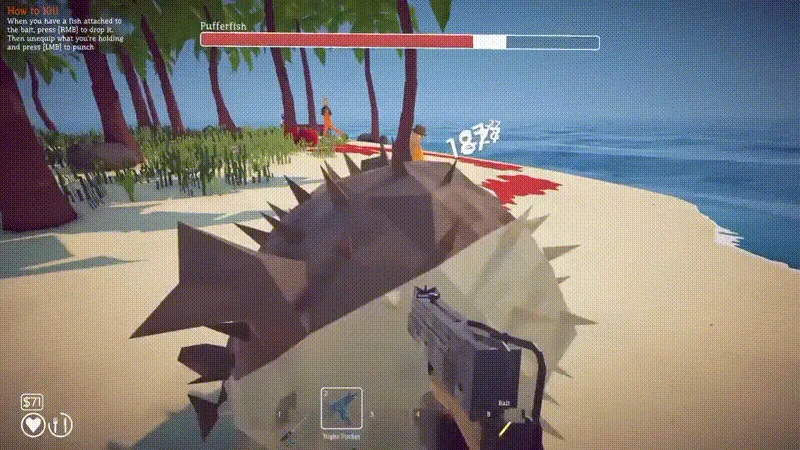
The Pufferfish can overwhelm an under-equipped player because of its size and attacks. An upgraded SMG is recommended, along with constant movement and the use of terrain to maintain distance. Patch 1.0.4 reduced the Pufferfish’s difficulty, but suitable equipment and positioning remain important. Returning the Pufferfish Fin to the tourist reveals a red radar destination for Island 4. The Boat Radar upgrade should be purchased before departing to improve navigation.
The desert island also contains an important optional objective involving the grill master. Use a Standard Boss Lure to catch the Blue Shark and give the creature to him. He provides a lighter, which can be used to ignite the grill. Once activated, the grill allows fish to be cooked before they are consumed or sold. - Island 4, the Tuna, and the Albatross
Progression on the fourth island begins with a Professional Boss Lure, which is used to catch and defeat the Tuna. Do not sell the Tuna after the fight because its body is required for the next encounter.
Place the dead Tuna on the grassy central area to summon the Albatross. Because it attacks from the air, the sniper rifle or another accurate firearm is preferable. Watch the creature’s movement pattern before firing and avoid wasting ammunition while it is difficult to hit.
After defeating the Albatross, give its head to the man hiding inside the shop. He provides the coordinates for Island 5, which appears as a magenta destination. - Island 5, the Bowhead Whale, and the Mutated Bowhead Whale
The final island begins with the scientist’s request for five fish. Delivering those catches provides Fish Bucket bait, which is required to attract the Bowhead Whale. Dynamite can gather several fish quickly for the scientist, although the explosion may scatter them.
The Bowhead Whale is best fought with a combination of the assault rifle, sniper rifle, and dynamite. It can launch itself into the air and perform a damaging belly-flop attack. Move away as soon as it becomes airborne instead of continuing to fire from the landing area.
After defeating the Bowhead Whale, transport its body to the summit of the volcano and throw it into the crater. This summons the Mutated Bowhead Whale. The mutated version uses similar physical attacks but can also project lava across the battlefield. Continue moving, use the available space around the military camp, and avoid remaining in areas covered by lava.
Patch 1.0.4 reduced the difficulty of the whale encounters, while the difficulty selector added later allows struggling players to lower creature health and damage further. After defeating the Mutated Bowhead Whale, return its fin to the scientist to receive the keys to the final black boat.
The fifth island does not unlock a sixth conventional fishing destination. Using the black boat returns the character to the mainland and concludes the campaign. The save remains available after the credits, allowing the player to revisit locations and complete optional collections or achievements.
Patch 1.0.5 corrected a progression bug that had allowed players to travel to islands without unlocking them properly. Under normal conditions, players must complete the relevant quest, deliver the boss trophy, obtain the new radar destination, and use the appropriate boat equipment before continuing.

How to Fish Multiplayer, Single-Player, PC Requirements, and Console Availability
How to Fish supports online cooperative multiplayer through Steam. One player can host a session and invite friends, while other players can join an available lobby through the multiplayer interface. The experience is built around shared fishing, combat, exploration, and quest progression, allowing group members to divide responsibilities while pursuing the same island objectives.
Patch 1.0.5 added private, invitation-only lobbies. This is the safest option for a closed group because unknown players cannot enter without receiving an invitation. The same update introduced controls for changing the session type through the server settings, although the session must be restarted before the change takes effect.
Cooperation can make several parts of the campaign easier. One player can reel in a boss while others prepare weapons or clear nearby threats. During combat, teammates can attack from different directions, distract a dangerous creature, and revive incapacitated players. Groups can also gather ordinary fish more quickly, increasing the rate at which they earn money for rods, bait, weapons, inventory space, and boat upgrades.
Players should coordinate before selling unusual creatures or quest-related objects. Several objectives require a specific corpse, body part, or unique catch. Selling or losing the necessary item creates extra work and may require the encounter to be repeated. The safest approach is to check the active quest, reserve the required object, and sell only surplus catches.
Connection, Player Limits, and Solo Play
Connection problems may sometimes involve Steam relay initialization or version differences between players. Patch 1.0.9 added a connection diagnostic to the main menu, while Patch 1.0.10 increased the amount of time allowed for a connection to complete. Restarting Steam and confirming that every participant has installed the latest game update may resolve some joining problems.
The game was originally released and advertised as a one-to-four-player experience. Patch 1.0.4 later added technical support for lobbies containing as many as eight players, but Dazed Games emphasized that the game remained designed primarily for groups of four or fewer. Sessions with more than four participants may produce additional physics chaos, balance irregularities, or situations outside the original design priorities.
The distinction is therefore important: How to Fish is officially presented and balanced around one-to-four-player sessions, but the updated PC version can technically accommodate up to eight players in one lobby. Public and private online sessions are supported, but there is no confirmed split-screen, local cooperative mode, or cross-platform multiplayer. Friends require separate PCs, Steam accounts, and game access, subject to Steam’s normal ownership and Family Sharing rules.
The entire campaign can also be completed in single-player. Solo players can fish, operate the boat, purchase upgrades, complete every major quest, defeat all required bosses, and reach the mainland ending without inviting another person. The single-player experience includes the same five principal locations, progression requirements, and post-credits continuation as multiplayer.
Playing alone can be more difficult because every responsibility belongs to one person. A solo player must manage the fishing interaction, inventory, hunger, healing, movement, ammunition, and boss damage without teammates to revive them or distract the creature. Preparation is therefore especially important. Players should purchase the strongest practical weapon available on each island, carry healing food, upgrade useful equipment, and avoid summoning a boss without enough ammunition.
Environmental cover and distance are often more effective than trying to overpower a boss immediately. Easy mode can reduce the pressure by lowering creature health by 25 percent and damage by 50 percent, while normal mode preserves the standard balance. Experienced solo players can select hard mode, which increases creature health and damage.
PC Requirements, Steam Deck, and Console Plans
The official minimum PC requirements are:
- Operating system: 64-bit Windows 10 or later
- Processor: Intel Core i5-5257U, AMD Ryzen 3 1200, or equivalent
- Memory: 8 GB RAM
- Graphics: Nvidia GeForce GTX 1050, AMD Radeon RX 460, or equivalent
- Storage: 1 GB of available space
- Network: Broadband internet connection
- Additional requirement: A 64-bit processor and operating system
The installation is comparatively small at only 1 GB, but the Steam page does not provide a complete recommended specification beyond the 64-bit requirement. Players should therefore treat the listed CPU, memory, and graphics hardware as the official minimum baseline rather than assuming an unpublished recommended configuration.
A broadband connection appears in the minimum requirements because online cooperative play relies on Steam networking. Single-player is separately supported, but an internet connection is still required at the appropriate stages to download the game, install updates, and access Steam services.
How to Fish includes full controller support and has been verified for Steam Deck. Steam Deck verification confirms compatibility with Valve’s handheld PC environment, not the existence of a native console release. Similarly, the addition of PlayStation controller icons to the PC version only allows compatible controllers to display the appropriate button prompts. It does not confirm that a PlayStation 5 edition is in development.
As of September 1, 2026, How to Fish was available only for Windows PC through Steam. No native editions had been released for PlayStation 5, Xbox Series X|S, or Nintendo Switch 2. Dazed Games has indicated that a console version is planned, but it has not announced a confirmed release date, complete platform list, pricing structure, or cross-play policy.
General confirmation of future console development should not be interpreted as proof that every current console will receive the game or that all versions will launch simultaneously. Until Dazed Games names the individual platforms, PS5, Xbox Series X|S, and Nintendo Switch 2 editions remain possibilities rather than confirmed products. The Steam version is currently the only edition that can be purchased and played.

Frequently Asked Questions (FAQs)
- When did How to Fish release?
How to Fish was released on August 20, 2026, for Windows PC through Steam. It launched as a complete commercial release rather than entering Early Access, which meant the full island progression, required quests, boss encounters, and ending were available immediately. Dazed Games continued supporting the game after launch with updates addressing multiplayer, difficulty settings, save reliability, controller prompts, creature balance, and connection issues. - Who developed and published How to Fish?
How to Fish was developed and self-published by Dazed Games, an independent studio based in Sweden. The company is credited as both the developer and publisher on the official Steam listing, meaning it handled the game’s creation as well as its commercial release. Dazed Games also managed the post-launch patches and communicated directly with players about fixes, multiplayer changes, and possible future content. - Can How to Fish be played alone?
Yes. How to Fish includes a complete single-player mode that allows one person to experience the entire campaign without entering a multiplayer lobby. Solo players can visit all five main locations, operate the boat, complete every required quest, buy equipment, and defeat the final bosses. Playing alone can make combat more demanding because there are no teammates to distract enemies or provide revives, but the difficulty settings allow players to adjust creature health and damage. - Does How to Fish support eight players?
Patch 1.0.4 added technical support for lobbies containing as many as eight players. However, Dazed Games explained that How to Fish was originally designed and remains primarily intended for groups of up to four. One to four players is therefore the recommended group size, while eight is the updated technical lobby limit. Larger sessions may create additional physics chaos and balance situations that were not central to the original design. - How many islands are in How to Fish?
The launch campaign contains five principal locations: the Lighthouse starting area and Islands 2, 3, 4, and 5. Each destination introduces new fishing equipment, stronger creatures, different quests, improved weapons, and at least one major progression encounter. The islands must normally be unlocked in order by completing an objective, defeating a boss, and obtaining the coordinates or radar destination for the next area. The final island leads back to the mainland rather than unlocking a sixth ordinary fishing location. - What is the best bait in How to Fish?
There is no universal best bait because the correct choice depends on the island and the creature being targeted. Standard lure tiers are used to catch regular fish and earn money, while bosses usually require dedicated Boss Lures or special quest items. For example, the Spider Crab requires an Empty Beer Can, the Giant Piranha uses Modified Leech bait, and the Pufferfish is attracted with a Carrot. Players should purchase the appropriate lure tier after reaching a new island and avoid selling unique bait before its purpose is clear. - What are the main bosses in How to Fish?
The principal progression encounters include the Spider Crab, Giant Piranha, Pufferfish, Albatross, Bowhead Whale, and Mutated Bowhead Whale. Defeating these creatures usually provides a body part, key item, or quest result needed to reach the next stage of the campaign. Other important or optional catches include The Old Pike, Blue Shark, Tuna, and Goblin Shark. Some of these creatures also serve another purpose, such as unlocking cooking facilities or acting as bait for a later boss. - Can players continue after completing How to Fish?
Yes. After defeating the final boss, returning to the mainland, and viewing the ending, players can continue using the same save file. The completed world remains available for revisiting earlier islands, catching missing species, finding rare variants, and finishing achievements. Players can also improve their equipment, complete optional activities, and recover collection items they may have overlooked during the main progression. - Is How to Fish Steam Deck compatible?
Yes. Valve lists How to Fish as Steam Deck Verified, which indicates that the game’s primary features work properly on the handheld without requiring extensive manual adjustments. Its default controller configuration functions correctly, appropriate controller prompts are displayed, interface text is readable, and the standard graphics settings perform acceptably on the device. Steam Deck verification applies to Valve’s handheld PC version and does not indicate that native console editions are available. - Will How to Fish come to consoles?
Dazed Games has indicated that a future console version is planned, but it has not announced a confirmed release date, final platform list, pricing structure, or cross-play policy. As of September 1, 2026, How to Fish remains available only for Windows PC through Steam. PS5, Xbox Series X|S, and Nintendo Switch 2 editions should therefore be treated as possibilities rather than individually confirmed releases until the developer names the supported platforms.

Conclusion
How to Fish turns a simple angling premise into a compact action-adventure built around physics, cooperative disorder and escalating equipment progression. The game begins with a basic rod and small crustaceans but eventually asks players to use firearms, explosives, specialized bait and environmental hazards against enormous bosses.
The How to Fish August 20 2026 release includes both solo play and online co-op. Although the game was designed for one to four participants, a post-launch update expanded lobby support to eight. Private sessions, multiple difficulty settings and continued developer patches give players several ways to tailor the experience.
Success depends on following the progression loop carefully. Use the appropriate lure tier, preserve quest-related catches, expand the inventory, cook fish when possible and upgrade weapons before major encounters. Completing NPC requests and returning boss trophies reveals the radar coordinates needed to reach each new island.
How to Fish is currently a Windows PC release, with future console plans lacking specific dates and platforms. For now, its full combination of fishing, combat, quests, bosses and multiplayer is available through Steam.
Sources and Citations
- Official Steam Store — How to Fish — Primary source for the August 20, 2026 release date, Dazed Games as developer/publisher, gameplay description, features, mature-content information and PC system requirements.
- Steam Community — How to Fish News & Updates — Official developer announcements and patch history covering multiplayer, connection fixes, gameplay changes and post-launch updates. The latest update also confirms Steam Deck Verified status and GeForce NOW support.
- GamesRadar+ — Full How to Fish Walkthrough — Covers the complete five-island campaign, objectives, quest sequence, equipment progression and final boss encounter.
- G2A News — How to Fish: All Fish, Bosses, Rods and Bait by Island — Covers the fish and bosses on each island, required rods, lures and boss bait, including the final Island 5 encounters.
- SteamDB — How to Fish — Provides the Steam app metadata, including App ID 4001890, Windows support, Unity Engine, developer/publisher and the precise release timestamp of August 20, 2026 at 14:03:36 UTC.
- SteamDB — How to Fish History — Useful for cross-checking the game’s release record and subsequent metadata/update history.
Recommendations
- Yerba Buena Preview: “We Have Portal at Home” – Gameplay, Release Date, and Puzzle Mechanics Explained
- Nintendo’s Stock Price Plummets After June 2026 Nintendo Direct Sparks Investor Panic Over Weak Switch 2 Lineup
- Scriptorium: Master of Manuscripts is the Kingdom Come: Deliverance and Animal Crossing-inspired medieval cozy art game with tiny dragons “Hans Capon mentioned therefore GOTY
- Project Hail Mary: Journey Among the Stars Game Adds a New Andy Weir Chapter with Maze Theory and Amazon MGM
- The Blood of Dawnwalker Free DLC Plans Revealed: Everything We Know About Post-Launch Content
- Return to Silent Hill Lands on Digital (Feb 24, 2026): Where to Watch, VOD Platforms, Cast, and Streaming Updates
- Iron Lung Indie Game Film Adaptation Earns $21.5 Million on Opening Weekend: Box Office Breakdown, Cast, and What Happens Next
- Ahoge Hair: Meaning, Cultural Significance, and 3D Modeling Techniques
- Best Drag Cars in Forza Horizon 6 for Maximum Straight-Line Speed



































































































