







In This Article (17 sections)
I Am Setsuna Overview, Story, and Its Chrono Trigger Inspiration
I Am Setsuna is a 2016 Japanese role-playing game (JRPG) developed by Tokyo RPG Factory and published by Square Enix. Created as a brand-new intellectual property, it was explicitly designed to emulate the style of classic 16-bit RPGs. Square Enix even described it during development as a “pure fantasy, true role-playing game,” emphasizing its goal of recapturing the feel of beloved 1990s RPGs.
The game is set in an entirely snowbound world plagued by monsters, where players follow Endir, a silent mercenary hired to assassinate a young woman named Setsuna. However, after witnessing her compassion and unwavering resolve, he instead becomes her reluctant bodyguard. Setsuna has accepted her fate as a sacrificial maiden destined to travel to the distant Last Lands, where her life is meant to preserve the fragile remnants of humanity by keeping a terrible force known as the Dark Samsara at bay.
From the outset, I Am Setsuna was built to evoke nostalgia for Chrono Trigger and other classic Square RPGs. Its battle system closely resembles Chrono Trigger’s turn-based Active Time Battle (ATB) mechanics, complete with a shared action meter and powerful dual- and triple-techniques that allow party members to combine attacks. Director Atsushi Hashimoto openly acknowledged that the team was heavily influenced by Chrono Trigger and other Square classics. Critics also noticed the similarities, with Game Informer pointing out direct references such as abilities named “X-Strike” and “Luminaire,” alongside combat that feels like a modern interpretation of Chrono Trigger’s iconic systems. While introducing a few fresh ideas, the game’s pacing, structure, and combat remain intentionally familiar to longtime JRPG fans.
A World of Endless Snow
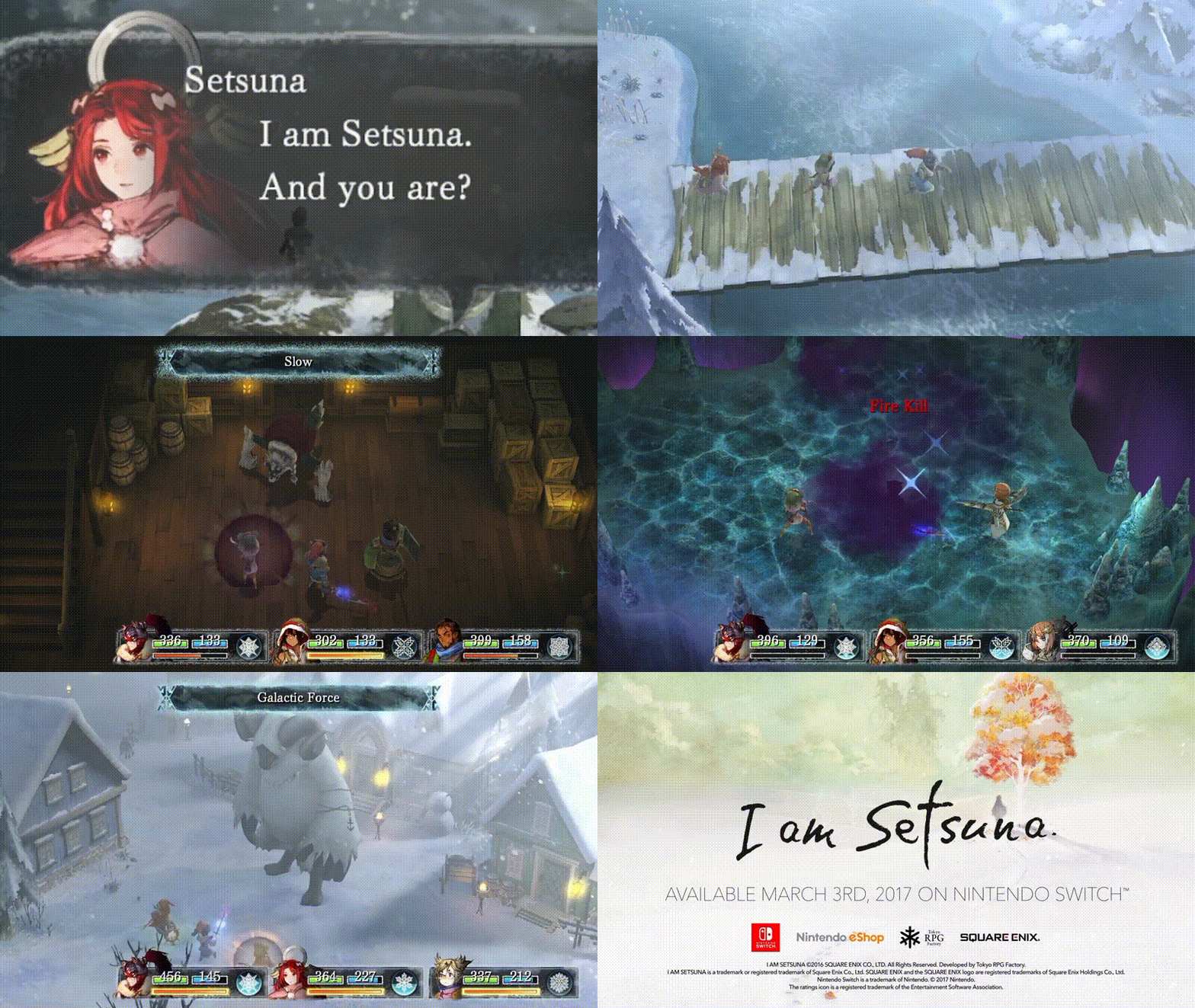
One of the game’s defining features is its unwavering commitment to a snowy setting. Rather than serving as a simple visual backdrop, the endless winter reflects the emotional core of the story. The title derives from the Japanese word setsunasa, meaning sadness or anguish, and the developers deliberately chose a frozen world to reinforce themes of sacrifice, loss, and fleeting life. Director Hashimoto explained that the snowy atmosphere was intentionally selected to embody these emotions, resulting in a haunting world of icy villages, frozen fields, and blue-and-white landscapes. Small visual details, such as characters’ reflections shimmering across frozen caverns, further strengthen the feeling of cold isolation while tying the game’s art, music, and narrative together.
Yes, I Am Setsuna remains almost entirely covered in snow from beginning to end. Although some players criticized the lack of environmental variety, the developers maintained that this artistic decision was essential to preserving the game’s emotional identity. The only significant departure from the perpetual winter occurs in the post-credits epilogue, where Endir walks through a landscape featuring a broadleaf tree covered in fresh green leaves. This brief glimpse of spring symbolizes the end of the long winter and the breaking of the endless cycle of sacrifice.
The story gradually reveals the truth behind that cycle. For generations, young maidens have willingly sacrificed themselves to strengthen the barrier imprisoning the Dark Samsara. Along their journey, Endir and Setsuna are joined by several companions, including Setsuna’s childhood friend Aeterna, the stoic swordsman Nidr, the hot-headed Kir, and the noble knight Julienne. Throughout their pilgrimage, the group repeatedly clashes with a mysterious specter known as the Reaper, also called Fides.
Truth of the Dark Samsara
When the party finally reaches the Last Lands, they meet the Time Judge, who reveals the true purpose of each sacrifice. Every maiden strengthens the barrier containing the Dark Samsara, which is ultimately revealed to be the tormented spirit of a boy whose ancestors experimented on magically gifted children, creating the curse that now threatens humanity. Setsuna herself is revealed to be the reincarnation of a soul capable of permanently ending the Dark Samsara, while Aeterna is exposed as a magical clone able to exist outside the normal flow of time.
Before the final confrontation, the Dark Samsara escapes, forcing Endir and Setsuna to pursue it by traveling into the past using special memory save points. Endir ultimately defeats the Dark Samsara in its human form on the day Setsuna’s mother died, bringing an end to the ancient curse. However, the remaining darkness still exists, and Setsuna willingly absorbs it into herself, mastering it through her own emotions. Knowing there is no other way to completely end the cycle, she asks Endir to take her life.
Following Setsuna’s final sacrifice, Aeterna peacefully disappears after fulfilling her purpose, while the remaining companions go their separate ways. The game’s closing moments return to Endir, who walks through a world where green leaves have finally returned to the trees, symbolizing that Setsuna’s sacrifice has restored life and ended the endless winter that had defined the world for generations.

I Am Setsuna’s Combat and Classic JRPG Design
I Am Setsuna combines a classic turn-based JRPG combat system with deliberate old-school game design, making it especially appealing to fans of Chrono Trigger. Battles use an Active Time Battle (ATB) gauge for each character, allowing players to issue commands once a character’s gauge is full. Characters can attack, cast magic, use skills, or consume items, and if multiple party members are ready, their turns are queued in the order chosen by the player. Each character equips Spritnite stones on talismans to learn Tech abilities, including powerful Double Tech attacks that combine the skills of two characters. Later in the game, Triple Techs become available, closely mirroring the iconic combo attacks found in Chrono Trigger.
The game’s most distinctive combat feature is the Setsuna gauge, also known as the momentum gauge. As battles progress, characters earn SP by attacking, taking damage, or simply waiting. Once a gauge node is filled, players can activate momentum to enhance their next action. A basic attack might strike multiple times, a healing spell can affect the entire party while curing status ailments, or a single-target ability can become an area-of-effect attack. Similar in concept to Final Fantasy VIII’s Gunblade timing mechanic, the momentum system adds meaningful tactical decisions without making combat overly complex. Players must constantly decide whether to spend momentum immediately for extra damage or save it for a critical defensive or healing opportunity.
After battles, characters gain experience and level up, while damage is fully restored at the next save point. The overall combat experience remains faithful to retro JRPGs with intuitive menus, straightforward character progression, and strategic use of ATB, combo attacks, and momentum mechanics. As Game Informer noted, the familiar mechanics remain enjoyable while the momentum system introduces valuable tactical depth.
Exploration and Deliberate Nostalgia
Beyond combat, nearly every aspect of I Am Setsuna embraces classic JRPG design. Exploration takes place on fixed top-down maps without modern conveniences like mini-maps or quest markers. Players travel between towns, dungeons, and wilderness areas while relying on conversations with NPCs to uncover story objectives and optional side quests. Basic facilities such as weapon and item shops are available, but players are expected to pay attention to dialogue and remember important clues rather than follow on-screen guidance.
The developers intentionally removed several modern quality-of-life features to preserve the nostalgic experience. There is no traditional world map or inns for healing. Director Atsushi Hashimoto explained that inns would not fit the game’s harsh setting, where travelers naturally sleep outdoors, and mini-maps were omitted because they discouraged exploration and weakened the sense of discovery associated with classic 1990s RPGs. Equipment upgrades, crafting, and character progression remain intentionally simple, reinforcing the game’s minimalist philosophy.
The user interface also reflects this retro approach. Menus are text-heavy, requiring players to manually manage equipment and Spritnite customization instead of relying on automatic optimization systems. Side quests are relatively few and entirely optional, rewarding players who choose to thoroughly explore the world. While these design choices may feel barebones compared to modern RPGs, they successfully recreate the pacing, challenge, and sense of adventure that defined the Super Nintendo and early PlayStation eras.
Chrono Trigger Resonance and Emotional Storytelling
These nostalgic design choices are exactly why I Am Setsuna resonates so strongly with Chrono Trigger fans. The combat feels immediately familiar thanks to its ATB system, three-character party, Double and Triple Tech attacks, and timing-based momentum mechanic. Many battle animations, sound effects, and visual cues intentionally echo Chrono Trigger, creating a strong sense of familiarity while still offering enough new mechanics to stand on their own.
The game’s emotional storytelling also recalls the themes that made Chrono Trigger memorable. Centered on a young girl destined to sacrifice herself to save the world, I Am Setsuna embraces heartfelt drama and emotional storytelling, supported by a fully piano-based soundtrack filled with melancholic melodies reminiscent of classic 16-bit RPGs.
Critics have frequently pointed to this blend of nostalgia and familiarity as one of the game’s greatest strengths. MMORPG.com recommended the game specifically to classic JRPG enthusiasts, particularly Chrono Trigger fans, while another reviewer observed that players coming from Chrono Trigger would find enough familiar ideas to stay engaged without feeling like they were playing a direct copy. Although I Am Setsuna never reaches the legendary status or innovation of its primary inspiration, it succeeds as a heartfelt love letter to the golden age of JRPGs, offering longtime fans a satisfying return to the style that defined the genre.

I Am Setsuna’s Strengths, Weaknesses, and Whether It’s Worth Playing Today
Among I Am Setsuna’s greatest strengths, its atmosphere and music stand out the most. The solo piano soundtrack, composed by Tomoki Miyoshi, is almost universally praised for its beautiful, elegiac melodies that perfectly capture the game’s melancholic tone. Restricting the soundtrack to piano alone reinforces the lonely winter atmosphere, creating a cohesive emotional experience that many reviewers felt dominated the game to great effect. The presentation is further enhanced by its art style. Despite the game’s modest budget, the snow-covered villages, frozen caves, and icy landscapes are crisp and visually appealing, with details like real-time reflections on ice adding extra polish. Although every area shares the same snowy theme, the consistent aesthetic helps immerse players in the game’s world.
The combat system is another highlight and is often considered the game’s strongest gameplay feature. Drawing inspiration from classic Active Time Battle systems, it remains engaging while introducing the Setsuna gauge, which adds tactical depth without making battles overly complex. Unlocking Dual Techs through Spritnite stones provides a satisfying sense of progression, while collecting materials to customize abilities encourages experimentation with different character builds. Many players enjoy discovering powerful combinations in a way reminiscent of Materia customization in classic Final Fantasy titles.
The game’s pacing is also widely appreciated. Unlike many modern RPGs that demand well over 100 hours, I Am Setsuna tells its story in roughly 20 to 30 hours. This focused runtime allows the adventure to maintain momentum without overstaying its welcome, making it an excellent choice for players who want a complete RPG experience without an enormous time commitment. Combined with its touching story, familiar cast of characters, and faithful retro-inspired design, the game offers a cozy experience that many consider an excellent entry point into classic-style JRPGs or a refreshing palate cleanser between larger games.
Weaknesses and Repetition
However, I Am Setsuna also has several notable shortcomings. The biggest criticism is its lack of variety. Since nearly every location is covered in snow, environments can begin to feel repetitive as the adventure progresses. Many dungeons share similar visual designs, and the constant winter setting eventually loses some of its impact. Even the acclaimed piano soundtrack becomes repetitive for some players because every piece relies on the same instrument throughout the entire game. While this consistency strengthens the atmosphere, others find it monotonous during longer play sessions.
The story and characters also receive mixed reactions. Although the narrative is sincere and emotionally driven, many critics felt it followed an overly familiar JRPG formula, with comparisons frequently drawn to Final Fantasy X because of its sacrificial pilgrimage premise. The plot contains few surprising twists, while the mostly silent protagonist and limited character development make it difficult for some players to form strong emotional connections with the cast. Several reviewers described the writing as predictable and the characters as underdeveloped.
Some gameplay mechanics also feel underutilized. Crafting and weapon upgrades rarely become essential because stronger equipment often drops naturally from enemies, reducing the incentive to invest in those systems. Cooking offers only minor benefits, and managing Spritnite can become tedious due to frequent menu navigation when trying to optimize Dual Tech combinations. Difficulty balance is another common complaint. Most of the adventure is relatively easy, allowing players to progress without much strategy, only for several late-game bosses to introduce sudden spikes in challenge that can catch players off guard.
Final Verdict and Value
Ultimately, I Am Setsuna remains a solid, if somewhat niche, JRPG that continues to be worth playing for the right audience. It may not satisfy players looking for a large, feature-rich modern RPG, but it succeeds as a heartfelt tribute to the genre’s golden era. Its strongest qualities—its emotional atmosphere, beautiful piano soundtrack, polished presentation, and enjoyable turn-based combat—still hold up well years after release. While its repetitive environments, predictable story, and limited gameplay variety prevent it from reaching the heights of the classics that inspired it, it largely delivers on its promise of being a focused old-school RPG.
The game is especially appealing when purchased at a discounted price, where its value becomes much easier to appreciate. Its shorter runtime also makes it easy to complete without requiring a major time investment. Players who enjoy Chrono Trigger-inspired combat, melancholic storytelling, and traditional JRPG design will likely find it a rewarding experience. Those expecting modern RPG features, extensive exploration, or significant gameplay variety may come away disappointed. Even so, for fans seeking a concise and atmospheric retro-style adventure, I Am Setsuna remains a worthwhile journey.

I Am Setsuna Platforms, Music, Atmosphere, and Beginner Tips
Platforms and Versions
I Am Setsuna was released on multiple platforms over time. It originally launched in July 2016 for PlayStation 4 and Windows PC. A PlayStation Vita version was also developed, though it was only released in Japan. In March 2017, the game became a launch title for the Nintendo Switch, bringing the complete experience to Nintendo’s console.
Across all platforms, the content is identical. The PS4 and PC versions run at a smooth 60 frames per second with slightly enhanced lighting effects. The Nintendo Switch version maintains the same graphical fidelity but runs at 30 fps instead. Aside from this performance difference and the convenience of handheld play on the Switch, there are no major extras or DLC. The game is not available on Xbox consoles or mobile devices. Most players choose the PS4 or PC version for the best performance, while the Switch version is ideal for portable play.
Music, Atmosphere, and Beginner Tips
The music of I Am Setsuna is one of its defining features. Composer Tomoki Miyoshi crafted an all-piano soundtrack to match the game’s themes of sorrow and nostalgia. From the very beginning of development, the team decided that piano would serve as the main driving force of the soundtrack because it best reflected the concept of setsuna (sadness). Miyoshi even abandoned orchestral demos in favor of a simpler solo-piano approach, believing it better captured the game’s emotional tone. Renowned pianist Randy Kerber performed the music live, giving every track a warm and authentic feel.
Critics and players have widely praised this musical direction. The sparse piano compositions create a wistful mood across the game’s snowy landscapes, with reviewers describing the soundtrack as beautiful and elegiac. Even though the music rarely becomes grand or dramatic, its consistency strengthens the game’s atmosphere. Combined with the visuals, every town, dungeon, and battle feels tranquil yet melancholic, creating a memorable emotional experience.
The atmosphere is one of the game’s greatest strengths. The combination of monochromatic winter environments and the gentle piano score creates a haunting, almost meditative mood. Even during battles, additional instruments are used only to support the piano rather than overpower it. Critics have described the presentation as both visually haunting and whimsical, with its unique style leaving a lasting impression long after the adventure ends.
For new players, a few strategies can make the journey much smoother:
- Save frequently, as the game only allows manual saves at designated save points and does not include an autosave system.
- Manage the Setsuna gauge carefully by timing button presses to enhance attacks or improve support abilities, such as turning a single-target heal into a party-wide heal.
- Equip Spritnite strategically to learn new skills. Experiment with different combinations, and remember that once a Spritnite skill is unlocked permanently, it remains available even after the crystal is removed.
- Experiment with Dual Techs and Triple Techs whenever multiple party members have full ATB gauges, as these powerful combination attacks can significantly improve combat efficiency.
- Rotate your party members regularly instead of relying on the same characters. Each character offers unique Tech combinations that become more valuable later in the game.
- Hunt monsters for crafting materials, especially enemies that drop rare items used to create powerful Spritnite.
- Keep healing items and SP restoration items stocked since there are no inns. Abilities such as Rush can quickly refill ATB gauges during difficult encounters, while status-curing items like Revitalizers can save your party in emergencies.
- Speak with NPCs after recruiting new party members, as additional side quests often become available. These optional activities reward valuable experience and equipment that make the main story easier.
- Upgrade weapons, purchase better armor whenever possible, and continue leveling your characters to stay prepared for the increasingly difficult late-game bosses.
- Be prepared for difficulty spikes near the end of the game. If a boss proves too challenging, spend time leveling up, collecting stronger Spritnite, and improving your equipment before attempting the fight again.

Best JRPGs Like I Am Setsuna
Fans looking for similar experiences have several excellent options. The most obvious comparison is Chrono Trigger, whose blend of Active Time Battle combat and emotional storytelling served as the primary inspiration for I Am Setsuna. Another classic Square Enix RPG is Final Fantasy X, which also centers on a heroine destined for sacrifice, with many reviewers noting strong similarities between the two games’ narratives.
Tokyo RPG Factory’s own follow-up titles are also natural recommendations. Lost Sphear (2017) builds on I Am Setsuna’s gameplay with nearly identical mechanics but tells a completely new story. Oninaki (2019) shifts to action-based combat while retaining the studio’s signature themes of sacrifice and its distinctive visual style.
Beyond those, several modern JRPGs capture a similar nostalgic appeal. Bravely Default and its sequel deliver classic turn-based gameplay, Radiant Historia features an engaging time-travel narrative, and Octopath Traveler embraces retro-inspired visuals and mechanics. Ni no Kuni: Wrath of the White Witch is another strong choice, offering a heartfelt story paired with beautiful painterly artwork. Overall, if you enjoyed I Am Setsuna, any JRPG that emphasizes classic combat systems, emotional storytelling, and a strong atmosphere—especially titles from Square Enix or other developers inspired by the genre’s golden era—is worth exploring.
frequently asked question(FAQs)
1.What platforms can I play I Am Setsuna on?
I Am Setsuna is available on PlayStation 4, Nintendo Switch, Windows PC, and mobile devices in Japan. It was also released on PlayStation Vita exclusively in Japan. Outside Japan, the game is officially available on PlayStation 4, Nintendo Switch, and PC through Steam, making those the primary platforms for most players today. The game is available on PlayStation 4, Windows PC, and Nintendo Switch (as a port released in 2017). A PlayStation Vita version exists but was released only in Japan. The Switch version runs at 30 FPS, while the PS4/PC versions run at 60 FPS. There is no Xbox or mobile version.
2. Is I Am Setsuna a sequel to Chrono Trigger?
No. I Am Setsuna is a completely separate game released decades after Chrono Trigger and is not connected to the Chrono series in terms of story, characters, or world. It was Tokyo RPG Factory’s debut title. That said, the developers intentionally drew inspiration from Chrono Trigger’s classic turn-based combat, emotional storytelling, and nostalgic presentation, which is why many players consider it a spiritual successor rather than an official sequel.
3. Who is Setsuna in the story?
Setsuna is the game’s titular heroine and the central figure of the story. She is a kind-hearted young woman chosen to become the sacrificial maiden, believing her sacrifice will save the world from monstrous threats. Endir, the main playable character, is originally hired to assassinate her before the ritual can take place, but after meeting her, he instead chooses to protect her and accompanies her on the dangerous journey.
4. What does “Setsuna” mean?
The title I Am Setsuna is inspired by the Japanese word setsunasa, which refers to feelings of sadness, sorrow, longing, or the bittersweet nature of fleeting moments. The name reflects the game’s emotional themes of sacrifice, loss, hope, and accepting difficult choices, making it an appropriate title for the story being told.
5. Is the game hard?
Overall, I Am Setsuna is considered fairly accessible and not especially difficult for most players. Regular enemies and many bosses can usually be defeated without excessive grinding. However, the final bosses and a few optional encounters are noticeably more challenging, requiring better party setups, careful use of Spritnite abilities, and thoughtful battle strategies.
6. How long is I Am Setsuna?
Most players finish the main story in about 20 to 30 hours, depending on how much exploration and side content they complete. Players who take on optional quests, collect stronger equipment, or challenge the post-game content can expect to spend several additional hours. The relatively short length was a deliberate design choice to deliver a focused story without unnecessary filler.
7. Who composed the music?
The soundtrack was composed by Tomoki Miyoshi, with piano performances by Randy Kerber. One of the game’s most distinctive features is that its entire soundtrack is performed using solo piano, creating a consistently melancholic atmosphere that perfectly complements the story’s themes of sacrifice and emotional loss.
8. Are there multiple endings or New Game Plus?
No. I Am Setsuna has a single canonical ending, so your choices do not lead to different conclusions. The game also does not include a New Game Plus mode. After completing the main story, you can continue exploring the world, challenge optional boss rush content, and collect remaining abilities or equipment, but the story itself does not continue beyond its ending.
9 Does the game have voice acting?
No. In keeping with its classic JRPG inspiration, I Am Setsuna does not feature full voice acting. All dialogue is presented through text, allowing players to read conversations at their own pace. Endir, the main protagonist, is also a silent character, a design choice commonly found in many traditional role-playing games.
10. Is the entire game set in a snowy environment?
Yes. Nearly every location in I Am Setsuna is covered in snow and ice, making its permanent winter setting one of the game’s defining visual features. The developers used this consistent snowy landscape to reinforce the story’s somber mood and themes of sacrifice. Aside from a brief green scene in the ending epilogue, where nature begins to recover, the world remains frozen throughout the adventure.

Conclusion
I Am Setsuna is a heartfelt homage to the golden age of JRPGs, with a focus on atmosphere and classic gameplay. Its persistent winter setting, emotional sacrifice story, and elegant piano soundtrack create a mood that many players find memorable. The combat system, while deliberately simple, provides satisfying Chrono Trigger–style battles with a few modern twists. At the same time, its lack of variety in scenery and characters can make the experience feel limited.
For enthusiasts of old-school JRPGs and Chrono Trigger fans in particular, I Am Setsuna offers a concise and polished adventure. It “doesn’t make any unforgiveable missteps”, delivering exactly the nostalgic nostalgia it promises. Even in 2026, it stands as a worthy experience for those seeking a moody, beautiful throwback – though it’s best enjoyed with expectations tuned to its retro scope.
Sources and Citations
- Wikipedia – I Am Setsuna
https://en.wikipedia.org/wiki/I_Am_Setsuna - Kotaku – Q&A: I Am Setsuna Director Talks Feedback, Snow, And Why There Were No Inns
https://kotaku.com/q-a-i-am-setsuna-director-talks-feedback-snow-and-wh-1784631092 - MMORPG.com – I Am Setsuna: Leveraging Modern Tech While Paying Homage to the Past
https://www.mmorpg.com/previews/i-am-setsuna-leveraging-modern-tech-while-paying-homage-to-the-past-2000094217 - Wikipedia – I Am Setsuna (Story Synopsis – Part 1)
https://en.wikipedia.org/wiki/I_Am_Setsuna#Plot - Wikipedia – I Am Setsuna (Story Synopsis – Part 2)
https://en.wikipedia.org/wiki/I_Am_Setsuna#Plot - Wikipedia – I Am Setsuna (Story Epilogue)
https://en.wikipedia.org/wiki/I_Am_Setsuna#Plot - Wikipedia – I Am Setsuna (Development)
https://en.wikipedia.org/wiki/I_Am_Setsuna#Development - Wikipedia – I Am Setsuna (Design Influences)
https://en.wikipedia.org/wiki/I_Am_Setsuna#Development - Wikipedia – I Am Setsuna (Theme of Sadness and Snow)
https://en.wikipedia.org/wiki/I_Am_Setsuna#Development - Nova Crystallis – I Am Setsuna Review
https://www.novacrystallis.com/2016/07/review-i-am-setsuna/ - Game Informer – I Am Setsuna Review
https://www.gameinformer.com/games/i_am_setsuna/b/playstation4/archive/2016/07/18/i-am-setsuna-review-game-informer.aspx - Siliconera – I Am Setsuna’s Switch Version Runs at 30 Frames Per Second
https://www.siliconera.com/i-am-setsunas-switch-version-runs-30-frames-per-second/ - TIME – I Am Setsuna Review by Matt Peckham
https://time.com/4413168/i-am-setsuna-review/ - GameMusic.net – Interview with Tomoki Miyoshi (I Am Setsuna Composer)
https://gamemusic.net/interview-with-tomoki-miyoshi-composer-of-i-am-setsuna/
Recommendations
- Summer Game Fest 2026 Schedule: All Conference Dates, Times, and Full Event Lineup Revealed
- Everwind Early Access Launch Explained: Why This Minecraft-Like Voxel Sandbox RPG With Flying Islands Is Getting Attention
- The 15 Best Sci-Fi Anime Series of All Time (Ultimate Ranking for 2026 Fans & Beginners Guide)
- Warren Spector’s Thief Spiritual Successor Thick as Thieves Launches Next Month for Just $5 With Intro Campaign Details Revealed
- Dreamlight Valley Treasure Hunt Event Guide: How Treasure Trove Clues Work and How to Finish
- Home Circuit Dev Velan Studios Opens Office in Toronto as It Expands Into Canada
- Delta Force X Rainbow Six Siege Official Crossover Trailer: Release Date, Operators, Skins, and Season 10 Details
- How to Retopology in Blender: A Step-by-Step Guide for Clean 3D Meshes
- Jean-Claude Van Damme’s 1988 Martial Arts Cult Classic Bloodsport Set for Remake at A24: Everything We Know So Far
- PC Gaming Revenue Outside the Top 20: Why Cyberpunk 2077, Elden Ring, and Skyrim Keep Selling



































































































