







In This Article (17 sections)
ReDefine’s Ikkis VFX Breakdown and the Battle of Basantar Recreation
ReDefine’s visual-effects breakdown of Ikkis reveals how practical engineering, digital tank creation, environment extensions, compositing, and combat effects were combined to reconstruct the Battle of Basantar, one of the most significant armored clashes of the 1971 India-Pakistan War. Directed by Sriram Raghavan, the Hindi-language biographical war drama follows Second Lieutenant Arun Khetarpal, the 21-year-old Indian Army officer whose actions during the battle earned him the Param Vir Chakra posthumously. The tanks are therefore not distant military decoration. They are central to Khetarpal’s experience and must communicate mass, danger, confinement, and mechanical power throughout the film.
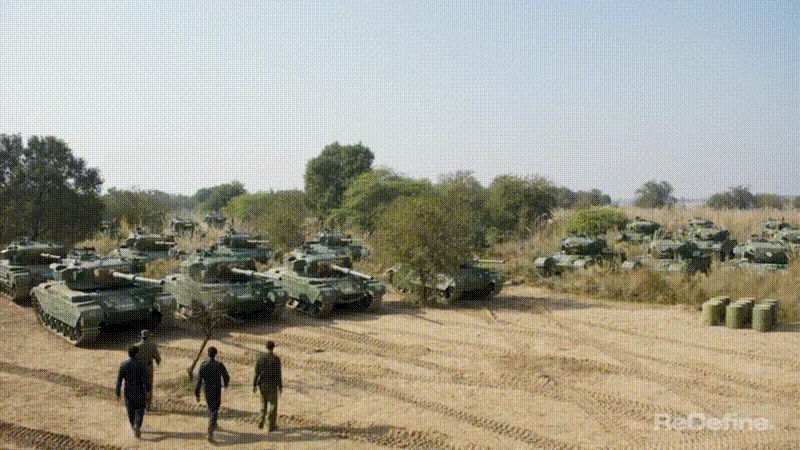
ReDefine’s official breakdown moves between completed shots and earlier stages of the visual-effects process, making the boundary between live-action photography and digital enhancement easier to understand. Images that appear to contain complete formations of operational period tanks were often assembled from a much smaller collection of moving replicas, dummy vehicles, digital assets, environmental additions, and layered combat effects. ReDefine created and multiplied tanks, extended exterior locations, strengthened explosions and gunfire, added destruction, and produced a visceral shot in which a shell penetrates a tank from the side.
The source plates already contain substantial practical detail. Actors, moving tank sections, outdoor terrain, smoke, mud, and foreground activity establish a tactile photographic foundation. ReDefine expands that material without making the completed image feel separated from the location photography. Digital tanks must match the original camera angle, lens, perspective, lighting, terrain, movement, motion blur, atmospheric haze, and depth. They must also appear to compress wet ground, produce dust, respond to uneven surfaces, and occupy believable positions within a formation.
Breakdown Limitations and Hybrid Approach
The breakdown is a focused presentation of ReDefine’s battlefield work rather than a complete technical record of every department or tool involved. It does not identify every software package, simulation setting, asset variation, or proprietary compositing method. The clearest documented principle is the hybrid production strategy: practical work supplied immediacy, physical interaction, and visual reference, while digital effects supplied multiplication, destruction, enhancement, and scale.
Recreating the historical setting required much more than placing tanks in an open field. The Battle of Basantar took place in the Shakargarh sector during the western campaign of the 1971 war and involved minefields, bridgehead operations, infantry, artillery, and intense armored combat. More than five decades later, the filmmakers could not simply locate the original equipment and battlefield conditions in a ready-to-film state. Costumes, military props, production design, practical vehicles, action staging, special effects, cinematography, location selection, and digital visual effects all had to support the same period.
Modern buildings, roads, utility structures, vehicles, and other contemporary intrusions had to be avoided, obscured, removed, or replaced. Raghavan said the tank action was filmed at real outdoor locations rather than staged entirely against green screens. The replicas moved through marshy ground and water, creating genuine displacement, track movement, spray, shadows, surface interaction, and reflections under natural light. These physical details gave ReDefine strong material to match when inserting vehicles or extending the environment.
Dramatic Reconstruction and Narrative-Driven Effects
The film remains a dramatic reconstruction rather than a piece of battlefield documentation. Its primary responsibility is to communicate the human stakes surrounding Khetarpal. The effects support that goal by making the tactical situation understandable. Wide shots establish vehicle numbers, open terrain, shifting formations, and the distances between opposing forces. Medium and close shots move the audience beside tanks, crew members, weapons, and impacts. ReDefine connects those visual scales so that the battle feels like one continuous event rather than a collection of unrelated effects shots.
Tank multiplication is not merely a method for making the frame look busier. It communicates the strength of the opposing advance. Environment extensions reveal how exposed the soldiers are within the broader battlefield. Smoke columns, distant impacts, muzzle flashes, burning vehicles, and dust imply that combat continues beyond the principal subject. Destruction effects identify changes in the engagement and increase the pressure surrounding the hero vehicles. The visual scale remains tied to Khetarpal’s decisions rather than existing only as spectacle.

Practical Centurion Replicas, Digital Tanks, and Armored Formation Multiplication
The Centurion tank is fundamental to Ikkis because Khetarpal served with the 17 Poona Horse and fought from a Centurion during the Battle of Basantar. Operational examples appropriate for filming were not readily available. Raghavan explained that surviving Centurions were largely static display pieces positioned outside military institutions and cantonments, so the production obtained designs and fabricated its own moving versions.
The filmmakers built three functioning tank replicas weighing approximately four to five tons each, along with two dummy vehicles for wider shots. Their construction reportedly took between three and six months and required considerable trial and error. The replicas needed to travel at an acceptable speed, turn believably, carry actors, support camera coverage, and continue functioning across irregular terrain, marshland, water, and mud. Raghavan described early tests in which prototypes travelled only a short distance before stopping or required far too much time to complete a turn.
These physical machines gave the actors something substantial to climb onto, enter, touch, and respond to. They created authentic eyelines, handholds, hatches, shadows, reflections, vibration, and mechanical movement. Cinematographer Anil Mehta could photograph real painted surfaces in changing daylight, while the tracks disturbed soil and water in ways that immediately communicated weight. The vehicles also created a physical sense of confinement and grandeur around the performers that would have been difficult to reproduce with an entirely imaginary tank.
Digital Tanks Extend Practical Work
Digital work extended what the fabricated vehicles could achieve. ReDefine could place tanks in dangerous positions, multiply them into larger formations, involve them in destructive action, repair or complete practical components, and show angles that were unsafe or impractical for the physical machines. A practical vehicle could dominate the foreground while digital tanks occupied the middle and far distance. Another shot could use the physical tank primarily as an actor platform, with effects completing the upper structure, adjusting the turret, extending the vehicle, or adding battle damage.
Creating a convincing digital tank involves several connected tasks. Artists must model the armor, tracks, road wheels, suspension, turret, gun, hatches, fixtures, and smaller mechanical details. Texturing must reproduce painted metal, dust, mud, soot, scratches, wear, and differences between exposed and sheltered surfaces. Rigging allows the hull, suspension, tracks, turret, barrel, and other components to move independently, while animation must respect the machine’s weight and mechanical restrictions.
Camera tracking and perspective reconstruction place the tank correctly within the photographed plate. Lighting artists match the direction, color, intensity, and softness of illumination from the location. Compositors then integrate the rendered vehicle through matched grain, contrast, depth, atmospheric haze, motion blur, shadows, reflections, dust, debris, and partial occlusion. Ground contact is particularly important because a technically detailed tank can still look weightless if its tracks do not appear connected to the terrain.
Multiplying Armored Formations with Variation
Tank multiplication allowed three moving replicas and two dummy vehicles to represent a much larger armored force. Effective multiplication requires more than placing identical copies across the frame. Exact repetition in turret angles, wheel positions, movement, speed, dirt patterns, crew visibility, highlights, spacing, and dust trails would reveal the technique immediately. Artists can reduce those patterns by varying orientation, animation timing, distance, surface condition, formation spacing, track response, and the relationship between each vehicle and the surrounding ground.
Distant vehicles require less visible geometric detail, but their silhouettes and movement must remain convincing. Atmospheric perspective becomes increasingly important as tanks recede into haze, smoke, and dust. Contrast and color separation diminish with distance, tracks become partly obscured, and the darker body and turret shapes carry most of the visual information. This keeps the formation readable without making every background vehicle unnaturally sharp.
Vehicle placement also serves the narrative. An expanding formation communicates an approaching threat. Immobilized or burning tanks show how the balance of the battle is changing. Readable spacing helps viewers understand which vehicles are advancing, which are defending, and where the immediate pressure is coming from. ReDefine therefore uses multiplication to construct tactical information rather than filling empty parts of the image indiscriminately.
The live-action replicas remain essential anchors. Their genuine shadows, surface imperfections, track movement, water displacement, vibration, and irregular motion establish a physical standard that the digital additions must follow. Dust and smoke can then cross in front of both practical and computer-generated vehicles, placing them inside the same atmosphere and helping hide the boundaries between sources. Color adjustments, contact shadows, disturbed ground, and layered debris complete the integration.
ReDefine increased the perceived scale of the battle in three principal ways:
- Vehicle expansion: A small number of fabricated tanks became complete armored formations through digital duplication and variation.
- Spatial expansion: Environment extensions carried the battlefield beyond the practical limits of the filming location.
- Activity expansion: Added smoke, impacts, gunfire, burning vehicles, debris, and distant movement suggested fighting across the entire landscape.
Scale also comes from contrast between wide and close imagery. A wide shot reduces individual tanks to small machines crossing a vast battlefield, while a close shot traps the audience beside the crew, armor, controls, smoke, and impacts. Alternating between those perspectives communicates both the strategic size of the engagement and the vulnerability of the people inside the vehicles.
Tank Shell Penetration, Explosions, Smoke, and Battlefield Environment Extensions
One of the most striking moments highlighted in coverage of ReDefine’s breakdown is a side view of a shell penetrating a tank. The shot presents armor not as an impenetrable wall but as a layered structure that can rupture with catastrophic consequences. ReDefine has not published a complete frame-by-frame recipe, but the breakdown makes the broad visual construction understandable.
A shot of this kind requires a controllable tank surface, precisely timed impact, progressive fragmentation or deformation, internal light, fire, smoke, and debris. The external armor can be represented with breakable digital geometry, allowing large fragments to separate according to the shell’s direction and force. Secondary particle layers provide smaller pieces of metal, hot material, dust, sparks, and smoke. An intense initial flash establishes the transfer of energy, followed by denser fire and smoke that reveal the destructive path.
The transition between the exterior and interior must remain coherent. Scale, camera movement, speed, focus, depth of field, and motion blur all need to connect the stages of the shot. Light from the penetration should affect nearby surfaces, while fragments must continue travelling with believable momentum. A practical shell could not safely be fired through an occupied set, making controlled digital construction the appropriate solution for portraying the event without endangering performers or equipment.
Sound design adds much of the completed moment’s violence, but the visual effects provide the physical logic that allows viewers to understand what happened. The image is effective because it exposes an event that usually takes place behind thick armor and turns it into an immediate cinematic experience. It also reinforces the vulnerability of the people inside the tanks, preventing the vehicles from feeling like invincible machines.
Explosions and Smoke Explain Combat Action
Explosions, muzzle flashes, ground impacts, fire, smoke, and debris have a similar responsibility throughout the battle. Their purpose is not only to make the footage more intense. Each effect helps explain action and consequence. A muzzle flash identifies the tank that fired. A ground impact reveals where the shell landed. A burning vehicle communicates that it has been disabled, while smoke alters visibility and changes the tactical environment.
The combat effects likely combine photographed practical elements with digitally generated simulations and enhancements, consistent with the hybrid approach visible throughout the breakdown. Practical charges can provide naturally irregular fire, dirt, smoke, light, and performer reactions. Digital effects allow artists to enlarge, redirect, retime, multiply, or place those events close to vehicles and actors without recreating the full danger physically. Compositors can combine several layers to form one final explosion or impact.
Different surfaces must produce different responses. Dry soil should create dust and granular debris. Marshy or wet terrain should throw darker earth and moisture. A shell striking metal should generate sparks, fragments, smoke, heat, and localized fire rather than behaving like an impact against loose ground. A tank that has already burned must continue accumulating soot, damage, fire, or persistent smoke instead of appearing restored in the next shot.
Smoke is also a major compositional tool. Large columns divide the frame and create visual depth. Low dust following tank tracks connects the vehicles to the ground. Atmospheric layers make distant tanks lose clarity naturally and help practical and digital elements share the same battlefield conditions. Smoke can conceal transitions or unwanted edges, but its use still needs to follow the geography and timing of the action.
Restraint is essential. If every part of the frame erupts simultaneously, viewers lose track of the hero tank, the enemy formation, and the direction of the attack. Effective battle imagery distributes muzzle flashes, shell impacts, dust, smoke, and fires according to the rhythm of the scene. ReDefine increases intensity without allowing the effects to obscure the principal story beats.
Extending the Battlefield Beyond the Practical Location
Environment extensions allow a manageable outdoor location to represent the broader Basantar battlefield. They can continue terrain beyond physical boundaries, control the horizon, replace modern buildings, add distant military activity, and remove features inconsistent with 1971. The outdoor shoot supplied real soil, water, vegetation, sky illumination, and atmospheric reference, allowing the effects team to extend an existing location rather than invent every part of the environment from nothing.
Successful extensions repeat the logic of the original plate. Terrain height, soil color, water distribution, vegetation density, haze, light, and distance must remain consistent. Distant defensive positions, wreckage, smoke columns, vehicle tracks, and damaged ground can indicate that fighting continues beyond the photographed area. The environment can also evolve over the sequence so that later shots contain accumulated destruction rather than appearing untouched after sustained combat.
The horizon is particularly important in wide armored imagery. A well-rendered tank can still look artificial if the surrounding landscape does not support its scale. Distant terrain must follow atmospheric perspective, while vehicle shadows must agree with the sunlight and ground shape. Crew-vehicle tracks, safety equipment, modern structures, and production infrastructure can be painted out or replaced to maintain the historical setting.
Before-and-After Comparisons and Hybrid Production Pipeline
The breakdown’s before-and-after comparisons reveal the full value of this work. Original plates often contain a practical hero tank, actors, foreground terrain, and selected atmospheric elements. The completed image introduces additional tanks, distant impacts, extended landscapes, strengthened smoke and fire, extra damage, debris, and greater military activity.
A sparse outdoor plate can become a full armored engagement without losing the tactile qualities captured on set. The comparisons also show why good source photography remains so valuable. ReDefine could match real tank movement, natural light, disturbed soil, and existing smoke rather than inventing every cue independently.
These images should not be interpreted as a competition between practical and digital effects. The live-action material was created with later enhancement in mind, while the digital work depends upon the practical photography for weight, reference, and interaction. The finished battle belongs to a shared production pipeline in which location work, vehicle fabrication, cinematography, special effects, animation, simulation, compositing, editing, and sound support the same result.

Arun Khetarpal’s Story, Ikkis Production Challenges, and Why the VFX Stands Out
Second Lieutenant Arun Khetarpal was commissioned into the 17 Poona Horse and fought during the Battle of Basantar at the age of 21. His Param Vir Chakra citation records his response to a call for reinforcement, his courage under intense tank fire, the destruction of enemy vehicles, and his refusal to abandon his position after his own tank was hit and caught fire. Ikkis places that history inside a personal story about youth, family, duty, courage, and sacrifice.
Agastya Nanda portrays Khetarpal, while Dharmendra plays his father, Brigadier M. L. Khetarpal. Jaideep Ahlawat appears as a Pakistani officer in a narrative connected to the later meeting between Khetarpal’s father and the officer associated with the fatal engagement. The film’s battlefield scenes therefore need to support a biographical story rather than exist as isolated military spectacle.
The visual effects make Khetarpal’s circumstances physically and emotionally legible. Tank multiplication shows the scale of the opposing threat. Wide environment extensions reveal the exposed ground and the distances involved. Shell penetration imagery demonstrates the vulnerability hidden behind the armor. Smoke, fire, impacts, and declining visibility progressively reduce the crew’s sense of safety.
This distinction is central to the film’s approach. The effects are not the subject of Khetarpal’s story. They are the means by which the audience understands what he faced and why his refusal to withdraw carried such danger. The most successful shots communicate the tactical pressure without pulling attention away from the young officer at the center of the sequence.
Major Practical and Digital Challenges
The production faced several major practical and digital challenges:
- Operational Centurion tanks suitable for filming were unavailable, requiring the construction of heavy moving replicas.
- The replicas needed to function across mud, water, marshland, and irregular terrain while carrying actors and supporting camera work.
- Practical tanks, dummy vehicles, and digital assets had to appear as parts of the same fleet.
- Paint, weathering, dimensions, turret movement, track behavior, and lighting needed continuity across different shots and distances.
- Modern structures, roads, utility elements, and production infrastructure had to be controlled or removed.
- Dangerous shell impacts, explosions, and penetrating damage had to be portrayed without exposing performers to real armored-combat hazards.
- Outdoor lighting, cloud cover, haze, soil moisture, and vegetation could change between takes.
- The finished sequence still needed clear geography so viewers could understand who fired, where the shell travelled, what was hit, and how the battle changed.
Fabricating the Centurion replicas alone involved substantial engineering. Vehicles weighing four to five tons had to turn, travel, enter water, and cross marshy surfaces believably. The early failures Raghavan described demonstrate that the practical work was not a simple matter of constructing a convincing shell around an ordinary vehicle. It required repeated testing until the replicas could perform within the demands of the action.
Continuity between practical and digital tanks created another challenge. A physical foreground tank could not look like a completely different machine when replaced or extended digitally in the next shot. Surface wear, soot, mud, paint, suspension response, and damage progression all had to remain consistent. The digital models needed to inherit the irregularity of the fabricated vehicles rather than appear cleaner or mechanically perfect.
Historical accuracy required coordination across departments. Uniforms, props, tanks, landscapes, production design, and digital extensions all needed to reinforce the same period. A modern feature left in the background could undermine the entire image, even when the hero vehicle and combat effects were convincing.
Safety determined which moments required visual effects. Real armored warfare could not be recreated literally around actors. Digital tools allowed shells, close explosions, fire, fragmentation, and destructive impacts to be staged with control. Practical effects could still provide dust, selected bursts, lighting interaction, and performer reactions, while ReDefine handled the imagery that would be too dangerous to capture directly.
Dramatic readability remained as important as mechanical credibility. Accurate action can still become confusing if viewers cannot follow the direction, distance, and result of an attack. Camera placement, editing, effects, sound, and vehicle positioning all need to communicate which side is advancing, where each shot originates, and how an impact changes the engagement.
Strengths of the Practical-Digital Balance
ReDefine’s Ikkis breakdown stands out among Indian war-film demonstrations because it shows a mature balance between physical construction and digital expansion. The production did not expect CGI to replace every material element. It built large moving replicas, photographed them in demanding outdoor environments, and used their behavior as the reference for the digital work.
That decision gives the completed footage weight. Tanks push into wet terrain instead of gliding across a generic surface. Actors occupy frames with substantial machines. Natural light reflects from real armor, while tracks move through soil and water. The digital additions then deliver what physical production cannot provide safely or economically: complete formations, extensive destruction, shell penetration, dangerous impacts, broader landscapes, and combat beyond the practical set.
The specificity of the armored warfare is another strength. The tanks are not interchangeable background props. Their mass, surfaces, weapons, movement, vulnerability, and tactical positions matter. The shell-penetration shot is memorable because it uses visual effects to expose the hidden violence of armored combat rather than treating destruction as a distant flash.
Most importantly, the scale remains connected to the biography. ReDefine helps the film communicate the magnitude of the Battle of Basantar while preserving its emotional focus on Khetarpal. The highest achievement of the work is therefore not the invisibility of one digital tank or the complexity of one simulation. It is the historical and emotional clarity created by combining practical weight with digital control.

Frequently Asked Questions (FAQs)
- What does ReDefine’s Ikkis VFX breakdown show?
The breakdown demonstrates how ReDefine combined live-action photography with digital tanks, battlefield extensions, explosions, smoke, debris and vehicle damage. Its before-and-after comparisons reveal how shots containing a few practical vehicles were transformed into much larger armored formations. They also show how the studio expanded locations and intensified combat while preserving the weight and texture established during filming. - Is Ikkis based on a true story?
Yes. Ikkis is inspired by the life and military service of Second Lieutenant Arun Khetarpal, who fought with the 17 Poona Horse during the 1971 India-Pakistan War. His actions during the Battle of Basantar included engaging enemy armor and refusing to abandon his position after his own tank was hit. He was awarded the Param Vir Chakra posthumously for his courage and sacrifice. - Why is the film called Ikkis?
“Ikkis” means “twenty-one” in Hindi. The title refers to Arun Khetarpal being only 21 years old when he was killed during the Battle of Basantar. It emphasizes his youth and gives the film’s large-scale battle story a personal focus by reminding viewers how young he was when he made his final stand. - Did the production use real tanks in Ikkis?
The production used specially fabricated physical tank replicas because suitable operational Centurion tanks were not readily available for filming. Sriram Raghavan said the team constructed three moving vehicles and two dummy tanks for wider shots. ReDefine then created digital versions to enlarge formations, complete or modify practical elements and handle dangerous or destructive action that could not be filmed safely. - How heavy were the practical tanks built for Ikkis?
According to Raghavan, each of the three moving tank replicas weighed approximately four to five tons. Building and testing them took roughly three to six months because they needed to move, turn and operate convincingly across difficult outdoor terrain. Early versions reportedly encountered mechanical problems, so the team had to refine them through repeated trials before filming. - Was Ikkis filmed entirely with green screens?
No. Raghavan said the tank sequences were filmed at real outdoor locations rather than being staged entirely against green screens. The practical replicas travelled through marshy ground, mud and water, creating genuine shadows, track movement, spray and surface displacement. ReDefine used that physical footage as a foundation before adding more tanks, combat effects and larger battlefield environments. - What is the most notable shot in ReDefine’s Ikkis breakdown?
One of the most discussed shots shows a shell penetrating the side of a tank and carrying the viewer close to the destructive path of the impact. The effect uses digital armor fragmentation, debris, flashes, fire, smoke and interior damage to communicate the violence hidden behind the vehicle’s thick exterior. Digital work made it possible to create this moment without firing a real shell through an occupied set. - How were more tanks added to the battle scenes?
ReDefine created digital tank assets and placed them around the practical hero vehicles to build much larger formations. The studio varied their positions, spacing, turret angles, movement, surface dirt, animation timing and distance so they did not look like obvious copies. Haze, smoke, dust trails, shadows and atmospheric perspective then helped integrate the added tanks into the photographed terrain. - Who directed Ikkis and who plays Arun Khetarpal?
Sriram Raghavan directed and co-wrote Ikkis. Agastya Nanda portrays Second Lieutenant Arun Khetarpal, placing the young officer’s personal experience at the center of the film’s reconstruction of the Battle of Basantar. The wider cast also includes Dharmendra as Khetarpal’s father, Brigadier M. L. Khetarpal. - Why were visual effects essential to Ikkis?
Visual effects allowed the filmmakers to depict the scale, destruction and danger of armored warfare without constructing dozens of functioning tanks or exposing actors to real military impacts. ReDefine could multiply vehicles, extend locations, remove modern elements, create period-appropriate horizons and add gunfire, smoke, fire, debris and progressive battle damage. The effects also helped viewers understand the overwhelming conditions Khetarpal faced while keeping the emotional focus on his actions and sacrifice.

Conclusion
ReDefine’s VFX breakdown of Indian war drama Ikkis reveals how carefully planned practical production and digital craftsmanship can work together to reconstruct history. The film’s creators fabricated heavy, mobile tank replicas and photographed them on real outdoor terrain, giving the action genuine mass, surface detail, and environmental interaction. ReDefine then extended this foundation through digital tanks, battlefield enlargement, combat enhancements, smoke, explosions, destruction, and sophisticated compositing.
The approach was particularly appropriate for a film about Second Lieutenant Arun Khetarpal because the Centurion tank is not merely military scenery. It is the place from which Khetarpal fought, made decisions, faced overwhelming danger, and ultimately sacrificed his life. Making that machine feel real was therefore essential to the emotional credibility of the story.
The breakdown’s tank-multiplication shots show how a limited physical fleet became a substantial armored force. Its environment work demonstrates how an outdoor location can be transformed into a period battlefield without losing natural texture. The shell-penetration sequence shows how visual effects can reveal a deadly event that could never be photographed safely or literally.
What makes the work memorable is its restraint as well as its scale. Digital effects expand the film without erasing its practical foundation. The completed sequences retain mud, weight, smoke, vibration, and mechanical imperfection. Those qualities prevent the combat from feeling like an abstract computer simulation.
ReDefine’s contribution ultimately succeeds because it places technique in service of history and character. The tanks, explosions, and extended environments establish the conditions surrounding Khetarpal’s actions, allowing viewers to appreciate both the scale of the Battle of Basantar and the extraordinary courage of the young officer at the center of Ikkis.
Sources and Citations
- ReDefine. Ikkis VFX Breakdown. Official VFX Breakdown Video and Studio Presentation.
https://www.youtube.com/@ReDefineOriginals - The Art of VFX. Ikkis: ReDefine Takes Us Behind the VFX of the Tank Battles.
https://www.artofvfx.com/ikkis-redefine-takes-us-behind-the-vfx-of-the-tank-battles/ - CG Channel. See ReDefine’s VFX Breakdown of Indian War Drama Ikkis.
https://www.cgchannel.com/2026/08/see-redefines-vfx-breakdown-of-indian-war-drama-ikkis/ - Bollywood Hungama. No Green Screen, No Junkyard Tanks: Ikkis Creates Centurion Tanks From Scratch.
https://www.bollywoodhungama.com/news/features/exclusive-no-green-screen-no-junkyard-tanks-ikkis-creates-centurion-tanks-scratch-mammoth-budget-3-moving-beasts-made-sriram-raghavn-shares-fascinating-details/ - The Indian Express. Story of Second Lieutenant Arun Khetarpal, Pictured in Ikkis.
https://indianexpress.com/article/explained/explained-history/story-of-2nd-lt-arun-khetarpal-battle-of-basantar-10444632/
Recommendations
- How to Make Anything a LEGO in Blender with Geometry Nodes: A Step-by-Step Guide
- Flesh Made Fear: The Survival Horror Game Reviving Fixed Camera Resident Evil Terror
- Dirty Hands Official Trailer: Everything We Know About the 2026 Crime Thriller
- VIRTUA FIGHTER CROSSROADS: Official “Legacy” AMV Trailer, VIRTUA FIGHTER CROSSROADS “Legacy”
- Mafia: Definitive Edition Comes to PS5 and Xbox Series With 60 FPS Upgrade
- No Rest for the Wicked 1.0 Release Window Trailer Explained: October Launch Details, Features, and Platforms
- Marathon Official Vandal Shell Cinematic Trailer: Vandal Abilities, Disruptor Cannon, and Gameplay Breakdown
- Pikuniku 2 Official Announcement Trailer Reveals 3D Sequel Coming in 2027
- Mina the Hollower Has a New Release Date and an Aggressively Low Price: May 29 Launch and $19.99 Cost Explained
- Witch Hat Atelier (Anime Series) Guide: Release Date, Where to Watch, Episode Schedule, Cast, and Story Overview



































































































