








This summary explores the technical and artistic framework of Il Baracchino, the first Italian Amazon Original animated series, created entirely in Blender by studio Megadrago.
In This Article (15 sections)
Il Baracchino: Noir-Style Mixed-Media Series
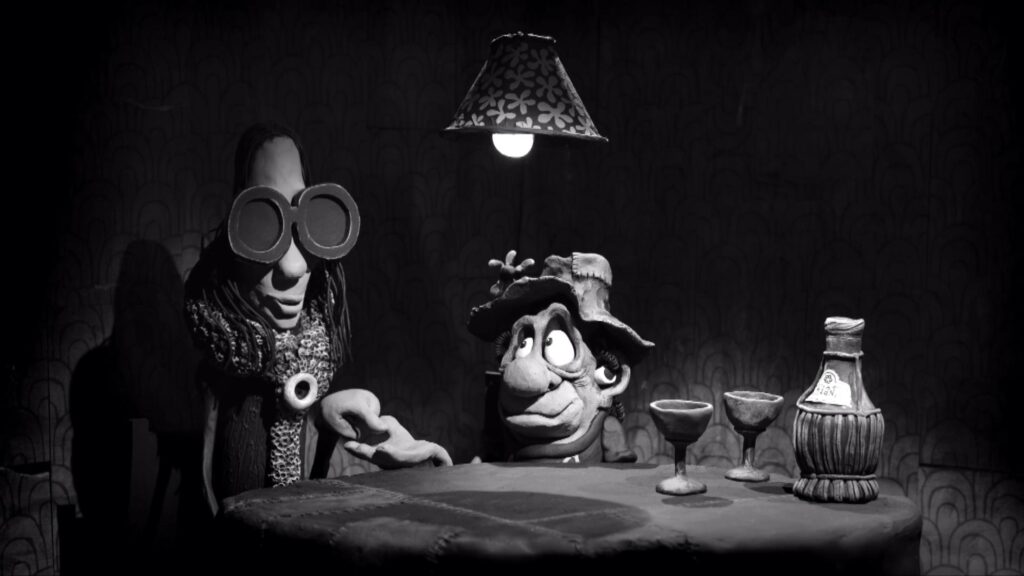
Il Baracchino is a groundbreaking adult comedy-drama co-created by Nicolò Cuccì and Salvo Di Paola. The series is distinguished by its “noir-style mixed-media” approach, merging 3D animation, 2D drawings, and simulated stop-motion within a unified 3D environment.
- Aesthetic: The show utilizes a gritty, high-contrast, black-and-white monochrome palette to evoke classic cinema while supporting a blend of absurd humor and melancholy.
- Production: Every frame was produced within Blender, moving away from traditional CG styles to create a dark, stylized tapestry where diverse artistic mediums coexist.
Where to Watch Il Baracchino
The series is available to stream on Amazon Prime Video. It premiered in Italy on June 3, 2025, as an Amazon Original.
- Availability: The first season consists of six episodes. While currently centered on Prime Video Italy, the show’s Annie Award nomination has generated international buzz, leading to anticipation for wider release news.
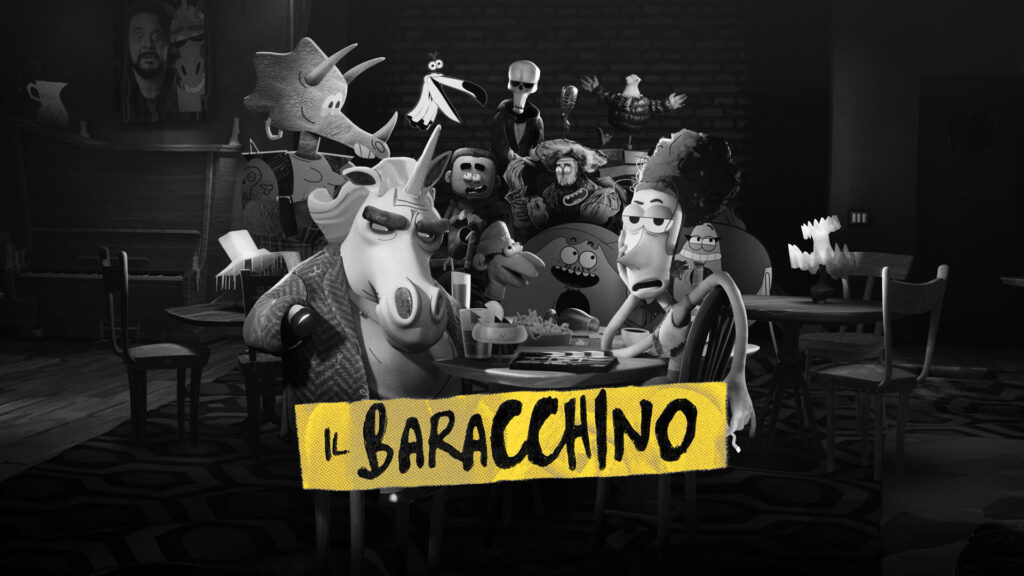
Plot and Characters
The narrative follows Claudia, an aspiring art director struggling to revive “Il Baracchino,” a legendary but crumbling stand-up comedy club. To save the venue, she recruits a surreal troupe of performers:
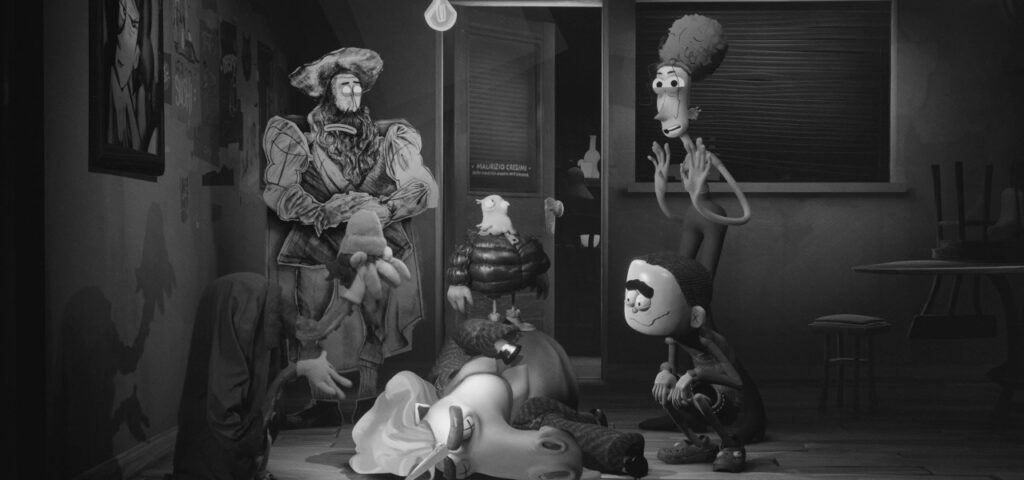
- The Performers: A chain-smoking pigeon, a “boomer” reincarnated Leonardo da Vinci, a living doughnut named Noemi Ciambell, and Death.
- Themes: The story balances the absurd with the poignant, using the smoky, dimly lit club as a backdrop for commentary on ambition and the preservation of laughter.
- Voice Cast: Features prominent Italian comedians including Lillo Petrolo and Frank Matano.
Mixed-Media Animation in Blender
The series demonstrates Blender’s versatility by seamlessly combining different dimensions:
- Hybrid Techniques: Fully 3D-rigged characters (like Claudia) interact with “2.5D” cutout puppets (like Da Vinci) and 2D elements created with the Grease Pencil tool.
- Visual Cohesion: To prevent the mix from feeling disjointed, the team applied consistent classical animation principles (weight, timing, squash-and-stretch) to all elements, regardless of their medium.
Noir-Style Animation Look
The visual identity is defined by stark chiaroscurolighting, a hallmark of film noir that uses high contrast between light and deep shadow.— ×1
- Unification: The black-and-white treatment acts as a “glue,” making pencil sketches and 3D renders feel like they inhabit the same gritty world.
- Atmospheric Details: The art direction emphasizes textures like cigarette smoke, rain-soaked streets, and “venetian blind” shadow patterns to underscore themes of moral ambiguity.
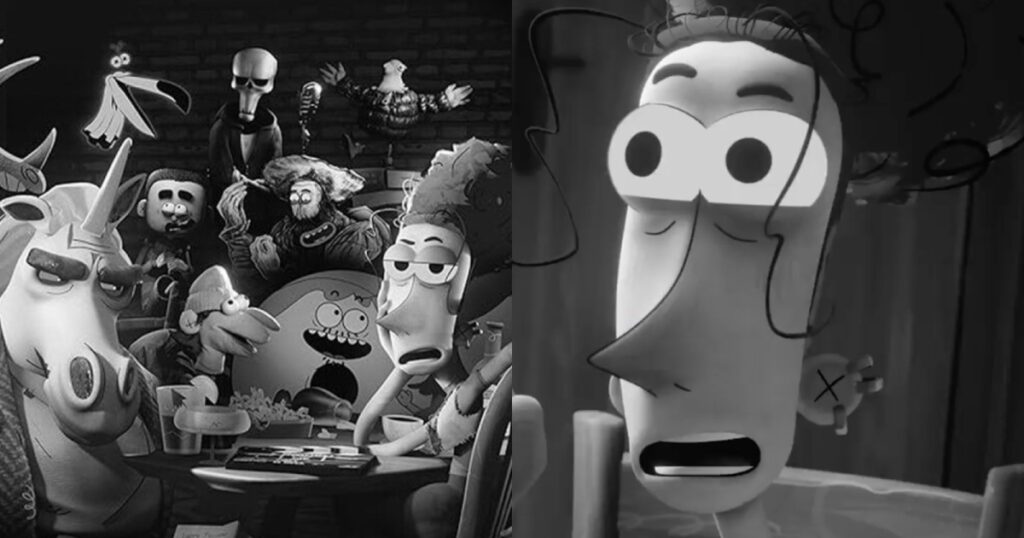
Film Noir Lighting Tutorial in Blender
The “Baracchino” team mastered low-key lighting through specific digital techniques:
- Hard Shadows: By using small, intense light sources (near-zero radius in Blender), they achieved the razor-sharp shadow edges typical of vintage noir.
- Practical Lights: Lighting is often “motivated” by objects within the scene, such as a single swinging bulb or a glowing cigarette, creating realistic and dramatic shadow play.
- Volumetrics: Blender’s volumetric fog was likely used to make light rays visible, enhancing the smoky atmosphere of the comedy club.
Noir Cinematography in Blender
The series utilizes cinematic conventions to guide the narrative tone:
- Camera Angles: Low-angle shots make characters appear intimidating or ironically important, while Dutch angles (canted tilts) signify psychological unease or chaos.
- Lens Choice: Wide-angle lenses are used for establishing the dark environment, while extreme close-ups focus on noir motifs like microphones, eyes, or smoldering cigarettes.
- Composition: The use of mirrors and reflections serves as a metaphor for duality, all orchestrated through Blender’s 3D camera and depth-of-field systems.
Style Consistency Across Mediums
Maintaining a unified look required ground rules:
- Animation Rules: Every character, whether 2D or 3D, adheres to the same physics and timing.
- Spatial Integration: 2D elements were placed on 3D planes within the scenes so they could be affected by the same light sources and camera perspectives as 3D models.
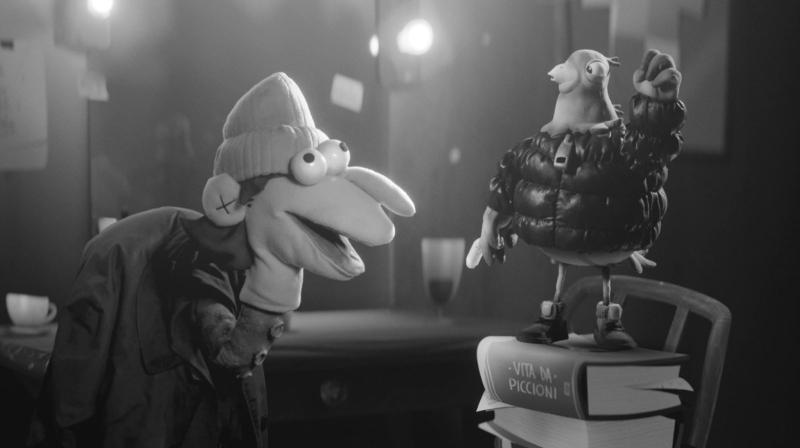
UV Warp Modifier Workflow
The team used the UV Warp modifier to create “paper cutout” animations.
- 2.5D Puppetry: Characters like Leonardo da Vinci consist of 2D textures mapped onto simple 3D geometry.
- Mechanism: By shifting UV coordinates in real-time using drivers or bones, animators could move a character’s mouth or eyes without deforming the underlying 3D mesh, mimicking traditional paper puppetry.
Rigify for Stylized Animation
Blender’s Rigify addon provided the foundation for character movement.
- Claudia’s Rig: While based on a standard human template, her rig was customized for exaggerated “Olive Oyl” proportions.
- Shape Keys: The team integrated a shape-key selector for facial expressions, allowing animators to snap to specific poses that matched 2D storyboards precisely.
Bendy Bones and Rubber-Hose Animation
To achieve a vintage 1920s-30s cartoon feel, the series employs Bendy Bones.
- Flexibility: This feature allows a single bone to curve smoothly, enabling the “rubber-hose” effect where limbs move like flexible tubes without rigid elbows.
- Application: This technique gives Claudia’s movements a fluid, elastic quality, allowing her to stretch and bounce during comedic overreactions.
In Il Baracchino, the main cast didn’t showcase advanced hair (Claudia’s short bob is straightforward, and others are anthropomorphic or fantasy where hair wasn’t a focus), but had it been needed say a character with an elaborate hairstyle PixelHair would have been a great resource. It aligns with the show’s ethos of mixing techniques: you could have a hyper-realistic hair on a stylized model if it serves the artistic vision (imagine a photoreal hair on a puppet character for uncanny effect).– ×2
Finally, PixelHair hints at the broader ecosystem around Blender that Megadrago likely tapped into: a network of add-ons and asset librariesthat can dramatically speed up production. Instead of reinventing the wheel for common needs (be it camera handling or hair or crowds), they could use existing solutions and focus their energy on the unique aspects of their project like the noir style and the mixed-media integration.
PixelHair is a prime example of an asset that, while not created forIl Baracchino, represents the kind of modern tool that makes ambitious projects feasible even for smaller teams. And as Yelzkizi continues to develop it (with geometry nodes and more assets, aiming for “road to 1000 assets” eventually), both Blender and Unreal artists stand to gain a versatile arsenal for character creation.– ×1
Frequently Asked Questions (FAQs)
- What is Il Baracchino and what is it about?
Il Baracchino is an Italian adult animated Amazon Original series created by Nicolò Cuccì and Salvo Di Paola at Megadrago studio. The story follows Claudia, an idealistic art director attempting to save a crumbling stand-up comedy club. The series features a surreal cast—including a talking pigeon, a reincarnated Leonardo da Vinci, and Death—and uses a noir, black-and-white mixed-media style blending 3D, 2D, and stop-motion. - Where can I watch Il Baracchino?
The series premiered June 3, 2025, on Amazon Prime Video in Italy. While it is an Amazon Original in its home region, international availability may vary. The first season contains six episodes. - What makes the animation style of Il Baracchino unique?
It employs a noir-style mixed-media approach, combining 3D animation, 2D hand-drawn art, and stop-motion-like effects in the same scenes. A cohesive look is maintained through gritty black-and-white art direction, high-contrast lighting, and unified animation principles that ensure all elements move with consistent physics and timing. - How was Blender used in making Il Baracchino?
Blender handled the entire production pipeline, including modeling, rigging, animation, lighting, and rendering (via the Cycles engine). The team used Rigify and bendy bones for 3D characters, the UV Warp modifier for 2D cutout-style animation, and adjusted frame rates to simulate stop-motion. Grease Pencil was utilized for storyboarding. - How did the animators ensure consistency between the 3D, 2D, and stop-motion elements?
They established a unified visual language where core animation principles (weight, timing, spacing) were applied to all mediums. 2D elements were often mapped onto geometry in 3D space to ensure they were affected by the same high-contrast noir lighting and camera perspectives as 3D objects. - What is the UV Warp modifier in Blender and why was it useful for this project?
This modifier slides or deforms UV texture coordinates based on control objects, allowing textures to animate on a static surface. It was the backbone for characters like Leonardo da Vinci, enabling “paper cut-out” style animation where 2D drawings (mouths, eyes) could be animated on simple 3D meshes. - What are bendy bones in Blender and how did they help in character animation?
Bendy bones allow a single bone to behave as a flexible curve rather than a rigid stick. This was used to achieve a “rubber-hose” animation effect for characters like Claudia, allowing her limbs to curve fluidly in a style reminiscent of 1930s cartoons. - How can I achieve a stop-motion animation look in Blender?
You can simulate this look by:- Animating “on twos” (e.g., 12 FPS) for staccato motion.
- Adding small jitters to transforms via noise modifiers to mimic manual puppet shifts.
- Avoiding motion blur and using handcrafted-style materials (e.g., clay shaders or fingerprint bump maps).
- Slightly varying lighting per frame to simulate flicker.
- Should I use Blender’s Grease Pencil or 2D textures on planes for mixing 2D and 3D animation?
It depends on the specific requirement:- Grease Pencil: Best for a true hand-drawn feel, frame-by-frame drawing in 3D space, and unique effects animation.
- 2D Textures on Planes: Ideal for cutout styles or cycling through pre-drawn frames. This method integrates better with 3D lighting and is generally less labor-intensive. Il Baracchino favored this for its 2D-styled characters to ensure consistency under noir lighting.
- What is PixelHair and how can it benefit Blender artists?
PixelHair is a library of nearly 200 high-quality, pre-made 3D hair assets for Blender and Unreal Engine. It allows artists to apply professional-grade hairstyles (braids, afros, etc.) to models without manual grooming. The assets are optimized for Blender’s latest hair systems (including Geometry Nodes) and can be exported as Alembic groom data.

Conclusion
Il Baracchinostands as a testament to creativity and ingenuity in modern animation. By leveraging Blender’s all-in-one pipeline, a small team in Sicily managed to produce a series with a visual style that is both evocative of classic noir films and entirely fresh in the realm of animation. The show’s mix of 3D, 2D, and stop-motion techniques all harmonized under a unifying black-and-white, gritty aesthetic demonstrates that technical hybridization can serve the story and mood when done thoughtfully. Every choice, from using bendy bones for rubbery motions to mapping hand-drawn art on 3D meshes, was driven by the desire to make the world ofIl Baracchino feel surreal yet cohesive.– ×2
For creators and animators, Il Baracchinooffers inspiration on many levels: artistically, it shows the power of a strong art direction; technically, it’s a case study in making diverse tools work together; and practically, it’s proof that a small, passionate team can punch above its weight. The project “built a studio, pipeline, and team” as they went, illustrating that sometimes you have to leap and build the plane on the way down but with modern tools, that’s more feasible than ever.– ×1
In conclusion, Il Baracchinoblends the old and new, old-school noir vibes and animation tricks with new-school technology and techniques, to create something wholly original. It blazed a trail as Italy’s first adult animated series made with Blender, and likely won’t be the last. Whether you’re an animator looking to experiment with mixed media, or a Blender user seeking to push the software’s limits, there’s a lot to learn fromIl Baracchino’s production journey. The series not only entertains with its offbeat story and style but also serves as a milestone for Blender in animation production, showing that with enough creativity and skill, the possibilities in animation are virtually limitless.– ×2
Sources and Citations
- Emma Collins — “Check Out Noir-Style Mixed-Media Animated Series Created Using Blender”, 80.lv
- Joe Foley — “What is Il Baracchino, Amazon Prime’s surreal new animation made entirely in Blender”, Creative Bloq
- Blender.org User Story — “Creating ‘Il Baracchino’: Italy’s First Adult Animated Series Made with Blender”, Blender Official
- Cartoon Brew — “‘Il Baracchino’: Italy’s First Original Adult Animated Series”, by Jamie Lang
- Blender Conference 2025 Talk — “Il Baracchino – Donuts don’t die in vain” by Andrea Cigognetti & Nicolò Cuccì
- Gleb Alexandrov — “Introduction to Low Key Lighting. When Less is More”, CreativeShrimp.com
- Finlay McGarry — “Common Camera Techniques In Film Noir”, WordPress blog
- GarageFarm — “Rubber Hose Animation: The Classic Technique That Defined an Era”, GarageFarm blog
- Lynn Nguyen — “Top 9 Blender Camera Add-ons to Improve Your Renders in 2025”, iRender Blog
- Yelzkizi — PixelHair Official Site and Posts
Recommendations
- Subnautica 2: Where to Find Sulfur
- 007 First Light Will Run at 60FPS on PS5 Pro: Performance Mode, Quality Mode Explained, PS5 vs PS5 Pro Comparison and Gameplay Details
- Peaky Blinders: The Immortal Man Review – Is Tommy Shelby’s Return Worth It?
- Dragon Ball Xenoverse 3 Finally Revealed: Akira Toriyama’s Last New Designs, Age 1000 Story, and 2027 Release
- Konami’s eFootball celebrates 1 billion downloads with Master League Sprint, a limited-time PES Master League-style mode
- Studio Mir Animation Success Explained
- Valor Mortis Preview: A First-Person Soulslike Where You Die Again and Again in Napoleon’s Army
- IO Interactive “Can’t Wait” to Return to the Hitman Series: What the Studio Has Said About the Next Agent 47 Game
- How to Make Mind-Blowing Anime FX in Blender and After Effects
- A Lego PlayStation Is Coming This Year, Report Claims: PS1 Set Leak, Price, Piece Count, and Release Date



































































































