







In This Article (19 sections)
Inscryption Gameplay Explained For Slay The Spire Fans
Inscryption is a unique roguelike deck-building game that combines card battles with escape-room style puzzles. In the first act, the player sits at a cabin table facing the woodsman Leshy, playing cards on a 3×4 grid (expanded to 3×5 in Act III) to tip a scale of teeth by five points and defeat enemies.
Each card has an attack, health, and often a special sigil (ability), and is played using different resources: Leshy’s cards cost blood (sacrificing another card), Grimora’s cost bone tokens (earned when cards die), P03’s cards use energy, and Magnificus’s require a gem on the board. Between battles, the player explores the cabin to find clues and new cards – for example, solving puzzles can add potent cards to the deck or modify the starting deck. This loop of card combat and exploration creates a persistent progression: even as each run resets, every success unlocks something for future playthroughs.
Is Inscryption Like Slay The Spire 2
Although both Inscryption and Slay the Spire 2 are labeled roguelike deck-building games, they feel very different to play. Slay the Spire 2 follows a familiar progression of choosing one of several characters and ascending procedurally-generated floors, collecting hundreds of cards and relics to build a synergistic deck.
By contrast, Inscryption emphasizes a set narrative and puzzle-driven structure. As Kotaku notes, “Inscryption is Slay the Spire 2’s deckbuilding polar opposite” – it’s built around a single-player story with a fixed sequence of acts, rather than indefinite replay through random acts. Where Slay the Spire 2 focuses on creating broad card synergies and repeated runs, Inscryption focuses on buffing a few key cards and solving its mysteries, making it feel more linear and narratively driven.

Inscryption Review For Roguelike Deckbuilding Fans
Inscryption has been widely praised by critics and players who enjoy deckbuilders. It won multiple Game of the Year awards and sold over a million copies by early 2022. Reviewers highlight its originality, card battle system, eerie visuals and narrative. One review describes it as a “dark, ominous blend of roguelike deckbuilder and escape room puzzler” with a surprising amount of story.
Unlike many deckbuilders, much of Inscryption’s appeal comes from its atmosphere and writing rather than endless card optimization. For fans, it stands out as a compelling example of how a card game can be integrated into a horror story. However, some players note that after finishing the main campaign (roughly 30 hours), Inscryption’s replayability is limited without the free expansion, reflecting its design as a focused “one-shot” adventure.
Why Inscryption Is The Opposite Of Slay The Spire 2
Kotaku explicitly calls Inscryption the “deckbuilding polar opposite” of Slay the Spire 2. Slay the Spire 2 is about building huge decks and scaling indefinitely, while Inscryption is story-focused and more constrained in scope. In Slay the Spire 2, each run unlocks new cards and mechanics for future runs, maximizing replay value. In Inscryption, progression instead comes from powering up individual cards and uncovering secrets.
Slay the Spire 2 has a whimsical fantasy tone and massive card pools, whereas Inscryption is morbid, horror-tinged, and has a much smaller set of creature cards (mostly animals and undead) that must be sacrificed and upgraded. Importantly, Slay the Spire 2 encourages heroic fantasy progression; Inscryption intentionally designs losses as part of the experience (your characters get captured and turned into cards). In summary, Inscryption’s roguelike deckbuilding is not about climbing forever, but about experiencing a rich, finite narrative – the very opposite philosophy of Slay the Spire 2.
Inscryption Horror Deckbuilding Explained
Inscryption marries deckbuilding with psychological horror, creating a uniquely eerie experience. The card battles take place in a dark, rustic cabin lit by candles, and every card has hand-drawn, unsettling art. According to developer Daniel Mullins, much of the game’s draw comes from elements “outside of the rules” – the mysterious card dealer Leshy, the talking cards and strange cabin fixtures contribute to a spooky atmosphere.
The game’s narrative draws on found-footage and occult influences; it presents itself as a cryptic recording of a card game gone wrong, with layers of hidden story. Clues and secrets abound: hidden messages on cards and cutscenes reveal psychological horror details. For example, the storyboard shows a content creator trapped in the game, and solving its puzzles reveals horrifying truths. This blending of horror atmosphere with the deckbuilder core sets Inscryption apart from other card games.
Inscryption Escape Room Puzzles And Card Combat
Inscryption interlaces its card combat tightly with escape-room style puzzles. The Hey Poor Player review explains that “the deckbuilding and escape room puzzles” are “intrinsically linked”. Some cards in your hand actually hint at solutions to puzzles scattered around the cabin, and conversely, items found while exploring (like the camera film or candles) give advantages in fights. Wikipedia describes how between card battles the player can stand up from the table and search the cabin for clues.
For instance, solving a puzzle might add a powerful new card to your deck or improve your totem (a persistent buff), which then changes how you approach future battles. In gameplay, this means that winning a fight may depend as much on your puzzle-solving skills and collected items as on the deck itself. Thus, Inscryption’s loop goes: fight a card battle, search the room for puzzle clues, solve them, then return to the card game with a strengthened deck.

Inscryption Card Game Mechanics For Beginners
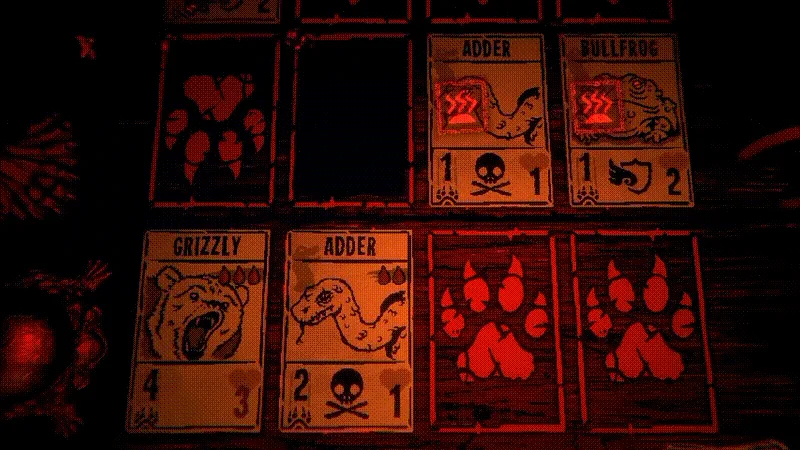
At its core, Inscryption’s card game is deceptively simple but deep. Each match plays out on a grid with three columns. You place cards on your side of the bottom row, and the opponent’s cards are pre-placed on the top row and move into play above you. On each turn, cards automatically attack the opposing card in the same column (dealing damage to its health); if no card blocks them, they deal damage directly to the opponent’s life (tracked as teeth on a scale).
To win a battle, you must tip the scale by five teeth against your foe. All your cards cost a resource to play. Cards from Leshy (the beast Scrybe) require blood – meaning you sacrifice one of your already-played creatures. Grimora’s cards use bones (tokens gained from card deaths). P03’s cards cost and generate energy each turn. Magnificus’s cards need a certain gem on the board to be played. Every card has a number in the top corner indicating its cost (blood, bone, or energy). Beginners should note that cards also have sigils (icons) that grant special abilities like flying or draining health.
You’ll start each run with a modest deck (usually basic beasts), and then add cards by winning battles or solving puzzles. New players should pay attention to their hand’s composition and resource costs: for example, playing a card that costs two blood means sacrificing two animals in play. The game gives new elements gradually, so by Act II the rules don’t suddenly change. Understanding how to leverage sacrifices and costs is key. (Detailed mechanics sources: Wikipedia, and review explanations).
Inscryption Story, Secrets, And Psychological Horror
Inscryption’s story is a cryptic, layered horror. The game is presented as “found footage” of a content creator known as the Lucky Carder, who stumbles upon a cursed Inscryption card game on a floppy disk. Unable to start a new game, he is forced to continue a save and ends up trapped in a cabin with the sinister Leshy.
Every time the player loses a card battle, Leshy traps the player’s soul in a death card. Between battles, the player finds helpful spirit-animal cards and solves chilling puzzles that reveal more of the plot (for example, finding a film roll to capture Leshy). The narrative is deliberately fragmented; clues appear in cabin decorations, card lore, and dialogue. One reviewer notes there is a “surprising amount of story for the genre” and advises players to pay attention to every hint.
On top of the in-game story, Inscryption even includes an alternate reality game (ARG) of easter eggs outside the game’s universe. All these elements combine to deliver psychological horror: players often feel unease seeing the antagonist’s glowing eyes across the table, hearing cards speak, and piecing together a mystery that feels very real.
Inscryption Compared To Slay The Spire 2
When directly comparing Inscryption to Slay the Spire 2, key contrasts emerge. Slay the Spire 2 offers multiple characters, cooperative multiplayer, and a completely replayable roguelike structure. Its gameplay is about ascending an infinite Spire with varied enemies and card synergies. Inscryption, on the other hand, has a single playable saga with three fixed acts. Its card combat encounters are interwoven with a plot, puzzles, and a set series of bosses. Reviewers emphasize that Inscryption’s progression centers on enhancing individual cards (like upgrading or merging them) instead of building an ever-growing deck.
In other words, a Slay the Spire 2 player is used to expanding a versatile deck over many runs, whereas an Inscryption player focuses on a relatively small deck that must become more powerful through sacrifices and upgrades. The overall feel is also different: Slay the Spire 2 is high fantasy and often whimsical (even if dark at times), whereas Inscryption is purposefully eerie and psychologically unsettling. Essentially, Inscryption is not just another deckbuilder – it’s a narrative-driven card adventure, whereas Slay the Spire 2 is a classic card-battling roguelike.
Why Inscryption Feels Different From Other Deckbuilders
Inscryption breaks the mold in several ways. Unlike typical digital deckbuilders, it intentionally mixes genres and styles. Its presentation shifts from a 3D cabin (first-person) to 2D pixel art to live-action footage across different acts. It begins with no explanation, forcing players to learn the rules and story through discovery, which is unusual for card games. The developer cites influences like tabletop RPGs, horror and found-footage films, reflecting in every aspect of the design.
Game Developer interviews highlight that the “tug-of-war” combat and sacrifice mechanics were born from a jam, meaning they are simple but unusual compared to typical CCGs. Moreover, the game frequently breaks the fourth wall (cards talking to you, events off-table affecting gameplay) and includes a meta-story of the player being trapped in the game. All these facets – changing art styles, high narrative focus, escape-room elements, and a foreboding atmosphere – give Inscryption a very different feel than even other popular deckbuilders. As one reviewer phrased it, “every element” is focused on storytelling and surprise, making Inscryption a standout dark odyssey in the card-game genre.

Inscryption Kaycee’s Mod And Roguelike Replay Value
After finishing the main story, Inscryption’s original Acts I–III end the roguelike runs, making it more finite than games like Slay the Spire 2. Recognizing this, the developer released a free update called Kaycee’s Mod (March 2022) to add endless replay value. This “mod” (actually an official mini-expansion) lets players replay the card game of Act I as much as they want. It adds new cards, items, and even a challenge mode with a boss, essentially turning the first act into a standalone roguelike deckbuilder.
Daniel Mullins himself said he created it because fans begged for “an endlessly playable version” of Part I. For players who enjoyed Leshy’s cabin battles and want more, Kaycee’s Mod provides a way to replay and experiment with decks without the story constraints. It introduces permanent upgrades and unlockables for Act I, so roguelike fans can grind and refine decks endlessly – something Slay the Spire players expect.
Best Inscryption Strategies For New Players
Beginners often wonder how to succeed in Inscryption’s tough card battles. A common piece of advice is to keep your deck small and focused. Experts note that Inscryption rewards buffing singular cards more than huge deck synergies, so try to build around a couple strong cards and upgrade them at campfires. Sacrificing lower-value cards aggressively to play stronger cards is key – treat each card as expendable once it has served its purpose.
Use campfire bonuses wisely: for example, you can fuse two copies of the same card to upgrade it (the game encourages creating these “overpowered combos”). Always use bonus items like cigarettes and totems: smoking a cigarette permanently boosts a card’s stats, and totems can grant powerful passive effects to a whole card type. Also, don’t ignore exploring the cabin each run – finding and solving puzzles early can unlock helpful starting cards.
In short, focus on strengthening the best cards you draw (often by merging duplicates), keep your deck lean to draw them consistently, and leverage the sacrifice costs to fuel big plays. (No connected source directly lists beginner tips, but these strategies follow from the mechanics cited and common player advice.)
Inscryption Dark Card-Based Odyssey Explained
Inscryption unfolds as a dark odyssey through three acts, each with its own style. In Act I, the player endures the ominous cabin card game with Leshy, gradually gathering cards and items by moving through a map of encounters. After the cabin trials are won, Act II shifts to a pixel-art overworld: the game recasts itself like a detective RPG as you explore, pick a Scrybe to replace, and challenge other Scrybes in card battles. Cards from all four Scrybes (creatures, technology, death, magic) become available, and you can roam freely to collect them.
Once the other bosses fall, Act III thrusts you into a robot factory (P03’s domain) in another roguelike map with new rules. In this final phase, lost characters (death cards) haunt you and checkpoints work like Binding of Isaac. The journey is “dark” both in tone and lore: you travel from the literal woods into twisted, otherworldly space, culminating in a confrontation with a digital overlord. This arc – from cabin to forest to factory – is why Inscryption can be called a dark card-based adventure or odyssey.
Games Like Inscryption For Horror Deckbuilder Fans
Fans who love Inscryption’s blend of horror and card combat often seek similar games. Inscryption’s unique mix of deckbuilding, puzzles and psychological horror means that recommendations include titles where narrative and cards intersect. Daniel Mullins’ other games, such as The Hex or Pony Island, share his surreal storytelling style (though not deckbuilders, they deliver narrative twists). Among card-based games, Black Book is often mentioned: it is an occult-themed RPG where your spells are cards drawn from a demonic book (featuring Slavic folklore and a dark atmosphere).
Penny Arcade Adventures: On the Rain-Slick Precipice of Darkness and Hand of Fate mix cards with adventure storytelling, which might appeal. Traditional deckbuilders that provide a grim tone include Slay the Spire or Darkest Dungeon II (though DD2 isn’t card-based, it is psychological). For horror fans, the key is narrative flavor: anything with a moody setting and rogue-like cards can fit, from Griftlands (for its character-driven plots) to Tainted Grail: Conquest (dark Arthurian myth). In general, Inscryption’s success lies in its unique theme, so look for games with a strong story focus, atmospheric art, or mystery elements alongside deck mechanics.

Should You Play Inscryption After Slay The Spire 2
If you’ve just played Slay the Spire 2, picking up Inscryption will feel like a big change – which can be a good or bad thing depending on your taste. Inscryption is shorter and its progression cap is fixed, so it won’t scratch the endless roguelike itch in the same way. However, many reviewers (and players) say it’s definitely worth playing for the variety. Kotaku notes that Inscryption might be the one deckbuilder on par with Slay the Spire 2 in quality, exactly because it offers a complete, satisfying story.
It excels as a one-shot experience: every element is polished to support its finale, and its writing and surprises are highly praised. In summary, if you want another deep card combat game with a strong narrative hook, then yes, Inscryption is an excellent follow-up. But if you’re looking for more of the same high-speed deckbuilding replay, you should know Inscryption is about flavor and atmosphere, not infinite runs. As one reviewer said, it focuses on storytelling and “buffing singular cards” rather than building huge decks.
FAQs
- What is Inscryption about?
Inscryption is a roguelike deckbuilding game developed by Daniel Mullins Games that blends strategic card battles with escape-room puzzles and psychological horror. Rather than focusing solely on building the strongest deck, the game tells a mysterious narrative that unfolds across multiple acts, each introducing new mechanics, environments, and story revelations. Its combination of horror, puzzles, and card gameplay makes it one of the most distinctive games in the genre.
- Is Inscryption like Slay the Spire 2?
Both games belong to the roguelike deckbuilding genre, but they are designed with very different priorities. Slay the Spire 2 emphasizes endless replayability, deep deck synergies, and procedural runs. Inscryption instead focuses on storytelling, mystery, puzzle-solving, and psychological horror. While both require strategic deck management, Inscryption delivers a more narrative-driven experience with a definitive conclusion.
- Is Inscryption difficult for beginners?
Inscryption can be challenging during the first few hours because it introduces unique mechanics such as blood sacrifices, bone resources, and card sigils. However, the game gradually teaches these systems through repeated runs and story progression. Most defeats are designed to help players learn rather than punish them, making perseverance an important part of the experience.
- How long does it take to beat Inscryption?
Most players finish the main story in approximately 15 to 25 hours, depending on how much time they spend solving puzzles, discovering secrets, and experimenting with different strategies. Players who continue into Kaycee’s Mod can easily spend dozens of additional hours mastering challenge runs and unlocking new content.
- What is Kaycee’s Mod in Inscryption?
Kaycee’s Mod is a free official expansion that transforms the first act into a fully replayable roguelike mode. It introduces new cards, items, challenge modifiers, unlockable content, and increased difficulty, giving players the endless replayability that many roguelike fans wanted after completing the main campaign.
- Does Inscryption have multiple endings?
Yes. While the main storyline reaches a definitive conclusion, the game contains numerous hidden secrets, optional discoveries, and alternate narrative details that players can uncover. Much of the enjoyment comes from piecing together the game’s deeper lore, hidden files, and psychological twists throughout multiple playthroughs.
- What makes Inscryption different from other deckbuilding games?
Inscryption combines several genres into a single experience. Alongside tactical card battles, players solve escape-room puzzles, explore mysterious environments, uncover hidden lore, and experience psychological horror. Frequent changes in gameplay, presentation, and storytelling keep the experience unpredictable, making it unlike traditional roguelike deckbuilders.
- What are the best beginner strategies in Inscryption?
New players should prioritize keeping their decks small and consistent, upgrading their strongest cards whenever possible, and learning how sacrifice mechanics work efficiently. Exploring every corner of the cabin, solving optional puzzles, and paying attention to card sigils can provide major advantages throughout the game. Careful resource management is generally more valuable than collecting every card available.
- What games are similar to Inscryption?
Players who enjoy Inscryption may also appreciate games such as Slay the Spire, Monster Train, Black Book, Hand of Fate, Griftlands, Tainted Grail: Conquest, The Hex, Pony Island, and Darkest Dungeon II. While none replicate Inscryption’s exact blend of horror and puzzles, each shares elements of strategic deckbuilding, dark storytelling, or roguelike progression.
- Should you play Inscryption after Slay the Spire 2?
Yes, especially if you want a completely different take on the deckbuilding genre. Rather than offering another endless roguelike focused on optimization, Inscryption delivers an unforgettable narrative adventure filled with suspense, creative mechanics, psychological horror, and memorable twists. It serves as an excellent companion to Slay the Spire 2 by demonstrating how versatile deckbuilding games can be.

Conclusion
Inscryption is deliberately designed to be the polar opposite of a game like Slay the Spire 2. It channels a fixed, eerie narrative and escape-room puzzles into every aspect of its roguelike deckbuilding, rather than offering countless modular runs. Its card combat mechanics – with sacrifices for blood or bone, totems and upgrades – force the player to build around individual card combos instead of vast deck synergies.
Critics and fans have praised Inscryption’s bold creativity: its blend of psychological horror and card gameplay has earned it awards and strong review scores. We hope this deep-dive has illuminated how Inscryption’s gameplay, story, and feel contrast sharply with other deckbuilders, helping players decide whether it’s the right next challenge after Slay the Spire 2.
Sources and Citations
- Game Developer – “How a game jam on ‘sacrifices’ became Inscryption” (March 2022)
- Inscryption – Wikipedia (Gameplay and Plot sections)
- Kotaku – “9 Games To Play After Slay the Spire 2” by Lewis Parker (June 2026)
- Hey Poor Player – “Inscryption Review: A Spooky Roguelike-Deckbuilder-Escape-Room Game” (October 2021)
- The Verge – “Inscryption mod makes the game’s best part endlessly replayable” by Ash Parrish (December 2021)
Recommended
- Europe’s Getting a Superior Switch 2: Nintendo Confirms a Replaceable Battery Model
- KIBORG Surpasses 100,000 Copies Sold: Why the Roguelite Beat’em up is Becoming a Hit
- Assassin’s Creed Shadows Winter Roadmap Includes Major Update 1.1.8, A Parkour Challenge, And Switch 2 Claws of Awaji DLC
- Ninjala 2: the Uncharted Planet Release in 2027, Switch 2 Open-World Sequel Explained
- Gothic 1 Remake: 6 Things You Need to Know Before You Play the 2026 RPG Reboot
- All Available Pokémon in Pokémon Champions: Full Roster, Mega Evolutions, and How to Get Them
- Apple Design Awards 2026 Winners Announced: Blue Prince and Cyberpunk 2077 Lead Apple’s Biggest Design Showcase Yet
- Warframe’s New Animated Shorts: Jade Shadows: Constellations Brings Orion vs Sirius to Life
- Nexon Revenue Rises 6.5% to $3.1bn in 2025, Driven by Ongoing Success of Arc Raiders



































































































