





In This Article (9 sections)
Left 4 Dead RTX: a Community Visual Overhaul of Left 4 Dead 2
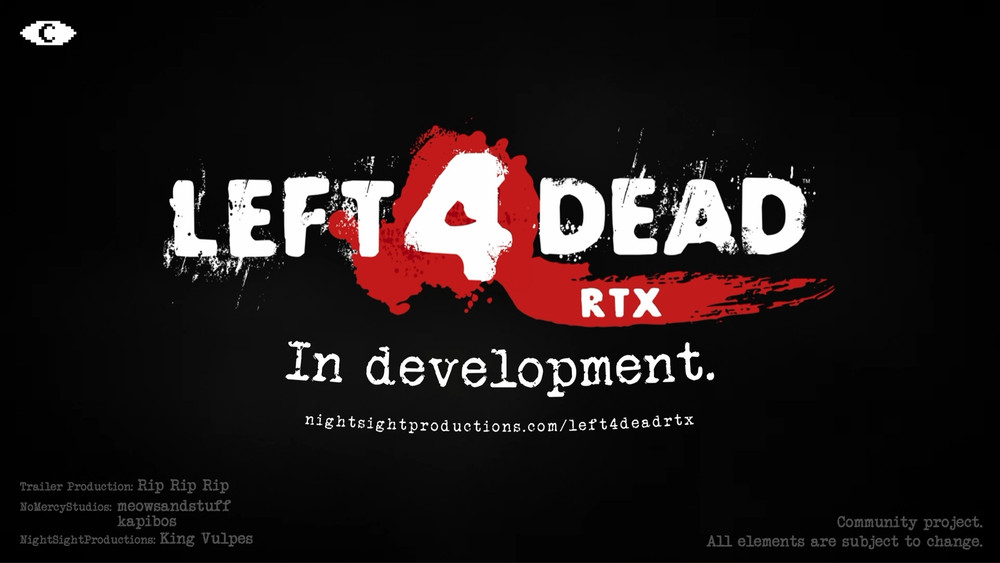
Left 4 Dead RTX is an upcoming, fan-made visual overhaul of Valve’s cooperative zombie shooter Left 4 Dead 2. Developed by NoMercyStudios and published by NightSightProductions, the project combines path tracing, physically based textures, enhanced models, and NVIDIA rendering technologies. It is planned as a free Steam release for owners of Left 4 Dead 2. The aim is to modernize the game’s presentation while retaining its familiar cooperative survival experience, rather than introduce an entirely new game or storyline. As of October 23, 2026, no release date, complete hardware specification, or confirmed public playtest schedule had been announced.
The project’s description retains the original premise of survivors navigating infected environments, working together, and moving toward rescue. Valve describes Left 4 Dead 2 as a cooperative action horror shooter whose AI Director adjusts enemy populations, effects, and sounds according to player performance. That responsiveness allows familiar locations to host encounters that unfold differently between playthroughs. Players must interpret changing situations quickly, making environmental awareness an important part of the experience. Updated graphics can influence the atmosphere surrounding those encounters, but they do not establish that the AI Director’s underlying behavior has been modified.
Updated lighting can change the atmosphere of familiar corridors and rooms without altering their basic layouts. Changes in shadows and illumination can emphasize dark areas and affect how players judge visibility and danger. A familiar hallway may feel more threatening even when its route remains unchanged. However, the result still needs to preserve the clarity required to recognize infected enemies, navigate the environment, and respond to sudden encounters. Rebuilt materials add another layer by changing how surfaces respond to light. Enhanced models can give familiar characters, objects, and environments a more detailed and substantial appearance. Together, these changes can refresh locations that players have explored many times without requiring redesigned levels or new narrative content. That visual renewal should not be mistaken for confirmation of changes to enemy behavior, campaign structure, or cooperative mechanics.
The project’s official website explicitly states that it is not affiliated with Valve Corporation. It should therefore be understood as an independent community undertaking, not an official Valve remaster or sequel. NVIDIA has highlighted the project through a public spotlight and provided technical context for its visual ambitions. That publicity does not make NVIDIA the developer or publisher, nor does it establish an official relationship with Valve. Evaluating the announcement also requires separating demonstrated improvements from the creators’ stated development goals. Features that have not been demonstrated or confirmed should remain distinct from completed work when assessing what the overhaul currently offers.
The Community Teams and RTX Remix Technology Behind Left 4 Dead RTX
Left 4 Dead RTX is a community-developed visual overhaul of Left 4 Dead 2, with NoMercyStudios credited as developer and NightSightProductions as publisher. It uses NVIDIA RTX Remix to replace assets, improve materials, and introduce modern rendering while aiming to preserve the recognizable experience of Valve’s cooperative horror shooter. These changes go beyond applying a visual filter because they affect the geometry, material properties, and lighting used to create the scene. NVIDIA has highlighted the project, but that publicity does not make it an official NVIDIA game. Valve’s role as creator of the original game likewise does not make it the developer of this community overhaul. Public announcements establish the credited organizations but do not provide a complete account of NoMercyStudios’ staffing, budget, or internal division of responsibilities.
NightSightProductions’ official team page identifies Lorenzo Acevedo, known as King Vulpes, as CEO and founder. Chris Medina, known as Miner 737, is listed as co-founder and co-owner, while Aden Medina, known as Wispoo, is also identified as a co-founder. The organization describes its work as combining development, art, modding, and graphics technology. Its website also features Portal 2 with RTX and Quake II RTX: Metal, providing context for its interest in modernizing established games. Those listings do not establish that the projects share identical development teams, production structures, or technical requirements.
NVIDIA describes RTX Remix as an open-source platform for modernizing compatible games through asset capture, replacements, revised lighting, and modern rendering. The platform has two complementary components: the toolkit and the runtime. The toolkit lets creators work with captured scenes, prepare replacement assets, and edit their visual properties. The runtime applies those replacements while the game operates and introduces supported rendering technologies such as path tracing, NVIDIA DLSS, and Reflex. The toolkit therefore supports creation and editing, while the runtime brings those changes into the playable experience. These are capabilities NVIDIA describes for RTX Remix, rather than a complete specification of every feature or implementation in Left 4 Dead RTX.
A room containing a table and lamp illustrates how the process differs from ordinary image adjustments. Increasing sharpness may make the original image appear clearer, but it cannot replace a basic table model with more detailed geometry. RTX Remix allows creators to change that model, revise its material properties, and adjust the room’s lighting. The renderer then has different geometry and surface information to work with, altering how objects appear and respond to illumination. The room can retain its original purpose within the game while receiving a substantially different visual treatment.
The framework provides these options but does not guarantee that replacements will fit convincingly into the game. Developers must decide which assets need attention, prepare suitable models and materials, position lights, and test the results during gameplay. Older assets were created around different graphical capabilities and rendering methods, so extra detail alone is not enough. Replacement geometry still needs to suit its surroundings and appear correctly during the action. Updated materials likewise need to interact coherently with the new lighting rather than retain visual assumptions tied to the original renderer. The overhaul’s effectiveness will depend on how consistently the team integrates these artistic and technical choices across the environments and moment-to-moment play.

Full Path Tracing, PBR Textures, High-Poly Models, and Reworked Lighting in Left 4 Dead RTX
Left 4 Dead RTX’s planned graphical overhaul combines full path tracing, handcrafted physically based textures, enhanced high-poly models, and reworked environmental lighting. Together, these improvements can transform familiar Left 4 Dead 2 environments without requiring a new storyline or completely redesigned levels. Path tracing samples light paths and evaluates their interactions with surfaces, accounting for both direct illumination and indirect light that has already interacted with other parts of the environment. In a hypothetical interior, a brightly colored wall may contribute softer, tinted illumination to nearby objects. Reflective surfaces can reveal parts of the room outside the camera’s direct view, while obstacles affect where illumination can travel. These interactions help create a more coherent relationship between lights, materials, and surrounding geometry.
Real-time path tracing still operates within a performance budget and does not calculate unlimited interactions or simulate every photon without approximation. NVIDIA’s RTX Remix documentation describes controls such as path continuation and bounce limits for managing that computational work. The renderer must remain responsive as players move, turn, and interact, so detailed illumination has to be balanced against the demands of active play. NVIDIA also identifies RTX Neural Radiance Cache, or NRC, as part of Left 4 Dead RTX’s technology. NRC uses a neural approach to estimate indirect illumination beyond the initially traced interactions, with the intended benefit of improving the efficiency and quality of multi-bounce lighting. The underlying research describes a cache that adapts during rendering rather than relying entirely on a network pretrained for every possible environment. That research does not supply performance measurements for Left 4 Dead RTX, whose final appearance and performance will depend on its implementation and available graphics settings.
Physically based rendering, or PBR, describes materials through properties such as base color, roughness, metallic behavior, and fine surface detail. Those properties influence how surfaces respond to illumination, so painted metal, untreated wood, fabric, and wet flooring should not all look identical under the same light. Rough surfaces generally produce broader, less concentrated reflections, while smoother ones can show more defined reflections. NVIDIA’s material replacement workflow supports inputs including albedo, normal, and roughness maps. Its documentation also notes that older game textures may contain baked lighting that does not translate cleanly into a path-traced environment. Replacing those textures can help separate a material’s characteristics from illumination embedded in the original image.
Left 4 Dead RTX advertises new, handcrafted PBR textures, making material creation part of the development effort alongside the rendering changes. A dirty tiled floor illustrates the distinction: color information can describe stains, scratches, and wear, while other properties determine how grout, dry tiles, and damp patches reflect light. These variations let different parts of one surface respond differently to the same source of illumination. Higher texture resolution remains useful for close-up detail, but it cannot by itself produce convincing material behavior. A detailed texture with unsuitable roughness or reflectivity may look less believable than a simpler surface whose lighting response matches the intended material.
High-poly models address the actual three-dimensional shapes of objects, including curved outlines, rounded edges, and visible components. A texture can suggest a scratch, seam, or dent on a flat surface, but geometry determines the silhouette and how an object appears from different angles. NVIDIA’s RTX Remix asset replacement documentation explains how creators can substitute more detailed models for original assets. It also emphasizes stable asset identification, which allows the runtime to apply the correct replacement consistently during gameplay. That makes integration as important as building an attractive model, since each replacement must appear in the right location and suit its surroundings as the player moves. The announcement does not provide a complete replacement inventory, so the extent of upgrades to individual characters, weapons, props, and campaign environments remains unclear.
Doorways, furniture, and other environmental objects also serve as navigation cues in a cooperative shooter. Greater geometric complexity should not make routes or potential enemy positions harder to recognize. This is a criterion for assessing the finished overhaul, not evidence that the developers have changed collision systems, movement mechanics, or level layouts. Lighting must meet a related requirement by helping players identify exits, distinguish characters from their surroundings, and recognize threats while retaining the uncertainty of a horror environment. Excessive darkness can conceal information needed during combat, while uniformly bright spaces can weaken tension. The challenge is to balance atmospheric contrast with the visibility required to react quickly and cooperate effectively.
NVIDIA’s relighting documentation explains that RTX Remix scenes may need changes to their original lighting arrangements. It distinguishes conventional light entities from emissive meshes and notes that these choices can affect sampling efficiency and visual noise. A visibly glowing object is therefore not necessarily an effective source of environmental illumination without appropriate setup. In an illustrative room, a small lamp can create a bright focal point while indirect light reveals nearby furniture and walls instead of leaving everything outside the direct illumination uniformly black. Achieving that balance requires artistic choices about the scene’s appearance and technical decisions suited to the renderer’s performance limits.
These technologies need to be assessed together rather than as isolated upgrades. A detailed model can still look unconvincing if its materials clash with neighboring objects, and advanced lighting can produce undesirable results if the scene loses readability. Screenshots can demonstrate changes in geometry, surfaces, and illumination, but they cannot establish how the overhaul behaves throughout active play. Rapid camera movement, sudden attacks, crowded encounters, and transitions between bright and dim areas can expose issues that static images do not reveal. The most meaningful evaluation will consider whether players can recognize threats, understand their surroundings, and respond effectively while moving through those conditions. The overhaul’s success will depend on how well its rebuilt assets, materials, and lighting preserve the original game’s atmosphere and responsive cooperative action.

Left 4 Dead RTX Graphics Comparisons, DLSS 4.5, and the Announcement Trailer
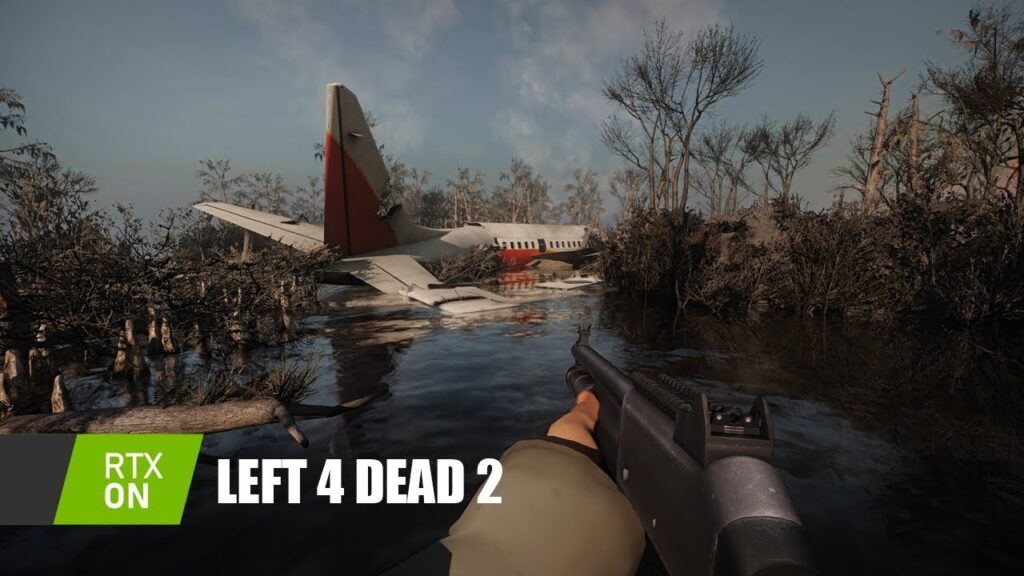
Left 4 Dead RTX aims to modernize Left 4 Dead 2 through full path tracing, physically based materials, enhanced models, and NVIDIA’s DLSS technologies. The changes go beyond brightness and texture sharpness: path tracing calculates direct and indirect lighting, updated materials change how surfaces respond to illumination, and enhanced models add geometric detail. NVIDIA’s RTX Remix documentation describes support for detailed replacement assets, multiple PBR material inputs, and dynamic lights that interact with those materials. Those capabilities explain what the framework can support, but they do not establish that every feature has been implemented across every asset or campaign location. The trailer and official comparison images therefore demonstrate the project’s visual direction rather than the performance or completeness of its finished release.
The official media page includes original-versus-RTX comparison sliders for an office desk and a living-room lamp. Other published comparisons feature an alley with a burning barrel, an interior kitchen, and a hospital room. These scenes offer opportunities to examine material separation, shadow placement, object definition, reflections, and the relationship between foreground and background elements. Changes in indirect illumination and contrast can give familiar rooms more depth or make hallways feel more atmospheric. However, greater realism alone is not the measure of success because the original game’s visual identity also supports survival-horror tension and rapid navigation. Reflective surfaces should respond consistently to surrounding lights, while characters and nearby objects need to remain distinct enough for players to recognize threats.
DLSS is a collection of features rather than a single process, so its components need separate evaluation. Super Resolution produces a higher-resolution output from a lower-resolution rendered input, using information that includes motion and previous frames. It aims to support image quality while reducing the workload compared with rendering every frame entirely at the target output resolution. Ray Reconstruction addresses incomplete, noisy ray-traced lighting information through AI-based reconstruction rather than relying exclusively on manually tuned denoising. This can influence the clarity of reflections, indirect illumination, and complex lighting interactions. In a fast-moving shooter, those reconstructed details also need to remain stable when the player turns quickly or changes viewing direction.
NVIDIA states that DLSS 4.5 Ray Reconstruction supports all GeForce RTX GPU generations. That compatibility does not guarantee satisfactory Left 4 Dead RTX performance on every supported card at every resolution or graphics setting. Actual results depend on the workload, hardware configuration, and implementation. Multi Frame Generation performs a different job by producing additional displayed frames between conventionally rendered frames. NVIDIA’s DLSS 4.5 documentation associates its Multi Frame Generation capabilities with GeForce RTX 50 Series hardware, so general DLSS support should not be interpreted as access to every feature on every RTX card.
The project also advertises NVIDIA Reflex, which focuses on reducing system latency. It coordinates CPU and GPU work to limit unnecessary rendering queues, helping reduce the delay between a player’s input and the resulting action appearing on screen. Unlike Super Resolution or Ray Reconstruction, its primary function is responsiveness rather than texture detail or lighting accuracy. These distinctions matter because a higher displayed frame rate does not necessarily represent an equivalent increase in conventionally rendered frames. Likewise, better image reconstruction does not automatically reduce input latency. Meaningful benchmarks should distinguish underlying rendering performance, displayed frame rate, visual quality, and responsiveness while accounting for the computational demands of full path tracing.
According to TweakTown, the announcement footage was captured on a GeForce RTX 5090 at 4K resolution with maximum graphical settings, path tracing, and DLSS 4.5. The coverage also noted an on-screen disclaimer stating that the footage was not representative of the final product. These details identify a high-end demonstration configuration, not a minimum hardware requirement. They neither establish that an RTX 5090 will be necessary nor provide enough information to predict results on other GPU generations or at lower settings. Selected trailer scenes also do not establish complete campaign coverage, gameplay compatibility, or the same level of development and testing throughout the mod.
Extended gameplay would provide evidence that comparison sliders and short promotional sequences cannot establish. Screenshots reveal textures, geometry, and reflections, but not whether those elements remain stable during rapid camera movement. Continuous play could show whether infected enemies remain recognizable during crowded encounters and whether transitions between bright and dim areas interfere with visibility. Long cooperative sessions could also test consistency when players move unpredictably, trigger large enemy encounters, and respond to sudden attacks. Until that broader evidence is available, the announcement is best treated as a development showcase rather than a guarantee of final performance or release readiness. The eventual measure of the overhaul will be whether its visual improvements remain readable, stable, and responsive during the cooperative action they are intended to enhance.
Left 4 Dead RTX Release Plans, Steam Distribution, and Ownership Requirements
As of October 23, 2026, Left 4 Dead RTX remained in development, with no officially announced release date or launch window. Its official download page stated that the mod had not been released, while Steam listed it as coming soon. The announcement trailer, comparison images, and NVIDIA spotlight demonstrate the project’s direction rather than establish that the complete overhaul is available to install. Promotional material does not confirm that every environment, rendering system, or compatibility requirement has been completed. Questions remain about which campaign areas are ready for testing, the stability of the announced rendering technologies, evaluated hardware configurations, and the content of the first public build.
NVIDIA’s October 21 spotlight said the project was seeking additional developers and considering playtests before a full demo release. Neither a public testing schedule nor a demo date was confirmed. These milestones are distinct: a playtest may let selected participants evaluate particular features or environments, while a demo provides access to a defined portion of the experience. A complete release represents broader availability of the finished overhaul and requires its own confirmation. Recruitment alone cannot reveal how many months remain, because teams may seek additional skills at different stages of development.
The announced distribution plan is a free Steam mod for players who own Left 4 Dead 2 on Steam. Under that plan, eligible owners will not need to pay a separate price for the overhaul, but people without the base-game license must still obtain Left 4 Dead 2. NightSightProductions specifically states that the original game does not need to be separately installed. Ownership and installation are therefore different conditions: the Steam license establishes eligibility, while maintaining a separate installation of the original game is unnecessary under the publisher’s description. Owning only the first Left 4 Dead does not satisfy the stated requirement.
The publisher’s proposed process involves owning the required game, obtaining Left 4 Dead RTX through its future Steam release, and launching the overhaul. Complete installation instructions and operational details will need to be checked when a public build becomes available. Planned Steam distribution does not confirm achievements, Workshop integration, multiplayer server compatibility, or support for existing modifications. These questions matter because Left 4 Dead 2 already has established cooperative systems and a community modification ecosystem. Compatibility with those features requires developer confirmation rather than assumptions based on the distribution platform.
Avoiding a separate base-game installation does not mean Left 4 Dead RTX will have a small download or establish how much storage it will require. The final package size will depend on replacement models, textures, rendering files, and other included content. High-quality assets can affect download and installation sizes, but the announcement does not provide enough information to calculate the eventual requirement. The same caution applies to hardware, since the trailer’s GeForce RTX 5090 configuration is a demonstration setup rather than a confirmed minimum graphics-card requirement. Players will need official requirements or representative testing results to assess how the finished overhaul performs on their systems.

Frequently Asked Questions (FAQs)
- What is Left 4 Dead RTX?
Left 4 Dead RTX is a fan-made graphical overhaul of Valve’s Left 4 Dead 2, developed by NoMercyStudios and published by NightSightProductions. The project uses NVIDIA RTX Remix to modernize the original game’s appearance through full path-traced lighting, enhanced high-poly models, handcrafted physically based textures, and improved environmental illumination. Rather than introducing a completely new storyline, the overhaul builds on the existing cooperative zombie survival experience. Players will still navigate infected environments, work together to survive, and face unpredictable encounters influenced by the AI Director, but with substantially updated visuals. - Is Left 4 Dead RTX an official Valve remaster?
No. Left 4 Dead RTX is an independent community-developed project rather than an official remaster created or published by Valve Corporation. Its official website explicitly states that the project is not affiliated with Valve. NoMercyStudios is responsible for development, while NightSightProductions serves as the publisher. Although NVIDIA has featured the overhaul in its promotional coverage and provides the RTX Remix technology supporting its graphical improvements, that involvement does not make the project an official NVIDIA or Valve release. The mod remains a fan-made effort focused on updating the visual presentation of Left 4 Dead 2. - Does it upgrade the first Left 4 Dead or Left 4 Dead 2?
Left 4 Dead RTX is specifically based on Left 4 Dead 2, not the original Left 4 Dead released in 2008. Although the project’s title references the broader franchise, its official description identifies the second game as the foundation for the graphical overhaul. The published ownership requirement also specifically names Left 4 Dead 2 on Steam. The project aims to modernize the sequel’s environments, lighting, textures, and models while retaining its cooperative survival gameplay. Owning only the first Left 4 Dead does not satisfy the stated requirement for accessing the RTX release. - When will Left 4 Dead RTX release?
As of October 23, 2026, Left 4 Dead RTX does not have an officially confirmed release date or launch window. The project remains in development, and its Steam availability is described as coming soon. NVIDIA’s October 21 spotlight also indicated that the team was recruiting additional developers and considering playtests before a full demo release. However, neither a public testing schedule nor a demo launch date has been announced. The existence of an announcement trailer and graphical comparisons does not establish how close the project is to completion. Any specific release prediction would therefore remain speculative until the developers provide an official schedule. - Will the mod cost money?
No. The announced plan is to distribute Left 4 Dead RTX as a free mod through Steam, meaning eligible players will not need to pay an additional fee for the graphical overhaul. However, the mod requires ownership of Valve’s Left 4 Dead 2, which remains a separate commercial game. Players who already own the sequel on Steam will satisfy the stated ownership requirement, while those without it must obtain the necessary license. The free distribution plan does not mean the mod is currently available, since development is ongoing and no public release date has been confirmed. - Must Left 4 Dead 2 already be installed?
No. According to NightSightProductions, players must own Left 4 Dead 2 on Steam, but they do not need to keep a separate installation of the original game on their computer. Ownership establishes the required entitlement, while the planned RTX package is intended to be obtained through its own Steam distribution process. However, complete installation and launch instructions have not yet been provided for a public release. The absence of a separate base-game installation requirement also does not establish the mod’s download size or storage needs, which will depend on the final package and included assets. - Does the trailer mean an RTX 5090 is required?
No. The announcement trailer was reportedly captured using an NVIDIA GeForce RTX 5090 at 4K resolution with maximum graphical settings, path tracing, and DLSS 4.5. This identifies the high-end hardware used to demonstrate the project’s visual capabilities, not its official minimum system requirements. The final mod may offer different graphics settings and performance characteristics across supported hardware, but those details have not been fully established. A demonstration recorded on an RTX 5090 cannot determine how well the overhaul will perform on older or less powerful graphics cards. Official requirements and performance testing will be necessary for reliable comparisons. - What is the difference between Ray Reconstruction and Multi Frame Generation?
DLSS Ray Reconstruction and Multi Frame Generation serve different purposes. Ray Reconstruction uses AI-based techniques to improve the reconstruction of ray-traced lighting information, helping produce more coherent reflections and indirect illumination from incomplete or noisy rendering data. Multi Frame Generation, by contrast, creates additional displayed frames between conventionally rendered frames to increase displayed frame rates. Their hardware support also differs. NVIDIA states that DLSS 4.5 Ray Reconstruction supports GeForce RTX GPU generations broadly, while its DLSS 4.5 Multi Frame Generation capabilities are associated with RTX 50 Series hardware. Neither feature independently guarantees satisfactory performance or low input latency. - Can players join a public playtest now?
No publicly available playtest has been established through the reviewed announcements. NVIDIA’s October 21, 2026, spotlight indicated that the developers were considering testing opportunities before releasing a full demo, but it did not confirm registration dates, participant requirements, or when testing would begin. A potential playtest is also different from an announced public demo or complete release. The project remains in development, and recruitment activity does not establish that a playable version is available to the public. Players should therefore distinguish discussions about possible future testing from an officially announced opportunity to participate. - Will existing mods and multiplayer servers work?
Compatibility with existing Left 4 Dead 2 Workshop content, third-party modifications, and multiplayer servers has not been fully confirmed. Although Left 4 Dead RTX retains the original game’s cooperative survival premise, that does not automatically establish that every existing mod or server configuration will work with its updated rendering system and replacement assets. Some modifications may affect the same models, textures, or environmental elements targeted by the overhaul, making compatibility an important consideration. However, the available announcements do not provide specific restrictions or verified compatibility results. Detailed support information and practical testing will be needed to determine which existing features and modifications can be used successfully.
Conclusion
Left 4 Dead RTX could give a familiar cooperative shooter a renewed sense of depth and atmosphere through rebuilt geometry, improved materials, and more coherent lighting. For now, however, the reveal demonstrates a visual direction rather than a finished experience. Release timing, system requirements, compatibility, and sustained gameplay performance still need clearer answers. The decisive test will come during full campaigns, where detailed surfaces and dramatic lighting must remain readable, stable, and responsive as a team fights through crowded encounters. Public gameplay and testing will show whether the overhaul can deliver its visual ambitions while preserving the clarity and responsiveness that the original game’s cooperative action demands.
Sources and Citations
- NightSightProductions, Official Left 4 Dead RTX Game Page: Establishes the project’s identity, cooperative gameplay foundation, and planned visual improvements using RTX technology.
NightSightProductions, Official Website - NightSightProductions, Download Page: Provides information about the project’s planned distribution, ownership and installation conditions, and preliminary system requirements.
NightSightProductions, Downloads - NVIDIA, October 21, 2026, Community Spotlight: Announces Left 4 Dead RTX, identifies its RTX Remix foundation, and discusses developer recruitment and potential testing opportunities.
NightSightProductions’ Left 4 Dead RTX Announcement - NVIDIA, RTX Remix Documentation: Explains how RTX Remix captures and replaces game assets, improves materials, updates lighting, and introduces path tracing. It also provides platform and system requirements.
NVIDIA RTX Remix - NVIDIA, DLSS Documentation: Explains AI-powered image reconstruction, super resolution, upscaling, and frame generation technologies used to improve visual quality and performance.
NVIDIA DLSS Technology - TweakTown, Left 4 Dead RTX Announcement Coverage: Provides additional reporting on the announcement trailer, its capture configuration, and the development disclaimer concerning the project’s early state.
TweakTown
Recommendations
- Roblox for PS5 Native Version Launch: Up to 30% Faster Load Times, Smoother Gameplay, and What’s New
- Steam Controller Hidden Easter Egg Explained: Why It Screams When Dropped and What It Means
- Intern Lumina U2: 16B Diffusion AI Unifies Image, Video and 3D
- Masters of the Universe Post-Credits Scene Explained: How Many There Are, What They Tease, and What it Means for She-Ra & Skeletor’s Return
- Starsand Island is leaving early access on August 18
- Intergalactic by Naughty Dog: Rumors, Leaks, and What We Know About the Studio’s Potential Sci-Fi Project
- Fears to Fathom Scratch Creek Walkthrough: Complete Co-Op Story and Ending Guide
- Tech Boss at Sony-Owned Bluepoint Says PlayStation Is Pulling Back From PC Because of Valve’s Steam Machine and Steam Deck
- GitHub Launches Copilot Desktop App in Technical Preview , Agent-Native IDE With Parallel Git Worktrees, Canvas Surfaces, and CI/CD Auto-Merge
- 007 First Light: All MI6 Intel Locations Guide (Full Checklist & Map Guide)



































































































