









In This Article (7 sections)
LEGO Derpy Tiger Revealed at LEGO World 2026: Design, Creator and Construction
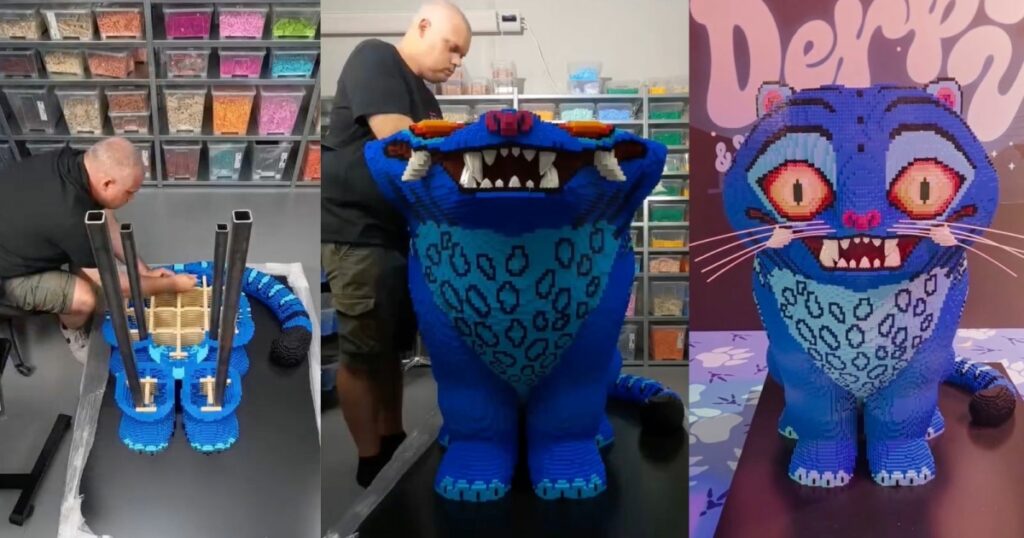
LEGO Derpy Tiger brings one of KPop Demon Hunters’ most recognizable creatures into an exhibition space through a sculpture made from approximately 37,000 LEGO pieces. Designed and built by Björn Ramant, the oversized blue tiger is on display at LEGO World 2026 in Utrecht, the Netherlands. Ramant identifies the project as a collaboration between the LEGO Group and Netflix, bringing the animated character into the physical world through an ambitious construction project.
Beyond its impressive piece count, the sculpture demonstrates the challenges of transforming an animated creature’s rounded body, distinctive stripes and comical expression into a structure that remains recognizable from different viewing angles. Its reported development period includes both design and construction, while its exact dimensions and measured weight have not been publicly established in the reviewed sources.
Ramant’s public reveal credits him with designing and constructing the giant sculpture, confirming its appearance at LEGO World 2026. His announcement also humorously suggested that Sussie, Derpy’s bird companion, might need to be added later, meaning the revealed installation focuses on Derpy rather than a completed recreation of both characters. An exhibition sculpture creates a different experience from watching the character on screen.
In KPop Demon Hunters, Derpy’s personality emerges through movement, reactions and comic timing, while the physical model must communicate much of that identity through its fixed pose, proportions and facial expression. The character is particularly suitable for this transformation because his unusual blue coloring and distinctive appearance can attract attention even before visitors recognize him from the film. For fans, the sculpture recreates a familiar character, while LEGO enthusiasts can examine how thousands of individual elements produce recognizable shapes and expressions.
Derpy is a supernatural tiger associated with Jinu who also becomes a loyal companion to Rumi in KPop Demon Hunters. Netflix describes his behavior as similar to that of an oversized house cat, combining affection and loyalty with a tendency to create accidental chaos. Alongside Sussie, a supernatural magpie, Derpy also helps connect characters by delivering messages. His appearance draws inspiration from the babo horangi, or foolish tiger, found in traditional Korean minhwa folk painting.
This cultural background helps explain why the character combines the physical presence of a powerful animal with a deliberately humorous personality. Unlike a conventional tiger sculpture that might emphasize strength, realistic anatomy or an intimidating stance, Derpy requires a softer appearance that preserves his awkward charm. His blue coloring provides immediate recognition, but the proportions of his head, body and eyes are equally important in making the finished sculpture feel like the character audiences remember.
Björn Ramant is the credited designer and builder responsible for translating that appearance into a large LEGO sculpture. Reporting from 80 Level describes his earlier career as a software architect, his return to LEGO building in 2016, his participation in LEGO Masters in 2020 and the establishment of his part time LEGO design business in 2021. His experience provides context for the technical and artistic decisions involved in the project. Designing a recognizable creature at exhibition scale requires careful consideration of its silhouette, head proportions, body structure, markings and the transitions between different surfaces.
A shape that looks convincing from the front may appear less natural from the side, while facial details that work in a smaller study may require adjustment when enlarged. The construction process involves translating those decisions into physical connections that can maintain the intended appearance across the entire sculpture. Ramant’s credit applies specifically to the giant exhibition build and should remain separate from the design credits associated with the smaller official consumer set.
The giant LEGO Derpy Tiger reportedly contains approximately 37,000 pieces, making it a substantial construction project. The published figure is approximate rather than an exact total supported by a publicly available inventory. Piece count alone also cannot establish the sculpture’s dimensions, weight or structural complexity because LEGO elements vary considerably in shape and size. Small plates, larger bricks and specialized components contribute differently to the finished model, meaning two sculptures with similar piece counts can have different proportions and internal arrangements.
One report attempted to estimate the sculpture’s mass by treating every element as though it weighed the same as a standard LEGO 2×4 brick, but that approach cannot establish a reliable measurement without the actual parts inventory and supporting structure. The more meaningful interpretation is that the project involves thousands of individual connections and design decisions, all contributing to the recognizable appearance of Derpy.
According to 80 Level’s coverage, Ramant spent approximately two and a half months developing the project, from the initial design sketches through final assembly. This period includes more than physically connecting bricks and should not be interpreted as a verified number of working hours. Large character sculptures require planning, experimentation, sourcing components and revising sections when their proportions or surfaces do not produce the intended result.
A change to Derpy’s head can affect the neck and shoulders, while adjusting a stripe may require rebuilding surrounding sections so the pattern continues naturally around the body. Construction videos may compress these activities into a short sequence, but the visible assembly represents only part of the process. The reported timeline therefore describes the broader development of the artwork rather than providing a precise measure of building speed or daily productivity.
Recreating Derpy’s blue fur presents a particular design challenge because animated fur can appear soft, flexible and continuously shaded, while LEGO pieces are rigid and form stepped surfaces. The sculpture must suggest softness through its overall shape rather than reproduce individual hairs. Rounded cheeks, a substantial torso and smooth transitions between the head and body help establish the character’s familiar appearance. At a distance, viewers primarily recognize the silhouette and broad areas of color, while closer inspection reveals the smaller connections used to create curves and changes in volume. This allows the model to function on two visual levels, appearing as a recognizable animated creature from a distance while revealing its construction methods when examined more closely.
The main visual challenges involved in recreating Derpy can be understood through several important elements:
- Blue fur and body shape: The sculpture must use rigid LEGO pieces to suggest the rounded, soft appearance of Derpy’s animated body.
- Tiger stripes: The markings need to remain recognizable while following the curves of the head, torso and other body sections.
- Eyes and facial expression: Their size, spacing and placement strongly influence whether Derpy appears curious, friendly, confused or intimidating.
- Character proportions: The relationship between the head, body and limbs must preserve the character’s distinctive silhouette.
- Viewing angles: The sculpture needs to remain convincing from the front and sides rather than relying on a single promotional photograph.
- Structural stability: The completed model must maintain its intended shape while functioning as a large exhibition display.
The eyes and facial expression are particularly important because small adjustments can significantly change how viewers interpret Derpy’s personality. LEGO’s separate account of the official retail set illustrates this challenge. Senior Design Master Wes Talbott explained that the shape and placement of Derpy’s eyes required extensive testing because relatively small changes affected the character’s overall appearance.
Although that account concerns the consumer model rather than Ramant’s sculpture, it demonstrates the broader artistic difficulty of recreating a recognizable animated face. The placement of stripes also matters because patterns that appear clear from one angle can become confusing as they wrap around curved surfaces. A successful character sculpture must therefore preserve both the recognizable physical features and the emotional impression associated with the original design.
Large LEGO sculptures also require structural planning. Reporting on Ramant’s project identifies four metal supports inside the build, demonstrating that an exhibition model can combine a LEGO exterior with internal reinforcement. This becomes important when constructing substantial sections such as a large head, projecting tail or heavy upper body. The supports help the sculpture maintain its intended form, although the reviewed sources do not provide engineering drawings, exact support dimensions, anchoring details or a complete explanation of how the structure distributes its weight. Their presence should therefore be understood as a reported construction feature rather than evidence of a particular undocumented engineering arrangement.
A reliable numerical height, width and depth for the giant LEGO Derpy Tiger have not been established in the reviewed sources. Published comparisons with Ramant differ, while photographs can exaggerate or reduce apparent size depending on perspective and camera placement. Describing the sculpture as life size would also require an official measurement of the fictional character and the completed model.
The appropriate description remains a giant exhibition sculpture whose exact dimensions are unconfirmed. This distinction is especially important because the separate retail LEGO Derpy Tiger and Sussie Bird set has a documented height of approximately 21 centimeters with Sussie positioned on Derpy’s head. That measurement applies only to the consumer product and should not be used to describe Ramant’s installation.

LEGO World 2026 Location, Netflix Collaboration and Official Derpy Tiger Set
The giant LEGO Derpy Tiger is displayed at LEGO World 2026 at Jaarbeurs in Utrecht, the Netherlands. Ramant confirmed the installation’s appearance at the exhibition, which runs from October 15 through October 21, 2026. As of October 20, the event is still taking place, giving visitors an opportunity to view the oversized character in person. Jaarbeurs is within walking distance of Utrecht Central Station and provides parking facilities for visitors arriving by car.
The official LEGO World event information lists regular opening hours of 10:00 to 17:00, alongside visitor guidance, the exhibition program and a floor plan. However, Ramant’s announcement does not establish an exact stand number, a permanent location after the event or an international touring schedule. Its appearance in Utrecht should therefore not be interpreted as confirmation that the sculpture will be displayed elsewhere.
Seeing the sculpture in person offers advantages that photographs and construction videos cannot fully reproduce. Visitors can move around the model to examine its proportions, observe how the markings continue across different surfaces and understand how its recognizable shape occupies physical space. Derpy’s expression may provide the immediate attraction, but the body, tail and transitions between sections also contribute to the finished work. This makes the installation appealing to different audiences. Fans of KPop Demon Hunters can encounter a familiar character, while LEGO enthusiasts can study the techniques used to create a large sculpture from individual pieces. The exhibition setting allows both groups to appreciate the relationship between animated character design and physical construction.
Ramant identifies the sculpture as a collaboration between the LEGO Group and Netflix, bringing together a recognizable character from KPop Demon Hunters and the creative possibilities of LEGO construction. The public information confirms the participating brands and Ramant’s design credit, but it does not disclose the project’s budget, contractual arrangements or complete approval process. The broader partnership between LEGO and Netflix was announced on February 4, 2026, with an initial KPop Demon Hunters product planned for that year and additional sets announced for 2027. The exhibition sculpture fits naturally within this collaboration, although the partnership announcement does not provide a technical description of the giant build or establish how its production was organized.
The collaboration also demonstrates how a recognizable animated character can become the centerpiece of an exhibition attraction. Netflix contributes the fictional world and established audience, while LEGO construction transforms that character into a physical object that visitors can examine. The resulting sculpture can attract attention from people familiar with the movie and those interested primarily in creative building. However, no reviewed source provides measured audience engagement, attendance increases or sales figures directly attributable to the giant Derpy Tiger. Its appeal can be discussed through its design and cultural recognition without assuming specific commercial results.
The approximately 37,000 piece sculpture is separate from the official LEGO KPop Demon Hunters Derpy Tiger and Sussie Bird set, numbered 72537. The consumer model contains 825 pieces and is recommended for children aged nine and above. LEGO announced the retail set on June 15, 2026, with an August 1 release date. Its official product information listed a United States price of $69.99 at the time reviewed, although regional pricing and availability may differ. Unlike Ramant’s exhibition sculpture, the smaller model is designed for customers to assemble and display at home.
The official Derpy Tiger and Sussie Bird building set includes several features intended to recreate the personalities of both characters:
- Derpy Tiger and Sussie Bird: The set includes both supernatural animal companions from KPop Demon Hunters.
- 825 LEGO pieces: The smaller model provides a manageable construction experience compared with the giant exhibition sculpture.
- Movable features: These allow owners to adjust the characters and create different display arrangements.
- Alternative expressions: The design provides options for changing the characters’ appearances.
- Two love notes and a flowerpot: These accessories reference the characters and their role in the film.
- Hidden storage compartment: Accessories can be stored inside a compartment in Derpy’s head.
- Compact display size: The assembled model measures approximately 21 centimeters high with Sussie positioned on Derpy’s head.
These features make the retail product a playable display model rather than a miniature reproduction of Ramant’s exhibition design. The sculpture’s promotional visibility should not be interpreted as an announcement that its full construction instructions or complete inventory will be sold commercially. Although both projects feature Derpy, they serve different purposes and use different approaches to recreating the character.
A commissioned LEGO sculpture is primarily designed to function as a completed exhibition object. Its success depends on visual impact, recognizable proportions and the ability to remain stable during display. A retail building set must additionally provide an enjoyable construction experience for customers, with manageable stages, clear instructions and features suited to regular handling. These different requirements influence the final designs. The exhibition model can prioritize a large silhouette and a carefully chosen pose, while the consumer set must balance appearance with assembly, movement and durability.
The smaller retail model also demonstrates how printed decoration can complement physical shaping. LEGO’s design account describes combining constructed forms with printed details to capture the characters’ recognizable features. This approach helps communicate personality without requiring the enormous number of pieces used in the exhibition sculpture. Neither method is automatically superior because each addresses a different design challenge. The giant sculpture provides scale and visual presence, while the retail set gives fans the opportunity to participate directly in building and displaying the characters.
Comparing the projects solely through their piece counts would therefore overlook their different achievements. A successful smaller model can preserve character identity through carefully selected details, while a giant sculpture must sustain the same identity across a much broader physical form. Both demonstrate how the same animated design can be interpreted through LEGO construction without requiring identical techniques or proportions.
The distinction between the two projects also matters when discussing their creators. Björn Ramant is credited with designing and building the exhibition sculpture, while Wes Talbott is associated with the official consumer set. Their shared subject does not establish that they followed the same construction process or that one design directly reproduces the other. Recognizing those separate contributions provides a clearer understanding of how the LEGO and Netflix collaboration has brought Derpy into different physical formats.

Why LEGO Derpy Tiger Is Popular With KPop Demon Hunters Fans and Builders
Derpy Tiger’s popularity comes from the combination of a distinctive appearance and an unexpectedly affectionate personality. Netflix describes him as loyal, playful and prone to accidental chaos, qualities that make him approachable despite his supernatural identity. His oversized house cat behavior contrasts with the physical presence normally associated with a tiger, while his connection to traditional Korean folk painting gives the design a recognizable cultural foundation. These characteristics make him particularly suitable for a LEGO sculpture because his personality can remain recognizable even when movement and dialogue are removed.
The blue coloring and tiger silhouette provide immediate visual recognition, while the facial expression encourages viewers to associate the sculpture with the character’s familiar behavior. Fans bring their memories of Derpy’s actions in KPop Demon Hunters to the display, allowing a fixed pose to suggest movement and personality without reproducing an entire scene from the film. This helps explain why a large model of Derpy can work as an independent exhibition attraction rather than requiring a detailed recreation of the surrounding fictional environment.
The sculpture also demonstrates how relatively simple construction elements can produce a complex visual result. Individual LEGO bricks are familiar objects, but their arrangement into a rounded, recognizable creature creates a striking transformation. Visitors can appreciate the finished character from a distance and then examine the smaller connections responsible for its curves, markings and expression. That combination of immediate recognition and visible construction makes the project interesting to both casual visitors and experienced builders.
The character’s proportions are particularly important to this effect. Derpy would be less recognizable if the sculpture emphasized realistic tiger anatomy at the expense of his rounded appearance and comical expression. Likewise, reproducing the blue coloring without preserving his facial features would not fully communicate his identity. The success of the design depends on maintaining the relationships between those elements, showing that character accuracy involves more than simply reproducing colors and stripes.
The project also highlights the difference between copying an animated image and interpreting it through another medium. Animation allows continuous surfaces, flexible movement and changing facial expressions, while a LEGO sculpture must suggest those qualities through fixed shapes. The builder therefore needs to make deliberate decisions about what details are essential and how they can be represented using available components. Preserving the character’s emotional effect becomes as important as reproducing individual visual features.
The exhibition’s scale makes those decisions especially visible. An enlarged face emphasizes the placement of the eyes and mouth, while a substantial body requires convincing transitions between its different sections. Internal supports add another layer of complexity because the final sculpture must remain structurally stable without losing its intended appearance. The reported use of approximately 37,000 pieces and four metal supports illustrates the physical demands of achieving that balance, while the two and a half month development period reflects the broader work required to turn the original concept into a completed display.
For KPop Demon Hunters fans, the sculpture provides a new way to engage with a character whose personality has already made him memorable. For LEGO enthusiasts, it demonstrates how animated designs can be reconstructed through physical elements, careful proportions and structural planning. The collaboration between LEGO and Netflix brings those interests together, making the giant Derpy Tiger both a character attraction and an example of large scale creative building.
Ultimately, the significance of LEGO Derpy Tiger extends beyond its approximate 37,000 piece count. The sculpture shows how a recognizable animated character can retain its identity when translated into a completely different material. Its blue body, distinctive markings and humorous expression remain central to that achievement, while the construction provides an additional reason for visitors to appreciate the finished work. Displayed at LEGO World 2026 in Utrecht, Ramant’s creation demonstrates how character design, technical planning and individual creativity can transform familiar bricks into an impressive physical interpretation of a beloved fictional creature.
Frequently Asked Questions (FAQs)
- What is the giant LEGO Derpy Tiger?
The giant LEGO Derpy Tiger is an oversized exhibition sculpture inspired by the blue supernatural tiger from Netflix’s KPop Demon Hunters. Designed and built by Björn Ramant, it uses approximately 37,000 LEGO pieces and is displayed at LEGO World 2026 in Utrecht, the Netherlands. The project is identified as a collaboration between the LEGO Group and Netflix and is separate from the smaller official consumer building set. - How many pieces does the sculpture contain?
The sculpture reportedly contains approximately 37,000 LEGO pieces. This figure reflects the scale of the project but should be treated as an estimate because a complete public inventory confirming the exact number has not been established. The pieces vary in shape and size, making the total useful for describing the construction effort but insufficient for calculating the sculpture’s dimensions or weight. - How long did the project take?
The giant Derpy Tiger reportedly took approximately two and a half months to complete, including the initial design sketches, planning and physical construction. This period should not be interpreted as continuous assembly time because developing a large character sculpture can involve experimentation, adjustments and revisions. The reviewed reporting does not provide a verified total number of working hours. - Who designed the giant Derpy Tiger?
Björn Ramant designed and built the exhibition sculpture. His background includes software architecture, participation in LEGO Masters in 2020 and the establishment of a LEGO design business in 2021. His work on the giant display should be distinguished from the smaller official Derpy Tiger and Sussie Bird set, which is associated with LEGO designer Wes Talbott. - Does the sculpture contain metal supports?
Yes. Reporting on the project identifies four metal supports inside the giant LEGO Derpy Tiger. These provide additional reinforcement for the substantial exhibition structure, helping it maintain its intended form. However, the reviewed sources do not include detailed engineering drawings or specifications explaining the exact dimensions, connections or weight distribution of those supports. - How tall is the giant sculpture?
The exact height of the giant LEGO Derpy Tiger has not been reliably established in the reviewed sources. Although photographs show that it is an oversized exhibition model, visual comparisons can be misleading because of camera angles and perspective. The separate retail Derpy Tiger and Sussie Bird set measures approximately 21 centimeters high, but that specification does not apply to Ramant’s giant sculpture. - Where is the sculpture being displayed?
The sculpture is displayed at LEGO World 2026, held at Jaarbeurs in Utrecht, the Netherlands. Visitors attending the exhibition can view the model in person and examine its construction from different angles. The reviewed announcements do not confirm a permanent display location, exact stand number or international touring schedule after the event concludes. - When does LEGO World 2026 take place?
LEGO World 2026 runs from October 15 through October 21, 2026, at Jaarbeurs in Utrecht. The official event information lists regular opening hours of 10:00 to 17:00. Visitors can consult the event program and floor plan for practical information about the exhibition, including how to locate its attractions and displays. - Can fans buy the giant model?
The approximately 37,000 piece exhibition sculpture is not listed as a consumer building set in the reviewed official product information. However, LEGO offers a separate Derpy Tiger and Sussie Bird set, numbered 72537, containing 825 pieces. Released on August 1, 2026, the smaller model includes movable features, alternative expressions and accessories, subject to regional availability. - Is the sculpture’s exact weight known?
A verified measurement of the giant sculpture’s weight has not been established. Although its approximate piece count is known, LEGO elements have different sizes and masses, and the installation also contains internal metal supports. Calculating its weight by assuming every piece weighs the same as a standard brick would therefore be unreliable without a complete inventory and structural specifications.

Conclusion
The LEGO Derpy Tiger sculpture transforms a familiar KPop Demon Hunters character into an impressive physical display using approximately 37,000 pieces. Designed by Björn Ramant, the project highlights how shape, color and expression can preserve Derpy’s personality through LEGO construction. While the giant sculpture showcases craftsmanship at LEGO World 2026, the smaller official retail set offers fans an accessible building experience with interactive features. Together, they demonstrate two different approaches to recreating the same beloved character.
Sources and Citations
- Björn Ramant, original project announcement : Confirms that he designed and built the Derpy Tiger sculpture for a LEGO Group and Netflix collaboration, with the finished creation displayed at LEGO World 2026. 75 comments
Citation: Derpy Tiger Sculpture and LEGO World Announcement. - 80 Level, October 19, 2026 : Reports that the sculpture contains approximately 37,000 pieces, took around two and a half months to complete and required four internal metal supports. The article also outlines Ramant’s background and previous LEGO work. 80.lv
Citation: LEGO & Netflix Presented a Giant Figure of Derpy Tiger from KPop Demon Hunters. - Jaarbeurs and LEGO World, official event information : Confirm that LEGO World 2026 runs from October 15 to 21 at Jaarbeurs Utrecht, with regular opening hours of 10:00 a.m. to 5:00 p.m. Their websites also provide tickets, travel guidance and visitor information. Jaarbeurs
Citation: LEGO World 2026 at Jaarbeurs and Official LEGO World Website. - LEGO Group, partnership announcement and retail set design story : Documents the Netflix collaboration and explains the development of the separate 825 piece Derpy Tiger and Sussie Bird retail set, including its expressive features, design process and August 1, 2026 release. LEGO.com
Citation: LEGO Group and Netflix Announce KPop Demon Hunters Collaboration and Derpy Tiger and Sussie Bird Design Story. - Netflix Tudum, character background and LEGO set coverage : Explains Derpy’s role in KPop Demon Hunters and his inspiration in traditional Korean folk painting. Its LEGO coverage details the retail set’s movable parts, alternate expressions, accessories and hidden storage compartment. Netflix Tudum
Citation: Derpy Tiger: Everything About the Cutest Demon Tiger and KPop Demon Hunters Derpy Tiger and Sussie Bird LEGO Set.
Recommended
- Nintendo Exploring a Switch 2 OLED but is Worried About Price: Report
- Gears of War: E-Day Launch Guide for Xbox Series and PC
- Why GTA 6 Won’t Be on PC at Launch (November 19, 2026): Take-Two CEO Strauss Zelnick Explains
- VHOLUME Launches August 21, 2026: Parkour Gameplay, Multiplayer and Steam Details
- 007 First Light Gameplay on Steam Machine: Performance, Features, and SteamOS Experience
- Justin Drake Crypto Bunker Mode Warning: AI-Accelerated Math Threatens ECDSA Vitalik Buterin Backs It
- Don’t Fret Hits All the Right Notes for a Frightening Survival-Horror Experience
- Creating Parallax Effect with Godot: Parallax2D Setup, Infinite Backgrounds, and Common Fixes
- Mortal Kombat 2 Box Office Forecast: How Much It’s Expected to Make in Theaters (Opening Weekend, Domestic vs Worldwide)
- Cyberpunk 2077 Standalone VR Experience: Everything to Know About the New Night City VR Project
- Callipeg 2D Animation App Update: Guide Layers, Clipping Masks, and More
- Best Cameras for Faceware Studio, Live, Analyzer & Retargeter – Budget to Pro Guide
- Rayman Legends Original Will Stay on Sale After Remake Release: Ubisoft Confirms No Delisting for Retold Launch



































































































