









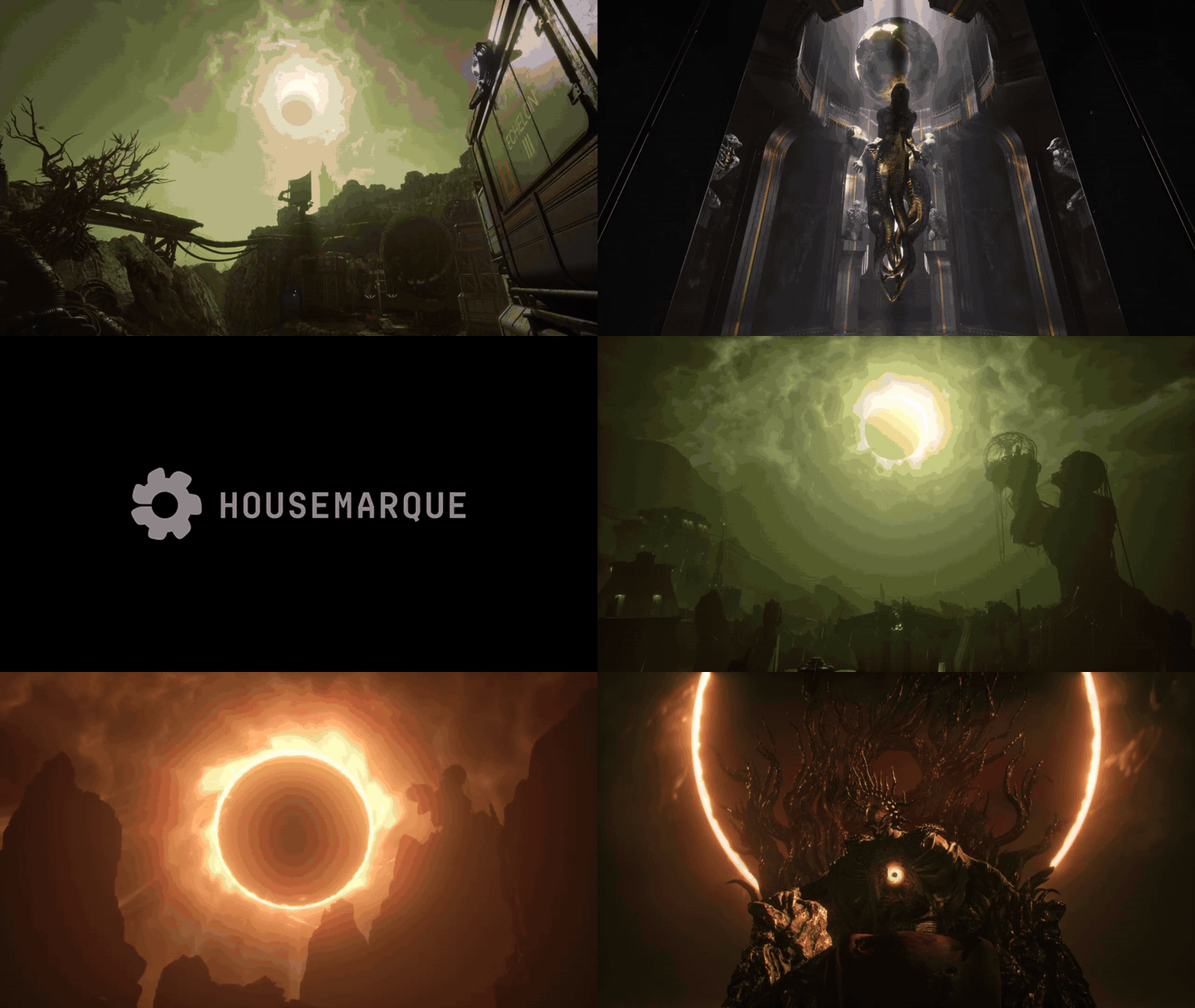
Saros, developed by Housemarque and published by Sony Interactive Entertainment, launched on April 30, 2026 as a single-player action game built around “bullet ballet” combat, permanent progression, and repeated runs across the eclipse-warped world of Carcosa. Official materials describe it as a new IP rather than a sequel, though it clearly evolves systems that studio fans will recognize from Returnal, especially in its emphasis on fast movement, layered projectile patterns, and survival through adaptation rather than passive play.
Saros Walkthrough Guide for Beginners: What to Do First
Your first objective in Saros is not simply to reach the next biome. It is to establish a progression loop that keeps every death productive. As soon as you unlock Primary in the Passage, you gain access to the Armor Matrix, which is where Lucenite and Halcyon turn failed runs into permanent power. The highest-value opening priorities are learning projectile colors, collecting Lucenite aggressively before it disappears, unlocking Second Chance as early as possible, and investing in upgrades that snowball later runs rather than only helping one attempt. The best early upgrade priorities are starting Proficiency boosts, Drive upgrades for faster Lucenite gain, early Restoration and Aether efficiency once available, and additional artifact capacity over expensive late-tree stat padding.
Saros rewards players who clear most of a biome before challenging its boss. Exploring side rooms means more resources, more containers, more chances at Halcyon, and a higher Proficiency threshold before the Overlord encounter. The game also marks its “golden path” objective with a scanable gold-flag icon, so even when a biome is partially reassembled from run to run, you can keep your progress route clean while still taking worthwhile detours.
One beginner mistake matters more than almost anything else: returning to the Passage too early. Fast travel is generous, but temporary Proficiency gains are lost when you go back to the hub, along with your current artifact stack. If your goal is to beat a boss, keep pressing forward. If your goal is permanent progression, return only after a strong resource haul or after a biome-ending boss.
Saros Story Summary and Setting on Carcosa (spoiler-Free)
Saros follows Arjun Devraj, a Soltari Enforcer searching for answers on Carcosa, a lost off-world colony trapped beneath a hostile eclipse. Official descriptions frame the game as both a sci-fi action experience and a character study, with Arjun returning to the Passage between runs to regroup with the Echelon IV crew while the Eclipse steadily distorts places, memories, and relationships. The world combines ancient ruins, alien technology, dreamlike liminal spaces, and cosmic-horror ambiguity rather than straightforward exposition.
Unlike the solitary isolation emphasized in Returnal, Saros leans harder into ensemble storytelling. Housemarque has said the new game adds more NPC interaction, more recurring dialogue at the hub, and more viewpoints through crew conversations and logs, while still preserving a deliberately haunting and interpretive tone. Arjun is played by Rahul Kohli, and official launch materials also identify characters such as Stack and Nitya as part of the game’s broader worldbuilding.

Saros Combat Tips: Bullet-Hell Movement, Dodging, and Survival
Saros is at its best when you stop treating enemy fire as a wall and start reading it as a resource map. Blue projectiles are the safest to engage because you can absorb them with the shield to charge your Power Weapon. Yellow or corrupted attacks are much riskier because they reduce your maximum health for that run if they connect. Red or Nova attacks cannot be dashed through at all, and later in the game they become prime parry targets instead. That means the core combat rhythm is not “stay back and roll away.” It is “stay mobile, identify color, absorb what helps, evade what punishes, and choose when to turn defense into offense.”
Dash timing is a survival skill, not just a panic button. Housemarque’s official hands-on breakdown notes that dash negates most damage during execution, while the shield converts blue bullet patterns into a Power Weapon refill. That creates a deliberate risk-reward loop: the best players do not only avoid projectiles; they move into the right ones. This is why Saros often feels more aggressive than a typical dodge-heavy shooter. You are constantly balancing evasion, shield timing, melee shield-breaks, and burst windows for Power Weapons.
Two more systems matter immediately. First, Adrenaline rises as you stay untouched and grants stronger passive run benefits, including a melee boost and later a power boost, but it resets the moment you take a hit. Second, your Power Weapon should be used often, not hoarded forever. In Saros, waiting too long usually wastes charge potential, especially in crowd-heavy rooms and boss phases with obvious punish windows.
Weapon handling also changes depending on whether Autohit is enabled. Most weapons have some homing assistance, which is ideal when you are reading patterns and moving constantly. Variants with Autohit disabled hit harder per shot, but they raise the execution floor because you now have to aim precisely while surviving bullet-hell pressure. For most players, reliable Autohit weapons are the most efficient way to stabilize boss attempts and late-biome chaos.
Best Early-Game Weapons in Saros and How to Unlock Them
The safest early-game weapon priorities are the Eruptor Handcannon, your first rifle variants once they enter the pool, and Prominence as the first Power Weapon. GamesRadar’s full-weapon testing ranks the Eruptor Handcannon and Onslaught Rifle as the best all-round main weapons because they combine strong baseline control with alt-fire options that reward precise weakpoint play. Prominence is valuable early because it has the area damage to erase clustered enemies before your Armor Matrix is fully developed.
Unlock order matters because Saros ties all weapons to story progress rather than hidden side quests. According to post-launch weapon guides, the pool expands in this sequence: Handcannon variants at the start, then Prominence, Rifles, Shotguns, Dispiritor, Crossbows, Nova Lance, Chakrams, and finally Illumine. There are no secret optional weapons in the current release build; pushing the story forward is what broadens the arsenal.
That makes the early recommendation straightforward. Stick with a strong Handcannon until the rifle family opens up, then favor high-quality rifle drops for consistency. Shotguns unlock in Ancient Depths and can be excellent on large targets, but they are less forgiving in mixed arenas. The Crossbow does not arrive until Blighted Marsh, yet it deserves special mention because VGC’s biome guide is right: once it appears, it becomes one of the strongest transition weapons in the entire game, especially with tracking alt-fire for flying enemies and Legion’s core target.
Saros Permanent Upgrades and Progression: What Carries over Between Runs
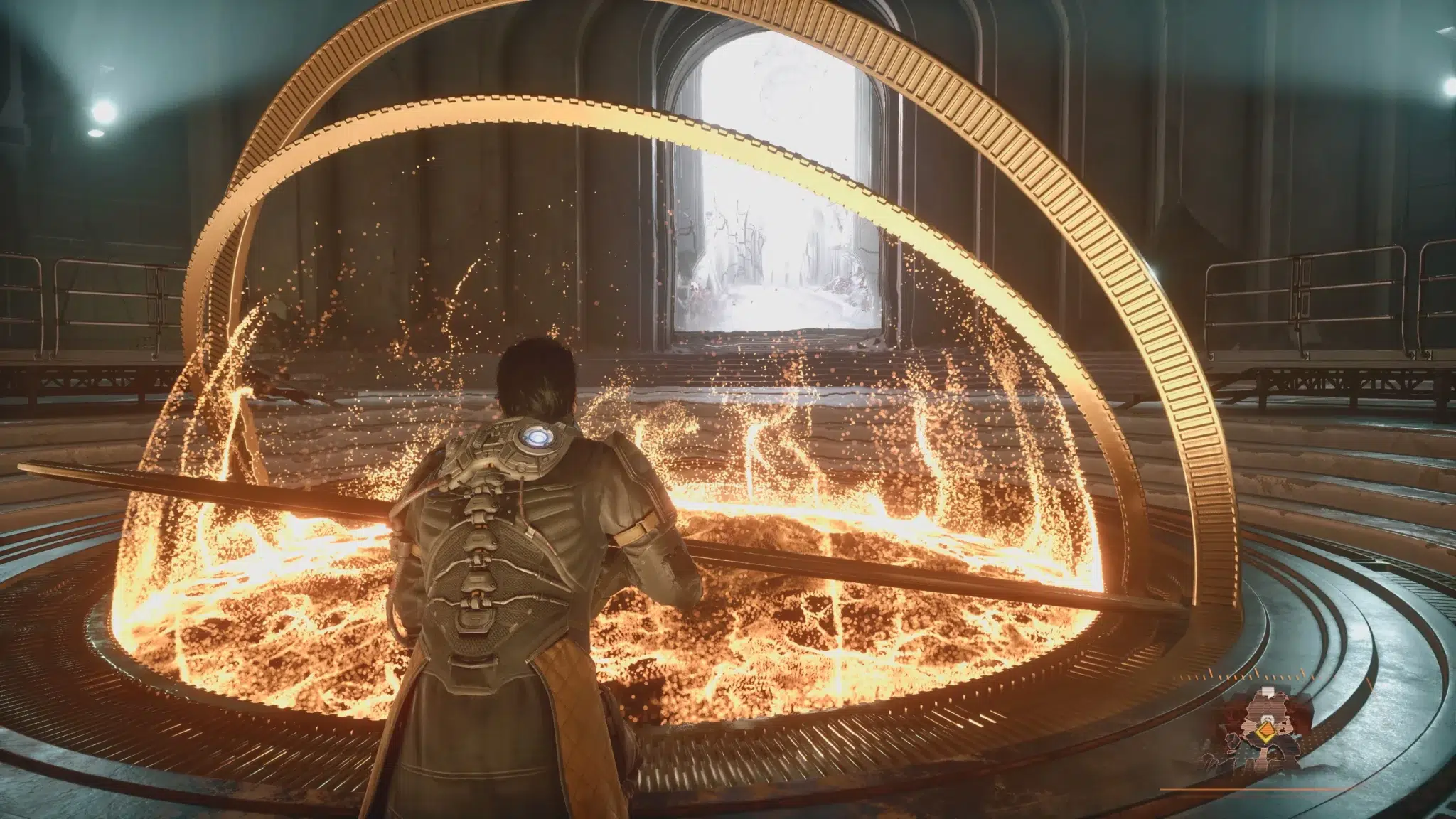
The defining difference between Saros and Returnal is that death is not a hard reset. Official developer messaging consistently stresses “permanent resources and progression,” and that is exactly how the game is structured. Lucenite and Halcyon feed the Armor Matrix at Primary, weapon archetypes unlock through story progression, and traversal-combat abilities such as Jump Network, Grapple, Overdrive, Parry, Eclipse Thread, and Blazing Strike permanently expand what each future run can do.
The six major permanent ability unlocks arrive in a fixed order: Jump Network after Prophet, Grapple after Ancient Depths and the Colony Ruins terminal, Overdrive in Shattered Descent, Parry in Blighted Marsh, Eclipse Thread in Desecrated Fortress, and Blazing Strike after Act 2 when Yellow Shore opens. These are not optional side perks. They are the backbone of both exploration and your long-term combat ceiling.
Temporary power, however, still exists. Proficiency gained during a cycle increases the level of weapons you find, but that temporary gain disappears when you return to the Passage. Artifacts are likewise run-based rather than permanently owned. By contrast, some long-term gains such as Integrity Augments, Armor Matrix nodes, and Second Chance have lasting account-wide value across future cycles. In practice, that means Saros asks you to separate “this run power” from “future run power” and to spend accordingly.
Saros Shattered Rise Walkthrough: Main Mission Steps and Navigation Tips
Shattered Rise is the first major biome and the place where Saros teaches its core rules. Start by opening as many red-and-black containers as possible, collecting Lucenite aggressively, and learning how room-to-room combat pacing works. Eventually you will reach a large hall with a blocked door and a hand-like structure protruding from the ground. Interacting with that structure triggers the Eclipse, which reshapes the area and increases pressure.
After the Eclipse starts, the critical route is simple. Move to the left of the large sealed gate, fight through the new enemy encounters, work your way through the corridor lined with beams, and activate the mechanism at the end to restore power. From there, take the teleporter back, reopen the now-powered gate, and enter the Prophet arena. The biome layout shifts between runs, but that objective chain does not.
How to Beat the Prophet Boss in Saros (Shattered Rise Boss Guide)
Prophet is an eye-and-bud weakpoint fight, not a pure damage race. The boss only becomes vulnerable when its central eye opens, and you force that opening by destroying the smaller growths on either side. During phase one, focus on three things: dodge corrupted attacks, absorb the safe blue patterns whenever possible, and do not waste shots on the eye before the weakpoint window is open.
Phase two adds more arena clutter and more add-like plants, which means target priority becomes even more important. Clear the extra plants, reopen the eye, then burst the weakpoint during each window. In phase three, the arena narrows into a corridor and the fight becomes more about composure than greed. Keep shooting only when movement is under control, because Prophet’s expanding ground attacks punish panic more than low DPS. If you are struggling, Second Chance is the best early safety net the Armor Matrix can offer.
Saros Blighted Marsh Walkthrough: Key Objectives and Route Tips
Blighted Marsh is the first biome where environmental awareness becomes almost as important as enemy awareness. The zone is full of toxic water, blue plants that explode if you linger too close, and green plants that can be destroyed for healing. Shortly after entering, you are directed toward the Crossbow, which is a major power spike for this stretch of the game because the zone constantly throws flyers and evasive targets at you.
The biome’s progression is partly permanent and partly repeatable. Your first major task is helping a survivor by finding the power source that raises the nearby bridge. That bridge state persists on later visits, which is why finishing that objective once is so valuable. This same sequence also unlocks Parry, which dramatically changes how you deal with Nova attacks. Later, near the large elevator, you must recover two illuminated generators from the far-left and far-right branches. Unlike the bridge, those generator tasks must be repeated on subsequent returns before the boss lift activates.

How to Beat the Legion Boss in Saros (Blighted Marsh Boss Guide)
Legion looks messy until you realize the fight is mostly target discipline. The floating horde around the boss is not the real health pool. The central bulb-like core is. That is why Crossbow builds work so well here: tracking alt-fire clears the outer swarm while still helping you keep pressure on the center.
The two attacks to watch most closely are the circular surround pattern and the beam-plus-homing projectiles sequence. When Legion encircles you late in the fight, Parry can create breathing room, but steady dodge rhythm also works. When the center fires a corrupted beam while the swarm launches blue homing shots, move away from the beam first and use the shield to absorb the blue projectiles for an immediate Power Weapon return. Whether you use Overdrive, the Crossbow, or a high-level Autohit weapon, the rule never changes: clear the clutter, punish the center.
Saros Bosses List: All Overlords and Best Strategies for Each
Saros’ main story is built around eight biome-ending Overlords, each with a distinct pressure pattern and a specific answer that tends to work best if you do not force the wrong loadout.
- Prophet — Destroy the side buds to expose the eye, absorb blue volleys whenever safe, and keep movement as the priority once the corridor phase begins.
- Bastion — Shoot immediately when the fight starts, absorb blue patterns without getting clipped by corrupted fire, and use jump pads to avoid full-wall Nova sequences in later health bars.
- Rhabdom — Use the arena vertically, save Overdrive for strong damage windows, and treat mobility as your real defense because the boss is far more mobile than Prophet or Bastion.
- Legion — Ignore the visual noise and focus on the bright red center. Parry or dodge the surrounding ring attack, and convert incoming blue tracking shots into shield-fueled damage.
- Architect — Bring a ranged weapon that can hit a moving target reliably. Handcannons, Rifles, and some Crossbows work far better than Shotguns because the boss spends so much time airborne or circling the arena.
- Shepherd — Kill the tentacles first, then punish the exposed head. This fight rewards players who are comfortable absorbing blue-yellow pressure while reflecting red attacks back for fast Power Weapon cycling.
- Priestess — The first phase hinges on killing two of the smaller priestesses before the main target opens up. Later phases replace that task with destroying red chimes, and the final platform-collapse sequence punishes poor repositioning.
- King — The final boss is mechanically simpler than its spectacle suggests. Absorb the heavy blue output in phase one, melee through the recurring shield prompts, then shift to red-parry and yellow-avoid discipline as the later health bars rotate projectile types.
Best Saros Builds: Loadouts, Suit Enhancements, and Synergy Tips
The most effective Saros builds are not rigid loot checklists because weapon traits and corrupted variants are randomized. Instead, the best build logic comes from matching a weapon family to the right stat growth and Armor Matrix path. The most stable all-purpose build is an Autohit precision build: prioritize an Eruptor Handcannon or Onslaught Rifle, invest early in Drive and Proficiency for faster scaling, then let Command and Power support frequent Power Weapon use. This build is the cleanest answer for players who want safe boss consistency without sacrificing weakpoint potential.
A second high-value route is the Crossbow control build. Once Blighted Marsh opens the Crossbow family, the weapon’s homing alt-fire and high burst damage make it exceptional against flying packs, split enemies, and bosses that punish tunnel vision. This build shines when paired with extra artifact slots, high Proficiency starts, and Overdrive nodes that help you convert strong room clears into repeatable elite and boss damage.
The third archetype is the Shield-Power loop build, which can feel like the “intended” advanced Saros experience. Here, you lean into blue projectile absorption, Parry timing, and broad-use Power Weapons such as Prominence or Illumine. Protection modifiers such as Shield Power Enhancement and Overlord Restoration strengthen the concept even further, while high Command values expand the size and frequency of your Power Weapon payoffs. If your reactions are good and your read on projectile color is consistent, this is the build style that most fully exploits Housemarque’s combat design.

Saros Difficulty Settings and Carcosan Modifiers: How to Unlock and Use Them
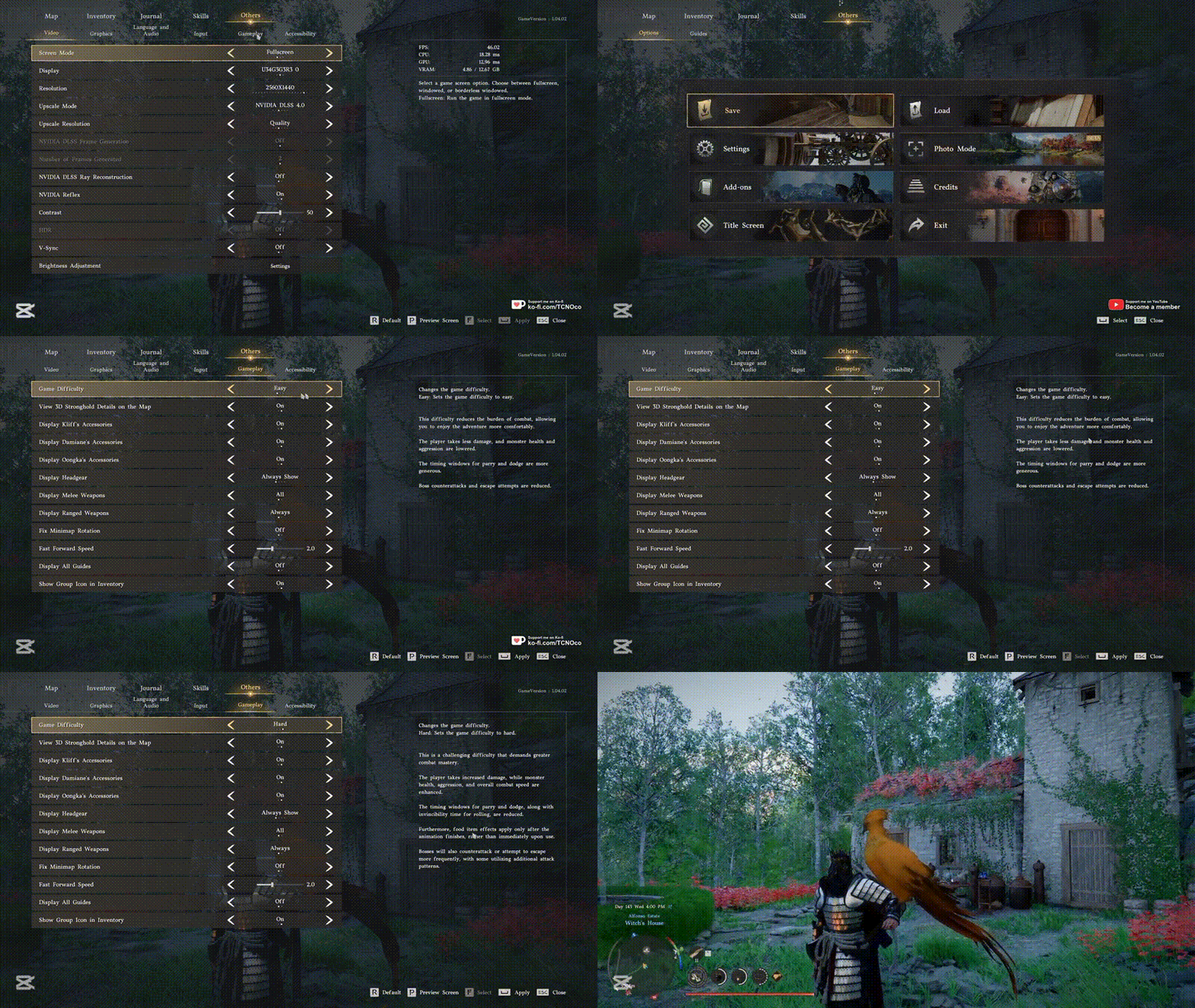
Saros does not use a traditional Easy/Normal/Hard selector. Instead, it uses Carcosan Modifiers, which are unlocked after the second Overlord and let you rebalance runs through Protection Modifiers and Trial Modifiers. Protection options can raise your damage, reduce shield power consumption, or fully restore armor integrity before Overlords, while Trial options add harsher conditions such as weapon decay or the removal of Second Chance.
This matters because Saros’ difficulty is modular rather than fixed. If a specific biome or boss is blocking progress, you can target the pressure point instead of flattening the whole experience. VGC and PowerPyx both note a further accessibility-oriented option, Unlimited Protection Modifiers, which removes the need to balance buffs with trials. It can only be turned on from the Passage and is explicitly framed as a way to reduce friction for players who want the story or need a more forgiving setup.
How to Get the True Ending in Saros (secret Ending Requirements)
The true ending is a post-credits epilogue path, not a hidden branch you can accidentally lock yourself out of during the first clear. First, finish the main story by defeating every main-story boss and watching the credits. After that, you wake back up in the Passage with new story objectives that send you through additional conversations, revisits, and hub-driven postgame steps.
The final requirement comes when you return to the last boss. On the original clear, the fight ends with a finishing melee prompt. For the true ending, do not take that finishing strike after the boss collapses. Instead, walk through the door that appears in the arena. Both VGC and PowerPyx confirm that this postgame second kill requirement is also tied to the Let Go trophy.
Saros Trophies Guide and Roadmap: Easiest Order to Earn Platinum
The Saros Platinum is unusually approachable for a modern action roguelite. PowerPyx estimates the trophy difficulty at 3/10 with Unlimited Protection Modifiers enabled and 4/10 without, with a finish time of roughly 20–25+ hours. The list contains 45 offline trophies, no online requirements, and no missable trophies, which makes Saros much cleaner to 100% than many players initially expected.
The easiest roadmap is three-phase. First, defeat the first two bosses, unlock modifiers, and buy Second Chance early. Second, clear the rest of the story while naturally working on weapon kills, Nightmare Strands, Halcyon totals, and Banyan Tree progress. Third, finish the epilogue for the true ending, then clean up biome-specific challenge trophies. PowerPyx specifically recommends Shattered Descent as the most efficient cleanup biome for modifier-run farming, Untouchable attempts, and Vincible because it is short and its Overlord structure is favorable for quick repeats.
A few trophy-specific habits save time. Always fire any newly found weapon variant so trait and variant tracking progresses; keep each weapon long enough to secure 25 kills when practical; complete all seven Nightmare Strands because they also pay out valuable progression resources; and make a point of entering the Banyan Tree after the milestone bosses that advance its four required encounters. If you are only optimizing for Platinum efficiency, keep at least one Carcosan Modifier active after you unlock them so Carcosan Cartographer advances passively rather than becoming a boring endgame grind.
Best Saros PS5 and PS5 Pro Settings: Performance and Visuals Explained
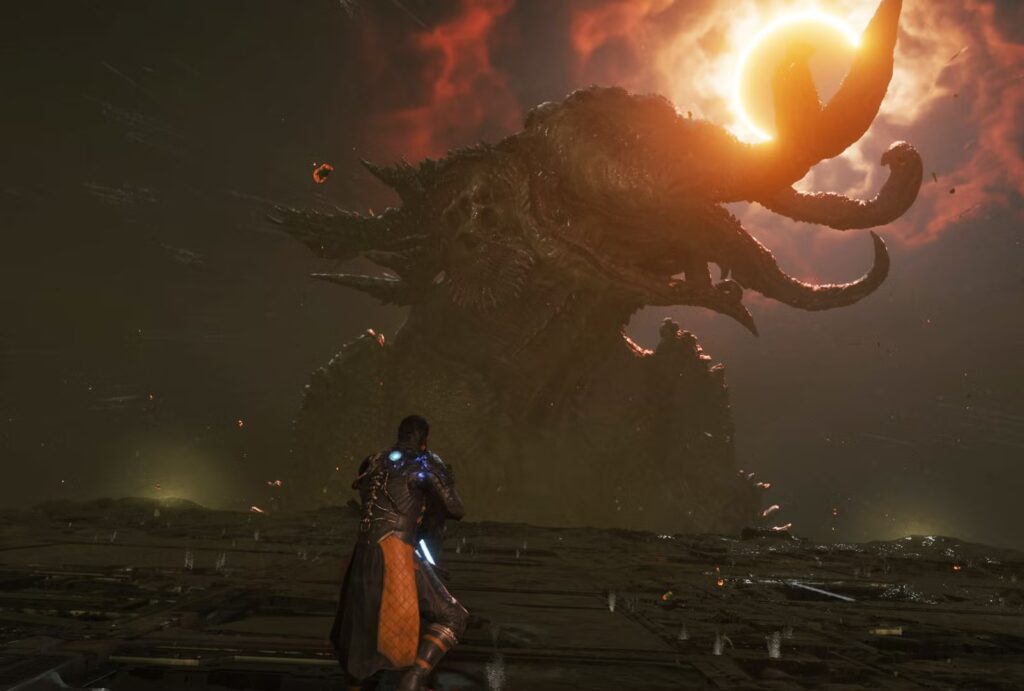
Officially, Saros already runs gameplay at a “rock solid” 60 fps on the base PS5, while PS5 Pro improves image clarity through updated PSSR support, a higher internal render resolution before upscaling, and extra reflection-quality tuning. Story cinematics remain 30 fps by design on both systems, with higher peak image quality on PS5 Pro. In practical terms, that means base PS5 owners are not missing the intended combat feel, while PS5 Pro owners get the cleaner presentation rather than a different gameplay target.
The best actual setup is therefore straightforward. On either console, keep 3D Audio enabled if you have compatible headphones or a suitable speaker setup, because official store and blog materials emphasize Carcosa’s directional sound design as a major part of threat tracking and atmosphere. Leave adaptive triggers on if you want the clearest distinction between alt-fire and Power Weapon inputs, since half-pull and full-pull L2 behavior is part of the combat language. On PS5 Pro, the visual boost is automatic, so you do not need to hunt for a special “best mode” toggle to benefit from it.
Within the menu, the most meaningful gameplay-facing settings are accessibility options rather than graphics toggles. Color-blind projectile options are especially valuable because Saros’ entire defensive logic depends on instantly reading normal, corrupted, and Nova attacks. Dialogue Focus Mode and controller remapping are also available at launch, so if a default input or readability issue is slowing you down, changing that is a smarter “best settings” adjustment than chasing nonexistent quality-performance tradeoffs.
Frequently Asked Questions (FAQs)
- Is Saros harder than Returnal?
Saros is still challenging, but Housemarque explicitly designed it to be more approachable through permanent progression and modifier-based difficulty tuning, so deaths tend to feel less punishing than they do in Returnal. - How long is a typical Saros run?
Housemarque and GamesRadar’s preview coverage describe the core run target as roughly 30 minutes, though that obviously stretches longer if you full-clear biomes or chain multiple areas in one cycle. - When do you unlock fast travel in Saros?
Fast travel, called the Jump Network, unlocks after you defeat Prophet at the end of Shattered Rise. After that, Primary can send you back to visited biomes from the Passage. - What is the best first permanent upgrade to buy?
Second Chance is the most impactful early safety net, while long-term efficiency favors Proficiency, Drive, and later Aether/Restoration upgrades in the Armor Matrix. - What carries over after death in Saros?
Armor Matrix upgrades, unlocked permanent abilities, weapon pool expansion through story progress, and other lasting progression systems remain. Temporary Proficiency, current artifacts, and run-specific power do not. - What weapon should you use against Legion?
The Crossbow is the standout recommendation because its damage and tracking alt-fire handle both the outer swarm and Legion’s central weakpoint far better than slower, less controlled options. - Do you need to beat every boss for the true ending?
Yes. The true ending only becomes available after finishing the main story, completing the epilogue objectives, and then handling the final boss encounter differently on the return visit. - Are any trophies missable?
No. Current post-launch trophy roadmaps agree that the trophy list has no missable trophies and no online requirements. - Can you make Saros easier without lowering trophy eligibility?
Yes. Carcosan Modifiers and Unlimited Protection Modifiers can make the game far more forgiving, and PowerPyx’s roadmap still rates the Platinum with those options in mind. - Is PS5 Pro required for the best Saros experience?
No. Base PS5 already delivers the intended 60 fps gameplay. PS5 Pro mainly improves image sharpness and some overall visual quality adjustments rather than changing the combat target.
Conclusion
The cleanest way to master Saros is to treat it as a progression-forward action roguelite rather than a pure endurance test. Learn the projectile language first, buy permanent power that compounds over time, clear biomes thoroughly before bosses, and build around weapons that suit your actual execution level rather than your ideal one.
Shattered Rise teaches the rules, Blighted Marsh teaches system mastery, and the later Overlords reward players who finally understand that shields, parries, Power Weapons, and movement are one loop rather than four separate mechanics. By the time you reach Yellow Shore, the “best” strategy is no longer a route exploit or single weapon tier list. It is disciplined pattern reading supported by a smart Armor Matrix and a build that turns your strengths into repeatable wins.
Sources and Citations
- PlayStation Blog — Announcing Saros
https://blog.playstation.com/2025/02/12/announcing-saros-the-next-game-from-housemarque-coming-2026/ - PlayStation Blog — Saros release date, gameplay, story details
https://blog.playstation.com/2025/12/11/saros-out-april-30-new-trailer-reveals-gameplay-story-details/ - PlayStation Blog — Saros PS5 and PS5 Pro features
https://blog.playstation.com/2026/04/16/saros-ps5-and-ps5-pro-features-detailed/ - PlayStation Blog — Saros gameplay modifiers and accessibility
https://blog.playstation.com/2026/04/23/saros-gameplay-modifiers-accessibility-options-and-more-detailed/ - PlayStation Store — SAROS listing
https://store.playstation.com/concept/10005069 - Housemarque — SAROS official game page
https://housemarque.com/games/saros - Video Games Chronicle — Saros guides and walkthrough hub
https://www.videogameschronicle.com/guide/saros-guides-and-walkthrough-boss-guides-collectibles-and-more/ - GamesRadar+ — Saros guide
https://www.gamesradar.com/saros-guide/ - PowerPyx — SAROS boss guide
https://www.powerpyx.com/saros-boss-guide-all-overlords/ - GAMES.GG — Saros all bosses guide
https://games.gg/saros/guides/saros-all-bosses-and-how-to-beat-them/
Recommended
- How do I set a camera to render in orthographic mode in Blender?
- League of Legends WASD controls ranked release date (Patch 26.9)
- Avengers: Doomsday Cast Update: Confirmed Stars, Returns, and New Additions
- What Is Gaussian Splatting? A Complete Guide to This Revolutionary Rendering Technique
- Project Hail Mary Video Game Gets Original Andy Weir Story in Journey Among the Stars
- How The View Keeper Simplifies Multi-Camera Animations in Blender
- Macrobit Interactive Releases Factory 95: A Windows 95 PowerPoint Automation Game
- 3D Rendering Services: Buyer’s Guide to Pricing, Quality & Turnaround for Animation, VFX & Real-Time Games
- Overwatch Reveals Its Newest Hero Look as Fans Guess Hero 51’s Identity