








In This Article (8 sections)
Lenovo Legion Go Gen 2 Price Increase, Official 2TB Listing, and $3,999 8TB Marketplace Offer
The Lenovo Legion Go Gen 2 pricing story involves two separate developments that should not be treated as one universal official price increase. October 2026 reporting identified a Lenovo US listing for the Ryzen Z2 Extreme model with 32GB of memory and a 2TB SSD at $3,081.99, while a separate Walmart marketplace listing advertised an 8TB configuration for $3,999. The first is a manufacturer listing for a specific factory configuration, while the second is a marketplace offer with a substantially larger storage capacity and its own seller terms. Keeping those sales channels separate is essential because they involve different configurations, warranties, fulfillment arrangements, and levels of certainty about what the buyer actually receives.
The official $3,081.99 figure applies to the Ryzen Z2 Extreme configuration with 32GB RAM and 2TB storage. October coverage described Lenovo’s product as “Available Soon,” with a notification option rather than an active purchase button, so the number should be treated as a displayed listing price rather than proof that the device could be ordered immediately at that amount. A notification page does not establish shipping time, final taxes, or whether Lenovo will retain the same price when stock returns. Lenovo’s US product page was accessible during research, but the retrievable page text did not independently expose the reported price and availability controls, which means the precise figure remains attributed to the October reporting rather than a completed checkout.
The historical comparison is striking because the same 32GB and 2TB Ryzen Z2 Extreme configuration was reported at $1,479.99 when it launched in 2025. A later figure of $2,849 appeared before the October 2026 listing reached $3,081.99. Comparing the same processor, memory, and storage configuration avoids confusing a specification upgrade with a price increase. From $1,479.99 to $3,081.99, the increase is exactly $1,602, or approximately 108.24 percent, meaning the displayed October figure is slightly more than double the launch price.
Most of that cumulative increase occurred before the latest step. The earlier rise from $1,479.99 to $2,849 was $1,369.01, or about 92.50 percent. The later move from $2,849 to $3,081.99 added $232.99, equivalent to approximately 8.18 percent. Those percentages describe different periods and should not be combined or presented as though the latest increase itself exceeded 100 percent. The larger cumulative figure measures the change from launch, while the smaller figure measures only the most recent reported movement.
The 8TB Walmart marketplace offer requires a separate calculation. The retrieved marketplace page showed an 8TB SSD and 32GB RAM option for $3,999, while the same page listed a 2TB and 32GB option at $2,799. That creates a $1,200 difference for an additional advertised 6TB of storage, equivalent to $200 per extra terabyte within that seller’s pricing structure. This does not establish the wholesale cost of the SSD, installation labor, warranty coverage, or seller margin because the package was not publicly itemized.
The marketplace listing also contains specification inconsistencies that make verification especially important. Its title identifies the Ryzen Z2 Extreme and describes Windows 11 Pro with a two-year CPS warranty, while the key features include a more generic Ryzen Z2 reference. The title also uses WQXGA terminology while the detailed display description states WUXGA. Those differences do not prove that the listing is inaccurate, but they make it important to obtain written confirmation of the exact processor, display, SSD, operating system, and warranty arrangement before paying a premium price.
Lenovo’s original launch material described factory storage options up to 2TB. The 8TB marketplace offer should therefore be treated as a separate seller-configured product rather than evidence that Lenovo introduced an official factory 8TB Legion Go Gen 2. The same distinction applies to support. A third-party CPS protection plan should not automatically be interpreted as identical to Lenovo’s manufacturer warranty, particularly if the SSD has been replaced or otherwise modified by the seller. Buyers need to know who handles failures, what components are covered, and whether the upgraded storage changes any manufacturer service obligations.
The identity of the actual seller also matters because the Walmart marketplace name does not mean Walmart necessarily configured or directly sold the device. Fulfillment, returns, warranty handling, and support may depend on another business operating through the marketplace. An unusually high asking price establishes what that seller is requesting, not what most buyers are paying or what the broader market considers reasonable. Price, availability, configuration, and support therefore need to be evaluated as one transaction rather than reduced to the product name alone.
The reason for the latest Lenovo price increase remains unconfirmed. The October reporting did not identify an official Lenovo explanation, so theories involving memory pricing, SSD costs, supply constraints, distribution expenses, or corporate pricing strategy should remain possibilities rather than established causes. The same caution applies to claims that the figure is simply an error. An unusually high listing may look suspicious, but identifying it as a mistake would require a correction or confirmation from Lenovo.
Availability is similarly fluid. The official premium configuration was reported as not immediately purchasable despite its displayed price, while marketplace configurations had their own order status. A product page can remain visible while stock is unavailable, delayed, or restricted by region. The useful question for a buyer is whether the exact selected configuration can be ordered to the intended address with a delivery estimate and clearly stated return terms. The available evidence supports a high premium US listing with limited immediate purchasing access, not a claim that every Legion Go Gen 2 configuration is unavailable worldwide.
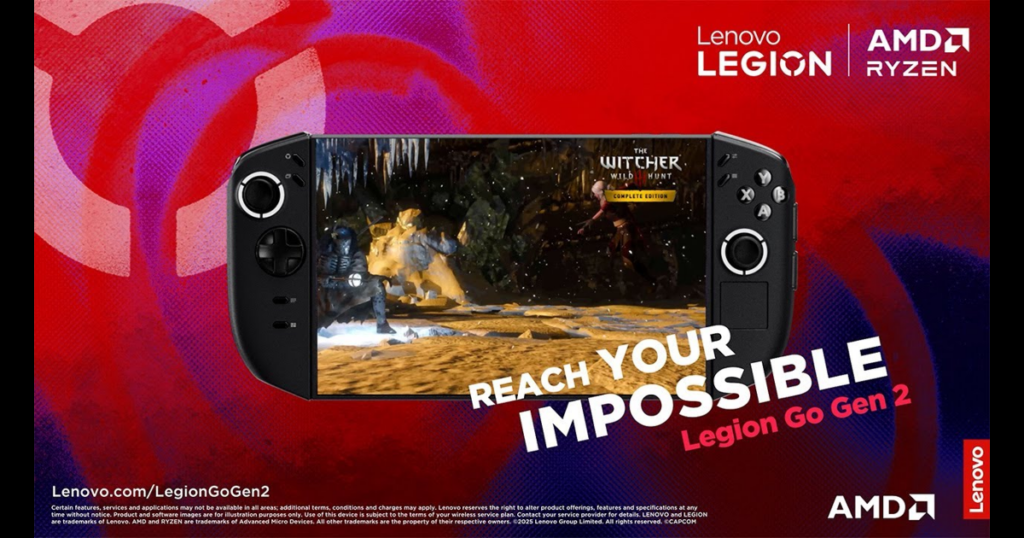
Legion Go Gen 2 Hardware, 2TB vs 8TB Storage, OLED Display, Battery, and Detachable Controllers
The premium Legion Go Gen 2 configuration discussed in the pricing reports uses AMD’s Ryzen Z2 Extreme platform with eight CPU cores, sixteen threads, Radeon 890M integrated graphics, and 32GB of LPDDR5x memory running at an advertised 8000 data rate. These are capable specifications for a handheld PC, but they remain subject to the thermal, power, and memory constraints of a compact portable device. A higher asking price does not transform the integrated graphics into a different performance category. The processor still has to balance gaming performance against heat, fan noise, and battery consumption.
This distinction is especially important when comparing expensive storage configurations. RAM and SSD capacity serve different purposes. The 32GB of system memory supports active workloads and shared graphics use, while the SSD stores games, applications, updates, and other files. Expanding the SSD from 2TB to 8TB increases how much can remain installed locally but does not provide the same type of gaming performance improvement as replacing the CPU or GPU architecture. Storage convenience is therefore the main practical benefit of the 8TB configuration.
The capacity difference is substantial. An 8TB drive provides four times the advertised storage of a 2TB model and can be useful for people with very large libraries, slow internet connections, data limits, or frequent travel. As a simple illustration, twenty games averaging 100GB each would consume around 2TB before accounting for Windows, updates, temporary files, and other software. Actual game sizes vary enormously, but the example shows how quickly a modern collection can fill a smaller drive. Someone who keeps only a few games installed at once may gain far less practical value from paying for the larger capacity.
Capacity alone also says little about SSD quality. The exact model, flash type, controller, thermal behavior, and sustained performance can all matter. An 8TB label does not automatically mean faster loading than a high-quality 2TB drive, and Windows will show less usable space than the advertised decimal capacity after formatting and system use. Buyers evaluating the marketplace configuration should therefore care about the specific storage hardware as well as the number printed in the listing.
The display remains one of the Legion Go Gen 2’s strongest distinctive features. Lenovo specifies an 8.8-inch OLED touchscreen with a 1920 × 1200 resolution, a maximum 144Hz refresh rate, and variable refresh support from 30Hz to 144Hz. The larger screen can make maps, subtitles, inventory screens, and interface elements easier to read than on smaller handhelds, while OLED technology can deliver deep blacks because individual pixels can turn off independently. Those qualities contribute to the premium feel of the device even though they do not guarantee high frame rates in demanding games.
Refresh rate and rendering performance should remain separate concepts. A 144Hz panel can refresh up to 144 times per second, but the hardware must still generate frames quickly enough for a game to approach that level. Less demanding titles may make better use of the upper refresh range, while demanding releases may require reduced graphics settings, a lower rendering resolution, or a frame cap. Variable refresh can improve how fluctuating performance is presented without creating additional processing power.
The handheld also includes a 74Wh battery and redesigned detachable TrueStrike controllers. The controls can be removed while the device is supported by its kickstand, and the right controller supports an FPS mode that allows it to function as a vertical mouse. These options make the device usable in several positions and can reduce the amount of weight held in the hands during longer sessions. Comfort remains subjective, but the combination of detachable controls and a kickstand gives the Legion Go Gen 2 a different ergonomic approach from fixed-controller handhelds.
Battery capacity should not be converted into a universal runtime claim. A high-power game running the system aggressively can drain the 74Wh battery far more quickly than a lightweight title using reduced brightness and a frame cap. As a purely mathematical example, a constant 25W total draw would divide 74Wh by 25W to produce about 2.96 hours before accounting for conversion losses or other practical limits. That is not a measured Legion Go Gen 2 runtime, but it illustrates why the actual result depends strongly on power consumption.
The hardware package therefore remains appealing even when the price rises dramatically. The large OLED display, detachable controllers, substantial battery, and 32GB memory all serve real use cases. The problem is that the underlying Z2 Extreme and Radeon 890M do not become proportionally faster simply because a listing has doubled or because the SSD capacity reaches 8TB. Value has to be judged by how much the buyer specifically benefits from the form factor, screen, controls, and storage rather than by assuming a higher price implies a matching performance class.

Legion Go Gen 2 vs ROG Xbox Ally X and Gaming Laptops at Similar Prices
The reported Lenovo pricing becomes much harder to evaluate when compared with other gaming hardware competing for the same budget. ASUS’s US specification page displayed the ROG Xbox Ally X at $999.99 during research, with a Ryzen AI Z2 Extreme processor, 24GB of LPDDR5x memory, a 1TB SSD, and an 80Wh battery. Against that amount, Lenovo’s reported $3,081.99 official listing is roughly 3.08 times as expensive, while the $3,999 marketplace configuration is almost four times the Ally X’s displayed price. Those ratios describe purchase prices only and should not be interpreted as equivalent differences in performance.
The devices also emphasize different features. The Legion Go Gen 2 offers a larger 8.8-inch OLED screen, detachable controllers, and substantially more memory and storage in the premium configurations discussed. The ROG Xbox Ally X offers a different handheld design, 24GB of memory, 1TB storage, and a larger stated battery capacity at 80Wh. A buyer who values a large OLED panel, detachable controls, or a very large offline game library may prefer Lenovo’s format. Someone who mainly wants portable gaming performance at a lower purchase price may place more weight on the Ally X’s significantly smaller financial commitment.
Storage differences should not dominate the comparison without considering actual needs. A player who regularly uses only a handful of games may receive little benefit from 8TB compared with 1TB or 2TB. Conversely, someone who travels for long periods without reliable high-speed internet or keeps a very large library available locally may value the added capacity much more. The meaningful comparison is therefore between the buyer’s actual usage pattern and the entire price premium, not simply which specification sheet contains the largest storage number.
Once the asking price crosses $3,000, gaming laptops become another obvious comparison. The categories serve different purposes, but they compete for the same pool of money. A gaming laptop typically has more physical room for cooling, a larger display, a built-in keyboard, and the possibility of a dedicated GPU operating at a significantly higher power budget than a handheld integrated graphics platform. A handheld instead prioritizes portability, integrated controls, and use away from a desk or stable surface.
Lenovo’s own 2025 material illustrates the category difference by describing Legion Pro 7 configurations with up to an RTX 5080 Laptop GPU, a 16-inch OLED display, and a much larger power allowance than a portable handheld. Those specifications do not establish a current checkout price or a fixed performance ratio, but they show why spending more than $3,000 naturally invites comparison with dedicated gaming laptops. At that budget level, a buyer interested primarily in demanding game performance should compare actual laptop configurations and benchmarks rather than treating the handheld category in isolation.
A laptop can also spread its cost across more general-purpose activities. Its keyboard, larger screen, ports, cooling capacity, and conventional operating position can make it more suitable for work, study, content creation, or other desktop-style tasks. A handheld can perform many of those tasks when connected to peripherals, but that may require additional accessories and a more stationary setup. The value of the Legion Go Gen 2 therefore depends partly on whether the buyer wants one highly portable gaming device or one expensive computer expected to cover several roles.
The opposite use case remains important. A more powerful laptop may be inconvenient in bed, on public transport, while standing, or in other environments where integrated controls and a smaller form factor matter more than peak GPU performance. The Legion Go Gen 2’s detachable controllers and kickstand also create usage modes that a conventional laptop does not replicate directly. Portability and ergonomics have value even when they cannot be expressed through benchmark charts.
The key point is that a $3,000 to $4,000 handheld is competing against far more than other handhelds. At those prices, buyers can reasonably consider lower-cost handhelds, premium laptops, desktop hardware, or combinations of devices. Lenovo’s distinctive design can still make sense for someone with a very specific use case, but the burden of justification becomes much greater as the price moves further from ordinary handheld territory.

Is the Lenovo Legion Go Gen 2 Worth $3,000 to $4,000?
At the reported October 2026 prices, the value proposition becomes highly specialized. The Legion Go Gen 2 remains a capable and distinctive handheld, but the $3,081.99 official 2TB listing and $3,999 marketplace 8TB offer place it in a price range where buyers can consider substantially different classes of gaming hardware. The hardware itself has not undergone a corresponding processor or graphics redesign that explains the increase through dramatically greater gaming performance. The higher prices primarily change what the existing configuration has to compete against.
For someone specifically seeking an 8.8-inch OLED handheld with detachable controls, 32GB of memory, and a very large local library, the Legion format can still have unusual appeal. That buyer may value being able to keep many large games installed without depending heavily on downloads, use the kickstand and detached controllers in different locations, and retain a large display within a portable device. Those benefits are legitimate, but they need to matter enough to justify spending several times the price of other capable handhelds. A feature can be desirable without making every asking price reasonable for every customer.
The 8TB marketplace configuration requires an even narrower use case because storage is the main advertised difference. Buyers should ask whether they will genuinely use enough of that capacity to justify the premium, especially given that unused storage provides no benefit to a game already installed. They should also verify the exact SSD model, installation method, processor, display specification, operating system, seller identity, return policy, and warranty coverage before paying nearly $4,000. Inconsistencies in the marketplace description make that verification particularly important.
For performance-focused buyers, the elevated prices are much harder to defend on specifications alone. The Ryzen Z2 Extreme and Radeon 890M remain compact integrated hardware operating under handheld thermal and power limits. A larger SSD does not produce proportionally higher frame rates, and an OLED panel does not replace the benefits of a dedicated laptop GPU when raw performance is the priority. Comparing measured game performance, actual use cases, and alternative devices becomes more important than comparing list prices or storage capacities.
The official pricing situation also remains incomplete because the reported Lenovo configuration was marked “Available Soon” rather than immediately purchasable. A high displayed figure does not prove that many customers have paid it, that it will remain unchanged when stock arrives, or that Lenovo has permanently repositioned every configuration at the same level. Likewise, the $3,999 marketplace price demonstrates one seller’s asking amount rather than a universal retail value. Prices and stock should therefore be treated as snapshots.
There is also no confirmed public explanation for the latest Lenovo increase. Without such a statement, the article should stop short of attributing the change to component costs, shortages, tariffs, corporate strategy, or an accidental listing. The evidence supports the existence of the reported prices and their scale relative to earlier figures, not the motive behind them. Future adjustments could move the prices in either direction, and the available information does not support predicting when that might happen.
The most useful conclusion is that the Legion Go Gen 2 can remain desirable while particular listings offer weak value. At approximately $1,000, a handheld competes largely on portable gaming features against other handheld devices. Above $3,000, it also has to justify itself against powerful laptops and other combinations of hardware. Near $4,000, storage convenience and distinctive controls need to serve a very specific buyer rather than simply looking impressive on a specification sheet.
For anyone considering the current offers, the complete transaction matters as much as the hardware. The exact configuration, immediate availability, seller identity, fulfillment terms, return policy, warranty responsibilities, and storage hardware should all be clear before purchase. A premium price makes ambiguity more costly. At these amounts, the Legion Go Gen 2 makes the most sense only when its particular combination of portability, OLED display, detachable controls, and large storage directly matches needs that cheaper alternatives do not satisfy.

Frequently Asked Questions (FAQs)
- Does the Lenovo Legion Go Gen 2 officially cost $3,999?
No. The $3,999 figure refers to an advertised 8TB configuration sold through Walmart’s marketplace, not Lenovo’s standard official price for the Legion Go Gen 2 lineup. The separate October manufacturer pricing report concerned a Ryzen Z2 Extreme model with 32GB of memory and a 2TB SSD listed at $3,081.99. Those offers come from different sales channels and include different storage configurations. The $3,999 amount should therefore be described as a marketplace asking price rather than an official Lenovo-wide price. - What configuration was associated with the reported official price increase?
The reported official Lenovo price concerned the Ryzen Z2 Extreme configuration with 32GB of LPDDR5x memory and a 2TB SSD. Matching those specifications is important because comparing a different processor, memory amount, or storage capacity could make the apparent increase misleading. The same configuration was previously reported at lower prices, allowing a more meaningful historical comparison. The price change should therefore be discussed at the configuration level rather than as though every Legion Go Gen 2 model increased identically. Different variants can follow different pricing paths. - Was the official model immediately available to buy?
Not according to the October reporting. The Lenovo listing was described as showing an “Available Soon” status with a notification option instead of an active purchase button. That means the displayed price did not necessarily represent a transaction a buyer could complete immediately at that moment. Availability can change independently from price, so a later visit may show a different stock status. The report should therefore be understood as a snapshot of both the listed price and the limited purchasing availability at the time. - How large was the increase from launch?
Using the reported launch price of $1,479.99 and the later $3,081.99 figure, the cumulative increase was exactly $1,602. That works out to approximately 108.24 percent, meaning the later listed price was slightly more than double the launch amount. However, most of that increase had already occurred before the latest adjustment. The move from $2,849 to $3,081.99 was $232.99, or approximately 8.18 percent. The 108.24 percent figure therefore describes the full change from launch, while 8.18 percent describes only the most recent reported step. - Is the 8TB version faster in games than the 2TB version?
Not simply because it has more storage. Increasing SSD capacity from 2TB to 8TB does not change the Ryzen Z2 Extreme processor or Radeon 890M graphics architecture. A specific SSD can affect installation times, file transfers, and some loading behavior, but those differences depend on the actual drive model and would require testing. The main benefit of the 8TB configuration is being able to keep a much larger game library installed locally. It should not be presented as a higher gaming-performance tier solely because of its storage capacity. - Is an 8TB model part of Lenovo’s original factory storage range?
No, based on the launch information discussed in the article. Lenovo’s original materials described factory storage options reaching up to 2TB. The 8TB configuration appeared through a marketplace listing and should therefore be treated as a separate seller-configured offer rather than evidence that Lenovo added an official 8TB factory model. Buyers should verify how the larger drive was installed, which SSD is included, and how the modification affects warranty or service arrangements. The marketplace listing and Lenovo’s factory specifications should not be treated as interchangeable. - Does the screen run every game at 144 frames per second?
No. The 144Hz specification describes the maximum refresh rate of the Legion Go Gen 2’s display, meaning the panel can update up to 144 times per second. The game itself still has to render frames quickly enough to make full use of that capability. Demanding games may run at much lower frame rates depending on resolution, graphics settings, power profile, and software optimization. Less demanding titles are more likely to approach the upper refresh range. The display can therefore support 144Hz without guaranteeing 144 fps in every game. - How long does the battery last?
There is no single battery-life figure that applies to every game or workload. The Legion Go Gen 2 has a 74Wh battery, but actual runtime depends on factors such as display brightness, power limits, frame rate caps, game complexity, wireless activity, and background software. A demanding game using a high-power profile can drain the battery much faster than a lighter title running with reduced settings. Battery capacity provides a useful basis for comparison but does not establish a fixed number of gaming hours. Reliable runtime estimates require measurements under specific, clearly defined conditions. - Why is the ROG Xbox Ally X relevant to this comparison?
The ROG Xbox Ally X is relevant because it is another premium Windows gaming handheld competing for many of the same buyers. ASUS’s US page displayed it at $999.99 during the research period, substantially below the Lenovo prices discussed in the article. The devices are not identical because they differ in memory, storage, display design, battery size, controls, and other features. Comparing them does not prove that one is proportionally faster or better simply because of price. It does, however, show how large the Legion Go Gen 2 premium has become within the handheld gaming market. - Has Lenovo confirmed why the latest price increased?
No specific official explanation was established by the sources used for the article. The reported listing price increased, but Lenovo did not provide a verified statement attributing that change to one particular cause. Component costs, supply conditions, inventory decisions, or broader pricing strategy could all potentially influence electronics prices, but none should be presented as the confirmed reason here. It is also unsupported to label the figure a pricing error without a correction or statement from Lenovo. The most accurate conclusion is simply that the increase was reported while its precise cause remained unconfirmed.

Conclusion
The Lenovo Legion Go Gen 2 pricing story is best understood by separating Lenovo’s reported $3,000-plus 2TB listing from the separate $3,999 marketplace 8TB configuration. Neither figure represents one universal price for every version of the handheld, and availability, seller terms, warranty coverage, and exact specifications remain important parts of the comparison.
The hardware still offers clear strengths, including its large OLED display, detachable controls, and portable PC design, but higher storage capacity does not create a new level of gaming performance. At these prices, buyers need to weigh those features against competing handhelds and laptops, making the reported premium difficult to justify on specifications alone.
Sources and Citations
- VideoCardz, October 13, 2026, “Official Lenovo Legion Go Gen 2 price climbs to $3,082, while 8TB version is listed for $3,999”: Reports that Lenovo’s US store listed the Ryzen Z2 Extreme model with 32GB RAM and a 2TB SSD for $3,081.99, marked “Available Soon.” It also identifies the separate $3,999 Walmart marketplace 8TB configuration, notes the earlier $1,479.99 launch price, and calculates the cumulative increase at roughly 108%. VideoCardz.com
- VideoCardz, Legion Go Gen 2 price climbs to $3,082
- Notebookcheck, October 13, 2026, “Lenovo Legion Go 2 Z2 Extreme with 2TB of storage gets another price hike, pushing it above $3,000”: Confirms the $3,081.99 Lenovo listing for the Z2 Extreme 2TB model, compared with its original roughly $1,480 launch price and later $2,849 listing. Notebookcheck calculates the increase from launch at $1,601.99 and notes that Lenovo had not provided an official explanation for the latest increase. Notebookcheck
- Notebookcheck, Legion Go 2 Z2 Extreme exceeds $3,000
- Wccftech, October 2026, Lenovo Legion Go Gen 2 Price Increase Report: Covers the same reported Lenovo pricing movement, including the large increase relative to the original launch price and limited availability of the premium configuration. Because Lenovo has not publicly attributed the change to one specific cause, explanations involving component costs or supply pressures should remain analysis rather than established fact.
- Wccftech, Lenovo Legion Go Gen 2 price increase and availability report
- Lenovo, Legion Go Gen 2 US Product Page: Official product page confirms the Legion Go Gen 2 family, including configurations with up to the AMD Ryzen Z2 Extreme, an 8.8-inch 1920 × 1200 OLED display, 144Hz refresh rate, detachable TrueStrike controllers, and integrated Radeon graphics. Lenovo’s currently retrievable page does not independently expose the reported $3,081.99 price, so that exact amount is best attributed to the October pricing reports rather than treated as a presently visible checkout price. Lenovo
- Lenovo, Legion Go Gen 2 US Product Page
- Lenovo PSREF, Legion Go 8ASP2 Product Specifications: Lenovo’s official specification reference confirms the Ryzen Z2 Extreme with 8 cores and 16 threads, up to 32GB LPDDR5x-8000 memory, and factory storage support of up to 2TB M.2 2280 PCIe 4.0 SSD. This is particularly important because it shows that the 8TB Walmart configuration is outside Lenovo’s documented factory storage range and should be treated as a seller-upgraded system. Lenovo PSREF
- Lenovo PSREF, Legion Go 8ASP2 Specifications
- Lenovo StoryHub, Legion Go Gen 2 Launch Announcement: Official launch material covers the second-generation Legion Go hardware, including the Ryzen Z2-series platform, OLED display, detachable controls, battery improvements, and Lenovo’s broader gaming-handheld positioning. This is the appropriate first-party source for the device’s original hardware announcement rather than later marketplace modifications.
- Lenovo StoryHub, Legion Go Gen 2 Launch Announcement
- Walmart Marketplace, Legion Go Gen 2 8TB Listing: The marketplace page explicitly lists an 8TB SSD / 32GB RAM configuration for $3,999, while the same seller lists a 2TB / 32GB option for $2,799. The 8TB listing includes Windows 11 Pro and a two-year CPS warranty and is sold and shipped by Mavark, not directly by Lenovo. The listing also contains some specification inconsistencies, including a generic Ryzen Z2 reference despite the product title naming Z2 Extreme, so buyers should verify the exact configuration before purchase. Walmart.com
- Walmart, Lenovo Legion Go Gen 2 8TB Marketplace Listing
- ASUS ROG, ROG Xbox Ally X US Specifications: ASUS’s official US page lists the ROG Xbox Ally X at $999.99 with an AMD Ryzen AI Z2 Extreme, 24GB LPDDR5X memory, 1TB PCIe 4.0 SSD, 7-inch 120Hz display, and 80Wh battery. These figures provide a useful current first-party comparison against the much higher Legion Go Gen 2 listings. @ROG
- ASUS ROG, ROG Xbox Ally X Specifications
- ASUS Pressroom, August 20, 2025, “ROG Xbox Ally and ROG Xbox Ally X to Hit Store Shelves October 16, 2025”: Official announcement confirming the October 16, 2025 retail launch of both handhelds and their use of AMD Ryzen Z2-series processors. ASUS had previously introduced the devices in June 2025 as a collaboration with Xbox focused on handheld ergonomics and an integrated Xbox/Windows experience. ASUS Pressroom
- ASUS Pressroom, ROG Xbox Ally and Ally X Launch Date
Recommendations
- Vivian Kubrick Debunks Eyes Wide Shut Deleted Scenes Theory
- Battlefield 6 2026 Roadmap: More Maps, “Legendary” Battlefield 4 & Battlefield 3 Remakes, and Wake Island’s Return
- Apple TV’s Widow’s Bay is the First Breakout TV Hit of 2026: Why Everyone is Talking About the Horror Comedy
- Pitchify Launches New Service to Connect Developers and Publishers: How Pitch Direct Works
- Pokémon Pokopia Bubbly Basin DLC Release: Date, New Pokémon, and Everything You Need to Know
- Nordic Game 2026 (NG26 Spring): Dates, Venue, Passes, Speakers, Expo & Awards in Malmö
- Subnautica 2 Early Access Roadmap: Co-Op Updates, Sprinting, and More
- Virtua Fighter 6 Leak Explained
- The Future of 3D Modeling: Insights on AI Advancements
- GTA 6 is Already Outselling Everything Else: Why Pre-Orders Are Dominating Gaming



































































































