










Lofsöng’s appearance at Gamescom Opening Night Live on August 25, 2026, introduced a wider audience to an exploration puzzle adventure built around monumental landscapes, mysterious sounds, and the traces of vanished civilizations. Developed by Unrelated Studio, its stark presentation prompted comparisons with Journey and Limbo, although its central interest lies in something more specific: whether meaning can survive long after the people who created it have disappeared.
The Gamescom presentation was not the game’s first public reveal. Lofsöng had already appeared during the April 23, 2026, ID@Xbox Showcase, making ONL a subsequent showcase rather than its original announcement. As of September 17, 2026, its release date remains unannounced. That distinction helps separate the confirmed project from the excitement surrounding its latest trailer. Lofsöng has a clearly defined identity built around exploration, sound, and interpretation.
In This Article (7 sections)
What Is Lofsöng? Unrelated Studio’s Exploration Puzzle Adventure Explained
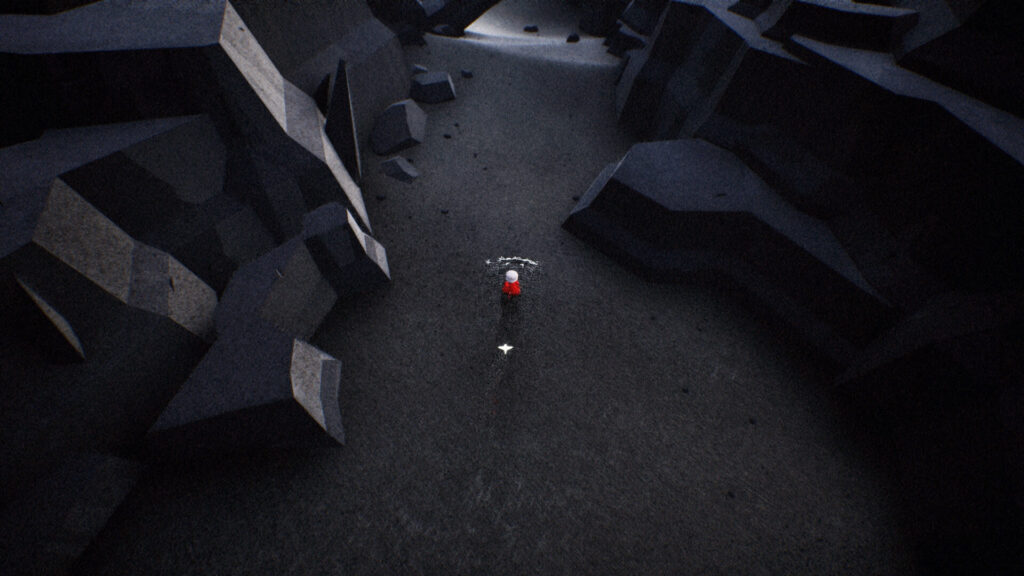
Lofsöng is a single player exploration puzzle adventure from Unrelated Studio in which a small, childlike traveler moves through a world of imposing structures, hidden spaces, and partially obscured histories. The protagonist is distinguished by unusually bulky headgear and is accompanied by an origami companion capable of changing shape. Rather than relying heavily on dialogue, the game is designed to communicate through places, objects, environmental details, and sound.
Its central idea is not simply that the world has been abandoned. Instead, the setting still contains information that the player must learn to interpret. A strange structure may function as more than an obstacle or landmark, and an object that initially appears decorative could preserve a message whose original context has been lost. This makes observation and interpretation central to the experience rather than treating exploration as movement between conventional puzzle rooms.
The announced features connect progression with discovery and recognition. Responsive objects, concealed areas, and clues that do not necessarily need to be encountered in a fixed order suggest a structure where players can gradually build an understanding of the world rather than being led through every idea in a strict sequence. Reaching a new place and finally understanding the meaning of a familiar one may therefore be equally important forms of progress.
That design direction also suggests that comprehension may matter as much as traversal. Players are being encouraged to pay attention to how locations, sounds, symbols, and objects relate to one another instead of assuming every challenge will present itself as a clearly marked puzzle with a single obvious solution path. However, many details about the game’s moment to moment challenges have not yet been fully demonstrated, so specific assumptions about puzzle mechanics or the final progression structure would go beyond what has been shown.
Lofsöng is therefore best understood as an exploration and interpretation focused puzzle adventure with an established creative direction but still limited publicly demonstrated detail about how every challenge will function in practice.
The comparison with Journey is most useful as a description of scale and emotional presentation. Both place a small traveler against landscapes that seem to dwarf individual lives, encouraging the player to find significance in movement, distance, and the remains of something older. The Escapist’s Gamescom coverage specifically connected Lofsöng with Journey through its use of silence and its willingness to let the environment communicate without constant explanation.
The difference lies in what those spaces appear to promise. Journey’s warmer desert imagery invites associations with pilgrimage and discovery, while Lofsöng’s gray expanses and enormous concrete forms suggest a civilization whose surviving messages may be difficult to recover. This is more than a change in color. An imposing structure can inspire wonder while also making the traveler seem exposed, especially when its purpose is unclear. The same destination can therefore feel both inviting and unsettling.
That tension also helps explain the comparison with Limbo. A vulnerable figure and an ominous setting can create unease before the player understands what might be dangerous. However, the comparison is best treated as a reference to mood, not as a description of identical mechanics. Lofsöng’s announced focus remains exploration, interpretation, and interaction with its surroundings rather than a promise to reproduce another game’s particular challenges.
Its strongest opportunity is to make that atmosphere inseparable from play. A player who initially regards a monument as threatening might later understand it as an instrument, a record, or a means of communication. That possibility gives the darker presentation an expressive purpose: uncertainty can change as knowledge grows. The interesting question is not simply whether Lofsöng resembles Journey, but whether its world can produce a similarly personal connection through a different emotional language.
The official setting gives the landscape a more specific identity than a generic abandoned fantasy world. Lofsöng takes place on an Earth described as long dead, with dust and ash covering an Exclusion Zone caught in an enduring nuclear winter. The description places the journey toward an epicenter and connects that movement with a growing sense of the cosmic unknown. The Dust Sea is part of this setting, providing a named expanse for the journey rather than merely a background of anonymous ruins.
The Xbox description also mentions the last humans, who wander as solitary nomads through a world they no longer understand. That detail complicates the idea of an entirely empty planet. The disappearance of earlier civilizations does not necessarily mean that every human presence has vanished. Instead, the setting suggests a break between surviving people and the knowledge once embodied by their surroundings. Humanity may still exist without retaining the ability to understand everything it inherited.
The origami companion provides a practical counterpoint to that isolation. The official description identifies a kite, a glider, and a sailboat among its forms, with new transformations becoming available as exploration progresses. It also expands the traveler’s acoustic abilities. Its role therefore connects movement with the same sound based interactions that give the world its puzzle identity, rather than separating transportation from the adventure’s central ideas.
There is a striking visual contrast in placing a folding companion beside monumental architecture. The structures suggest weight, permanence, and histories measured across immense stretches of time, while the companion represents adaptability and movement. As an interpretation of the presentation, that contrast makes the partnership feel especially appropriate: something capable of changing shape helps the traveler approach a world whose most enduring objects have become difficult to understand.
The transformations also give the Dust Sea a role beyond establishing distance. Different ways of crossing an expanse can change how a player experiences its scale and notices its landmarks. The announced forms suggest variety within exploration, while keeping the relationship between the traveler, companion, and environment at the center of the adventure.

How Lofsöng Uses Sound, Geometry, Hidden Language, and Environmental Guidance
Lofsöng builds its puzzle identity around the relationship between shapes, structures, sound, and interpretation. Official descriptions connect monuments, playable sculptures, mechanisms, and acoustic behavior, while Xbox identifies vocalization as one way of interacting with the environment. The central design idea appears to be that seeing and hearing can provide different parts of the same answer. A structure’s form may suggest a relationship, while its sound or resonance helps confirm whether that interpretation is meaningful.
Creative director Alessandro Durando’s Tribeca profile provides further context through Architecture Parlante, an approach in which architecture expresses meaning through its form. The profile connects Lofsöng with this idea alongside brutalist architecture and deep time. In the game’s context, that helps explain why geometry is presented as something to interpret rather than simply admire. A monument’s shape belongs to the same communicative system as the sounds it produces.
This also gives the question of communicating with the future a useful tension. Preserving an object is not the same as preserving its meaning. A structure may endure while the language, customs, and assumptions of its builders disappear. From that perspective, the player’s task resembles recovering a relationship between form and intention, rather than merely locating a surviving message.
That does not mean every puzzle should be understood as a musical performance. Sound can function as information without requiring players to reproduce a melody or possess formal musical knowledge, and nothing publicly shown establishes Lofsöng as a rhythm game. Similarly, references to vocalization do not confirm that players must speak into a microphone. The announcement describes an interaction concept, not a mandatory real world voice input system.
For these ideas to work well, feedback will be especially important. If players experiment with sound, geometry, or responsive objects, the game needs to communicate whether something meaningful happened. Otherwise, atmospheric audio could become difficult to distinguish from an actual clue. Accessibility will matter for the same reason. Visual reinforcement, adjustable audio presentation, or alternative ways of reading sound based information could affect how many players can engage comfortably, although no specific accessibility systems have been confirmed.
The game also deliberately reduces conventional guidance. Its official presentation emphasizes the absence of dialogue and a map, while Xbox describes navigation through sound, resonance, and the origami companion. Removing a map does not mean eliminating direction altogether. Instead, guidance has to come from the environment itself, such as distinctive silhouettes, openings, recurring shapes, acoustic responses, or other consistent cues.
The challenge is to make uncertainty encourage investigation rather than arbitrary confusion. Players should be able to form ideas about where to go or what a structure means and then receive enough feedback to refine those ideas. Wordlessness also should not be confused with a total lack of interface text. A game can avoid spoken exposition and still provide readable controls, settings, or accessibility menus.
This approach could make navigation part of the storytelling itself. Learning how to move through the world becomes connected to learning how the world communicates. The hidden language is therefore central to Lofsöng, but it should not automatically be imagined as a conventional alphabet waiting to be translated. The announced concept spreads meaning across sound, stone, structures, and the relationships between them.
That creates two kinds of discovery. One concerns function, such as understanding what a monument or mechanism does. The other concerns interpretation, including why it exists and what its continued presence means. The game also promises deeper mysteries beyond the apparent conclusion of the main adventure, suggesting that some discoveries may reinterpret earlier locations rather than simply unlock new ones.
Another announced feature is the ability to leave sound traces in the world. The exact implementation has not been explained in detail, but the concept extends the relationship between the traveler and the environment beyond passive listening. As a thematic possibility, leaving a trace would let the player participate in the same problem the ruins represent: making something that remains after its creator moves on. It is an intriguing counterpart to discovering the memories left by others.
Unrelated Studio’s official website extends this atmosphere through an “Atomic Vault” archive fragment that speculates about signals traveling backward through time while explicitly calling that retrocausal explanation unverified. It is better understood as promotional world building than as a confirmed scientific explanation or final story answer. Likewise, hints that mysteries may continue beyond the screen do not automatically confirm an alternate reality game, downloadable content, or a New Game Plus mode.
The strongest storytelling possibility is reinterpretation. A place does not necessarily need to physically change to become more important. Discovering new information can alter what an earlier monument, sound, or encounter means, allowing the player’s growing understanding of the world to become a form of progression in its own right.

Unrelated Studio, Lofsöng’s Reveal Timeline, and Current Release Date Status
Lofsöng is being developed by Unrelated Studio, an independent developer based in Turin, Italy. The studio’s public description emphasizes creator led projects that combine gameplay, visual art, and emotional storytelling. Bologna Game Farm identifies the company behind the project as Unrelated SRL and describes it as a startup founded by professionals with more than 15 years of experience in audiovisual work and design.
That experience refers to the backgrounds of the people involved rather than proving that Unrelated Studio itself has been operating for 15 years. The distinction matters because professional experience across creative fields should not be converted into claims about an undocumented history of earlier games.
Lofsöng fits the studio’s stated interests through its emphasis on presentation and the relationship between image, sound, and meaning. Its appeal is not based on the scale of an established franchise but on the coherence of a specific artistic and interactive concept. The eventual test will be whether those ambitions translate into satisfying play across the full adventure, since strong visual composition and mysterious world building still need to support puzzles and exploration that consistently reward curiosity.
The game’s documented history also predates its Gamescom appearance. Bologna Game Farm lists Lofsöng as part of its BGF4 2024 edition, establishing an earlier development context before its larger 2026 showcases. On April 23, 2026, Xbox included the game in its official Spring Showcase recap, highlighting its sound focused exploration concept and confirming Xbox Series X|S, Xbox on PC, and Xbox Play Anywhere support.
An April 27 developer post on Steam then confirmed that the announcement trailer had premiered during the IGN x ID@Xbox Showcase. The studio thanked viewers and encouraged interested players to wishlist the game. Lofsöng later appeared again at Gamescom Opening Night Live on August 25 with new footage, and contemporary reporting distinguished that presentation from the earlier April reveal.
Between those two showcases, Lofsöng also reached players directly through the 2026 Tribeca Festival. Unrelated Studio announced its Official Selection on May 12 and offered a free playable demo at Pier 57 from June 10 to June 14. In a June 29 Steam update, the team described the event as the first time the game had been playable in public.
That distinction separates three different milestones: a trailer announcement, a public opportunity to play, and a later presentation to a larger showcase audience. Tribeca’s demo was an event appearance, not a retail launch. The studio’s August 31 update then confirmed that its new trailer had premiered at Opening Night Live, where creative director Alessandro Durando joined Geoff Keighley onstage to introduce the project.
The clearest chronology is therefore earlier development exposure through Bologna Game Farm, an April 2026 showcase announcement, and a later Gamescom presentation. Describing the Gamescom footage as a first look can make sense for viewers discovering the project there, but it would be inaccurate to imply that the game had never been publicly shown before that event.
As of September 17, 2026, Lofsöng still does not have an announced release date. Its Steam listing does not provide a launch date, while the PlayStation Store identifies the game as announced with its release timing still undetermined. The “2026” in references to Lofsöng at Gamescom Opening Night Live 2026 refers to the year of the showcase rather than a confirmed release year. Official storefront listings checked on September 29, 2026, continue to show the release timing as unannounced.
Phrases such as “coming soon” also do not establish a month, quarter, or dependable launch window. There is therefore no basis for presenting a specific release date as confirmed or treating the absence of one as evidence that the game has been delayed. A delay would require an earlier announced schedule that was later changed.
For players considering the PC version, Steam currently lists both Unrelated Studio as developer and publisher, alongside a single player feature designation. Its minimum requirements provide a more concrete indication of the intended hardware than the game’s stylized appearance alone:
- Operating system: Windows 10, 64 bit, or later.
- Processor: Intel Core i5-11400H or AMD Ryzen 5 5600H, or better.
- Memory: 16 GB RAM.
- Graphics: NVIDIA GeForce RTX 2060 or AMD Radeon RX 6500 XT, or better.
- Graphics API: DirectX 12.
These requirements do not specify a target resolution or frame rate, so they should not be read as a guarantee of a particular performance level. The current recommended requirements section does not provide a complete higher performance specification.
Xbox Play Anywhere is a separate consideration from hardware performance. Microsoft’s program allows a qualifying digital purchase through its Xbox storefronts to provide access on supported Xbox consoles and Windows PCs, with progress continuing across the supported versions. For Lofsöng, that could make changing between a console and a compatible PC more convenient without restarting the adventure.
The entitlement should not be confused with ownership across every storefront. A Steam purchase is separate from an Xbox storefront purchase, and the Xbox Play Anywhere announcement does not establish shared ownership with PlayStation. It also does not, by itself, confirm inclusion in Game Pass.
For now, Lofsöng remains an announced title that players can follow and wishlist. A future dated announcement from Unrelated Studio, supported by updated official storefront listings, would provide the first reliable basis for more specific release planning.
Frequently Asked Questions (FAQs)
- Will Lofsöng contain mysteries after the credits?
The developer has said that additional layers of mystery extend beyond the apparent end of the main adventure. That suggests players may still have discoveries or unanswered questions to investigate after reaching the credits. However, the exact structure has not been explained, so this should not be interpreted as confirmation of downloadable content, New Game Plus, or a specific postgame mode. - What is Lofsöng?
Lofsöng is a single player exploration puzzle adventure developed by Unrelated Studio. Players travel through a mysterious world filled with unusual structures, hidden spaces, and traces of earlier civilizations, using environmental interaction, sound, and observation to understand what happened there. Its design places more emphasis on interpretation and discovery than on conventional dialogue driven storytelling. - Was Lofsöng first announced at Gamescom ONL 2026?
No. The game’s announcement trailer appeared earlier during the IGN x ID@Xbox Showcase in April 2026. Lofsöng later returned at Gamescom Opening Night Live on August 25, 2026 with additional footage. Gamescom therefore provided a later presentation rather than the game’s first public announcement. - Why is Lofsöng compared with Journey?
The comparison mainly comes from its atmospheric exploration, unusual companionship, wordless presentation, and travel through visually striking landscapes. Those similarities can make Journey a useful reference point for describing the mood and structure. However, Lofsöng is its own game from Unrelated Studio and is not a sequel, spin off, or officially connected project. - Is Lofsöng a multiplayer game?
No. The announced format is single player. The protagonist travels with an origami companion that can help with movement and exploration, but that companion is part of the game’s design rather than another human controlled character. Nothing announced so far establishes online co-op or local multiplayer. - Does Lofsöng have dialogue or a map?
The official presentation says the game does not use dialogue or a conventional map. Instead, players are expected to learn from the environment itself, including architecture, sounds, visual landmarks, responsive objects, and their companion. Removing those traditional forms of guidance makes observation and interpretation more important to navigation and storytelling. - What can the origami companion transform into?
Confirmed forms include a kite, a glider, and a sailboat. These transformations are connected to traversal, particularly moving through the Dust Sea and reaching places that would otherwise be difficult to access. The developers have also suggested that exploration will reveal additional possibilities, although the full range of forms has not been disclosed. - Does Lofsöng have a confirmed release date?
No. As of September 17, 2026, official storefront listings still leave the release date undetermined. Its appearance at Gamescom Opening Night Live 2026 refers only to the year of the showcase and should not be interpreted as confirmation that the game launches in 2026. - Is Lofsöng coming to PS5 as well as Xbox and PC?
Yes. The developer’s official link hub includes PlayStation 5 wishlisting alongside Steam and Xbox links, and a PlayStation Store page is available. Xbox Series X|S and Xbox on PC support had already been confirmed through the April 2026 showcase material, so the game is currently planned across PS5, Xbox, and PC. - Does Xbox Play Anywhere mean a Steam purchase includes the Xbox version?
No. Xbox Play Anywhere applies to supported digital purchases made through Microsoft’s Xbox and Windows distribution ecosystem. A Steam purchase is separate and does not automatically provide an Xbox copy simply because the same game supports Play Anywhere through Microsoft’s own stores.
Conclusion
Lofsöng’s most interesting prospect is not simply being a darker counterpart to Journey. It is the possibility of making interpretation itself feel like adventure: learning to recognize significance in a structure, understanding why an object responds, and discovering that a seemingly empty place still has something to communicate.
Its Gamescom presentation strengthened that identity without answering every practical question. The completed game will need to turn its atmosphere into readable interactions, rewarding discoveries, and a sustained relationship between the traveler and the world.
The most useful expectation is therefore curiosity rather than certainty. Lofsöng has a distinctive premise and an identifiable creative ambition. Whether its mysteries ultimately prove as compelling to solve as they are to contemplate will depend on the quality of the playable experience, not the strength of its comparisons alone.
Sources and Citations
- Steam, Lofsöng Official Store Page : Official listing identifying Unrelated Studio as both developer and publisher, with the release date currently listed as “To be announced.” It describes the game’s sound based puzzles, transforming origami companion and environmental storytelling, while also providing language support, listed PC requirements and the option to add the game to a wishlist. Steam Store
Citation: Lofsöng on Steam. (Steam) - PlayStation Store, Lofsöng Official Product Page : Official PlayStation listing presenting the game as announced, with its release date still to be determined. Alongside screenshots and a wishlist option, the page explains how players interact through sound, discover hidden areas and use their companion’s changing forms to explore a world without conventional dialogue or maps. PlayStation Store
Citation: Lofsöng on PlayStation Store. (PlayStation Store) - Xbox, Lofsöng Official Product Page : Microsoft’s dedicated game listing confirms Xbox Play Anywhere support and provides the publisher information, age rating and official gameplay description. It outlines the ruined setting, evolving companion abilities and mysteries encoded in architecture and sound, making it a direct reference for the features advertised for the Xbox version. xbox.com
Citation: Lofsöng on Xbox. (Xbox) - Xbox Wire, April 23, 2026 Showcase Recap : Official recap of the ID@Xbox Spring Showcase featuring Lofsöng’s announcement trailer and an introduction to its exploration mechanics. The dedicated section confirms Xbox Series X|S, Xbox on PC and Xbox Play Anywhere support, while explaining how vocalisation and environmental interactions help players uncover paths and interpret memories left within the landscape. XBOX Wire
Citation: ID@Xbox Spring Showcase: Check Out All of the Amazing Games Announced and Revealed. (Xbox Wire) - Unrelated Studio, Lofsöng Official Website : The developer’s official website introduces Lofsöng’s wordless journey, its mysterious companion and a world where sound carries information about lost civilizations. It also provides the trailer, links to the game’s store listings and information about the Turin based studio’s approach to combining gameplay, visual art and emotional storytelling. Unrelated Games
Citation: Lofsöng: Unrelated Studio Official Website. (Unrelated Studio) - Bologna Game Farm, Lofsöng and Unrelated Project Profile : Official project profile identifying Lofsöng as part of the BGF4 2024 edition and describing the team’s background in audiovisual production and design. It explains the game’s early focus on solo exploration, environmental storytelling and communication across deep time, providing useful context for the project’s development and central themes. Bologna Game Farm
Citation: Lofsöng: Unrelated Srl Project Profile. (Bologna Game Farm) - Thatgamecompany, Journey Official Game Page : Official overview of Journey’s desert exploration, ancient ruins, music and opportunities to encounter other players during the adventure. It provides a reference for comparisons involving atmosphere, visual presentation and travel through mysterious landscapes, while keeping Journey’s documented features separate from the mechanics announced for Lofsöng. thatgamecompany
Citation: Journey Official Game Page. (Thatgamecompany) - Xbox, Xbox Play Anywhere Official Information : Microsoft’s explanation of how eligible digital purchases through the Xbox or Windows Store can be played across Xbox consoles, Windows PCs and supported gaming handhelds without an additional purchase. It also describes shared saves, achievements and game add ons, providing context for understanding what the Play Anywhere label means. xbox.com
Citation: Xbox Play Anywhere. (Xbox) - Valve, Steamworks Wishlists Documentation : Official guidance explaining how players use Steam wishlists to track games and receive notifications about releases and qualifying discounts. The documentation also covers notification triggers, email preferences and delivery restrictions, helping explain what players can expect after adding an upcoming game such as Lofsöng to their wishlist. Steamworks
Citation: Wishlists: Steamworks Documentation. (Steamworks) - Valve, Steamworks Store Presence Documentation : Official documentation covering Steam store pages, Coming Soon listings, Early Access, language support and release procedures. It provides background for interpreting how games are presented before launch and distinguishes general Steam publishing processes from the specific release information and features shown on an individual game’s store page. Steamworks
Citation: Store Presence: Steamworks Documentation. (Steamworks)
Recommendations
- The Procession to Calvary: Review, Walkthrough, Gameplay, and Complete Guide
- Meccha Chameleon: 25 Best Places To Hide (All Top Spots and Routes)
- Top 5 Things You Need to Know About World of Tanks: HEAT, Gameplay, Agents, Modes, and More
- Serial Killer Slasher Heart Eyes 2 Gets 2028 Release Date: Latest Updates, Cast, Plot, and Trailer News
- How to Create an Infrared Camera Effect in Blender: A Complete Step-by-Step Guide
- Netflix’s Man on Fire Review: Yahya Abdul-Mateen II Reboots a Classic Vigilante Thriller With Grit, Grief, and Divisive Action
- Bruce Campbell Says He Will No Longer Play Evil Dead’s Ash Williams
- Servant of the Lake: How to Unlock All 49 Achievements
- Cronos: Lazarus Leak. Two Images Surface Ahead of Official Announcement, DLC or New Game Teased
- Highguard to Permanently Shut Down Less Than Two Months After Launch: Wildlight Confirms March 12, 2026 Server Shutdown



































































































