








In This Article (7 sections)
How Lunarium Combines Hand Painted Art With 3D Environments
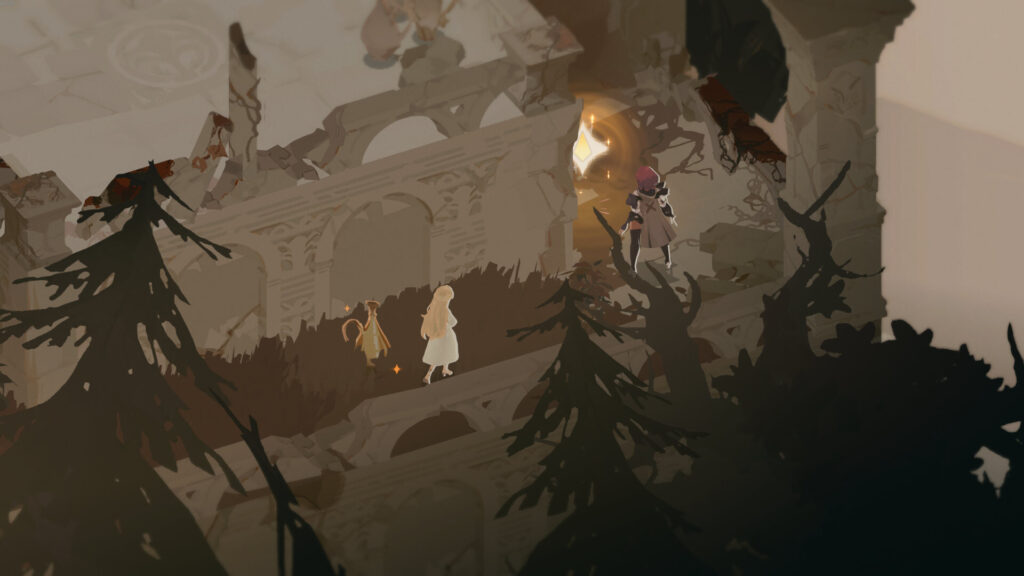
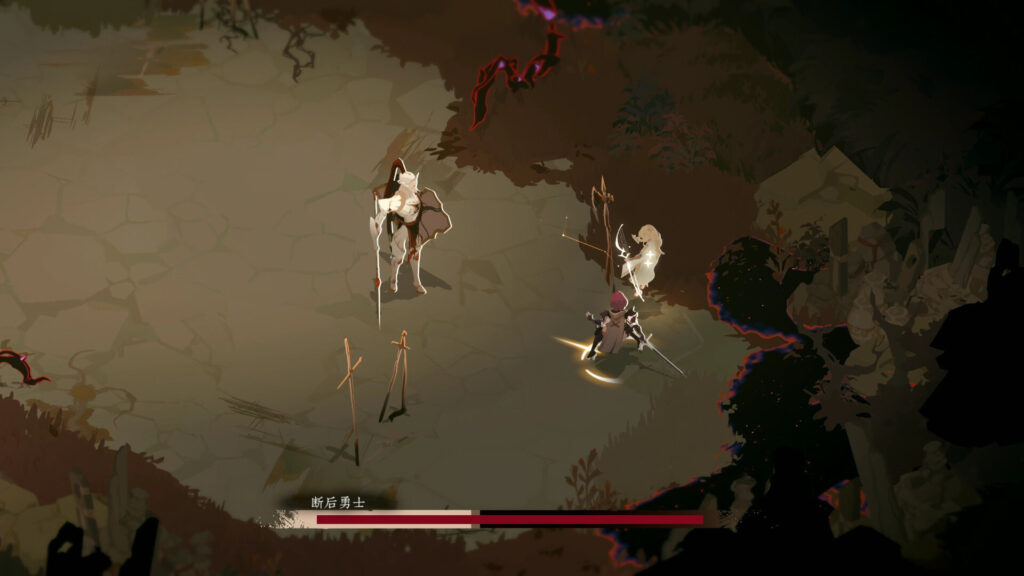
Lunarium combines 2D painting and 3D geometry by giving each medium a distinct role. Painted artwork supplies much of the color design, surface detail, atmosphere, ornamentation, lighting values, and overall scene composition, while three dimensional geometry provides spatial structure, perspective, depth, elevation, collision, occlusion, and the foundation needed for interactive movement. Jixiang described the character workflow as a fairly standard 3D production process, although the resulting models are not presented through conventional 3D lighting. Environments use a broader mixture in which some objects are fully modeled and others begin as painted assets.
The approach allows a modeled staircase, painted wall, animated character, and atmospheric effect to appear as parts of the same illustrated world. This is important because Lunarium is not simply a flat 2D game decorated with 3D objects. Combat and exploration depend on real spatial relationships. Ave must move around obstacles, approach enemies, dodge attacks, navigate different elevations, discover paths, and understand the dimensions of battle arenas. A completely flat background would make those interactions more difficult to construct, while a conventional 3D scene could weaken the carefully controlled painterly composition the studio wanted.
That desire for artistic control is one of the main reasons Lunarium uses a hybrid style. In a hand painted image, artists can determine every visible value transition, color relationship, highlight, shadow, silhouette, and focal point. Conventional 3D rendering calculates much of the final image from geometry, materials, lights, surface normals, shadows, reflection data, and post processing. That approach can be useful for realistic or dynamically lit games, but it may conflict with a scene where a wall must remain a specific shade or a pathway needs to stay brighter than its surroundings regardless of physically accurate illumination.
Lunarium instead allows artists to treat environments almost like complete illustrations. Painting largely determines what the player sees, while geometry helps determine how the world functions. The two are interdependent. Painting creates the visual identity, while geometry tells the game where characters can walk, what blocks attacks, when objects should disappear behind structures, and how enemies move across elevated terrain. Not every crack, carving, leaf, or patch of erosion needs physical geometry because much of that complexity can remain in the painted image.
This produces environments that can function as action RPG spaces without sacrificing the feeling that every visible element was deliberately composed. Ruins, forests, temples, churches, fallen kingdoms, and other locations can establish distinct moods through hand painted surfaces while still supporting navigation, combat, collision, and interaction.

How Lunarium Uses Unity, Projected UVs, and Custom Lighting
Lunarium builds its painterly world by combining Unity’s scene hierarchy, cameras, mesh data, animation tools, scripting environment, rendering access, and runtime systems with a custom art pipeline designed around hand painted environments. Artists begin with an illustration that establishes composition, architecture, color, lighting, pathways, and decorative detail. Inside Unity, simple geometry is then created or positioned to match important forms such as floors, stairs, walls, platforms, rocks, columns, and other structures that require real depth or gameplay functionality. Because this geometry is aligned with the game camera, its visible edges can be matched closely to the painted artwork while artists evaluate scale, perspective, combat space, and character proportions in the same environment where the game is actually played.
The studio’s camera projection method then automatically generates UV coordinates based on how each mesh appears through the chosen game camera. In a traditional workflow, artists unwrap a model and create textures around a flat UV layout, but Lunarium instead projects the existing illustration onto simple geometry.
A painted tower, staircase, wall, or rock formation can therefore be matched with a relatively basic mesh occupying the same position from the intended perspective, while the projection system assigns the appropriate section of the artwork to that geometry. This allows intricate visual detail to come from the painting rather than requiring equally complex models. A wall can appear elaborately carved even if its underlying mesh is simple, while a staircase can remain physically traversable despite most of its surface detail and shading being embedded in the illustration.
This approach also allows brushwork and color relationships to flow across several surfaces as part of one composition rather than being divided into many conventional materials. The tradeoff is that projected artwork is most reliable from a controlled viewpoint because large camera movements could expose unpainted surfaces or create projection distortion. Lunarium turns that limitation into part of its design by building its environments, geometry, and framing together around the isometric perspective.
Creating and adjusting these elements directly inside Unity also helps reveal conflicts earlier. A doorway that looks correct in the illustration may be too narrow for combat, or a painted staircase may suggest a slope that does not match the collision surface, so the art and level design can be corrected together before those issues become deeply embedded in production.
The lighting pipeline follows the same philosophy. Conventional 3D lighting can create highlights, shadows, and surface responses that conflict with values already established in the painting. A pillar may already contain a deliberate highlight, a bridge may have a carefully placed cool shadow, or a doorway may be designed as a warm focal point. Applying standard lighting on top of those choices could introduce a second system for deciding where brightness and darkness should appear, while also making fully modeled objects look visually different from painted surfaces.
To avoid that problem, the studio created a custom 2D lighting solution for scenes that still use three dimensional perspective. Rather than trying to simulate physically realistic illumination, the system allows lighting to function as part of the composition, reinforcing pathways, deepening interiors, separating characters from backgrounds, or changing the mood of an area without disrupting the balance of the original painting. Characters are also created through a 3D production pipeline without relying entirely on conventional 3D lighting, helping them remain visually consistent with the surrounding environment. Public interviews have not revealed the exact shaders, render passes, masks, blending methods, or other internal technical details, so those systems remain unspecified.
Real time 3D shadows are still used selectively where they improve readability. Ave and Lune are among the few elements that use these shadows, helping ground them against detailed painted backgrounds and making their position easier to read during play. This selective use of realism supports what has been described as a painting in motion. The environment remains visually stable like an illustration, while characters, enemies, spells, atmospheric effects, shadows, and camera feedback introduce movement. Ave’s sword attacks and Lune’s magic animate the composition, while enemies and effects create contrast without forcing every decorative object to compete for attention.
Hand painted textures are central to this style because they let artists exaggerate, simplify, and redirect attention according to emotional and visual needs rather than physical simulation. Surface detail can become stronger where players should look and quieter where the composition needs space, while ruined architecture can communicate abandonment, danger, melancholy, or wonder through broken forms, vegetation, color, and value structure. The result is a world where Unity’s 3D systems provide depth and functionality, while projected artwork and custom lighting preserve the appearance and control of a hand painted scene.
How Lunarium Balances Painterly Art, Combat Readability, and Technical Design
Lunarium’s richly painted environments create a major design challenge because characters, enemies, pathways, attack zones, and interactive elements still need to remain clear during fast combat. Instead of simplifying the artwork, the game uses several layers of visual communication. Current targets receive lock on indicators and outline highlights, dangerous attacks use recognizable warning effects, and Ave and Lune are among the limited scene elements that receive real time 3D shadows. These shadows help separate their silhouettes from painted floors and make their positions easier to read without disrupting the overall illustrated presentation.
Combat readability also influenced how the two protagonists were designed to work together. The studio wanted Ave and Lune to feel like a coordinated pair rather than two characters that require constant simultaneous control, so their actions were built to avoid excessive overlap and unnecessary visual competition.
Their roles remain clearly separated, with Ave handling close range sword combat, parries, and dodges, while Lune weakens enemies, strengthens Ave, casts magic, and helps overcome environmental obstacles. Animation, audio, camera feedback, effects, and input timing were repeatedly tested so actions such as parries, dodges, guard breaks, and spellcasting could remain understandable within the painterly visual style. The developers improved these systems through iteration, studying successful action games and refining their own approach over time.
The same attention to readability applies to environmental construction. Painted perspective must correspond with the underlying geometry, walkable areas need to look accessible, obstacles must visually occupy the same space enforced by collision, and shadows and effects need to support rather than contradict the sense of depth. When these systems align properly, the player experiences a coherent interactive environment instead of noticing separate layers of artwork, models, effects, and collision.
Lunarium’s artistic direction was influenced by several games, although the studio treated them as starting points rather than templates. Hades and Transistor helped shape priorities such as composed isometric framing, strong silhouettes, controlled color, atmospheric environments, readable combat, and the integration of character art with gameplay. Hades demonstrated how illustrated surfaces and bold character designs can remain clear during rapid action, while Transistor provided another example of deliberate color, ornamentation, atmospheric storytelling, and carefully composed isometric spaces. Tunic and Death’s Door also served as broader action adventure influences, while CrossCode informed the desire for frequent dialogue and reactions between Ave and Lune.
Despite these influences, Lunarium developed its own technical approach through camera projected UVs, custom 2D lighting, and a mixture of painted and modeled environmental assets. That distinctive style created significant production challenges. Large painted assets consume memory, layered 2D and 3D elements need to be ordered correctly, projected artwork must stay aligned with geometry, and characters still require animation, collision, shadows, effects, and combat feedback. Memory optimization became particularly important late in development because so many painted and modeled layers had to operate together.
These challenges were amplified by Lunarium being the team’s debut action RPG. Development required simultaneous work across combat, artificial intelligence, animation, input timing, progression, effects, level construction, narrative systems, optimization, cutscenes, and overall presentation, meaning problems in one area could easily affect several others. During a post launch discussion, the studio described the difficulty of polishing combat, performance, cutscenes, and presentation at the same time without introducing new issues elsewhere.
One of Jixiang’s main production lessons was therefore to complete and validate each stage before building too much on top of unfinished work. Properly testing projection tools, lighting systems, asset formats, and other foundations reduces the risk of problems multiplying across many environments later. Lunarium’s visual identity depends on this balance between artistic freedom and technical restraint, giving artists extensive control over composition and atmosphere while requiring the underlying systems to remain stable enough to support that style throughout an entire action RPG.
Frequently Asked Questions (FAQs)
- What engine was used to create Lunarium?
Lunarium was built in Unity. The studio also created custom tools inside the engine to support its unusual mixture of painted artwork and three dimensional assets. Unity handles the runtime side of the game while also serving as an environment authoring workspace where artists can work with geometry, camera projected UV coordinates, custom lighting, character animation, and the game’s isometric combat spaces. - Is Lunarium a fully 2D game?
No. Lunarium has a strongly hand painted appearance, but the game uses both 2D and 3D elements. Its environments can combine painted artwork with modeled geometry, while simple three dimensional forms provide perspective, collision, depth, navigation, elevation, and occlusion. The paintings then supply much of the visible detail, color, atmosphere, and surface treatment. - Are Lunarium’s characters 2D sprites or 3D models?
The developers have described the characters as using a fairly standard 3D character production pipeline. They are therefore modeled and animated as three dimensional characters rather than functioning purely as flat sprites. However, they are not presented with conventional 3D lighting, which helps them visually blend into the surrounding painted environments instead of looking like normally shaded models placed on top of illustrations. - What are camera-projected UVs?
Camera projected UVs assign texture coordinates based on where parts of a 3D mesh appear from a selected camera viewpoint. Instead of manually unwrapping every surface, the studio can align simple geometry with a painted scene and let its tools associate visible mesh points with the corresponding areas of that painting. This allows the artwork to remain aligned with the geometry when viewed through the intended isometric camera. - Why does Lunarium use a custom 2D lighting system?
Lunarium combines painted 2D artwork with three dimensional perspective and geometry, so conventional 3D lighting could conflict with shadows, highlights, and color values that are already painted into the scene. The custom lighting system gives the artists greater control over atmosphere and composition, helping modeled and painted elements appear as parts of one unified illustration instead of separate visual layers. - Does Lunarium use no real-time shadows?
Lunarium does use real time shadows, but only selectively. Jixiang explained that the player characters are among the few objects that receive real time 3D shadows. These shadows help ground Ave and Lune within the environment and make them easier to distinguish from detailed painted backgrounds, showing that the studio uses real time effects when they provide a clear gameplay benefit. - How does Lunarium prevent detailed artwork from hiding enemies?
The game uses several visual cues to keep combat readable despite its richly detailed environments. Focused enemies can receive lock on indicators and outline highlights, while dangerous attacks use warning effects that make threats easier to identify. Selective character shadows also help separate the protagonists from the background, and the dual character combat system was designed to avoid excessive overlapping actions and information. - Were Hades and Transistor direct technical templates for Lunarium?
No. The studio has identified Hades and Transistor as early visual inspirations rather than exact technical models. Their influence can be seen in broader qualities such as isometric composition, strong atmosphere, controlled color, and illustrated presentation, but Lunarium developed its own production approach using camera projection, custom lighting, mixed environmental assets, and tools created specifically for the project. - Can other indie developers reproduce Lunarium’s workflow with standard Unity tools?
The general principles could be recreated because Unity provides meshes, UV coordinates, cameras, editor scripting, custom shaders, render textures, and several lighting options. However, Lunarium’s exact tools were customized for the studio and have not been publicly released in full. Reproducing the same result would also require strong skills in painting, composition, technical art, animation, environment design, and level construction, not just access to Unity itself. - What is the biggest advantage of Lunarium’s hybrid pipeline?
Its main advantage is that it combines direct artistic control with the spatial functionality required by an action RPG. Artists can preserve the composition, color, atmosphere, and surface detail of a hand painted illustration, while designers still have the three dimensional geometry needed for movement, collision, combat, elevation, depth, and environmental interaction. This allows the world to behave like a functional game space while still retaining the appearance of a carefully composed painting.

Conclusion
How Lunarium blends hand painted 2D art with 3D environments in Unity reveals a production philosophy built around purposeful compromise. The studio preserves the visual control of painting without giving up the spatial advantages of three dimensional game development. Painted imagery determines much of the world’s appearance, geometry gives that imagery functional depth, camera projected UVs connect the two, and customized lighting prevents conventional rendering from overwhelming the art direction.
The process is especially effective because it extends beyond surface appearance. The same concern for composition influences environment construction, character presentation, shadows, combat indicators, attack effects, camera feedback, and level readability. Even Lunarium’s dual protagonist design reflects the effort to keep complexity understandable within visually detailed scenes.
Its broader value for independent developers lies in the relationship between tooling and creative intent. Lunarium does not look distinctive merely because its team produced attractive paintings. It looks distinctive because the studio built a Unity workflow that protects those paintings throughout modeling, scene assembly, animation, lighting, optimization, and gameplay.
The project also demonstrates that hybrid art is not automatically a shortcut. It can demand custom systems, disciplined camera design, memory optimization, careful validation, and close cooperation between artists and programmers. When those requirements are handled successfully, however, the result can occupy a compelling space between illustration and interactive environment: a world that behaves like three dimensional game space while continuing to feel like a painting in motion.
Sources and Citations
- 80 Level Interview With Lunarium Director Jixiang
- David Jagneaux, How Lunarium Blends Hand-Painted 2D Art With 3D Environments, 80 Level, August 12, 2026.
- This is the strongest primary technical source. The interview identifies Jixiang as Lunarium’s director and covers:
- The initial visual influence of Hades and Transistor.
- A conventional three-dimensional character-production pipeline without traditional 3D lighting.
- Environments assembled from both fully modeled 3D objects and painted 2D assets.
- A customized 2D lighting system designed to illuminate scenes presented through a 3D perspective.
- Unity as the game engine.
- An in-engine tool that lets artists align simple geometry with the camera, place it over hand-painted art and automatically generate camera-projected UV coordinates.
- Combat-readability measures including lock-on indicators, enemy outlines, real-time character shadows and warning effects for important attacks.
- Production lessons involving feature validation, project scope and the danger of building new systems on top of unfinished work. (80 Level)
- Citation-ready entry:
- David Jagneaux, “How Lunarium Blends Hand-Painted 2D Art With 3D Environments,” 80 Level, August 12, 2026. The interview with director Jixiang explains Lunarium’s hybrid 2D and 3D environment pipeline, customized lighting, Unity tools, camera-projected UV generation, combat-readability systems, artistic influences and development lessons.
- Lunarium Studio’s First-Party Reddit Discussions
- Bunny and the Lunarium team, [AMA] I’m Bunny From the Team Behind Lunarium, an Atmospheric Fantasy Action RPG Is Out Now on Steam, r/Games, July 29, 2026.
- This is the most useful post-launch Reddit source. The author identifies themselves as a member of the Lunarium team and carries the “Lunarium – Community Manager” flair. The studio’s responses explain that final development involved simultaneously polishing combat responsiveness, impact and timing, optimizing memory for layered 2D and 3D assets and refining late-stage cutscenes.
- The same discussion confirms that characters were created through a largely conventional 3D pipeline, while environments combine modeled 3D elements with painted 2D assets. Because standard 3D lighting did not produce the desired appearance, the team created customized 2D lighting that operates within the game’s 3D perspective. A player described the result as a “painting in motion,” and the studio said this closely matched its intended goal. (Reddit)
- Bunny and the Lunarium team, [AMA] I’m Bunny From the Team Behind Lunarium, an Atmospheric Fantasy Action RPG Launching Today on Steam, r/rpg_gamers, July 30, 2026.
- This companion developer AMA adds that the team wanted a softer, more painterly identity than the Western comic-influenced style it associated with Hades and Transistor. It describes the goal as blending hand-painted textures with 3D characters and environments so that the finished game resembles a two-dimensional illustration. It also identifies Sekiro and Flintlock as major combat references, particularly for blocking, parrying and building an enemy’s stamina gauge.
- Citation-ready entry:
- Lunarium Game Studio, “[AMA] I’m Bunny From the Team Behind Lunarium,” r/Games, July 29, 2026. The first-party discussion covers layered 2D and 3D assets, customized lighting, memory optimization, combat polishing, visual influences, late-stage production challenges and the studio’s “painting in motion” objective.
- Official Lunarium Steam Listing
- Lunarium Game Studio, Lunarium on Steam.
- The official listing confirms that Lunarium launched on July 28, 2026. It identifies Lunarium Studio as the developer, with Lunarium Studio and Imperfect Games listed as publishers, and describes the title as an “atmospheric fantasy A-RPG.” Steam’s formal genre fields classify it under Action, Adventure, Indie and RPG. (Steam Store)
- The store description establishes the story of Ave and Lune attempting to save a collapsing world. Ave is presented as an agile, light-armored knight specializing in sword combat, dodging and parrying, while Lune uses mysterious magic to weaken enemies, enhance Ave’s attacks and overcome environmental obstacles. (Steam Store)
- It also documents:
- Embroidery, Cloaks and the Skill Tree as the main build and progression systems.
- Temples, fallen kingdoms and mist-covered churches with different terrain, atmosphere and combat rhythms.
- Single-player support, Steam Achievements, Steam Cloud and Family Sharing. (Steam Store)
- One terminology distinction is useful: “Isometric,” “Hand-drawn” and “Souls-like” appear on the store page as popular user-defined tags. They should not be described as Valve or Lunarium Studio’s formal genre classification. The official store copy calls the game an atmospheric fantasy A-RPG. (Steam Store)
- Citation-ready entry:
- Lunarium Game Studio, “Lunarium,” Steam, released July 28, 2026. The official store listing documents the story, Ave and Lune’s abilities, combat and progression systems, environments, supported Steam features and the game’s official atmospheric fantasy action-RPG description.
- Unity Technical Documentation
- Unity Technologies, Mesh.uv.
- Unity explains that
Mesh.uvcontains the texture coordinates stored in the mesh’s first UV channel. UV coordinates are ordinarily stored in normalized 0-to-1 space, with the lower-left texture corner represented by(0,0)and the upper-right by(1,1). This is the appropriate source for explaining what UV coordinates are and how Unity stores them on a mesh. - Unity Technologies, Camera.WorldToViewportPoint.
- This API transforms a point from three-dimensional world space into viewport space. Unity describes viewport coordinates as normalized and relative to the camera, with
(0,0)at the lower-left and(1,1)at the upper-right. It provides useful conceptual background for understanding how world geometry can be related to a camera’s view. - Unity Technologies, Introduction to 2D Lighting in URP.
- Unity’s documentation explains that standard URP 2D lights illuminate objects such as sprites, tilemaps and sprite shapes. It also explicitly distinguishes this system from 3D lighting by noting that Unity’s 2D lighting is not physically based. The manual describes how 2D light and shadow information is rendered into textures before being applied to the relevant game objects.
- These documents provide technical background only. They do not establish that Lunarium directly calls
WorldToViewportPoint, relies on the standard URP 2D Light component or implements its custom tools in the same way as Unity’s examples. Jixiang’s 80 Level explanation remains the authoritative source for the game’s actual camera-projected UV generator and proprietary lighting workflow. (80 Level)
- RPGFan Review
- Audra Bowling, Lunarium Review, RPGFan, August 6, 2026.
- RPGFan classifies Lunarium as an action RPG and describes it as an isometric title with Soulslike elements. The review highlights its hand-drawn visuals, atmospheric soundtrack, parry-and-dodge-focused combat, skill progression and the gameplay relationship between Ave and Lune. It identifies the bond between the two protagonists as the game’s greatest strength both narratively and mechanically. (RPGFan)
- The review also provides useful critical balance by noting Ave’s initially sluggish movement, the importance and difficulty of parrying, and the continued improvement of the English localization. These are the reviewer’s observations and should be attributed to RPGFan rather than presented as developer-confirmed technical facts. (RPGFan)
- Citation-ready entry:
- Audra Bowling, “Lunarium,” RPGFan, August 6, 2026. The review discusses the game’s hand-drawn presentation, action-RPG combat, progression, atmosphere and the narrative and mechanical relationship between Ave and Lune.
- PC Gamer
- Tyler Colp, Don’t Let This Beautifully Drawn Action RPG Starring Two Girls Trained in Sekiro-Style Combat Get Lost in the Sea of New Games on Steam, PC Gamer, July 28, 2026.
- PC Gamer describes Lunarium as an evocative hand-drawn action RPG with muted colors, ruined architecture, overgrown environments and an isometric two-dimensional presentation. Its hands-on observations compare the combat rhythm more closely with Sekiro than Dark Souls and discuss Ave’s initially heavy movement becoming more agile as upgrades are acquired. (PC Gamer)
- The article also praises the way environmental detail and hidden shortcuts reward exploration, making it useful for claims about level construction and the relationship between the game’s visual composition and navigable spaces. (PC Gamer)
- Citation-ready entry:
- Tyler Colp, “Don’t Let This Beautifully Drawn Action RPG Starring Two Girls Trained in Sekiro-Style Combat Get Lost in the Sea of New Games on Steam,” PC Gamer, July 28, 2026. The article examines Lunarium’s hand-drawn isometric presentation, muted atmosphere, environmental detail, exploration, hidden shortcuts and Sekiro-influenced combat rhythm.
- Indie Games Devel Hands-On Preview
- Francesco Mastrodicasa, Lunarium Hands-On Preview: Don’t Call It Just Another Souls-like, Indie Games Devel, March 30, 2026.
- This pre-release hands-on piece describes Lunarium as an evocative isometric action RPG with Soulslike influences but a distinct artistic identity. It emphasizes the game’s melancholy, quiet atmosphere, decaying ruins, suspended environments, combat timing, dodging, parrying and sense of vulnerability. (INDIE GAMES DEVEL)
- Because this article was published four months before release, it is best used for critical impressions of the preview build. It should not be used as the definitive source for the final release date, launch features or post-launch condition; the Steam listing and later reviews supersede it for those points.
- Citation-ready entry:
- Francesco Mastrodicasa, “Lunarium Hands-On Preview: Don’t Call It Just Another Souls-like,” Indie Games Devel, March 30, 2026. The preview discusses the title’s isometric action-RPG identity, melancholic atmosphere, environmental presentation, combat structure and Soulslike influences.
- Hades and Supergiant’s Painterly 2D-to-3D Production
- The direct evidence that Hades influenced Lunarium comes from Jixiang and the Lunarium team. Supergiant’s material provides context for what that influence may refer to visually, but it should not be used to claim that Lunarium Studio duplicated Supergiant’s production methods. (80 Level)
- Supergiant Games, Inside Hades: 3D Modeling & Rigging.
- In this official development video, Supergiant 3D artist Paige Carter explains how hand-painted character concepts were translated into modeled, textured, rigged and animated in-game characters, using Nyx as the principal example. (YouTube)
- Chris Kerr, Learn How Supergiant Brought Hades’ Hand-Painted Characters to Life, Game Developer, October 21, 2020.
- Game Developer’s accompanying summary explains that Supergiant built 3D models from hand-painted portrait art, using tools such as ZBrush, Maya and Substance. It describes the process of comparing the model directly with the 2D concept, reducing conventional lighting during texturing and applying hand-painted linework so the resulting character retained the appearance of the original illustration. (Game Developer)
- Supergiant Games, 2D Environment Artist and 3D Character Artist, March 13, 2018.
- Supergiant’s own recruitment material describes environment production involving concepting, painting, integration and isometric tilesets. On the same page, the studio states that it uses 3D modeling to create characters for its painterly worlds. This provides useful first-party context for the wider combination of painted environments and modeled characters associated with Supergiant’s visual identity. (supergiantgames.com)
- Supergiant Games, Team.
- Supergiant identifies art director Jen Zee’s imaginative hand-painted artwork as a defining element of the studio’s game worlds and characters. (supergiantgames.com)
- Transistor’s Isometric and Atmospheric Context
- Greg Kasavin, First Look at Our Next Game: Transistor, Supergiant Games, March 19, 2013.
- Supergiant’s official reveal presents Transistor as a science-fiction action RPG set in a futuristic city and emphasizes the combination of responsive action, strategic planning and atmospheric storytelling. This supports contextual comparisons involving setting, mood and presentation. (supergiantgames.com)
- Alex Wawro, How Supergiant Hopes to Avoid the Sophomore Slump With Transistor, Game Developer, May 2, 2014.
- This development interview with Supergiant creative director Greg Kasavin explicitly discusses Transistor’s isometric real-time combat and the challenge of making that format satisfying over a full game. It also states that the underlying engine was fundamentally two-dimensional but supported custom animation and lighting technology. (Game Developer)
- Citation-ready combined entry:
- Greg Kasavin, “First Look at Our Next Game: Transistor,” Supergiant Games, March 19, 2013; Alex Wawro, “How Supergiant Hopes to Avoid the Sophomore Slump With Transistor,” Game Developer, May 2, 2014. These sources provide background for Transistor’s atmospheric science-fiction world, isometric real-time presentation, responsive action and custom visual technology.
Recommendations
- V-Ray for Blender 2026 Guide: Installation, Supported Versions, Render Settings, and Workflow Tips
- Improving Blender Rendering: How The View Keeper Makes Rendering a Fun Experience
- Tomb Raider: Legacy Of Atlantis Features “AI-Assisted Assets” That Were “Refined By Humans”, Any AI content in Legacy of Atlantis was either replaced for the final version or “refined” by humans
- 13 Things I Wish I Knew Before I Started 3D Printing (Beginner Checklist to Avoid Failed Prints)
- Solarpunk: Where to Get Silicon (Best Sources and Farming Routes)
- Get A Free Fortnite Skin And Car During Rocket League Crossover Event (Rivals & Rockets) — How to Unlock Dueling Dragons Jackie + Havoc Car Body
- Closure of Midsummer Studios: What Happened to Jake Solomon’s Burbank Life Sim
- Uwe Boll Announces Unofficial House of the Dead Sequel 23 Years Later
- Master Healer Kale with Useless Party Explained: Gameplay, Skills, Incremental Healing Mechanics, and Strategy Guide
- Meltopia Sales Surpass 50,000 Copies in Under a Month: Indie Steam Breakout Success Explained



































































































