







In This Article (8 sections)
Mario Tennis Fever Review: a Fast, Flexible, and Chaotic Return to the Court
Mario Tennis Fever understands why Mario sports games remain appealing after decades of tennis, golf, football, baseball, kart racing, and Olympic competition. It does not attempt to recreate professional tennis with strict realism. Instead, it combines familiar rules, responsive shot-making, competitive depth, imaginative court effects, and enough disorder to keep family matches entertaining when the players have very different skill levels.
Developed by Camelot Software Planning and published by Nintendo, Fever follows Mario Tennis Aces while changing the way special abilities influence rallies. Aces placed heavy emphasis on energy management, Zone Shots, slow-motion defensive techniques, racket damage, and knockout pressure. Fever replaces much of that structure with interchangeable Fever Rackets, defensive slide moves, environmental hazards, broader match customization, and Nintendo Switch 2 features such as GameShare.
The result works as three different games without forcing players into one style. Standard rackets and conventional courts create a mechanically credible arcade tennis game. Ranked Match and carefully selected Fever combinations offer a more demanding competitive experience. Four-player matches with hazards, Wonder effects, transformations, and unusual courts turn the same system into a lively party game.
Version 1.1.0 strengthens the launch package. Released across July 15 and July 16, 2026, depending on region, the free update added the Black Hole Racket, Galaxy Court, a Super Mario Galaxy-themed special match, five additional Luma colors, Mario’s classic outfit, GameShare through GameChat, and numerous character and racket adjustments. Tier lists based only on the launch build should therefore be treated cautiously.
The review verdict is positive, though not without reservations. The responsive tennis, flexible rules, 38-character roster, strong multiplayer, and character-and-racket combinations create considerable replay value. Adventure Mode is much less ambitious, functioning mainly as an extended tutorial with a humorous story and several imaginative boss encounters. The $69.99 price is consequently easier to recommend to multiplayer households than to someone seeking a lengthy solo sports adventure.
Is it Mario’s best sports adventure? As a narrative campaign, no the story is too brief and instructional to earn that description. As a complete arcade sports package, it has a convincing claim. Few Mario sports games have combined accessible controls, tactical depth, social play, and configurable chaos this effectively.

Release Date, Fever Rackets, Gameplay Changes, and the 38-Character Roster
Mario Tennis Fever was released on February 12, 2026, exclusively for Nintendo Switch 2. It is not sold as a native game for the original Switch, Switch Lite, or Switch OLED Model. The standard United States price is $69.99, with digital and physical editions available in supported markets. Regional prices vary between Nintendo eShop territories and retailers.
An original Switch can still participate in selected local GameShare sessions. A Switch 2 owner must own and host the game, after which nearby Switch or Switch 2 users can receive temporary access. The shared software remains usable only during the active session. Version 1.1.0 also introduced online GameShare through GameChat, though participating systems must be Switch 2 consoles for that method.
The ordinary tennis system remains easy to understand. Players can use topspin, slices, flat returns, drop shots, and lobs while deciding how long to charge each stroke. Charging produces a stronger reply, but preparing too early can leave the opposite side of the court exposed. Slide and leap moves extend defensive reach, yet poor positioning still tends to produce a rushed or weak return.
Fever Rackets provide the major change. The Fever Gauge fills during play, allowing the player to release a special shot carrying the selected racket’s effect. Unlike a fixed character ability, the racket can be paired with different competitors. That allows a fast character to use an offensive hazard, a powerful character to improve movement, or a defensive player to add another form of court control.
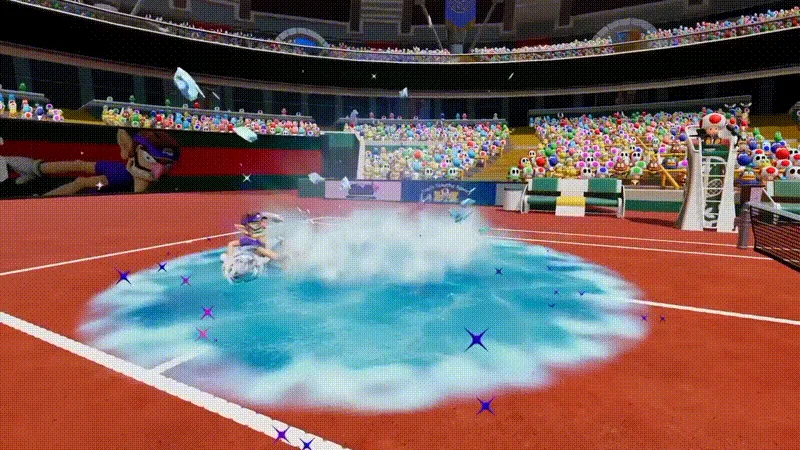
Examples include the Ice Racket, which creates a slippery area; the Mini Mushroom Racket, which can shrink an opponent; the Amp Racket, which places electrical barriers; the Golden Dash Racket, which improves movement; the Shadow Racket, which summons a duplicate; and the Metal Racket, which temporarily increases strength and protection. The Black Hole Racket added in version 1.1.0 creates an expanding hazard that pulls nearby players toward it and damages their HP.
Many Fever effects activate only when the ball touches the court. Reaching the shot before its first bounce allows the defender to perform a Fever Shot Counter and potentially send the hostile effect back to the attacker’s side. This prevents special moves from becoming automatic point winners and keeps movement, anticipation, and ball tracking relevant even during the busiest rallies.
Free Play supports standard rackets, one Fever Racket, or two. In a two-racket match, players can switch between their selected options before a serve. A movement-based racket can be used while receiving against a strong server, followed by a hazard racket when the player gains control of the next point.
The game contains 38 playable characters: Mario, Luigi, Peach, Daisy, Rosalina, Pauline, Wario, Waluigi, Toad, Toadette, Luma, Yoshi, Bowser, Bowser Jr., Donkey Kong, Boo, Shy Guy, Koopa Troopa, Kamek, Spike, Diddy Kong, Chain Chomp, Birdo, Koopa Paratroopa, Petey Piranha, Piranha Plant, Boom Boom, Blooper, Dry Bowser, Dry Bones, Baby Mario, Baby Luigi, Baby Peach, Wiggler, Nabbit, Goomba, Baby Wario, and Baby Waluigi.
All-round characters such as Mario, Luigi, Daisy, and Birdo are sensible starting choices. Toad, Yoshi, Pauline, and Diddy Kong favor speed, while Bowser, Donkey Kong, Wario, Chain Chomp, and Petey Piranha provide greater power at the cost of easier recovery. Technical characters emphasize placement, and tricky competitors rely more heavily on spin and unusual trajectories. Pairing these attributes with interchangeable rackets produces far more tactical combinations than a system in which every character has one permanent special move.

Best Character and Racket Combinations, Adventure Mode, Game Modes, and Courts
There is no single character-and-racket combination that dominates every format. Singles, doubles, ball speed, court type, opponent selection, and enabled special rules all change what a useful pairing looks like. Version 1.1.0 also adjusted a substantial part of the roster, making rigid launch-period rankings less dependable.
Several combinations provide useful starting points:
- Waluigi with the Golden Dash Racket combines his long reach with an emergency movement option, helping him defend the complete court during singles.
- Bowser or Donkey Kong with the Shadow Racket gives a powerful character additional coverage and makes passing shots more difficult.
- Pauline, Toad, or Yoshi with Ice, Amp, or Black Hole allows a fast character to exploit the space created by a movement-restricting hazard.
- Chain Chomp or Petey Piranha with Golden Dash reduces the recovery weakness of a heavy hitter.
- Boo, Rosalina, or Kamek with Shadow or Amp combines unusual spin with another visual or positional problem for the opponent.
The most dependable approach is to learn one character before constantly changing combinations. Understanding reach, acceleration, preferred contact distance, reliable angles, and recovery time produces more consistent improvement than selecting a new racket after every defeat. Fever abilities strengthen an existing game plan; they do not replace proper positioning.
Adventure Mode begins when Princess Daisy becomes seriously ill before an important tennis event. Wario and Waluigi reveal that a magical golden fruit may cure her, leading Mario, Luigi, Peach, Wario, and Waluigi on a search for the remedy. Their treasure hunting provokes mysterious creatures, and the group is cursed and transformed into babies.
Baby Mario and his allies are taken to a tennis academy, where they must relearn the sport. The campaign uses lessons and challenges to teach serving, movement, shot placement, lobs, drop shots, charged returns, and defensive techniques. The story later moves beyond the academy, introduces Bowser and additional monsters, and gradually restores the affected characters.
The premise is amusing, and several bosses provide a welcome change from ordinary matches. However, the campaign explains its mechanics slowly and rarely becomes the substantial sports role-playing adventure suggested by its setup. It is useful for children and newcomers, but experienced players may see it primarily as structured training.
Tournament Mode provides singles and doubles brackets across three cups, with a second local player able to participate in doubles. Trial Towers offers more demanding objectives involving accuracy, survival, rally control, Fever Shots, and assigned racket effects. It can be played alone or with a second player in supported challenges.
Free Play is the most valuable long-term mode because it supports up to four players and allows control over match length, ball speed, camera, court, CPU difficulty, and racket rules. Mix It Up provides the party-focused material, including Ring Shot, Score Challenges, hazard matches, Wonder Court Match, and the Galaxy Court Match added in version 1.1.0.
Courts influence play rather than serving only as decorative backgrounds. Traditional surfaces affect bounce and pace, while Airship, Forest, Waluigi Pinball, Racket Factory, Wonder, and Galaxy environments introduce obstacles or unusual geometry. Galaxy Court produces high bounces, while its special spherical format can be altered by one of three Prankster Comets.
These effects never become compulsory replacements for ordinary tennis. Conventional courts and standard rackets remain available, allowing the game to move between serious competition and Mushroom Kingdom disorder without compromising either audience completely.

Controls, Swing Mode, Local Multiplayer, GameShare, Online Play, and Performance
Mario Tennis Fever uses a straightforward button layout with additional shot combinations for players who want greater control. A drop shot is performed by pressing B and then quickly pressing A, while a lob reverses that sequence by using A followed by B. The tactical relationship is simple: use the drop shot when an opponent stays deep and the lob when someone moves too close to the net.
Charging improves shot quality but requires early positioning. Reaching the correct location before the ball arrives provides enough time to choose an angle and prepare for the next exchange. Slide and leap moves can rescue a difficult point, though repeatedly depending on emergency movement usually leads to weak returns and poor recovery.
Selected shots can be reassigned to shoulder buttons including L, R, SL, SR, ZL, and ZR. This makes frequent combinations more comfortable and provides an alternative for players who find rapid face-button sequences difficult.
Swing Mode supports as many as four participants, with each person using one Joy-Con 2 or compatible Joy-Con controller. Physical swings produce different shot types, making the mode easy for spectators and occasional players to understand. It is not a detailed simulation of grip, body position, or racket speed, but it works well as an active family or party option.
Button controls remain preferable for precise competition because they provide more consistent shot selection and quicker reactions. Swing Mode is designed for social play rather than ranked mastery, though it still supports Fever Rackets instead of reducing the experience to a basic exhibition.
Local multiplayer is the game’s strongest use case. Free Play, Mix It Up, and Swing Mode can support four players, while Tournament and Trial Towers support up to two. Doubles remains readable even when summoned partners, hazards, court effects, and four characters occupy the same screen. Teammates can divide responsibilities between the baseline and net or use complementary offensive and defensive rackets.
Local wireless sessions can connect multiple systems, while LAN play is available between Switch 2 consoles. GameShare allows one Switch 2 owner to host for as many as four people, with nearby participants able to join from Switch 2 or original Switch hardware. The access is temporary and ends with the session.
GameShare through GameChat expands that idea to remote Switch 2 users. It supports button-controlled matches, Swing Mode, and Mix It Up without requiring every participant to own the game. It requires Switch 2 hardware for the receiving players, a GameChat room, a stable connection, compatible software versions, and Nintendo Switch Online.
Conventional internet play is divided between Ranked Match and Online Rooms. Ranked Match tracks competitive progress through relatively concise formats, while Online Rooms provide greater control for friends and customized sessions. Standard-racket play rewards movement, anticipation, placement, and consistency. Fever-enabled competition adds hazard knowledge, gauge management, counter timing, and matchup planning.
The presentation is colorful but usually clear. Character animation communicates movement and racket contact without hiding the ball, while court hazards remain visually distinct. Reviews cited in the source generally describe a 60-frames-per-second target in handheld and docked play, with occasional variation during especially effect-heavy moments. Short transitions, responsive menus, crowd reactions, clear sound cues, and distinct character silhouettes support the fast pace, though Talking Flower commentary can become repetitive during repeated tournaments.

Frequently Asked Questions (FAQs)
- When was Mario Tennis Fever released?
Mario Tennis Fever was released worldwide on February 12, 2026. It launched as a Nintendo Switch 2 exclusive rather than a cross-generation game sold for both Switch systems. - Is Mario Tennis Fever available on the original Nintendo Switch?
The complete game is not available as a native original Switch release. An original Switch can temporarily join selected nearby GameShare sessions hosted by a Switch 2 owner, but access ends when the shared session closes. - How much does Mario Tennis Fever cost?
The regular United States price is $69.99. The amount may differ according to country, currency, tax, retailer, and local Nintendo eShop pricing. - How many playable characters are in Mario Tennis Fever?
Mario Tennis Fever has 38 playable characters, the largest roster Nintendo has promoted for the series. It includes familiar competitors such as Mario, Luigi, Peach, Bowser, Yoshi, and Donkey Kong alongside Goomba, Piranha Plant, Nabbit, Baby Wario, and Baby Waluigi. - How many Fever Rackets are in Mario Tennis Fever?
Nintendo promoted 30 Fever Rackets in the launch version. Version 1.1.0 later added the Black Hole Racket, though the rackets available to an individual player may depend on progression and the selected mode. - Can Fever Rackets be turned off?
Yes. Free Play supports standard rackets for matches without special effects. Players can also configure formats using one or two Fever Rackets, with two-racket competitors able to switch before serves. - Does Mario Tennis Fever support four-player local multiplayer?
Yes. Free Play, Mix It Up, and Swing Mode support as many as four participants in suitable formats. Tournament and Trial Towers allow up to two players. - How does Mario Tennis Fever GameShare work?
One Switch 2 owner can host a temporary session for up to four players. Nearby users can join through local GameShare from Switch 2 or original Switch hardware, while version 1.1.0 added remote GameShare through GameChat for Switch 2 participants. - Is Nintendo Switch Online required for Mario Tennis Fever?
It is not required for ordinary offline play on one console. It is required for conventional internet multiplayer and online GameShare through GameChat, and all participants must use compatible versions of the software. - Is Mario Tennis Fever better than Mario Tennis Aces?
Mario Tennis Fever is the better choice for most players because it has a larger roster, broader multiplayer options, GameShare, configurable Fever Rackets, and more party-focused content. Mario Tennis Aces may still suit highly competitive players who prefer energy management, Zone Shots, racket damage, technical blocking, and knockout pressure. Fever is the more complete social package, while Aces retains a more concentrated advanced system.

Conclusion
Mario Tennis Fever succeeds because it does not confuse accessibility with shallowness. A first-time player can enjoy a rally almost immediately, but advanced competition demands careful positioning, varied shot selection, early preparation, hazard awareness, character knowledge, and Fever Counter timing. The best points contain a recognizable tennis pattern even when the court is covered in ice, electricity, mushrooms, shadows, or black holes.
The Fever Racket system is an effective successor to the energy mechanics of Mario Tennis Aces. It provides visual spectacle, but its greatest contribution is customization. A character is no longer defined by a single fixed special move. Powerful, fast, technical, tricky, defensive, and all-round characters can be paired with abilities that reinforce a strength or compensate for a weakness. Standard rackets remain available when players want to remove those variables.
Mario Tennis Fever is not flawless. Adventure Mode introduces the mechanics efficiently but never becomes the deep solo journey suggested by its premise. Some special combinations can feel oppressive, especially before players learn to counter them. The $69.99 price places significant pressure on the multiplayer and replayable modes to carry the package.
Fortunately, those modes are strong. The 38-character roster, Trial Towers, Tournament Mode, Free Play, Mix It Up, Swing Mode, local wireless play, GameShare, Online Rooms, and Ranked Match provide several reasons to return. Version 1.1.0 further strengthens the game with Galaxy content, Black Hole Racket, online GameShare, balance changes, new Luma colors, and a classic Mario outfit.
Is it Mario’s best sports adventure yet? As a story-driven adventure, it falls short of that description because the campaign is too brief and instructional. As a complete arcade sports game, however, Mario Tennis Fever has a persuasive claim. It combines one of Camelot’s best tennis systems with the largest roster in series history, strong local and online multiplayer, imaginative Nintendo environments, and enough rule flexibility to satisfy both traditional competitors and party-game players. Mario has developed into quite the sportsman over the years, and Mario Tennis Fever stands among the clearest demonstrations of his athletic appeal.
Sources and Citations
- Nintendo – Mario Tennis Fever official game page (release date, price, roster, features, modes, platforms)
- Nintendo – Mario Tennis Fever game page (Adventure, Tournament, Trial Towers, Free Play, Mix It Up, Swing Mode, Online Play, GameShare, roster)
- Nintendo Support – Mario Tennis Fever Multiplayer Guide (Local Wireless, LAN, Online, GameShare, GameChat, Controllers)
- https://en-americas-support.nintendo.com/
- Search: Mario Tennis Fever multiplayer
- Nintendo Support – Mario Tennis Fever Ver. 1.1.0 Update Notes
- https://en-americas-support.nintendo.com/app/answers/list
- Search: Mario Tennis Fever Ver. 1.1.0
- Nintendo (Regional News) – July 2026 Mario Tennis Fever Version 1.1.0 Announcement
- https://www.nintendo.com/en-gb/News/
- Search: Mario Tennis Fever Version 1.1.0
Recommended
- Brian Cox Joins Cast of Dexter: Resurrection Season 2 as the New York Ripper
- The View Keeper’s Best Features for Blender Animators
- Xbox’s Third Price Increase is the Biggest Yet, Unlocked 747: What it Means for Xbox Series X/S Prices, Console Market Shock, and Gaming Costs in 2026
- GTA Online Is Adding a Massive New Heist in July: The Kortz Center Heist Arrives Before GTA 6
- A Star Wars Expansion Is Coming to PowerWash Simulator 2: Everything You Need to Know About the Galactic Cleaning Adventure
- Everything in Xbox Game Pass Wave 2 May 2026: Full List of New Games, Day-One Drops, and Release Dates
- How to Make Hair in Blender
- Battlefield 6’s New Patch 1.2.1.5 (March 3, 2026): Full Patch Notes, Crash Fixes, Spawn Updates & REDSEC Changes
- Storage Wars Star Darrell Sheets Dies Aged 67: Cause of Death, Career, and Latest Updates



































































































