





In This Article (12 sections)
Farid M. Panah’s Maya Bifrost Rig Explores Detached Facial Features
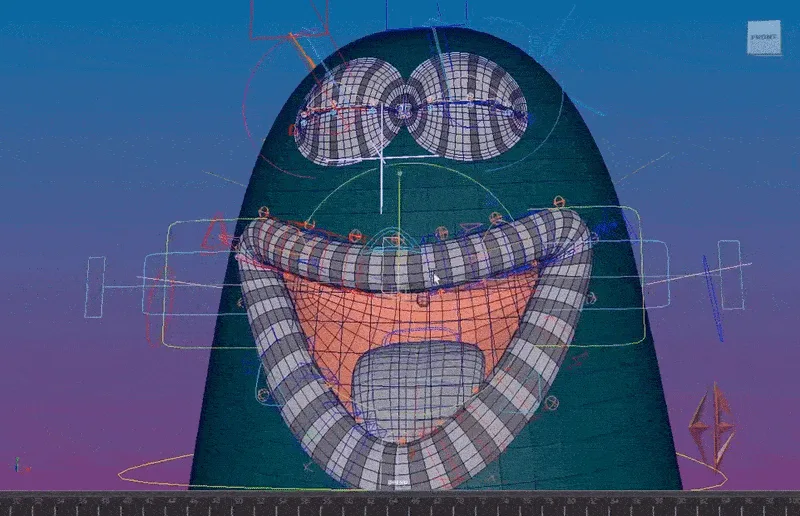
Farid M. Panah’s Maya Bifrost rig explores a possibility for stylized character animation: a mouth that can be repositioned and reshaped without remaining permanently embedded in the head’s polygon layout. Panah identifies Pixar’s Win or Lose as the inspiration for his detached facial features demonstration, emphasizing expressive freedom with fewer topology restrictions. Coverage published by 80 Level on August 31, 2026, identifies Maya’s Bifrost plug in as the technology behind the setup. The project demonstrates an approach to flexible facial control rather than presenting a universal animation standard or a finished commercial rig.
The distinction between the demonstrated result and its implementation is important. Panah’s presentation establishes the creative purpose without providing a complete technical specification. His portfolio also includes a separate lips rig in Maya inspired by Win or Lose, which he described as a prototype requiring repeated experimentation and further development. That assessment applies to the lips rig entry and should not automatically be extended to every later detached facial features demonstration. Similarly, inspiration from Pixar does not establish shared code, employment at the studio, or access to its internal production rig.
Pixar’s published research provides context for the creative connection. It describes a production combining a large character workload with strongly graphic facial designs, where separating features helped address asset building demands and deformation challenges associated with broad mouth shapes. In Pixar’s documented arrangement, the head retains the eyes while the mouth, nose, and ears are modeled, articulated, and shaded separately before being visually reintegrated. “Detached” describes their construction and control, while the finished image should still read as one coherent character.
Geometry Integration and Bifrost Implementation Challenges
This differs from a texture based face. A texture can depict a mouth without providing separate three dimensional lip structure, whereas detached geometry introduces questions involving depth, overlap, attachment, and visibility into the mouth interior. The mouth needs enough structure to support its expressions, and the head must preserve the character’s overall volume. Successful integration reconciles those requirements so that independent movement does not make the feature appear to float in front of the face.
Autodesk describes Bifrost as a visual programming environment whose nodes support modeling, rigging, simulation, and other procedural tasks. Technical artists can build graphs and package them for reuse, making it useful beyond effects such as smoke or fluids. Conceptually, a detached feature graph could receive a head surface, an articulated mouth, and animator driven parameters, then produce geometry or attributes governing their relationship. That is a possible way to organize the problem, not a reconstruction of Panah’s graph.
The available material does not disclose a complete node graph, exact Bifrost version, full animator interface, or every masking operation involved. Viewer questions about voxel based masking, transparency maps, and live Boolean operations should therefore remain questions rather than descriptions of the implementation. A detailed breakdown would need to distinguish the graph’s inputs, calculations, and outputs, including which operations affect geometry and which affect shading. What Panah’s presentation establishes is the goal of expressive independence combined with convincing visual integration.

Expressive Mouth Control, Topology and Facial Integration
A useful way to understand detached mouth control is to separate expression identity from placement. Expression identity includes the lip curves, the shape of the opening, and the relationship between the mouth corners; placement determines where that expression sits on the face. A small crooked mouth could move toward one cheek without requiring the animator to rebuild its local shape. A nervous reaction might use a compressed mouth positioned to one side, while a shout could require an opening that dominates the lower face. These examples illustrate the freedom such a system can support rather than documenting specific controls or poses in Panah’s scene.
Topology describes how vertices, edges, and faces connect. Separating the mouth means it does not have to share one continuous polygon network with the surrounding cheeks and head. In a conventional connected facial mesh, moving the mouth also affects neighboring vertices, so the rig must manage how deformation spreads through the lower face. A detached arrangement can give the mouth greater independence, but the challenge shifts toward maintaining attachment, shading continuity, and believable overlap. Neither construction method determines the animator controls by itself: detached mouths can use familiar deformation techniques, and connected rigs can support extreme cartoon acting.
The practical advantage depends on the performance required. If a shot moves the mouth far from its neutral position, a connected rig must preserve believable deformation across the surrounding face, while a detached setup must keep the relocated feature visually integrated. Restrained acting with little displacement may gain less from the additional integration machinery. Detached facial features therefore redistribute constraints rather than eliminate them, and their usefulness depends on the character design, expression range, and shots the production needs.
Attachment Solutions and Testing Priorities
Surface conforming systems illustrate one class of attachment solution. Blender’s Shrinkwrap modifier, for example, moves vertices toward another object’s surface, demonstrating how separate geometry can relate to a target. In a hypothetical facial setup, the expressive lip region could retain freedom while its surrounding border stays close enough to the head to avoid a visible seam. This does not establish that Panah uses an equivalent operation in Maya. It shows why detaching polygons alone is insufficient: separation creates independence, while reintegration requires additional relationships.
Testing should distinguish placement problems from expression problems. Moving the mouth while preserving its local shape helps evaluate attachment; changing expressions while keeping the mouth in one position tests its geometry and deformation controls. Combining those operations then reveals how they interact. Head turns are equally important because a convincing frontal pose can expose an excessive offset, awkward intersection, or poor attachment from a three quarter view. These are suggested evaluation methods, not a documented control list for Panah’s rig. A production interface would ideally keep expressive controls understandable while hiding the integration graph’s complexity from the animator.
The expressive result also needs to be judged as a designed shape. A test sequence could begin with a small compressed line, expand into a tall opening, shift upward, and settle into a wide asymmetric grin. Each pose should remain readable, and the transitions should preserve the character’s identity. The largest deformation is not automatically the strongest expression: an oversized mouth can compete with the eyes or disrupt the face’s balance, while a smaller placement adjustment may improve the acting. Comparing restrained and exaggerated versions helps identify where additional freedom contributes to the performance, especially in relation to the eyes, brows, head angle, and body pose.
Topology Visibility and Interior Masking
Topology remains relevant even when the mouth is independent. Its own geometry needs enough detail to support smooth lip contours and the intended range of deformation, while the head must behave correctly around the attachment region. A useful comparison would keep the character design and target expression constant while changing the construction method. It could then assess whether mouth edits require repairs elsewhere, whether expressions remain stable when repositioned, and how much corrective work is needed around the attachment. Those measures reveal practical independence more clearly than polygon counts or general claims about flexibility.
An open mouth introduces another problem: the original head surface can obstruct the intended view into the interior. Pixar’s published approach describes generating a live signed distance field from geometry associated with lip articulation and using that signal across rigging, hardware shading, and downstream rendering. A separately documented Blender experiment by Krysidian uses a mouth opening cutout wrapped to the head, with distance information driving a transparency mask. These are documented approaches to the visibility problem, but neither establishes the operations inside Panah’s Bifrost graph.
Conceptually, the visibility mask determines where the head remains visible and where the mouth interior should appear. That does not necessarily require physically deleting polygons. The system needs evaluation with the mouth closed, slightly open, widely stretched, and repositioned because a mask that works in one pose may expose gaps or unwanted surfaces in another. Teeth, the tongue, and other visible interior structures also need to stay aligned with the expression without revealing intersections or appearing detached from the mouth.
Shading Integration and Visual Inspection
Geometric alignment and shading integration require separate attention. Two surfaces can sit closely together yet appear disconnected because their highlights or material responses differ. Blender’s Data Transfer modifier illustrates this distinction by transferring information such as custom normals, UV maps, and color attributes without joining or moving the underlying geometry. Pixar’s published system also included blending shading information between detached features and the head, reinforcing that a convincing result involves more than matching positions.
A highlight break may come from normals or materials, so moving the mouth again might not solve it. Conversely, matching shading cannot repair a real gap visible in silhouette. A practical review should vary the camera and lighting: soft frontal illumination helps assess the expression, while stronger directional light can reveal discontinuities around the attachment. Inspecting position, normals, and materials separately makes it easier to identify whether the problem is geometric, visual, or a combination of both.

Pixar’s Research and Comparing Maya Bifrost With Blender
The relevant Pixar publication is Eyes Without a Face: Integrating detached facial features into Pixar’s character pipeline by Anna Christine Lykkegaard, Ana Lacaze, and Jonathan Page. It appeared in SIGGRAPH Talks in 2023 with DOI 10.1145/3587421.3595414. The paper discusses the production challenges of integrating separately constructed facial elements, including auxiliary geometry used to manage relationships between the mouth and head. Its future work identifies further challenges involving reuse, extreme poses, and less stylized mouth interiors.
The paper’s value when studying Panah’s work is methodological. It identifies problems a production system needs to solve, but it is not a Maya Bifrost tutorial or a complete recipe for reproducing Pixar’s implementation. Knowing that a system uses auxiliary geometry or a spatial signal does not reveal its full data representation, parameters, rendering assumptions, or animator controls. The research is most useful for framing questions about attachment, mouth visibility, and the information shared between the feature and the head.
Those questions apply across applications. A technical explanation needs to establish how the mouth remains attached, how its opening is communicated to rendering, which information moves with the mouth, and which remains tied to the head. It also needs to account for what happens when expressions exceed the normal range. This broader view prevents detached facial features from being reduced to the idea of moving one mesh over another, while keeping Pixar’s documented system distinct from Panah’s demonstration and independent experiments.
Bifrost and Blender Tool Differences
Maya Bifrost and Blender can both support procedural approaches, but their implementations should not be assumed to be interchangeable. For a production already centered on Maya, Bifrost can provide a way to build custom facial integration without moving the broader character workflow into another application. Blender offers its own building blocks, including Geometry Proximity, which calculates closest points and distances to target geometry. Those outputs can support surface relationships or masking within an appropriate setup, but the node is not a complete detached facial feature rig.
The Blender examples also need to retain their individual scope. Shrinkwrap illustrates surface attachment, Data Transfer illustrates the movement of surface information, and Geometry Proximity supplies spatial measurements. Mentioning these tools does not establish that Panah uses equivalents or that every tool appears in Krysidian’s implementation. Krysidian’s experiment demonstrates its own use of geometry derived information for mouth visibility and should be assessed on those terms.
A meaningful comparison would use the same head design, expression targets, and camera movement in both applications, then evaluate posing clarity, attachment stability, render consistency, and the amount of technical intervention required. Without such a controlled test, claims that either Maya Bifrost or Blender is inherently faster, cleaner, or more production ready remain unsupported. The quality of the individual rig, the technical artist’s skill, the existing pipeline, and the character’s expression requirements provide a stronger basis for judging the approach than the software name alone.

Frequently Asked Questions[FAQs]
- What does DFF stand for in facial rigging?
DFF stands for detached facial features. In this type of setup, selected facial elements are built separately from the main head surface and then visually reintegrated so the character still reads as one coherent face. Pixar’s documented approach includes separately modeled mouth, nose, and ear elements, allowing those features to be controlled more independently than they would be in a fully connected facial mesh. - Did Farid M. Panah create Pixar’s original DFF system?
The available project descriptions do not establish that. Panah describes his work as being inspired by Win or Lose, which means the Pixar production influenced his own experimentation and design thinking. Pixar’s published research on detached facial features credits Anna-Christine Lykkegaard, Ana Lacaze, and Jonathan Page, so Panah’s rig should be treated as an independently developed project rather than the origin of Pixar’s internal system. - Is Bifrost only useful for simulation?
No. Autodesk describes Bifrost as a broader visual programming environment that supports modeling, rigging, simulation, procedural geometry, and other technical workflows. That makes it suitable for building custom relationships between character surfaces and controls, not just for fluids, smoke, or other physical simulations. In a DFF context, it can therefore be used as part of a procedural facial rigging solution. - Does DFF eliminate the need for mouth topology?
No. DFF changes where the topology constraints exist rather than removing them. The mouth still needs enough geometry to support the intended lip shapes, openings, and expression changes, while the surrounding head and attachment region also need to behave convincingly. The main benefit is that the mouth does not have to derive every deformation from the same continuous topology as the cheeks and face. - Is Panah’s exact mouth-masking technique public?
Not in the reviewed project material. Public comments mention possibilities such as voxel masking, transparency maps, and live Boolean operations, but those are viewer questions rather than confirmed explanations from Panah. Without a documented node graph or technical breakdown, those ideas should remain possibilities rather than being presented as facts about his implementation. - Can detached facial features be created in Blender?
Yes. Krysidian has documented a Blender approach using Geometry Nodes to help create a mouth opening cutout and generate information that can drive shader transparency. This shows that similar detached feature ideas can be implemented outside Maya. However, it is an independent Blender method and should not be treated as an exact recreation of Panah’s Bifrost setup. - Can a detached mouth still use ordinary facial animation controls?
Yes, in principle. Detached construction does not require abandoning familiar animation controls. A rig could separate placement controls from local mouth shaping controls, allowing the animator to move the mouth across the face while still adjusting lip shape and expression in a conventional way. The exact use of joints, deformers, blendshapes, or procedural operations depends on the implementation, and Panah’s complete control setup has not been publicly documented. - Does moving a mouth independently guarantee better animation?
No. Greater freedom simply gives the animator more options. The final expression still depends on timing, readability, pose design, and how well the mouth works with the eyes, brows, head angle, and overall character performance. A large mouth shift may improve one expression and weaken another, so the real test is whether the extra movement makes the acting clearer and more appealing. - Is Panah’s DFF rig confirmed to be ready for game-engine export?
The reviewed presentation does not confirm that capability. Game engine readiness would require separate evidence showing how the geometry, animation data, materials, masking system, and any Bifrost dependencies are exported and reproduced outside Maya. A successful viewport or rendered demonstration alone does not prove that the rig can be transferred directly into a real time engine. - Where is the clearest creator-controlled reference for the demonstration?
Panah’s DFF project page on his ArtStation hosted portfolio is the clearest direct reference because it presents the work under his own project description and includes an embedded demonstration video. His LinkedIn post provides additional context around the experiment. Neither source, however, should be described as a complete step by step Bifrost tutorial because they do not publicly document the full graph or implementation process.
Conclusion
Farid M. Panah’s Maya Bifrost DFF rig highlights a useful direction for stylized facial animation: separating expressive mouth control from the surrounding head’s topology. Its significance is the possibility of giving animators more room to shape a performance without treating the mouth’s neutral location as an immovable construction constraint.
The broader lesson is not that connected facial meshes are obsolete. It is that construction choices should serve the intended expression range. A detached approach shifts attention toward surface attachment, mouth-interior visibility, and consistent appearance between separate components.
Those requirements also explain why a convincing demonstration is not the same thing as a fully documented production system. Panah’s work, Pixar’s research, and independent Blender implementations should be studied together while keeping their authorship and technical details distinct.
For evaluating DFF, the most useful question is whether the extra freedom survives real animation demands: changing expressions, changing placement, changing camera angles, and final rendering. A rig succeeds when those freedoms remain controllable and visually coherent—not merely when its mouth can move farther.
Sources and Citation
- Farid M. Panah’s Detached Facial Features (DFF) project
Panah’s own LinkedIn presentation is the strongest primary source for his implementation. He describes the setup as a DFF technique inspired by Pixar’s Win or Lose, separating the mouth from the head topology to allow greater freedom in positioning, reshaping, and exaggerating facial expressions. The post also identifies the work with Maya/Bifrost-related rigging terminology. LinkedIn
Citation: Farid M. Panah – Detached Facial Features (DFF) LinkedIn post - Amber Rutherford / 80 Level – Pixar-Style Detached Facial Features Rig With Bifrost
Amber Rutherford’s report was published by 80 Level on August 31, 2026. It specifically identifies Panah’s implementation as being built with Maya’s Bifrost plug-in and reports that he intended to release a breakdown or tutorial after taking time to get the technique working properly. 80 Level
Citation: 80 Level – Pixar-Style Detached Facial Features Rig With Bifrost - Pixar – Eyes Without a Face: Integrating Detached Facial Features into Pixar’s Character Pipeline
This is the primary research source for the DFF method used on Pixar’s Win or Lose. Anna-Christine Lykkegaard, Ana Lacaze, and Jonathan Page explain that the face uses a largely blank underlying facial surface while the ears, nose, and mouth are modeled, articulated, and shaded separately before being reintegrated. The paper also discusses spatial reintegration, projection, SDF-based signals around the mouth, topology distortion, and shading challenges. It was presented as a SIGGRAPH Talks 2023 publication. Pixar Animation Studios
Citation: Pixar Graphics – Eyes Without a Face PDF
Citation: Pixar Graphics research library entry - Autodesk – Bifrost documentation
Autodesk describes Bifrost as a visual programming environment in Maya for building customizable procedural systems. Its graph system supports modeling, rigging, simulation, geometry processing, reusable compounds, and custom procedural workflows, making it relevant background for how a DFF implementation such as Panah’s can be constructed. Autodesk Help
Citation: Autodesk Bifrost Help
Citation: Autodesk – Anatomy of a Bifrost Graph - Blender – Shrinkwrap
Blender’s official documentation establishes Shrinkwrap as a mechanism for moving geometry toward or onto another mesh surface. Its nearest-surface and projection modes are directly relevant to Blender implementations where a detached mouth or auxiliary surface must remain fitted to the head. Blender Documentation
Citation: Blender Manual – Shrinkwrap Constraint
Citation: Blender Manual – Shrinkwrap Modifier - Blender – Geometry Proximity
The Geometry Proximity node calculates the closest position on target geometry and provides a distance value. Blender specifically notes that this distance can be mapped into a falloff, which makes the node relevant to proximity-driven masks and blending around detached facial components. Blender Documentation
Citation: Blender Manual – Geometry Proximity Node - Blender – Data Transfer Modifier
Blender’s Data Transfer Modifier copies mesh data such as vertex groups, UV maps, color attributes, and custom normals between meshes using several geometric mapping methods. This supports the normal-transfer portion of comparable detached-mouth workflows. Blender Documentation
Citation: Blender Manual – Data Transfer Modifier - Krysidian – independent Blender DFF implementation
In a first-person Blender Artists explanation, Krysidian describes reproducing the detached-facial-feature technique with Geometry Nodes. The workflow uses a mouth-opening cutout wrapped to the head, calculates distance between the cutout and head, and uses the resulting attribute as a transparency mask. Krysidian says the Geometry Nodes setup automates operations that would otherwise involve duplicating geometry, filling it, shrinkwrapping it, and rigging it. Blender Artists Community
Citation: Blender Artists – Detached Facial Features (DFF) in Blender?
Recommendations
- Echoes of Aincrad Crafting Guide: Recipes, Materials and Unlock Requirements
- Did Christopher Nolan’s Depiction of the Gods Pay Off in The Odyssey?
- Castlevania: Belmont’s Curse Runs at Only 30 FPS on Nintendo Switch
- EA Sports College Football 27 Preview: Defense Wins Championships
- Jurassic World Evolution 2 Complete Edition Comes to Nintendo Switch 2 on July 30, 2026
- Unity-Based Tool for JRPG Game Development: RetroGig’s Retro JRPG Template for SNES/PSX-Style RPG Systems
- Keanu Reeves & China Miéville BRZRKR: Light Draws Breath — Release Date, Story, Creative Team & Variant Covers
- CD Projekt Raises Profit Goals with Witcher 4, 5, and 6 Coming: 5 Billion PLN Target Explained
- Creepshow Official Announcement Trailer Reveals a New Anthology Horror Game Experience
- GTA 6 Leans Into Vice City’s Influencer Hustle Where Looks Matter



































































































