










In This Article (8 sections)
Mystery House 3D Remake, Development Team, Original Apple II Legacy, and Modern Horror Direction
Mystery House 3D is a modern revival of Roberta and Ken Williams’ influential 1980 Apple II adventure, developed by Guillotine Games and published by MMMera, Inc. The project revisits the original murder mystery through a fully three-dimensional horror environment while retaining the central idea of entering an isolated house, investigating its secrets, and trying to survive. Its significance comes partly from the historical importance of the original, which helped establish the graphical adventure by combining text-based interaction with visual information. The remake therefore faces an unusual challenge: modernizing a game whose technological limitations were themselves an important part of its identity.
The development team includes Marcus Mera as executive producer and designer, James Carroll as programming and art director, Steven Alexander as narrative designer and writer, and Dan Policar handling music and sound design. Mera previously worked on the modern Colossal Cave revival alongside Ken and Roberta Williams, providing relevant background for his involvement with another historically significant adventure. That connection should not be confused with evidence that the Williamses are directing Mystery House 3D. Their role concerns authorship of the original game, while Guillotine Games is responsible for the new production.
Roberta Williams designed, wrote, and illustrated the original Mystery House, while Ken Williams programmed it. Roberta’s interest in text adventures developed into the idea of combining interactive storytelling with pictures, with the murder mystery drawing inspiration from Agatha Christie’s And Then There Were None and the board game Clue. The game was released through On-Line Systems, which later became Sierra On-Line. Historical research published in the American Journal of Play explains that its illustrations were stored as coordinates, allowing roughly seventy images and the game code to fit on a floppy disk, with Roberta’s drawings transferred through a VersaWriter device and displayed using the Apple II’s high-resolution mode.
That technical achievement changed how players could investigate a digital environment. Instead of relying entirely on written descriptions, they could examine illustrations while interpreting text, making the images another channel through which clues and locations were communicated. Mystery House 3D continues that same basic question through a much richer visual medium: what happens when additional visual information becomes part of an investigation? The difference is that modern players can now move through rooms, change their viewpoint, inspect objects, and understand spatial relationships that the original line drawings only suggested.
The transformation from sparse illustrations to navigable 3D environments affects more than appearance. In the Apple II version, players had to identify an intended action and express it through text commands. In the remake, they instead need to identify meaningful objects, understand possible interactions, and interpret the environment spatially. Both systems can create satisfying discoveries, but their sources of friction are different. A parser can frustrate when it rejects an expected phrase, while a modern adventure can frustrate when an important object or interaction is visually unclear.
Faithfulness therefore cannot be judged only by screenshot comparisons. The remake also needs to preserve the importance of investigation, information, danger, and deduction while translating those ideas into another form of interaction. The original artwork provides a starting point, but its deliberately economical drawings leave many unanswered spatial questions. A few lines might indicate furniture, stairs, or a doorway without establishing ceiling height, room depth, materials, or what exists outside the original viewpoint. Building those spaces in three dimensions inevitably requires interpretation.
The contemporary story retains the premise of a group entering a dangerous property but expands the narrative beyond the original game. Marcus Mera has said the revival develops the characters and introduces a new backstory, while the official site describes an evening among eight friends in an abandoned mansion that goes terribly wrong. This gives the remake more room to explore relationships, motives, and hidden information while still drawing from the earlier treasure hunt and murder mystery structure. The new setting should not be assumed to repeat the original solution or introduce a particular supernatural explanation unless the finished game confirms it.
This expanded setting also provides the basis for turning the original mystery more explicitly toward horror. Investigation and horror naturally support one another because both rely on incomplete knowledge. Players may know that a room could contain useful evidence while remaining uncertain about what entering it will expose them to. Curiosity pushes the player forward while danger creates hesitation, allowing exploration itself to become part of the tension. The strongest version of that design would preserve enough clarity for players to understand the environment while leaving the mystery uncertain.
Mystery House 3D Gameplay, Puzzles, Exploration, Inventory, Cameras, and Mansion Design
The Steam description establishes Mystery House 3D as an exploration-focused adventure with an inventory system that allows players to collect, inspect, and combine important objects. Puzzles are tied to the unfolding mystery, making observation and interpretation central to progression. Finding an item is only the first step because its significance may depend on information discovered elsewhere, the state of another mechanism, or the player’s developing understanding of what occurred inside the house. These are confirmed systems, although the complete puzzle structure cannot yet be judged from promotional material.
Marcus Mera has described the puzzles as being designed around observation, experimentation, and connections between ideas, with the aim of making players feel clever rather than frustrated. That approach suits a murder mystery because understanding an event and overcoming a physical obstacle can rely on similar reasoning. Players may need to compare clues, recognize contradictions, or revisit something they initially considered unimportant. A good mystery puzzle should reward understanding rather than require arbitrary combinations that make sense only after the answer is known.
The distinction between difficulty and arbitrariness is particularly important. A fictional mechanism can follow unfamiliar rules while remaining fair if the game teaches those rules consistently. Conversely, an everyday object can become frustrating if progress depends on using it in a way the environment never suggested. Inventory combinations face the same problem. Combining objects can feel satisfying when their relationship fits the fiction, but repeatedly trying every possible pair because the game provides no logical direction turns investigation into trial and error.
Environmental readability therefore becomes one of the remake’s most important design challenges. Players need enough guidance to form useful questions without having every clue highlighted immediately. If meaningful objects look indistinguishable from decorative clutter, exploration can become repetitive searching. If every important item glows or stands apart too obviously, the mystery can lose much of its investigative character. The house must provide enough visual information for observation to matter without reducing every room to a checklist.
Mystery House 3D supports both first-person and third-person viewpoints, giving players different ways to experience that environment. First person places attention directly on what the player sees and can make close examination feel immediate, while also allowing doorways, corners, and limited fields of view to contribute to suspense. Third person keeps the player character visible within the scene, helping communicate spatial relationships between the character, furniture, walls, and nearby movement. Character animation and body language can also contribute more directly to the presentation in this mode.
Neither camera perspective automatically produces stronger horror or better exploration. Their effectiveness depends on room proportions, camera behavior, interaction distance, and how consistently clues remain visible from each viewpoint. Supporting both creates an additional design responsibility because an important interaction cannot become clear in one mode and nearly unreadable in the other. Narrow corridors, small rooms, and close furniture arrangements may also challenge a third-person camera differently from an open environment. The existence of both perspectives is confirmed, but their comfort and consistency require extended play to evaluate properly.
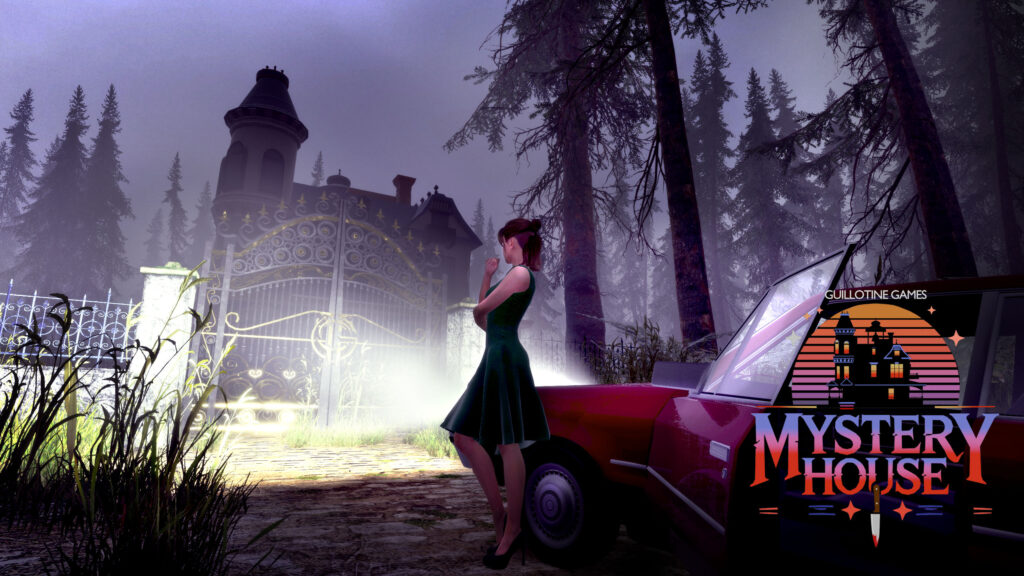
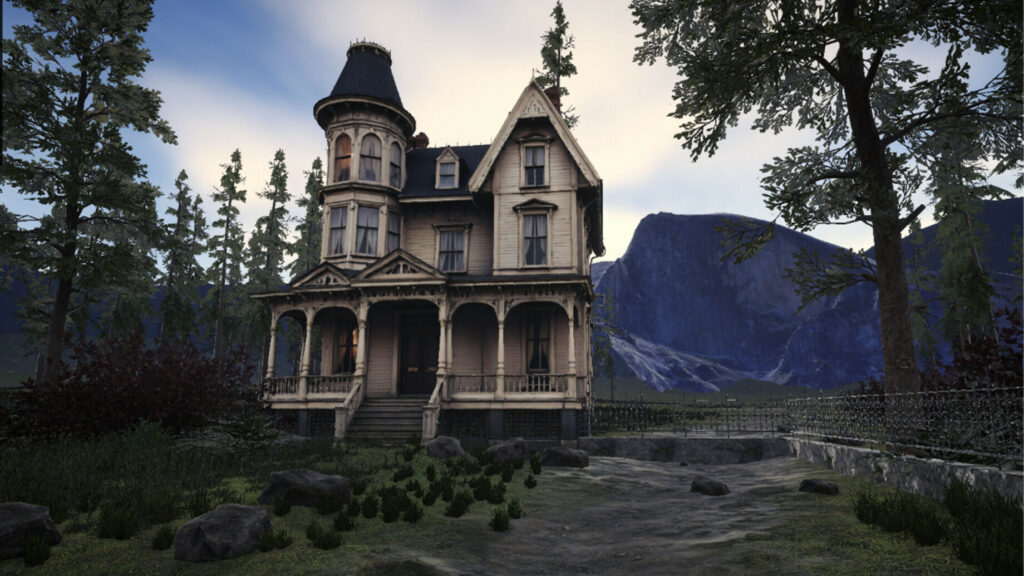
The mansion’s visual design is equally important because it needs to function as both a believable environment and an investigative interface. Rich decoration can suggest age, former occupants, interrupted routines, and hidden history, but excessive detail can compete with meaningful clues. A room containing only obvious puzzle objects creates the opposite problem by feeling artificial and making every important interaction immediately recognizable. Strong environmental composition can balance those extremes through placement, contrast, repetition, and visual hierarchy.
Spatial familiarity can also contribute to suspense. When players understand the layout of a house, later changes to that familiar structure gain significance. An altered object, unexpected opening, or changed interpretation of a previously ordinary detail can become more unsettling because players already understand what should be present. This is one reason mansion design matters beyond graphical quality. Navigation, clue visibility, and memory of space all influence how effectively the mystery works.
The original concept art provides guidance for this process without serving as a complete architectural blueprint. Guillotine Games has explained that recognizable room relationships and architectural elements influence the new version, while details that did not exist in the earlier drawings must be invented for a fully navigable environment. Materials, proportions, hidden surfaces, and distances can dramatically change the emotional character of the same basic composition. The artistic task is therefore to create a coherent modern space while preserving enough visual logic for returning players to recognize the source.
A successful adaptation would use those new details to support the investigation rather than merely increase graphical complexity. A doorway, staircase, or piece of furniture that mattered visually in the original can retain importance even if its surrounding room is now considerably more detailed. New decorative elements can build atmosphere and history without overwhelming the clues required for progress. The mansion works best when its appearance helps players reason about the place rather than simply giving them more surfaces to examine.
Unity Development, Graphics, Audio, Horror Atmosphere, and Translating the Original into 3D
Guillotine Games has identified Unity, Blender, and GIMP among the tools used to develop Mystery House 3D. James Carroll also explained in an October 2026 interview that the project moved from Unity’s High Definition Render Pipeline to the Universal Render Pipeline. Those tools provide technical context for the production but do not, on their own, establish visual quality, frame rate, or optimization. The finished result depends on how the development team configures those systems and builds the content around them.
Every additional layer of environmental detail creates practical design decisions. An object that appears movable may need appropriate interaction rules, animation, collision behavior, sound, and changes to game state if the player can manipulate it. If it cannot be touched, the game needs to communicate that limitation clearly enough that the player does not waste time assuming it is part of a puzzle. Even a seemingly simple interaction can require coordination among art, programming, camera behavior, audio feedback, and narrative state.
This is especially important in a mystery because consistency teaches the player how to interpret the environment. If similar objects behave according to completely different rules without explanation, observation becomes less useful. If every meaningful action follows understandable visual or contextual logic, players can build expectations and use them when solving later problems. Technical sophistication therefore matters most when it supports a coherent investigative language.
The movement from the original’s economical line drawings to detailed 3D spaces gives the remake much more control over atmosphere. Materials, lighting, room scale, object placement, environmental audio, and character presence can turn a previously abstract mansion into a place that feels physically threatening. Dan Policar’s music and sound work becomes part of that transformation because horror depends not only on what the player sees but also on what the game suggests through silence, movement, and sound cues. Atmospheric intensity needs to support the investigation rather than overpower it.
Horror and comprehension must remain balanced. Darkness can make a corridor unsettling, but an important clue becomes frustrating if the player cannot reasonably see it. Loud effects can create tension, but they become counterproductive if they hide feedback needed to understand an interaction. Likewise, constant intensity can reduce the impact of individual scares or discoveries. Quiet periods give players time to examine evidence, develop expectations, and interpret what they have already learned before later events challenge those assumptions.
The expanded narrative offers similar opportunities. A group of characters trapped in a dangerous house can support suspicion, conflicting information, and changing interpretations of events. Developing those characters beyond the original gives the player more reasons to question what different people know and why they behave as they do. The building itself can also participate in that narrative by suggesting former occupants, changes in ownership, or events that happened before the current group arrived. Investigating the house can therefore become inseparable from investigating the people connected to it.
The remake’s historical source gives these modern techniques an unusual context. Mystery House was significant because its pictures expanded what a text adventure could communicate. Mystery House 3D increases the amount of visual and spatial information dramatically, but more information is not automatically better. The design still needs to determine which details deserve attention and how they contribute to deduction. The project succeeds as an adaptation only if technological expansion strengthens the original pleasure of discovering something through careful observation.
This is also why the remake should not be judged solely as a demonstration of modern graphics. A visually impressive mansion could still provide a weak adventure if navigation is confusing, clue placement is arbitrary, or interactions lack understandable logic. Conversely, a restrained environment can be effective if every detail contributes to mood, investigation, or player understanding. The relevant question is how well the modern production turns visual sophistication into meaningful interaction.
Mystery House 3D Release Date, Steam and VR Plans, Development Status, and What Remains Unconfirmed
Mystery House 3D remains unreleased, and its current Steam listing gives the release date as “To be announced.” An earlier official announcement dated May 5, 2025, referred to a planned late 2025 release, but that historical target is no longer the current schedule. As of October 16, 2026, no replacement launch date has been established through the present store listing. The correct description is therefore an upcoming project without a confirmed release date.
There is continuing evidence of active development. A detailed 80 Level interview appeared on October 13, 2026, discussing the project’s art, technical development, adaptation choices, and design. June reporting also described a larger public demonstration at Too Many Games and announced Lloyd Kaufman as narrator. These developments show that work continues, but neither establishes how much content, testing, optimization, or release preparation remains before launch.
An event demonstration should also be distinguished from a publicly downloadable demo. Showing a portion of the game at Too Many Games establishes that playable material existed for the event, but it does not automatically mean Steam users can download the same build. Likewise, a teaser trailer can establish atmosphere, visual direction, and the project’s central premise without demonstrating the complete flow of exploration or puzzle solving. Short edited footage cannot reliably establish uninterrupted performance, pacing, or the quality of extended investigation.
The game has a Steam page under the title Mystery House, where it can be wishlisted, but it is not yet available for purchase or play. The current listing provides Windows system requirements, making PC the clearest confirmed platform in the available store information. An earlier announcement also described plans for PC-connected VR headsets, although those plans should be discussed separately from the conventional Windows version. The existence of a VR intention does not confirm every headset, motion-controller setup, performance target, or whether VR support will arrive simultaneously with the standard release.
The reviewed sources do not establish PlayStation, Xbox, Nintendo, macOS, or native Linux editions. That absence should not be turned into a declaration that those platforms can never be supported, but they should not be listed as announced platforms without further confirmation. Steam Deck compatibility also remains a separate issue because a Windows Steam listing does not establish satisfactory performance, interface readability, controller behavior, or official verification on Valve’s handheld.
The project’s teaser and other public footage should be treated as introductions rather than substitutes for a complete gameplay assessment. Adventure games are especially difficult to evaluate through brief trailers because the quality of the experience depends on how players discover information, experiment with possibilities, become stuck, and eventually understand a solution. An atmospheric shot of a room demonstrates presentation but says little about whether the room communicates interactions effectively over several minutes of exploration. Longer demonstrations and the final release will provide stronger evidence.
The same caution applies to the advertised murder mystery and horror elements. Promotional material establishes an abandoned mansion, a group of friends, an expanded narrative, puzzles, inventory interactions, and an investigative structure. It does not yet justify revealing a killer, confirming supernatural explanations, reconstructing a complete puzzle sequence, or assuming combat and chase mechanics that have not been fully demonstrated. The project’s direction is sufficiently clear to analyze, but many specifics remain dependent on the finished game.
For returning players, the historical connection remains one of the strongest reasons to follow development. Mystery House 3D is revisiting a game whose importance came from expanding the visual language of computer adventures, and it now attempts another large shift in representation by turning those line drawings into navigable space. For newcomers, the remake needs to work independently as a coherent contemporary mystery rather than relying on recognition of the 1980 release. Those two audiences give Guillotine Games a demanding adaptation problem but also a distinctive opportunity.
As development continues, the most useful information will concern the final release date, current platform plans, system requirements, availability of any public demo, VR implementation, and extended examples of puzzle and exploration design. Until those details are confirmed, Mystery House 3D is best understood as an active modern reinterpretation of a foundational graphical adventure with its final launch schedule and complete experience still unresolved.

Frequently Asked Questions (FAQs)
- What is Mystery House 3D?
Mystery House 3D is Guillotine Games’ modern revival of the 1980 Apple II adventure created by Roberta and Ken Williams. It takes the original game’s isolated-house mystery and reinterprets it as a contemporary three-dimensional horror experience. Instead of relying on sparse line drawings and text commands, the remake allows players to explore a navigable environment, inspect objects, and solve puzzles through modern interaction systems. That makes it more than a simple graphical remaster because the shift to 3D changes how players understand space, clues, and danger. Its final success as an adaptation will still depend on how well the finished game preserves the investigative appeal of the original while making the experience work for modern players. - Who created the original Mystery House?
Roberta Williams designed, wrote, and illustrated the original Mystery House, while Ken Williams programmed it. Roberta developed the story, visual presentation, and adventure structure, while Ken handled the software needed to make those ideas work on the Apple II. Their collaboration was important because the game combined text-based interaction with graphical scenes at a time when text adventures were the more established format. The illustrations became part of how players understood and investigated locations rather than serving only as decoration. That division of responsibilities is therefore central to both the game’s authorship and its historical significance in the development of graphical adventures. - Is Mystery House 3D being developed by Roberta and Ken Williams?
No. Guillotine Games is the announced developer of Mystery House 3D, with MMMera, Inc listed as publisher. Roberta and Ken Williams created the original 1980 game, but the available information does not establish that they are personally directing, programming, or designing this remake. Executive producer and designer Marcus Mera previously worked with the Williamses on the modern Colossal Cave revival, which provides a relevant connection to their earlier work. That professional relationship should not be expanded into a claim that the Williamses are leading Mystery House 3D. Their role in this story is primarily as the creators of the original game that Guillotine Games is adapting. - Does Mystery House 3D have a confirmed release date?
No. As of October 16, 2026, the current Steam listing shows the release date as “To be announced.” An earlier official announcement referred to a planned late 2025 launch, but that target has passed and should now be treated as historical information rather than the active schedule. Continued interviews and public demonstrations show that development remains ongoing, but they do not establish when the final game will be ready. A new release date should only be reported once Guillotine Games or the publisher provides an updated official announcement. Until then, Mystery House 3D is best described as an upcoming game without a confirmed launch date. - Can players use first person and third person cameras?
Yes. The official presentation confirms that Mystery House 3D supports both first-person and third-person viewpoints. First person can make close examination and restricted sightlines feel more immediate, while third person keeps the player character visible and can make spatial relationships easier to understand. Supporting both perspectives also creates design challenges because important clues and interactions need to remain readable regardless of the selected camera. Tight corridors or small rooms may also behave differently depending on the viewpoint. The availability of both modes is confirmed, but comfort, consistency, camera sensitivity, and performance will require longer hands-on testing to evaluate properly. - Will Mystery House 3D be available on Steam?
Yes. Mystery House 3D already has a Steam store page where players can wishlist the game and review the currently published information. The existence of the page confirms Steam as a planned distribution platform for the Windows version. However, a store listing should not be confused with an available release because the game cannot yet be purchased or played through that page. Steam currently identifies the release timing as “To be announced.” The page is therefore most useful as a source for future launch information, system requirements, announcements, and eventual availability. - Is a VR version planned?
Yes, the original project announcement included support for PC-connected VR headsets among the development plans. That establishes VR as an intended part of the project, but the available information does not confirm every supported headset, controller system, or release arrangement. It also does not establish whether VR support will launch at exactly the same time as the standard Windows version. Standalone VR devices should not automatically be assumed compatible simply because PC-connected headsets were mentioned. More detailed hardware and platform information will be needed before players can determine whether their particular VR setup is supported. - Does the remake preserve every original puzzle?
That has not been confirmed. The development material emphasizes respecting the original game’s identity while expanding its narrative, environments, and interaction design for a modern three-dimensional experience. Moving from a text parser and line drawings to physical exploration naturally changes how players discover objects and understand possible actions. The public material does not provide a complete puzzle-by-puzzle comparison with the 1980 release. Some ideas may remain recognizable while others may be expanded, reinterpreted, or replaced to suit the new format. Claims that every original solution, sequence, and narrative event survives unchanged would therefore go beyond the available evidence. - Are console versions confirmed?
No. The official material reviewed for the article establishes a Windows Steam version and earlier plans involving PC-connected VR headsets, but it does not confirm PlayStation, Xbox, or Nintendo editions. The absence of those announcements does not prove that console versions could never be developed later. It simply means they should not currently be listed as supported platforms. Any future console announcement would need separate confirmation of the platform, release timing, controls, and any platform-specific features. For now, Windows remains the clearest documented conventional platform. - Is the teaser enough to judge the finished game?
No. A teaser is useful for showing visual direction, atmosphere, the mansion setting, and the general tone Guillotine Games wants to create. It cannot demonstrate whether the full game’s puzzles are fair, navigation remains comfortable over several hours, interactions are consistently communicated, or the narrative delivers a satisfying conclusion. Edited footage can also combine moments from different parts of the game and does not provide reliable evidence of uninterrupted performance or pacing. Adventure games are particularly difficult to judge from short promotional clips because much of their quality depends on how discovery, uncertainty, and problem solving unfold over time. More representative gameplay or the finished release will be needed for a meaningful assessment.

Conclusion
Mystery House 3D has a strong foundation in one of the earliest graphical adventures, but its success will depend on more than modern visuals. The remake needs to preserve the original’s emphasis on investigation while using its 3D mansion, puzzles, objects, and horror atmosphere to make discovery feel natural and rewarding.
Guillotine Games has established a clear direction, but important questions about puzzle design, exploration, technical quality, and narrative payoff remain unanswered. As of October 16, 2026, Mystery House 3D remains an upcoming PC adventure with a Steam listing and no confirmed release date, leaving the finished game to determine how effectively it carries the original’s legacy forward.
Sources and Citations
- Mystery House Official Website: The official site establishes the remake’s core premise: eight friends enter an abandoned mansion for a game night that turns deadly. It confirms a fully 3D horror setting, puzzles throughout the house, and the ability to switch between first-person and third-person perspectives. MYSTERY HOUSE
Mystery House Official Website - Guillotine Games, Teaser Launch Day Announcement, May 5, 2025: The original announcement describes the project as a full 3D remake of Mystery House for PC and PC-VR headsets, developed by Guillotine Games. It also gives the original late-2025 target and lists the development team: Marcus Mera, James Carroll, Steven Alexander, and Dan Policar. MYSTERY HOUSE
Mystery House Returns: Teaser Launch Day Announcement - Steam, Mystery House: The current Steam page lists Guillotine Games as developer and MMMera, Inc. as publisher, with the release date still “To be announced.” It confirms Windows support, first- and third-person play, inventory management, puzzles, multiple endings, and current minimum and recommended PC requirements. Steam Store
Mystery House on Steam - 80 Level, October 13, 2026: The developer interview explains how Guillotine Games is translating the 1980 Apple II original into a modern 3D environment while preserving recognizable room relationships, characters, mystery structure, and puzzle philosophy. It confirms the use of Unity, Blender, and GIMP, notes the move from HDRP to URP, and discusses how original drawings are being treated as architectural reference rather than literal blueprints. 80 Level
Reviving Mystery House, Roberta and Ken Williams’ 1980 Apple II Classic - GameGrin, June 14, 2026: Marcus Mera describes the new version as a revival rather than a simple reimagining. He says the team is expanding the characters, creating a new backstory, and designing puzzles around observation, experimentation, and connecting ideas so players feel clever rather than frustrated. He also discusses lessons carried over from the Colossal Cave 3D project. GameGrin
Mystery House Interview with Marcus Mera - Roberta Williams, Official Biography: Williams’ official biography states that she wrote the story, designed the game, and drew the graphics for the original Mystery House, while Ken Williams created the Apple II engine. It also documents inspiration from Agatha Christie’s And Then There Were None and Clue, along with Roberta’s use of a VersaWriter to transfer hand-drawn room art into the Apple II. Roberta Williams
About Roberta Williams - American Journal of Play, “Let’s Begin Again”: Laine Nooney’s historical research provides detailed production context for the original Mystery House. It states that Ken Williams fit roughly 70 illustrations and the rest of the game code onto a single floppy disk by storing the pictures as coordinate data, while Roberta created the images with a VersaWriter. The article also documents the Apple II high-resolution graphics mode and the game’s early distribution through On-Line Systems. The Strong National Museum of Play
Let’s Begin Again: Sierra On-Line and the Origins of the Graphical Adventure Game - Rely on Horror, June 27, 2026: Reports that Lloyd Kaufman joined Mystery House 3D as narrator, recording more than five minutes of original narration. It also confirms that an expanded 2.0 demo was playable publicly at Too Many Games 2026 and reiterates planned features including first/third-person switching, evolving puzzles, voice acting, multiple endings, and planned PC-connected VR support. Rely on Horror
Troma’s Lloyd Kaufman Joins Mystery House 3D, Playable Demo at Too Many Games
Recommendations
- Vivian Kubrick Debunks Eyes Wide Shut Deleted Scenes Theory
- Battlefield 6 2026 Roadmap: More Maps, “Legendary” Battlefield 4 & Battlefield 3 Remakes, and Wake Island’s Return
- Apple TV’s Widow’s Bay is the First Breakout TV Hit of 2026: Why Everyone is Talking About the Horror Comedy
- Pitchify Launches New Service to Connect Developers and Publishers: How Pitch Direct Works
- Pokémon Pokopia Bubbly Basin DLC Release: Date, New Pokémon, and Everything You Need to Know
- Nordic Game 2026 (NG26 Spring): Dates, Venue, Passes, Speakers, Expo & Awards in Malmö
- Subnautica 2 Early Access Roadmap: Co-Op Updates, Sprinting, and More
- Virtua Fighter 6 Leak Explained
- The Future of 3D Modeling: Insights on AI Advancements
- GTA 6 is Already Outselling Everything Else: Why Pre-Orders Are Dominating Gaming



































































































