






In This Article (9 sections)
No Man’s Sky’s Original Release and Its 10th Anniversary
No Man’s Sky originally launched for PlayStation 4 in North America on August 9, 2016. Sean Murray’s official tenth anniversary message specifically marks August 9 as the day PlayStation Travellers first began exploring the universe. The Windows PC version followed through platforms including Steam later that week. The original game was built around a bold procedural concept. Rather than manually designing every planet, Hello Games created systems capable of generating an enormous galaxy of worlds, terrain, plants, creatures and resources. Players were encouraged to explore, survive, trade and fight while travelling towards the centre of the galaxy. Those central exploration and survival principles remain part of the game in 2026 even though almost every surrounding system has expanded.
The scale of the launch was particularly significant for Hello Games because it was still a very small developer. In his fifth anniversary retrospective, Murray said the team averaged only six people during much of development and numbered 15 at launch. That contrast between a small studio and extraordinarily high expectations would become central to understanding both the difficulties of 2016 and the decade long recovery that followed.
The No Man’s Sky tenth anniversary commemorates ten years since its August 2016 debut, but Hello Games has treated the milestone as much more than a nostalgic birthday. Murray’s anniversary message describes a game that has received 40 major free updates and repeatedly expanded into areas that were not part of the original release. Those additions include base building, exocraft, settlements, mechs, pets, living ships and Expeditions, alongside repeated reconstruction of the procedural universe itself. PlayStation versions have also expanded through PSVR, PS5 and PSVR2 support, while the wider game now spans numerous console and PC ecosystems.
Perhaps the most striking anniversary statistic is that Hello Games says players have collectively explored less than one per cent of the available planets despite tens of millions of Travellers spending hundreds of millions of hours in the game. That enormous remaining space helps explain how an exploration focused game can continue generating fresh experiences after a decade. The anniversary has also become a forward looking event. Rather than announcing that support is winding down as Hello Games develops Light No Fire, Murray has reiterated his enthusiasm for continuing No Man’s Sky and revealed that another update called COSMOS is coming.

How No Man’s Sky Changed and Recovered Over 10 Years
The most important difference between No Man’s Sky in 2016 and No Man’s Sky in 2026 is breadth. The original release was principally an isolated journey through procedurally generated planets built around gathering materials, improving equipment, trading, surviving environmental threats and moving between systems. The modern game preserves that foundation while layering entire genres of activity over it. Players can now establish elaborate planetary bases, manage settlements, own freighters and frigate fleets, travel in exocraft, raise companion creatures, undertake shared Expeditions, experience the entire game through supported virtual reality systems, join other players across platforms and construct customised starships.
Hello Games has also repeatedly altered the universe rather than only adding activities to the existing map. Origins, Worlds Part I and Worlds Part II expanded or transformed planet generation, creatures, terrain, water, environments and visual technology. Worlds Part II, for example, introduced new stars, gas giants, deep water worlds, terrain changes, new biomes and new story material. The transformation is therefore both vertical and horizontal. Existing mechanics have become deeper, while completely new forms of play have been added. A player who wants the lonely 2016 style exploration loop can still pursue it, but someone else can spend hundreds of hours designing bases, collecting ships, running multiplayer missions or building a multi crew Corvette.
The 2016 launch became controversial because exceptionally high expectations collided with a game many players considered narrower, more technically troubled or different from what they believed pre release coverage had promised. The backlash became serious enough that the UK Advertising Standards Authority investigated complaints about the game’s Steam advertising. The regulator ultimately ruled that the advertising did not breach its codes, an important detail often lost in retellings of the controversy.
Hello Games’ recovery strategy was unusual in its simplicity: the studio largely stopped trying to win the argument rhetorically and instead kept changing the product. Foundation arrived roughly ten weeks after launch and introduced base building, a feature that Murray later described as becoming integral to the game. From there, the updates became increasingly ambitious. Atlas Rises expanded story systems, NEXT introduced the transformative full multiplayer experience and greatly expanded base construction, Beyond incorporated major online and VR improvements, while later releases added companions, settlements, Expeditions, starship building, overhauled worlds and entirely new gameplay loops.
The improvement in public sentiment happened gradually rather than through a single “redemption update.” By September 2021, the game’s cumulative Steam reviews had climbed into the “Mostly Positive” range after years of work, while recent reviews were already significantly stronger. Continued updates have since further normalised No Man’s Sky as an example of successful long term post launch support. The lesson of the comeback is therefore less about one patch fixing everything than about sustained trust building. Hello Games kept releasing substantial content without charging existing owners for major expansions, and the modern game became progressively harder to judge solely by the limitations of its launch version.
Major No Man’s Sky Updates, New Features and Multiplayer Evolution
Hello Games says No Man’s Sky has received 40 major updates in ten years, although the studio’s terminology does not always place every patch, platform upgrade, Expedition and named content release in identical categories. Its official release log therefore provides the safest record of the game’s evolution rather than assuming every version number change represents a separate major update.
The major updates across the decade include:
- Foundation, Path Finder and Atlas Rises: Foundation introduced base building in 2016, while Path Finder expanded planetary exploration and vehicles. Atlas Rises substantially increased narrative content and other systems in 2017.
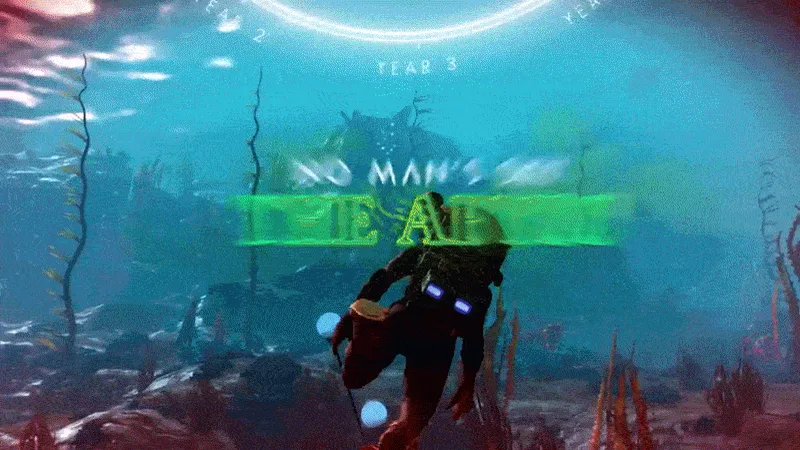
- NEXT, The Abyss and Visions: In 2018, NEXT brought full multiplayer, major base building expansion, third person play and graphical changes. The Abyss focused heavily on underwater exploration, while Visions expanded planetary variety and discoveries.
- Beyond and Synthesis: These updates arrived in 2019, with Beyond delivering major online and VR improvements and Synthesis continuing to expand and refine the wider experience.
- Living Ship, Exo Mech, Desolation, Origins and Next Generation: The 2020 updates added living ships, mechs, abandoned freighters and a major transformation of planetary generation. The year also brought the critical introduction of cross platform multiplayer.
- Companions, Expeditions, Prisms and Frontiers: In 2021, Companions allowed players to tame and develop creature companions, Expeditions created structured shared seasonal journeys, Prisms enhanced presentation and Frontiers introduced planetary settlements alongside a major base building overhaul.
- Sentinel, Outlaws, Endurance and Waypoint: The 2022 updates pushed combat, piracy, freighters and broader game systems in new directions.
- Fractal, Interceptor and Echoes: The 2023 releases expanded virtual reality functionality, introduced corrupted Sentinel technology and new ships, added the robotic Autophage civilisation and delivered large scale space combat. Expeditions also continued to provide limited time communal stories between major updates.
- Omega, Orbital, Adrift, Worlds Part I, Aquarius and The Cursed: Hello Games officially described The Cursed as its sixth named update of 2024. Orbital introduced true starship construction from salvaged components and completely rebuilt space stations. Worlds Part I significantly transformed planetary environments, Aquarius introduced fishing and The Cursed experimented with a reality distortion survival scenario.
- Worlds Part II, Relics, Beacon and Voyagers: The 2025 cycle began with Worlds Part II, a major universe overhaul introducing new stars, gas giants, water worlds, new terrain and additional environmental technology. Relics added palaeontology and collectible fossil systems, Beacon expanded planetary settlement management and Voyagers introduced custom built, habitable, multi crew Corvette class ships. The year also included community Expeditions such as Titan and Breach, with the official release log recording Breach as Expedition Twenty.
- Remnant, Xeno Arena and The Swarm: In 2026, Remnant launched in February as update 6.2 with a functional gravity tool, salvage mechanics and expanded vehicle customisation. Xeno Arena then introduced turn based battles between creature companions. The Swarm, update 6.4, followed in May with enormous space battles, robotic swarms and the Hive of Glass. The next major update is titled COSMOS, although its exact feature set had not been officially explained as of August 12, 2026.
The cumulative list of additions demonstrates why modern No Man’s Sky can feel like several games layered together. Hello Games has expanded planetary exploration with new biomes, weather, terrain, oceans, creatures and environmental systems while also adding activities that barely existed in the original design. Construction is now an enormous part of the experience. Players can create planetary bases, develop large settlements and build increasingly complex structures. They can own freighters, command frigate fleets, drive exocraft and manage technologies that support long term life rather than simply moving continuously from one planet to another.
The game has also gained pets, mechs, living starships, multiplayer missions, Expeditions and cross platform interaction. Crossplay, introduced in 2020 between PlayStation, Xbox and PC ecosystems, was particularly important because it turned the game’s increasingly social universe into a community that was less fragmented by hardware. Ship ownership has become dramatically deeper as well. Orbital introduced a Starship Fabricator that lets players salvage components and assemble custom spacecraft, while Voyagers went further by offering fully habitable Corvette class ships built from hundreds of modules and designed to carry multiple players. Virtual reality, next generation console support and repeated graphical upgrades have simultaneously changed how the same universe is presented.
Multiplayer represents one of the most profound changes in No Man’s Sky. The turning point was NEXT in 2018. Hello Games described update 1.5 as introducing a “full multiplayer experience,” allowing small groups to explore, build and travel together while also adding player character customisation and dramatically expanded base construction. Murray later called NEXT an inflection point that felt almost like another game launch.
The next crucial milestone was crossplay in June 2020. Hello Games rebuilt underlying networking technology so PlayStation 4, Xbox One and PC users could explore, survive, build, trade and journey together despite using different platforms. Multiplayer has subsequently become embedded in many other systems rather than existing as a separate mode. Expeditions bring players into shared journeys, the Space Anomaly functions as a social meeting point, collaborative construction remains central to community life, and Voyagers introduced huge ships specifically designed to allow friends aboard together. The Swarm extends that philosophy to enormous shared conflicts in space, where players can participate in efforts against the Hive of Glass and its forces.
Base building was not part of the original launch experience. Foundation introduced it roughly ten weeks later, and Murray has said it rapidly became so central to No Man’s Sky that it is now difficult to imagine the game without it. NEXT expanded construction towards near unlimited base building, allowed greater freedom over where structures could be established and introduced hundreds of additional building components. Frontiers later performed another major overhaul while linking construction to procedurally generated planetary settlements.
These additions changed the psychological rhythm of the game. The original experience encouraged constant movement towards new stars; base construction gives players reasons to stop, claim a location, decorate it, optimise it and return later. Ship customisation had a similarly transformative effect but arrived much later.
Orbital changed that philosophy in 2024 with the Starship Fabricator, which allows players to dismantle vessels for reusable components and construct customised ships. Voyagers took the concept far beyond conventional fighters and haulers in 2025, allowing players to assemble large Corvette class vessels from hundreds of modules, furnish their interiors and invite other players aboard. Together, bases and custom ships turned No Man’s Sky from a game primarily about discovering what procedural generation gives you into one where players can increasingly shape the universe around their own identity.

No Man’s Sky in 2026, Its Community and Why It Remains Popular
The original No Man’s Sky can now feel almost minimalist when compared with the 2026 version. Sean Murray himself has revisited the launch build and acknowledged that it is considerably more bare bones while retaining a distinctive sense of isolation and mystery. He described the older version as “a little bit weirder” and said it still had charm.
A 2016 player travelled primarily through an enormous procedurally generated universe, collected resources, upgraded equipment and moved from system to system. A 2026 player can still choose that lifestyle but can also establish a permanent home, run settlements, build custom ships, command fleets, raise companions, fight alongside other players, participate in community Expeditions or explore in VR. Visually and procedurally, the comparison is equally dramatic. Origins, Worlds Part I and Worlds Part II repeatedly changed the kinds of planets and environments players could discover. Worlds Part II alone added new stars, gas giants, dramatic terrain, new water technology, additional creatures and varied biomes.
Yet Murray argues that the emotional core remains recognisable: stepping onto a world without knowing what lies over the horizon. Ten years later, he does not speak about the original No Man’s Sky as something the studio wishes to erase. In his 2026 reflections, he said he still plays versions of the game and retains affection for the launch experience, particularly its strange, sparse and isolated quality.
That perspective is significant because the conventional story of No Man’s Sky often divides its history into a “bad” 2016 version and a “good” modern version. Murray’s comments suggest a more nuanced interpretation. He acknowledges how much more players can now do but still values the launch build’s focus on solitary exploration and the unknown.
He has also made clear that continued development has not become an obligation the team is desperate to escape. Around the tenth anniversary, Murray said that if people continued playing, he could imagine working on the project indefinitely. He linked ongoing development to both player enthusiasm and the team’s continued enjoyment of inventing new features. That philosophy also explains the studio’s approach to paid expansion content. Murray reiterated in 2026 that the updates would remain free, saying the team values having everyone in the community able to access the same new material rather than splitting players across paid DLC packages.
The tenth anniversary does not correspond to a single already released patch called the “10th Anniversary Update.” Instead, 2026 has been an anniversary year containing multiple substantial releases, while Hello Games used the August celebration to reveal the name of its next update, COSMOS. Remnant added a gravity based Multi Tool system that lets players manipulate salvage and industrial debris, alongside upgraded vehicle systems and a community Expedition.
Xeno Arena followed with structured turn based combat involving collected creature companions. The Swarm then arrived as update 6.4 in May, bringing large space confrontations featuring elite ships, huge robotic forces and the Hive of Glass. Hello Games described these as its largest and most epic space battles to that point, with scenes containing hundreds of ships.
The exact content of COSMOS had not been publicly detailed in the anniversary material available by August 12. Suggestions that its name necessarily means a particular space overhaul, storyline conclusion or new galaxy system remain speculation until Hello Games provides official patch information. The important distinction is that COSMOS is confirmed as the next update, but its exact gameplay additions should not yet be treated as confirmed.
Continual free expansion is one of the strongest explanations for No Man’s Sky remaining relevant. A player who purchased the game years ago can return after an absence and discover major new systems without buying a conventional paid expansion. The updates are also substantive enough to create reasons to return. Voyagers, with its buildable multi crew Corvettes, generated exceptionally strong interest. Murray’s anniversary message said the Voyagers period brought more players than the game had seen since launch, underscoring that late life additions can still create launch scale attention.
The procedural foundation provides another advantage. Hello Games says less than one per cent of the game’s planets have been explored despite hundreds of millions of hours played. Variety matters too. The same game can now serve explorers, builders, collectors, photographers, multiplayer groups, survival players, ship enthusiasts and Expedition participants. Someone exhausted by one activity can move into another without leaving the underlying universe. Most importantly, the relationship between Hello Games and its community changed. The studio’s repeated delivery of large free updates gradually replaced the launch controversy as the defining story of the game. That long term consistency has become part of No Man’s Sky itself.
Hello Games marked the tenth anniversary with retrospective messages and material celebrating the journeys created by players over the past decade. Murray’s PlayStation anniversary post highlighted bases, friendships, custom ships and the enormous amount of collective exploration that has accumulated since August 2016. The celebration is especially community focused because modern No Man’s Sky is far more social than the launch game. Expeditions, shared missions, cross platform play and player built settlements or bases give the anniversary a communal dimension that would have been difficult to imagine during the game’s earliest period.
Hello Games’ release history has repeatedly incorporated Community Spotlight sections and events highlighting player creations, photography and Expeditions. Anniversary discussion has likewise encouraged long time Travellers to revisit memories of early versions while newer players explore features added years after release. Rather than drawing a line under the game, the community celebration has therefore become another transition point towards the next update.
What No Man’s Sky’s Comeback Means for Hello Games and Light No Fire
The comeback fundamentally changed Hello Games’ reputation. In 2016, the studio was closely associated with the gap between extraordinary pre release expectations and the reality players encountered at launch. A decade later, it is equally associated with refusing to abandon that launch and spending years expanding the game. That history is particularly important as Hello Games develops Light No Fire.
The studio now approaches its next major project with ten years of experience building persistent procedural worlds, networking technology, large scale terrain systems and community driven updates. Some technology developed around recent No Man’s Sky work has also been connected by Hello Games to ideas relevant to its next project.
The comeback also demonstrated an alternative business model for post launch support. Murray has said the studio does not regard the theoretical income from paid No Man’s Sky DLC as more important than keeping its community together around free updates. That approach is possible partly because Hello Games remains comparatively small and independently structured.
Perhaps most importantly, No Man’s Sky gave the developer time to prove that an unsuccessful or controversial launch does not necessarily define the final life of a game. That does not erase legitimate criticism of 2016. Instead, it demonstrates that sustained development can materially change both a product and the way audiences evaluate its creator. After ten years, the game’s identity is therefore defined not only by its original procedural universe, but also by the extraordinary amount of content, technology, multiplayer functionality and community history Hello Games has built on top of it.

Frequently Asked Questions (FAQs)
- Will Hello Games stop updating No Man’s Sky because of Light No Fire?
There is no announced end to No Man’s Sky support because of Light No Fire. Sean Murray has instead continued to express enthusiasm for the game and its future, saying he could imagine working on it for as long as people continue playing and the developers remain excited about creating new ideas. The development of Light No Fire therefore has not been presented as the end of No Man’s Sky. - When was No Man’s Sky first released?
No Man’s Sky first launched for PlayStation 4 in North America on August 9, 2016. Hello Games continues to use August 9 as the anniversary date, marking the day PlayStation players first began exploring its procedurally generated universe. The Windows PC version followed later that week. - How many major updates has No Man’s Sky received?
Sean Murray said during the tenth anniversary celebration that No Man’s Sky had received 40 major updates. These updates have been released free to existing players and have added or significantly changed major systems such as base building, multiplayer, settlements, companions, Expeditions, ship customisation and planetary generation. - Does No Man’s Sky still receive free updates?
Yes. Hello Games continues to release substantial updates without charging existing players for conventional expansion DLC. This approach has been maintained throughout the game’s long post launch history, and Murray reaffirmed around the tenth anniversary that the studio intends to keep major updates accessible to the whole community. - What is the next No Man’s Sky update after the 10th anniversary?
The next announced update is called COSMOS. Hello Games revealed the name during the tenth anniversary celebrations, but it had not fully explained what the update would contain as of August 12, 2026. Any specific claims about its features should therefore be treated as speculation until the studio provides more information. - Is the No Man’s Sky COSMOS update already available?
No. There was no confirmed full release of COSMOS in the official material available by August 12, 2026. The latest completed major 2026 releases mentioned by Hello Games were Remnant, Xeno Arena and The Swarm, while COSMOS remained the next announced update. - Did No Man’s Sky have base building when it launched?
No. Base building was not part of the original August 2016 release and was added roughly ten weeks later through the Foundation update. The feature eventually became a major part of the game, giving players a reason to settle on planets and create permanent structures rather than constantly travelling between worlds. - When did No Man’s Sky get full multiplayer?
The NEXT update in 2018 introduced what Hello Games described as a full multiplayer experience. It allowed players to explore, build and travel together in a much more substantial way than the original release. Cross platform multiplayer between PlayStation, Xbox and PC followed in 2020, allowing players on different systems to share the same universe. - Can players customise ships in No Man’s Sky?
Yes. The Orbital update in 2024 introduced the Starship Fabricator, allowing players to salvage components from existing ships and use them to construct customised vessels. Voyagers expanded the concept in 2025 with large, modular Corvette class ships that can have habitable interiors and support multiple players, making them useful as both transportation and social spaces. - How much of the No Man’s Sky universe has been explored?
Hello Games says players have explored less than one per cent of the available planets, despite the community having spent hundreds of millions of collective hours in the game. This leaves an enormous amount of the procedurally generated universe unexplored and helps explain why the game can continue offering new discoveries even after ten years.

Conclusion
The tenth anniversary of No Man’s Sky is remarkable not simply because the game survived for a decade, but because it spent that decade continually redefining itself. What began in 2016 as a comparatively sparse procedural exploration and survival experience now incorporates elaborate base construction, planetary settlements, companions, mechs, freighters, crossplay, Expeditions, VR, custom starships, multi crew Corvettes and repeated transformations of its planetary universe. Hello Games says that evolution has taken place across 40 major free updates.
Its recovery from the controversial launch was neither immediate nor based on pretending the criticism never occurred. Foundation began adding major missing layers only weeks after release, NEXT transformed multiplayer, Beyond broadened the social and VR experience, and later updates continually gave existing players new reasons to return. Over time, the product changed enough that the story surrounding it changed too.
The 2024, 2025 and 2026 updates demonstrate that Hello Games has not slowed to maintenance mode. Orbital introduced true starship building, Worlds Part I and II reconstructed planetary environments, Voyagers created habitable multi crew vessels, Remnant introduced physics-driven salvage, Xeno Arena added creature combat and The Swarm delivered enormous space battles.
Now COSMOS is next. Its contents remain deliberately undisclosed, but its existence is enough to demonstrate the central point of the tenth anniversary: No Man’s Sky is still an active development project rather than a completed relic of 2016.
Sean Murray’s reflections capture the unusual relationship between the old and new versions. He can still appreciate the sparse mystery of the original while valuing the enormous depth that has accumulated around it. The basic fantasy of landing somewhere unknown has survived beneath ten years of new systems.
That continuity is what makes the transformation significant. Hello Games did not replace No Man’s Sky with a sequel. It spent a decade turning the same game into something far larger than its launch version, and with COSMOS ahead, Light No Fire in development and the studio still publicly committed to its existing community, the tenth anniversary looks less like the end of the journey than the beginning of another phase.
Sources and Citations
- PlayStation Blog – No Man’s Sky Developer Hello Games Celebrates 10-Year Anniversary
- Murray, Sean. “No Man’s Sky Developer Hello Games Celebrates 10-Year Anniversary.” PlayStation Blog, August 10, 2026. This is the principal official tenth-anniversary source. Murray confirms 40 major updates, all free, says tens of millions of Travellers have spent hundreds of millions of hours exploring, notes that players have still explored less than 1% of the game’s planets, and says Voyagers attracted more players than any point since launch. (PlayStation.Blog)
- Hello Games – No Man’s Sky Release Log
- Hello Games. “Release Log.” No Man’s Sky Official Website. The official running chronology of major updates, Expeditions, patches and version numbers, covering the game’s development from its early releases through the current 2026 updates. (nomanssky.com)
- Hello Games – No Man’s Sky 5th Anniversary
- Murray, Sean. “No Man’s Sky 5th Anniversary.” Hello Games, August 10, 2021. Official retrospective confirming that the development team averaged only six people and numbered 15 at launch. Murray discusses the game’s evolution through multiplayer, base building, VR, cross-play, Expeditions and other systems, while reiterating that all updates had been free. (nomanssky.com)
- Hello Games – NEXT: Introducing Update 1.5
- Hello Games. “NEXT: Introducing Update 1.5.” No Man’s Sky Official Website, 2018. Official documentation for the major NEXT update, confirming the introduction of a full multiplayer experience, greatly expanded base building, multiplayer exploration, communal bases, freighter improvements and other features. (nomanssky.com)
- Hello Games – Introducing Crossplay for No Man’s Sky
- Murray, Sean. “Introducing Crossplay for No Man’s Sky.” Hello Games, June 10, 2020. Documents the networking overhaul that introduced cross-platform multiplayer and allowed PlayStation, Xbox and PC players to encounter and travel with one another. (nomanssky.com)
- Hello Games – No Man’s Sky Orbital Update
- Hello Games. “Orbital: Introducing Update 4.6.” No Man’s Sky Official Website, 2024. Primary documentation for Orbital’s starship-customisation system. The Starship Fabricator allows players to design custom ships using components salvaged from existing vessels. (nomanssky.com)
- Hello Games – No Man’s Sky Voyagers Update
- Hello Games. “Voyagers: Introducing Update 6.0.” No Man’s Sky Official Website, August 2025. Official documentation for modular Corvette-class starships, including bespoke ship construction, furnished interiors and the ability to invite friends aboard as crew. (nomanssky.com)
- Hello Games – No Man’s Sky: Remnant
- Murray, Sean. “No Man’s Sky: Remnant.” Hello Games, February 11, 2026. Official announcement for the Remnant update, introducing the gravity-based Gravitino Coil/“gravity gun” mechanics and an expanded salvage-focused gameplay loop. (nomanssky.com)
- Hello Games – No Man’s Sky: The Swarm
- Murray, Sean. “No Man’s Sky: The Swarm.” Hello Games, May 27, 2026. Official source for the 2026 Hive of Glass conflict, swarms of hostile spacecraft, crashed-drone salvage and the large-scale space battles introduced in Update 6.4. (nomanssky.com)
- TIME – Watchdog Group: ‘No Man’s Sky’ Wasn’t Misleading
- Peckham, Matt. “Watchdog Group: ‘No Man’s Sky’ Wasn’t Misleading.” TIME, November 30, 2016. Reports the UK Advertising Standards Authority investigation into complaints about No Man’s Sky advertising. The regulator ultimately concluded that Hello Games had not misled consumers and did not uphold the complaints. (TIME)
- PC Gamer – Sean Murray Still Loves Playing the 2016 Version of No Man’s Sky
- Livingston, Christopher. “Sean Murray Still Loves Playing the 2016 Version of No Man’s Sky.” PC Gamer, August 10, 2026. PC Gamer’s tenth-anniversary interview documents Murray’s continued affection for the sparse, unusual atmosphere of the original 2016 release while contrasting it with the much greater variety and depth of the modern game, including base building and custom ships. (PC Gamer)
- GamesRadar – No Man’s Sky COSMOS Is the Next Big Update
- Koselke, Anna. “No Man’s Sky Cosmos Is the Next Big Update as Hello Games Refuses to Slow Down After 10 Years.” GamesRadar+, August 10, 2026. Confirms COSMOS as the next announced No Man’s Sky update. At publication, Hello Games had not revealed substantive details about what COSMOS would contain, so suggestions about its particular focus remained speculative. (gamesradar.com)
Recommended
- EA Sidelines Need for Speed and Burnout as Criterion Focuses Exclusively on Battlefield
- The Well Is Not Empty Announced for PC: Release Window, Story, Trailer, and Gameplay Details
- How to Increase Your Backpacks Inventory Size in Marathon: Best Ways to Get More Slots Fast
- Naughty Dog’s State of Play No-Show Sparks Concern as Fans Fear Intergalactic: The Heretic Prophet Is Still Years Away From Release
- Battle for Embolia: Everything You Need to Know About the Fast-Paced Indie MMORPG with Responsive Combat and Constant Updates
- Japanese Online Game Developers Reach 100% Generative AI Adoption, New Survey Finds
- Metaphor: ReFantazio Switch 2 Release Date & Details
- PlayStation State of Play June 2, 2026: Full 60+ Minute Showcase, Gameplay Reveals, and Everything You Need to Know
- Devil May Cry 5 Devil Hunter Edition on Nintendo Switch 2: 60 FPS Performance, Features, and Release Guide
- Project Hail Mary: Journey Among the Stars Game Adds a New Andy Weir Chapter with Maze Theory and Amazon MGM



































































































