








In This Article (7 sections)
Nooks Secures $500M From General Catalyst: Financing Structure, Growth Performance and Expansion Plans
Nooks secured a $500 million non dilutive financing commitment from General Catalyst’s Customer Value Fund (CVF) on November 4, 2026, marking a major development in the artificial intelligence sales automation industry. The San Francisco company intends to use the financing to expand customer acquisition, develop new AI products, strengthen enterprise adoption, and accelerate international growth.
Unlike conventional venture capital financing, the agreement does not involve issuing additional ownership shares in exchange for the committed capital. Instead, General Catalyst will participate in the financial returns generated through the arrangement, allowing Nooks to pursue expansion without the immediate ownership dilution associated with traditional equity fundraising. However, the complete contractual terms, including financing costs, repayment obligations, and the schedule for accessing the capital, have not been disclosed.
Founded in 2020 by Dan Lee, Rohan Suri, and Nikhil Cheerla, Nooks initially developed virtual collaboration technology before shifting toward sales productivity and AI supported outbound communications. Its products evolved from calling and sales engagement tools into a broader platform supporting prospecting, automated sequencing, coaching, and revenue management. In October 2024, the company raised $43 million in Series B financing led by Kleiner Perkins, bringing its disclosed equity funding at that time to approximately $70 million. The latest $500 million commitment represents a significantly larger financing arrangement, but it should not be classified as another conventional equity round or interpreted as the company’s valuation.
General Catalyst’s Customer Value Fund provides an alternative financing model for businesses with established products and measurable customer acquisition performance. Rather than purchasing company shares, the fund supplies capital intended to support commercial expansion and receives an agreed portion of the resulting economic returns. This approach can be attractive to subscription software companies that have demonstrated predictable relationships between customer acquisition spending and recurring revenue. However, the arrangement is not equivalent to a grant or unrestricted financial assistance. The financing provider expects compensation, and unfavorable customer acquisition performance could affect the company’s future cash flow. Because the contractual formula remains undisclosed, the effective financing cost cannot be independently compared with traditional equity funding or ordinary borrowing.
General Catalyst identified Nooks’ predictable revenue engine and favorable unit economics as important reasons for the commitment. Pranav Singhvi, a partner and cohead of the Customer Value Fund, emphasized the company’s ability to generate measurable commercial returns. Unit economics describe the relationship between the cost of acquiring and serving customers and the revenue those customers generate.
Businesses with strong customer retention and attractive lifetime value may be able to increase acquisition spending while maintaining sustainable commercial performance. Nooks also uses its own AI software in its sales operations, providing an internal environment for testing the technology while supporting customer acquisition. Nevertheless, General Catalyst’s financing decision represents confidence in the company’s business model rather than proof that its future financial targets will be achieved.
Nooks reported approximately threefold annual growth, more than 2,000 business customers, and 135% net revenue retention in connection with the November announcement. Net revenue retention measures changes in recurring revenue from an existing group of customers after accounting for expansion, upgrades, reductions, and cancellations. A rate of 135% means that the measured customer cohort generated 35% more recurring revenue than at the beginning of the period. For example, a hypothetical customer group initially generating $10 million in recurring revenue would generate $13.5 million at that retention rate. This is an illustrative calculation rather than Nooks’ disclosed revenue. Strong retention can indicate successful expansion within existing accounts, although it does not independently establish profitability or reveal the company’s operating expenses.
The company also reported that more than half of its customers use multiple Nooks products. Its customer base includes Glean, Notion, Deel, Replit, and Factory, while Reuters additionally identified businesses including Cursor and HubSpot. These relationships indicate adoption among technology companies familiar with modern software and AI applications.
Nooks expects its annual recurring revenue to nearly triple by the end of 2026, but it has not disclosed the underlying revenue figure needed to independently calculate that growth. The company’s reported threefold annual expansion and its expectation for annual recurring revenue should also be distinguished because one describes reported performance while the other represents an anticipated outcome. Customer counts and retention figures do not reveal average contract values, customer concentration, geographic revenue distribution, or operating margins.
Nooks attributes part of its growth to expanding beyond outbound calling into a wider portfolio of sales applications. Its AI dialing technology originally focused on helping representatives connect with prospective customers more efficiently, while subsequent products introduced prospect research, personalized outreach, sequencing, coaching, and revenue intelligence. The February 2026 introduction of AI Sequencing strengthened its ability to coordinate outbound communication across channels. Nooks also claims that customers typically generate three times as much sales pipeline using its platform compared with their previous tools. That figure represents a company reported result rather than a guaranteed improvement for every organization, since outcomes depend on sales processes, customer databases, team experience, and implementation quality.
The financing will support several areas of expansion:
- Customer acquisition: Increasing sales and marketing activities to reach additional businesses interested in AI sales automation.
- Enterprise adoption: Strengthening integrations, security, administrative controls, customer support, and other capabilities required by larger organizations.
- Product development: Advancing the Revenue Agent Platform, Node, and additional AI agents designed for different stages of the customer relationship.
- International expansion: Entering additional markets while addressing local communications, privacy, and data protection requirements.
- Recruitment: Expanding engineering, research, product, design, and commercial teams, with more than 100 open positions reported in November 2026.
The company has not disclosed how much of the $500 million will be allocated to individual initiatives. The commitment also does not necessarily mean Nooks received the entire amount as unrestricted cash when the agreement was announced. Its strategic importance lies in providing access to substantial growth financing while allowing existing shareholders to retain their ownership percentages. The effectiveness of this approach will depend on whether customer acquisition costs, retention, and commercial returns remain favorable as Nooks expands into larger enterprises and international markets.
Nooks Revenue Agent Platform, Node AI Assistant and Automated Sales Workflows
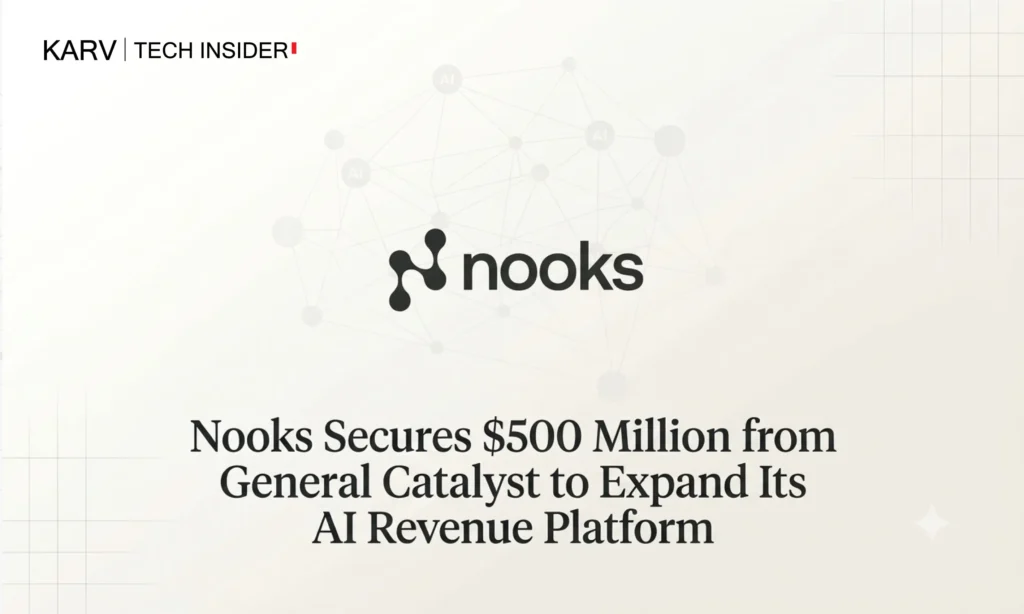
The Nooks Revenue Agent Platform represents the company’s effort to move beyond individual AI productivity tools toward a coordinated system supporting the entire customer revenue lifecycle. Announced alongside the General Catalyst financing, the platform combines AI agents, sales engagement capabilities, communications infrastructure, and customer interaction data. Its purpose is to reduce repetitive administrative work while helping sales representatives manage prospecting, outreach, active opportunities, customer expansion, and coaching. Traditional sales teams often switch between several applications for research, email sequencing, calling, customer records, and performance analysis. Nooks aims to bring more of these activities into a unified environment where AI agents can prepare recommendations and participate in executing commercial workflows.
The company’s approach emphasizes three characteristics: goal orientation, durable context, and continuous learning. Goal orientation allows an agent to work toward a commercial objective rather than simply responding to isolated prompts. Durable context helps preserve information about customers, previous conversations, commitments, objections, and sales opportunities. Continuous learning reflects Nooks’ ambition to improve agent performance through feedback from actual sales outcomes. The company reports processing more than one billion sales interactions through its platform, providing information that can help connect recommendations with customer responses and commercial results. However, the effectiveness of these capabilities depends on data quality, measurement practices, model reliability, and appropriate information governance. The available evidence does not establish that every autonomous workflow consistently outperforms competing products.
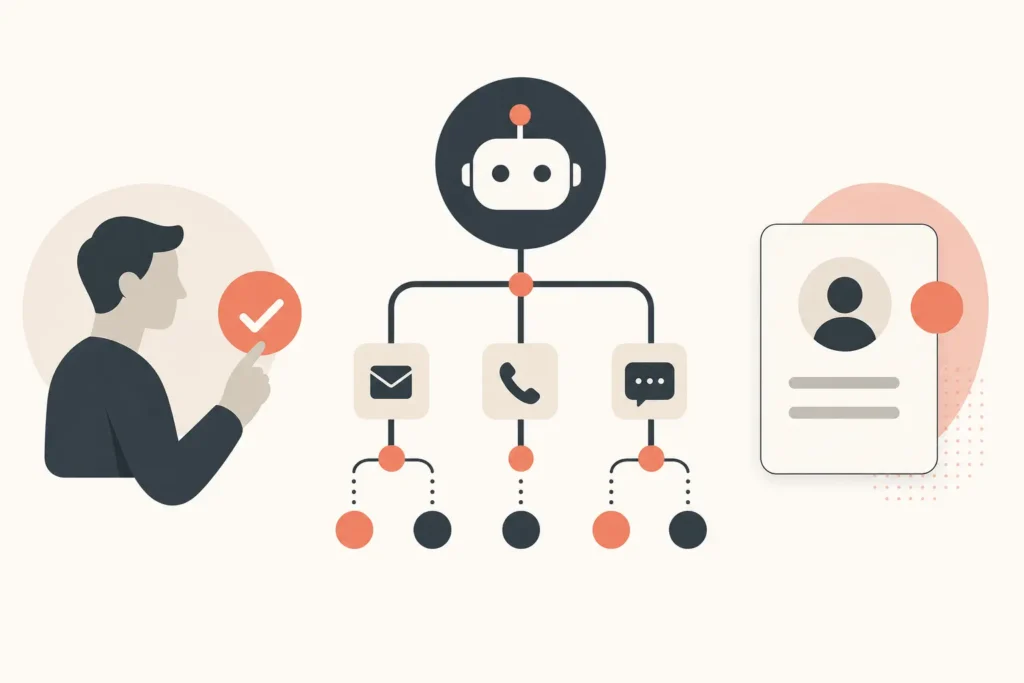
Node is the company’s newly introduced AI personal assistant for sales professionals. Announced on November 4, 2026, it is designed to monitor opportunities, identify potential deal risks, prepare followup activities, and help representatives prioritize their work. Unlike a conventional assistant that waits for an explicit instruction, Node is intended to recognize when an action may be necessary and prepare it for the user’s attention.
For example, if a representative promises to send additional product information after a meeting, Node can identify the commitment, prepare the communication, and request approval. It can also flag opportunities showing reduced customer engagement or recommend actions that may help progress negotiations. Nooks describes the product as an executive assistant for account executives, emphasizing its role in reducing administrative responsibilities while allowing salespeople to maintain oversight of important communications.
Node is also designed to support collaboration among account executives, account managers, and solutions engineers. Individual assistants can share relevant customer information and learn from successful approaches, helping teams maintain continuity across complex account relationships. Nooks reported that early users experienced productivity improvements of up to 80% and saved approximately two hours daily.
The company also stated that 96% of emails drafted by its agents were sent without edits. These figures represent early company reported outcomes rather than independently established results for all users. Sending an email without changes also does not automatically demonstrate that the message was effective or positively received. As of November 6, 2026, Node had been introduced with early access registration, while broader availability was planned for early 2027.
The Revenue Agent Platform includes several specialized agent categories designed around different sales responsibilities:
- Deal Agents: Monitor active opportunities, identify potential obstacles, organize customer information, and recommend actions that could help progress negotiations.
- Outbound Agents: Support prospect research, account prioritization, personalized outreach, calling, and communication sequences.
- Expansion Agents: Identify opportunities to increase revenue from existing customers through additional products, larger deployments, or broader adoption.
- Coaching Agents: Analyze sales conversations and provide feedback intended to improve representative performance and sales techniques.
- Inbound Agents: Planned for the first quarter of 2027 to extend automation into activities involving incoming buyer interest.
These agent categories reflect Nooks’ ambition to support revenue teams throughout the customer relationship rather than concentrating exclusively on initial prospecting. The platform can help identify potential customers, prepare communications, organize information gathered during interactions, and recommend subsequent actions. As opportunities progress, agents can support meeting preparation, stakeholder coordination, and deal management. After a purchase, expansion capabilities may help account teams identify opportunities for additional products or increased usage. Shared customer context is important because complex sales relationships often involve several employees, multiple communication channels, and decisions made over extended periods. However, the planned Inbound Agents had not yet reached their announced release window as of November 2026, and their final functionality remained subject to future product development.
Sales productivity is central to the platform’s commercial proposition. Representatives frequently spend considerable time updating records, researching accounts, preparing prospect lists, writing messages, and coordinating meetings. Although necessary, these activities reduce the time available for direct customer engagement. Nooks aims to automate portions of that workload and help representatives concentrate on relationship building, negotiation, and strategic decisions. Its claimed threefold improvement in customer pipeline generation suggests potential benefits, but pipeline growth does not guarantee completed sales. Organizations still need to evaluate opportunity quality, conversion rates, deal values, and customer retention rather than measuring success solely through the number of messages sent or activities automated.
Useful performance measures include qualified pipeline generated per representative, meeting conversion rates, opportunity win rates, average sales cycle duration, customer retention, and revenue per employee. Companies must also account for software subscriptions, integration expenses, implementation time, and the effort required to review AI generated work. An automation system that produces more outreach while introducing inaccurate information or irrelevant messages may not deliver meaningful commercial value. Nooks’ ability to connect recommendations with actual customer interactions could support more informed decisions, but reliable results require accurate data, responsible automation, and clear boundaries around actions affecting customers.
CEO Dan Lee has described a future in which AI agents become persistent collaborators rather than passive assistants. Lee studied artificial intelligence at Stanford University and previously worked in machine learning roles at Scale AI and Cerebras Systems before founding Nooks with Rohan Suri and Nikhil Cheerla. His vision emphasizes allowing AI to handle more supporting work while human sales professionals remain responsible for relationships, customer trust, and important commercial decisions.
He has also suggested that increased productivity could encourage companies to pursue additional opportunities and expand their sales teams. However, the broader employment effects remain uncertain because some businesses may use automation to increase hiring while others reorganize responsibilities or reduce staffing requirements. Nooks’ long term product success will depend on whether its agents consistently improve customer outcomes while operating reliably within established business processes.

Nooks vs Outreach and Salesloft: AI Sales Competition, Enterprise Growth and 2027 Plans
Nooks operates in a competitive AI sales software market that includes established platforms such as Outreach and Salesloft. All three companies provide technologies designed to improve sales productivity, coordinate customer interactions, and support revenue operations, although their product histories and areas of emphasis differ. Nooks initially gained attention through AI supported outbound calling before expanding into sequencing, coaching, and revenue agents. Outreach has an established position in sales execution and engagement software, offering automation, prospect research, personalization, deal management, and AI assisted workflows. By 2026, Outreach had introduced several AI agent capabilities covering account research, personalized communication, meeting preparation, and opportunity management. Its Omni capabilities also allow users to access sales information through natural language interactions.
Salesloft provides a broader revenue orchestration platform that includes sales engagement, conversation intelligence, pipeline management, coaching, and AI supported workflows. In September 2026, the company announced its Predictive Revenue System strategy, emphasizing collaboration between human sellers and AI agents. Additional capabilities followed in October, including automated meeting preparation, analytics, agentic workflows, and real time sales guidance. Salesloft has also developed integrations designed to make revenue information accessible through external AI systems. These developments show that agent based sales technology is not exclusive to Nooks, and competition increasingly involves platforms coordinating multiple stages of revenue operations rather than offering isolated automation features.
Nooks differentiates its strategy through integrated calling and messaging infrastructure combined with access to customer interaction feedback. The company argues that agents capable of participating in actual communications can improve their recommendations by observing subsequent outcomes. This approach connects prospect research, outreach execution, customer responses, and opportunity management within the same platform. However, Outreach and Salesloft also possess established enterprise relationships, extensive integrations, and their own AI development programs. Nooks’ introduction of a Revenue Agent Platform does not automatically establish technological superiority, just as performance claims made by competing vendors may rely on different customer groups and measurement methods.
Organizations comparing these platforms should consider several practical requirements:
- Customer relationship management integration: Whether the software can reliably access and update relevant customer information.
- AI capabilities: How effectively agents support research, outreach, deal management, coaching, and other revenue activities.
- Security and compliance: Whether the platform provides suitable permissions, data protection, monitoring, and administrative controls.
- Human oversight: How representatives review AI recommendations and approve actions that affect customers.
- Implementation costs: Subscription pricing, integration requirements, employee training, and ongoing operational expenses.
- Commercial performance: Improvements in qualified opportunities, conversion rates, revenue generation, and customer retention.
The comparison becomes more important as AI agents move from preparing recommendations toward executing business activities. Enterprise buyers need systems that maintain accurate customer context, respect communication preferences, and operate within applicable privacy and marketing requirements. International deployments introduce further complexity because calling regulations, electronic marketing rules, and data protection obligations differ between markets. Nooks will need to address these requirements while competing against providers with established enterprise infrastructure and customer relationships.
Nooks enters 2027 with expansion plans supported by its General Catalyst financing commitment and the introduction of its Revenue Agent Platform. One important milestone is the planned general availability of Node in early 2027, which will provide an opportunity to evaluate whether the early productivity improvements reported by the company remain consistent across a larger customer population. The planned introduction of Inbound Agents during the first quarter of 2027 represents another product objective, although Nooks has not disclosed complete specifications or guaranteed public release dates. Broader enterprise adoption will also require reliable integrations, permissions, monitoring, audit trails, and appropriate control over automated customer communications.
International expansion and recruitment are additional priorities. Nooks reported more than 100 open positions in November 2026 across engineering, AI research, product development, design, and commercial operations. These hiring plans reflect management’s intention to expand technical capabilities and customer coverage, although advertised vacancies do not guarantee completed recruitment. Entering new markets could increase demand for the platform while introducing additional localization, regulatory, and support requirements. Enterprise customers operating across several countries may benefit from unified revenue systems, but Nooks must ensure its products accommodate differences in communication practices and legal obligations.
The company’s financing structure places particular importance on maintaining attractive customer economics. As Nooks expands, customer acquisition costs, retention, expansion revenue, and the time required to recover acquisition expenditure will influence whether aggressive growth remains financially sustainable. If acquisition costs rise or customer retention weakens, the economics supporting further expansion could become less favorable. Competition from established sales platforms and emerging AI startups will also require continued investment in product quality, integration capabilities, and customer support. Nooks has not published a complete financial forecast for 2027, meaning its reported 2026 growth should not automatically be projected into subsequent years.
The $500 million commitment provides Nooks with substantial financial resources to pursue its ambitions, but its long term market position will depend on execution rather than financing alone. The company intends to evolve from a provider of AI assisted sales tools into a coordinated platform where agents help manage prospecting, customer engagement, active opportunities, account expansion, and coaching. Its reported growth, customer retention, and expanding product portfolio provide evidence of commercial momentum, while the planned launch of Node and additional agents will test its ability to deliver useful automation at greater scale. The central challenge for 2027 will be maintaining customer confidence, improving measurable sales outcomes, and supporting expansion without undermining the economic advantages that attracted General Catalyst’s investment.

Frequently Asked Questions (FAQs)
- What is the $500 million General Catalyst commitment to Nooks?
The $500 million commitment is a non dilutive growth financing agreement announced on November 4, 2026, between Nooks and General Catalyst’s Customer Value Fund. It is intended to finance customer acquisition, product development, enterprise adoption, and international expansion without requiring Nooks to issue additional ownership shares through the transaction. General Catalyst instead receives an agreed share of the economic returns associated with the financing. However, the precise financial terms, repayment arrangements, and schedule for accessing the committed capital have not been publicly disclosed. - Why did General Catalyst provide Nooks with $500 million?
General Catalyst identified Nooks’ reported commercial growth, customer retention, and favorable unit economics as important reasons for the commitment. Nooks reported approximately threefold annual growth, more than 2,000 customers, and 135% net revenue retention. These indicators suggest that the company has established demand for its products and opportunities to expand revenue from existing customers. The Customer Value Fund focuses on businesses capable of generating measurable returns from customer acquisition expenditure, although the investment does not guarantee future profitability. - Is the Nooks $500 million financing an equity investment or a loan?
Nooks describes the arrangement as non dilutive growth financing rather than a conventional equity investment. General Catalyst does not receive newly issued company shares through the commitment, and its economic return is associated with the financing arrangement. The structure resembles customer acquisition or revenue linked financing, but the complete contractual terms have not been disclosed. It should therefore not automatically be classified as a traditional bank loan, nor should it be treated as unrestricted financial assistance. - What is the Nooks Revenue Agent Platform?
The Nooks Revenue Agent Platform is an AI sales automation system designed to support activities throughout the customer revenue lifecycle. It combines prospecting, outbound engagement, deal management, account expansion, coaching, and communications infrastructure within a coordinated environment. Its agents are intended to use shared customer information and previous interactions to recommend or perform appropriate tasks. The platform was formally announced on November 4, 2026, alongside the General Catalyst financing and the introduction of Node. - What is Node, the Nooks AI personal assistant for sales?
Node is an AI personal assistant designed to proactively support sales representatives by monitoring opportunities, identifying potential deal risks, preparing communications, and recommending followup activities. It uses information from customer interactions to understand relevant commitments and priorities rather than relying exclusively on individual prompts. Representatives can review and approve proposed communications before they are sent. Nooks announced Node in November 2026, with early access registration available and general availability planned for early 2027. - How many customers does Nooks have in 2026?
Nooks reported more than 2,000 customer companies as of its November 4, 2026 announcement. Its customers include Glean, Notion, Deel, Replit, and Factory, while Reuters also identified Cursor and HubSpot. The company stated that more than half of its customers use multiple Nooks products, suggesting adoption across different sales workflows. However, it has not publicly disclosed complete information about average contract values, customer concentration, or the geographic distribution of its revenue. - What does Nooks’ 135% net revenue retention mean?
A 135% net revenue retention rate means that recurring revenue from an existing customer group increased by 35% over the measurement period after accounting for upgrades, expansion, reductions, and cancellations. For example, a hypothetical group generating $10 million initially would generate $13.5 million at the same retention rate. This indicates that additional spending from existing customers exceeded revenue lost through contraction or churn. However, net revenue retention alone does not establish profitability because operating expenses and other financial obligations must also be considered. - How does Nooks compare with Outreach and Salesloft?
Nooks, Outreach, and Salesloft all provide platforms designed to improve sales productivity and revenue operations. Nooks emphasizes integrated calling and messaging infrastructure alongside AI agents supporting different sales activities. Outreach offers established sales engagement, execution, automation, and AI assisted workflows, while Salesloft focuses on revenue orchestration, conversation intelligence, coaching, and agent based processes. The most suitable platform depends on integration requirements, security, pricing, workflow needs, and measurable commercial results. The available evidence does not establish one provider as universally superior. - How will Nooks use the $500 million financing in 2027?
Nooks plans to use the financing to expand customer acquisition, develop AI products, strengthen enterprise adoption, recruit employees, and reach international markets. Important product objectives include the broader release of Node in early 2027 and the planned introduction of Inbound Agents during the first quarter. The company also reported more than 100 open positions in November 2026. However, it has not published a detailed allocation showing how much of the financing will be spent on individual activities. - Does the $500 million commitment mean Nooks is valued at $500 million?
No. The $500 million figure represents committed growth financing rather than a publicly disclosed equity valuation. Because the arrangement does not involve a conventional purchase of newly issued ownership shares, it does not establish a new priced investment valuation. Nooks previously raised equity financing, including a $43 million Series B in October 2024, but that transaction should be distinguished from the November 2026 agreement. The company has not announced a new valuation associated with the General Catalyst commitment.
Conclusion
Nooks’ $500 million financing commitment from General Catalyst marks a significant step in the company’s expansion within the AI sales automation market. Announced on November 4, 2026, the agreement coincided with the introduction of the Revenue Agent Platform and Node, an AI assistant designed to support sales professionals through proactive recommendations and automated workflows. Nooks’ reported threefold annual growth, 135% net revenue retention, and customer base exceeding 2,000 companies provide context for the investment. The financing also allows the company to pursue expansion without immediately issuing additional equity, although the undisclosed contractual terms prevent a complete assessment of its long term financial obligations.
Looking toward 2027, Nooks plans to expand enterprise adoption, enter international markets, develop additional AI agents, and recruit employees to support continued growth. Its technology aims to improve prospecting, customer outreach, deal management, account expansion, and sales coaching while reducing administrative workloads. However, competition from Outreach, Salesloft, and other AI software providers will require Nooks to demonstrate measurable improvements in customer outcomes and sustainable financial performance. The broader significance of the agreement lies in the growing use of alternative financing structures to support established AI businesses, but Nooks’ long term success will ultimately depend on how effectively it converts substantial growth capital and technological innovation into lasting commercial results.
Sources and Citations
- Nooks, November 4, 2026: Official announcement confirming a $500 million growth-capital commitment from General Catalyst’s Customer Value Fund, the launch of the Nooks Revenue Agent Platform, and the introduction of Node, its AI personal assistant for sales. Nooks reported roughly 3x year-over-year growth, 135% net revenue retention, more than 2,000 customers, and plans to use the capital for new products, enterprise expansion, international growth, and hiring. nooks.ai
Nooks — Sales is next: Nooks secures $500M and introduces Node - Reuters, November 4, 2026: Independent reporting confirms that General Catalyst’s Customer Value Fund committed $500 million to finance Nooks’ sales and marketing expansion. Reuters reports that the arrangement does not involve General Catalyst taking an equity stake; instead, the fund receives a share of the returns generated by its capital. CEO Dan Lee declined to disclose the detailed terms. Reuters also confirms more than 2,000 customers, 135% net revenue retention, and an expectation that ARR would nearly triple by year-end. Reuters
Reuters — AI sales startup Nooks secures $500 million in funding for expansion - Dan Lee, Nooks, November 4, 2026: In his launch post, CEO Dan Lee explains the company’s model for revenue agents around three ideas: goal orientation, durable customer context, and continuous learning. He also describes Node as a proactive assistant that can monitor deals, identify risks, prepare follow-ups, and work alongside account executives. Lee links the financing directly to Nooks’ customer economics and says the company uses its own platform for go-to-market operations. nooks.ai
Dan Lee — Nooks Revenue Agent Platform and Node announcement - Undiluted, November 4, 2026: Undiluted classifies the $500 million commitment as revenue-based financing from General Catalyst’s Customer Value Fund. Its analysis explains that the fund takes a share of the returns its capital helps generate rather than purchasing equity. It also notes Nooks’ earlier $43 million Series B, its $70 million total disclosed funding at that stage, and General Catalyst’s focus on companies with predictable customer economics after product-market fit. Undiluted
Undiluted — General Catalyst’s Customer Value Fund commits $500m to Nooks - Nooks, October 24, 2024: Nooks announced a $43 million Series B led by Kleiner Perkins, taking its total funding at the time to about $70 million. The announcement also introduced its AI Sales Assistant Platform and described the company’s strategy of combining human sales representatives with AI-assisted prospecting, research, calling, and outreach rather than replacing sales teams entirely. nooks.ai
Nooks — $43M Series B and AI Sales Assistant Platform - Outreach, 2026: Outreach’s official documentation describes a portfolio of AI agents covering account and prospect research, personalization, revenue workflows, deal guidance, meeting preparation, and natural-language interaction through Omni. Its 2026 release notes also show continued integration of AI agents into revenue workflows, prospecting, buyer signals, and seller activity. Customer Support Portal
Outreach — Agents & AI Overview - Salesloft, September 24, 2026: Salesloft introduced the next evolution of its Predictive Revenue System, describing a model in which people and AI agents collaborate across forecasting, sales execution, context, and adaptive revenue workflows. The company said its goal was to move beyond isolated AI tasks toward a system that continually guides seller activity based on changing revenue conditions. salesloft.com
Salesloft — Vision for the Agentic Era - Salesloft, October 27, 2026: Salesloft announced additional agentic AI capabilities including Agentic Playbook, AI analytics, automated meeting preparation, and real-time sales guidance. The company says these tools are designed to connect pipeline signals with coordinated actions by sellers and AI agents, while maintaining human control over objectives, guardrails, and approval requirements. salesloft.com
Salesloft — New AI Capabilities for Sales Teams
Recommendations
- Paramount Closes $111B to Warner Bros. Deal: WB Games Uncertain
- Final Fantasy X/X-2 HD Remaster Switch 2 Release Guide and New Features
- Blender DLSS (2026 Guide): Enable DLSS Ray Reconstruction for Faster Cycles Viewport Denoising
- Steam Controller Hidden Easter Egg Explained: Why It Screams When Dropped and What It Means
- ANBERNIC RG DDS: 3DS-Inspired Handheld Starts at $299.99
- Anthropic’s $660M Charity Match Bill Could Reach Billions After IPO
- Ghostly Whiskers Faces Haunted Paws Copycat Allegations on Nintendo eShop
- Chaos releases V-Ray 7.4 for Houdini
- Marvel Rivals “Daredevil’s Shadowed Start” Costume Trailer Explained: Release Date, Event Details, Skin Rewards, and Everything We Know
- Horror Romance Visual Novel This Game Is Not Real Gets Rejected By Steam For “Not Meeting Platform Criteria”



































































































