










In This Article (8 sections)
NVIDIA Nemotron-3-Ultra-CC IOI 2026 Results, Human Comparisons and Gold-Medal Threshold
NVIDIA researchers reported one of 2026’s most consequential results in AI-assisted competitive programming: a competition-specialised Nemotron-3-Ultra-CC system scored 535.4 out of 600 on the International Olympiad in Informatics 2026 problem set during the competition window. The official IOI results show that the highest-scoring human contestant, Qiwen Xu, finished first with 498.27, while the final gold-medal score was 361.12. NVIDIA’s reported system score was therefore 37.13 points above the top official human score and 174.28 points above the gold threshold.
There is an essential qualification. Nemotron-3-Ultra-CC was not an official IOI contestant, and NVIDIA states that its run was not supervised by the IOI. The 535.4 result consequently does not appear in the official rankings and should be described as an unofficial, unsupervised benchmark conducted prospectively during IOI 2026. NVIDIA’s researchers report that they used the same competition time limits, submission platform, internet restrictions and submission limits as the human contestants.
That distinction does not make the result unimportant. Rather, it defines exactly what was demonstrated: under NVIDIA’s reported matched contest constraints, an AI system using a specialised 550-billion-parameter sparse model, extensive test-time generation and as many as 760 NVIDIA GB300 GPUs produced a score higher than every official human contestant on the same previously unreleased IOI 2026 problems. It was a system-level demonstration, not a claim that a model and a teenager competed with equal computational resources. NVIDIA’s own paper explicitly acknowledges that limitation.
The headline result of 535.4 points equals approximately 89.23% of the maximum IOI score. The official IOI 2026 scoreboard records the human champion at 498.27 points, or 83.05%, and shows that the last gold-medal recipient scored 361.12. NVIDIA’s research paper states that its result came from a single prospective live run using the competition-specific Ultra-CC configuration. “Prospective” is important: the model was run while IOI 2026 was taking place and before the problems were publicly released, so the 2026 tasks could not simply have been added retrospectively to the training corpus. The authors also report explicitly excluding and deduplicating earlier evaluation sets from their competitive-programming training data.
The NVIDIA team subsequently ran the more general five-round GenCorrect configuration five times after the competition. Those post-competition runs averaged 521.72 points, with results ranging from 495.0 to 545.8. The live score of 535.4 therefore falls inside the later observed range rather than appearing as an isolated score that the standard pipeline could never approach. The authors describe the result as, to their knowledge, the first time an AI system has outscored the highest-scoring human competitor on an IOI problem set. That wording is appropriately narrower than saying AI has universally surpassed competitive programmers. It refers to this problem set, this system and this reported evaluation methodology.
The official IOI scoreboard provides the human comparison. Qiwen Xu of China ranked first with 498.27 points. The second-place result was 482.75, and the remaining gold medallists scored below that. The last gold position listed on the official scoreboard was Jerome Austin Te of the Philippines with 361.12 points; the next contestant, at 358.76, received silver. Against that scoreboard, the reported Nemotron score of 535.4 is 37.13 points higher than the human champion’s score, representing an advantage of approximately 7.45%.
Those numbers require contextual discipline. The human contestant solved the tasks personally within an official secondary-school competition. NVIDIA’s system was deployed using large-scale computational infrastructure, with the researchers reporting a peak allocation of up to 760 GB300 GPUs. The authors explicitly caution that the result should be understood as a system-level comparison under matched time and submission limits, not an equal-resource comparison between a human and a machine. The most defensible conclusion is therefore not simply “AI is better than the world’s best programmer.” It is that a specialised AI inference system can search, generate, test and refine competitive-programming solutions effectively enough to exceed the numerical score of the highest official contestant on a fresh IOI problem set.
IOI 2026 took place in Tashkent, Uzbekistan, from August 9 to 16, 2026. The official IOI organisation describes it as the 2026 edition of the International Olympiad in Informatics, and the official statistics site publishes the final contestant rankings. The human competition remains fundamentally different from NVIDIA’s AI experiment. Official contestants are individual secondary-school students, whereas NVIDIA’s system combined a 550-billion-parameter sparse foundation model with specialised post-training, iterative inference software and its substantial GPU deployment.
This resource difference is precisely why “AI beat humans at IOI” needs qualification. On the scoreboard metric, the AI’s reported score was higher. On resource efficiency, learning process, official status and conditions of supervision, the comparison is not symmetrical. NVIDIA’s own limitations section says the experiment should be treated as a system-level comparison rather than an equal-resource contest. Still, the comparison marks a genuine change in the capability frontier. Competitive-programming problems that previously required extraordinary human algorithmic skill can now be attacked successfully by automated systems operating on fresh tasks and constrained submission budgets. The remaining scientific question is how much of that capability can be retained while reducing the enormous inference cost.
The official 2026 results also make the medal comparison unambiguous. Rank 32, Jerome Austin Te, received gold with 361.12 points, while rank 33 scored 358.76 and received silver. Consequently, 361.12 is directly visible on the official scoreboard as the lower edge of the gold-medal results. Nemotron-3-Ultra-CC’s reported 535.4 score was 174.28 points higher, or approximately 1.48 times that threshold. It was also well above the human champion’s already exceptional 498.27.
NVIDIA’s standard post-competition GenCorrect runs reinforce the conclusion that the live score was not merely barely gold-level. Across five independent runs, the general configuration averaged 521.72, with its lowest observed result at 495.0 and its highest at 545.8. Even the mean comfortably exceeded both the official gold threshold and the highest official human score. Nevertheless, medal terminology should be used carefully. Nemotron did not receive an IOI gold medal because it was not an official contestant. “Gold-medal-level score” or “above the gold threshold” is accurate; claiming that Nemotron officially won a gold medal would not be.
NVIDIA Nemotron-3-Ultra-CC 550B Architecture and Competitive-Programming Training
Nemotron-3-Ultra-CC is a competitive-programming-specialised system based on NVIDIA Nemotron-3-Ultra-550B-A55B. The underlying Ultra model contains approximately 550 billion total parameters but activates roughly 55 billion per token, reflecting its sparse mixture-of-experts design. NVIDIA describes the base architecture as a Mamba2-Transformer hybrid Latent Mixture-of-Experts model with Multi-Token Prediction. Unlike a conventional dense 550-billion-parameter network, its parameters do not all participate equally in every token computation.
The “CC” version should not be confused with the untouched foundation model. NVIDIA’s competitive-programming research starts with Nemotron-3-Ultra and specialises it using supervised fine-tuning on competitive-programming reasoning data. GenCorrect is then added as an inference-time procedure. For the live IOI 2026 experiment, NVIDIA further modified the training-data choice and inference strategy specifically for the competition. Ultra-CC therefore layers competitive-programming specialisation on the base model rather than constituting an entirely unrelated architecture.
That distinction explains why a parameter count alone does not predict the result. The 550B/55B architecture supplies modelling capacity, but the 535.4 score emerged from an entire system: competitive-programming data, specialised supervised fine-tuning, large candidate pools, execution, subtask feedback, iterative correction, generated tests, quantised high-throughput inference and substantial GPU compute. The base Nemotron-3-Ultra itself was designed as a general foundation model. NVIDIA’s official model card states that it was pretrained for roughly 20 trillion tokens, supports contexts of up to one million tokens and includes data covering code, mathematics, science and general knowledge.
The Mamba2-Transformer Hybrid Latent Mixture of Experts architecture interleaves Mamba-2 and mixture-of-experts components with selected attention layers. In the LatentMoE design, token representations are projected into a smaller latent space for expert routing and computation, which NVIDIA says improves efficiency per byte. Ultra also incorporates Multi-Token Prediction layers. Instead of training solely to predict the immediately following token, MTP provides signals for multiple future tokens and can support speculative decoding techniques that increase generation speed. That feature became particularly useful in the IOI experiment because candidate-generation throughput directly affected how broadly the system could search within the fixed contest window.
NVIDIA’s general competitive-programming pipeline begins with a large curated corpus. Researchers assembled approximately 22,000 problems from 16 families of regional and international competitions and online programming platforms. Problems were converted into executable environments containing statements, constraints, test cases, auxiliary material and reference solutions so that generated programs could be compiled and objectively evaluated. This provided the basis for specialising the model around problems whose proposed solutions could be checked through execution rather than judged only by how plausible the generated code appeared.
For the Ultra system, supervised fine-tuning was the main coding-specialisation method. The general Ultra-CC experiments used hundreds of thousands of synthetic reasoning traces. For the IOI 2026 competition-specific version, NVIDIA evaluated alternative teacher-generated data and selected GLM-5.2-derived data after it performed better on the IOI 2025 development benchmark while generating shorter solutions. NVIDIA did not use code-specific reinforcement learning on Ultra for the live run, citing the strong contribution of supervised fine-tuning and the compute cost of reinforcement learning at Ultra scale.
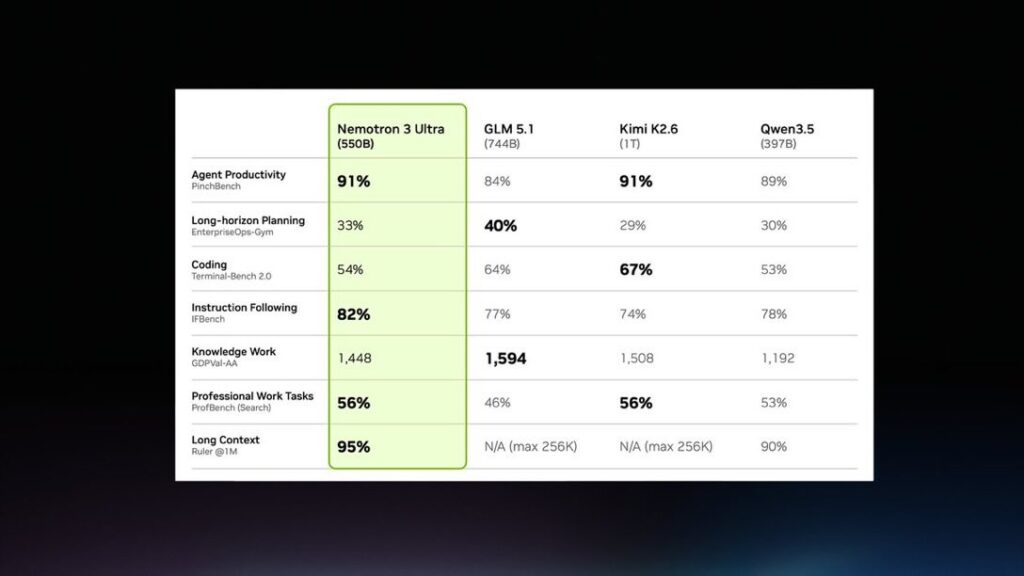
Nemotron-3-Ultra’s design reflects NVIDIA’s effort to combine high reasoning capability with sparse computation. Its official model card reports strong base-model performance across knowledge, mathematics, coding and long-context evaluations. The competitive-programming research adds an important lesson: reasoning ability is not produced exclusively during pretraining. NVIDIA found major benefits from supervised fine-tuning on synthetic competitive-programming traces and even larger end-to-end gains once inference-time search and correction were introduced.
For the general Ultra-CC experiment, the researchers generated 477,642 Ultra training traces and used one supervised fine-tuning epoch in the documented configuration. The paper contrasts that approach with Nano-CC, which also received reinforcement learning. Ultra did not receive code-specific reinforcement learning because the researchers judged supervised fine-tuning sufficiently effective and Ultra-scale reinforcement learning too computationally expensive for their available budget. That finding complicates simplistic comparisons between foundation models. The relevant unit of capability is increasingly the model plus post-training, tools and inference strategy, not simply the model checkpoint viewed in isolation.
How GenCorrect Helped Nemotron Solve the IOI 2026 Problems
Nemotron-3-Ultra-CC did not reach 535.4 by asking one large language model for one answer to each problem. The system was designed around large-scale candidate generation, execution, feedback and refinement. IOI problems are particularly difficult for language models because producing syntactically valid code is only the beginning. A successful solution must infer an algorithm from the statement, reason about constraints, choose an appropriate complexity, implement it correctly and survive hidden test cases. IOI’s partial-credit subtask system makes the process even more interesting because a program can solve certain input regimes while failing others. NVIDIA’s paper describes six problems worth up to 100 points each and a maximum aggregate score of 600.
Nemotron’s strategy exploited that feedback structure. Instead of assuming the first generated program was correct, GenCorrect produced many alternatives, selected a behaviourally diverse subset and submitted representative solutions. It then incorporated the observed subtask scores into subsequent rounds so the model could preserve already solved regions while targeting remaining weaknesses. During IOI 2026, each of the two contest days had a five-hour session containing three problems. NVIDIA reports operating with the same prohibition on internet access, the same allowance for local code execution, the same 50-submission-per-problem limit and the same one-submission-per-minute restriction as the contestants.
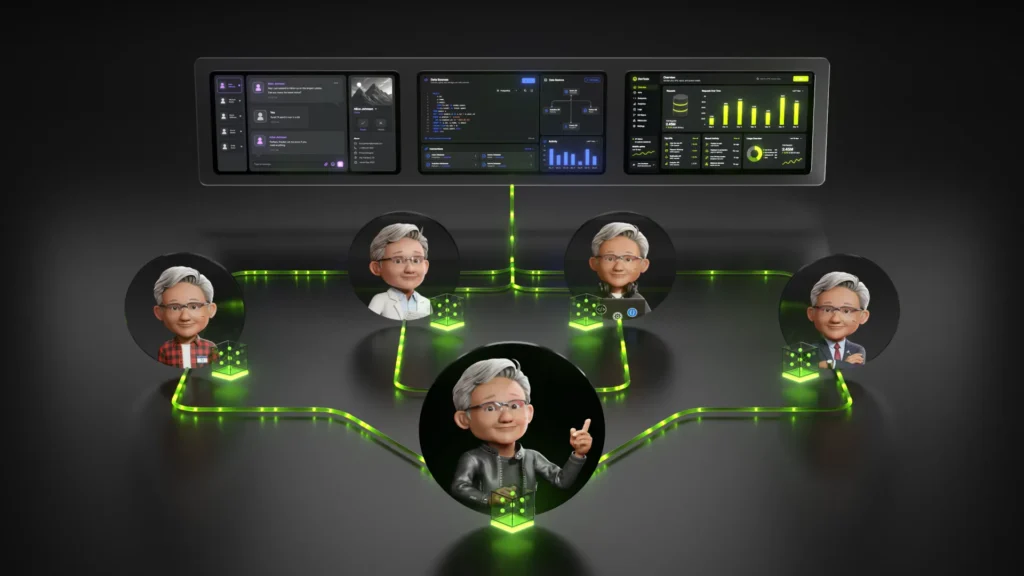
The system can therefore be understood as algorithmic search mediated by a reasoning model. Nemotron proposes implementations, execution gives objective evidence, clustering prevents all submissions from collapsing onto near-duplicates, and later generations use feedback to attack weaknesses discovered in earlier solutions. At inference time, GenCorrect provides the iterative search-and-correction procedure around the model. During the first four competition rounds, it generated 200 potential solutions for each problem and selected ten for submission. In the final round, NVIDIA increased generation to 1,000 candidates and introduced model-generated tests and a ranking procedure to choose the ten submissions judged most promising.
In its standard form, GenCorrect runs for as many as five rounds. Each round starts by producing up to 200 candidate programs. Invalid outputs are removed, and the remaining solutions are compared so the system can select representatives from different behavioural clusters rather than simply submitting ten closely related programs. The ten representatives are then sent to the evaluator. For IOI, the resulting feedback contains scores for subtasks. GenCorrect accumulates the best performance observed for each subtask and conditions the next generation round on that record, together with selected previous solutions intended to preserve successes, address unsolved portions and retain diversity.
Five rounds of ten submissions exactly fit IOI’s 50-submission-per-problem allowance. This is important because unlimited brute-force submission would make the comparison considerably less meaningful. GenCorrect instead attempts to compress information from hundreds of generated candidates into a small number of strategically selected official-style submissions. On the IOI 2025 development benchmark, Ultra-CC’s mean result increased from 343.9 after the first GenCorrect round to 502.0 after five, a gain of 158.1 points. The researchers concluded that the large model benefited particularly strongly from both large candidate pools and iterative evaluator feedback.
GenCorrect addresses one of the central weaknesses of one-shot code generation: a language model can produce a plausible algorithm while making a subtle mistake that hidden tests expose. Simply asking the same model repeatedly can generate many near-identical failures. GenCorrect tries to convert additional inference compute into genuinely useful diversity. Its clustering stage matters because 200 generated programs do not represent 200 independent ideas. Many may implement essentially the same algorithm. Selecting candidates that are dissimilar increases the chance that the limited submission budget tests meaningfully different approaches.
Feedback then changes the process from parallel guessing into sequential problem solving. If one candidate passes certain subtasks and another passes different ones, the system gains information about which conceptual pieces are working. Later generations can be conditioned on the accumulated score vector rather than starting from scratch. The IOI 2025 experiments provide quantitative evidence for that advantage, with Ultra-CC’s first-round average of 343.9 rising to 502 after all five GenCorrect rounds. NVIDIA also found that Ultra’s advantage over the smaller Nano model grew as more inference-time compute was applied, suggesting that a larger model’s value may become more visible when it is allowed to explore and refine multiple candidates rather than being measured only by a single generation.
This result has broader relevance to AI coding systems: improving code-generation quality may depend not only on stronger base models but also on building reliable loops around those models for testing, feedback and revision. The IOI 2026 experiment used a competition-specific configuration rather than merely running the general Ultra-CC pipeline unchanged. NVIDIA first used IOI 2025 as a development benchmark, allowing the researchers to optimise choices without exposing the model to the then-unreleased IOI 2026 tasks. The principal changes concerned training-data selection, final-round search and inference throughput:
- Training-data selection: NVIDIA compared GLM-5.2 and DeepSeek-V4-Flash on the 2025 development set. GLM-5.2 achieved 66.0% Score@1 with shorter average generations, while DeepSeek-V4-Flash achieved 55.3%. The Ultra-CC model trained with GLM-derived data subsequently reached 59.4%, compared with 50.7% for the DeepSeek-derived counterpart, leading NVIDIA to choose GLM-5.2 training data for the live configuration.
- Expanded final-round search: The first four GenCorrect rounds generated 200 solutions each and selected ten submissions. The final round generated 1,000 candidate programs. The model also created 50 problem-specific test-input generators and validators, from which the system obtained 100 valid tests. Compiled candidate programs were executed on those tests, after which a model-produced scoring script ranked them and the ten highest-ranked candidates were submitted.
- Higher-throughput inference: For the live deployment, NVIDIA used an NVFP4-quantised configuration with an FP8 KV cache and Multi-Token Prediction enabled. The live NVFP4 configuration reached 736.8 generated tokens per second per GPU in the reported IOI 2025 throughput experiment, approximately 3.7 times the BF16 baseline, although single-generation performance fell by 6.6 percentage points. The design choice prioritised total search capacity over maximum accuracy from one isolated output, enabling far more candidates to be generated during the fixed contest window.
What Nemotron’s IOI Performance Means for AI Coding Agents and Human Programmers
The result matters because IOI tasks test a form of coding substantially different from routine autocomplete. They demand algorithm discovery, formal reasoning about constraints, efficient implementation and robustness against unseen cases. NVIDIA’s paper specifically frames competitive programming as a test of the ability to synthesise algorithms and produce implementations that survive hidden time and memory constraints. A score of 535.4 also moves the discussion beyond “medal-level AI.” Previous systems had already demonstrated performances around gold-medal thresholds. NVIDIA’s reported 2026 experiment instead crossed the score of the highest official human contestant on that particular IOI set.
The larger significance may be the method rather than the ranking. The system did not rely on perfect first answers. It generated competing hypotheses, tested programs, collected external evidence and revised its strategy. That resembles the workflow desired from practical coding agents: inspect a problem, propose a change, execute tests, diagnose failure and attempt an improved solution. At the same time, the result is not evidence that today’s AI can replace expert software engineers across all real-world work. NVIDIA explicitly cautions that its findings may not generalise beyond competitive programming and notes the considerable training and inference compute involved.
The strongest implication for coding agents is the value of execution-grounded iteration. A useful software agent should not merely output plausible source code and stop. It should run the program, observe failures, determine what information those failures provide, modify its approach and test again. GenCorrect demonstrates how powerful that pattern can become when combined with a capable model. The 2026 system also demonstrates a second principle: candidate selection can matter almost as much as candidate generation. In the final competition round, NVIDIA did not blindly submit ten of 1,000 programs. The system generated its own tests, executed candidates against them and ranked the resulting programs before consuming the scarce submission budget.
For production coding agents, an analogous system might generate several patches, run unit and integration tests, inspect static-analysis output, compare performance regressions and select the patch with the strongest evidence. That is an inference from NVIDIA’s demonstrated methodology rather than a capability directly measured by IOI, but the architectural pattern is clear. The major obstacle is cost. NVIDIA’s live IOI deployment peaked at up to 760 GB300 GPUs, so reproducing this exact level of search is far beyond ordinary developer-agent economics. Future progress will therefore depend partly on obtaining similar correction benefits with smaller candidate pools, cheaper models or more efficient verification.
On a carefully defined metric, AI systems can now outperform elite human competitive programmers. NVIDIA reports that Competition Ultra-CC scored 535.4 on the IOI 2026 problems, and the official IOI scoreboard independently establishes that the top human contestant scored 498.27. The numerical comparison is therefore straightforward. However, the broader interpretation requires more nuance. The AI did not officially enter IOI, was not supervised by IOI organisers and did not operate with resources comparable to an individual student. NVIDIA’s researchers themselves disclose all three points.
What the result demonstrates is that modern AI systems can combine learned algorithmic reasoning with enormous inference-time search, program execution and feedback to achieve superhuman scoreboard performance on at least one fresh elite programming contest. It does not establish that an AI model independently possesses every skill associated with elite human programmers, such as learning efficiently from limited experience, explaining strategy under interrogation, maintaining large software systems or solving broadly unfamiliar engineering problems with minimal computational support.
The next stage of competition is therefore likely to concern efficiency as much as raw score. A 535.4 result backed by hundreds of high-end GPUs demonstrates the level of capability currently achievable. Achieving comparable reasoning with one or a few affordable accelerators would be a different and potentially more transformative milestone, particularly for coding agents expected to operate within the practical resource constraints of everyday software development.
Frequently Asked Questions (FAQs)
- Did NVIDIA Nemotron-3-Ultra-CC officially win IOI 2026?
No. NVIDIA states that the system was not an official contestant and that its run was not supervised by IOI organisers. Its reported 535.4 score therefore does not appear in the official rankings and did not earn an official medal or championship title. The result is described as an unofficial prospective benchmark, meaning the system attempted the problems during the competition window rather than being evaluated retrospectively after their public release. - What score did NVIDIA Nemotron-3-Ultra-CC get at IOI 2026?
NVIDIA reports a score of 535.4 out of 600, approximately 89.23% of the maximum available points. The problem set contained six tasks worth up to 100 points each, with partial credit available through subtasks. This score came from the competition-specific system’s single live run. Five subsequent runs using the more general GenCorrect configuration averaged 521.72 points, but those later evaluations are separate from the reported live result. - What was the highest human IOI 2026 score?
The official IOI 2026 results cited in the article list Qiwen Xu of China in first place with 498.27 points, equivalent to approximately 83.05% of the maximum score. The second-place contestant scored 482.75. Qiwen Xu remains the highest-ranked official contestant regardless of NVIDIA’s separate benchmark, because Nemotron’s reported result was outside the supervised human competition and was not included in its standings. - How much higher was Nemotron’s score than the top human score?
NVIDIA’s reported 535.4 points exceeded the human champion’s 498.27 by 37.13 points. Dividing that difference by the champion’s score gives a relative advantage of approximately 7.45%. This should not be confused with a 37.13-percentage-point improvement: 37.13 is the difference in contest points. The comparison describes the reported scoring advantage, not equivalent resource efficiency or superiority across every programming task. - What was the IOI 2026 gold-medal threshold?
The lowest official gold-medal score was 361.12, achieved by Jerome Austin Te of the Philippines at rank 32. The next contestant scored 358.76 and received silver, establishing the boundary in the published results. Nemotron’s reported 535.4 was 174.28 points above that lowest gold score. It is therefore appropriate to describe the result as above the gold-medal threshold, but not as an officially awarded gold medal. - What does 550B-A55B mean in Nemotron-3-Ultra?
“550B” refers to approximately 550 billion total model parameters, while “A55B” indicates that roughly 55 billion are active when processing a token. Its sparse mixture-of-experts architecture selectively activates parts of the model rather than using every parameter for every token. The designation describes the underlying model, not the complete competition system, which also incorporated specialised training, candidate generation, program execution and iterative correction. - Did Nemotron-3-Ultra-CC use reinforcement learning for the IOI 2026 run?
The competition Ultra system did not receive code-specific reinforcement learning. NVIDIA instead focused on supervised fine-tuning using synthetic competitive-programming reasoning traces, citing strong experimental gains and the computational expense of reinforcement learning at Ultra scale. The system still used execution results and evaluator feedback during the contest, but those informed GenCorrect’s subsequent solution attempts rather than constituting code-specific reinforcement-learning updates to the model. - What is GenCorrect?
GenCorrect is NVIDIA’s iterative inference-time procedure for generating, selecting and improving program candidates. It produces many potential solutions, chooses behaviourally diverse representatives and uses evaluator feedback to guide later attempts. The live configuration generated 200 candidates per problem in each of the first four rounds and 1,000 in the final round. Selecting ten submissions per round kept the five-round process within IOI’s 50-submission-per-problem allowance while allowing much broader internal exploration. - How much hardware did NVIDIA use for the live IOI experiment?
NVIDIA reports a peak live allocation of up to 760 NVIDIA GB300 GPUs. “Peak” describes the maximum reported allocation, not necessarily the hardware usage throughout every stage of the experiment. This infrastructure supported large-scale solution generation within the competition’s time limits. Consequently, the researchers frame the result as a system-level score comparison under matched contest restrictions, not an equal-resource contest between an AI model and an individual student. - Does the Nemotron result prove AI is better than human programmers?
It supports a narrower conclusion: according to NVIDIA’s reported prospective benchmark, the complete system scored higher than every official contestant on the IOI 2026 problem set under matched time, submission and internet-access restrictions. It does not establish superiority across software engineering, including maintaining large codebases or handling unfamiliar practical requirements. NVIDIA also acknowledges that the findings may not generalise beyond competitive programming, while the unofficial evaluation and substantial compute requirements remain important qualifications.
Conclusion
NVIDIA Nemotron-3-Ultra-CC’s reported 535.4 out of 600 on the IOI 2026 problem set is an important milestone in AI coding because it moves beyond merely reaching a medal threshold. The official human champion scored 498.27, while the final gold-medal score was 361.12, making NVIDIA’s reported result 37.13 points above first place and 174.28 points above the gold boundary.
The achievement depended on far more than a huge language model. Nemotron-3-Ultra provides a 550-billion-total, 55-billion-active hybrid Mamba2-Transformer LatentMoE foundation. Competitive-programming SFT specialised that foundation. GenCorrect generated, clustered, executed and refined hundreds of candidate solutions. Competition-specific modifications expanded the final candidate pool to 1,000 programs, generated additional tests and ranked solutions before submission. NVFP4 quantisation increased generation throughput, and the live infrastructure scaled to as many as 760 GB300 GPUs.
That system design may be the most important aspect of the result. It suggests that the frontier of AI coding increasingly lies in closed-loop agents that can reason, execute, receive objective feedback and correct themselves rather than in models that simply produce one answer.
Accuracy about the comparison is equally important. Nemotron-3-Ultra-CC did not officially compete in IOI 2026, did not receive a medal and was not supervised by the IOI. NVIDIA describes the experiment as an unofficial unsupervised benchmark conducted prospectively under matched contest time, submission-platform, internet and submission constraints. The researchers also acknowledge the enormous compute difference between the AI system and human contestants.
Properly stated, the milestone is still remarkable: on a fresh IOI problem set, a specialised AI system using execution-grounded iterative reasoning produced a higher score than the world-leading official human contestant. The next frontier is not merely to repeat that score, but to determine how efficiently, reliably and generally such reasoning can be transferred from programming competitions into real software-development agents.
Sources and Citations
- NVIDIA’s Post-Training Language Models paper — 535.4 result, GenCorrect, training, inference and limitations
- Official IOI 2026 page — event/location/date confirmation
- Official IOI 2026 results database — official rankings and medal thresholds
- NVIDIA Nemotron 3 Ultra documentation — 550B/55B architecture and model details
Recommended
- Designing Blender Hair for Stylized and Realistic Characters: Fantasy, Sci-Fi, Historical, Modern, and Cartoon Styles
- Corsair Cove: Complete Black Powder Material Guide
- $270 Stranger Things: the Complete Series Blu-Ray Collection Announced 25 Discs, 148-Page Artbook, and Exclusive Hellfire Club D20 Dice
- How Switching Between GTA 6’s Two Protagonists Works
- Rune Dice Achievement and Trophy Guide: How to Unlock Every Achievement
- Valor Mortis Release Date Delayed to October 13: New Launch Date, Reasons Behind the Crowded Release Schedule, and What to Expect
- Witchspire: How to Get Coins Fast (Best Money Methods and Early Routes)
- Ubisoft Keeps Guidance Despite Black Flag Remake Success
- Destroy All Humans! Switch 2 Release Date, Features, and Everything to Know This Week



































































































