





In This Article (8 sections)
Ocarina of Time Remake Full English Voice Cast and Major Character Roles
The Legend of Zelda: Ocarina of Time remake launched for Nintendo Switch 2 on November 5, 2026, with fully voiced cutscenes and expanded character dialogue. The English credits identify Erica Mendez as Princess Zelda and Sheik, Matt Mercer as Ganondorf, and Lisa Reimold as Navi. Richard Epcar voices the Great Deku Tree, while Deva Marie Gregory voices the Deku Tree Sprout. Suzie Yeung plays Saria, Laura Post plays Impa, Josh Petersdorf voices Darunia, Anne Yatco plays Princess Ruto, Cristina Vee voices Nabooru, and Frank Todaro performs both Kaepora Gaebora and Rauru. Reba Buhr voices Koume, Kotake, and their combined form, Twinrova.
IGN verified the English cast against the remake’s credits for its November 5 report, while Nintendo Everything published its cast coverage on November 4 and Zelda Universe published its English lineup on launch day. The reports agree on the performers behind the principal characters, although their wording differs slightly in places. IGN explicitly credits Buhr for Twinrova as well as Koume and Kotake, while Nintendo Everything and Zelda Universe list her English role under the names of the two witches. Several performers therefore cover more than one identity or form within the same story. The cast details also include spoilers involving Sheik and the identities of the Sages.
Erica Mendez voices both Princess Zelda and Sheik in the English version, marking her first performance as Princess Zelda. Her earlier Nintendo roles include Lianna in Fire Emblem Warriors, Bernadetta in Fire Emblem: Three Houses, and Great Fairy Tera in Hyrule Warriors: Age of Calamity. The shared Zelda and Sheik credit follows one of Ocarina of Time’s central story developments, with young Zelda warning Link about Ganondorf before Sheik later guides him during the adult portion of the adventure.
The two identities require different kinds of delivery because Zelda must persuade Link to take a threat seriously, while Sheik provides guidance without revealing the personal connection behind it. Other language tracks do not necessarily use the same casting structure, with some localizations assigning separate performers to young Zelda, adult Zelda, and Sheik.
Matt Mercer reprises Ganondorf after previously voicing the character in The Legend of Zelda: Tears of the Kingdom. Nintendo publicly identified Mercer as Ganondorf’s English actor in 2023, and players recognized a familiar voice when the Ocarina of Time remake was shown before launch. In this story, however, Mercer plays Ganondorf at an earlier point and under different circumstances, beginning with Zelda’s suspicions while he still operates within Hyrule’s political order. Adult Link later encounters the consequences of Ganondorf’s rise to power after the seven-year gap. Mercer’s return provides continuity for English-speaking players even though the two games present the character in different eras and relationships.
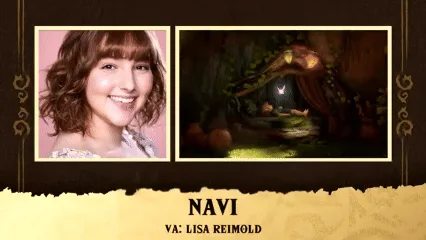
Lisa Reimold voices Navi, giving extended dialogue to a character whose short calls already formed part of the original game’s recognizable sound. Reimold previously played Framme in Fire Emblem Engage. Navi accompanies Link from Kokiri Forest through the rest of his journey, so the role serves both as a character performance and as part of how the game communicates information to the player. Nintendo said the development team wanted the new voices to fit players’ established impressions of the characters, especially when familiar sounds such as Navi’s “Listen!” already carried decades of recognition. The English credits identify Reimold, while the Japanese cast uses Kaori Mizuhashi for Navi.

The Sages, Kokiri Forest Characters, Ganondorf, and Twinrova Voice Performances
Richard Epcar voices the Great Deku Tree, while Deva Marie Gregory voices the Deku Tree Sprout. Epcar is known for roles including Ansem in Kingdom Hearts, while Gregory previously voiced Flayn in Fire Emblem: Three Houses. The two characters appear at very different stages of Link’s relationship with Kokiri Forest. The Great Deku Tree sets the adventure in motion by sending Navi to summon Link and directing him toward his first dungeon. The Deku Tree Sprout appears much later and provides important information about Link’s origins after the Forest Temple is completed.
Suzie Yeung voices Saria, Link’s childhood friend and the Sage of Forest. Her relationship with Link begins before the larger conflict in Hyrule has fully taken shape, which gives her later appearance additional emotional weight after the seven-year time jump. Saria’s Song already connected the character strongly to the game’s musical identity in the original release. Voiced dialogue adds another recognizable dimension to her farewell and her later role in the Forest Temple storyline. Her position among the Sages also makes Link’s return to Kokiri Forest both a major part of the attempt to save Hyrule and a reunion with someone closely associated with his childhood.
Frank Todaro voices both Kaepora Gaebora and Rauru in the English cast. The owl guides young Link as the world opens beyond Kokiri Forest, while Rauru meets adult Link in the Chamber of Sages and explains the passage of seven years and the need to awaken the other Sages. The shared actor credit reflects the long-standing connection between the two roles established in the original game’s lore. A Gossip Stone describes Kaepora Gaebora as the reincarnation of an ancient sage, while character references connect the owl specifically with Rauru. The Japanese version also pairs the roles under a single performer, Tsuguo Mogami.
Laura Post voices Impa, Zelda’s protector, a member of the Sheikah, and the Sage of Shadow. Post previously played Yunaka in Fire Emblem Engage. Impa first helps Link after his meeting with Zelda and teaches him Zelda’s Lullaby, giving him information and direction from within the royal family’s inner circle. Her later association with Kakariko Village and the Shadow Temple expands her role beyond serving as Zelda’s attendant. The voiced performance therefore spans both her early authority and her later importance to one of the game’s darker sections.
Josh Petersdorf voices Darunia, leader of the Gorons and eventual Sage of Fire. Darunia’s first major encounter with Link already had a strong performance element in the Nintendo 64 release because he moves from irritation to an exuberant dance when Link plays Saria’s Song. Spoken dialogue adds another layer to that sudden shift in mood and helps establish the relationship that becomes more serious when Link returns as an adult. By the Fire Temple portion of the story, Darunia’s concern has shifted toward the survival of his people. Petersdorf’s role therefore spans the character’s more comedic introduction and the later crisis that establishes his place among the Sages.
Anne Yatco voices Princess Ruto in English, covering the Zora princess during both the childhood and adult portions of the story. Young Ruto directs Link throughout the events inside Lord Jabu-Jabu even while he is trying to rescue her. When Link returns as an adult, she is dealing with the danger facing Zora’s Domain and eventually becomes the Sage of Water. Her direct personality remains recognizable across those two stages even as her responsibilities change. Some other language tracks split young and adult Ruto between separate performers, while the English credits use one actor.
Cristina Vee voices Nabooru, the Gerudo who opposes Ganondorf and later becomes the Sage of Spirit. Her early conversation with Link is important because it provides a perspective on Ganondorf from within his own people. That opposition also establishes the conflict that later connects her to Koume, Kotake, and the Spirit Temple. The temple’s use of both child and adult Link allows Nabooru’s first appearance to shape the meaning of what the player later learns about her fate. Vee’s performance therefore connects the early establishment of Nabooru’s independence with the later resolution of her story.
Reba Buhr voices Koume, Kotake, and Twinrova in English. Koume and Kotake are the fire and ice witches associated with the Spirit Temple, while Twinrova is their combined form. Using one performer for all three identities allows the individual sisters, their interactions with one another, and their fused boss form to remain connected through the same voice performance. IGN explicitly lists Twinrova alongside Koume and Kotake, while some other cast reports name only the two witches under Buhr’s English credit. Other localizations can split the roles differently, which explains why cast lists from different language tracks do not always match one-to-one.

Link’s Silence, Additional Voice Support, and How the English Cast Differs Across Languages
Link continues to have no spoken dialogue in the Ocarina of Time remake. Voiced cutscenes allow characters around him to speak while he responds through his actions, reactions, and movement rather than through spoken lines. IGN’s English cast report contains no named dialogue role for Link. Nintendo Everything’s Japanese credits list Serika Hiromatsu as young Link and Shou Komura as adult Link, which is compatible with the character making vocal sounds without participating in conversations. The distinction matters because hearing grunts, shouts, or exertion sounds does not mean Link has been given spoken story dialogue.
That decision changes the rhythm of scenes because everyone around Link now has a fully voiced performance while he remains silent. Zelda can communicate urgency through delivery, Rauru can give explanations with an audible pace and emphasis, and Navi can respond conversationally while Link’s actions continue to function as his answer. His ocarina playing remains one of the most important ways he interacts with the world. Nintendo also added a feature that recognizes melodies hummed into the Switch 2 microphone and has Link perform them in the game. That mechanic belongs to musical interaction rather than spoken dialogue and does not change Link’s silent-protagonist role.
Daniel Bushey, Rachel Seeley, Danny Hunt, and Haley Hanna Hunt receive voice support credits in the English version. Published cast reports give them a collective attribution rather than assigning each performer to a specific named character. Their inclusion belongs in a complete account of the English credits, but the available information does not support identifying them with particular townspeople, creatures, or incidental vocal parts. The wording of the credits should therefore be preserved rather than expanded into unsupported character assignments. Other language tracks use different categories, including broader additional voices credits.
The cast must also be understood on a language-by-language basis because Nintendo did not necessarily cast corresponding characters in the same way for every localization. The English version combines Zelda and Sheik under Erica Mendez, while some other languages use separate performers for young Zelda, adult Zelda, and Sheik. English credits Anne Yatco for Ruto across both ages, while other language versions can split young and adult Ruto. Frank Todaro covers both Kaepora Gaebora and Rauru in English, and the Japanese version also pairs those roles under one performer. Reba Buhr covers Koume, Kotake, and Twinrova in English, while some localizations divide the sisters and combined form between different actors.
Players can select different voice languages through the game’s System options. The same settings area also includes controls for subtitles and speaker names. Those options make it easier to follow conversations with several speakers and allow players to compare how the same scene is performed in different localizations. Because casting choices vary, switching languages can result in more than just a change of spoken language. It can also change how many actors portray a single character across different ages, identities, or forms.

How Full Voice Acting Changes Ocarina of Time Compared with the Nintendo 64 Original
The 1998 Nintendo 64 version presented most conversations through on-screen text supported by music, animation, and short vocal sounds. Navi’s calls and Link’s exertion noises gave the game a recognizable vocal identity without a cast speaking the story’s conversations line by line. The Switch 2 remake retains the same broad two-era adventure while adding spoken performances to its cutscenes and expanding character dialogue. Nintendo connected this decision to the remake’s more detailed presentation, with the development team feeling that the upgraded visuals called for voiced scenes. The result changes how familiar conversations are paced while preserving much of the original structure around them.
Recorded dialogue fixes elements of performance that text previously left to the player’s imagination. A written warning from Zelda can be read at any pace and with whatever emphasis the player supplies internally. A voiced performance determines pauses, urgency, emotional tone, and timing. Rauru’s explanations, Darunia’s changes in mood, and Nabooru’s opposition to Ganondorf can therefore establish character through delivery as well as through the wording of the scene. Link’s silence becomes more noticeable in that environment precisely because everyone around him now speaks aloud.
Navi demonstrates how Nintendo had to connect new dialogue with an audio identity already established in 1998. Her brief calls had become familiar to players even though the original did not include fully voiced conversations. Extending that character into longer spoken exchanges required a performance that could remain recognizable while also handling clearer conversational timing and sustained dialogue. Nintendo’s developer interview indicates that the team wanted voice casting to respect the impressions players already associated with the characters. The goal was therefore not simply to add speech but to make the new performances feel compatible with memories of the original.
The voice acting is part of a larger audio redesign rather than an isolated feature. Nintendo added environmental sounds such as running water and rustling leaves, recorded a real ocarina, and supported 5.1-channel surround sound. These additions create a more detailed acoustic environment around the voiced scenes. They also help preserve the importance of music and familiar sounds rather than allowing dialogue to dominate every part of the presentation. The remake uses voice performances as one component of a broader attempt to make the world sound as substantially rebuilt as it looks.
The English cast reflects that balance between familiarity and reinterpretation. Matt Mercer returns as Ganondorf from a recent Zelda game, while Erica Mendez and Lisa Reimold provide new English performances for Zelda, Sheik, and Navi. Several performers handle multiple identities that already have narrative connections, including Zelda and Sheik, Kaepora Gaebora and Rauru, and Koume, Kotake, and Twinrova. Separate performers give the Great Deku Tree and Deku Tree Sprout distinct voices even though they frame Link’s relationship with the same forest. These decisions allow the remake to make its story more audible without changing the fundamental roles those characters occupy in Ocarina of Time.
The end result is a remake in which spoken performance changes the presentation more than the underlying narrative structure. The same characters still guide Link, challenge him, reveal information, and become Sages at the same major points in the story. What changes is how directly tone, rhythm, and personality reach the player. A returning player no longer supplies every voice internally, while a newcomer encounters the cast as part of the game’s presentation from the beginning. Link remains the notable exception, preserving his silent role even as the world around him becomes fully voiced.

Frequently Asked Questions (FAQs)
- When was the Ocarina of Time remake English voice cast revealed?
The English cast became public around the remake’s launch in early November 2026. Nintendo Everything published its cast list on November 4, one day before the Nintendo Switch 2 release. IGN followed on November 5 with a report that checked the English performers against the credits in the released game. That launch-day verification confirmed the actors attached to the principal characters and clarified some multi-role credits. The timing means the full English lineup was effectively established immediately before and at launch rather than through a single earlier Nintendo cast announcement. - Who voices Princess Zelda and Sheik in the Ocarina of Time remake?
Erica Mendez voices both Princess Zelda and Sheik in the English version of the remake. This is her first performance as Princess Zelda, although she previously worked on other Nintendo games, including Fire Emblem titles and Hyrule Warriors: Age of Calamity. Giving both identities to the same performer follows the story’s connection between Zelda and Sheik. The two roles still require noticeably different performances because young Zelda speaks as a princess worried about Ganondorf, while Sheik acts as a guarded guide during Link’s adult journey. Other language versions can divide those identities among multiple actors, so the combined credit specifically describes the English cast. - Is the Ganondorf voice actor the same as in Tears of the Kingdom?
Yes. Matt Mercer voices Ganondorf in both the 2026 Ocarina of Time remake and 2023’s Tears of the Kingdom. Nintendo had already publicly identified Mercer as Ganondorf’s English actor for Tears of the Kingdom, so some players recognized his voice when the remake was shown before release. The two performances portray the same character in different stories and circumstances rather than continuing one identical version of Ganondorf. In Ocarina of Time, players first encounter him while he is still operating within Hyrule’s political order before seeing the consequences of his rule seven years later. - Who voices Navi in English and Japanese?
Lisa Reimold voices Navi in the remake’s English track, while Kaori Mizuhashi is credited for Navi in Japanese. Reimold previously voiced Framme in Fire Emblem Engage. Navi is unusually important to the remake’s voice design because the original game already gave her highly recognizable short calls such as “Listen!” even though its conversations were largely text-based. The development team wanted the expanded performances to remain compatible with how players remembered the characters sounding. The English and Japanese versions therefore have different actors while preserving Navi’s familiar role as Link’s guide throughout the adventure. - Does Link have dialogue or a named English voice actor?
Link does not receive spoken dialogue in the remake, and the published English cast does not list a named performer for him. He continues to communicate mainly through actions, reactions, expressions, and gameplay rather than participating in conversations with spoken responses. The Japanese credits do list Serika Hiromatsu for young Link and Shou Komura for adult Link. Those credits can cover vocal sounds such as shouts, grunts, and exertion noises without giving Link actual dialogue. The distinction is important because hearing Link make sounds during gameplay does not mean Nintendo changed him into a fully voiced protagonist. - Are the Great Deku Tree and the Deku Tree Sprout played by the same person?
No. The English remake gives the two characters separate performers. Richard Epcar voices the Great Deku Tree, while Deva Marie Gregory voices the Deku Tree Sprout. The distinction fits their different places in Link’s story, with the Great Deku Tree appearing at the beginning to set his journey in motion and the Sprout appearing much later after the Forest Temple. The Sprout also reveals information about Link’s origins that changes how the player understands his childhood in Kokiri Forest. Separate actors therefore give the two generations of the forest guardian distinct voices while preserving their connection to the same place. - Who voices Kaepora Gaebora and Rauru?
Frank Todaro voices both Kaepora Gaebora and Rauru in the English version. Kaepora Gaebora is the owl who guides young Link as he begins exploring areas beyond Kokiri Forest, while Rauru is the Sage of Light who explains Link’s situation after the seven-year time jump. Giving the two roles to one actor reflects the long-standing connection between the characters in Ocarina of Time’s lore. The original game contains information linking the owl to an ancient sage, and character references identify that connection with Rauru. The Japanese remake similarly pairs the two roles under one performer, although it uses a different actor. - Does Reba Buhr voice Twinrova as well as Koume and Kotake?
Yes. IGN’s credits-verified English cast report identifies Reba Buhr as the performer for Koume, Kotake, and Twinrova. Koume and Kotake are the two witches associated with fire and ice in the Spirit Temple, while Twinrova is the form they create when they combine. Some cast reports list Buhr only under the names Koume and Kotake, which can make the Twinrova credit appear unclear at first. IGN’s listing confirms that the combined boss form is included in her English performance. Other language versions can divide the sisters and Twinrova among different actors. - Is all dialogue in the Ocarina of Time remake voiced?
Nintendo describes the remake as having fully voiced cutscenes and expanded character dialogue. That means major cinematic conversations now feature spoken performances rather than relying entirely on the text presentation used in the Nintendo 64 version. The description does not mean every possible piece of text or every gameplay interaction necessarily becomes a fully performed conversation. Link also remains silent and does not receive spoken story lines even when other characters address him. The major change is that the remake’s cutscenes and expanded character exchanges now use voice performances while preserving Link’s traditional silent role. - Can you change the voice language in the Ocarina of Time remake?
Yes. Players can change the spoken language through the game’s settings. Open the in-game menu, move to the System tab, select Options, and use the Voice Language setting to choose an available voice track. The same area includes options controlling subtitles and whether speaker names are displayed. These settings are particularly useful because the cast structure can differ between languages, with some localizations using separate performers for identities or age groups that share one actor in English. Changing the voice language therefore lets players compare both the performances and the different casting choices across localizations.

Conclusion
The Zelda: Ocarina of Time remake’s English cast gives the 1998 adventure spoken performances anchored by Erica Mendez as Zelda and Sheik, Matt Mercer as Ganondorf, and Lisa Reimold as Navi. The credits also capture connections that matter to the story. Frank Todaro plays the owl guide and the Sage of Light, Reba Buhr plays the witch sisters and their combined form, and Richard Epcar and Deva Marie Gregory voice successive guardians of Kokiri Forest.
Nintendo’s approach makes the biggest difference in scenes players remember by sound or gesture. Navi’s familiar call had to carry over into a fuller performance. Darunia’s dance still has its music, with spoken dialogue now giving his change of mood another register. Link still leaves his responses to his actions. The result is a cast that changes how Hyrule’s inhabitants tell the story while preserving the role of music, movement, and silence in how Link takes part.
Sources and Citations
- IGN via Yahoo Tech, November 5, 2026: Reports the English cast after checking the in-game credits, including Reba Buhr’s Twinrova credit and the four voice support contributors.
https://tech.yahoo.com/gaming/articles/legend-zelda-ocarina-time-remake-075250443.html - Nintendo Everything, November 4, 2026: Provides the English cast, earlier actor credits, and cast lists for other localizations.
https://nintendoeverything.com/zelda-ocarina-of-time-remake-voice-actors/ - Zelda Universe, November 5, 2026: Reports the English character cast and identifies the four contributors credited for voice support.
https://zeldauniverse.net/2026/11/05/voice-actor-cast-for-the-ocarina-of-time-remake-is-revealed/ - Nintendo, “The Legend of Zelda 40th Anniversary Direct”: Confirms the release date, fully voiced cutscenes, and expanded character dialogue.
https://www.nintendo.com/us/whatsnew/the-legend-of-zelda-40th-anniversary-celebration-revealed-in-new-nintendo-direct-presentation/ - Nintendo UK, “Ask the Developer Vol. 24, Chapter 4”: Describes the voice casting goals, the blind Japanese auditions, and the remake’s wider audio changes.
https://www.nintendo.com/en-gb/News/2026/November/Ask-the-Developer-Vol-24-The-Legend-of-Zelda-Ocarina-of-Time-Chapter-4-3230321.html - Nintendo, May 30, 2023: Identifies Matthew Mercer as Ganondorf’s voice actor in Tears of the Kingdom.
https://www.nintendo.com/us/whatsnew/critical-role-x-the-legend-of-zelda-tears-of-the-kingdom/ - Nintendo, “The Legend of Zelda: Ocarina of Time Launch Announcement”: Confirms that the remake launched on November 5, 2026, exclusively for Nintendo Switch 2.
https://www.nintendo.com/us/whatsnew/its-time-experience-the-legend-of-zelda-ocarina-of-time-reborn-exclusively-for-nintendo-switch-2/ - Siliconera, November 5, 2026: Reports English character assignments from the remake’s credits and notes actor announcements made around launch.
https://www.siliconera.com/english-the-legend-of-zelda-ocarina-of-time-remake-voice-actors-revealed/ - Zelda Dungeon Wiki, “Ocarina of Time Characters”: Documents the characters’ roles in the original story and their relationships to the Sages and temples.
https://www.zeldadungeon.net/wiki/Ocarina_of_Time_Characters - Zelda Dungeon Wiki, “Ocarina of Time Gossip Stones”: Records the original in-game clue about Kaepora Gaebora and the ancient sage.
https://www.zeldadungeon.net/wiki/Ocarina_of_Time_Gossip_Stones - How to Video Game, November 6, 2026: Documents the remake’s voice language menu, subtitle settings, and speaker-name display options.
https://howtovideogame.com/ocarina-of-time-remake-voice-cast/
Recommendations
- Echo Weaver Release Date, Platforms, Gameplay and Story Guide
- Major Pokémon Go 10th Anniversary Broadcast Announced: Date, Time, Twitch Drops, and What to Expect
- Prince of Persia The Lost Crown Is Free on Switch With One Catch
- The Last Ronin Noir Novel Explained: How TMNT’s Darkest Story Gets Even Deeper
- HBO Harry Potter Making Of Documentary: Everything We Know About Finding Harry and the Big-Budget Wizarding World Series
- Kynseed Console Launch and Beast of Reincarnation Explained
- Boris FX Continuum 2026.5: New AI Deinterlacing, FX Editor Updates, and Particle Illusion Improvements
- SoftBank Plans $50 Billion Malaysia AI Investment, Prime Minister Anwar Says
- Ballistic Moon, the Developer Behind the “Until Dawn” Remake, Has Shut Down: What Happened to the Studio and the Future of the Game
- Boston Dynamics Atlas Gets Scooter Wheels and Lands a 360-Degree Jump First Try



































































































