












In This Article (9 sections)
Doctrine’s Background and Support Role in Overwatch Season 5
Doctrine is a vampire-inspired Support hero introduced to Overwatch on October 6, 2026, alongside Season 5, officially titled Reign of Talon: A Grim Doctrine. His kit combines ranged healing, offensive pressure, mechanical drones, and flexible movement, giving him several ways to influence engagements beyond simply restoring health. Unlike healers who primarily concentrate on keeping teammates alive, Doctrine rewards players who alternate between supporting allies, damaging opponents, and empowering abilities through his signature Infuse mechanic.
His effectiveness depends on maintaining appropriate distance, choosing targets carefully, and deciding whether an engagement requires additional healing, damage, or defensive mobility. This Overwatch: Doctrine hero abilities and tips guide covers his abilities, perks, combinations, team synergies, counters, and competitive strategies, with particular attention to the changes introduced for his Season 5 release.
Doctrine’s real name is Tamuka Yeukai, a former cyberneticist whose determination to save his chronically ill brother, Tatenda, eventually led him toward increasingly unethical experiments involving human lives and experimental technology. Although his original motivation was to preserve someone he loved, his methods produced devastating consequences and placed his scientific ambitions in direct conflict with conventional morality. His actions ultimately resulted in imprisonment at Watchpoint: Grímsvötn, where he remained for decades before Doomfist orchestrated his escape.
Blizzard’s official character biography identifies Doctrine as 77 years old, gives his birthday as October 20, and lists Watchpoint: Grímsvötn as his base of operations. His Eternal Scepter and mechanical drones reflect that scientific background, while his varied support tools reward mechanically confident players who enjoy proactive decision-making. In gameplay, he belongs to the Support category and uses the Survivor sub-role passive, which initiates passive health regeneration when he uses movement abilities.

Doctrine’s Abilities, Combat Uses and Season 5 Balance Changes
Doctrine’s five active abilities work together to provide healing, damage, mobility, and team-wide utility, but their launch values differ from those demonstrated during his earlier trial. Blizzard explained that the hero performed above expectations during that period, prompting several adjustments in the October 6, 2026, balance update. Those changes affect Invigorating Drones, Shrouded Momentum, Deliverance, and the Transfusion perk, making older advice less reliable when it assumes trial-level effectiveness.
Not every weapon statistic or ability timing is specified in the public descriptions referenced here, including exact damage, healing per shot, individual ranges, and resource recovery timings. For those details, the current in-game Advanced Info Panel should take precedence over unverified figures or information from earlier builds. Blizzard expanded the panel in Season 5 to include additional projectile speed, projectile size, and ability mechanic information.
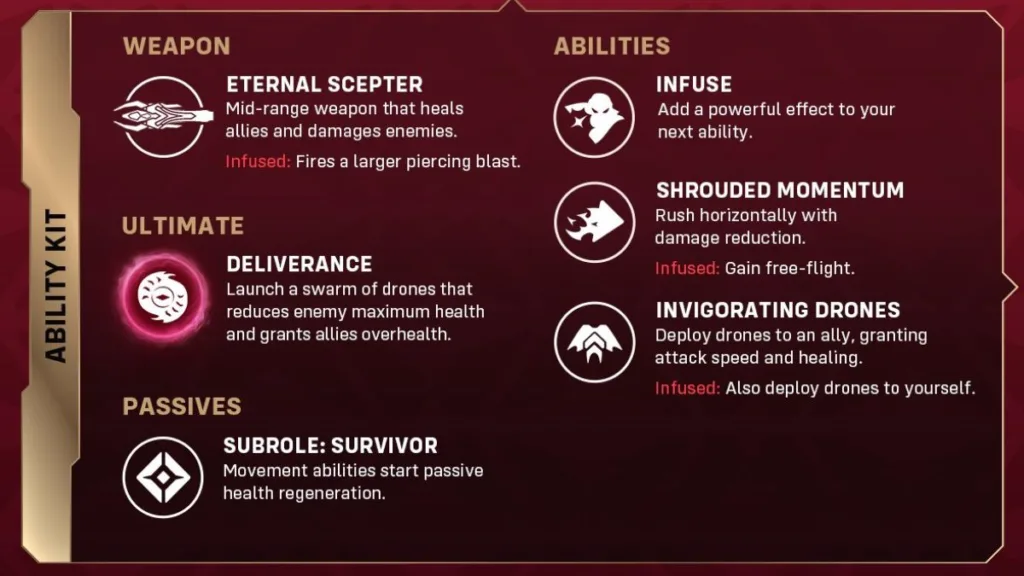
Eternal Scepter is Doctrine’s primary weapon, healing friendly targets and damaging enemies at medium range. Its dual purpose requires constant awareness of both teams, since concentrating exclusively on damage can leave vulnerable teammates without support, while ignoring exposed opponents can waste offensive opportunities. Accuracy and target selection are therefore central to maintaining useful pressure without neglecting healing. When empowered by Infuse, Eternal Scepter fires a larger piercing blast capable of affecting multiple targets along the same firing path.
Look for aligned characters, such as an enemy retreating behind another opponent, or arrange useful firing angles through teammates when enhanced healing is needed. Doorways, narrow corridors, and other predictable movement paths can make these shots easier to land because targets have fewer opportunities to change direction. Use natural cover and disciplined peeking rather than remaining exposed to maintain continuous fire, since sustained accuracy and survival provide more value than risky shots.
Infuse empowers Doctrine’s next eligible ability, allowing him to enhance Eternal Scepter, Invigorating Drones, or Shrouded Momentum according to the situation. Doctrine has two Infuse charges, which provide opportunities to strengthen successive actions during an engagement rather than relying on a single enhanced ability. However, those charges should not be spent automatically whenever they become available, because the best option depends on immediate team needs and the pressure Doctrine is likely to face next.
An Infused Eternal Scepter shot is useful when aligned enemies offer an opportunity for piercing damage, while Infused Invigorating Drones can support an ally and improve Doctrine’s own sustain simultaneously. Infused Shrouded Momentum provides free-flight when a horizontal escape is insufficient or a different angle is needed. Spending charges offensively can create an advantage, but doing so without considering an approaching dive may leave fewer defensive options available. Effective Infuse management therefore relies on adapting to the engagement rather than following one fixed rotation.
Invigorating Drones deploys mechanical drones to an allied hero, providing healing and increased attack speed. The October 6 launch update reduced its attack-speed bonus from 35% during the trial to 30%, preserving its offensive utility while lowering its overall contribution. Target selection should account for both parts of the ability: a teammate actively attacking can immediately benefit from the speed increase, but a critically injured ally may require healing regardless of offensive potential.
A frontline tank maintaining pressure is often a useful target, as are Damage heroes who can capitalize on repeated weapon attacks during an appropriate engagement window. Before deploying drones, consider whether the ally is preparing to attack, retreat, or reposition, since the strongest uses allow the target to benefit immediately from both effects. When Infused, the ability also deploys drones to Doctrine, making it particularly useful when he and the selected teammate are both under pressure. Nevertheless, drones should complement good positioning and other support resources, not be treated as guaranteed protection for an isolated ally already overwhelmed by concentrated fire.
Shrouded Momentum launches Doctrine horizontally while providing temporary damage reduction, allowing him to move between cover, escape unfavorable engagements, and avoid incoming attacks. At launch, its cooldown increased from seven seconds to eight seconds, its damage reduction fell from 50% to 40%, and it stopped granting immunity to critical hits. These changes make it important to reposition before opponents fully surround Doctrine rather than waiting until his health is critically low. Move toward cover or teammates instead of assuming the ability will carry him safely through concentrated attacks.
Infuse transforms Shrouded Momentum into free-flight, providing access to elevated positions, routes around difficult terrain, and firing angles unavailable through the standard horizontal rush. However, flying into an open area can expose Doctrine to several enemies at once, so additional movement flexibility does not replace route planning. The ability also interacts with Survivor by initiating passive health regeneration, creating opportunities to disengage, recover, and return to supporting teammates, provided Doctrine first escapes active danger.
Deliverance is Doctrine’s Ultimate, launching a swarm of mechanical drones that grants overhealth to affected allies while temporarily reducing affected enemies’ maximum health. This combination supports both offensive pushes and defensive stabilization, particularly when teams are contesting an objective or committing to a coordinated engagement. On a control point, for example, allied overhealth can help teammates advance while the enemy maximum-health reduction creates an opportunity for concentrated damage.
Its effectiveness depends on whether teammates can capitalize on those effects, since scattered allies may receive less defensive value and an unsupported enemy debuff may produce little offensive benefit. Activate it around a meaningful commitment, such as shortly before teammates use major offensive abilities or when opponents begin an aggressive push. Deliverance can help stabilize a dangerous fight, but it should not be treated as guaranteed protection against every opposing Ultimate.
The launch adjustments changed Deliverance’s application speed and duration compared with the trial version. Blizzard increased its drone fire rate from four to five, reduced the duration of its overhealth and maximum-health reduction effects from eight seconds to six seconds, and shortened the associated decay duration from five seconds to four seconds. Doctrine’s overall Ultimate charge requirement also increased by 8%, making unnecessary activations more costly across successive engagements.
Together, these changes preserve its ability to produce an immediate impact while reducing its sustained influence. Its shorter effect window makes coordinated follow-up particularly important, so communicate before activation and identify which teammates are ready to exploit it. Using Deliverance during an actual, winnable engagement generally provides more value than either saving it indefinitely or committing it after the fight is effectively lost.
Best Doctrine Perks, Builds and Ability Combinations
Doctrine unlocks his Minor Perks at Level 2 and his Major Perks at Level 3, allowing players to adapt his kit to their preferred approach and the demands of the match. Among the Minor Perks, Saving Grace causes Invigorating Drones to restore 40 health immediately when applied, improving its ability to stabilize teammates during unexpected damage spikes.
This makes it a dependable option for beginners and for matches where allies frequently face concentrated pressure. Sanguine Siphon, the alternative Minor Perk, heals Doctrine for 50% of the damage dealt by an Infused Eternal Scepter attack. It rewards players who consistently land enhanced shots and can improve personal survivability without abandoning offensive pressure. However, its value depends on successful execution, so players who struggle to connect Infused attacks may receive more consistent results from Saving Grace.
The Major Perk Transfusion reduces Infuse’s cooldown through damage and healing, creating more opportunities to empower abilities when Doctrine consistently participates in combat. Blizzard reduced its damage and healing conversion rate by 50% in the October 6 update, so recommendations based on the trial may overestimate how frequently it restores Infuse availability. The alternative, Cost of Life, sacrifices 25 maximum health in exchange for a 20% increase in Eternal Scepter healing.
Third-party hero databases list Doctrine’s standard maximum health as 250, meaning the perk reduces that total to 225 under the standard configuration. Although stronger weapon healing can improve sustained support, the durability loss creates additional risk against opponents capable of sudden bursts of damage. Choosing between these Major Perks therefore requires considering whether more frequent enhanced abilities or increased weapon healing better addresses the team’s needs.
The following combinations provide practical starting points for different approaches:
- Beginner build: Saving Grace and Transfusion.
Immediate drone healing provides dependable support, while Transfusion rewards consistent healing and damage with additional Infuse availability. This combination encourages players to learn Doctrine’s core mechanics without sacrificing maximum health and offers a useful baseline before experimenting with more demanding alternatives. - Aggressive build: Sanguine Siphon and Transfusion.
Sanguine Siphon turns accurate Infused Eternal Scepter attacks into self-healing, while Transfusion supports further enhanced ability usage. The combination suits mechanically confident players who have favorable sightlines and teammates capable of maintaining frontline pressure, but it becomes less reliable when offensive shots repeatedly miss. - Healing-focused build: Saving Grace and Cost of Life.
This pairing combines immediate drone healing with stronger Eternal Scepter healing. Its reduced maximum health makes disciplined positioning, reliable cover, and protection from teammates especially important, so the additional healing should be weighed against the greater risk of being eliminated.
Ability combinations become more effective when they support a clear purpose rather than simply consuming available cooldowns. For sustained frontline healing, deploy Invigorating Drones to a teammate preparing to engage, then use Eternal Scepter to provide additional support while that ally benefits from increased attack speed. This is particularly useful for a tank holding a contested position or advancing under pressure.
When Doctrine also expects to take damage, using Infuse before the drones extends their support to him, allowing both characters to benefit during the same engagement. Infuse followed by Eternal Scepter instead favors offensive opportunities against enemies sharing a firing line, while Infuse followed by Shrouded Momentum provides a defensive route to high ground, nearby teammates, or broken enemy sightlines. The movement combination is most valuable when it creates a genuinely safer position rather than merely adding distance.
Deliverance can strengthen several of these sequences when the team is ready to commit. Deploying Invigorating Drones to a teammate with a sustained-damage opportunity, then activating Deliverance during the push, aligns increased attack speed with the enemy maximum-health reduction. Doctrine can also follow Deliverance with an Infused Eternal Scepter attack to pressure exposed opponents, especially when they remain grouped along a useful firing path.
In both cases, the value depends on immediate follow-up rather than the abilities being activated in a particular order for its own sake. Healing combinations should take priority when teammates are vulnerable, while offensive combinations become more attractive when the team has sufficient health and an opportunity to capitalize. Doctrine’s flexibility is strongest when players change their sequence to suit the fight instead of forcing the same combination into every situation.

Best Doctrine Teammates, Counters and Matchups
Doctrine works well with teammates who can benefit from sustained healing, increased attack speed, and coordinated engagements while helping him maintain a safe position. Reinhardt is a practical frontline partner because his ability to establish space gives Doctrine room to support from behind the tank. Invigorating Drones can assist Reinhardt during close-range engagements, although the attack-speed benefit depends on the attacks being used.
Ramattra similarly creates opportunities for sustained support through his frontline presence, allowing Doctrine to help maintain pressure while remaining ready to respond to threats. Mauga can benefit from both healing and attack-speed enhancement during extended exchanges, but Doctrine must avoid losing access to cover when those fights become chaotic. Across these pairings, the important consideration is whether the tank can make productive use of support without forcing Doctrine into unnecessary danger.
Among Damage heroes, Bastion is an appealing drone target during an appropriate firing window because his sustained weapon pressure creates a clear opportunity to exploit the buff. Soldier: 76 offers a similarly straightforward partnership through consistent weapon damage, while Reaper can benefit when already operating within his effective engagement range. However, Doctrine should not follow Reaper into a dangerous position merely to continue supporting him.
Genji and other highly mobile Damage heroes may gain value from drones applied before they enter combat, although maintaining reliable Eternal Scepter healing afterward can become more difficult. These examples reinforce the importance of timing support around the teammate’s immediate plans rather than choosing a target based solely on hero identity. A suitable ally who is actively engaging may gain more from the ability than another who is retreating or unable to attack.
Doctrine’s second Support also influences how safely and aggressively he can play. Kiriko provides healing and defensive utility that can help compensate for his vulnerability during certain engagements, while Ana offers long-range support and abilities that complement offensive pressure. Brigitte can protect the backline against opponents attempting to isolate Doctrine, and Zenyatta can support coordinated damage, although that pairing may struggle against aggressive dives without sufficient protection.
Early community discussions have also highlighted Doctrine alongside Zenyatta, Brigitte, and the reworked Support Sombra, but those observations are situational rather than universally established best combinations. As of October 12, 2026, Counterwatch identified Torbjörn, D.Mon, and Zenyatta among his strongest-performing teammates in its tracked matches. These results are observational rather than controlled evidence, so player skill, map selection, and the rest of the composition remain important when interpreting them.
To counter Doctrine, opponents should look for moments when his defensive resources are unavailable and his positioning becomes easier to punish. Shrouded Momentum is his primary mobility tool, so forcing it out before committing additional pressure can create a useful vulnerability window. Its reduced launch damage reduction and removal of critical-hit immunity also mean that careless movement no longer offers the same protection demonstrated during the trial.
Long-range damage, pressure from multiple angles, and unexpected flanks can limit Doctrine’s ability to use Eternal Scepter comfortably or maintain useful sightlines toward teammates. However, diving him without checking his resources can fail if he escapes with Shrouded Momentum or improves his sustain through Infused Invigorating Drones. A more disciplined approach is to draw out those defensive options, restrict his angles, and then commit when he has fewer ways to respond.
Disrupting Doctrine’s teammates can also reduce the value of his support, particularly when a drone target becomes isolated, retreats before attacking, or cannot maintain offensive pressure. Against Deliverance, avoid unnecessary exposure and delay an unfavorable engagement until its temporary effects expire when circumstances allow. Counterwatch’s October 12 data identified Illari, Torbjörn, and Sombra as challenging matchups for Doctrine, with D.Va also appearing among notable opponents in its matchup measurements.
Those findings should be considered alongside each hero’s actual capabilities and the way the match is unfolding, rather than treated as automatic counter selections. A favorable matchup on paper does not compensate for poor timing, weak positioning, or an uncoordinated attack. Successfully exploiting Doctrine’s weaknesses requires tracking his cooldowns, selecting targets carefully, and limiting the opportunities his teammates have to capitalize on his utility.
Doctrine’s Positioning, Beginner Tips and Advanced Ranked Strategies
Beginners should first establish a reliable balance between healing, offensive pressure, and survival before attempting complicated combinations. Use Eternal Scepter to keep endangered teammates alive, then shift toward exposed enemies when the team has sufficient health and the opportunity is safe.
This requires regularly checking both teams rather than remaining focused on whichever target was selected first. Infuse decisions should follow the same principle: choose enhanced drones when both Doctrine and an ally need support, an enhanced Scepter shot when aligned targets offer value, or enhanced movement when the current position is becoming unsafe. Avoid spending resources simply because they are available, and check potential escape routes before the fight begins. Practicing these habits in Quick Play before entering ranked matches can help establish consistent target selection, ability management, and positioning.
Doctrine generally benefits from operating behind the frontline at a distance where he can heal allies and pressure opponents without becoming the easiest target. Walls, corners, and elevated terrain provide opportunities to contribute while avoiding unnecessary exposure, but staying excessively far back can make it difficult to support advancing teammates. When the team moves forward, assess whether it is possible to follow while retaining access to cover and an escape route.
A nearby doorway, corner, platform, or teammate position can become crucial if opponents suddenly attack. Shrouded Momentum should be preserved when enemy pressure is likely rather than spent casually to cover a short distance. Infused flight can expand the available routes, but high ground is only useful when it also offers defensible cover and a safe way to retreat. An elevated position with open firing angles from several enemies can be more dangerous than a lower, protected location.
Awareness and communication are equally important to remaining alive. Regularly check surrounding angles for flankers instead of assuming the frontline contains every relevant threat, and inform teammates when an enemy is approaching the backline. Communicate when defensive resources are unavailable so allies understand why Doctrine may need protection or a less aggressive engagement. Opponents may deliberately apply limited pressure to force Shrouded Momentum before launching their main attack, making it important to distinguish manageable threats from situations that require an immediate escape.
They may also deny familiar sightlines to separate Doctrine from his teammates, which calls for thoughtful repositioning rather than repeatedly exposing himself from the same location. In ranked matches, survival often contributes more than an additional risky damage opportunity because a living Doctrine can continue healing, building Ultimate charge, and providing attack-speed support.
At a more advanced level, manage Infuse across the phases of an engagement rather than evaluating each charge in isolation. Before a fight, conserve resources while establishing favorable positioning and assessing the enemy’s likely approach. During the opening exchange, an enhanced ability can help create an advantage, but its use should account for the defensive requirements of the next several seconds.
As the fight develops, reassess whether healing, damage, or escape has become the priority, and avoid wasting remaining charges once the engagement is over. This approach also helps Doctrine influence the team’s tempo, supporting an initiation with drones, maintaining a position through healing, or creating pressure with an enhanced Scepter shot. Recognizing when the team should attack, hold, or retreat improves the value of the entire kit more than treating every available ability as an invitation to advance.
Target prioritization becomes increasingly important as engagements grow more demanding. Healing the first injured teammate visible is not always the most effective choice when another ally is maintaining a crucial position or preparing a decisive attack. A tank controlling important space may need sustained Eternal Scepter support, while a Damage hero about to commit could gain more immediate value from Invigorating Drones.
Offensive targets deserve similar consideration, since an exposed enemy Support may offer a better opportunity than a heavily protected tank. These decisions still need to respect immediate survival needs, because pursuing an attractive damage target is rarely worthwhile when a teammate requires urgent healing. Doctrine’s strongest players continually reassess which action is most likely to change the outcome of the current engagement rather than relying on habitual target choices.
Ultimate economy requires the same judgment. Deliverance’s increased charge requirement makes it important to consider whether the current fight is realistically winnable before committing, since using it after several decisive losses may delay its availability for a more valuable engagement. Conversely, holding it through multiple winnable fights while waiting for an ideal opportunity can waste its potential. Communicate before activation so teammates can prepare concentrated damage and take advantage of the shortened effect window immediately.
When defending against an aggressive push, assess whether its overhealth and enemy debuff can stabilize the fight rather than assuming the Ultimate automatically reverses any disadvantage. Coordinated, purposeful usage is more valuable than activating Deliverance merely because it is ready or because the situation has become desperate.
Reviewing unsuccessful engagements can reveal recurring mistakes that mechanical practice alone may not resolve. Common problems include wasting Infuse, spending Shrouded Momentum too early, assigning drones to teammates who cannot use them effectively, and activating Deliverance without adequate follow-up. Improving those decisions can have a greater effect than concentrating exclusively on weapon accuracy.
Early community statistics provide some context for Doctrine’s competitive performance: Counterwatch reported a 52.7% win rate across 38,253 tracked five-versus-five matches as of October 12, 2026. That result suggests encouraging early performance within the tracked sample, but it does not guarantee the same effectiveness across future patches, ranks, maps, or team compositions. Ultimately, mastering Doctrine means consistently recognizing when to preserve teammates, when to apply damage, and when to change position so his flexible Support kit remains effective throughout the match.
Frequently Asked Questions (FAQs)
- Is Doctrine a Support hero in Overwatch Season 5?
Yes. Doctrine is a Support hero introduced on October 6, 2026, during Reign of Talon Season 5: A Grim Doctrine. He combines ranged healing with attack-speed enhancements, defensive mobility, and an Ultimate that strengthens allies while weakening enemies. Rather than concentrating exclusively on restoring health, his playstyle involves switching between healing teammates, pressuring opponents, and empowering abilities through Infuse. This makes him suited to players who enjoy actively managing both offensive and defensive responsibilities. - What is Doctrine’s best ability in Overwatch?
Infuse is arguably Doctrine’s most important ability because it enhances several parts of his kit rather than serving one fixed purpose. An Infused Eternal Scepter produces a larger piercing blast, Infused Invigorating Drones also deploys drones to Doctrine, and Infused Shrouded Momentum grants free-flight. The best choice depends on whether the engagement requires damage, additional sustain, or an escape. Managing his two Infuse charges carefully is therefore more valuable than repeatedly choosing the same enhancement regardless of the situation. - What are the best Doctrine perks in Season 5?
Saving Grace and Transfusion provide a reliable starting combination. Saving Grace adds 40 immediate healing when Invigorating Drones is applied, while Transfusion reduces Infuse’s cooldown through healing and damage. Together, they reward regular support play without sacrificing maximum health. Players who consistently land Infused Eternal Scepter attacks may prefer Sanguine Siphon for self-healing. Cost of Life offers 20% stronger Eternal Scepter healing at the expense of 25 maximum health, making it better suited to players who can maintain safe positioning. - How does Doctrine heal teammates in Overwatch?
Doctrine primarily heals through Eternal Scepter and Invigorating Drones. Eternal Scepter restores health when aimed at allies, making accurate target selection important during sustained fighting. Invigorating Drones adds healing and a 30% attack-speed increase, so it is especially useful on teammates who need support while actively attacking. The two abilities can be combined to sustain an ally under pressure. Deliverance provides additional survivability through overhealth, but it should complement rather than replace Doctrine’s regular healing. - Can Doctrine fly in Overwatch?
Yes, but free-flight requires an enhanced ability rather than being permanently available. Activate Infuse before Shrouded Momentum to gain movement beyond the standard horizontal rush, allowing Doctrine to reach elevated positions, navigate difficult terrain, or escape through a different route. Without Infuse, Shrouded Momentum provides horizontal movement with temporary damage reduction. Flight is most useful when it leads to cover or a safer angle, since moving into open air can still expose Doctrine to enemy attacks. - What does Doctrine’s Deliverance Ultimate do?
Deliverance launches a swarm of drones that grants overhealth to affected allies while temporarily reducing affected enemies’ maximum health. This helps teammates withstand incoming pressure while creating an opportunity to attack weakened opponents. Following the launch adjustments, those effects last six seconds, making immediate coordination important. Use it when teammates are ready to push, contest an objective, or respond to an enemy attack. Activating it while allies are scattered or unable to follow up can waste much of its value. - What heroes work best with Doctrine?
Doctrine benefits teammates who can turn sustained healing and increased attack speed into meaningful pressure. Reinhardt, Ramattra, and Mauga are useful frontline partners, while Bastion, Soldier: 76, and Reaper can capitalize on drones during suitable attack windows. Among Supports, Kiriko provides defensive utility, Brigitte can protect Doctrine from backline attackers, and Zenyatta supports coordinated offensive pressure. However, the Zenyatta pairing may struggle against aggressive dives without protection. The strongest combination depends on positioning, team composition, and whether allies can immediately use Doctrine’s support. - How do you counter Doctrine in Overwatch?
Pressure Doctrine into using Shrouded Momentum, then exploit the period before it becomes available again. Breaking his sightlines and attacking from different angles can make it harder for him to heal teammates while protecting himself. However, committing too early may allow him to escape or sustain himself with Infused Invigorating Drones, so track those resources before pursuing him. During Deliverance, avoid unnecessary exposure and delay unfavorable engagements when possible, limiting the advantage created by allied overhealth and your temporarily reduced maximum health. - Is Doctrine difficult to play in competitive Overwatch?
Doctrine has a demanding learning curve because effective play requires more than accurate healing. Players must balance damage and support, choose the right Infuse enhancement, select useful drone targets, and preserve movement for dangerous situations. His basic healing tools are relatively straightforward to learn, but mistakes in resource management can leave him vulnerable or reduce his team’s support. Beginners should first practice healing from cover and maintaining escape routes, then develop more advanced combinations as their awareness and timing improve. - Was Doctrine nerfed in Overwatch Season 5?
Yes. Blizzard adjusted Doctrine for his October 6, 2026, release after he overperformed during the trial. Invigorating Drones’ attack-speed bonus fell from 35% to 30%. Shrouded Momentum’s cooldown increased from seven to eight seconds, its damage reduction dropped from 50% to 40%, and it lost critical-hit immunity. Deliverance’s effects were shortened from eight to six seconds, and its Ultimate cost increased by 8%, although its drone fire rate improved. Transfusion’s damage and healing conversion rate was also reduced by 50%, making careful Infuse management more important.

Conclusion
Doctrine brings a versatile Support playstyle to Overwatch Season 5, combining healing, offensive pressure, mobility, and resource management despite pre-release balance reductions. Eternal Scepter heals allies and damages enemies, while Invigorating Drones provides healing and increased attack speed. Infuse enhances abilities, Shrouded Momentum offers defensive movement, and Deliverance strengthens allies while reducing enemy maximum health. Beginners should prioritize safe positioning, consistent healing, effective drone targeting, and preserving escape options. Experienced players can improve through disciplined Infuse management, coordinated Ultimate use, and suitable perk choices, with Saving Grace and Transfusion offering a practical starting combination. Mastering Doctrine ultimately requires balancing personal survival with team support, selecting targets accurately, and recognizing when enhanced abilities can change an engagement’s outcome.
Sources and Citations
- Blizzard Entertainment: Overwatch Official Doctrine Hero Profile, Abilities, Survivor Passive, Biography and Perks
https://overwatch.blizzard.com/en-us/heroes/doctrine/ - Blizzard Entertainment: Season 5 A Grim Doctrine, Official Hero Introduction and Gameplay Mechanics
https://overwatch.blizzard.com/en-us/news/24303008/feed-your-hunger-in-reign-of-talon-season-5-a-grim-doctrine/ - Blizzard Entertainment: Overwatch Retail Patch Notes, Doctrine Balance Changes and Perk Adjustments
https://overwatch.blizzard.com/en-us/news/patch-notes/pc/ - Blizzard Entertainment: BlizzCon Doctrine Hero Reveal, Story and Release Details
https://overwatch.blizzard.com/en-us/news/24294376/ - Blizzard Entertainment: Overwatch Hero Roster and Survivor Subrole Documentation
https://overwatch.blizzard.com/en-us/heroes/
Recommendations
- How to Create a Cinematic Short Film with Metahuman, Motion Design, Text Actors, UDraper, and Cloth Simulation in Unreal Engine 5
- Star Wars: Knights of the Old Republic Could Come Out in 2028: What We Know
- Bad Magpie Game Guide: Story, Gameplay, and 50,000 Wishlist Milestone
- Assassin’s Creed Codename Hexe is Expected to Get a DLC Set in Würzburg
- PUBG 120 FPS on Consoles: Release Date, Supported Systems, and Performance Explained
- What is Hot Dogs, Horseshoes & Hand Grenades 2? Everything We Know so Far
- Dragon Ball Xenoverse 3 Will Let You Summon Goku’s Spirit
- The First KPop Demon Hunters LEGO Set Has Finally Been Revealed: Derpy Tiger & Sussie Bird Set 72537, Release Date, Price, and Full Details Explained
- Luna Abyss Bullet-Hell FPS Gameplay Explained: Mechanics, Story, Release Date, and Features
- Minute Cryptic Answer and Hints October 7, 2026: Solved



































































































