

Introduction
Physically based rendering (PBR) has become the dominant standard for realistic real-time materials because it models how light behaves in the real world and separates “material description” from “lighting,” which helps assets remain coherent across different environments. Hand-painted texturing remains essential for stylised art direction because it prioritises deliberate shape language, colour design, and controlled readability over physically correct light response.
In practice, modern pipelines often combine these approaches: a physically based shader can render the asset, while artists still hand-paint key accents, masks, and stylised details to push the look.

What is PBR texturing in 3D art?
PBR texturing is the process of authoring texture data that describes a surface’s physical light interaction—typically using parameters such as base colour (albedo), metallic/metalness, roughness (or glossiness), and normals—so a renderer can produce consistent, plausible results under many lighting conditions.
The core idea is that the shader enforces key physical constraints (especially energy conservation and Fresnel behaviour), reducing “eye-balling” that can look unstable when lighting changes. In film and high-end animation, physically based shading models were adopted to make lighting responses more consistent across materials and environments while improving artist productivity via simpler, more robust controls.
What is hand-painted texturing in 3D?
Hand-painted texturing (in 3D) is a workflow where surface detail, colour variation, gradients, and often some lighting cues are painted manually to achieve a specific illustrative or stylised look. It is commonly tied to visible brushwork and exaggerated design choices, though it can be pushed toward realism with enough skill and reference.
In hand-painted pipelines, artists frequently paint forms and readability directly into the texture (for example, soft ambient occlusion-like shadowing) but must be careful not to “lock” lighting so strongly that the asset breaks when rotated or moved into different scene lighting.
PBR vs hand-painted texturing: key differences
The most fundamental difference is what the texture set is supposed to represent. In PBR, the base colour/albedo is intended to be “just colour” (no baked lighting), while the shader and lighting system generate shading; in many stylised hand-painted workflows, artists often bake or paint shading cues into the diffuse texture to control the look.
PBR is generally stricter about physically plausible behaviour: energy conservation and Fresnel effects reduce how far artists can push reflectance without the material looking wrong under different lights. Hand-painted texturing is more flexible for art direction and readability (especially at small on-screen sizes), but can require more rework when lighting, camera exposure, or time-of-day changes significantly.
A practical production difference is texture complexity. PBR commonly uses multiple maps (often at least base colour, normal, and a packed roughness/metallic texture, plus optional AO/emissive), while hand-painted approaches can sometimes rely on one main colour texture (and maybe a normal/AO), which simplifies memory pressure and management.

PBR workflow explained: albedo, roughness, metallic, normal maps
Most real-time PBR pipelines revolve around a small set of material parameters. A widely used formulation is the metallic–roughness workflow, where metallic acts like a mask that separates “conductors” (metals) from “dielectrics” (non-metals), and the shader handles grazing-angle reflectance via the BRDF/Fresnel terms.
Albedo / Base colour (sometimes called baseColor). This should represent the perceived “material colour” without baked lighting; metals typically use the base colour to represent their specular colour, while non-metals use it mainly as diffuse colour. Many PBR guides explicitly recommend keeping base colour free of lighting information (with micro-occlusion sometimes treated as the small exception).
Metallic / Metalness. In metal/rough workflows, metallic is close to binary for most surfaces (0 for dielectrics, 1 for metals), with intermediate values mainly for transitions like rust, dirt, or layered materials.
Roughness (or glossiness inverted). Roughness controls how sharp vs blurry reflections appear because it represents micro-surface variation; smooth surfaces produce tighter, brighter specular highlights, while rough surfaces spread the reflection more broadly. In metal/rough pipelines, roughness is a primary artistic lever for “material feel,” especially for wear and tear.
Normal maps. Normal maps encode surface direction detail so lighting reacts as if there were more geometric detail than the mesh actually contains. The glTF specification, for example, defines normal textures as tangent-space vectors encoded in RGB and sampled as linear data. This is one reason engines and formats treat normals as “data textures,” not colour textures.
Common supporting maps. Ambient occlusion (AO) and emissive are frequent additions. In glTF, AO is sampled from the red channel as linear data and represents how much indirect light reaches an area, while emissive is defined as an sRGB-encoded texture controlling emitted light colour and intensity.
Channel packing and colour space hygiene. Metallic–roughness workflows often pack metalness and roughness into different channels of a single texture; glTF specifies roughness in G and metalness in B, with linear transfer (not sRGB). Platform guidance for games also recommends packing related greyscale maps (for example, roughness/smoothness and metallic, sometimes with opacity) and ensuring packed textures are treated as linear.

Hand-painted texture workflow: diffuse painting, highlights, and shadows
A typical hand-painted workflow begins with a “diffuse” (colour) texture where the artist hand-paints large shapes, mid-tone gradients, edge accents, and material separation to make the asset read clearly. Unlike PBR base colour, this diffuse map may include subtle shadowing or ambient occlusion-like depth cues (especially for low-poly styles), depending on the art direction and the lighting setup the game intends to use.
A recurring constraint is portability: if shadows and highlights are painted too strongly, the asset can look “double-lit” (painted highlight plus real highlight) or incorrect when rotated, animated, or placed in other lighting conditions. For this reason, guidance drawn from stylised pipelines emphasises keeping light information subtle enough that the asset can still perform across different placements in a scene.
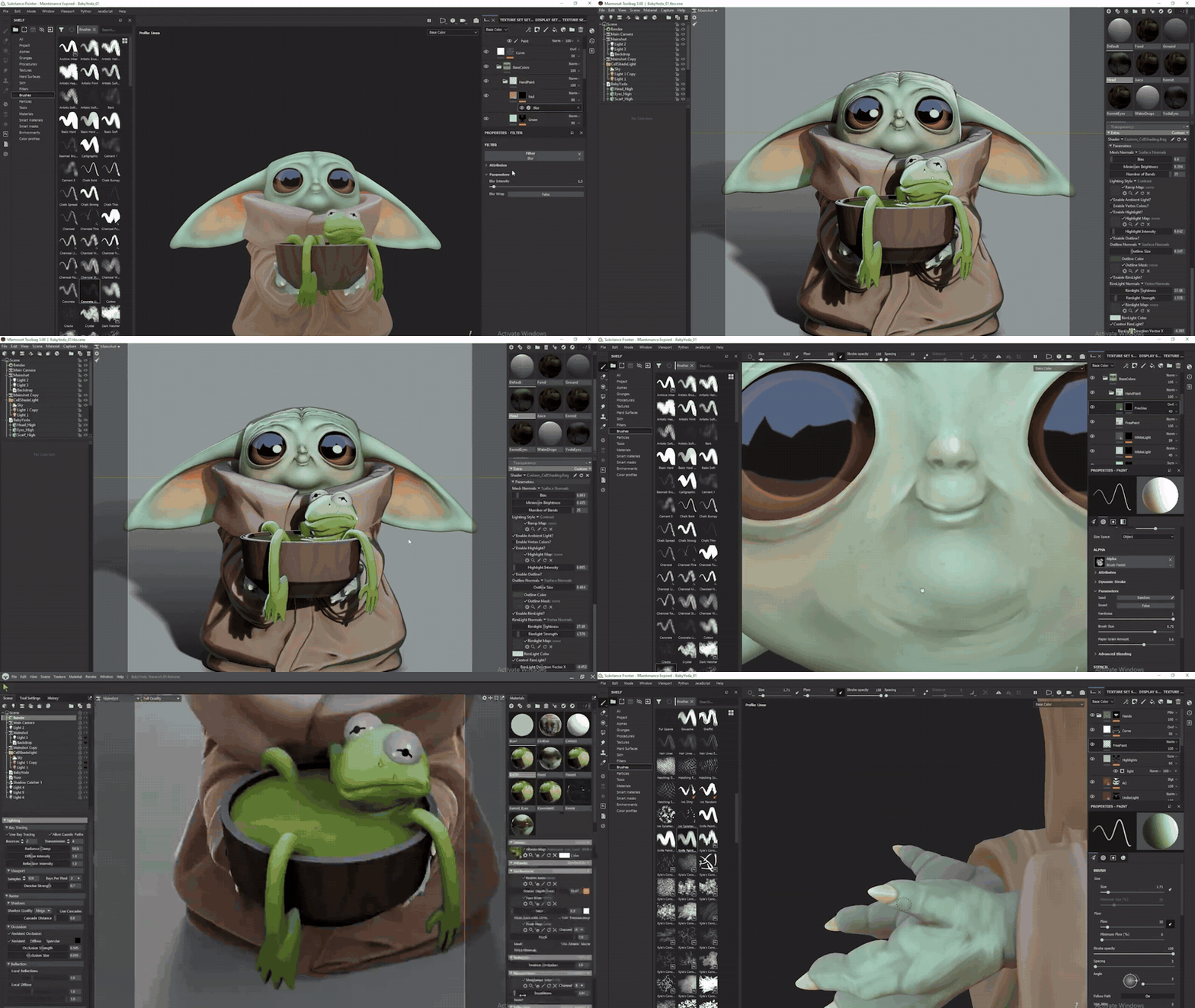
Hand-painted production can be approached either by painting directly on the 3D model (projection/3D paint) or by painting in 2D on the UV layout and iterating through test renders. Both approaches exist in common tools, and external image editors remain a standard part of the workflow when teams split work across different software.
How lighting affects PBR textures vs hand-painted textures
PBR’s separation of “material parameters” from “lighting” is specifically designed to keep assets plausible under many lighting environments; multiple technical and production guides highlight that energy-conserving physically based models help preserve realism without extensive per-scene tweaking. This is a key reason PBR became popular across both film and games: consistent lighting response and reduced ad hoc adjustment.
Hand-painted textures can look outstanding in controlled or stylised lighting, but they are more sensitive to lighting changes if significant shading cues are baked into the diffuse texture. Artists often compensate by keeping painted lighting subtle, relying on soft AO-like depth cues rather than strong directional highlights that would conflict with dynamic light sources.
A helpful mental model is: PBR aims for physical consistency (the material “behaves”), while hand-painted aims for visual consistency (the asset “reads”), and these goals sometimes tug in different directions when lighting is highly dynamic.

How to mix PBR and hand-painted texturing in one asset
Mixing is common, and it is often the most production-effective solution: keep a PBR shader model so lighting behaves consistently, then hand-paint selectively to enforce style and readability. One thesis-based comparative analysis explicitly notes that PBR workflows do not exclude hand-painted detail: artists may still paint into albedo/base colour and/or roughness to push stylised results.
The “rules” that prevent visual contradictions are mostly about where you place stylisation:
- A safe approach is to keep base colour/albedo free of explicit lighting (no strong cast shadows or hard spec highlights), and instead push stylised depth through (a) AO/cavity maps, (b) normal detail, and (c) intentional roughness design that shapes highlights. This aligns with multiple PBR references that define base colour as non-lit colour data and place light response into metallic/roughness/BRDF evaluation.
- When you do paint lighting cues into colour (a common stylised technique), it works best if lighting in-engine is also deliberately constrained (for example, softer, more uniform lighting and fewer harsh moving lights), so the painted forms remain the dominant read.
- Modern examples show the blend clearly: Overwatch and Prey are cited as cases where a PBR pipeline is paired with hand-painted detailing to emphasise stylised results.

When to use PBR texturing for games and film
PBR is the default choice when the project demands believable materials across many lighting scenarios—dynamic day/night cycles, multiple biomes, user-driven lighting changes, or heavy look-development iteration—because the material definitions remain stable while lighting shifts.
For film and high-end animation, physically based shading is strongly favoured when the goal is consistent material response and predictable lighting workflows. Disney’s production notes highlight adoption motivations including richer materials, more consistent lighting responses between materials/environments, and simplified artist controls.
In games, PBR also supports team scalability: shared material rules and validated ranges help multiple artists produce assets that “sit” together in the same world.
When to use hand-painted textures for stylized games
Hand-painted texturing is often the right call when the art direction prioritises graphic clarity, exaggerated shapes, “illustrated” colour decisions, or a deliberately non-photoreal look—especially when assets must read instantly at small sizes (common for strategy, isometric, or mobile titles).
It can also be a strategic choice for low-poly projects, where the geometry is intentionally simplified and the texture must carry the personality. Research on low-poly character workflows describes modern low-poly style as a conscious aesthetic choice and notes that flat textures are an integral part of that style; adding carefully hand-painted texture detail can “mask” simplicity and imply form.
Hand-painted pipelines can remain efficient when the project wants to minimise the number of maps and keep asset management simpler—particularly where memory budgets are tight and the lighting model is intentionally simple.
![Textures - hand painted - 3d model by makeshift. [82c8940] - sketchfab](https://images.openai.com/static-rsc-4/D8JC4aJAMR9nnOQclC2vimCJSWhEX0pYuRi9vDalvf1ol5gJA7pLntRMg6q55Vfv2qhscpr5rhyC4IY6CGcZ2cvc5bC88sufSz5NCMBWj6q6SnWeOAXQaZbmZ14Szk3EkKjp3Y4yoGmndJQRRWRaw2pS_sg2qE5NQauUjH0VDcw?purpose=inline "Pbr Vs Hand-Painted Texturing: Differences, Workflows, And When To Use Each")
Stylized PBR vs hand-painted textures: which looks better?
“Better” is primarily about whether the rendering method supports the intended art direction, not about which is objectively superior. PBR can support stylisation—because stylised models and simplified textures can still benefit from physically coherent material response—so long as the project’s style goals are encoded into the authored parameters (colour choices, roughness design, controlled normals) rather than baked lighting tricks.
Hand-painted textures typically win when the desired look depends on illustrated lighting cues, painterly gradients, and art-directed form definition that is intentionally independent of physically correct lighting. PBR typically wins when the project demands lighting variability (multiple time-of-day looks, strong emissive scenes, flashlights, explosions) while still keeping surfaces predictable.
A useful production framing is that stylised PBR can be harder than realistic PBR because it requires finding a “fine line” where maps don’t contradict each other visually (for example, overly busy albedo fighting roughness/spec response), which can increase iteration cost.
Is hand-painted texturing still used in modern games?
Yes—often as either the main approach for stylised titles or as a complementary layer within PBR pipelines. A comparative analysis of texturing pipelines notes that PBR workflows do not remove the need for hand-painted details and highlights examples where PBR pipelines incorporate hand-painted detailing to emphasise stylised outcomes.
Modern production also keeps hand-painting relevant because even when materials are procedural or scan-based, teams still need bespoke paint work for hero assets, storytelling detail, and controlled readability. One low-poly workflow thesis notes that efficiency and speed often drive baking and procedural generation, but these approaches can limit the creative freedom the texture artist can take—making manual painting valuable when art direction demands it.

Best software for PBR texturing (Substance Painter, Blender, etc.)
For PBR authoring, the “best” tool is usually the one that lets you paint and preview directly on the 3D asset with the target shader model, then export consistent texture sets for the engine or renderer.
Adobe Substance 3D Painter is explicitly described in official documentation as a 3D painting tool for texturing and rendering 3D meshes, with built-in projections that can avoid manual painting for certain layers (useful for masks, fill layers, and repeatable materials). Additionally, Adobe’s PBR Guide outlines the mainstream PBR workflows (metal/roughness and specular/glossiness) and discusses their map logic and texture-memory implications, which is directly relevant to production texturing choices.
For broader pipelines, node-based material authoring (for example, procedural texture graphs) is commonly paired with Painter-style painting for faster variation and non-destructive iteration; one case study describes this approach as useful for producing many textures by copying/editing graphs and making variations with less work.
Best software for hand-painted textures (Blender, Photoshop, Krita, etc.)
Hand-painted texturing typically benefits from strong brush engines, layer workflows, and fast iteration—either directly on the model (3D paint/projection) or in 2D on UVs with frequent viewport checks.
A widely used approach is to paint in a dedicated 2D painting tool and test in a 3D viewport. Documentation for Wolfram Research’s rendering tutorial highlights that PBR pipelines are now common in 3D graphics programs and contrasts physically motivated methods with purely artistic techniques, which reflects the broader ecosystem where both “art-first” painting and “physics-first” shading coexist.
Photoshop remains common for texture painting because of mature brush and texture-stamp controls; Adobe’s help documentation describes paint tools that support textured brush strokes and varied brush dynamics used for digital painting workflows.
Krita is a widely used open-source painting program, with its manual explicitly listing “textures” among supported painting fields and positioning the toolset around digital painting workflows.
For painting on 3D models, Blender includes texture painting approaches that allow painting in the 3D view while updating the UV texture, and it also supports using external editors as part of the workflow.

PBR vs hand-painted texturing: time, cost, and production speed
Time and cost are less about “PBR vs hand-painted” as labels and more about how much of the work can be standardised, reused, and validated across many assets. PBR pipelines can be faster at scale because physically based rules reduce guesswork and because smart materials, masks, and non-destructive layers can be reused across asset sets.
By contrast, high-quality hand painting can be inherently time-consuming because it relies on manual judgement and brushwork, especially when each asset is treated as bespoke. A comparative thesis concludes that hand-painting (and learning node-based tooling) took more time than anticipated, while PBR texture production in a modern 3D painting tool was “surprisingly quick.”
Tooling and preview also affect speed. One production comparison found that a workflow without real-time 3D-preview required more tests and iterations to ensure the texture fit the model, increasing overall production time compared with a 3D painting workflow; the same comparison notes that the 3D painting tool benefited from built-in generators and seamless painting across UV borders, while also being more hardware-demanding.
The most reliable planning assumption is that PBR reduces rework risk when lighting changes late, while hand-painted reduces art-direction risk when readability is the priority—so the “fastest” choice depends on what kind of iteration the project expects.
PBR vs hand-painted textures for mobile games and performance
On mobile, performance pressure is often dominated by texture memory, bandwidth, and shader cost. Unity’s performance guidance notes that memory-bandwidth limitation frequently indicates too many textures or textures that are too large, and it recommends compression because compressed textures use only a fraction of the bandwidth of uncompressed textures.
This is where hand-painted pipelines can be attractive: fewer maps can mean fewer texture samples and simpler content management. A comparative analysis explicitly states that the hand-painted workflow is less memory heavy because it can require only one or two texture maps, whereas PBR may need at least three and up to eight maps (depending on material features used).
That said, mobile PBR is absolutely feasible when the pipeline is disciplined. Two widely used optimisation techniques are (a) channel packing—storing multiple greyscale masks in a single texture—and (b) ensuring that data maps (roughness/metallic/AO) are treated as linear rather than sRGB. Android game optimisation guidance shows packing opacity with roughness/smoothness and metallic in one texture and explicitly warns to keep packed textures in linear colour space. The glTF 2.0 specification similarly requires linear transfer for metallic–roughness textures and defines which channels are used.
A practical mobile heuristic is: if the game relies on dynamic lighting and material response (metal, glossy plastics, wet surfaces), then PBR with packed maps and compressed textures tends to be the more maintainable long-term solution. If the game relies on graphic clarity and consistent “painted” presentation under simple lighting, hand-painted (or hybrid stylised PBR) can reduce texture and shader complexity.

Frequently Asked Questions (FAQs)
- Do PBR textures automatically look realistic?
No—PBR provides a physically coherent framework, but realism still depends on correct values, strong references, and lighting. The advantage is that the separation of materials and lighting makes it easier to keep assets accurate across lighting conditions. - Is “albedo” the same as “diffuse”?
They are related but not identical in intent. In PBR guidance, base colour/albedo is defined as colour without baked lighting, while stylised/hand-painted workflows often bake shading and AO into a diffuse map. - Should you paint shadows and highlights into PBR albedo?
Most PBR references recommend keeping base colour devoid of lighting information (with small-scale micro-occlusion sometimes treated as a special case), because lighting response should come from the shader and material parameters. - What’s the difference between roughness and glossiness?
They describe the same concept with inverted meaning in many workflows: one commonly treats roughness as the inverse of glossiness, and both control the appearance of specular reflections via micro-surface detail. - Why do metallic maps tend to be mostly black or white?
In metallic–roughness models, metallic typically acts as a mask between metals and non-metals, and many implementations recommend values near 0 or 1, using mid-values mainly for transitions like rust or dirt layers. - Do you need normal maps in hand-painted styles?
Not always; many hand-painted looks rely heavily on colour and gradients for form, especially in low-poly styles. But normals are still useful when you want lighting to add detail and when you need consistent response to dynamic lights. - Can a stylised game still use PBR?
Yes. Multiple sources describe that stylisation can coexist with physically based shading, and modern games can combine a PBR pipeline with hand-painted detailing for stylised results. - What’s the main risk of heavy baked lighting in hand-painted textures?
If painted lighting is too strong, it can clash with real-time lighting when the asset rotates or moves into different environments, producing a “double-lit” or inconsistent look. - How do you optimise PBR texture sets for mobile?
Typical steps include reducing texture resolution where possible, using compression to cut bandwidth and memory footprint, and packing multiple greyscale maps into one texture; packed maps should be treated as linear data, not sRGB. - Is Substance Painter required for PBR?
No—PBR is a methodology, not a single tool. However, official documentation describes it as a 3D painting tool for texturing and rendering 3D meshes, and it is widely used in modern pipelines because it supports direct-on-model painting and export of texture sets.
Conclusion
PBR texturing and hand-painted texturing solve different problems: PBR maximises physical coherence and lighting robustness, while hand-painted maximises readability and art-directed stylisation. Most modern production realities favour hybrid thinking—use physically based shading for stable lighting response, then hand-paint the details that make the asset communicate style, hierarchy, and story.
Sources and Citations
- Khronos Group. glTF 2.0 Specification
- https://registry.khronos.org/glTF/specs/2.0/glTF-2.0.html Google. Filament: Physically Based Rendering in Filament
- https://google.github.io/filament/Filament.md.html Wolfram Documentation. Physically Based Rendering
- https://reference.wolfram.com/language/tutorial/PhysicallyBasedRendering.html Marmoset. Basic Theory of Physically-Based Rendering
- https://marmoset.co/posts/basic-theory-of-physically-based-rendering/ Self Shadow. SIGGRAPH 2012 Course: Practical Physically Based Shading in Film and Game Production
- https://blog.selfshadow.com/publications/s2012-shading-course/ Walt Disney Animation Studios. Burley, B. Physically Based Shading at Disney
- https://disneyanimation.com/publications/physically-based-shading-at-disney/ Walt Disney Animation Studios. Burley, B. Physically Based Shading at Disney (PDF)
- https://media.disneyanimation.com/uploads/production/publication_asset/48/asset/s2012_pbs_disney_brdf_notes_v3.pdf Game Developer. Physically Based Rendering and Stylization
- https://www.gamedeveloper.com/art/physically-based-rendering-and-stylization Neppius, A. 3D Game Texturing: Comparative Analysis Between Hand-painted and PBR pipelines
- https://www.theseus.fi/handle/10024/750261 Neppius, A. 3D Game Texturing: Comparative Analysis Between Hand-painted and PBR pipelines (PDF)
- https://www.theseus.fi/bitstream/handle/10024/750261/Ale_Neppius.pdf?isAllowed=y&sequence=2 Kaasinen, I. Texturing Process in Hand Painted Low Poly Game Art
- https://www.theseus.fi/handle/10024/804299 Kaasinen, I. Texturing Process in Hand Painted Low Poly Game Art (PDF)
- https://www.theseus.fi/bitstream/10024/804299/2/Kaasinen_Inka.pdf Unity Technologies. Unity Manual: Graphics performance fundamentals
- https://docs.unity3d.com/2021.3/Documentation/Manual/OptimizingGraphicsPerformance.html Android Developers. Textures | Android game development
- https://developer.android.com/games/optimize/textures Adobe Substance 3D Painter Documentation
- https://experienceleague.adobe.com/en/docs/substance-3d-painter/using/home Photoshop Help. Painting tools
- https://helpx.adobe.com/photoshop/using/painting-tools.html Krita Manual. Welcome to the Krita Manual
- https://docs.krita.org/en/ Blender Manual. Texture Paint
- https://docs.blender.org/manual/en/latest/sculpt_paint/texture_paint/index.html Blender Manual. Texture Paint Introduction
- https://docs.blender.org/manual/en/latest/sculpt_paint/texture_paint/introduction.html Blender Manual. Texture Paint — Using an External Image Editor
- https://docs.blender.org/manual/en/latest/sculpt_paint/texture_paint/index.html
Recommended
- AI in Game Development (2026): Wins, Losses, and How to Use AI for Critique & Feedback
- How to Create a 3D Environment Like Arcane: A Step-by-Step Guide
- The Best Beards in Video Games: Iconic Characters and Their Legendary Facial Hair
- Super Battle Golf sells 100,000 copies in two days on Steam: what the fast launch success means
- What 3D Program Did Arcane Use? An In-Depth Look at the Animation Tools Behind Riot Games’ Hit Series
- The Best Bearded Video Game Characters: Iconic Facial Hair and Their Impact on Gaming
- The Audience for the Silent Hill 2 Remake Has Surpassed 5 Million People: What Konami Announced and What It Means
- Slay The Spire 2 Is Absolutely Crushing It With 400,000 Concurrent Players And A 97 Percent Positive Rating On Steam
- How to Animate Metahuman in Unreal Engine 5: The Ultimate Step-by-Step Guide to Bringing Digital Characters to Life