










PlayStation Revenue Per Active User Increased 59 Percent by FY2025
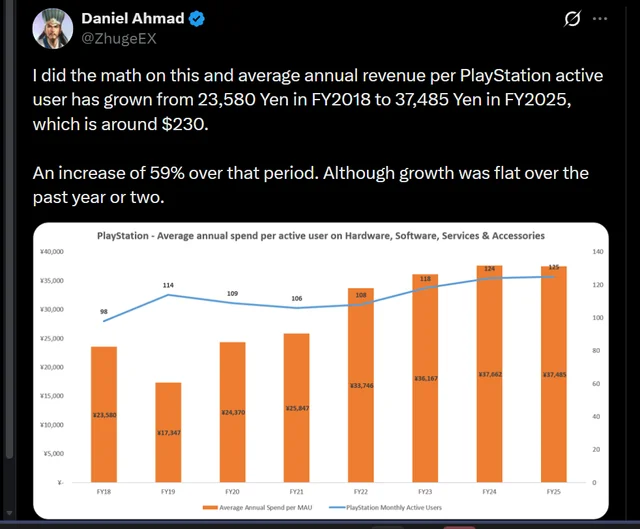
Sony’s PlayStation business is generating substantially more annual revenue from each active user than it did during the peak PS4 era. Niko Partners analyst Daniel Ahmad calculated that PlayStation’s average annual revenue per active user rose from ¥23,580 in FY2018 to ¥37,485 in FY2025. That is an increase of ¥13,905 per active user, or approximately 58.97%, which rounds to 59%. Ahmad presented the figures as his own calculation based on PlayStation financial and active user data rather than as a new Sony reported KPI.
The increase highlights how PlayStation has evolved from a business primarily dependent on selling consoles and packaged games into a broader digital ecosystem built around subscriptions, downloadable games, add on content, recurring spending, and a large active audience.
That distinction is important because Sony publicly reports detailed Game & Network Services revenue, software sales, network services revenue, PlayStation hardware sales, and monthly active users, but its FY2025 supplemental disclosure does not identify a specific line item called “average annual revenue per active user.” Ahmad’s AARPU figure is therefore best understood as an analytical measure constructed from Sony’s broader financial and user data. The 59% increase also does not mean that every PlayStation player personally spends ¥37,485 each year. It represents average revenue across the active user base, with spending distributed unevenly across millions of accounts, and it measures revenue rather than profit.
The growth is particularly notable because PlayStation is already well beyond the early growth phase of the PS5 cycle. Sony reported 125 million monthly active PlayStation accounts for March 2026, while FY2025 Game & Network Services sales reached ¥4.686 trillion. The combination of a large established audience and substantially higher monetisation per user helps explain why Sony’s strategy late in the PS5 generation increasingly emphasises engagement and recurring spending rather than simply maximising the number of consoles shipped. It also illustrates why the value generated by each established PlayStation account has become increasingly important to Sony’s wider gaming business.

PlayStation Revenue Per User in 2025 vs 2018 Explained
Niko Partners analyst Daniel Ahmad calculated that PlayStation generated an average of ¥37,485 in annual revenue per active user in FY2025, compared with ¥23,580 in FY2018, representing an increase of approximately 59%. The appropriate interpretation is revenue associated with the average active user, not a claim that every individual customer personally paid Sony exactly that amount. Heavy spenders, people buying new hardware, PlayStation Plus subscribers, occasional users and players purchasing large amounts of downloadable content all contribute differently to the average.
Ahmad said in his September 2026 post that he had “done the math” using Sony’s financial and user information. Sony provides the underlying information needed to examine the relationship between revenue and active users, including quarterly monthly active user figures and detailed Game & Network Services sales categories, but Ahmad is the one who framed the result as average annual revenue per active user.
Average annual revenue per active user, or AARPU, relates annual platform revenue to the size of its active audience. Sony defines a PlayStation monthly active user as an estimated unique account that played games or used PlayStation online services during the last month of a quarter. The company reported 123 million MAUs at the end of FY2025’s first quarter, 119 million in the second, 133 million in the third and 125 million in the fourth, while noting that these figures are based on company research and may later be updated.
This definition means AARPU should not be confused with revenue per PS5 owner. PlayStation’s active population is account based and includes activity across the wider PlayStation platform rather than simply dividing revenue by the number of PS5 consoles sold. A user can remain active on older hardware, while more than one account can interact with a household’s PlayStation equipment.
FY2018 represents a mature period of the PS4 generation, while FY2025 corresponds to the fiscal year ending March 31, 2026, deep into the PS5 lifecycle. The increase from ¥23,580 to ¥37,485 therefore spans a period in which digital distribution, subscriptions, add on purchases and recurring online engagement became increasingly important to PlayStation’s economics. Sony’s FY2025 results illustrate the scale of the revenue sources behind the average.
Game software generated approximately ¥2.641 trillion in segment sales, including about ¥1.056 trillion from digital software and ¥1.360 trillion from add on content. Network services generated another ¥763.1 billion, while hardware produced approximately ¥944.4 billion. Sony defines network services revenue as revenue recognised through PlayStation Plus and advertising, while add on content includes purchases such as in game currency, in game items and expansion packages.
The changing sales mix is particularly visible in software. Of the 317.9 million PS4 and PS5 full game software units sold during FY2025, 78% were digital downloads. Sony reported ¥1.360 trillion from add on content, exceeding the ¥1.056 trillion attributed to digital full game software and vastly surpassing the ¥125.1 billion attributed to physical software. Revenue per active user is therefore most useful as a comparative indicator rather than a measure of what a typical individual spends.
Total revenue can rise simply because a platform gains more users, while revenue per active user asks whether the platform is generating more economic value relative to the size of its engaged audience. Ahmad’s calculation indicates that PlayStation did so substantially between FY2018 and FY2025.
In This Article (8 sections)
Why Sony Makes More Revenue From Each PlayStation Player
Sony generates more revenue per active PlayStation user because the modern PlayStation ecosystem provides considerably more opportunities for spending after the initial console purchase. A player can buy full games digitally, subscribe to PlayStation Plus, purchase expansions, acquire in game currency, buy cosmetic or gameplay items, spend on first party and third party content, purchase accessories and remain economically active for years after buying the hardware. This makes measuring PlayStation’s economics solely through the price of a PS5 increasingly incomplete. The console is becoming the beginning of a longer commercial relationship rather than the main source of lifetime revenue.
During the PS4 era, digital sales and PlayStation Plus were already important, but the PS5 period has pushed PlayStation further toward continuous digital monetisation. By FY2025, Sony was receiving hundreds of billions of yen from network services and more than one trillion yen annually from add on content. Digital distribution also gives PlayStation a direct storefront relationship with its users. Sony’s FY2025 digital download ratio for full game software reached 78%, while its digital software category includes full game downloads from first party and third party publishers through PlayStation Store. Add on content covers purchases such as virtual currency, items and expansion packs, creating repeated opportunities to generate revenue from established users without requiring another console sale.
Sony’s year over year FY2025 results further illustrate this change. Game & Network Services sales were essentially flat at approximately ¥4.686 trillion, yet operating income increased 12% to ¥463.3 billion. Sony identified increased network services revenue as one of the positive factors supporting both sales and operating income, while declining hardware unit sales reduced revenue. Excluding specified one time items, Sony said segment operating income increased 45% year over year. This pattern highlights the difference between selling another physical console and monetising an established digital audience. Hardware remains strategically important because it expands and refreshes the installed base, but software, subscriptions and services can continue producing revenue after the original hardware transaction.
The 59% increase does not mean that every PlayStation user is personally spending substantially more than before. An average can rise because highly engaged customers spend heavily, prices increase, subscribers move to more expensive tiers, or a greater share of transactions moves into categories from which Sony earns revenue. The figure instead describes the economics of the overall active user base. Taken together with the growth of digital downloads, add on content and network services, it shows how PlayStation has evolved from a business heavily dependent on selling consoles and packaged games into a broader digital ecosystem capable of generating repeated revenue from its active audience.
How Subscriptions, Games, DLC and Hardware Drive PlayStation Revenue Per User
PlayStation Plus is one of the clearest recurring revenue mechanisms in Sony’s gaming business. Sony defines network services sales as revenue recognised through PlayStation Plus and advertising. In FY2025, network services revenue reached ¥763.1 billion, up from ¥669.9 billion in FY2024, an increase of roughly 14%. Sony has also cited a continued shift toward higher PlayStation Plus tiers as a positive business trend.
The modern service structure allows subscribers to choose different levels with different benefits, enabling Sony to generate more revenue when customers select more expensive tiers while preserving the recurring nature of the subscription relationship. This model can continue generating revenue even in months when subscribers do not buy a new console or full priced game, although customers can still cancel or downgrade.
A crucial distinction is that Sony’s roughly 125 million monthly active PlayStation users are not all PlayStation Plus subscribers. Sony defines that figure as monthly active accounts across the PlayStation platform. Some secondary reporting around Sony’s 2026 strategy has blurred the distinction, but Sony’s own disclosure identifies the figure as active accounts rather than subscription memberships.
Add on content has also become one of PlayStation’s largest revenue categories. Sony reported approximately ¥1.360 trillion in FY2025 add on content revenue, which includes digital content other than full games sold through PlayStation Store, such as in game currency, items and expansion packages. That figure exceeded FY2025 revenue from digital full game software, which was roughly ¥1.056 trillion, while physical software contributed approximately ¥125.1 billion. Although these categories are not directly comparable in every commercial respect, their scale shows why downloadable content and in game transactions have become so important to PlayStation’s economics.
Third party games can contribute substantially to Sony’s results even when Sony did not develop them. Sony said higher sales of non first party game software supported FY2025 revenue, while network services growth also benefited the segment. Successful games can therefore continue producing transactions well beyond their initial launch through expansions, season content, digital currency and continued player engagement, increasing the amount of revenue associated with active PlayStation users.
Hardware pricing also affects revenue per user, but the relationship is less straightforward. Higher console prices can mechanically increase revenue from customers who purchase a new system, but only when demand remains sufficiently resilient. Higher prices can also reduce unit sales or delay purchases. Sony shipped 16.0 million PS5 consoles in FY2025, down from 18.5 million in FY2024, while hardware revenue declined from approximately ¥1.133 trillion to ¥944.4 billion. Software and network services helped keep total Game & Network Services sales essentially flat despite that decline.
Pricing became particularly important during 2026 as Sony faced elevated memory costs and had already increased PS5 prices in some markets. Sony said in August that it had secured enough memory for its projected FY2026 PS5 sales volume and expected hardware profitability to remain similar to FY2025. The Verge reported in May 2026 that two US price increases had raised the standard PS5 from its earlier $499.99 price to $649.99, while Sony’s fourth quarter shipment volume had fallen to 1.5 million units. These developments illustrate why higher revenue from each hardware buyer must be considered alongside affordability, demand and overall console sales.
Sony’s PS5 Strategy Shifts Toward Recurring Revenue as AARPU Growth Slows
Sony’s reduced emphasis on aggressively selling additional PS5 consoles is closely connected to the maturity of the platform. Sony CEO Hiroki Totoki said in an August 2026 Wall Street Journal interview, as reported by GamesRadar, that the console was in the latter half of the PlayStation lifecycle and that Sony did not need to “aggressively sell the console today.” This does not mean Sony has stopped pursuing hardware growth. Its August FY2026 presentation said the company would continue seeking further installed base growth while monitoring demand and memory availability. Instead, the balance of the business is shifting as Sony gains more opportunities to monetise its already large audience.
This progression reflects normal platform economics. Early in a console generation, expanding hardware distribution is essential because software, subscription and digital content revenue depend on having an installed base. Once tens of millions of consoles are in use and the platform has roughly 125 million monthly active accounts, the commercial opportunity increasingly depends on what users spend after entering the ecosystem. Totoki said Sony was focusing more on recurring revenue from its existing user base, while the company’s investor material confirms that additional installed base growth remains part of its strategy.
The financial logic is visible in FY2025. PS5 hardware unit sales declined, yet network services revenue increased to ¥763.1 billion, add on content remained above ¥1.35 trillion and total Game & Network Services operating income rose 12%. Sony specifically identified network services growth as a positive contributor to operating income. Its strategy therefore increasingly depends on two related goals: maintaining a large active audience and increasing the revenue generated by that audience through games, subscriptions and digital content.
Daniel Ahmad’s calculation that PlayStation average annual revenue per active user was 59% higher in FY2025 than in FY2018 provides a concise measure of how far this model has developed. However, his analysis also suggests that the long term increase has recently begun to flatten. Reporting on the calculation noted that much of the AARPU growth occurred earlier and that progress had stalled over roughly the previous two years.
Sony’s recent operating results help explain why further gains may become more difficult. FY2025 Game & Network Services sales were essentially flat year over year at ¥4.686 trillion, while FY2026 first quarter sales were also essentially flat at ¥937.1 billion. Monthly active users reached 125 million in June 2026, up 2% year over year, but quarterly total playtime declined 4% against an unusually strong comparable period.
A slowdown does not mean Sony’s monetisation strategy has failed. After AARPU has already increased by almost 60%, maintaining elevated revenue levels across more than 100 million active accounts can remain economically significant. Future growth may depend increasingly on subscription mix, content quality, pricing, successful live service games and Sony’s ability to keep users engaged without pushing spending to levels that weaken consumer satisfaction.

Frequently Asked Questions[FAQs]
- What does the 59% increase in PlayStation revenue per user mean?
It means Daniel Ahmad calculated that PlayStation’s average annual revenue per active user increased from ¥23,580 in FY2018 to ¥37,485 in FY2025, a rise of approximately 59%. The figure shows that Sony is generating considerably more revenue across its active PlayStation audience than it did during the PS4 era. However, it does not mean every individual PlayStation player is personally spending 59% more. Some users spend heavily on games, subscriptions and additional content, while others spend relatively little, and all of that activity contributes to the overall average. - How much annual revenue does Sony make per active PlayStation user?
According to Ahmad’s calculation, PlayStation generated approximately ¥37,485 in average annual revenue per active user in FY2025, compared with ¥23,580 in FY2018. This provides a useful way to measure how much revenue Sony generates relative to the size of its active PlayStation audience. However, the figure is an analyst derived calculation based on PlayStation financial and user data, rather than an official Sony KPI formally reported under the AARPU label. - Is the ¥37,485 figure the amount every PS5 owner spends?
No. The ¥37,485 figure is an average across PlayStation’s active user base rather than the amount paid by every individual PS5 owner. Sony’s monthly active user metric estimates unique accounts that played games or used online PlayStation services during the final month of a quarter, so those users can have very different spending habits. Some may purchase consoles, games, subscriptions and add on content, while others may spend very little. The figure also represents revenue per active user across the PlayStation ecosystem and should not be confused with revenue generated from each PS5 console sold. - How important is PlayStation Plus to Sony’s revenue?
PlayStation Plus is an important source of recurring revenue because it is included in Sony’s network services category alongside advertising revenue. Network services revenue increased from approximately ¥669.9 billion in FY2024 to ¥763.1 billion in FY2025, showing that subscriptions and related online services represent a substantial part of the PlayStation business. Because subscription revenue can continue as long as customers remain subscribed, it also gives Sony a more consistent revenue stream than relying only on individual hardware or game purchases. - How much does PlayStation make from DLC and microtransactions?
Sony reported approximately ¥1.360 trillion in add on content revenue during FY2025. This category includes digital content sold separately from full games, such as in game currency, in game items and expansion packages. The size of this revenue category shows how important spending beyond the initial game purchase has become to the PlayStation business, particularly as many games continue generating revenue from players after their original purchase or download. - Are digital games now more important than physical PlayStation games?
Digital distribution is substantially larger in Sony’s current PlayStation software sales mix. During FY2025, 78% of PS4 and PS5 full game software units were sold digitally, meaning fewer than one quarter were physical copies. Sony also reported roughly ¥1.056 trillion in digital software revenue compared with approximately ¥125.1 billion from physical software. These figures demonstrate how strongly PlayStation game purchasing has shifted toward digital storefronts, although physical games continue to remain part of the business. - Why is Sony no longer pushing PS5 sales as aggressively?
Sony CEO Hiroki Totoki has said that the PS5 is in the latter half of its lifecycle, meaning Sony does not need to pursue aggressive console sales to the same extent as during earlier stages of the generation. With a large installed user base already established, Sony can place more emphasis on generating recurring revenue from existing players through games, subscriptions, add on content and digital services. This does not mean Sony has stopped caring about PS5 hardware sales, as its investor materials still indicate that expanding the installed base remains worthwhile where doing so makes economic sense. - How many active PlayStation users does Sony have?
Sony reported 125 million monthly active PlayStation accounts in June 2026, representing a 2% increase year over year and a record for the month of June. Monthly active users measure the accounts actively engaging with the PlayStation platform rather than the total number of consoles ever sold. The figure also should not be mistaken for PlayStation Plus membership, since an account can be considered an active PlayStation user without subscribing to PlayStation Plus. - Has PlayStation revenue per user stopped growing?
Not completely, but the pace of growth appears to have slowed. Ahmad’s analysis showed that PlayStation’s AARPU remained substantially higher than its FY2018 level, while also indicating that growth had flattened during roughly the previous two years. Sony’s FY2025 Game & Network Services revenue was also essentially flat year over year. However, network services revenue and operating income improved, so the broader business continued to show strength even without another major increase in overall revenue per active user. - What does higher PlayStation revenue per user mean for Sony’s future strategy?
Higher revenue per active user gives Sony a stronger incentive to retain existing PlayStation players and encourage continued spending through compelling software, PlayStation Plus, add on content and other digital services. Rather than depending entirely on continually increasing console shipments, Sony can generate more value from the large audience already using its platform. At the same time, Sony is investing in its next generation platform while continuing to manage the PS5 installed base, suggesting that recurring ecosystem revenue and future hardware development will remain complementary parts of its strategy..

Conclusion
Sony making approximately 59% more annual revenue per active PlayStation user than it did in FY2018 is one of the clearest signs of how profoundly the PlayStation business has changed since the PS4 era. Daniel Ahmad’s calculation shows AARPU rising from ¥23,580 in FY2018 to ¥37,485 in FY2025, while Sony’s own disclosures reveal the commercial forces behind that increase: a 78% digital full-game download ratio, ¥1.360 trillion in annual add-on-content revenue and ¥763.1 billion in network-services revenue.
Hardware remains essential, but it is no longer sufficient to explain PlayStation’s financial performance. PS5 shipments fell to 16 million units in FY2025, yet Sony’s Game & Network Services segment generated approximately ¥4.686 trillion in sales and increased operating income by 12%. Network services helped offset weaker hardware revenue, demonstrating the economic strength of an installed base that can continue buying content and services after the console itself has been sold.
That is also why Sony can afford to talk differently about the later years of the PS5. Totoki’s comments that aggressive hardware selling is no longer as necessary should not be understood as Sony abandoning console growth. Sony still says it wants to expand the installed base. The difference is that, with around 125 million monthly active accounts, increasing the lifetime value of existing users has become at least as important as adding another machine to the sales total.
The biggest unanswered question is whether Sony can continue raising revenue per user without undermining affordability or player goodwill. Ahmad’s analysis indicates that AARPU growth has recently slowed, while PS5 pricing, hardware costs and engagement levels remain moving variables. What is already clear, however, is that modern PlayStation economics are defined increasingly by recurring digital relationships. The PS5 is not merely a product Sony sells once; it is the gateway to a software, subscription and content ecosystem designed to generate revenue throughout a player’s years on the platform.
Sources and citation
- Daniel Ahmad’s 59% PlayStation AARPU calculation
- Source: Sony Is Making 59% More Revenue Per PlayStation User Since PS4 Generation, Says Analyst: Reports Niko Partners research director Daniel Ahmad’s calculation that average annual revenue per active PlayStation user increased from ¥23,580 in FY2018 to ¥37,485 in FY2025, a rise of approximately 59%. Ahmad shared the calculation on X on September 1, 2026. This is an analyst-derived estimate, not a financial metric Sony officially publishes as AARPU.
Citation: McCaffrey, Ryan. (September 2, 2026). “Sony Is Making 59% More Revenue Per PlayStation User Since PS4 Generation, Says Analyst.” Yahoo Finance. Read the report. - Source: Analyst Reports 59% Growth in PlayStation Revenue Per Active User: Provides additional coverage of Ahmad’s calculation, including his explanation that higher PlayStation Plus subscription tiers, software and DLC spending, microtransactions, and hardware prices contributed to the increase.
Citation: Seidl, Maik. (September 3, 2026). “Analyst rechnet nach: So stark ist Sonys Umsatz pro PlayStation-Nutzer gewachsen.” play3.de. Read the report.
- Source: Sony Is Making 59% More Revenue Per PlayStation User Since PS4 Generation, Says Analyst: Reports Niko Partners research director Daniel Ahmad’s calculation that average annual revenue per active PlayStation user increased from ¥23,580 in FY2018 to ¥37,485 in FY2025, a rise of approximately 59%. Ahmad shared the calculation on X on September 1, 2026. This is an analyst-derived estimate, not a financial metric Sony officially publishes as AARPU.
- Sony Group Corporation FY2025 Game & Network Services supplemental information
- Source: FY2025 Q4 Supplemental Information – Sony Group Corporation: This is the primary source for Sony’s FY2025 Game & Network Services figures. Its PlayStation section provides hardware and software revenue breakdowns, physical software, digital software, add-on content, network-services revenue, PS5 hardware shipments, full-game software sales, digital-download ratios, and monthly active users. It reports 16 million PS5 hardware units sold during FY2025 and 125 million PlayStation monthly active users in Q4.
Citation: Sony Group Corporation. (May 8, 2026). “Supplemental Information for the Consolidated Financial Results for the Fourth Quarter Ended March 31, 2026.” Official FY2025 supplemental information (PDF). - Source: Sony FY2025 Earnings Releases Archive: Official archive confirming the May 8, 2026 publication date and providing access to Sony’s FY2025 financial statements, earnings presentation, speech transcript, Q&A summary, and supplemental information.
Citation: Sony Group Corporation. (2026). “Earnings Releases – FY2025.” Official investor-relations archive.
- Source: FY2025 Q4 Supplemental Information – Sony Group Corporation: This is the primary source for Sony’s FY2025 Game & Network Services figures. Its PlayStation section provides hardware and software revenue breakdowns, physical software, digital software, add-on content, network-services revenue, PS5 hardware shipments, full-game software sales, digital-download ratios, and monthly active users. It reports 16 million PS5 hardware units sold during FY2025 and 125 million PlayStation monthly active users in Q4.
- Sony Group Corporation FY2025 consolidated financial results
- Source: Consolidated Financial Summary for the Fiscal Year Ended March 31, 2026: Sony’s official consolidated financial report, containing segment-level sales and operating-income figures. It reports Game & Network Services sales of ¥4,685.7 billion and operating income of ¥463.3 billion for FY2025.
- Citation: Sony Group Corporation. (May 8, 2026). “Consolidated Financial Summary for the Fiscal Year Ended March 31, 2026.” Official consolidated financial report (PDF).
- Source: FY2025 Consolidated Financial Results – Earnings Speech Transcript: Particularly useful for explaining the reasons behind the Game & Network Services results. Sony identifies increased network-services revenue and third-party game software sales as positive contributors to segment sales, while lower PS5 hardware unit sales had a negative effect. It also explains the increase in operating income and the impact of Bungie impairment losses.
- Citation: Sony Group Corporation. (May 8, 2026). “FY2025 Consolidated Financial Results – Speech Transcript.” Official earnings transcript (PDF).
- Sony FY2026 first-quarter investor materials
- Source: FY2026 Q1 Supplemental Information: Official supplemental report for the quarter ended June 30, 2026. It provides the latest quarterly PlayStation figures, including PS5 hardware shipments, software sales, digital-download ratios, network-services revenue, and monthly active users. It records 125 million monthly active users for June 2026.Citation: Sony Group Corporation. (July 31, 2026). “Supplemental Information for the Consolidated Financial Results for the First Quarter Ended June 30, 2026.” Official FY2026 Q1 supplemental report (PDF).
- Source: FY2026 Q1 Earnings Presentation: Official investor presentation covering Sony’s first-quarter performance and Game & Network Services outlook. Useful for understanding PlayStation business performance, hardware demand, and management’s financial expectations.
Citation: Sony Group Corporation. (July 31, 2026). “Q1 FY2026 Consolidated Financial Results – Earnings Presentation.” Official investor presentation (PDF). - Source: FY2026 Q1 Earnings Speech Transcript: Provides management’s commentary on PlayStation engagement and hardware economics. Sony confirms 125 million monthly active accounts in June, up 2% year-on-year, while total playtime declined 4%. It also states that Sony secured enough memory for its projected FY2026 PS5 sales volume and expects hardware profitability to remain similar to FY2025.
Citation: Sony Group Corporation. (July 31, 2026). “Q1 FY2026 Consolidated Financial Results – Speech Transcript.” Official earnings transcript (PDF).
- Wall Street Journal reporting on Sony CEO Hiroki Totoki
- Source: How Sony Reinvented Itself as an Entertainment Powerhouse: Wall Street Journal coverage of Sony CEO Hiroki Totoki’s strategy for transforming Sony into an entertainment-focused company. Provides broader corporate context for Sony’s shift toward entertainment, recurring revenue, and monetising its established audience amid rising component costs and supply-chain pressures.
Citation: The Wall Street Journal. (August 2026). “How Sony Reinvented Itself as an Entertainment Powerhouse.” Read the WSJ report. - Source: Sony CEO Says PS5 Does Not Need Aggressive Sales Push: Reports Totoki’s comments in the Wall Street Journal interview that Sony is in the latter half of the PS5 lifecycle and can focus more on its existing user base and monetisation rather than aggressively pushing hardware sales. It also discusses the distinction between PlayStation monthly active users and PS Plus subscribers.
Citation: Barker, Sammy. (August 21, 2026). “‘We Don’t Need to Aggressively Sell the Console’: Sony CEO Says Timing of Memory Crisis Is ‘Lucky’ for PS5.” Push Square. Read the report.
- Source: How Sony Reinvented Itself as an Entertainment Powerhouse: Wall Street Journal coverage of Sony CEO Hiroki Totoki’s strategy for transforming Sony into an entertainment-focused company. Provides broader corporate context for Sony’s shift toward entertainment, recurring revenue, and monetising its established audience amid rising component costs and supply-chain pressures.
- The Verge coverage of PS5 price increases and memory costs
- Source: Sony’s PS5 Sales Plummet Amid Price Rises and a Memory Crisis: Reports Sony’s weaker PS5 hardware shipments, price increases, and the impact of memory costs on console economics. It notes that Sony sold 1.5 million PS5 consoles in the reported quarter, down 46% year-on-year, and that full-year FY2025 shipments reached 16 million, compared with 18.5 million in the previous year.
Citation: The Verge. (May 2026). “Sony’s PS5 Sales Plummet Amid Price Rises and a Memory Crisis.” Read the report.
- Source: Sony’s PS5 Sales Plummet Amid Price Rises and a Memory Crisis: Reports Sony’s weaker PS5 hardware shipments, price increases, and the impact of memory costs on console economics. It notes that Sony sold 1.5 million PS5 consoles in the reported quarter, down 46% year-on-year, and that full-year FY2025 shipments reached 16 million, compared with 18.5 million in the previous year.
Recommendations
- Lanterns Trailer Theory: Is Hal Jordan the Show’s Real Villain?
- Bergfried: Release Date, Gameplay, Castle Building, and Siege Strategy Details
- A Practical Guide to Applying Physically Based Lighting in Unreal Engine 5
- Xbox Delays Fable Again to February 2027 Amid GTA 6 Pressure: What it Means for Release Plans, Competition, and the Future of Xbox Exclusives
- Gears of War E-Day Gets Its Own Limited Edition Xbox Controller
- Subnautica 2 Update 1.1: Everything Confirmed for the First Big Content Patch
- Big Game Pass Rumor: Possible New Tier of Xbox Game Pass Codenamed Triton
- Halo: Campaign Evolved – How Long To Beat
- Marvel’s X-Men ’97: Season Two Comic Will Bridge the Gap Between Seasons of the Animated Series
- How to Do Object Tracking in Blender: Complete Beginner Guide



































































































