






In This Article (8 sections)
Project Zeta Overview, Gamescom Reveal, and Development Background
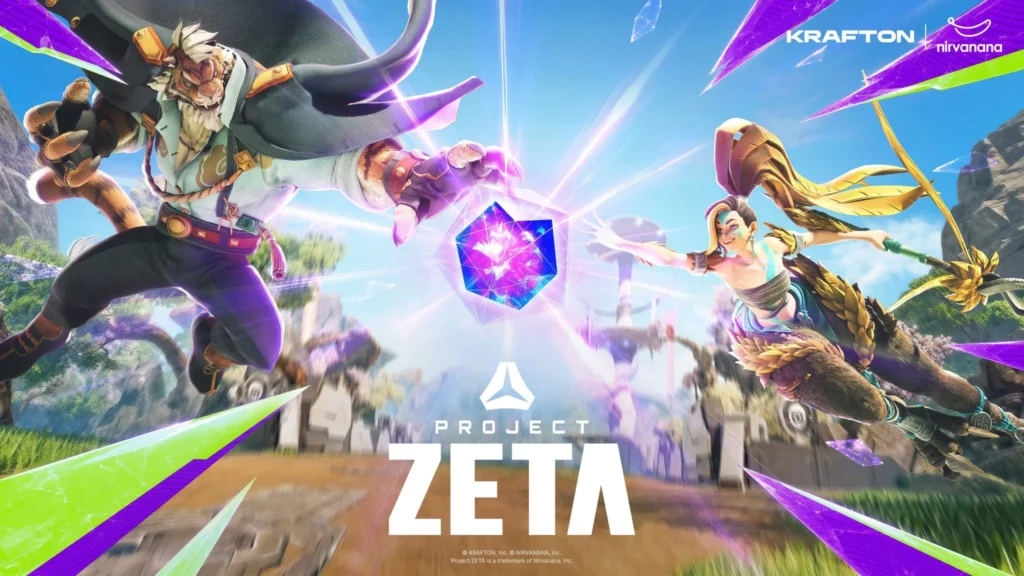
Project Zeta’s appearance at Gamescom Opening Night Live 2026 highlighted a competitive action game built around an unusual format: four teams of three players sharing one battlefield. Developed by Nirvanana and published by Krafton, it combines distinctive heroes, objective battles, and opportunities to interrupt rival squads rather than following a straightforward two-team shooter structure. Its official Gamescom presentation describes the experience as a Multi-team Tactical Arena.
For readers following Project Zeta’s hero PvP trailer at ONL, the important distinction is between what the trailer demonstrated, what subsequent testing established, and what remains a development target. As of September 18, 2026, the advertised September community test has ended. A developer interview reports a late-2026 Early Access target, but that is not an exact release date or confirmation of a finished version 1.0 launch.
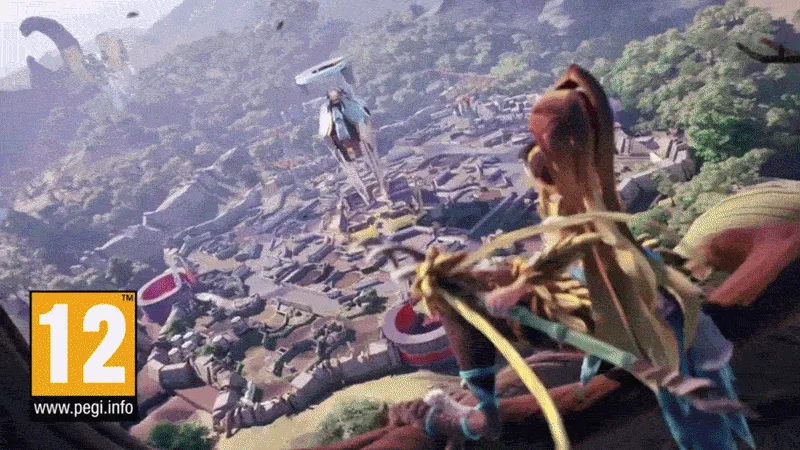
Project Zeta appeared during the August 25, 2026, Opening Night Live showcase. Its trailer presented work-in-progress gameplay and concluded with a Steam wishlisting message rather than a dated launch announcement. The official Gamescom video listing also connected the presentation with Steam playtest registration. The trailer’s visual introduction establishes a world that mixes fantasy with technology. Floating architecture, an enormous tree, and a winged mechanical figure precede the transition into arena combat. The fighting footage emphasizes varied character silhouettes, melee attacks, ranged pressure, defensive effects, and rapid movement. These are useful signals about the game’s visual identity and combat variety, although they do not explain every match rule.
The central takeaway is therefore broader than “another hero shooter.” Krafton’s accompanying Gamescom description identifies four competing trios, making the number of rival squads an essential part of the design rather than a minor mode variation. A trailer is best treated as an introduction to those ideas. It cannot establish average matchmaking quality, long-term hero balance, or performance on every supported computer. The strongest way to interpret the ONL footage is alongside the published rules and later test notes, separating attractive presentation from systems that players can actually evaluate.
Project Zeta is a third-person competitive hero game in which twelve players form four squads. Its official Gamescom description places those squads together on a shared battlefield, with one team ultimately winning. That structure creates competition from several directions instead of a fixed frontline between two opposing sides. Nirvanana’s design introduction explains that positioning, movement, targeting systems, and hero abilities are intended to matter more than conventional crosshair accuracy. It also describes changing responsibilities around the Prism objective: a player might help transport it, pursue an enemy carrier, or concentrate on strengthening the team before contesting another opportunity.
The practical appeal is the interaction between fighting skill and judgment. A technically impressive duel may accomplish little when another squad completes an objective elsewhere. Conversely, a well-timed interception could be valuable even when it does not produce the highest elimination count. This makes awareness a central learning priority. A useful question during play is not simply whether an opponent can be defeated, but whether engaging that opponent improves the team’s position. The four-team format gives that question several possible answers: attack immediately, intercept a carrier, protect an ally, or leave two rivals fighting while pursuing a different opportunity.
Nirvanana is the developer, while Krafton is the publisher. The studio’s own company profile states that it was established in 2022 and describes its first project as character-based strategic PvP. Nirvanana also identified itself as a Korean development team in its public Project Zeta developer discussion. The distinction matters because publishing and development credits are not interchangeable. Calling it “Krafton’s Project Zeta” is reasonable shorthand for the publishing relationship, but it should not erase the studio responsible for the game’s design.
Nirvanana’s stated ambition is to build a lasting original property and earn continued player interest through repeated development and delivery. That is a studio objective, not evidence that the game has already achieved a sustainable competitive community. The development process has already involved structural changes. Official June communication described a smaller battlefield and a reduction from five competing teams to four. Older footage showing a different team count therefore represents an earlier design rather than the current format. For prospective players, this history is significant: testing is influencing fundamental decisions, not merely adjusting damage values. It also means that older guides should be checked against newer announcements before their advice is treated as current.
Project Zeta Setting, Lore, and Genre Positioning
The Aran Plateau is the central setting identified in Project Zeta’s game description. Its world combines humans, humanoids, dragons, monsters, and heroes, rather than presenting a purely military or contemporary science-fiction arena. The official lore explains that the Zeta Dimension contains the information underlying the universe. Humanity accessed it through an artificial intelligence called Infinity Improving Intelligence, or I³, and used it to store knowledge and communicate. Humanoids subsequently investigated its deeper significance, including the possibility that reality itself was projected from information within that dimension.
Conflict followed. Humans attacked the humanoid city of Prismcorp and won, but the loss of functioning humanoids also left humanity unable to access its accumulated knowledge. The setting’s present-day history is consequently reconstructed from incomplete archives and uncertain accounts. Kallipolis selects heroes to confront Dimensional Storms, although each hero also has personal motives and a CODEX they seek. The official presentation makes that difference between public duty and private ambition part of the roster’s identity.
Thematically, this gives the arena a setting shaped by lost knowledge and competing interpretations of the past. It helps explain the mixture of technology, fantastical creatures, and unusual heroes. It should not, however, be mistaken for confirmation of a separate single-player campaign.
The most precise genre description is the official Multi-team Tactical Arena label. “Hero PvP” is also useful because it communicates competitive play through distinct characters without suggesting that the entire experience depends on firearms or conventional shooting accuracy. The MOBA comparison is understandable because Project Zeta combines hero abilities, combat progression, and contested objectives. Windows Central’s developer interview nevertheless describes a roughly 20-minute format without a conventional laning phase. That makes it an imperfect match for expectations built around traditional lane-based competition.
The hero-shooter comparison captures the character roster and third-person action, but it can understate the importance of transport objectives and multi-squad decisions. Similarly, the presence of several teams does not automatically make the game a battle royale. Nirvanana explicitly distinguishes its design from that genre and emphasizes the ability to respawn and attempt another fight. These labels are most useful as starting points, not substitutes for understanding the rules. A shooter player should investigate targeting and movement. A MOBA player should examine how progression interacts with objective timing. A battle royale player should reconsider habits built around avoiding all risk, because the cost and consequences of defeat are different here.
Project Zeta Gameplay, Objectives, Heroes, Combat, and Controls
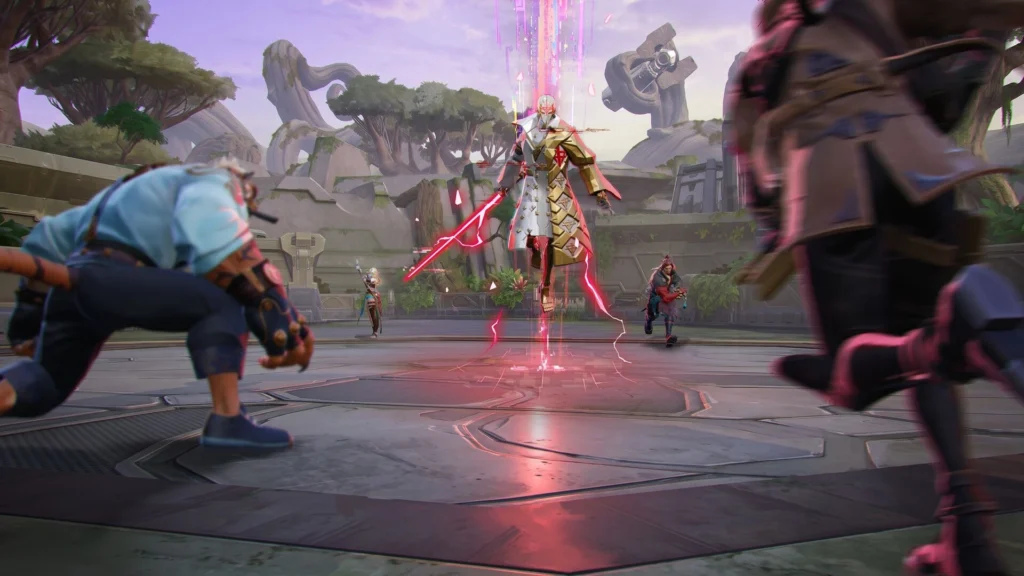
Project Zeta’s match objective revolves around acquiring and scoring with Prisms. CGMagazine’s Gamescom preview describes bosses that drop these objects, carriers who must deliver them, and a scoring process that leaves room for enemies to intervene. The first team to reach five points wins. The demonstrated rules distinguish ordinary Prisms from S-Prisms. The first two points use ordinary Prisms, while the final three require S-Prisms. The preview describes upgrading a carried Prism by eliminating an opposing squad, while a special boss can also provide an already upgraded S-Prism. These are descriptions of the previewed build, not a guarantee that every scoring detail will remain unchanged at launch.
The strategic consequence is that obtaining an objective and safely scoring it are separate challenges. A team can succeed against a boss yet lose the resulting opportunity during transport. Protecting the route can therefore matter as much as winning the initial encounter. Consider a hypothetical situation in which two rival squads fight around a boss while a third waits near the delivery area. Joining the boss fight immediately might create an opening, but it might also leave the eventual carrier exposed. A more useful decision could involve denying the waiting squad a favorable position first.
This is why elimination totals alone would provide an incomplete account of a player’s contribution. Creating a safe scoring window, delaying a pursuer, or drawing attention away from a carrier can all be strategically meaningful, even when those actions look less spectacular than a finishing blow.
The official hero directory currently displays 16 hero entries, organized through Fighter, Assassin, Marksman, and Mage filters. Named characters include Laveck Boggins, Piper Eredh, Vesper, Kurogane Isamu, Mika Mist, Azrakel, and Nova Crash. This is the published roster snapshot, not a promised final launch total. Laveck provides a concrete example of ability interaction. His Ramspike places a spike that slows enemies, while striking it with Slam or Rampage triggers additional damage and a stun. Anchoring lets him move to a spike and grant nearby allies damage reduction. His kit therefore includes setup and protection as well as direct aggression.
That combination suggests a useful approach to team composition: identify how one character creates opportunities that another can exploit. A stun is more valuable when an ally is ready to follow it, while a protective effect is wasted when teammates have already moved beyond its reach. The September update introduced Azrakel as an assassin and Nova Crash as a melee fighter focused on disrupting formations.
It also added build preparation for automatic CODEX purchasing and ability progression during matches. For a new squad, learning a small set of complementary heroes is likely to be more productive than chasing an unsupported “best character” ranking. Early priorities should include understanding initiation distance, escape options, control effects, and which teammate should remain available to protect an objective carrier.
Nirvanana’s design explanation presents combat as a contest of movement, ability use, and judgment rather than a conventional aiming exercise. The intended distinction is not that mechanical skill disappears, but that reading an opponent and selecting the right action become important expressions of that skill. Mobility has also been adjusted during testing. The September update reduced the shared Dash cooldown from 30 seconds to 15 seconds. That is a test-build balance value and should not be treated as an immutable launch specification.
A particularly important system is Fighting Spirit. In its developer discussion, Nirvanana explained that wiping out an opposing squad restores the victorious team’s health and ability cooldowns. The purpose is to give teams a way to survive successive engagements instead of becoming automatic victims when another squad arrives. The tactical implication is more complicated than simply avoiding every multi-team fight. A nearly completed enemy wipe may represent a recovery opportunity, while abandoning it could leave the team vulnerable. On the other hand, chasing one escaping opponent too far could separate allies and undermine that opportunity.
A sensible learning exercise is to track the sequence of a fight. Which ability forced the first dodge? Which movement option remains available? Can the team finish the engagement together, or has its formation broken apart? Those questions encourage deliberate decisions rather than spending every ability at the first visible target.
Project Zeta supports controller and mouse-and-keyboard play. In its developer discussion, Nirvanana explained that basic attacks do not require conventional manual aiming and shooting, while smart aim assistance and target locking are intended to reduce differences between the two control methods. That describes a design approach, not independent proof of perfectly equal competitive results. Balance between inputs also depends on how comfortably players can move the camera, choose targets, and place abilities during complicated encounters.
A meaningful comparison should therefore test more than whether basic attacks connect. Can a player select the intended opponent when several characters overlap? Can an escape ability be placed accurately under pressure? Is it easy to turn toward an approaching squad without losing awareness of the current fight? Those are practical evaluation questions rather than claims that one device already has an advantage. Input choice should also be kept separate from specific hardware certifications.
General controller support does not, by itself, establish every controller feature, accessibility option, or handheld compatibility status. Players should look for explicit documentation before assuming support for a particular device-specific capability. The useful starting point is that the game is being designed around both major PC input approaches, rather than treating controller use as an incidental substitute.
Project Zeta Playtests, Release Timing, Platforms, PC Requirements, and Pricing
The advertised September event was Global Community Test #2, and its scheduled window has ended. Official instructions set regional availability from September 4 at 8 p.m. until September 7 at 12 a.m., meaning midnight at the end of Sunday, September 6. The reference time zones were PDT, UTC; 7, for North America; CEST, UTC+2, for EMEA; and UTC+9 for Asia. PvP was advertised as continuously available within those regional windows. Daily 8 to 11 p.m. “prime time” periods were recommendations for finding more players, not the only hours during which matches were scheduled.
The difference matters when interpreting archived announcements. A headline describing a September 4 to 6 test and a schedule ending at midnight on September 7 are compatible. They do not establish an additional full day of play on Monday. As of September 18, instructions inviting players to join that specific weekend should be treated as historical. A visible registration button is not evidence that the same servers remain open indefinitely. The September build also introduced Bounty and Shard Compensation systems intended to help keep matches competitive when teams developed at different rates. Whether those systems achieve consistently satisfying comebacks requires broader play evidence; their inclusion establishes the design intention, not a proven outcome.
Project Zeta’s Steam page contains a “Join the Project ZETA Playtest” section with a Request Access option. The listing also identifies a Krafton ID account requirement, with Steam account linking supported. The registration process begins by signing into Steam, locating the correct game page, and submitting the request through that playtest section. Players should then follow Steam’s access notification and the developer’s instructions for any announced test window.
Wishlisting and requesting playtest access are separate actions. Valve’s documentation explains that playtests use an associated application distinct from the main game and that developers can control admission and availability. A test may accept registrations even when its build is not currently playable. This creates several separate checkpoints: registration, admission, installation, and an active test period. Completing one does not necessarily complete the others.
A player who sees the test in a library but cannot enter a match should first establish whether an official session is running. Reinstalling repeatedly or purchasing an unofficial key would not resolve an inactive test schedule. The appropriate reference is the latest dated announcement, rather than an old trailer or a registration page viewed without its surrounding context.
Project Zeta does not yet have a confirmed exact release date in the reviewed sources. Steam displays “Coming soon.” Windows Central’s September 18 developer interview reports that the team is targeting an Early Access launch in late 2026. That target is more informative than saying no release timing has been discussed. However, it still leaves important questions unanswered, including a specific launch day and the timing of a completed version 1.0 release.
Three milestones should remain separate: a temporary community test, an Early Access launch, and a full release. A test demonstrates that a development build is available during a particular period. It does not automatically establish the commercial release schedule. Likewise, “late 2026” should not be converted into an invented December date. A useful release announcement would identify the date, the platforms participating at that stage, and the conditions of access. The current planning position is therefore a late-year Early Access target, not an unconditional promise that every announced version and feature will arrive simultaneously.
PC and PlayStation 5 are the platforms identified in Windows Central’s developer interview. The same report discusses cross-play between PC and PlayStation as part of the game’s design. Those are platform plans, not evidence that a public cross-platform release is already available. An Xbox version could not be confirmed from the announcements and interviews reviewed for this article. It would therefore be inaccurate to present Xbox Series X|S as an announced platform. It would be equally premature to interpret the absence of an announcement as proof that an Xbox edition can never happen.
Platform support also should not be confused with controller support. Using an Xbox-style controller on a PC does not establish an Xbox console release. For groups planning to play together, the important future details are more specific than a list of platform logos. They include whether the relevant versions launch together, whether cross-play is active at that stage, and whether progression can move between accounts or platforms. Cross-play and cross-progression should not be treated as interchangeable promises.
The published PC requirements specify a 64-bit processor and Windows 10 64-bit, 16 GB RAM, DirectX 12, broadband internet, and 9 GB of available storage at both minimum and recommended levels.
- Minimum hardware: Intel Core i3-10100F or AMD Ryzen 5 4500, paired with an NVIDIA GeForce GTX 1060 with 6 GB VRAM or Radeon RX 5500 XT with 8 GB VRAM.
- Recommended hardware: Intel Core i5-12400F or AMD Ryzen 5 5600, paired with an NVIDIA GeForce RTX 3060 with 8 GB VRAM or Radeon RX 6600 XT with 8 GB VRAM.
The RTX 3060 memory figure above follows the listing rather than substituting a different configuration. The 9 GB figure is an available-space requirement, not a verified download size or a promise about the final installation footprint. These specifications should not be converted into unsupported frame-rate claims. The listing does not associate them with a stated resolution, graphics preset, or guaranteed performance target. For competitive play, a practical evaluation should examine consistency rather than only the highest frame rate observed. A quiet area and a crowded objective fight are different test conditions. Reliable conclusions would require measurements from the relevant build, settings, and hardware, especially before recommending a purchase solely for this game.
The September community test was advertised as free to play. That statement applies to the test period; it does not establish Project Zeta’s final launch business model. Valve’s Steam Playtest documentation also states that the feature is free for players and that developers must not sell access to Steam Playtests or their keys. That gives players a reason to be cautious about anyone demanding payment specifically to unlock an official Steam Playtest.
A definitive launch price or fully described monetization model could not be verified from the reviewed materials. Consequently, claims that the finished game will be permanently free, require a particular upfront payment, or use a specific premium currency would go beyond the available evidence. The test’s progression systems should not be mistaken for that missing announcement. September documentation includes hero unlocking through account progression and earned currency used in a shop, but test systems are not a complete contract for the eventual commercial economy. A useful pricing announcement would explain more than whether the download costs money. Character access, competitive restrictions, and the distinction between cosmetic and gameplay-affecting purchases would all matter when evaluating the eventual model.

Frequently Asked Questions (FAQs)
- How many players are in a Project Zeta match?
The current format has twelve players divided into four teams of three. That four-team structure is important because it changes the flow of a match: threats can come from several directions, and two squads fighting each other can create opportunities for a third team. Older references to five competing teams reflect an earlier design phase and should not be treated as the current match specification. - What is the main objective in Project Zeta?
Teams compete to acquire and score with Prisms, with the first team to reach five points winning. In the previewed rules, ordinary Prisms are used for the first two points, while S-Prisms are required for the final three. This means the objective is not just to win fights, but to secure Prisms, protect the carrier, interrupt rival teams, and choose when to contest or avoid engagements. The exact scoring details may still change before launch, since they come from a previewed build. - Is the September 4 to 6, 2026 playtest still running?
No. The advertised regional schedule for Global Community Test #2 ended at midnight concluding September 6, depending on the listed regional time zone. As of the researched date, that specific test should be treated as historical. A remaining Steam registration button or playtest page does not mean those servers are still open. It may only mean players can request access for a future session or that the page has not been removed. - How is Project Zeta playtest access requested?
Project Zeta playtest access is requested through the game’s Steam playtest registration section. Players need to sign into Steam, find the correct Project Zeta page, and use the Request Access option if it is available. However, requesting access is not the same as being admitted or being able to play immediately. The developer controls who receives access, when the test app is available, and whether an active test window is currently running. - When will Project Zeta release?
The reported target is late-2026 Early Access. That is useful timing information, but it is not the same as a confirmed release date. No exact launch day has been confirmed in the reviewed sources, and the late-2026 target should not be rewritten as a specific month or a finished version 1.0 launch. A temporary playtest, an Early Access release, and a full commercial launch are separate milestones and should be treated separately. - Is Project Zeta coming to PS5 or Xbox?
PC and PlayStation 5 are identified in the developer interview, alongside planned PC to PlayStation cross-play. That means PS5 is part of the stated platform plan, while PC is also central because Steam playtest registration and system requirements are already public. An Xbox edition could not be confirmed from the reviewed announcements, so it should not be listed as an announced platform. At the same time, the lack of an Xbox announcement does not prove that an Xbox version can never happen. - Does Project Zeta support controllers?
Yes. Controller and mouse-and-keyboard support are part of the stated design. Nirvanana has explained that basic attacks do not rely on conventional manual aiming in the same way as a standard shooter, and that smart aim assistance and target locking are intended to reduce the gap between input methods. Still, support does not automatically prove perfect competitive parity. The more useful question is how targeting, camera control, movement, and ability placement feel during actual matches. - How much storage and memory does Project Zeta require?
Steam lists 9 GB of available storage and 16 GB of RAM. The 9 GB figure should be understood as available storage space, not necessarily the exact download size or the final installed footprint after future updates. The listing also includes broader requirements such as Windows 10 64-bit, DirectX 12, broadband internet, and a 64-bit processor. These specifications should not be converted into unsupported claims about guaranteed frame rates or performance settings. - How many Project Zeta heroes have been shown?
The official directory currently contains 16 hero entries. Named examples include Laveck Boggins, Piper Eredh, Vesper, Kurogane Isamu, Mika Mist, Azrakel, and Nova Crash. That number describes the published roster snapshot at the time of research, not a guaranteed final launch total. Since the game is still in testing and development, hero availability, balance, and even the final roster size may continue to change. - Does a free playtest mean Project Zeta will be free at launch?
No. Free testing and launch pricing are separate matters. Steam Playtest access is free by design, and Valve’s system does not allow developers to sell access to official Steam Playtests or their keys. That does not determine whether Project Zeta will be free-to-play, premium-priced, or use another commercial model at launch. The final pricing, character access rules, and monetization details still require a separate announcement.

Conclusion
Project Zeta’s strongest distinguishing feature is the interaction between four competing squads, hero abilities and contested objectives. Its Gamescom presentation positions it as a Multi-team Tactical Arena, making decisions about engagement and opportunity central to its identity.
That creates an interesting proposition: victory need not belong to the team that fights most often, but to the team that turns the right fights into meaningful progress. The challenge for the finished game will be making those decisions readable, rewarding and consistently fair.
The release position remains provisional. The September test is over, and the reported late-2026 Early Access target still awaits an exact date. Launch pricing and some platform details also require further confirmation.
The ONL trailer supplies the introduction; complete matches, clear release information and sustained testing will provide the stronger basis for judging the game.
Sources and Citations
- Gamescom, Project ZETA Official Game Listing : Official Gamescom catalogue entry identifying Project ZETA among the games featured on the event website. It provides an organizer hosted reference for the title’s exhibition presence, while KRAFTON’s announcement supplies the more detailed information about its Opening Night Live presentation, announced platforms and community testing schedule. gamescom
Citation: Project ZETA at Gamescom. (Gamescom) - KRAFTON, Project ZETA Official Website : Official game hub linking to Steam, Discord, the lore section, hero profiles and customer support. It introduces the heroes’ connection to Kallipolis and the Dimensional Storms, while providing newsletter registration for news, events and promotional updates. This serves as a central reference for reaching the game’s official information and community channels. Project ZETA
Citation: Project ZETA Official Website. (KRAFTON) - KRAFTON, Project ZETA Lore and Universe Guide : Official worldbuilding page explaining the Zeta Dimension, the artificial intelligence known as I³ and humanity’s conflict with increasingly advanced humanoids. It describes how accumulated knowledge became inaccessible and presents a fictional chronology reconstructed from surviving records. The page also introduces CODEX items, providing background for the setting and terminology used throughout the game. Project ZETA
Citation: Project ZETA: Lore, Universe and Chronicles. (Project ZETA) - KRAFTON, Official Hero Directory : Official character guide organised into Fighter, Assassin, Marksman and Mage categories, with character backgrounds and ability previews. For example, Laveck Boggins’ profile explains his hammer attacks, spike combinations and abilities that protect nearby allies. These descriptions provide direct references for individual combat mechanics alongside the personal motivations behind each hero’s participation. Project ZETA
Citation: Project ZETA: Official Heroes and Abilities. (Project ZETA) - KRAFTON Japan, Gamescom Announcement, August 27, 2026 : Publisher issued press release presenting Project ZETA alongside four other projects. Its dedicated section describes four teams of three players competing over objectives, identifies Nirvanana as developer and confirms planned Steam and PlayStation 5 versions. It also records the September 4 to 6 community test, distinguishing the testing schedule from the game’s eventual commercial release. プレスリリース・ニュースリリース配信シェアNo.1|PR TIMES
Citation: KRAFTON Reveals New Footage for Five Games at Gamescom 2026. (PR TIMES) - Steam, Project ZETA Official Store Page : Official PC listing identifying Nirvanana as developer and KRAFTON as publisher, with the release status currently displayed as “Coming soon.” It provides supported languages, the KRAFTON ID account requirement and a wishlist option. Its playtest section explains that applicants receive notification when the developer is ready to admit more participants, rather than guaranteeing immediate access. Steam Store
Citation: Project ZETA on Steam. (Steam) - KRAFTON Help Center, Project ZETA Support and Gameplay Information : Official support directory collecting explanations of Aran Mode, victory conditions, controller support, Prisms and depositing objectives into Ballasts. Its technical section also links to recommended system requirements and troubleshooting for settings, crashes and low frame rates. This provides a more practical reference for gameplay rules and technical assistance than the promotional website alone. Krafton Help Center
Citation: Project ZETA Support and Gameplay Guides. (KRAFTON Help Center) - KRAFTON Help Center, Aran Mode Overview, Updated June 16, 2026 : Official explanation describing 24 minute matches between four teams of three players on Aran Plateau. It outlines collecting Prisms, depositing them into Ballasts and using combat, cooperation and route planning to accumulate points, while confirming keyboard, mouse and gamepad controls. These are the rules documented in that support update, rather than a guarantee that every later test uses identical settings. Krafton Help Center
Citation: What Kind of Game Is Project ZETA, Aran Mode?. (KRAFTON Help Center) - KRAFTON, Official Community Test Announcements and Updates : Official Steam announcements document the September 4 to 6, 2026 Global Community Test, regional schedules and changes based on player feedback. The accompanying patch notes introduce Azrakel and Nova Crash, preset character builds and interface improvements. The supplied website article did not return readable text, so the Steam archive provides an accessible alternative for these announcements. Steam Community
Citation: Project ZETA Official News Page and Official Steam Announcements and Test Updates. (Project ZETA) - KRAFTON, Closed Beta Test 2 Patch Notes, June 18, 2025 : Historical developer update whose indexed text confirms the introduction of custom matches for playing Aran Mode with selected players. The accompanying official Steam announcement highlights two new heroes. This documents an earlier closed beta, not the September 2026 Global Community Test; the complete article text could not be retrieved during verification. Project ZETA
Citation: Patch Notes: Closed Beta Test 2 and Official Steam Announcement. (Project ZETA)
Recommendations
- Opening Night Live 2026
- Pokémon Pokopia: Zorua’s Hide-and-Sneak Contest Event Guide
- Why the Forever Home is the Perfect High-Concept Sci-Fi Comic for 2026
- New Spider-Man Filming Spotted in London
- Hell Let Loose: Vietnam: Console Release, 50v50 Battles, Maps, and Everything You Need to Know
- Project Zeta Playtest
- Capcom Responds to Onimusha Demo Criticism as Way of the Sword Promises a Harder Challenge
- Nic Cage’s Spider-Noir Community Reaction and Everything We Know: Trailer Breakdown, Release Date, Cast, and Story
- Project Zeta Gameplay
- Where to Find the Hokuryu Sunflower Farm in Forza Horizon 6



































































































