






In This Article (7 sections)
Quake Dawn of the Machine Shadow Drop, Release Details and Development History
The Quake Dawn of the Machine shadow drop happened on 6 August 2026, during QuakeCon 2026 and the wider celebration of Quake’s 30th anniversary. Bethesda announced the episode as already available through the free 30th Anniversary Update rather than giving players a future launch date. Although Bethesda and id Software formally describe it as a new episode and free update, the announcement and immediate release make “shadow drop” an accurate description.
Bethesda’s 6 August QuakeCon roundup positioned the release as part of a broader celebration of both the game and the convention. QuakeCon 2026 ran from 6 to 9 August, with a dedicated Dawn of the Machine presentation featuring representatives from MachineGames and id Software alongside Quake co-creator John Romero. That setting gave the announcement a direct connection to the series’ development history and longstanding multiplayer community. The surprise was therefore not simply the appearance of another downloadable episode, but the arrival of a playable anniversary project while the celebration was taking place.
Quake Dawn of the Machine is available through supported versions of Quake on Xbox Series X|S, Xbox One, PlayStation 5, PlayStation 4, Nintendo Switch and Nintendo Switch 2 through backward compatibility. On PC, it is available through Steam, the Microsoft PC Store, Game Pass and PC Game Pass. However, as of August 14, 2026, Bethesda’s official FAQ states that the episode is not currently available through the Epic Games Store or GOG versions of Quake. This can also cause compatibility problems when players using those versions attempt to join sessions using Dawn of the Machine maps. Bethesda says resulting disconnections are caused by the content mismatch rather than an account penalty.
Existing owners of supported Quake versions do not need to purchase the episode separately. Bethesda says the 30th Anniversary Update should download automatically according to the player’s platform and update settings. Players who do not own Quake need the enhanced release through a supported storefront or subscription service. The Nintendo Switch 2 version is specifically supported through backward compatibility, rather than through a separately announced native Switch 2 edition.
To begin, install any pending updates for the supported enhanced edition, launch Quake and choose Dawn of the Machine when starting a new game. Bethesda’s anniversary FAQ also identifies level selection and cooperative multiplayer as ways to access its content. A separate purchase or promotional redemption code is not part of that process. On Steam, returning players should check that they are launching the enhanced game rather than one of the original executables retained alongside it, a distinction documented in Bethesda’s original enhanced-release FAQ.
The word “free” applies to the episode for eligible players, rather than announcing that the entire Quake package has become a free-to-play game. The update also should not be confused with a limited free weekend requiring players to finish the campaign during QuakeCon. Bethesda presents it as an addition to supported copies of Quake, not a temporary event mode. For subscription users, access to the underlying game remains distinct from purchasing it outright. Checking the base game’s availability and the installed edition is therefore more useful than searching for a standalone Dawn of the Machine product.
Dawn of the Machine joins a package that already contains several distinct stages of Quake’s expansion history. The current Xbox product description lists the original Scourge of Armagon and Dissolution of Eternity expansions alongside MachineGames’ Dimension of the Past, Dimension of the Machine and the new episode. The similarly named projects should not be treated as interchangeable. Bethesda’s August 2021 release notes identify Dimension of the Machine as the episode created for Quake’s 25th anniversary, while Dawn of the Machine is the separate 30th-anniversary addition.
MachineGames also created Call of the Machine for the enhanced Quake II release in 2023, as documented in Bethesda’s Quake II launch material. That project belongs to the second game, not to the original Quake installation. For newcomers searching their libraries, distinguishing Dawn, Dimension and Call helps avoid launching the wrong title or assuming that a previously completed MachineGames campaign is the new release.
Bethesda’s 6 August 2026 PlayStation Blog feature explains that lead level designer Andrew Yoder discussed another Quake project with game director Jerk Gustafsson following the team’s work on Indiana Jones and the Great Circle and The Order of Giants. Their internal Quake Club brought together colleagues with different levels of experience creating Quake maps. The project’s goals included celebrating the original game, surprising established players and allowing developers to contribute outside the narrow specialisations often required by larger productions.
In Bethesda’s accompanying behind-the-scenes account, Yoder identifies H. P. Lovecraft’s “Nyarlathotep,” Philip K. Dick’s novels and Thomas Ligotti’s short fiction as influences on the episode’s unstable reality. He also explains that early ambitions for a more extensively interconnected sandbox were revised as the team developed its levels. That distinction matters when describing the finished game: looping routes and persistent progression do not automatically make it an unrestricted open-world campaign.
The same development account traces the recurring angel imagery to shrines in The Matriarch of Decay. Erik Hörnström’s early shrine forms were replaced by an angel model created by Pontus Wåhlin, which other designers then adopted. Another experiment, seamless teleportation, helped Tom Fritzson develop The Haunted Tower. These examples show how individual level ideas influenced the wider episode rather than every visual theme and encounter originating in a fixed initial plan.
The PlayStation Blog feature also credits advanced level designer Christian Plogfors with creating the new dark-ambient soundtrack while contributing two levels. His involvement gives the music a direct connection to the team constructing the spaces it accompanies. The result is a new musical identity for Dawn of the Machine, rather than a claim that the original Quake soundtrack has been replaced throughout the package.

Quake Dawn of the Machine Campaign, Multiplayer, Achievements and Anniversary Features
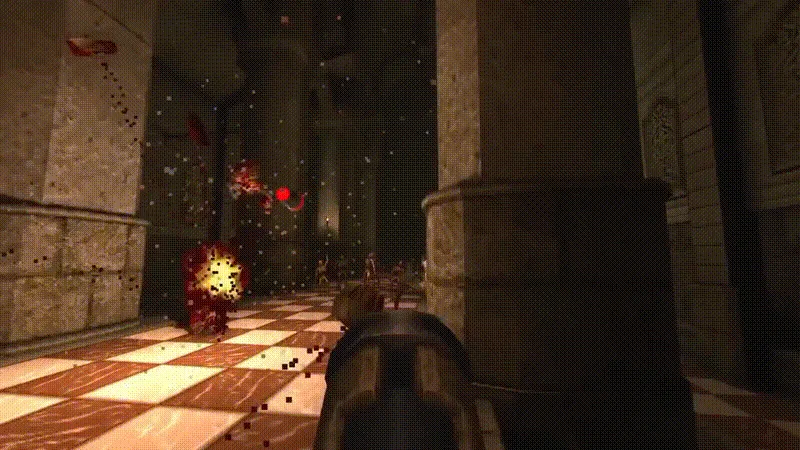
Quake: Dawn of the Machine is a new official episode for the enhanced edition of the original Quake, created by MachineGames in collaboration with id Software. The campaign follows the Ranger after he becomes trapped in a dimension built around recurring violence and illusion, with his escape connected to the mysterious Nightmare Machine. Rather than functioning as a small anniversary bonus, the episode delivers a cohesive 19 map campaign, a dedicated deathmatch map, new music, hidden secrets, additional weapons, enemy variants and progression systems that expand the structure of classic Quake while preserving its fast first person combat, exploration and horror atmosphere.
The campaign’s defining mechanic is looping progression. Players collect runes that can open previously inaccessible routes when returning to familiar areas, while encounters, secrets and other elements may change between visits. Persistent upgrades to health and ammunition also strengthen the Ranger across subsequent loops, giving progression more lasting impact than in a traditional sequence of independent levels. Dimension shifting adds another layer to navigation and puzzles, while some enemies can return or behave differently after appearing to have been defeated. MachineGames uses these systems to make revisiting areas meaningful without replacing Quake’s core focus on movement, projectile avoidance, weapon switching and aggressive combat.
For players approaching the campaign for the first time, the practical consequence of this structure is that an inaccessible passage is worth remembering rather than immediately treating as a dead end. A useful approach is to note the map, nearby landmark and symbol associated with a blocked route, then reconsider it after obtaining another rune. Because familiar locations can change, remembering where an exit used to be is not necessarily enough. Exploration becomes a process of comparing what the player previously understood with what the current visit reveals.
Persistent upgrades also change how optional exploration can be valued. An improvement that remains useful beyond one encounter can justify taking a detour even when the immediate supply situation looks comfortable. This creates an additional choice between pushing towards the next objective and investigating suspicious corners. It does not remove the importance of surviving the current battle, but it gives careful navigation a longer-term purpose alongside the satisfaction of finding a secret.
New enemies and weapons reinforce that expanded design. Confirmed enemy variants include the Rocket Ogre, Demo Dog and Blood Shambler, while additions such as the Super Axe and Laser Cannon provide different combat options. The Super Axe can unleash lightning after successive attacks, while the Laser Cannon fires shots capable of ricocheting through environments. These additions are designed to fit within the established Quake combat framework rather than turning the game into a fundamentally different type of shooter.
The new arsenal suggests different tactical priorities rather than a single weapon that should replace everything else. A melee weapon with a successive-hit effect encourages players to consider whether closing the distance is worth the exposure, while ricocheting shots invite attention to walls and firing angles. These are useful ways to think about the confirmed weapon properties, not guarantees that one approach will dominate every encounter. Likewise, the presence of altered enemy variants is a reason to observe unfamiliar behaviour before relying entirely on tactics remembered from the original campaign.
The wider 30th Anniversary Update also introduces the id Vault, an interactive archive containing historical Quake development material and playable early development maps. Three new achievements and a single player Cheats menu are included as well, giving returning players additional material beyond the main episode.
Multiplayer remains part of the package. The enhanced Quake release supports up to four players in local or online cooperative campaign play, allowing groups to play through Dawn of the Machine together. Competitive multiplayer gains the new deathmatch map, while the broader game supports up to eight players online and up to four locally. Cross platform multiplayer and cross platform co op are also supported.
Bethesda’s enhanced-release FAQ describes a four-letter room-code system for joining friends through the multiplayer menu. A host can share the lobby code with the group, avoiding the need to locate the same session manually in a browser. Cross-play must also be enabled where platform settings permit it. For a Dawn session, agreeing on a compatible host and checking that everyone has the episode installed should come before troubleshooting invitations. The launch announcement also confirms that the new Deathmatch map supports matches involving bots, giving players another way to learn its layout without first assembling a full online group.
There are currently some platform limitations. The GOG and Epic Games Store versions do not contain Dawn of the Machine, which prevents those editions from properly joining sessions that use its maps. Nintendo Switch players may also encounter a problem when hosting Dawn online, with level transitions potentially disconnecting the host and other players. Bethesda’s temporary recommendation is for Switch users to join a cross play Dawn of the Machine session rather than host one themselves.
The official Steam achievement list makes the three additions more specific than the general anniversary announcement. They cover campaign completion, a higher-difficulty finish and a hidden discovery:
- Disillusioned: Awarded for finishing Dawn of the Machine in single-player mode.
- True Sight: Requires a single-player completion of Dawn of the Machine on Nightmare difficulty.
- Bloody Nightmare: Unlocked by discovering the Death Knight’s head.
The single-player wording matters for completionists. Cooperative support does not mean that a group playthrough satisfies every achievement condition, and the two completion achievements explicitly specify solo play. Bloody Nightmare is also a discovery objective according to its listed requirement, despite a name that could suggest another full-campaign difficulty challenge. Players planning their achievement run should therefore distinguish between finishing the story, completing the required difficulty and searching for the relevant secret rather than assuming that one ordinary cooperative run covers everything.
A sensible first playthrough can focus on understanding the campaign’s routes and progression before attempting a stricter completion goal. Keeping track of unexplored branches is particularly useful when returning to the episode after a break. Players who prefer discovery without spoilers can use the achievement descriptions as broad objectives while avoiding detailed walkthroughs until they encounter a genuine obstacle. This approach preserves the uncertainty built into the campaign without overlooking the fact that its optional discoveries and completion requirements serve different purposes.
The id Vault offers another kind of exploration, this time through material from Quake’s development rather than Ranger’s new adventure. PC Gamer’s launch-day coverage highlighted playable unfinished levels and accompanying development notes, including plainly labelled working maps rather than a collection presented as another polished campaign. Their unfinished state is part of their historical value. Exploring an abandoned route or an incomplete room can reveal design questions that the finished game no longer exposes, although these fragments should not be mistaken for a fully reconstructed lost episode.
Taken together, the new campaign and the archive offer a useful contrast: one shows designers making fresh work within Quake’s established framework, while the other lets players examine parts of that framework before it was finalised. The archive is especially relevant to readers interested in level construction, since a navigable space can communicate scale, sightlines and movement more directly than a screenshot alone. It gives the anniversary update a preservation component alongside its new playable content.

Quake Dawn of the Machine Performance, PC Requirements and Platform Details
Quake: Dawn of the Machine runs through the existing enhanced edition of Quake rather than using a separate technical foundation. On PlayStation 5, Bethesda lists support for up to 4K resolution at 120 frames per second with a compatible display. The PS5 version also supports DualSense vibration, adaptive triggers and controller speaker features. Xbox Series X|S offers the same maximum target of up to 4K at 120fps, while the Xbox version includes Smart Delivery, Xbox Play Anywhere, cloud saves, cross platform multiplayer and cross platform co op. Existing supported Quake owners receive Dawn of the Machine through the free anniversary update rather than purchasing a separate version.
Nintendo Switch retains the technical targets of the enhanced Quake release, running at 720p and 60fps in handheld mode and 1080p and 60fps while docked. Bethesda has not announced separate rendering targets specifically for Dawn of the Machine. Nintendo Switch 2 can run the game through backward compatibility, but there is currently no separately advertised native Switch 2 version or official Switch 2 specific resolution and frame rate target. The 30th Anniversary Update also improves the broader enhanced release through reduced input latency, adjusted interpolation and weapon bobbing, improved font rendering, lower menu memory usage and changes to enemy shadow handling intended to improve performance.
On PC, Dawn of the Machine uses the existing enhanced edition system requirements. Bethesda associates the minimum specification with 1080p at 60Hz:
- Windows 10
- Intel Core i5 3570 or AMD Ryzen 3 1300X
- NVIDIA GeForce GTX 650 Ti 2GB or AMD HD 7750 1GB
- 8GB RAM
- At least 2GB of available storage
- High speed broadband connection for online play
For the recommended 4K at 120Hz configuration, Bethesda lists an Intel Core i5 6600K or AMD Ryzen 5 1600, an NVIDIA GeForce GTX 1070 8GB or AMD RX Vega 56 8GB, and 8GB of RAM. At least 2GB of storage is again required, while additional space may be needed for downloaded community content. The relatively modest requirements reflect the technical foundation of the enhanced 1996 game rather than the demands of a newly built 2026 AAA shooter.
The console features also depend on launching the appropriate version. Bethesda’s October 2021 next-generation upgrade announcement distinguishes the native PS5 and Xbox Series editions from their older console counterparts. PS5 users should check which version is installed, while Xbox uses Smart Delivery for the supported upgrade path. These upgrades apply within the same console family, not as a transfer of ownership between PlayStation and Xbox. They are separate from installing the 2026 anniversary content.
The advertised resolution and refresh-rate figures describe supported configurations, not a guarantee that every display or setup will automatically use them. A 4K television is not necessarily capable of displaying a 120Hz signal, and the game, console and screen settings must be compatible. On PC, the minimum and recommended specifications likewise should not be read as independent benchmarks of every Dawn of the Machine map.
PC users should also be aware of a documented DirectX 11 launch issue, particularly on systems using Intel graphics drivers. Bethesda’s current Steam workaround is to launch the game with the command +d3d11_compileShaders 1 while a broader fix is being developed. Steam, the Microsoft PC Store, Game Pass and PC Game Pass currently support Dawn of the Machine, while the Epic Games Store and GOG versions do not currently contain the episode.
Bethesda’s detailed troubleshooting instructions distinguish two cases. For Steam users with Intel graphics, including Intel Arc, the fuller launch option is +r_rhirenderfamily "d3d11" +d3d11_compileShaders 1, entered in Quake’s Properties under Launch Options. For Xbox PC users whose game reaches the main menu but crashes when starting Dawn under DirectX 11, Bethesda instead instructs them to open the in-game console with the tilde key and enter d3d11_compileShaders 1. These are targeted workarounds for the documented crashes, not compulsory settings for every PC player or fixes for missing episode content.
Separating installation, graphics and multiplayer issues is important here. A renderer command cannot provide maps absent from a storefront build, just as changing the multiplayer host does not diagnose a local graphics-driver crash. Identifying whether the problem occurs before the main menu, when launching the episode or during an online level transition makes the relevant troubleshooting guidance easier to apply.
For existing owners, the anniversary update offers substantial value because it adds the full 19 map campaign, new enemies, weapons, progression systems, music, secrets, multiplayer content, achievements and the id Vault without requiring another purchase. MachineGames also uses Dawn of the Machine to experiment with looping progression, runes, persistent upgrades and dimension shifting while preserving Quake’s fast movement and combat. Players who prefer the original game’s completely linear structure may find the new systems more elaborate, but the episode exists alongside the classic campaigns rather than replacing them, giving both returning players and newcomers another substantial way to experience the enhanced release.

Frequently Asked Questions (FAQs)
- Is Quake Dawn of the Machine a new standalone game?
No. Dawn of the Machine is a new official episode included as part of Quake’s free 30th Anniversary Update, rather than a separate game that needs to be purchased on its own. Players need a supported version of the enhanced Quake release to access the campaign and its additional content. - When was Quake Dawn of the Machine released?
Quake Dawn of the Machine was released on 6 August 2026, at the same time Bethesda and id Software announced it during QuakeCon 2026. Because players were able to download and play the episode immediately instead of waiting for a previously announced launch date, the release is accurately described as a shadow drop. - Is Quake Dawn of the Machine free?
Yes. Bethesda provides Dawn of the Machine as part of the free 30th Anniversary Update for owners of supported versions of Quake. This includes supported Xbox, PlayStation and Nintendo versions, along with selected PC releases. Players do not need to purchase Dawn as a separate expansion, although they still need access to a supported version of Quake itself. - How many maps are in Quake Dawn of the Machine?
The main campaign contains 19 all new maps, making it a substantial addition rather than a small anniversary bonus. The update also includes a separate new deathmatch map for competitive multiplayer, alongside new weapons, enemies, secrets, music and progression systems. - Is Quake Dawn of the Machine on Nintendo Switch 2?
Yes, but there is an important distinction. Bethesda specifies that Nintendo Switch 2 runs the Nintendo Switch version of Quake through backward compatibility. There is no separately announced native Switch 2 edition of Dawn of the Machine with its own official resolution or frame rate specifications. - Does Quake Dawn of the Machine support multiplayer?
Yes. Dawn of the Machine can be played cooperatively, allowing players to experience the campaign with others. The broader enhanced Quake release supports local and online cooperative play for up to four players, while the anniversary update adds a new deathmatch map and supports online competitive matches for up to eight players. - Can GOG and Epic Games Store owners play Dawn of the Machine?
Not currently. As of 14 August 2026, Bethesda states that Dawn of the Machine is unavailable through the GOG and Epic Games Store versions of Quake. This can also cause compatibility problems if players on those versions attempt to join sessions using Dawn maps from supported versions, as the different content packages can result in a disconnection. - What new weapons are in Quake Dawn of the Machine?
Dawn of the Machine introduces new weapon variations intended to give experienced Quake players different ways to approach combat. The Super Axe can generate lightning after successive attacks, while the Laser Cannon fires projectiles that ricochet through the environment. These additions are part of MachineGames’ effort to experiment with Quake’s established arsenal while retaining its fast combat style. - Does Dawn of the Machine have roguelike progression?
Dawn of the Machine features a looping progression structure with some elements that may remind players of roguelike games. Runes can unlock new routes when areas are revisited, encounters and environments can change, and persistent health and ammunition upgrades carry progression forward. However, Bethesda presents Dawn as a new Quake episode rather than formally describing it as a roguelike, so that comparison should not be treated as an official genre classification. - Can Quake Dawn of the Machine run at 120fps?
Yes, on supported hardware. The enhanced Quake client supports up to 120fps on PS5 and Xbox Series X|S when paired with a compatible display, while appropriately equipped PCs can also target high refresh rates. The original Nintendo Switch’s published target is 60fps. Bethesda has not announced separate Dawn specific performance targets beyond the capabilities of the enhanced Quake versions in which the episode runs.

Conclusion
Quake Dawn of the Machine is one of the most substantial ways id Software could have celebrated the original game’s 30th anniversary. Released without a conventional waiting period on 6 August 2026, the free episode gives supported Quake owners 19 new maps, a new deathmatch arena, original music, additional enemies and weapons, looping progression, persistent upgrades, dimension-shifting mechanics, achievements and the archival id Vault.
It also succeeds in being more than an exercise in nostalgia. MachineGames has deliberately expanded its approach after earlier Quake projects, using Dawn of the Machine to experiment with changing routes, persistent character improvements and enemy variants while retaining the original game’s recognisable first-person combat.
The broad platform support makes the release accessible across PC, PlayStation, Xbox and Nintendo hardware, although players should remember the current exceptions: GOG and Epic Games Store PC copies do not yet contain the episode, Switch 2 support is through backward compatibility, and Switch hosts currently face a known multiplayer transition bug.
Taken as a whole, Quake Dawn of the Machine is not merely a surprise content drop. It is a substantial new official campaign for a game released three decades earlier, built by developers consciously attempting to preserve Quake’s character while proving that its design can still accommodate new ideas. For existing owners on a supported platform, the combination of scale, experimentation and free availability makes it one of the most significant additions to the modern Quake package.
Sources and Citations
- Quake – 30th Anniversary Update
id Software. “Quake – 30th Anniversary Update.” Bethesda Slayers Club, August 6, 2026. (Slayers Club) - MachineGames and id Software Celebrate Quake’s 30th Anniversary with a New Episode
Bethesda Softworks. “MachineGames and id Software Celebrate Quake’s 30th Anniversary with a New Episode.” Bethesda Slayers Club, August 6, 2026. (Slayers Club) - All the News from QuakeCon 2026
Bethesda Softworks. “All the News from QuakeCon 2026.” Bethesda Slayers Club, August 6, 2026. (Slayers Club) - Behind the Scenes: Making Dawn of the Machine for Quake
Wilhelm, Parker. “Behind the Scenes: Making Dawn of the Machine for Quake.” Bethesda Slayers Club, August 6, 2026. The article features MachineGames Lead Level Designer Andrew Yoder discussing the episode’s development and design. (Slayers Club) - What Are the System Requirements for Quake?
Bethesda Support. “What Are the System Requirements for Quake?” Bethesda Support. The page lists the official minimum 1080p/60Hz and recommended 4K/120Hz PC specifications. (Bethesda Support) - Free Next-Gen Update Available Now
Bethesda Softworks. “Free Next-Gen Update Available Now.” Bethesda.net, October 12, 2021. This is the official source for the native PS5 and Xbox Series X|S versions, 4K/120Hz support, Xbox Play Anywhere, and PS5 DualSense features. (Bethesda.net) - Quake Release Notes & FAQ
Bethesda Softworks. “Quake Release Notes & FAQ.” Bethesda.net, August 19, 2021. This contains the Nintendo Switch 720p/60 FPS handheld and 1080p/60 FPS docked specifications, cross-play information, split-screen details, platform specifications, and other enhanced-edition information. (Bethesda.net) - Quake – Xbox Store
Microsoft Xbox. “Quake.” Xbox Store. The listing confirms online/local co-op and multiplayer, including four-player co-op, eight-player online multiplayer and four-player local split-screen support. (xbox.com) - Quake – PlayStation Store
Sony Interactive Entertainment. “Quake.” PlayStation Store. The official US listing confirms PS4 and PS5 availability, up to eight online players, one-to-four local players, cross-play, Remote Play, and DualSense vibration/trigger support on PS5. (store.playstation.com)
Recommended
- Unrailed 2: Back on Track Guide, Biomes, Boss Battles, Train Upgrades, and Co-Op Strategy Explained
- Super Battle Golf sells 100,000 copies in two days on Steam: what the fast launch success means
- Kiln, the Next Game From Psychonauts Studio Double Fine, Has an April Launch Date and Steam Open Beta (April 23, 2026)
- All Anomalies in Animal Hospital Guide: Every Roblox Anomaly Explained
- Best Camera Settings in Blender for Rendering
- Should I Get Blender Alpha or Beta? How to Choose the Right Build (Daily Builds, Beta, RC, and Add-on Compatibility)
- Disgaea Mayhem: Shifting from Tactical RPG to Action RPG and What It Means for the Series
- Gamescom Asia x Thailand Game Show 2026: John Romero Confirmed as Keynote Speaker
- Nintendo’s Stock Price Plummets After June 2026 Nintendo Direct Sparks Investor Panic Over Weak Switch 2 Lineup
- Steam’s New Update Simplifies Gifting & Brings Custom Wishlist Categories



































































































