








In This Article (7 sections)
Queen’s Domain Review: A King’s Field Inspired RPG With Modern Controls and PS1 Dark Fantasy Visuals
Queen’s Domain is a first person action RPG that recreates the atmosphere of classic PlayStation dungeon crawlers while introducing modern camera controls, improved equipment management, and exploration abilities. Developed by Freshly Baked Games and published by Future Friends Games, the game launched on October 30, 2026, for Windows PC through Steam, PlayStation 5, Xbox Series X and S, and Nintendo Switch 2. Its greatest influence is FromSoftware’s King’s Field series, particularly the original 1994 PlayStation game, which established a distinctive approach to first person exploration, deliberate combat, and dungeon navigation.
The game follows Prince Berium as he searches for his missing father on the mysterious Isle of Neasied. Players explore ruins, dungeons, and interconnected environments while fighting enemies, collecting equipment, and discovering routes that gradually make the island easier to navigate. The experience emphasizes observation and patience rather than constant action. A locked passage might require investigating another section of a dungeon, while a newly acquired weapon or movement ability can make an earlier obstacle easier to overcome. Shortcuts become particularly valuable because they reduce the number of encounters required to revisit familiar locations.
Queen’s Domain offers considerable equipment variety, with its Steam listing advertising more than 50 melee weapons and over 20 types of secondary throwing weapons. Character levels, accessories, artifacts, and food that improves statistics contribute to progression. However, equipment upgrades are only one part of the experience. Understanding the island’s layout can be equally important because a newly discovered shortcut may eliminate several difficult fights from future journeys. This relationship between exploration and progression is one of the game’s strongest design features.
The comparison with King’s Field extends beyond visual presentation. FromSoftware released the original game for PlayStation on December 16, 1994, with controls that required separate inputs for turning, strafing, and looking vertically. Equipment changes also involved opening a status menu, while saving was limited to designated locations. Queen’s Domain preserves the slow combat rhythm, power management, and fixed save points but modernizes how players interact with those systems. Mouse look on PC and right stick camera control on consoles make exploring and fighting more comfortable without removing the need for careful positioning.
These improvements become especially noticeable during combat. Players can track an enemy while retreating, adjust their view quickly, and cycle between equipped weapons without repeatedly opening the equipment menu. However, easier camera movement does not make the combat fast. Players still need to judge attack range, observe enemy movements, and decide when they have enough time to recover power before striking again. The modern controls reduce friction associated with the original King’s Field interface while retaining much of its deliberate gameplay.
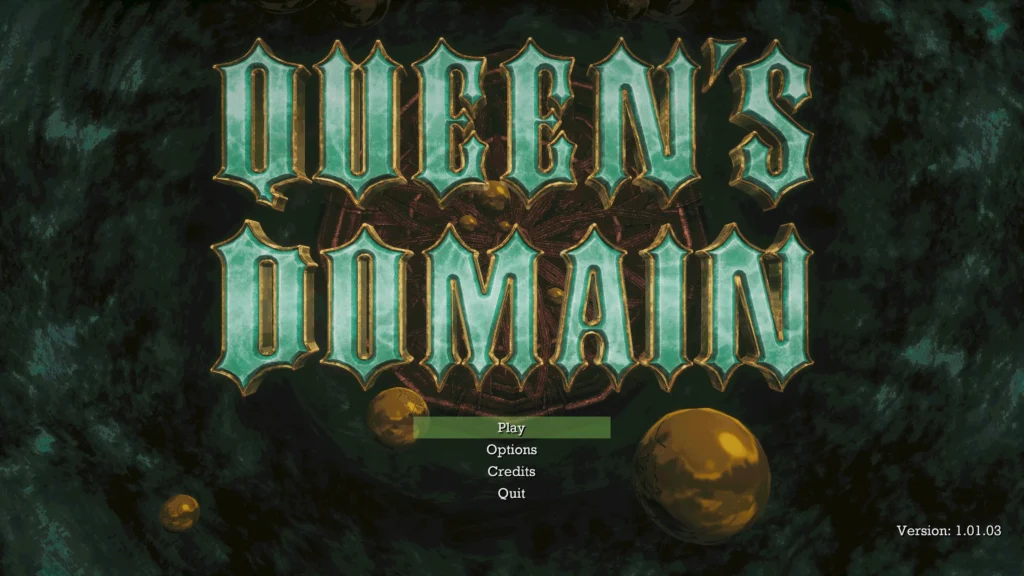
Visually, Queen’s Domain uses low polygon environments, pixelated textures, angular character models, and dark fantasy architecture to recreate the appearance of early 3D games. Rough stone walls, dim corridors, and indistinct shapes contribute to the atmosphere of an unfamiliar island. The style also supports exploration because players must examine environmental details to identify passages, hidden objects, and potential shortcuts. A distant ledge might suggest an accessible route, while a narrow opening could conceal an item or another section of the dungeon.
However, the retro presentation occasionally affects readability. Hitbox Magazine reported overlooking important objects because they blended into surrounding textures. This can be frustrating when progression depends on locating a small item or identifying an interaction point. The game helps by changing the crosshair’s appearance when it passes over interactive objects, while audio cues can warn players about enemies before they become visible. Careful observation and listening are therefore important parts of navigating the island.
Queen’s Domain also includes a retro resolution option, allowing players to adjust how the visual style is presented. The low polygon models and coarse textures remain part of the game’s artistic direction, but image clarity varies depending on platform and rendering settings. RPG Site found noticeable differences between versions even after disabling the retro resolution option. These variations can influence how easily players identify objects and enemies, particularly on smaller handheld screens.
Camera customization offers another improvement over older first person dungeon crawlers. The game supports mouse movement on PC and right stick camera control on compatible controllers. Published Switch 2 reviews confirmed options for control remapping, camera sensitivity, inversion, acceleration, and stick deadzones. Sensitivity determines how quickly the view moves, acceleration affects changes in turning speed, and deadzone settings determine how far a stick must move before the camera responds. Adjusting these options can make combat and exploration more comfortable, particularly for players who find the default camera movement inconsistent.
Camera control is especially important when judging enemy attack distances or navigating elevated platforms. Players may need to retreat while watching an opponent’s attack animation, look downward to estimate a landing, or examine overhead structures for possible routes. These actions are easier with contemporary camera controls than with the separate directional inputs used by the original King’s Field. Nevertheless, camera responsiveness can also be affected by performance. Early Switch 2 reviews documented uneven frame rates in demanding areas, while the developer identified camera movement and screen tearing among the problems targeted by planned updates.
Queen’s Domain succeeds most clearly when its modern conveniences support rather than replace its older design principles. The game remains demanding, and players are still expected to learn enemy behavior, remember locations, and explore without extensive guidance. Its improved camera and equipment controls make these tasks easier to perform, but the challenge comes from deciding where to go, when to fight, and how far to travel before returning to safety.
Queen’s Domain Combat, Weapon Evolution, Saving, and Isle of Neasied Exploration
Combat in Queen’s Domain revolves around a Power Meter that determines the effectiveness of melee attacks. A standard strike delivered with a full meter can deal its normal damage, while attacking again before the meter recovers produces a weaker hit. Running also drains power, although players can continue sprinting after the meter empties. This creates an important tactical consideration because escaping an enemy through prolonged running may leave the player unable to immediately deliver an effective counterattack. Combat therefore rewards patience, positioning, and allowing sufficient time between strikes.
Players can also hold the primary attack input to prepare a stronger charged blow. The meter changes color as the attack charges, and charging can begin while power is recovering. However, preparing a charged attack restricts other actions, including running, using throwing weapons, and performing the Wind Dash ability. This makes charged attacks valuable when an enemy is approaching slowly or recovering from a committed attack, but dangerous when several opponents are already within striking distance. In some situations, a properly timed standard swing is more effective than attempting a stronger attack without a safe opening.
Weapons introduce additional tactical variety through differences in range, attack speed, damage type, and special abilities. The Azure Torch, for example, can burn nearby enemies and launch a bouncing fireball through its special attack. Different enemies also have varying resistances, meaning a weapon that performs well against one opponent may be ineffective against another. Experimenting with equipment can reveal more efficient approaches to difficult encounters, particularly when the player’s usual weapon produces unexpectedly low damage.
The equipment system supports up to three primary weapons and three secondary weapons assigned for use during gameplay. Players equip weapons through the inventory or status menu and can cycle between their assigned choices without reopening the menu for every change. Early in the adventure, Commander Ekonta provides the Rusted Short Sword, which must be equipped before it can be used. The pause menu includes a controls guide identifying the relevant switching inputs for each platform.
A balanced loadout can make difficult encounters more manageable:
- Long reach weapons: Useful for striking enemies while maintaining distance from dangerous close attacks.
- Alternative damage types: Provide options against opponents resistant to a preferred weapon.
- Secondary throwing weapons: Allow players to attack from outside melee range.
- Weapon specials: Offer additional effects that can change how particular encounters are approached.
- Quick slot consumables: Provide access to healing and other usable items without repeatedly opening the inventory.
Quick slots are separate from equipped weapon switching. On PC, TechRaptor identifies the mouse wheel as the default input for cycling usable items and F as the default key for activating the selected item. Players can remove unwanted items from the rotation through the inventory, making frequently used consumables easier to access. This distinction is useful because cycling an item slot does not necessarily change the weapon currently held.
Weapon progression rewards continued use, allowing equipment to grow stronger over time. Certain weapons can eventually evolve into different forms, sometimes gaining new abilities. RPG Site identified rusty weapons among those capable of becoming unique equipment, giving players a reason to experiment with apparently weak early finds. Character experience and levels develop independently of weapon progression, while accessories, artifacts, and certain foods provide additional ways to improve statistics.
This progression system creates decisions about whether to continue improving a familiar weapon or test newly acquired equipment. A weapon with predictable reach and attack timing can remain valuable during dangerous journeys, even when another weapon appears stronger on paper. Conversely, a new damage type or special ability might solve a problem that an established loadout cannot handle. Testing weapons against manageable enemies helps players understand their practical advantages before relying on them during difficult encounters.
Queen’s Domain can be particularly challenging during its opening hours because healing supplies are limited, enemies can deal substantial damage, and save locations are separated by dangerous stretches of exploration. The game also lacks an internal map. A compass helps players maintain their direction, but navigating the island requires remembering landmarks, staircases, corridors, and shortcuts. Players who become comfortable with combat may still struggle when they cannot determine how to return to a save point or locate an overlooked progression item.
Saving takes place at Crystal Monuments, which are also described as shrines or obelisks in reviews. Players can choose to save or rest, and these actions have different effects. Saving records progress without necessarily resetting the surrounding area. Resting restores health, removes negative status effects, and causes regular enemies to return. Reviews and guides also note that enemies can respawn after enough time passes without resting, meaning previously cleared routes may not remain permanently safe.
Death returns the player to the most recent save, undoing progress made afterward. Unlike games built around recovering dropped currency or resources, Queen’s Domain does not offer a conventional corpse retrieval system. Equipment collected, shortcuts opened, and other progress made after the last save must generally be repeated. This gives exploration additional tension because pushing farther into an unfamiliar dungeon can result in losing substantial progress. However, knowledge gained during a failed attempt can make the next journey easier.
The story provides context for these expeditions. In the Kingdom of Bamaen, Queen Siraatsu returns, prompting King Abraon to sail with his warriors to the Isle of Neasied before she regains her strength. When the expedition fails to return, his son, Prince Berium, becomes shipwrecked on the island and begins searching for his missing father. At an early encampment, Commander Ekonta gives Berium the Rusted Short Sword and explains that the king and some soldiers entered the Deimpo Mausoleum.
Much of the narrative unfolds through conversations, item descriptions, and environmental discoveries rather than frequent cinematic sequences. Players encounter evidence of the expedition while gradually learning more about the island and its history. Certain familiar locations also change as the adventure progresses, rewarding those who revisit places they previously explored. The storytelling complements the interconnected world because new information may change how earlier discoveries are understood.
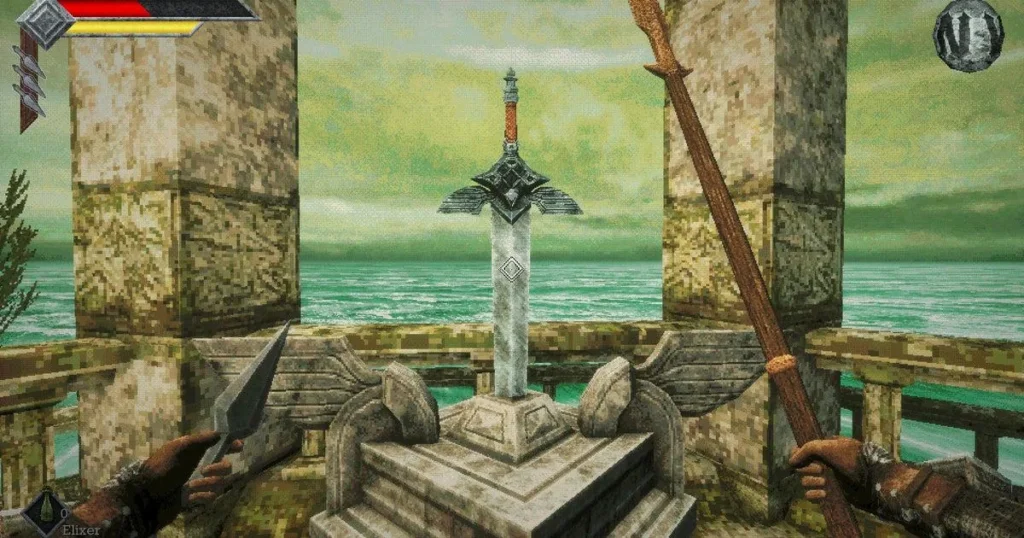
One of the game’s most distinctive features is the Holy Sword Endu, which grants the Wind Dash ability. Endu allows players to extend jumps through the air and reach platforms that would otherwise remain inaccessible. Additional upgrades provide more dash charges, making it possible to cross larger gaps or connect several aerial movements. The charges appear on the HUD and recover over time, while Wind Dash can also function as an alternative attack.
Endu changes the exploration structure because players frequently encounter locations they can see but cannot initially reach. A distant balcony, isolated platform, or passage across a large gap may become accessible after acquiring additional dash charges. These situations encourage players to remember previously discovered obstacles and return when their movement abilities improve. The challenge also involves judging distance and landing positions from a first person perspective, particularly when several dashes are required to cross an opening.
Shortcuts and movement upgrades contribute to exploration in different ways. Opening a door or passage makes familiar routes faster, while upgrading Endu creates access to places that were previously unreachable. Nintendo Life also identified a throwable knife among the tools used to open certain gated areas. These mechanics create a structure resembling a Metroidvania, where new abilities encourage revisiting earlier environments.
Queen’s Domain also shares characteristics with Soulslike action RPGs through demanding combat, deliberate attack timing, dangerous journeys between recovery points, and bosses that test player knowledge. However, its death system is closer to older save and reload RPGs because unsaved progress is lost rather than recovered through a corpse run. The combination of Soulslike combat, Metroidvania exploration, and classic King’s Field design gives the game its identity.
The interconnected Isle of Neasied is ultimately the strongest part of the experience. Shortcuts reward careful observation, new abilities make previously inaccessible routes meaningful, and returning to familiar locations can reveal unexpected connections. However, the same design can become frustrating when a small missed item prevents progression or when death forces players to repeat long sections between save points. Nintendo Life found the game increasingly approachable after its demanding beginning, while Hitbox Magazine highlighted frustrations involving sparse saving and unclear progression clues. These differing experiences reflect how strongly the game’s appeal depends on a player’s tolerance for deliberate exploration.

Queen’s Domain Nintendo Switch 2 Performance, Steam Demo, Platform Differences, and Final Review
Queen’s Domain launched simultaneously across Windows PC, PlayStation 5, Xbox Series X and S, and Nintendo Switch 2, but its technical performance varies between platforms. Nintendo lists the Switch 2 version as a digital release supporting TV, tabletop, and handheld play, with a 1.8 GB file size and one player per system. The ability to move between portable and television play makes the Switch 2 version convenient, although early reviews identified performance problems that could affect the experience during demanding scenes.
Nintendo World Report found ordinary exploration mostly smooth but reported lengthy reloads and a significant frame rate reduction during a large boss encounter involving fire effects. In that specific fight, performance reportedly dropped into the teens. This observation illustrates how demanding visual effects can affect gameplay even when less intensive sections run comfortably. It does not establish that every boss encounter performs similarly, but it highlights the importance of considering performance beyond normal exploration.
RPG Site’s November 8 comparison reported that the console versions target 60 FPS, although Switch 2 performance varied in more demanding locations. Its testing found lower image clarity than on the other consoles examined, along with visible reductions in the animation rate of some distant enemies. The reviewer also found handheld mode more comfortable than docked play in certain areas, suggesting that the smaller screen and different presentation conditions could influence how performance problems were perceived.
Reloading after death presents another consideration because Queen’s Domain relies on manual saving and potentially repeated attempts at difficult encounters. RPG Site measured approximately 19 to 20 seconds for a reload after game over when testing the Switch 2 version using internal storage. That delay becomes more noticeable when players repeatedly fail during the same section. Since death also removes unsaved progress, loading times can add to the frustration associated with replaying familiar routes.
Perfectly Nintendo reported that the developer was preparing Switch 2 improvements addressing screen tearing, camera movement, and stability. However, the November 5 report did not confirm a release date for the update. The published performance observations therefore describe early versions of the game, and later changes could affect the experience. Players comparing platforms should consider both the specific build tested and the conditions under which performance was measured.
The retro resolution option also affects how the game’s visual style is presented. RPG Site disabled the setting during its platform comparisons but still identified differences in image quality. While the low polygon models and coarse textures are intentional, the clarity of environmental details can vary depending on hardware and rendering conditions. This matters because Queen’s Domain frequently requires players to notice small items, distant enemies, and subtle environmental clues.
For players choosing between platforms, the main considerations are portability, image clarity, performance consistency, and preferred controls. The Switch 2 version offers handheld play, while other tested systems may provide a clearer image or steadier performance in demanding environments. PC players can also benefit from mouse look and configurable controls, although performance depends on individual hardware.
A major advantage for PC players is the availability of a free Queen’s Domain demo on Steam. The demo was released on December 4, 2025, and remains accessible through its dedicated store page and the full game’s listing. Freshly Baked Games describes it as a sample of the opening area, several weapons, the first dungeon, and a boss. The estimated completion time is approximately one hour for most players, although exploration speed and familiarity with the combat system can affect the actual duration.
The demo provides an opportunity to evaluate the game’s distinctive mechanics before purchasing the full release. Players can experiment with the Power Meter, compare standard and charged attacks, switch between equipped weapons, and experience the risks associated with exploring unfamiliar areas. The opening dungeon also demonstrates how the game expects players to navigate without relying on an internal map.
However, the demo should not be treated as a complete performance benchmark for the full game. RPG Site found that the complete release was more demanding than the demo on Steam Deck, showing that a smooth opening experience does not necessarily predict performance in later areas. Similarly, testing the PC demo does not establish how the Switch 2 or console versions perform under equivalent conditions.
For players interested in the original King’s Field series, Queen’s Domain is a strong modern interpretation of its most recognizable qualities. It preserves the lonely atmosphere, slow melee combat, sparse saving, and satisfaction of gradually understanding a complicated world. The improved camera and equipment controls make those systems more approachable without eliminating the need for caution.
The most successful addition is the Holy Sword Endu, which gives the interconnected island a distinct form of movement based progression. Discovering a distant platform, remembering its location, and eventually reaching it through upgraded Wind Dash abilities creates satisfying moments that distinguish Queen’s Domain from a straightforward retro imitation. The island’s layout encourages players to think about how areas connect rather than treating each dungeon as a separate destination.
Combat is more divisive. Its stamina dependent attacks, deliberate spacing, and weapon progression provide tactical options, but the repeated rhythm of approaching, striking, and retreating can feel stiff. This is particularly noticeable early in the game, before players have access to a wider selection of weapons and abilities. Those who enjoy careful combat timing may appreciate the system, while players looking for fast, responsive action could find it restrictive.
Progression can also become frustrating when important items blend into the retro environments or when the next objective is unclear. The absence of a map strengthens the feeling of exploration but increases the amount of navigation players must remember. Similarly, limited saving adds tension while occasionally requiring the repetition of lengthy sections after death. These features are central to the game’s design, so their appeal depends largely on whether a player finds this uncertainty rewarding.
Overall, Queen’s Domain is most successful as an exploration focused action RPG that combines classic King’s Field atmosphere with more convenient modern controls and a distinctive movement system. Its interconnected world, hidden routes, weapon variety, and Holy Sword Endu provide compelling reasons to explore, while combat stiffness, sparse saves, and occasional performance issues may discourage less patient players. The free Steam demo offers a useful introduction for anyone uncertain about its pacing, allowing prospective players to experience the game’s combat and dungeon navigation before committing to the full adventure.

Frequently Asked Questions (FAQs)
- Who made Queen’s Domain?
Queen’s Domain was developed by Freshly Baked Games and published by Future Friends Games. It is a first person action RPG inspired by classic PlayStation dungeon crawlers, particularly FromSoftware’s King’s Field series. Although it recreates several design characteristics associated with those earlier games, Queen’s Domain is an independent title rather than an official continuation of King’s Field. - When did Queen’s Domain come out?
Queen’s Domain launched on October 30, 2026, for Windows PC, PlayStation 5, Xbox Series X and S, and Nintendo Switch 2. Its free Steam demo was released earlier, on December 4, 2025, giving players an opportunity to experience part of the opening adventure before the full game became available. - What platforms is Queen’s Domain available on?
Queen’s Domain is available on Windows PC through Steam, PlayStation 5, Xbox Series X and S, and Nintendo Switch 2. The game offers the same core adventure across these platforms, although performance, image clarity, and control options can differ. Nintendo Switch 2 supports handheld, tabletop, and television play, while the PC version includes mouse look and configurable controls. - Is Queen’s Domain Steam Deck Verified?
Yes. The developer announced Steam Deck verification before the game’s October 2026 release. However, verification does not guarantee identical performance throughout the adventure. RPG Site’s testing found that the complete game was more demanding on Steam Deck than the earlier demo, making full release performance observations more useful than judging the experience solely from the introductory sample. - Does Queen’s Domain have multiplayer or co-op?
No. Queen’s Domain is designed exclusively as a single player experience. Steam identifies the game as single player, while Nintendo lists one player per system for the Switch 2 version. The adventure focuses on individual exploration, combat, equipment progression, and discovering connections throughout the Isle of Neasied. Cooperative multiplayer and competitive online modes are not listed as supported features. - Can you remap controls in Queen’s Domain?
Yes. Queen’s Domain supports control remapping, with published reviews confirming the feature on PC and Nintendo Switch 2. Controller settings also include camera sensitivity, inversion, acceleration, and deadzone adjustments. These options allow players to customize how quickly the camera responds and how movement inputs behave, which can be particularly useful during combat and precise jumps. - Is there an in-game map in Queen’s Domain?
No. Queen’s Domain does not provide an internal map showing the island’s layout. Players must navigate by recognizing landmarks, remembering pathways, and learning how shortcuts connect different locations. A compass on the HUD helps identify direction, but it does not replace the need to understand the environment. This design reinforces the game’s emphasis on exploration and discovery. - Does Queen’s Domain have fast travel?
Yes. Players can use discovered Wing Altars as fast travel destinations, reducing the need to repeatedly cross familiar sections of the island. A Travel Crystal Fragment can also return the player to the last Crystal Monument where progress was saved. These options become particularly useful as the island’s interconnected routes expand, although reaching new areas still requires exploration and unlocking the appropriate paths. - Do all weapons evolve in Queen’s Domain?
No. Weapons can become stronger through continued use, but only certain weapons evolve into different forms after sufficient progression. An evolution may change the weapon’s appearance or grant an additional ability. Some rusty weapons can eventually develop into unique equipment, making them worth experimenting with even when they appear weak initially. The exact progression possibilities depend on the individual weapon. - How long is the Queen’s Domain demo?
The developer estimates that the free Steam demo takes approximately one hour for most players to complete. It includes the opening area, several weapons, the first dungeon, and a boss encounter. Players who explore thoroughly or spend additional time learning combat mechanics may take longer. The demo provides a practical introduction to weapon switching, Power Meter management, and navigation before purchasing the complete game.
Conclusion
Queen’s Domain successfully recreates the atmosphere, patience, and tension of classic PlayStation era dungeon crawlers such as King’s Field while introducing more responsive camera controls, convenient weapon switching, and expanded exploration mechanics. However, its deliberate combat can feel stiff, manual saving makes failure costly, and the retro visual style occasionally makes important objects difficult to identify. These limitations are particularly noticeable during the opening hours, when players have limited equipment and little familiarity with the Isle of Neasied.
The game becomes more rewarding as players learn the island’s interconnected layout, discover shortcuts, and unlock new movement possibilities through the Holy Sword Endu. Previously inaccessible platforms and seemingly unimportant passages gain new significance, encouraging exploration and revisiting familiar locations. This combination of challenging combat, environmental discovery, and movement progression gives Queen’s Domain an identity beyond its retro inspiration. Despite its occasional frustrations, it remains a worthwhile experience for King’s Field fans and players who enjoy deliberate first person exploration.
Sources and Citations
- Steam, Queen’s Domain Official Store Page: Official PC storefront confirming that Queen’s Domain launched on October 30, 2026, developed by Freshly Baked Games LLC and published by Future Friends Games. Describes the retro-fantasy action RPG’s interconnected world, challenging combat, and exploration mechanics. Details the Holy Sword Endu, more than 50 melee weapons, rechargeable throwing weapons, character progression, Steam Deck verification, controller support, system requirements, and available demo.
https://store.steampowered.com/app/1799840/Queens_Domain/ - Steam, Queen’s Domain Official Demo, December 4, 2025: Official listing for the free playable demo, allowing players to experience the opening area of the Isle of Neasied. Introduces the game’s stamina-based combat, weapon-specific attacks, exploration mechanics, and Holy Sword Endu traversal abilities. Explains that the demo includes introductory equipment, an early dungeon, and a boss encounter, with approximately one hour of gameplay expected for most players.
https://store.steampowered.com/app/4081520/Queens_Domain_Demo/ - Nintendo, Queen’s Domain for Nintendo Switch 2: Official Nintendo storefront confirming the October 30, 2026 release date, digital availability, and Future Friends Games as publisher. Lists a 1.8 GB download size, single-player functionality, and support for TV, tabletop, and handheld play modes. Also provides information about supported languages, Nintendo Account family-group lending, cloud saves, and the game’s exploration-focused combat and progression systems.
https://www.nintendo.com/us/store/products/queens-domain-switch-2/ - FromSoftware, King’s Field Official Product Information, December 16, 1994: Official historical reference documenting the original King’s Field release for PlayStation. Describes the game as a first-person, three-dimensional action RPG featuring dungeon exploration, sword combat, magic, and challenging encounters. The product page also provides access to historical documentation, including the original manual, offering context for the camera controls, equipment management, and traditional gameplay systems that influenced Queen’s Domain.
https://www.fromsoftware.jp/ww/detail.html?csm=001 - Nintendo Life, November 2026, Queen’s Domain Review (Switch 2): Mitch Vogel examines Queen’s Domain as a modern successor to FromSoftware’s King’s Field series. Discusses its mysterious setting, interconnected level design, demanding combat, and gradual character progression. Explores the importance of discovering shortcuts, improving weapons, and mastering the Holy Sword Endu’s movement abilities. Also evaluates the Nintendo Switch 2 version’s retro presentation, atmospheric environments, and occasional frame-rate drops.
https://www.nintendolife.com/reviews/nintendo-switch-2/queens-domain - Nintendo World Report, November 2026, Queen’s Domain Review: Independent Nintendo Switch 2 review examining the game’s exploration systems, combat difficulty, enemy encounters, and environmental progression. Highlights the interconnected world, gradually expanding gameplay mechanics, and rewarding discovery of hidden routes. Also discusses enemy respawning, the challenge of learning unfamiliar mechanics, and occasional performance problems during demanding combat encounters.
https://www.nintendoworldreport.com/review/78085/queens-domain-switch-2-review - So Many Games, November 9, 2026, Queen’s Domain Review: Matt Murray reviews Queen’s Domain with particular attention to its exploration, interconnected environments, and extensive weapon variety. Explains how weapon abilities, stamina management, and the Holy Sword Endu’s aerial movement influence combat and progression. Discusses the game’s minimal guidance, hidden passages, alternate endings, and customization options, including camera inversion, sensitivity adjustments, and control remapping.
https://somanygames.co.uk/review/queens-domain/ - Hitbox Magazine, November 1, 2026, Queen’s Domain Review: A Demanding King’s Field Heir: Julien Lefevre examines the game’s deliberate combat, retro-inspired visual presentation, and intricate level design. Discusses weapon evolution, hidden shortcuts, scarce save points, and the consequences of losing progress after death. Explains how the Holy Sword Endu’s aerial dashes unlock previously inaccessible areas, while also evaluating the challenges created by limited guidance and difficult encounters.
https://hitboxmagazine.com/en/queens-domain-review/ - RPG Site, November 1, 2026, Queen’s Domain Review: James Galizio provides an extensive analysis of the game’s combat mechanics, exploration, and weapon progression. Explains how stamina affects attack damage, why different enemies require different weapon types, and how equipped weapons develop new properties through continued use. Also examines the Wind Gem system, aerial traversal, environmental secrets, multiple endings, and the relationship between Queen’s Domain and the original King’s Field games.
https://www.rpgsite.net/review/21673-queens-domain-review - RPG Site, November 8, 2026, Queen’s Domain Platform Performance Comparison: Mikhail Madnani compares the game across PlayStation 5, PlayStation 5 Pro, Xbox Series X, Nintendo Switch 2, Steam Deck, ROG Ally, and AYN Thor. Examines differences in image quality, frame rates, loading times, controller features, and performance stability. Includes measured loading results and practical observations about Nintendo Switch 2 performance, PC graphics settings, handheld optimization, and camera sensitivity adjustments.
https://www.rpgsite.net/feature/21709-queens-domain-nintendo-switch-2-vs-ps5-pro-xbox-series-x-steam-deck-rog-ally-ayn-thor-pc-performance - TechRaptor, Queen’s Domain Starter Guide: Beginner Tips and Tricks: Gameplay guide explaining the Power Meter, charged attacks, equipment switching, weapon slots, and basic combat strategies. Details the importance of saving manually at Crystal Monuments, the consequences of dying without saving, and how resting affects health and enemy respawns. Also explains navigation without an in-game map and the different fast-travel methods involving Wing Altars and consumable travel items.
https://steamcommunity.com/sharedfiles/filedetails/?id=3830300163 - DigitalTQ, November 9, 2026, Queen’s Domain Walkthrough and Game Guide: Comprehensive gameplay reference introducing the Isle of Neasied, early exploration, equipment progression, and puzzle-solving mechanics. Provides a structured walkthrough covering the game’s opening sections, important items, hidden routes, and combat encounters. Also includes guidance on reaching the Endu Shrine, obtaining early weapons, finding the shrine key, and defeating the first boss.
https://www.digitaltq.com/game/queens-domain - DigitalTQ, November 9, 2026, Endu Shrine: Part One Queen’s Domain Walkthrough: Step-by-step guide to the beginning of Queen’s Domain, including the shipwrecked starting location and the search for the Endu Shrine. Explains how to locate healing items, obtain early weapons, navigate the opening environments, and prepare for the first major boss encounter. Provides practical information about early progression and acquiring the Holy Sword Endu.
https://www.digitaltq.com/game/queens-domain/endu-shrine-part-one-walkthrough - Perfectly Nintendo, November 5, 2026, Queen’s Domain Switch 2: All the Updates: Nintendo Switch 2 update tracker documenting fixes planned by Freshly Baked Games. Lists improvements targeting screen tearing, camera movement, general stability, Dagoom death bugs, ground-wave projectiles, and locations where players can become stuck. Also explains how to check the installed version and download updates through the Nintendo Switch 2 system interface.
https://www.perfectly-nintendo.com/queens-domain-switch-2-all-the-updates/
Recommendations
- Milky Subway: The Galactic Limited Express Netflix release details
- Starfield Lands on PS5 With Free Lanes Update, Fallout-Style Bobbleheads, and Real Ship Travel
- ‘Defiant New Videogames Magazine’ Continue Funded In 7 Hours On Kickstarter: What It Is, Who’s Behind It, and How to Back the Print Revival
- IGN Entertainment Promotes Alex Simmons and Wesley Yin-Poole in 2026
- PyRUA-REAL dual-arm robot self-improves through code, reaching 91.1% success across eight real-world tasks
- Low-Budget Repairs: Release Date, Renovation Gameplay, and Everything You Need to Know
- What 3D Program Did Arcane Use? An In-Depth Look at the Animation Tools Behind Riot Games’ Hit Series
- Ghost of Yōtei Complete Edition Launch Times Revealed
- Happy’s Humble BURGATORY Turns Fast Food into Co-Op Cooking Horror
- Taylor Swift’s Role in Toy Story 5 Seems Obvious to Toy Story 2 Fans: the “When She Loved Me” Clue



































































































