





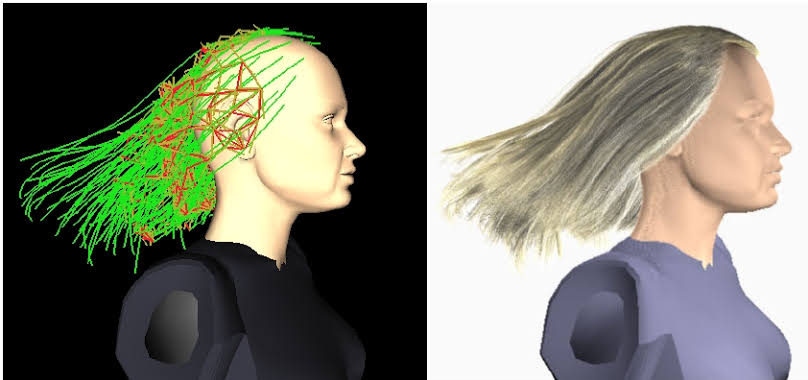
Real-time hair simulation is a significant challenge in computer graphics due to the complexity of simulating approximately 100,000 hair strands, each with intricate physical interactions like collisions and bending. Traditional graphics methods often simulate a small subset of “guide” strands and interpolate the rest to approximate the motion of the full hairstyle, which reduces computational demands but sacrifices finer details and accuracy, particularly for complex styles. Neural interpolation leverages neural networks to learn these interpolation mappings or even the entire dynamics of hair motion, enabling high-fidelity simulations at interactive speeds suitable for real-time applications like games or virtual reality.
By performing complex hair physics computations offline and deploying compact AI models during runtime, neural approaches achieve significantly higher quality than traditional methods, reducing simulation times from days to hours while maintaining visual realism. Recent advancements, such as CNN-integrated pipelines, have introduced frameworks capable of simulating diverse hairstyles with realistic motion at interactive framerates, replacing simplistic hand-crafted interpolation with learned functions that capture nonlinear hair behaviors. These techniques form the foundation for advanced methods discussed below, including convolutional networks, generative adversarial networks, autoencoders, and graph neural networks, all tailored to address real-time hair dynamics.
In This Article (28 sections)
Adopting Data-Driven Methods for Scalable Hair Simulation
Classical hair simulation relies on physics-based models like mass-spring systems or elastic rods, incorporating collision handling for accuracy. These models are computationally intensive and require meticulous parameter tuning, making them impractical for real-time use. Data-driven methods offer a scalable alternative by learning hair behavior from example data, such as physics-based simulations or motion-capture recordings. Once trained, neural models generalize to new scenarios orders of magnitude faster than traditional physics solvers, enabling real-time performance.
A typical pipeline involves collecting diverse hair motion examples and training a neural network to map inputs, like character motion, wind forces, or previous hair states, to the next hair state. Early frameworks, such as Lyu et al.’s (TVCG 2022), demonstrated efficient simulation of various hairstyles using CNNs trained on synthetic data. However, pure data-driven models risk producing nonphysical outputs, such as stretched or intersecting strands, if not constrained properly. Modern approaches address this by integrating physics-informed loss functions or hybridizing data-driven learning with physics priors, ensuring physically plausible results. This scalability, simulating once and reusing learned knowledge, makes data-driven methods ideal for interactive applications like games and VR, where traditional solvers are too slow.— ×4
Leveraging Convolutional Neural Networks (CNNs) for Hair Dynamics
Convolutional Neural Networks (CNNs) are central to many neural hair simulation frameworks due to their ability to process spatially local interactions, such as collisions between neighboring strands or bending along a strand’s length. Hair state is encoded into grid or image-like structures, such as depth maps of hair volume or 2D orientation fields, allowing CNNs to learn filters that propagate local motion effects across the hairstyle. Lyu et al.’s Real-Time Hair Simulation with Neural Interpolation pioneered this approach, using CNNs to predict motion between sparsely simulated guide strands, interpolating full hairstyles efficiently.
The strength of CNNs lies in their weight sharing and locality, enabling them to handle thousands of strands without a parameter explosion. For example, a CNN can take guide strand positions as input and output a dense displacement field adjusting each strand based on neighbors’ movements. Wang et al. utilized a hybrid volumetric representation aligned to guide strands, capturing hair appearance under motion with preserved details like curls. Modern CNN-based simulators stack multiple layers to model long-range interactions and include recurrent connections or frame sequences to capture temporal behavior, internalizing hair physics as learned update rules for real-time simulation on GPUs.

Utilizing Fully-Convolutional Networks for Strand-Level Hair Modeling
Fully-convolutional networks (FCNs) are CNN architectures without fully-connected layers, allowing them to process inputs of arbitrary size and produce correspondingly sized outputs. In hair simulation, FCNs are valuable for strand-level modeling, predicting updates for each strand or spatial location. For instance, hair can be rasterized into an image where pixels encode features like strand count or direction, and an FCN predicts per-pixel properties such as displacement vectors for the next time step. FCNs scale naturally to different hair densities and image sizes, accommodating varied hairstyles.
They act as hair motion filters, mapping coarse hair states to refined ones with translation-invariant behaviors, ensuring consistent physics across the scalp. Lyu et al.’s neural upsampler exemplifies this, mapping low-density guide hair maps to high-density ones. FCNs integrate multi-scale context via downsampling/upsampling paths, like U-Net architectures, capturing both fine strand details and global shapes, making them ideal for dense, strand-accurate real-time simulations.
Designing Neural Interpolators for Smooth Hair Transitions
Neural interpolators are neural networks designed to produce smooth hair transitions, either spatially between guide strands or temporally between animation frames. Spatially, they learn to fill gaps between simulated guide hairs with realistic intermediate strands, capturing effects like clumping or varying curliness, unlike simple linear interpolation. Lyu et al.’s neural upsampler converts sparse guide strands into dense hairstyles, modeling nonlinear blending for smooth transitions.
Temporally, interpolators ensure fluid frame-to-frame motion by incorporating previous states or recurrent components like LSTMs, embedding continuity priors to avoid jitter. Style interpolation in latent spaces, as seen in generative models, enables smooth morphing between hairstyles by interpolating latent vectors. Saito et al.’s Volumetric Hair VAE demonstrated this, though with some detail loss. Neural interpolators replace ad-hoc rules with learned behaviors, ensuring physically plausible and visually coherent transitions across strands, time, or styles, enhancing realism in dynamic animations.
Enhancing Temporal Coherence in Hair Animation Through Neural Networks
Temporal coherence ensures smooth, continuous hair motion without flickering or erratic oscillations, critical for realistic animation. Neural networks achieve this through several techniques:
- Sequence Input/Output Training: Training on frame sequences teaches the model motion continuity, predicting future states based on past ones.
- Recurrent Architectures: RNNs or LSTMs store velocity or force effects, ensuring momentum-aware predictions to prevent sudden jumps.
- Temporal Loss Functions: Losses penalize abrupt changes, like excessive acceleration or strand length deviations, stabilizing simulations.
- Physics-Based Damping in Network: Low-pass filters or damping mimic physical solvers, reducing high-frequency jitter in outputs.
Quaffure (2024) splits motion into rigid body follow and learned deformation, ensuring coherence by handling bulk motion deterministically and predicting subtle gravitational settling. These methods produce fluid, believable animations, meeting the demands of real-time applications where visual stability is paramount.

Employing U-Net Architectures for Detailed Hair Feature Extraction
U-Net architectures, with downsampling encoders, upsampling decoders, and skip connections, are well-suited for hair simulation due to their ability to extract and reconstruct detailed features. They analyze complex hair states, such as voxel grids or images, to output refined states or strand attributes. Applications include hair segmentation, collision mask generation, or neural rendering, as seen in Currius et al.’s (2022) autoencoder for filtering noisy hair renderings.
U-Nets preserve fine strand details via skip connections while capturing global context through bottleneck features, balancing local (stiffness, curls) and global (gravity, head motion) influences. In GroomGen, a U-Net-like upsampler processes guide strand maps to output interpolation weights, retaining local detail. Operating on 2D scalp maps or 3D voxel grids, U-Nets excel at extracting features like curls or tension, producing high-fidelity simulation outputs critical for realistic hair dynamics.
Applying Instance Normalization and Softmax in Hair Simulation Models
Instance normalization (IN) normalizes feature maps per sample, subtracting the mean and dividing by the standard deviation, aiding generalization across diverse hairstyles by removing biases like hair density. IN stabilizes training, especially with varied datasets like PixelHair, focusing the model on dynamic patterns. Softmax layers output weights for blending guide strands, as in GroomGen’s upsampler, where weights sum to 1 for physically constrained interpolation. Alternatively, softmax selects motion modes (e.g., “sway left”) in multi-prototype models. IN is applied to convolutional layers in generators for stability, particularly in GAN setups, while softmax structures outputs for attention mechanisms or expert mixtures. These techniques enhance robustness and interpretability, ensuring realistic and stable hair simulation outputs.
Combining Convolutional and Fully-Connected Layers for Complex Hair Patterns
Convolutional layers capture local hair interactions, like collisions or bending, but global patterns, such as hairstyle or pose effects, require fully-connected (FC) layers. Hybrid architectures use convolutional encoders to extract regional features, FC bottlenecks to condense global states, and convolutional decoders to produce per-strand outputs. FC layers enable global receptive fields, encoding coherent motions like “hair swaying left.” They also condition simulations on global inputs, such as character pose, via feature modulation (e.g., FiLM), influencing local conv features. In latent space models, FC layers compress strand geometries into codes, as seen in hair VAEs. This combination ensures the model respects both micro-level strand interactions and macro-level constraints, like braids or updos, for complex, realistic hair patterns.
Developing Autoencoder Networks for Hair Style Compression and Reconstruction
Autoencoders compress hairstyles into low-dimensional latent codes, reconstructing them with minimal error, enabling tasks like style transfer or simulation. They encode 3D strand geometries or occupancy grids into compact vectors capturing volume, curl patterns, or length distribution. In simulation, autoencoders reduce dimensionality by updating latent codes instead of individual strands, significantly lowering computational load (e.g., 128 dimensions vs. 300k variables). GroomGen’s hierarchical autoencoders compress strand, guide, and hairstyle levels, supporting interpolation and editing with high compression rates. Autoencoders ensure outputs stay within the realistic hair manifold, aid style clustering, and handle noisy data robustly, making them valuable for efficient, high-fidelity real-time simulation.
Exploring Variational Autoencoders (VAEs) in Hair Simulation Frameworks
Variational Autoencoders (VAEs) extend autoencoders by learning a continuous latent distribution, enabling generative sampling for diverse hairstyles. In simulation, VAEs initialize varied starting hairstyles, simulate latent dynamics, or enable style transfer via latent editing. Saito et al.’s (2018) Volumetric Hair VAE encoded hairstyles into flow fields but risked smoothing details. GroomGen’s hierarchical VAEs split global and local details for better fidelity. VAEs introduce stochasticity, generating varied motion outcomes, and can encode dynamic sequences for motion extrapolation. By enforcing a Gaussian latent space with KL-divergence, VAEs ensure plausible outputs, enhancing flexibility in games or interactive applications requiring diverse, realistic hair behaviors.

Navigating Nonlinear Subspaces for Diverse Hair Style Representations
Hair configurations form a constrained nonlinear subspace within their high-dimensional space, learned via VAEs or autoencoders. Navigating this subspace through interpolation, sampling, arithmetic, or clustering generates diverse, realistic hairstyles. Latent interpolation morphs styles smoothly, while sampling creates novel variations. Latent arithmetic blends styles (e.g., long curly + short straight), and clustering identifies style categories. Unlike linear models, neural subspaces capture nonlinear effects, like entanglement differences with length. Confining simulations to this subspace regularizes outputs, ensuring realism while reducing complexity to low-dimensional latent dynamics, preserving the richness of hair’s appearance.
Extracting Feature Descriptors for Improved Hair Simulation Accuracy
Feature descriptors, such as orientation fields, curl frequency, density, or tension, distill hair state into informative signals for neural learning. Preprocessing converts hair into feature maps (e.g., direction variance on a 2D grid), simplifying dynamics prediction. Descriptors in loss functions, like matching orientation fields, improve accuracy over raw position comparisons, ensuring correct hair flow. Predicting fields (e.g., orientation) and adjusting coordinates enhances physical plausibility. HairNet used 2D orientation maps for reconstruction, applicable to simulation by predicting future fields. Descriptors focus models on relevant patterns, like curl retention or wind alignment, boosting training convergence and simulation accuracy.
Applying Generative Adversarial Networks (GANs) to Enhance Hair Realism
Generative Adversarial Networks (GANs) enhance hair realism through a generator producing hair states and a discriminator ensuring outputs mimic real hair distributions. GANs capture fine details and stochasticity, like stray wisps, unlike regression models that may overly smooth outputs. Lyu et al.’s GAN-based upsampler synthesizes dense hair with realistic randomness, avoiding uniform interpolation. GANs suit hair’s variability, producing statistically correct outputs without unique ground truths, as noted in GroomGen. They also refine renderings or simulations, adding natural variation for visually superior results, ensuring hair motions appear dynamic and lifelike.
Implementing Adversarial Discriminators to Improve Simulation Fidelity
In GAN setups, adversarial discriminators scrutinize hair simulation outputs to distinguish them from real or physics-simulated hair, guiding generators toward realism. They operate on:
- Image-based discriminator: Analyzes renders or video clips, checking visual cues like frizz or motion blur consistency.
- State-based discriminator: Evaluates geometry descriptors, like strand orientation distributions or collision counts.
Discriminators detect unrealistic patterns, such as overly synced motion, prompting generators to add variability. Lyu et al.’s Wasserstein GAN discriminator ensured stable, plausible upsampler outputs. Temporal discriminators judge motion sequences, flagging impossible accelerations. Trained on diverse hairstyles, discriminators encode broad fidelity criteria, pushing generators to produce complex, natural hair behaviors that align with real-world expectations.
Balancing Discriminative and Generative Models in Hair Simulation
Balancing Generator and Discriminator Losses
Adversarial training in hair simulation requires balancing generative and discriminative models. The generative model aims to match physics and fool the discriminator, but an overly strong discriminator or high adversarial loss weight can lead to artifacts that violate physical constraints like hair length conservation. Conversely, low adversarial weight may produce overly smooth, unrealistic results. Careful tuning of loss weights and training schedules is essential to achieve both physical accuracy and visual realism. Validation monitors the balance, ensuring the simulator produces hair that satisfies physics and passes human visual checks.
Balancing these requires careful tuning of loss weights and training schedules:
- Often a weighted sum of losses is used:
L = L_{\text{phys}} + \lambda L_{\text{adv}}. For example,L_{\text{phys}}could be an L2 distance to a ground-truth simulation (or a self-supervised physics loss), andL_{\text{adv}}is the GAN loss. A proper choice of\lambdaensures that the generator pays attention to both. In hair, one might set\lambdato ensure strand-length preservation and collision avoidance (physical metrics) are not sacrificed while adding fine details for realism. - Training procedure can alternate phases: sometimes training the network first without GAN (to get physically reasonable behavior), then fine-tuning with GAN to add details. This two-stage training prevents the model from ignoring the primary task of correctness. For instance, one might train a hair simulator to get the bulk motion right (by supervised learning on simulation data), then introduce the discriminator to refine the output’s microstructure.
- The discriminator itself must be properly regularized (using techniques like spectral normalization or WGAN gradient penalty) to avoid it becoming too brittle or overfitting. If the discriminator overfits to trivial cues, the generator may exploit that rather than truly improve realism.

Implementing Wasserstein GANs for Stable Hair Simulation Training
Wasserstein GANs (WGANs) enhance stability in hair simulation by using Wasserstein distance and a Lipschitz constraint, avoiding the instability of traditional GANs. WGANs provide a smooth loss signal, guiding the generator incrementally toward realistic hair details without mode collapse or oscillation. This stability is crucial for high-dimensional hair outputs, ensuring steady improvement in adversarial training.
To implement WGAN in hair simulation:
- Use a Wasserstein loss for the discriminator: output a score (not probability) and train to maximize real scores minus fake scores.
- Apply a gradient penalty on the discriminator’s inputs (hair states) to enforce the Lipschitz constraint, as per Gulrajani’s improved WGAN. For hair data (which might be 3D geometry), this means sampling points along the line between real and generated hair representations and penalizing large gradient norms.
- Ensure the discriminator is powerful enough to approximate Wasserstein distance. It could be a deep CNN or even incorporate graph-based reasoning if operating on hair graph, but with WGAN it’s important not to over-restrict it (WGAN does allow a stronger discriminator than vanilla GAN in practice).
Optimizing Loss Functions for Accurate Hair Movement Prediction
Loss functions are critical for accurate hair movement prediction, combining multiple components to capture numerical, physical, and visual accuracy. A well-designed loss ensures the model aligns with reference trajectories, adheres to physical laws, and maintains temporal coherence. Balancing these terms requires iterative tuning to avoid conflicts between data matching and physics adherence, ensuring generalizable, realistic results.
The design of the loss function is central to training an accurate hair simulation model. A good loss function should capture what “accuracy” means for hair movement. Several components are typically combined to guide the model:
- Position/Velocity Error: Penalizes differences between predicted and ground truth strand positions or velocities, often using L2 error, though it may smooth out high-frequency details.
- Orientation and Shape Preservation: Ensures strand length and orientation are maintained, penalizing deviations to prevent nonphysical elongation, as emphasized by Quaffure.
- Inter-strand Interaction Loss: Penalizes strand-body or strand-strand intersections using proxies like penalties for hair points inside head geometry.
- Physics-based Losses: Incorporates elastic and gravitational energy terms to guide the model toward low-energy, plausible states, as in Quaffure’s self-supervised loss.
- Temporal Smoothness Loss: Encourages smooth motion by penalizing differences in successive accelerations, ensuring physical inertia and temporal coherence.

Applying L1 Norm Loss Terms to Enhance Hair Simulation Precision
L1 norm loss enhances hair simulation precision by preserving sharp features and tolerating outliers, unlike L2, which may over-penalize large errors and smooth motion. L1 allows the model to capture crisp, precise strand movements, especially for stray hairs or sudden motions. It’s often combined with other losses to balance overall accuracy and detail.
When it comes to capturing fine details in hair simulation, the choice of using L1 norm (mean absolute error) vs L2 can have a noticeable impact. L1 loss tends to preserve sharp features and is more robust to outliers. In hair dynamics, an outlier could be a strand that moves very differently than others (perhaps due to a sudden flick or external force), an L2 loss might overly penalize a prediction that doesn’t exactly match that outlier motion, causing the model to “tone down” such drastic changes in future predictions (result: overly damped hair).
L1 loss, being linear, doesn’t disproportionately punish larger errors; it treats a 10 cm error as ten times worse than a 1 cm error, whereas L2 would treat it as 100 times worse. Therefore, with L1 the model is freer to occasionally make big moves when needed, without a huge loss spike. This often translates to maintaining precise, crisp behavior.– ×1
Employing Data Augmentation Strategies for Robust Hair Simulation Models
Data augmentation is vital for robust hair simulation models, expanding training data to prevent overfitting and enhance generalization. By simulating varied scenarios, augmentation ensures models handle diverse hairstyles, motions, and environments. Physically plausible augmentations teach the model general principles, improving scalability and reliability.
Augmentation strategies for hair simulation can be quite creative:
- Physical Parameter Variation: Vary gravity, wind, or head movement to expose the model to diverse scenarios, as GroomGen did with gravity direction.
- Hairstyle Perturbation: Modify hairstyles by removing strands or altering lengths to teach invariance to slight changes.
- Synthetic Transformations: Apply rotations, scaling, or color jitter to image-based data for robustness.
- Interpolation Augmentation: Generate new hairstyles by interpolating latent spaces or mixing simulation segments.
- Noise Injection: Add random displacement to inputs to enhance resilience to errors or noise.
- Augmenting Collisions: Introduce artificial collision events to train the model on rare interaction responses.
Integrating Displacement Generators for Fine-Scale Hair Details
Displacement generators add fine-scale details to coarse hair simulations, enhancing visual realism. A primary network predicts bulk motion, while a displacement generator computes small strand offsets. Trained with adversarial or perceptual losses, these generators capture natural randomness, making hair appear detailed and lifelike.
Even with powerful CNNs and GANs, capturing the extremely fine-scale details of hair, the tiny deviations and fluttering of individual strands, can be challenging. A proven strategy is to integrate a displacement generator that focuses specifically on adding high-frequency details to a coarser hair solution. Essentially, one network predicts the large-scale motion (position of guide strands or a smoothed hair volume) and another network (the displacement generator) adds the small displacements to each strand or cluster of strands to introduce local detail.– ×2
Integrating Super-Resolution Techniques to Refine Hair Simulation Outputs
Super-resolution techniques refine coarse hair simulations by increasing spatial or temporal resolution. Neural models upscale low-res outputs to high-detail visuals, adding strand-level fidelity or interpolating frames for smoothness. Applied as a post-process, these methods ensure lightweight simulations with visually convincing results.
Super-resolution isn’t only for images: the concept of taking a lower-resolution or coarser output and refining it to higher resolution applies to hair simulation as well. Super-resolution techniques in this context mean methods (often neural) that can increase the spatial or temporal resolution of hair data.– ×1

Advancing Deep Learning Approaches in Real-Time Hair Simulation
Deep learning enables real-time hair simulation with film-quality fidelity, leveraging GPU acceleration and physics-informed models. Neural networks trained on diverse simulations handle thousands of strands and complex interactions, outperforming classical methods. Scalable and user-friendly, these models transform hair simulation into a data-driven, high-performance solution.
One aspect of advancing these approaches is combining them with classic techniques. We don’t throw physics away; instead, many deep learning models are trained on physics simulations or augmented with physics losses, effectively capturing the best of both. This blending has advanced the state of the art by making simulations both fast and reliable. For example, by training on a diverse set of physical simulations, a neural network learns a general solution that can be reused. In the case of hair, networks have now been shown to handle full-scale heads of hair with thousands of strands and even account for complex interactions like collisions with the body in real time, something barely imaginable a few years ago.– ×1
Exploring Deep Graph Networks for Complex Hair Structure Modeling
Deep Graph Networks (GNNs) model hair as a graph of interconnected strands, capturing complex structures like braids or entanglements. By passing messages along edges, GNNs compute forces and interactions, offering accurate simulation of topological changes. Despite computational challenges, GNNs promise generalizable, precise hair simulators.
One notable advantage of graph networks is their ability to directly incorporate Newtonian mechanics structure: they can pass messages along edges that resemble forces. For example, along a strand, a message passing update could compute tension force from one segment to the next; between strands, a message could compute repulsion if two segments are too close.
Sanchez-Gonzalez et al. (2020) and Pfaff et al. (2021) from DeepMind showed that GNN-based simulators can learn to simulate a wide variety of materials, including cloth and fluids. They treat each particle as a node and edges connecting particles that interact. Hair was mentioned as one of the materials that can be handled by such learned simulators, essentially treating hair like a set of constrained particles.– ×1
Implementing a graph network for hair simulation typically involves:
- Constructing the graph each frame (or having a fixed graph of potential connections). Spatial partitioning algorithms (like neighbor search) can find which strands are near which others to add edges.
- A graph neural network (with several message-passing layers) that updates node attributes (like position, velocity) using information from connected nodes (neighbors along the strand, neighbors from collisions).
- Graph networks often enforce physical invariances like translation and rotation equivariance by using relative positions in messages. This suits hair physics which should be invariant to overall position/orientation of the character.
Incorporating Skinning Techniques for Realistic Hair Movement
Skinning techniques enhance neural hair simulation by binding strand roots to head motion, ensuring responsive attachment. A neural model predicts secondary dynamics, like inertia or settling, while skinning handles primary kinematic motion. This hybrid approach improves realism and generalization, leveraging classical animation methods.
In practice, many real-time hair systems do a hybrid: skinning + simulation. For example, when a character turns their head rapidly, rather than expecting the simulator alone to flail the hair appropriately, one can skin each hair strand’s root (and maybe a portion of the upper strand) to the head rotation. This ensures no lag or delay in the vicinity of the scalp, the hair moves with the skull for the first few milliseconds. The neural simulator then handles the secondary motion: as the head stops, the hair continues due to inertia (which the skinning doesn’t account for), and then settles, perhaps swaying. This approach prevents large penetrations or unrealistic lag at the roots and gives a baseline motion.– ×1
Evaluating Perceptual Realism in Neural Hair Simulation Outputs
Evaluating perceptual realism ensures neural hair simulations appear lifelike, combining user studies, perceptual metrics, and physical checks. Metrics like LPIPS and FID quantify visual similarity, while user feedback identifies subtle flaws. Iterative evaluation refines models to achieve immersive, movie-quality hair motion.
Evaluation can be done in several ways:
- User Studies: Conduct side-by-side comparisons of real or physics-based simulations versus neural simulations and ask experts or users to identify which looks more realistic. If observers can’t reliably tell, the model has achieved perceptual parity. User studies might involve rating the naturalness of hair movement on a Likert scale, or choosing which of two animations looks better.
- Perceptual Metrics: Borrowing from computer vision, metrics like LPIPS (Learned Perceptual Image Patch Similarity) or FSIM could be applied to rendered frames of hair. These metrics use deep neural networks to gauge visual similarity in a way that correlates better with human perception than pixel L2. A low LPIPS between simulated and ground truth hair motion sequences could indicate high perceptual similarity.
- Physical Plausibility Checks: Sometimes even if something is physically a bit off, it’s not perceptible. However, obvious violations (like hair clipping through geometry or a strand moving in isolation unnaturally) will catch the eye. Ensuring those are rare (perhaps counting intersection events, etc.) can be part of a perceptual score.
- Temporal coherence metrics: Calculating something like the jerk (derivative of acceleration) and ensuring it’s within human-observed range for hair can indirectly measure perceptual naturalness, hair shouldn’t teleport or change acceleration too abruptly.
Implementing the View Keeper for Consistent Camera Perspectives in Hair Simulation
The View Keeper, a Blender add-on, ensures consistent camera perspectives for evaluating hair simulations, preventing bias from varying angles. It saves preset views and automates repeatable renders, streamlining comparisons and demos. This tool enhances workflow efficiency, keeping focus on hair behavior.
In practical terms, integrating The View Keeper into a hair simulation workflow means one can:
- Save preset camera positions (e.g., front view, side view, close-up of head) and easily switch between them without error.
- Ensure that when comparing two simulation methods (say Method A vs Method B on the same motion), the camera is identical, same position, rotation, lens, so the only differences in the render come from the hair motion itself. This is crucial for fair visual comparison.
- Create repeatable demo videos. For instance, one might want a turntable animation of the character to see hair from all sides. The View Keeper can store that motion path for the camera so it can be reused exactly for different hair models or simulation runs.

Utilizing PixelHair Dataset for Training and Validating Hair Simulation Models
The PixelHair dataset is a comprehensive collection of 3D hair assets, originally designed for Blender, featuring diverse hairstyles from straight to afro-textured and short bobs to long dreadlocks. It serves as a valuable resource for training and validating neural hair simulation models due to the lack of large public dynamic hair datasets. The dataset’s meticulously crafted, realistic strand-based models allow for the generation of diverse training data through physics simulations or animations.
By exposing neural networks to a wide range of hair types and conditions, PixelHair helps models learn varied hair behaviors, such as the distinct movement of tightly curled versus fine straight hair. Its artistic origins also make it a bridge between engineering and creative applications, enabling cohesive workflows.
PixelHair’s high-quality, premade hairstyles distinguish it from other datasets like USC HairSalon, offering a large volume of styles that can act as separate subjects. When augmented with different motions, the dataset significantly increases data volume for training robust models. For validation, PixelHair’s diverse and exotic hairstyles test a model’s generalization to unseen styles and challenging scenarios like thick hair or accessories. The dataset’s integration into real-time simulation pipelines allows artists to design and simulate hair cohesively. Ultimately, PixelHair’s diversity ensures models can handle the broad spectrum of human hair appearance and behavior, critical for industrial applications.
Training Workflow with PixelHair
Select a hairstyle from the PixelHair collection, which includes realistic strand-based models. The chosen hairstyle is selected from PixelHair’s diverse library of realistic 3D assets. A physics simulation is run in a graphics engine to capture hair movement. These motions are recorded as training sequences for the neural network. Run a physics simulation in a graphics engine or use canned animations with forces like wind. The simulation applies forces like wind to the hairstyle to generate dynamic motion data. This data captures realistic hair behavior under various conditions. The resulting sequences are used to train the neural network effectively.
Record the motions as training sequences for the neural network, repeating for many styles. Motions from diverse hairstyles are recorded to create a comprehensive training dataset. This process is repeated across multiple styles and scenarios. The neural network learns varied hair behaviors from these sequences. The variety in PixelHair’s realistic assets ensures neural networks learn diverse hair behaviors, avoiding overfitting to limited styles. Its use in validation and artistic pipelines enhances the development of robust, generalizable hair simulation models.

Conclusion: Future Directions in Neural Interpolation for Hair Simulation
Neural interpolation and hair simulation are advancing, but significant opportunities remain to enhance their capabilities. Future developments aim to improve physical accuracy, real-time adaptability, and integration with rendering pipelines. Innovations like hybrid neural-physical models could stabilize simulations by correcting out-of-distribution physics. Techniques such as meta-learning may enable models to adapt to new hairstyles dynamically, while neural rendering could unify simulation and rendering for efficiency. Open datasets like PixelHair could evolve to include dynamic sequences, fostering standardized benchmarks and community-driven progress.
Addressing complex challenges like hair-strand topology changes, multi-character interactions, and augmented reality applications will push the field forward. Efficiency improvements, such as model compression or dedicated hardware, are crucial for high-frame-rate scenarios like VR. Democratizing these techniques through open datasets and competitions will accelerate innovation. The future promises intelligent, real-time hair simulations that adapt to new scenarios and integrate seamlessly with rendering for lifelike virtual avatars. These advancements will bring hair simulation closer to indistinguishable realism.
Future Directions
- Improved Physical Accuracy: Integrating differentiable physics engines with neural networks for hybrid models. Hybrid models combine neural networks with physics engines to enhance simulation stability. They correct errors in out-of-distribution scenarios using low-cost physics solves. This ensures more accurate hair behavior across diverse conditions.
- Real-Time Adaptivity: Models that dynamically adjust to new hairstyles using meta-learning or one-shot learning. Future models could infer latent parameters to adapt to new hairstyles instantly. Meta-learning enables generalization with minimal calibration. This reduces the need for retraining per hairstyle.
- Scalp-Hair Interaction and Rendering: Joint models for simulation and neural rendering, handling self-shadowing. Joint models simulate hair movement and render aspects like self-shadowing. Neural rendering predicts final pixel colors for efficiency. This unifies simulation and rendering processes.
- Hair-Strand Topology Changes: Handling dynamic changes like braid unraveling or hair cutting using graph networks. Graph networks could detect when hair strands merge or split. This addresses unsolved problems in dynamic topology changes. It enhances realism in complex hair scenarios.
- Augmented Reality and Vision Applications: Real-time hair simulation from video using incomplete observations. Models could simulate hair movement from webcam images in real-time. They fuse vision and simulation for virtual effects like wind. This enables immersive augmented reality experiences.
- Feedback from Rendering (perceptual training): Training with perceptual losses on rendered frames for realism. Perceptual losses compare simulated hair against real video using neural evaluators. This approach uses GAN-like techniques for pixel-level realism. It enhances visual fidelity of simulations.
- Multi-character and Global Effects: Simulating hair interactions between characters or with cloth. Neural nets could coordinate hair and cloth simulations via shared latent spaces. They handle complex interactions like hair entanglement. This addresses frontier multi-domain simulation challenges.
The future of neural interpolation involves generalizing to space and time for multi-character scenes and optimizing efficiency for complex scenarios. These advancements will lead to intelligent, adaptive, and highly realistic hair simulations integrated into broader rendering pipelines.

Frequently Asked Questions (FAQs)
- How does neural interpolation differ from traditional hair simulation techniques?
Neural interpolation uses a learned model, typically a CNN, to predict the behavior of all hair strands, unlike traditional hair simulation, which solves physics equations for a subset of strands and interpolates the rest with simple schemes. This approach captures complex, nonlinear strand interactions and details that manual interpolation misses. It results in more realistic hair motion while significantly reducing computation costs. The CNN learns from data to account for intricate effects, enhancing the overall visual quality. - Why are CNNs particularly useful for hair dynamics?**5 CNNs are effective for hair dynamics because they capture local spatial patterns through convolutional filters, ideal for the local interactions among hair strands. They learn bending and nearby strand influences from data, handling different hair resolutions efficiently. Fully-convolutional designs enable per-strand or per-pixel updates, optimized for GPUs. This makes CNNs suitable for real-time hair physics calculations, ensuring high performance and adaptability across various hair types.
- What role do GANs play in hair simulation?
GANs enhance hair simulation realism by having a generator produce hair movement and a discriminator critique it against real or high-quality data. This adversarial training ensures physically accurate and visually authentic hair motion. GANs capture fine details like stray wisps and subtle random motions, avoiding the oversmoothing common in MSE-trained networks. The result is natural-looking hair with lifelike variation and detail, improving overall simulation quality. - How do autoencoders and VAEs contribute to hair modeling?
Autoencoders compress hair geometry into a compact latent code, capturing essential hairstyle features like shape and curl pattern, and reconstruct it. VAEs enhance this by creating a smooth, samplable latent space for generating new hairstyles via interpolation. In simulations, VAEs simplify dynamics by predicting latent code changes instead of individual strand motions. This approach reduces complexity while maintaining hairstyle essence, enabling efficient and versatile hair modeling. - How is temporal coherence ensured in neural hair simulations?
Temporal coherence in neural hair simulations is maintained by training on sequences to learn smooth transitions and using recurrent architectures like LSTMs to carry temporal information. Explicit temporal smoothness losses penalize sudden changes, and inputting previous hair states ensures continuity. These methods prevent frame-to-frame jitter, respecting physical momentum and damping. The result is fluid, coherent hair motion that enhances realism in dynamic simulations. - What are deep graph networks, and why might they be useful for hair?
Deep graph networks, like graph neural networks, process graph-structured data, representing hair strands and their connections naturally. They simulate physics through message passing, handling complex interactions like braids or entanglement effectively. Unlike CNNs, which treat hair as a volume, graph networks model relational physics directly. This makes them powerful for interconnected hair systems, complementing CNNs’ spatial approach with a physics-inspired method for realistic simulation. - How do loss functions incorporate physics in training a neural hair simulator?
Loss functions for neural hair simulators combine regression losses with physics-inspired terms to ensure realistic outcomes. These include strand stretch losses for consistent lengths, bending losses to prevent unnatural curvature, and collision penalties for solid interactions. Energy-based losses minimize the hair’s total physical energy, aligning with natural behavior. Such terms train the network to respect physical laws while matching data, enhancing simulation plausibility. - Can these AI-driven hair simulations run in real time on consumer hardware?
AI-driven hair simulations achieve real-time performance on consumer GPUs, leveraging neural networks’ parallel processing. Optimized architectures infer hair motion in milliseconds, with models like Quaffure (2024) achieving 30 or 60 FPS for a character. Performance scales with network size, not strand count, making it faster than traditional simulators. This enables dense hair simulation on gaming GPUs, meeting real-time demands efficiently. - How do we handle new hairstyles or characters not seen during training?
Models trained on diverse hairstyles, like PixelHair assets, generalize to new styles within the training spectrum. For novel hairstyles, fine-tuning with small simulation data or using latent hairstyle representations adapts predictions. Conditioning on style descriptors (e.g., length, curliness) enhances flexibility. Extensive training data and augmentation ensure robustness, while ongoing research aims for universal simulators to handle arbitrary styles effectively. - What is the PixelHair dataset and why is it useful for AI hair simulation?
PixelHair is a collection of high-quality 3D hair models and grooms, offering diverse hairstyle geometries. It provides training data for AI simulations by enabling simulations under various conditions, enhancing model generalization across hair types. Its realistic styles ensure true-to-life behavior in trained models. PixelHair also stress-tests simulator versatility in validation, filling the data gap with the variety and quantity needed for robust hair modeling.

Conclusion
Real-time hair simulation has been revolutionized by neural interpolation techniques, marrying the strengths of data-driven machine learning with physics-based realism. By leveraging CNNs, GANs, VAEs, and GNNs, engineers can now create hair simulations that run in real time yet capture strand-level details and natural motion that were once limited to offline CGI. We discussed how fully-convolutional neural networks predict hair dynamics efficiently, how adversarial training adds realism, and how autoencoders compress hairstyle complexity, among many other advanced topics.
The collaboration between traditional methods (like skinning and guide strands) and modern AI has proven fruitful, hybrids ensure both stability and fidelity. The use of rich datasets (e.g., PixelHair) and tools (like The View Keeper for consistent evaluation) further streamline development. The result is a new generation of hair simulators capable of handling diverse styles and conditions with high accuracy and visual realism.– ×1
Emerging Features and Continued Refinement
As we move forward, the boundary between simulation and rendering continues to blur with neural approaches, and the door opens for features like interactive style editing, multi-character hair interactions, and learning directly from real footage. For AI and ML engineers in top-tier graphics companies, the message is clear: deep learning isn’t just an assistive tool for hair simulation, it is becoming the foundation of how we achieve cinematic-quality hair in real-time environments.
By continuing to refine neural architectures, loss functions, and training strategies, we edge ever closer to the holy grail of trulyunbelievable yet believablevirtual hair: hair that not only fools the eye but does so at a fraction of the computational cost, leaving more room for creativity and complexity in our virtual worlds.— ×1
Sources and Citations
- G. Lous et al.,
- “Quaffure: Real-Time Quasi-Static Neural Hair Simulation,”
- arXiv preprint arXiv:2412.10061, 2024.
- Q. Lyu et al.,
- “Real-Time Hair Simulation with Neural Interpolation,”
- IEEE TVCG, vol. 28, no. 4, pp. 1894–1905, 2022. Also searchable on arXiv.
- Y. Zhou et al.,
- “GroomGen: A High-Quality Generative Hair Model using Hierarchical Latent Representations,”
- ACM TOG, SIGGRAPH Asia, vol. 42, no. 6, Article 268, 2023. ACM DL title search: link.
- NVIDIA Research,
- “Not a Hair Out of Place: Neural Physics Enables Realistic Simulations,”
- SIGGRAPH 2023 press coverage, VentureBeat.
- Roc R. Currius et al.,
- “Real-Time Hair Filtering with Convolutional Neural Networks,”
- Proceedings of the ACM on Computer Graphics and Interactive Techniques, vol. 5, no. 1, Article 4, May 2022.
- X. Saito et al.,
- “Volumetric Hair Rendering with Deep Single-View Hair Inference,”
- Computer Graphics Forum, 2018.
- H. Ummenhofer et al.,
- “Lagrangian Fluid Simulation with Continuous Convolutions,”
- ICLR, 2020.
- T. Pfaff et al.,
- “Learning Mesh-Based Simulation with Graph Networks,”
- ICLR, 2021. OpenReview page: link.
- Yelzkizi Blog,
- Yelzkizi Blog,
Recommendations
- Stranger than Heaven – Official Combat Overview Trailer and Everything We Know (Story, Gameplay, Release Date & Updates)
- Supercell Acquires Metacore: What the Merge Mansion Deal Means for Mobile Gaming
- Mina the Hollower Preview: Kinda Like Bloodborne as a Cute 8-Bit Adventure Game, Gameplay, Release Date, and Full Breakdown
- Interactive Materials in Unreal Engine: How to Create Dynamic and Responsive Surfaces in Real Time
- GDEV Earned Nearly $100 Million in Q1 2026 Earnings Overview
- Pokemon Pokopia Withered Wastelands Guide: How To Increase The Humidity, Trigger Rain, And Rescue Onix
- 9 Months Away From GTA 6’s November Release, Retailer Cheekily Promises Free Copies to Anyone Who Gives Birth on Launch Day (Komplett, Norway)
- When Is PS6 Coming Out, How Much Will the PS6 Cost, and Will PS6 Be Backwards Compatible? (2026 Update)
- Assassin’s Creed PVP Multiplayer Spin-Off’s Recent Playtest Reportedly Didn’t Go Well: Invictus Leak, Possible Delay, and What it Means
- A Star Wars Expansion Is Coming to PowerWash Simulator 2: Everything You Need to Know About the Galactic Cleaning Adventure



































































































