









In This Article (7 sections)
ReStory Sales Milestone and Launch Performance
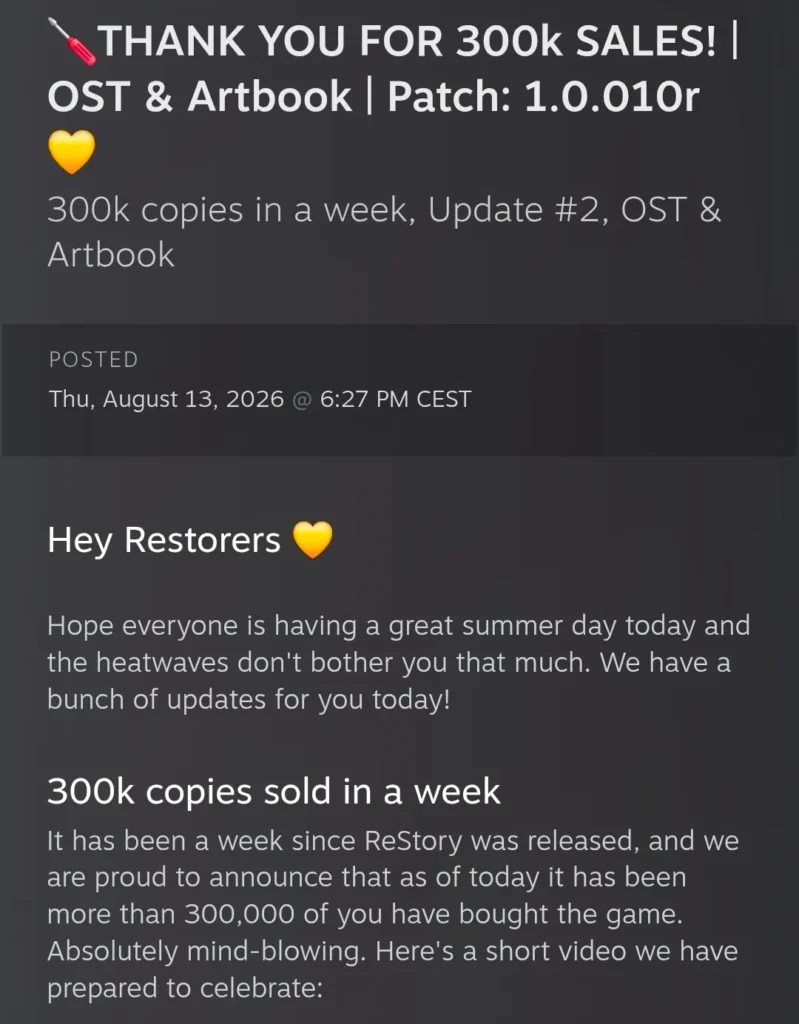
Mandragora officially announced on August 13, 2026 that ReStory had sold more than 300,000 copies within seven days of release. Because the figure came directly from the development team through Steam Community, it is a confirmed unit sales milestone rather than an estimate based on review counts, ownership algorithms or third party tracking. ReStory launched on August 6, 2026, meaning the game reached the milestone during its first week rather than over a long catalogue life.
The speed of the result makes it particularly notable. tinyBuild and Mandragora also reported a launch weekend concurrency peak above 19,000 players, showing that the large number of purchases translated into substantial active engagement. There had been no later publicly confirmed unit sales milestone in the official material located by August 20, so “more than 300,000 copies” remains the latest verified figure. Actual sales may already be higher, but assigning a newer total without a developer or publisher disclosure would be speculative.
The 300,000 figure should also be kept separate from ReStory’s pre release audience metrics. By June 17, reporting based on information from tinyBuild indicated that more than 300,000 players had participated in the playtest and that the game had accumulated more than 400,000 Steam wishlists. Those figures demonstrated strong interest before launch but did not represent paid purchases. Wishlists do not automatically become sales and playtest participation can be free, so converting that level of awareness into more than 300,000 buyers during the first week is one of the clearest indicators of a strong launch.
Commercial momentum appeared almost immediately. Nearly 80,000 units were reportedly sold by the day after release, alongside more than $1 million in gross sales. By August 10, gross sales had reached approximately $3 million, according to tinyBuild CEO Alex Nichiporchik, and the development budget had reportedly been recovered within the first 12 hours. These figures suggest that ReStory was not simply moving a high number of discounted copies while remaining commercially marginal.
The $3 million figure should still be understood as gross sales rather than Mandragora’s profit. Platform fees, refunds, taxes, regional pricing and the commercial arrangement between Mandragora and tinyBuild all affect how much revenue is ultimately retained. Likewise, multiplying 300,000 copies by one Steam list price would create a misleading estimate because ReStory launched with a discount and Steam pricing varies by currency and region.
Steam itself remained central to the game’s launch. On August 20, the store displayed a European reference price of €19.99 with a 10% introductory price of €17.99, but buyers in other regions could pay different amounts. The more reliable commercial conclusion is therefore that ReStory had generated approximately $3 million in reported gross sales by August 10 and subsequently passed 300,000 unit sales, rather than assigning an unsupported net revenue number to the milestone.
Why ReStory Became a Successful Indie Game and Maintained Strong Steam Reception
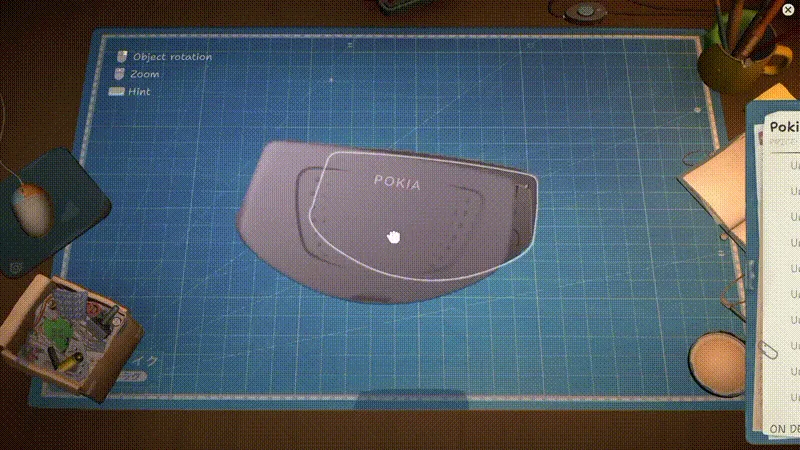
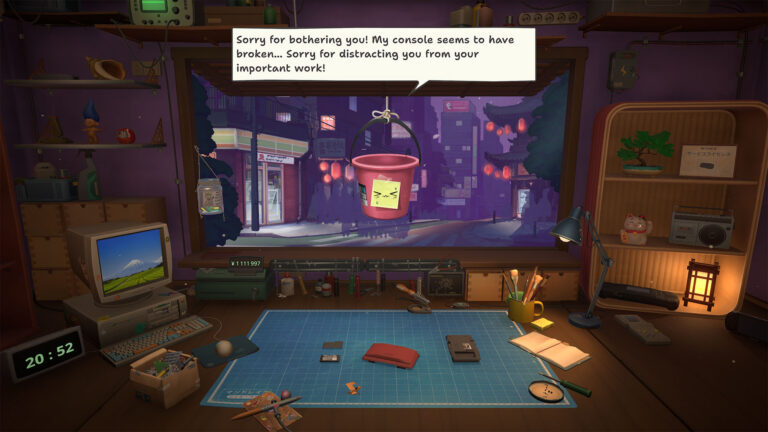
ReStory found success by combining cosy simulation, hands on electronics repair, shop management, branching narrative choices and Y2K nostalgia in a setting built around mid 2000s Tokyo. Players operate an electronics repair shop and restore devices inspired by mobile phones, handheld consoles, music players, cameras and other period technology, with officially licensed Atari hardware adding recognizable consumer electronics history. The repair loop is easy to understand but varied enough to remain engaging, as players open devices, clean components, solder parts, repaint surfaces, replace damaged pieces and reassemble machines before returning them to customers. Shop management adds resource planning and replacement part purchases, while conversations and choices introduce story elements and multiple outcomes.
The combination gives ReStory appeal across several audiences. Simulation players can focus on repair and management systems, cosy game fans can enjoy the relaxed atmosphere, technology enthusiasts can recognize familiar early 2000s design language and story focused players can follow customer narratives and make decisions that affect outcomes. Steam tags reflect that overlap through categories such as Cozy, Management, Relaxing, Shop Keeper, Simulation, Choices Matter, Multiple Endings and Story Rich. Nostalgia strengthens the concept further. Studio director Evgeny Kisterev said the game was inspired by memories of polyphonic ringtones, infrared file transfers, cassette tapes and distinctive consumer electronics, while 2000s Tokyo was selected because Japanese companies played a major role in consumer technology during that period.
Importantly, nostalgia is integrated into the gameplay rather than functioning only as decoration. Players physically manipulate older style devices and restore them piece by piece, turning the look and feel of period technology into part of the central interaction. Repair also provides a naturally satisfying progression structure because every broken device presents a visible problem, the restoration process provides clear intermediate steps and the completed machine offers an obvious endpoint.
Pre release exposure gave the concept a substantial audience before launch as well. ReStory had more than 400,000 reported Steam wishlists by June, while over 300,000 players had participated in its playtest. A larger Steam Next Fest demo then introduced more potential buyers to the repair systems, with early coverage praising the recognizable gadget details and encouraging continued play.
That pre release interest translated into strong launch activity and reception. The game reached a launch weekend peak of more than 19,000 concurrent Steam players, and Mandragora announced more than 300,000 copies sold by August 13. On August 20, Steam classified the English review set as Overwhelmingly Positive, with 95% of 3,642 reviews recommending the game.
An earlier August 10 snapshot placed the rating at 96%, meaning sentiment remained exceptionally strong even as thousands of additional reviews accumulated. Steam Community also showed 4,473 players in game at one point on August 20, although that figure represents only a live snapshot rather than a daily average or all time peak. Taken together, the wishlists, playtest participation, sales, concurrency and reviews suggest that ReStory performed strongly across discovery, trial, purchase, continued play and player satisfaction, although the developer has not published a formal conversion rate linking those stages.
Mandragora also supported the launch quickly enough to address problems before they significantly disrupted momentum. In its first post launch update on August 11, the small team said the response had exceeded expectations and thanked players for reviews and bug reports while confirming that it already had ideas for future development. The August 13 sales announcement arrived alongside update 1.0.010r, which addressed long save problems, possible crashes, a progression blocker involving missing screws and an issue affecting Robby’s wires. The studio also released the soundtrack, expanded the digital artbook and confirmed that another repairable gadget was being developed for the first free content update.
Version 1.0.011r followed on August 19 with achievement fixes, quality of life improvements, audio additions, inventory changes, corrections involving cleaning and quest items, Atari Lynx competition adjustments and optimization of some 3D assets. That rapid response mattered because unresolved technical problems during the opening weeks can quickly damage user reviews and reduce visibility. Instead, ReStory maintained a 95% positive English Steam rating as its audience expanded.
Steam therefore supported nearly every stage of the game’s growth, functioning as the primary storefront, wishlist and demo platform, review system, engagement tracker and communication channel for sales milestones, patches and future content. This combination of a distinctive concept, strong pre release interest, satisfying repair mechanics, broad audience appeal and active post launch support helps explain why ReStory became a successful indie release.

ReStory Development, Commercial Success and Long Term Potential
ReStory was publicly announced in December 2025 by tinyBuild and Mandragora, the developer also associated with I Am Future. The electronics repair and shop management simulator was presented as a PC game set in Y2K era Japan, with players restoring period inspired technology while running their own repair business.
Interest grew quickly before release. By June 2026, reports citing tinyBuild said more than 300,000 people had participated in the playtest and the game had exceeded 400,000 Steam wishlists. Steam Next Fest expanded that exposure with a larger demo containing additional gadgets and customization systems. The full game launched on August 6, 2026, with Mandragora as developer and tinyBuild as publisher. Steam lists support for Windows and macOS as well as nine interface and subtitle languages, helping the game reach audiences beyond English speaking players.
Commercial momentum followed almost immediately. The reported development budget was recovered within 12 hours, nearly 80,000 copies had been sold by the following day, gross sales surpassed $1 million and reached approximately $3 million by August 10. By August 13, more than 300,000 copies had been sold.
The exact profit available to Mandragora is unknown because the financial arrangement between the developer and publisher has not been disclosed, but recovering the development budget within hours significantly reduced the project’s early financial risk and created a stronger foundation for continued investment. The launch also provided Mandragora with more than immediate revenue. ReStory gained a large customer base, thousands of highly positive Steam reviews and a recognizable identity built around cosy electronics restoration and early 2000s nostalgia.
Selling more than 300,000 copies in a week represents a strong indie launch, although it should not be treated as an unprecedented record because indie games differ substantially in price, genre, publisher support, platforms, marketing reach and existing audiences. One useful 2026 comparison is Mina the Hollower from Yacht Club Games, which sold approximately 300,000 copies within three days and more than 500,000 during its first week.
ReStory therefore did not match one of the year’s fastest documented indie launches, but the context is different. Yacht Club Games already had years of recognition from Shovel Knight, while ReStory is a newer intellectual property built around the relatively specialized idea of repairing nostalgic electronics. Reaching more than 300,000 first week sales still demonstrates that the concept moved beyond a narrow niche and attracted a substantial paying audience.
Mandragora quickly indicated that the launch would not mark the end of development. The studio confirmed work on a new repairable gadget for the first free content update and discussed a broader roadmap involving additional updates, collaborations and DLC. Announcing longer term support only about a week after release suggests that the early performance gave the team confidence to treat ReStory as an ongoing product rather than a one off release. A customer base of more than 300,000 players means future content already has a meaningful audience, while positive reviews, sales promotions and updates could help extend the game’s catalogue life and bring in additional buyers over time.
The success may also strengthen Mandragora’s position beyond ReStory itself. Strong sales and reception provide evidence that its combination of tactile simulation, narrative design and technology nostalgia can reach a broad market, which could make the studio more attractive to future publishers and collaborators.
That remains a business inference rather than a publicly announced strategy, and there is no confirmation of a sequel or larger franchise plan. Even so, the game’s first weeks substantially reduced its initial financial risk, established a recognizable new IP and created an audience large enough to support continued development. Whether ReStory eventually expands into a broader franchise remains unknown, but its launch provided Mandragora with a strong commercial and creative foundation for whatever comes next.
Frequently Asked Questions (FAQs)
- How many copies has ReStory sold?
ReStory: Chill Electronics Repairs sold more than 300,000 copies during its first week. Mandragora officially announced the milestone on August 13, 2026, exactly seven days after the game launched. This is a confirmed developer figure rather than an estimate based on Steam reviews or third party ownership data, making it the most reliable publicly available sales milestone. - When was ReStory released?
ReStory launched on Steam on August 6, 2026. The game was developed by Mandragora and published by tinyBuild. Its release followed months of growing interest through playtests, Steam wishlists and a Steam Next Fest demo, helping the game enter launch with a substantial audience already familiar with its electronics repair concept. - Where can ReStory be played?
Steam is the primary storefront covered by the game’s launch information. The current Steam page lists system requirements for both Windows and macOS, confirming support for those platforms. The game is presented there as a single player simulation experience focused on electronics repair, shop management and customer stories. - How quickly did ReStory recover its development budget?
According to tinyBuild CEO Alex Nichiporchik, ReStory recovered its development budget within approximately 12 hours of release. Such a short reported payback period indicates that the game’s initial sales were strong enough to cover its production costs almost immediately, although this does not reveal exactly how much profit Mandragora ultimately received. - How much money has ReStory made?
The strongest publicly reported figure is approximately $3 million in gross sales by August 10, 2026, only four days after release. The game had already passed $1 million in gross sales by the day after launch. These figures represent consumer spending rather than Mandragora’s net profit, since platform fees, taxes, refunds and the commercial arrangement with tinyBuild affect the amount ultimately retained. - What is ReStory’s Steam review score?
On August 20, 2026, Steam showed 95% positive sentiment across 3,642 English language reviews, giving ReStory an “Overwhelmingly Positive” classification. The score is particularly notable because it remained extremely high as the number of buyers and reviews increased, suggesting that the strong initial reception continued beyond the earliest group of players. - How many concurrent players did ReStory reach?
tinyBuild and Mandragora reported that ReStory exceeded 19,000 concurrent players during its launch weekend. Concurrent players represent the number of people playing at the same time rather than total owners, so the figure should not be confused with the game’s 300,000 plus sales. However, the five figure peak shows that a meaningful portion of its early buyers actively engaged with the game around launch. - Why has ReStory become popular?
Several elements appear to have contributed, including Y2K technology nostalgia, detailed electronics repair mechanics, cosy shop management, customer stories, branching choices and officially licensed Atari devices. ReStory also had considerable exposure before release through its playtests, Steam Next Fest demo and more than 400,000 reported wishlists, giving it a large pool of potential players before launch day. - Is ReStory receiving updates after launch?
Yes. Mandragora released patch 1.0.010r on August 13 and followed it with version 1.0.011r on August 19, addressing bugs while adding quality of life improvements and other adjustments. The developer has also confirmed that a free content update containing another repairable gadget is in development, alongside longer term plans for additional updates, collaborations and DLC. - Could ReStory reach 500,000 or one million sales?
It is possible, particularly after selling more than 300,000 copies in its first week, but there is not enough reliable evidence to predict either milestone with confidence. Strong Steam reviews, continued updates and the large pre release wishlist base are encouraging indicators, but none guarantees a specific lifetime sales total. As of August 20, 2026, more than 300,000 copies remains the latest verified official milestone.

Conclusion
ReStory: Chill Electronics Repairs passed 300,000 copies within one week of launching on 6 August 2026, giving Mandragora and tinyBuild one of the more striking new indie game success stories of the period. The milestone is official rather than an ownership estimate, and it came alongside a reported launch weekend peak above 19,000 concurrent players.
Its commercial trajectory was strong almost immediately. tinyBuild CEO Alex Nichiporchik said ReStory recovered its development budget within approximately 12 hours, sold nearly 80,000 copies and grossed more than $1 million by the day after release, then reached about $3 million in gross sales by 10 August.
The sales result was not created from a standing start. ReStory had reportedly accumulated more than 400,000 Steam wishlists and attracted over 300,000 playtest participants before release. A Steam Next Fest demo helped introduce the tactile repair mechanics, while the game’s combination of mid 2000s technology nostalgia, cosy shop management, recognisable gadgets and branching customer stories gave it a distinctive identity in the simulation market.
Strong reception has continued after launch. Steam showed 95% positive sentiment among 3,642 English reviews on 20 August, while Mandragora rapidly delivered patches and announced a free content update, future gadgets, collaborations and DLC.
ReStory’s next sales milestone is not yet known, and extrapolating first-week momentum into a precise lifetime forecast would be unreliable. What can be stated with confidence is that the title has already crossed the threshold from promising niche simulation to demonstrated commercial success. More than 300,000 first week purchases, rapid budget recovery, multimillion dollar early gross sales and overwhelmingly positive Steam reception provide independent measures pointing in the same direction.
Sources and Citations
- Valve — ReStory: Chill Electronics Repairs, official Steam Store page
Steam Store – ReStory: Chill Electronics Repairs
The official Steam listing confirms the August 6, 2026 release date, Mandragora as developer, tinyBuild as publisher, PC requirements, Steam features, achievements, supported languages and storefront information. The English user-review rating is currently Overwhelmingly Positive, with roughly 95% positive reviews. (Steam Store) - Mandragora — “THANK YOU FOR 300k SALES! | OST & Artbook | Patch: 1.0.010r” — August 13, 2026
Steam – Thank You for 300k Sales
This is the key primary sales source. Mandragora says more than 300,000 copies were sold during ReStory’s first week and confirms work on a free content update, a new gadget, a longer-term roadmap, collaborations and DLC. (Steam Store) - Mandragora — “First Update is Live (1.0.009r)” — August 11, 2026
Steam – ReStory Patch 1.0.009r
Mandragora says the game’s launch “exceeded all our expectations” and details fixes for prematurely unlocking achievements, firmware problems, competition-mode inventory, disassembly issues, ultrawide displays, sonic-bath problems and several specific gadgets. (Steam Store) - Mandragora — Patch 1.0.010r — August 13, 2026
Steam – ReStory Patch 1.0.010r and 300k Announcement
The August 13 update accompanied the 300,000-sales announcement and fixed long-save/crash issues, missing screws and a problem involving Robby’s wires. (Steam Store) - Mandragora — “Patch 1.0.011r” — August 19, 2026
Steam – ReStory Patch 1.0.011r
This update added a one-click inventory quality-of-life feature and fixed achievement, cleaning, quest-item, store, competition and visual issues. Mandragora also optimized some 3D assets for improved performance. (Steam Store) - GamesRadar+ — “Chill shop sim about repairing off-brand PS1s makes its budget back ‘within 12 hours’ and earns $3 million days after launch” — August 10, 2026
GamesRadar+ – ReStory Recoups Budget in 12 Hours
GamesRadar reports figures disclosed by tinyBuild CEO Alex Nichiporchik: ReStory recovered its development budget within 12 hours, had sold nearly 80,000 units and grossed over $1 million by the day after launch, and had reached approximately $3 million in gross sales by August 10. (GamesRadar+) - The release states that ReStory sold 300,000 copies in one week, had an Overwhelmingly Positive Steam rating, exceeded 19,000 peak concurrent players, and that Mandragora was developing additional story content and retro devices. (Capsule Computers)
- Gematsu — “Y2K-era Japan electronics repair shop simulator ReStory announced for PC” — December 9, 2025
Gematsu – ReStory Announced for PC
Gematsu’s original announcement coverage documents ReStory’s Y2K-era Japanese setting, development by Mandragora, publishing by tinyBuild and studio director Evgeny Kisterev’s nostalgic inspiration. It also covers the electronics-repair gameplay and early concept. (Gematsu) - DLH.NET — Original ReStory announcement — December 10, 2025
DLH.NET – tinyBuild Reveals ReStory
While this is not the August 2026 300,000-sales article, it is a verified DLH ReStory source. It reproduces tinyBuild’s original announcement in extensive detail, including the mid-2000s Japan setting, repair systems, branching narrative, shop management, Kisterev’s comments and officially licensed Atari 2600 and Jaguar hardware. (DLH.net) - SavePoint Gaming — “ReStory: Chill Electronics Repairs Lets Players Fix Y2K Gadgets In A Cosy Tokyo Repair Shop This Summer” — June 17, 2026
SavePoint Gaming – ReStory Steam Next Fest Preview
SavePoint reports tinyBuild’s pre-launch figures of more than 300,000 playtest participants and over 400,000 Steam wishlists. It also documents the Steam Next Fest demo, expanded repair systems, Patento BS handheld, customization tools, licensed Atari equipment and branching customer stories. (SavePoint Gaming) - Shacknews — “ReStory: Chill Electronics Repairs is a cozy game for retro gaming nerds” — June 18, 2026
Shacknews – ReStory Steam Next Fest Preview
Lucas White’s hands-on Steam Next Fest preview provides independent pre-release impressions. It describes taking apart phones, virtual pets and handheld systems component by component, cleaning and repairing devices, buying upgrades and interacting with customers. White’s response to the demo was strongly positive and he said he wanted to continue playing after it ended. (Shacknews) - GamesRadar+ — Mina the Hollower first-week sales comparison
GamesRadar+ – Mina the Hollower Sells 500,000 in Its First Week
GamesRadar reports that Mina the Hollower sold approximately 300,000 copies during its first three days and surpassed 500,000 copies during its first week. That makes it a useful contemporary comparison for ReStory’s 300,000-in-one-week performance without incorrectly presenting ReStory’s result as an industry record. (GamesRadar+)
Recommended
- SpaceXAI and Cursor Launch Their First Frontier AI Model to Challenge Industry Leaders
- Apparent Elden Ring Movie Set Leak Videos Go Viral: First Look at a Game-Accurate Church of Marika Statue
- Guns of Eschaton Release News: Souls-Like FPS Western Game Coming to PC, PS5, and Xbox Series X|S Explained
- PlayStation Wireless Fight Stick Release Date August 2026 Explained
- Can I use real-world camera settings in Blender?
- Guerrilla Games Co-Founder Arjan Brussee is Building “The Immense Engine”: a European Alternative to Unreal Engine and Unity
- Super Mario Galaxy 2 Becomes the Third Highest-Rated Game of All Time
- AionGuard Was Supposed To Be The Crimson Desert Of 15 Years Ago, But Was Canceled In A Text
- PlayStation Ends Physical Game Discs in 2028: Everything You Need to Know
- The Surprising Reason Nintendo’s New Switch 2 Joy-Con Colors Are a Disappointment
- CoD: Black Ops 7 and Warzone Season 5 Release Date and Details: New Maps, Spectre, Zombies Finale, and More



































































































