








In This Article (8 sections)
The Dog Stars Plot, Cast, and Performances
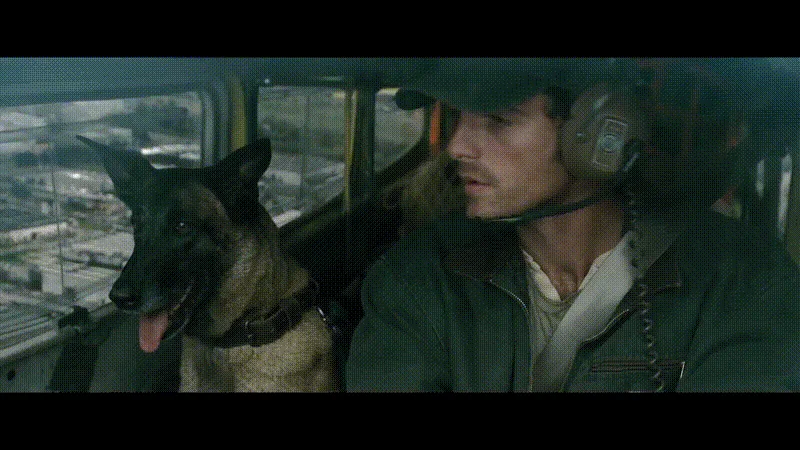
Ridley Scott’s The Dog Stars adapts Peter Heller’s 2012 novel into a post-apocalyptic survival drama set in 2035, years after a catastrophic flu pandemic has devastated humanity. The story follows Hig, played by Jacob Elordi, a mechanic and pilot living at an abandoned airfield in Erie, Colorado, with his dog Jasper and Bangley, a former Marine played by Josh Brolin.
Hig has lost his wife and remains emotionally trapped in grief despite having developed the practical skills needed to survive. Bangley, by contrast, is focused almost entirely on defense, weapons, and territorial security. Their partnership works because they need each other, but it is also strained by a deeper disagreement about whether survival means simply staying alive or remaining open to connection with other people.
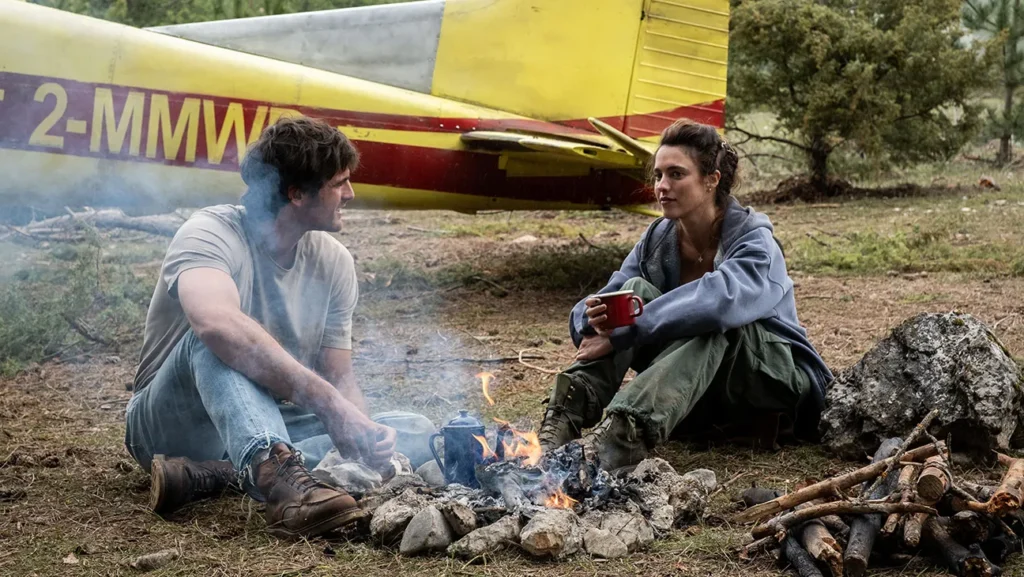
A mysterious radio transmission offers Hig a possible escape from that emotional and physical isolation. His decision to investigate leads him away from the compound and eventually into contact with Cima, played by Margaret Qualley, and her father Pops, played by Guy Pearce. Their presence changes the story from one about maintaining a defensive perimeter into one about whether Hig can imagine a future involving other people. Allison Janney appears as Darlene, an eccentric former flight attendant linked to Grand Junction, while Benedict Wong plays Aaron, an important figure within the surviving Mennonite community. Together, these characters represent different responses to collapse, including armed isolation, family protection, mutual assistance, and attempts to preserve recognizable social rituals.
Elordi’s performance depends on balancing practical capability with emotional exhaustion. Hig must be believable as someone who can repair machinery, fly, and endure danger without turning into an invulnerable action hero. The role works when his quietness communicates grief rather than emptiness. AVForums critic Mark Costello praised Elordi’s ability to convey that inward struggle through restraint, while Ridley Scott has also highlighted the actor’s comfort around machinery and animals, including the dogs used to portray Jasper.
Not every critic was convinced by the emotional results, however, with ScreenAnarchy questioning elements of his romantic chemistry with Qualley and criticizing parts of the dialogue. That tension captures the central risk of the performance: understatement can feel moving when the character’s internal life is legible, but distant when the surrounding drama does not develop it enough.
Brolin has a more immediately forceful role as Bangley. He speaks with certainty, treats hesitation as a danger, and regards defense as the essential condition of survival. JoBlo singled out Brolin as a standout and praised his chemistry with Elordi, while Scott described Hig and Bangley as an incompatible pair whose dependence on one another creates both conflict and humor. The role becomes more interesting when Bangley is allowed to be protective, funny, and dependable rather than simply brutal. If he were entirely heartless, Hig’s moral position would become too easy. Instead, Bangley represents the harder possibility that someone can genuinely help keep another person alive while also narrowing what that person believes life can still become.
Qualley’s Cima changes the emotional direction of Hig’s journey. Her importance depends on whether she feels like a person with her own grief and uncertain future rather than merely a romantic reward. The Associated Press highlighted a scene in which she hears recorded music after years without it, turning an ordinary pleasure into something emotionally significant. Scott has described her relationship with Pops as protective but unsustainable in the long term, making her connection with Hig partly about what kind of future remains possible.
Pearce provides a practical counterweight as Pops, while Janney’s Darlene introduces a different and more unsettling social register by presenting apparent order in a world where recognizable structures can conceal danger. Collectively, these performances broaden the film beyond Hig and Bangley, although their impact still depends on whether the screenplay gives them enough space to affect the story rather than simply signal each tonal shift.

The Dog Stars Book Adaptation, Ridley Scott’s Direction, and Visual World
The film preserves the novel’s central ingredients: a grieving pilot, an uneasy partnership, a beloved dog, a radio signal, and a longing for human connection beyond an isolated home. However, faithfulness cannot be measured only by whether characters and incidents remain present. Heller’s novel uses clipped, fragmented first-person narration, and much of its emotional force comes from the way Hig remembers, notices, and struggles to articulate experience. Film cannot reproduce that interior voice directly, so Scott’s adaptation has to translate it through performance, landscapes, pauses, sound, and scene construction.
Peter Heller himself has said that screenwriter Mark L. Smith was given substantial creative freedom and that the finished film retained the spirit of the book. That endorsement is meaningful evidence of the author’s response, but it does not determine whether every reader will consider the adaptation equally faithful. One documented change involves the stars: Scott said the film removes the novel’s constellation guidebook while retaining Hig’s fascination with the night sky. The adaptation is therefore best understood as an interpretation of the novel’s emotional premise rather than a scene-for-scene transcription.
Scott’s earlier work offers useful comparisons without providing a single template. Alien turns confinement into a survival trap, Blade Runner examines humanity through speculative world-building, and The Martian connects practical competence with hope. The Martian is especially relevant because both films involve protagonists capable of surviving through knowledge and physical skill. The difference is that Hig’s problem cannot be solved through engineering alone. Repairing a machine can help keep him alive, but it cannot answer why remaining alive still matters.
Scott has said optimism was essential to The Dog Stars, making the film’s hopeful direction an intentional organizing principle rather than an accidental softening of the apocalypse. Critical discussion also highlights the director’s interest in physical processes such as ammunition production, improvised infrastructure, and practical survival routines. The larger question is whether those details, the action, and the emotional journey all reinforce one another. The film appears strongest when survival mechanics reveal something about character and weakest when spectacle, environment, and personal drama feel like separate attractions.
The visual presentation is one of the most consistently praised aspects. Cinematographer Erik Messerschmidt and production designer Chris Seagers have drawn positive attention even from critics who were less convinced by the overall film. Although the story takes place in Colorado, much of the production was filmed in Italy across Friuli, Veneto, Abruzzo, Lazio, and Cinecittà. Bordano was used for Hig and Bangley’s airfield, where physical hangars and buildings were constructed. Cansiglio represented the Mennonite settlement, areas around Sirente Velino and Ovindoli supplied mountain landscapes, Preturo airport stood in for Grand Junction’s exterior, Rome’s EUR district provided urban locations, Cinecittà housed a recreated airport environment, and the Circeo area represented the setting associated with Cima and Pops.
These locations help create an apocalypse built from recognizable physical spaces rather than constant digital destruction. A functioning hangar, cultivated field, empty road, or airport can communicate what remains usable after collapse. The challenge is to make beauty serve the drama rather than merely decorate it. Landscapes become most meaningful when they clarify vulnerability, distance, scarcity, and what the characters stand to lose.

Survival, Grief, Hope, Jasper’s Death, and the Dog Stars Ending
The film’s central theme is the difference between surviving biologically and living meaningfully. Bangley’s priorities are practical: shelter, ammunition, supplies, surveillance, and a defensible position. Hig’s dissatisfaction asks whether those achievements are enough when emotional life has been reduced to grief and routine. Heller’s publisher materials frame the original novel around this same tension between self-protection and the need for human connection.
Grief complicates the problem because safety can become a way of avoiding future attachment. Hig is not simply searching for better living conditions when he follows the radio signal. He is exposing himself to the possibility of caring again and therefore to the possibility of another loss. Nature adds another dimension because Heller has described environmental loss and his attachment to the natural world as central to the novel’s creation. The landscapes are therefore not just scenic refuge from ruined civilization but part of what remains worth valuing.
The film’s humanist ambitions also face criticism. Slant and ScreenAnarchy questioned the treatment of threatening outsiders, arguing that some action sequences reproduce racialized imagery associated with older frontier stories. That criticism creates a meaningful tension within a film that otherwise argues for openness and renewed human connection. The moral argument becomes less convincing if unfamiliar people are repeatedly reduced to anonymous threats while compassion is reserved only for characters already known to the audience.
Jasper’s death is one of the adaptation’s most significant changes. In the film, Jasper dies during a raid, while in Heller’s novel he dies of old age. The change alters the emotional emphasis. A natural death foregrounds time and inevitable loss, while a violent death makes human danger directly responsible for Hig losing another essential relationship. Scott has explained that Jasper connects Hig to his late wife and their former domestic life, making the dog both a present companion and a living continuation of what Hig has lost.
That death becomes a turning point because it changes the meaning of the airfield. The compound may remain defensible, but it no longer offers the same emotional refuge. The adaptation choice can be criticized for using violent animal death as an immediate source of dramatic force, yet its effectiveness ultimately depends on whether Jasper has been established as a genuine relationship rather than simply a device. For viewers sensitive to animal death, the practical warning is clear: Jasper does not survive the film.
The ending further develops the story’s distinction between safety and connection. Hig, Cima, and Pops reach Grand Junction hoping it may represent a return to recognizable civilization, only to discover a coercive community that conceals cannibalism. Darlene’s version of order therefore becomes another form of danger rather than the refuge Hig imagined. The three escape and attack the airport terminal from the air before returning to Erie, where Bangley has survived an assault but has been wounded.
The final movement does not restore the old arrangement. Instead, the survivors move toward joining the Mennonite community. Bangley remains alive, while Hig’s journey ends not with the recovery of the old world but with a different understanding of the relationships still available to him. The closing image of Hig and Cima looking at the stars, with Hig identifying a constellation using Jasper’s name, carries the lost relationship forward without undoing the death.
The ending is hopeful without being restorative. Hig has not overcome grief, rebuilt civilization, or secured a danger-free future. What changes is his willingness to believe that new attachment does not betray the people and companion he has lost. The novel’s ending should still be distinguished from the film’s because Heller’s version retains a more explicitly ambiguous balance between family formation, environmental decline, and unexplained aircraft overhead. Scott’s film places greater emphasis on the emotional conclusion that isolation no longer has to define Hig’s life.

The Dog Stars Reviews, Pacing, Rating, and Whether it is Worth Watching
The screenplay’s main challenge is connecting several different dramatic modes. Hig’s routines with Bangley establish a survival story, his departure creates a journey, his relationship with Cima introduces romance, and Grand Junction shifts toward a more overtly disturbing form of horror. These sections need to feel like developments of the same emotional trajectory rather than loosely connected episodes. Critics who disliked the film often focused on this issue, describing uncertain transitions, inconsistent dialogue, and difficulty reconciling the quieter grief narrative with more forceful action sequences.
Edward Douglas criticized the dialogue and the film’s uncertain balance between action and horror despite praising elements of the cast and visual execution. JoBlo’s Chris Bumbray was considerably more positive but still pointed to rough transitions in later sections. His sense that material might be missing should be treated as a critical impression rather than evidence that a superior alternate cut definitely exists. Costello similarly identified tension between the inward emotional journey and the more aggressive set pieces.
Slow pacing is not inherently a problem in a film about mourning. Quiet scenes can be essential if they deepen relationships, expose habits, or make later decisions more understandable. The difficulty arises when contemplation and incident do not build on one another. The published reviews suggest that The Dog Stars contains enough atmosphere, humane intention, and strong performances to sustain sympathetic viewers, but not enough connective development to convince everyone that its changes in tone are fully earned.
As of September 22, 2026, Rotten Tomatoes showed a 41% Tomatometer score from 216 reviews and a 70% Popcornmeter score from more than 1,000 verified audience ratings. These are dated snapshots and can change. The Tomatometer represents the percentage of professional reviews categorized as positive rather than an average score of 41 out of 100, while the audience percentage reflects a different group with different verification rules. The difference therefore should not be treated as a controlled comparison between equivalent samples.
Individual responses illustrate that split. Bumbray rated the film 7/10, while the Associated Press review gave it 2.5 out of four stars, and The Guardian criticized its familiarity and lack of energy. These reactions suggest that critics and audiences may be responding to many of the same qualities but assigning them different importance. Someone drawn to melancholy, landscape, actors, and a deliberate pace may accept weaknesses that become decisive for a viewer seeking more originality or sustained suspense.
The Dog Stars was released theatrically in the United States on August 28, 2026. Its official runtime is 1 hour and 58 minutes, and its American classification is R for strong violence and language. Despite the title and Jasper’s importance, it is not a gentle animal-centered film. It contains violent attacks, bereavement, disturbing behavior, and the death of the central dog. The US rating should also not be treated as universal, and local classifications may differ by territory.
The most balanced assessment is that The Dog Stars is likely to work best for viewers interested in a reflective survival drama rather than those expecting an essential Ridley Scott action film. Its strongest reported qualities are the cast, physical environments, moments of tenderness, and the idea of survival as an emotional problem. Its weaknesses concern familiar genre material, abrupt changes in tone, and whether the screenplay develops its supporting relationships fully enough.
The film is therefore neither best described as a misunderstood masterpiece nor dismissed as a total failure. It appears to offer meaningful rewards within an uneven adaptation. Its central dramatic question, whether a person who knows how to survive can risk caring again, remains compelling. For book readers, the most useful approach is to judge Scott and Smith’s interpretation on its own terms while paying attention to what the change of medium preserves and what it simplifies.
Frequently Asked Questions (FAQs)
- What book is The Dog Stars based on?
The film is based on Peter Heller’s 2012 novel The Dog Stars. The book follows Hig, a grieving pilot living in the aftermath of a devastating pandemic, where survival at an abandoned airport has become routine but emotionally hollow. The adaptation keeps that central premise, particularly Hig’s struggle between remaining protected in isolation and risking new relationships that could give his life meaning again. - Who plays Hig and Bangley in The Dog Stars?
Jacob Elordi plays Hig, while Josh Brolin plays Bangley. Their relationship is one of the film’s central dramatic tensions because they represent different ideas about how to survive after societal collapse. Hig still wants human connection and the possibility of something beyond mere endurance, while Bangley is much more focused on security, weapons, and self-preservation. Their partnership works because they depend on one another, even when their philosophies frequently conflict. - When was The Dog Stars released?
The Dog Stars opened theatrically in the United States on August 28, 2026. That date refers specifically to its U.S. cinema release and should not be confused with later stages of distribution such as digital rental, digital purchase, or subscription streaming. Those formats can receive different release dates, so a later home-viewing date would not contradict the August theatrical opening. - How long is The Dog Stars?
The official theatrical runtime is 118 minutes, which is 1 hour and 58 minutes. The film is rated R in the United States for strong violence and language, so its content is considerably darker than the title alone might suggest. Despite the importance of Hig’s dog Jasper, this is not a gentle animal-centered adventure, but a post-apocalyptic survival drama involving violence, grief, and disturbing situations. - Is The Dog Stars a zombie movie?
No. Ridley Scott explicitly stated that the film does not contain zombies. Its apocalypse comes from a catastrophic flu pandemic that devastated humanity, leaving scattered survivors to deal with isolation, scarcity, violence, and the difficulty of trusting strangers. The major threats therefore come from the post-pandemic world and the people living within it rather than from undead creatures. - Does Jasper survive The Dog Stars?
No. Jasper is killed during an attack, and his death becomes one of the film’s major emotional turning points. Jasper is more than simply Hig’s pet because he connects Hig to his late wife and to the domestic life he lost before the collapse. Losing him changes the emotional meaning of Hig’s isolated routine and contributes to his decision to leave the relative safety of the airfield. Viewers sensitive to animal death should be aware of this before watching. - Does Bangley die at the end of The Dog Stars?
No. Bangley survives the film. When Hig returns to the airfield after the later events of the story, he finds Bangley wounded after an attack but still alive. His survival matters because the ending does not simply erase Hig’s old relationships in favor of new ones. Instead, the story moves toward a different form of community while allowing Bangley to remain part of that future. - Where was The Dog Stars filmed?
Although the story is set in Colorado, substantial filming took place in Italy. Locations included Bordano, which was used for Hig and Bangley’s airfield environment, Cansiglio for the Mennonite community, areas of Abruzzo for mountain landscapes, Rome for urban settings, and Cinecittà for recreated airport material. Other Italian locations were also used to represent parts of the film’s post-apocalyptic American setting. - What is The Dog Stars’ Rotten Tomatoes score?
As of September 22, 2026, The Dog Stars had a 41% Tomatometer score from 216 professional reviews and a 70% Popcornmeter score from more than 1,000 verified audience ratings. These percentages represent different groups and should not be read as directly comparable average scores. They are also snapshots that can change as additional reviews and audience ratings are added. - When will The Dog Stars stream on Disney+?
Disney’s official film information had not announced a Disney+ release date in the material reviewed. That means an exact subscription-streaming date remains unconfirmed. The film’s theatrical release and Disney’s ownership of the relevant distribution platform do not, by themselves, establish when it will enter the Disney+ catalog, so any specific streaming date should be treated cautiously until officially announced.

Conclusion
The Dog Stars raises a compelling distinction: protecting life is not necessarily the same as giving life meaning. Hig’s journey asks whether grief must lead to permanent withdrawal or whether new relationships can coexist with enduring loss.
The research and published criticism support a measured assessment. Scott’s adaptation offers an accomplished ensemble and an appealingly humane premise, but its pacing, familiar conflicts, and uneven dramatic transitions prevent a straightforward declaration of success. Its divided reception is understandable rather than contradictory. Different viewers will place different weight on atmosphere, emotional sincerity, originality, and narrative momentum.
The final judgment is a qualified one: a potentially rewarding post-apocalyptic drama whose emotional ambitions are more persuasive than its claim to reinvent the genre. The strongest reason to engage with it is not the destruction of civilization, but the quieter question that remains afterward; whether a person can learn to participate in life again.
Sources and Citations
- 20th Century Studios’ official The Dog Stars page is the primary source for the film’s credits, runtime, release date and principal cast. It lists Ridley Scott as director, Mark L. Smith as screenwriter, a 1 hour 58 minute runtime and an August 28, 2026 U.S. theatrical release, with Jacob Elordi, Josh Brolin, Margaret Qualley, Guy Pearce, Benedict Wong and Allison Janney in the ensemble. 20th Century Studios
Citation: 20th Century Studios: The Dog Stars Official Movie Page - The Walt Disney Company’s August 27, 2026 feature independently confirms the August 28 theatrical opening and the adaptation’s basic premise. Disney describes the film as based on Peter Heller’s bestseller and discusses the central tension between survival and retaining humanity, with comments from Ridley Scott and Josh Brolin. The Walt Disney Company
Citation: Disney: Ridley Scott and Josh Brolin on The Dog Stars - Disney’s Summer 2026 theatrical overview provides another official release reference, placing The Dog Stars on August 28, 2026 and identifying it as a 20th Century Studios release starring Elordi, Brolin, Qualley, Pearce, Wong and Janney. The Walt Disney Company
Citation: The Walt Disney Company: Disney Movies Coming to Theaters Summer 2026 - Rotten Tomatoes’ current movie page, checked October 2, 2026, shows a 41% Tomatometer from 221 critic reviews and a 70% Popcornmeter from 1,000+ verified audience ratings. These figures are fluid rather than permanent: Rotten Tomatoes’ earlier August 26 first-reviews article showed 40% and 70%, demonstrating why reception numbers should always be dated when quoted. Rotten Tomatoes
Citation: Rotten Tomatoes: The Dog Stars
Citation: Rotten Tomatoes: The Dog Stars First Reviews - Rotten Tomatoes’ official FAQ explains how those scores should be interpreted. The Tomatometer is the percentage of approved professional critic reviews classified as positive, while the Popcornmeter is based on audience ratings. Rotten Tomatoes also states that scores can change as additional reviews are added. Rotten Tomatoes
Citation: Rotten Tomatoes: Official FAQ and Scoring Explanation - Rotten Tomatoes’ September 22, 2026 scoring update provides the newest explanation of the Popcornmeter and its thresholds. A movie is labeled Hot when at least 60% of audience ratings are 3.5 stars or higher, while Verified ratings rely on confirmed theatrical ticket purchases where verification is available. Rotten Tomatoes Editorial
Citation: Rotten Tomatoes: Updated Popcornmeter and Verified Hot System - Penguin Random House’s official page for Peter Heller’s The Dog Stars establishes the source novel and provides both the book description and a substantial author interview with Heller. The interview discusses his move from nonfiction and adventure writing into fiction, while the novel page documents Hig, Jasper, Bangley, the pandemic and the radio transmission that drives the journey. PenguinRandomhouse.com
Citation: Penguin Random House: The Dog Stars by Peter Heller - Penguin Random House’s 2026 movie tie-in edition directly connects the novel to Ridley Scott’s film and identifies Jacob Elordi, Margaret Qualley and Josh Brolin among the adaptation’s stars. The tie-in edition was published August 4, 2026 and retains Heller’s original novel rather than presenting a novelization of the screenplay. PenguinRandomhouse.com
Citation: Penguin Random House: The Dog Stars Movie Tie-in Edition - Penguin Random House’s official Reader’s Guide is particularly useful for literary comparison. It emphasizes Hig’s grief, his relationship with Jasper and Bangley, environmental loss, isolation, human nature after civilization’s collapse, and comparisons with other dystopian literature. These themes provide a firmer basis for comparing the novel and movie than treating plot differences alone as the measure of adaptation fidelity. PenguinRandomhouse.com
Citation: Penguin Random House: The Dog Stars Reader’s Guide - Italy for Movies’ official production-location page documents the extensive Italian shoot. Production lasted roughly nine weeks between April and June 2025, using locations across Friuli Venezia Giulia, Veneto, Abruzzo and Lazio, including Bordano, Polcenigo, the Cansiglio plateau, Secinaro, Ovindoli, Cinecittà and Rome’s EUR district. Italy for Movies
Citation: Italy for Movies: The Dog Stars Filming Locations - Italy for Movies’ August 27, 2026 production feature adds unusually detailed location context. It explains that Bordano was transformed into Hig and Bangley’s base and Eerie Airport, the Cansiglio represented a Mennonite settlement, Abruzzo locations stood in for Colorado landscapes and Grand Junction exteriors, Cinecittà housed constructed sets, and Rome’s EUR district supplied large-scale post-apocalyptic urban imagery. Italy for Movies
Citation: Italy for Movies: Ridley Scott’s Post-Apocalyptic Italy in The Dog Stars - The Guardian’s August 25 review by Benjamin Lee provides one of the clearly negative critical assessments used in reception discussion. Lee argues that the adaptation struggles with familiar survival-movie material and lacks sufficient dramatic energy. This is the reviewer’s judgment and should remain attributed rather than presented as an objective conclusion about the film. The Guardian
Citation: The Guardian: The Dog Stars Review - Variety’s August 26 review by Peter Debruge similarly finds the movie low-energy and argues that its character-oriented approach does not provide enough developed characterization to sustain the drama. It is useful for discussing the film’s pacing and adaptation choices, while remaining an attributed critical assessment. Variety Australia
Citation: Variety: The Dog Stars Review - The Hollywood Reporter’s review by David Rooney offers a somewhat more sympathetic counterpoint, describing the film as a restrained and soulful dystopian western while still raising concerns about the screenplay’s psychological depth. Rotten Tomatoes’ review roundup also quotes Rooney’s criticism of the script, making it useful when presenting mixed rather than uniformly negative reception. Hollywood Reporter
Citation: The Hollywood Reporter: The Dog Stars Review - Time Out’s August 26 review by Simon Crook provides another useful counterbalance, awarding the film three stars and interpreting it as a hopeful but uneven post-collapse drama rather than simply a failed action thriller. That perspective is useful when discussing themes of grief, connection and renewal alongside the harsher reception elsewhere. Time Out Worldwide
Citation: Time Out: The Dog Stars Review - The New York Times’ August 27 review by Jeannette Catsoulis praises the strength of the cast while arguing that the film’s contemplative dystopian approach remains dramatically sluggish. Like the other review sources, this supports attributed discussion of critical reception rather than an unqualified factual judgment about quality. Monorepo Sample1
Citation: The New York Times: The Dog Stars Review
Recommendations
- Echoes of Aincrad Crafting Guide: Recipes, Materials and Unlock Requirements
- Did Christopher Nolan’s Depiction of the Gods Pay Off in The Odyssey?
- Castlevania: Belmont’s Curse Runs at Only 30 FPS on Nintendo Switch
- EA Sports College Football 27 Preview: Defense Wins Championships
- Jurassic World Evolution 2 Complete Edition Comes to Nintendo Switch 2 on July 30, 2026
- Unity-Based Tool for JRPG Game Development: RetroGig’s Retro JRPG Template for SNES/PSX-Style RPG Systems
- Keanu Reeves & China Miéville BRZRKR: Light Draws Breath — Release Date, Story, Creative Team & Variant Covers
- CD Projekt Raises Profit Goals with Witcher 4, 5, and 6 Coming: 5 Billion PLN Target Explained
- Creepshow Official Announcement Trailer Reveals a New Anthology Horror Game Experience
- GTA 6 Leans Into Vice City’s Influencer Hustle Where Looks Matter



































































































