







In This Article (7 sections)
Rubinite Release Platforms Story and Boss Rush Structure
Rubinite is a 2D pixel art action RPG built around consecutive boss encounters rather than a large interconnected world filled with ordinary enemies. The game officially launched worldwide on July 23, 2026, although Steam may display July 22 in some regions because of regional timing and store metadata. The commercial release is currently available on Steam for Windows PC and macOS, with Cup Dog Games and GameWorks Ventures listed as developers and Cup Dog Games as publisher. No PlayStation, Xbox, Nintendo Switch or Switch 2 release date had been confirmed at the time covered here. The Steam version includes 38 achievements, Steam Cloud support, leaderboards, Family Sharing, full controller support and multiple interface and subtitle languages.
The game’s structure was heavily inspired by Titan Souls, but Cup Dog Games wanted longer and more mechanically developed battles than one hit encounters. The developers combined weak point observation with ideas closer to Soulslike combat, including dodging, healing, pattern recognition and repeated attempts. The boss rush format also allowed the relatively small development team to spend more time making a limited number of encounters distinctive rather than dividing resources across large maps, common enemies and traditional dungeons. Boss mechanics were reportedly designed before their final visual appearance, showing that combat behavior was treated as the priority.
Rubinite is not simply a sequence of disconnected arenas. Between battles, Ruby returns to a hub shared with her companions Roy and Wichiwi. As the story progresses, additional rooms, memories, conversations, upgrades and occasional environmental puzzles become available. These quieter sections reveal more about Ruby, the Witch and the destruction of the Scarlet Kingdom while providing breaks between demanding fights.
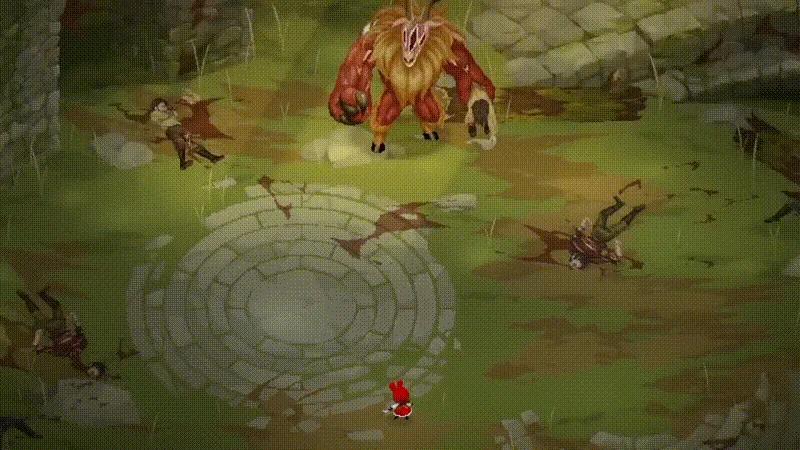
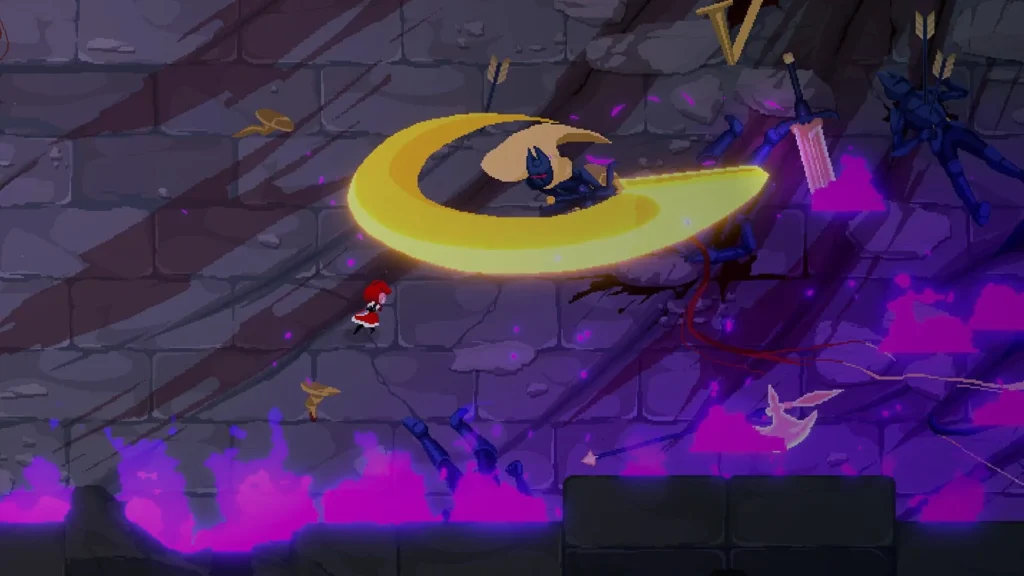
Ruby is the princess of the Scarlet Kingdom and the protagonist of the story. After escaping the destruction of her home, she begins a journey to confront the Witch responsible and reclaim what has been lost. Her crimson eyes allow her to perceive the hidden Pureblood cores inside Bloodstained creatures, making her uniquely capable of defeating them. Visually, Ruby appears as a small red cloaked figure with a rabbit themed hood, a design chosen partly to create a recognizable silhouette when placed against enemies many times her size.
The Scarlet Kingdom itself has been transformed into a hostile world populated by Bloodstained monsters, ancient cults, immortal parasites and beings connected to a deadly plague. The story is revealed through companion conversations, environmental details, dreamlike sequences and memories between battles. Cup Dog Games originally treated the narrative mainly as a way to connect encounters, but it gradually expanded into a larger story about Ruby’s choices, the truth behind her journey and the events that caused the kingdom’s downfall.
The Bloodstained are the major enemies standing between Ruby and the royal capital. Earlier promotional material sometimes referred to them as Blood Recipients, while the final Steam description primarily uses Bloodstained. They are not one species, and their different forms allow encounters to involve single large enemies, multiple bodies, summons, possession mechanics, separating segments and other variations. What connects them is their Pureblood power and resistance to normal attacks.
Rubinite’s visual presentation combines dark fairy tale imagery with horror. Ruby’s bright red cloak contrasts against decaying halls, religious structures, diseased landscapes and grotesque enemies. Reviews have frequently praised the fluid animations, dramatic boss introductions, transformation sequences and finishing attacks. The world is designed to feel both majestic and ruined, reinforcing that Ruby is fighting through the remains of her own kingdom rather than a collection of unrelated arenas.

Rubinite Focus Mechanic Lethal Thrusts and Boss Combat Strategy
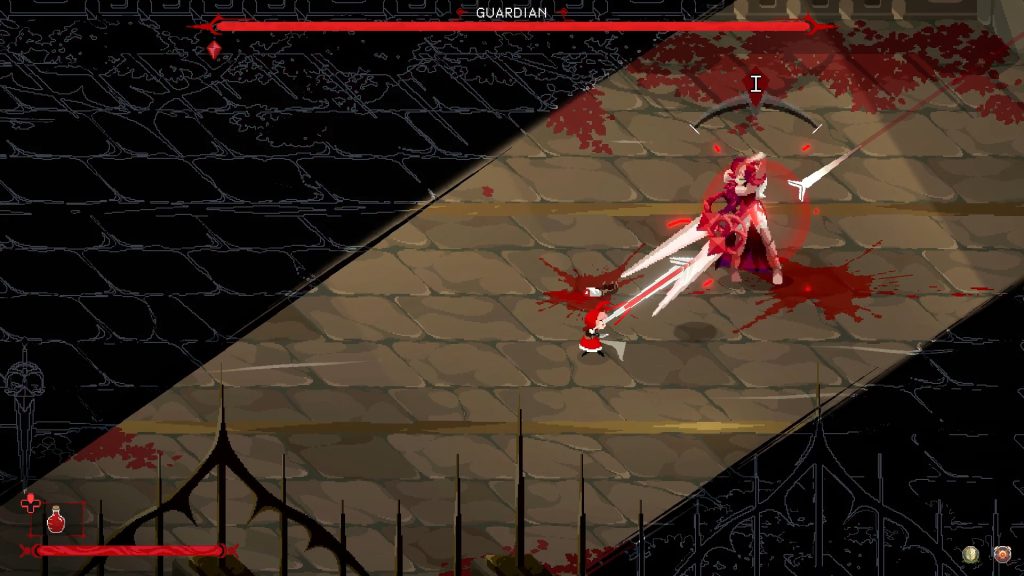
Focus is the defining combat mechanic in Rubinite. Ruby’s normal knife attacks cause only limited damage against Bloodstained enemies, so victory depends on locating the Pureblood crystal hidden inside each opponent. Holding Focus directs Ruby’s attention toward a selected area and gradually fills an observation meter while the enemy remains within that field. Completing the meter creates a Pureblood mark, with Ruby normally able to store up to three before converting them into a lethal thrust.
Distance directly affects how quickly marks are built. Ruby identifies weaknesses faster when she stays closer to the enemy, while remaining at long range causes Focus to fill more slowly. The system therefore encourages players to remain near danger rather than waiting safely at the edge of the arena. This creates constant pressure because getting hit before spending accumulated marks causes those marks to disappear.
Players must repeatedly decide whether to spend one or two marks immediately or risk building the maximum three mark stack for greater damage. Against unfamiliar bosses, smaller attacks may be more reliable because a single mistake cannot erase as much progress. Once patterns become familiar, three mark attacks become easier to prepare and can considerably shorten an encounter.
Perfect dodges make the system more aggressive. Dodging at the correct moment while observing an enemy can instantly grant a Pureblood mark instead of requiring the normal Focus meter to fill. Later fights add specialized responses to grabs, aerial attacks and other color coded threats, while some counters also generate marks. This means the fastest way to build damage is often to Focus during dangerous attacks and respond correctly rather than wait for the boss to become inactive.
Focus has drawbacks as well. Reviews have noted that maintaining it can narrow the player’s attention and make projectiles or secondary enemies near the edges of the screen harder to track. Holding Focus continuously is therefore risky, especially in battles containing multiple threats. Effective play requires switching between focused observation and wider arena awareness.
Identifying a weakness is only the first part of the process. Players must learn each boss’s animation, movement, sound and positioning cues to determine when it is safe to keep observing and when to dodge. Some attacks demand specialized counters rather than standard evasion, while phase changes and summons can create situations where continuing to Focus would be dangerous. The safest position is usually close enough to build marks efficiently but far enough away to react to the next attack.
Lethal thrusts are the payoff for successful observation. Once Ruby has at least one Pureblood mark, she can launch a critical attack against the exposed core, converting the stored marks into direct damage. Larger stacks produce stronger results, but positioning and timing still matter. Ruby must strike when the enemy is vulnerable and avoid committing during an active countermeasure, hazard or phase transition.
The developers wanted these critical attacks to feel like decisive exchanges rather than ordinary special moves. Ruby often passes through or alongside the enemy during the animation, emphasizing the moment when she commits to the exposed core. Normal knife attacks remain useful for smaller amounts of damage, specific interactions and techniques gained through progression, but they are not intended to replace lethal thrusts.
General boss strategy revolves around patience and pattern recognition. Early attempts are best used to study telegraphs, counters, phase transitions and safe openings rather than forcing a quick victory. Players should avoid standing between several threats, spending marks during unsafe animations or maintaining Focus so long that they lose awareness of the arena. Basic attacks, healing, darts, counters and talisman effects work best when they support the Focus loop rather than compete with it.
Rubinite is intentionally difficult and becomes more demanding as bosses combine faster attacks, additional phases, arena hazards, extra enemies and specialized counters. Normal and Story difficulty options are available. Reviews of the launch version reported that Story mode included assistance such as wider perfect dodge timing and higher damage, although those settings were tied to Story mode and switching back to Normal was reportedly restricted. More demanding advanced content also exists after the main experience, including challenges with reduced interface information and fights where a single hit can end an attempt.

Rubinite Pureblood Talismans System Requirements and Player Reception
Pureblood functions as both a story element and a progression resource. Bloodstained creatures draw power from it, while Ruby can absorb surrendered power after defeating them and use it to prepare for future encounters. The progression system is deliberately limited so that upgrades support player skill rather than replace it. Rubinite is not designed around grinding until Ruby can overpower bosses without learning their mechanics.
Players can improve Ruby through a skill tree containing passive bonuses and additional techniques, including abilities connected to Focus. Healing resources can also be improved, while Blood Dust serves as an important currency for skill development and talisman crafting. Reviews reported that Blood Dust is not lost on death, reducing the punishment for repeated attempts and allowing players to return to the hub, improve Ruby and retry difficult encounters.
Talismans provide equipment based modifiers, often combining an advantage with a tradeoff. Defensive setups can improve survivability or reduce the impact of a specific boss mechanic, while more aggressive setups can strengthen Focus related damage or reward close range play. Because bosses behave differently, adjusting talismans between encounters can be more effective than relying on one universal build throughout the game.
Rubinite has relatively modest hardware requirements. On Windows, the minimum specification lists an AMD Athlon X4 or Intel Core i5 4460 processor, 8 GB of RAM, an Nvidia GeForce GTX 950 or AMD Radeon R7 370 graphics card, DirectX 11 and 10 GB of available storage. The recommended tier lists an AMD Ryzen 3 or Intel Core i5 Skylake processor, an Nvidia GeForce GTX 970 or AMD Radeon RX 570 and the same storage requirement. Steam displays 8 MB of RAM in the recommended memory field, but that is almost certainly a listing error because the minimum requirement is 8 GB and the Mac specifications also list 8 GB.
For macOS, the minimum listing names an M1 MacBook Air class processor, 8 GB of RAM, M1 graphics and 10 GB of storage. The recommended tier lists an M1 Pro processor with the same memory and storage. Steam also lists macOS 10.13, which conflicts with the Apple silicon hardware requirement, so Mac users should verify current compatibility information before purchasing. Full controller support makes a gamepad a practical option because Focus, aiming, dodging and specialized counters often need to be performed in rapid succession, although keyboard and mouse controls are also supported.
Rubinite can reasonably be described as a Soulslike inspired boss rush action RPG. Its difficult encounters, repeated attempts, healing, precise dodges and emphasis on learning patterns reflect influences from Dark Souls III and Sekiro: Shadows Die Twice. However, it differs from a conventional Soulslike by removing most large scale exploration and ordinary enemy combat. Players usually move between the hub and dedicated boss arenas rather than navigating an interconnected world filled with checkpoints and minor enemies.
Titan Souls remains the clearest comparison for the overall structure, while Sekiro is particularly relevant to Rubinite’s emphasis on reactive combat and personal mastery. Elements of Hollow Knight can also be seen in Ruby’s recognizable silhouette and talisman style customization, although Rubinite is not a Metroidvania. Players expecting extensive exploration may therefore find the structure narrow, while those who primarily enjoy difficult boss encounters may appreciate how quickly it reaches its main challenge.
Early player reception has been strongly positive. On July 28, 2026, Steam classified Rubinite as Very Positive, with 91 percent of more than 1,300 Steam purchaser reviews recommending it. Professional coverage has been more limited but generally favorable. Noisy Pixel scored the game 9 out of 10 and praised its bosses, Focus system, progression, characters and hub exploration. Game8 awarded it 82 out of 100, highlighting its combat, pixel art and emotional story while criticizing some storytelling choices and hitbox issues. The Wand Report gave it 7 out of 10, praising the art and central mechanics while criticizing mechanical inconsistencies, accessibility decisions and lengthy narrative interruptions.
Metacritic had only three professional reviews at the time covered, which was not enough to generate an official Metascore. The available sample is therefore too small to establish a final critical consensus. The most consistent praise centers on the Focus mechanic, boss variety, animation and pixel art, while recurring criticisms include occasional hitbox uncertainty, attacks arriving from outside the narrowed Focus view and story sections that some players feel interrupt the momentum between battles.
Rubinite is best suited to players who enjoy mastering carefully designed encounters rather than exploring an enormous world. Its campaign is relatively concentrated around repeated boss attempts, character interactions, build customization and demanding advanced content. For fans of Titan Souls, Sekiro, Nine Sols and other precision focused action games, its combination of observation, perfect dodging, counters and lethal strikes gives it a distinct identity beyond simply reproducing traditional Soulslike combat.
Frequently Asked Questions (FAQs)
- What type of game is Rubinite?
Rubinite is a single player 2D dark fantasy boss rush action RPG built around learning and defeating powerful enemies. Instead of moving through large dungeons filled with ordinary opponents, players progress through dedicated boss fights, story sequences and a central hub. Between encounters, Ruby can unlock skills, craft talismans, interact with companions and prepare for increasingly difficult battles. - When was Rubinite released?
Rubinite officially launched on July 23, 2026. Steam may show July 22 in some regions because of differences in storefront timing and regional release metadata, but the developer’s international launch announcement used July 23 as the official release date. - What platforms is Rubinite available on?
Rubinite is currently available through Steam for Windows PC and macOS. The Steam version includes features such as achievements, Steam Cloud, leaderboards and full controller support. No confirmed release date had been announced for PlayStation, Xbox, Nintendo Switch or Switch 2 at the time covered. - How does Focus work in Rubinite?
Focus allows Ruby to observe Bloodstained enemies and locate the hidden Pureblood crystal that acts as their main weakness. Keeping the boss inside the Focus field gradually fills an observation meter and creates Pureblood marks, with up to three marks normally stored at once. Ruby can then spend those marks on a powerful critical strike, but taking damage before using them causes the accumulated marks to disappear. - What does a perfect dodge do in Rubinite?
A perfect dodge lets Ruby avoid an attack with precise timing and can immediately grant a Pureblood mark when performed while Focus is active. This makes it much faster than waiting for the observation meter to fill normally. The mechanic encourages players to stay engaged with attacking bosses and learn their timing instead of simply waiting for completely safe openings. - Can Ruby defeat bosses with normal attacks?
Normal knife attacks can deal limited damage and may support certain skills or special situations, but they are not the intended primary method for defeating Bloodstained enemies. Most bosses are highly resistant to conventional attacks, so Ruby must use Focus to expose their Pureblood weakness and then convert her stored marks into critical or lethal strikes. - Does Rubinite have upgrades and character builds?
Yes. Ruby can develop new skills, improve practical abilities, absorb power from defeated Bloodstained enemies and use Blood Dust to support progression. Talismans also provide different bonuses and tradeoffs, allowing players to build around defense, survivability or more aggressive combat. These upgrades can make encounters more manageable, but they do not remove the need to learn boss patterns and execute the correct responses. - Is Rubinite difficult?
Rubinite is intentionally challenging and is designed around repeated attempts, pattern recognition and improving execution. Normal difficulty expects players to learn dodges, counters and Focus timing, while Story mode provides more forgiving assistance such as easier dodge windows and stronger damage. The advanced content after the main campaign becomes considerably harder and can include encounters that demand nearly flawless performances. - Is Rubinite a Soulslike or a roguelike?
Rubinite is better described as a Soulslike inspired boss rush action RPG rather than a roguelike. It shares Soulslike ideas such as difficult bosses, healing resources, precise dodging, repeated attempts and learning attack patterns. However, it does not revolve around randomized runs, procedurally generated levels or restarting an entire run after death, which separates it from typical roguelikes. - Is Rubinite worth buying?
Rubinite is worth considering for players who enjoy demanding boss battles, pattern based combat and improving through repeated attempts. Its Focus mechanic gives fights a distinctive rhythm, while its pixel art, boss variety and combat design have received strong early praise. Players looking for a large exploration focused RPG or a more relaxed action experience may find its concentrated boss rush structure and difficulty less suitable.
Conclusion
Rubinite succeeds because it builds almost every part of its combat around one clear idea: observation should be as important as attacking. Ruby cannot simply overwhelm the Bloodstained with faster button presses. She must study their movements, expose their Pureblood crystals, preserve her Focus marks, perform perfect dodges, and choose the correct moment for a lethal thrust.
That system gives the game a recognizable place within the crowded Soulslike genre. Rubinite borrows the concentrated boss structure of Titan Souls, the reactive mastery of Sekiro, and selected progression ideas associated with other modern action games, but its Focus mechanic changes how those influences are experienced. The player is constantly balancing proximity, visibility, patience, and risk.
Its dark fairy tale world, detailed pixel animation, memorable protagonist, and story of the ruined Scarlet Kingdom provide context for the battles. Talismans and skills add flexibility without allowing statistics to replace execution. Although some reviews have identified hitbox concerns, pacing issues, and restrictive difficulty options, the broader reception has emphasized the quality of the bosses and the satisfaction of mastering them.
For players searching for a difficult 2D boss rush with a distinctive combat system, Rubinite is one of the more notable independent action releases of 2026. It is compact, demanding, and built for players who enjoy turning repeated failure into knowledge and knowledge into a perfectly timed final strike.
Sources and Citation
- Steam — Rubinite: The official Steam page provides the release date, developer/publisher information, features, system requirements, price, description, achievements and current user-review data. It currently lists July 22, 2026 as the release date.
- Cup Dog Games — Rubinite: The developer’s official website provides the game’s description and feature overview, including the Focus mechanic, Ruby, Blood Recipients, Pureblood and Talismans.
- Gematsu — “2D pixel art boss rush action game Rubinite launches July 23”: This May 20, 2026 report documents the announced Steam release date, platform and developer-provided feature summary.
- Gematsu — Rubinite game page: Provides the game’s platform, developer/publisher, release information and official feature summary.
- UK Anime Network — “Cup Dog Games Interview”: The interview covers the Focus mechanic, Ruby’s design, the game’s influences including Titan Souls, Sekiro and Dark Souls III, boss design, the decision to make Rubinite a boss rush, story development and the team’s development philosophy.
- Noisy Pixel — “Rubinite Review – For My Clouded, Fettered Vision”: The July 22, 2026 launch review covers combat, bosses, progression, Focus, Talismans, story, characters and hub exploration.
- The Wand Report — Rubinite review: Metacritic identifies The Wand Report’s review as published July 24, 2026, scoring the game 70/100. The review discusses the game’s difficulty, combat issues, progression, story pacing and overall evaluation.
- Metacritic — Rubinite critic reviews: The page records the early critic scores, including Noisy Pixel (90), Game8 (82), Tech-Gaming (78), and The Wand Report (70). The aggregate was 80 Metascore from four critic reviews in the current listing.
Recommendations
- My Adventures with Superman Season 3 Review: Reign of the Supermen, Supergirl’s Rise, and DC’s Most Ambitious Animated Chapter Yet
- Maxon Releases Cinema 4D 2026.3 (New Tools, Workflow Upgrades, and Performance)
- Trend VFX Reveals 7-Minute Asad VFX Breakdown
- Dark Outlaw Games Founder Jason Blundell Appeared on Stream With JCbackfire to Decompress About the Unexpected Shift
- Ryan Coogler’s the X-Files Reboot Cast: Full List of New Guest Stars
- Lord of the Rings Legend Andy Serkis Joins Critical Role’s the Legend of Vox Machina Season 4 Cast in Major New Role
- REANIMAL Has Launched on PC and Console — Little Nightmares Creators Release a New Co‑Op Horror Game
- Where to Find the Pond Jockey Location in Grounded 2
- Resident Evil: Requiem Sold 5 Million Copies in Five Days — Capcom Confirms Record-Breaking Launch
- Octopath Traveler and Octopath Traveler II Switch 2 Release Date, Features, and Everything to Know



































































































