









In This Article (7 sections)
What Is Sandustry and How Does Its Gameplay Work?
Sandustry release date details confirm an August 13, 2026 Early Access launch for a factory automation sandbox where players mine, mix, process, destroy, and industrialise an unexplored simulated planet.
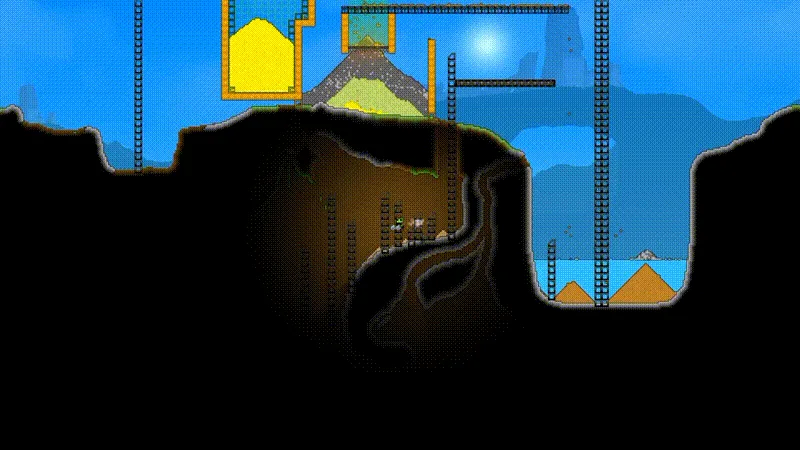
The early game begins modestly, with the player processing resources such as gold from sand. Progressively more sophisticated technologies and production chains become available, encouraging expansion from simple material handling into a network of conveyors, filters, drones, pipes, pumps, thermal equipment, energy systems and automated logic. The core gameplay loop moves through several interconnected activities: exploration reveals resources and locations, mining extracts useful materials, processing converts raw materials into more valuable forms, logistics moves those materials around, automation reduces repetitive manual labour, and technological progression opens increasingly complex factory systems.
The important twist is that physical simulation continues while this is happening. Individual grains of sand, pieces of ice, snow, seeds and other materials have properties rather than behaving like abstract numerical inventory values. The player therefore has to consider what a substance will physically do when it encounters heat, water, gravity or another material. Factories can be designed neatly, with carefully optimised material flows, or assembled as complicated networks that simply accomplish the required job. Steam specifically describes both the possibility of “pixel-perfect” optimisation and more chaotic webs of conveyors and lifts.
Production chains transform whatever the player extracts from the environment into materials or products required for continued industrial development. Sandustry distinguishes itself by making those chains depend not only on machines but on physical and chemical reactions. Ice melts into water when heated, water can boil into steam, steam rises and may eventually return as rain, sand absorbs surrounding water, and slag can be burned and processed further to recover useful resources. The official wiki documents solid, liquid, gaseous, slushy and other material types, including sand, wet sand, ice, water, steam, copper, liquid copper, gold, liquid gold, lava and numerous fictional substances.
This means a production line cannot always be understood as a simple input and output equation. Temperature, movement and environmental exposure can become part of the chain. Pipes may be required for fluids, conveyors move suitable solids, thermal equipment can alter the state of matter, and logic systems can coordinate more advanced setups. Resource management similarly involves more than maintaining large inventory totals because substances physically occupy and move through the world. Water reservoirs can be affected by sand absorption, while heat can change ice into water and water into steam.
The automation system begins with basic logistics and expands into an extensive set of machines. The official Sandustry Wiki documents multiple conveyor tiers, launchers, filters, conveyor portals, fans, shakers, kinetic presses, planter boxes, synthesis equipment, pipes, pumps, vents, smelters, condensers, steam dryers, snowmakers and thermal buffers. Power generation includes batteries, energy connectors and steam turbines, while logic components include switches, sensors, buffers, repeaters and AND, OR, NOT, NAND, NOR, XOR and XNOR gates. Drones add another layer, with documented Sweeper, Digger, Recon and Hauler drones.
A Sandustry base can therefore evolve from a basic processing area into a large industrial complex containing logistics, production machinery, foundations, power systems, fluid infrastructure and automated controls. Construction components include foundations, glass foundations, doors, fences and lighting. Because terrain is destructible, the environment can also be remodelled to accommodate the factory. Sensors and logic gates allow factories to respond to changing conditions rather than simply operating as fixed lines, while drones can assist with transport, excavation and reconnaissance.

Sandustry Destructible World, Exploration and Early Access Explained
Sandustry is built around procedurally generated environments where much of the terrain can be physically altered, destroyed and converted into useful resources. Steam describes its worlds as fully destructible, while the game’s pixel simulation gives materials physical behavior instead of treating the environment as static scenery. Sand, snow, seeds, spores, ice, liquids and gases are represented as simulated particles with their own properties, allowing them to fall, flow, rise, become wet, react to heat and interact with nearby substances.
The phrase “every pixel is a resource” captures one of the game’s main design ideas. A pile of sand is not simply a visual representation of a hidden resource number because the material itself participates in the simulation. Heat can change states of matter, liquids can flow through the environment and reactions can transform substances into new forms. This makes the terrain simultaneously a source of materials, an obstacle and a system the player can manipulate.
Mining begins through direct interaction with the environment and becomes increasingly technological as the player progresses. Early descriptions mention using tools and weapons to dig deeper for sand and raw resources, while the official wiki lists excavation equipment including a shovel, gun, rocket launcher, drill, laser and Void Gun. Other tools such as the flamethrower and Cryoblaster can modify terrain through temperature rather than simply breaking it apart.
Different environments can therefore support different solutions. Explosives can remove large areas quickly, a flamethrower can change frozen material, and lava can be redirected as a natural way to melt through ice. Pumps and pipes become useful when liquids need to be controlled or transported. Steam specifically gives the example of either attacking a thick wall of ice with a flamethrower or using nearby lava to melt through it, demonstrating how environmental systems can be combined instead of relying on one fixed solution.
The description of the world as fully destructible should not be interpreted to mean that absolutely every object can always be removed. The official wiki includes an Indestructible terrain category, suggesting that protected materials can still be used for structural or gameplay boundaries. The broader principle remains that large parts of the world can be physically manipulated rather than treated as untouchable background scenery.
Exploration pushes the player beyond the factory and into deeper parts of the procedurally generated planet. Steam describes varied biomes, underground mysteries and remnants of an ancient civilisation, while earlier developer material mentions temples, structures, puzzles and bosses. Because terrain can often be altered directly, exploration and excavation are closely connected. Players may create their own routes with drills or explosives or use environmental interactions such as melting ice to reach otherwise blocked areas.
Exploration also feeds back into factory progression. Ancient vaults can contain knowledge and power, while artifacts can provide useful benefits worth spending resources to obtain. Going deeper can reveal new materials, ancient structures, challenges and technologies. In return, a stronger factory can produce better equipment that allows the player to push further into the planet.
The largest mystery concerns the ancient civilisation whose structures and artifacts remain beneath the surface. Steam says players can discover vaults containing significant knowledge and power and overcome challenges left behind by this civilisation. Artifacts are not merely decorative lore objects because they can provide meaningful benefits. However, the civilisation’s full identity, history and fate had not been comprehensively explained before Early Access, so detailed conclusions about what happened to it would be premature.
Sandustry is scheduled to launch into Early Access on August 13, 2026. Steam, Hooded Horse and the official community announcement all identify that date. Lantto Games describes the initial version as fully playable and containing the features advertised on the Steam page, while also making clear that Early Access is not the final version of the game.
The current plan is for Sandustry to remain in Early Access for roughly one year, although that is an estimate rather than a guaranteed 1.0 release date. Development may change according to player feedback and evolving design decisions. The eventual full version is expected to include additional buildings, resources, production chains, quests and technologies, while the developer has also said the price may increase as more content is added during Early Access.
Community feedback is intended to play an important role in development. Lantto Games plans to monitor suggestions, bug reports and other feedback through Steam discussions and Discord. Modding is also part of the long term plan, with Sandustry designed around tools that could support visual modifications, handcrafted maps, additional buildings, new production processes and potentially much larger overhauls.
A playable demo was already available before the Early Access launch and had accumulated a Very Positive Steam user review summary at the time of research. This gave prospective players a way to test the game’s fundamental pixel physics, environmental manipulation and factory concepts before the full Early Access version became available.

Sandustry Factory Building, Automation and PC Requirements
Sandustry centers on turning the planet’s physical materials into an increasingly efficient industrial system. Players gather resources, control how those materials behave, process them through machinery and build logistics networks that keep production moving. The factory system is closely connected to the game’s physical simulation, so optimization is not limited to calculating machine output. Materials can move, react, change state or be lost if the player does not account for their properties.
Water, for example, can be absorbed by sand and gradually reduce limited reservoirs, while heat can turn ice into water and water into steam. That means production planning must consider containment, separation, transport and temperature as well as raw throughput. Conveyors move solid materials, filters separate resource flows, pumps and pipes handle liquids, thermal equipment manages heat based processes, and drones can assist with transportation or excavation.
This creates a different form of automation from more conventional factory games. A production line may technically have enough resources available, but poor containment or material handling can still cause losses. Players therefore need to think about where substances are stored, how they reach machines, whether different materials need to be separated and how heat may affect the process.
Factories can expand both physically and technologically. Foundations and other construction components support organized industrial layouts, while more advanced production, logistics, power, fluid and thermal systems allow increasingly complex production chains. Logic systems add another layer by letting machines and connected systems react to conditions, making factories more programmable as the player advances.
The environment itself remains part of this industrial process. Digging through terrain can provide raw materials, create new routes and expose additional resources or progression areas at the same time. The world being industrialized therefore has physical properties that can either create problems for the factory or be deliberately used as part of the solution.
Sandustry’s PC requirements are relatively modest compared with many modern releases. For Windows, the minimum specification requires Windows 10 64 bit, an Intel Core i5 4670K quad core or AMD FX Series FX 8100 quad core, 4 GB of RAM and either an Nvidia GeForce GTX 550 Ti with 1 GB of VRAM or an AMD Radeon HD 7750 with 1 GB. DirectX 11 is required, while the game needs 1 GB of available storage and recommends using an SSD.
The recommended Windows specification also uses Windows 10 64 bit but raises the processor requirement to an Intel Core i5 9600K hexa core or AMD Ryzen 5 1600 hexa core. Recommended memory is 8 GB of RAM, while the graphics target increases to an Nvidia GeForce GTX 960 with 4 GB of VRAM or an AMD Radeon RX 570 with 4 GB. DirectX 12 is listed, storage remains at 1 GB and an SSD is again recommended.
Steam also lists macOS and SteamOS or Linux support, confirming that Sandustry is available beyond Windows systems. For players specifically checking whether a Windows PC can run the game, however, the minimum and recommended specifications above are the relevant published requirements.

Frequently Asked Questions (FAQs)
- Does Sandustry have a demo?
Yes. A Sandustry demo has been available through Steam, giving players an opportunity to experience the game’s core mining, factory building and pixel physics systems before committing to the Early Access version. The demo also provides a useful introduction to how physical materials interact with the industrial systems. - When does Sandustry release?
Sandustry is scheduled to enter Early Access on August 13, 2026. This marks the beginning of its publicly available development period, with Lantto Games planning to continue expanding and refining the game based on player feedback. - Is Sandustry an Early Access game?
Yes. Lantto Games is launching Sandustry as an Early Access game rather than presenting the August 2026 version as the final release. The developer considers the initial version fully playable but plans to use community feedback, suggestions and bug reports to improve and expand it during development. - How long will Sandustry remain in Early Access?
The developer currently estimates that Sandustry will remain in Early Access for approximately one year. However, this is only a target and not a guaranteed 1.0 release date, as Lantto Games says the schedule could change depending on development progress and player feedback. - Is Sandustry like Factorio?
Sandustry shares Factorio’s focus on automation, resource management and increasingly complex production chains, but its systems work differently because the world itself is physically simulated and destructible. It combines factory building with side view exploration, mining and pixel based material physics, leading PCGamesN to compare its automation and sandbox combination with games such as Factorio and Terraria. - Is every pixel in Sandustry simulated?
Sandustry’s core material system treats individual particles such as sand, snow, seeds and ice as physical entities with their own properties. These materials can move, interact with other substances and change state, which is central to the game’s pixel physics. However, the official wiki also lists indestructible terrain, so “every pixel” should be understood as the game’s guiding simulation concept rather than a guarantee that every map element can be mined or removed. - Can you automate mining in Sandustry?
Yes. Sandustry gradually introduces more advanced automation and industrial equipment, including Digger Drones documented by the official wiki. These systems allow players to reduce manual work as their factories become more sophisticated, while conveyors, logistics equipment and other machines can help manage the resources obtained from excavation. - Does Sandustry have a story?
Yes. Sandustry has a narrative mystery built around an unexplored planet and the remnants of an ancient civilisation. Players can discover structures, vaults and artifacts containing knowledge and other benefits as they explore deeper regions. However, the complete history, identity and fate of that civilisation had not been publicly revealed before the Early Access launch. - Does Sandustry have mod support?
Yes. Steam says Sandustry was built with modding in mind and includes dedicated tools for creating additional content. The planned possibilities range from visual changes and handcrafted maps to new buildings, processes and more substantial modifications, giving the community room to expand the factory and sandbox systems. - How much RAM does Sandustry require?
The official Windows minimum specification requires 4 GB of RAM, while 8 GB is recommended. The recommended configuration is intended for players who want to meet the game’s higher hardware target, alongside the stronger CPU and graphics requirements listed by Steam.

Conclusion
Sandustry’s most important idea is deceptively simple: the factory and the planet are not separate systems. The same sand, ice, water, steam, lava and other substances that make up the environment can become obstacles, resources or functional parts of an industrial solution.
That principle changes familiar automation-game problems. Instead of merely determining how many units a conveyor moves per minute, players may need to consider whether a material absorbs water, melts under heat, rises as a gas or can be rerouted through a different physical process. Conveyors, pumps, pipes, thermal machines, drones, energy systems and logic gates give players increasingly sophisticated methods for bringing the simulation under control.
Exploration prevents the factory from becoming completely self-contained. The world contains diverse terrain, deeper regions, ancient structures, puzzles and artifacts, encouraging players to leave established production lines and push into unknown areas. Better exploration produces new opportunities, while stronger factories make deeper exploration possible.
Sandustry enters Early Access on August 13, 2026, with the developer currently targeting roughly a year of further development. Lantto Games expects that period to bring additional buildings, resources, technologies, quests and production chains, with community feedback influencing how the game evolves.
For Factorio and factory automation fans, Sandustry’s attraction is therefore not that it simply recreates a familiar conveyor-belt formula in two dimensions. Its real differentiator is the attempt to merge automation engineering with a destructible falling-material sandbox. Players who find satisfaction in transforming unruly physical systems into reliable production lines are the audience most likely to understand why Sandustry’s seemingly troublesome sand is not merely terrain, it is the foundation of the entire game.
Sources and Citations
- Steam : Sandustry Official Store Page
- Hooded Horse : Sandustry Official Game Page
- Hooded Horse Wiki : Sandustry Official Wiki
- Steam Store : Early Access schedule, gameplay, pixel physics, modding plans, and system requirements
- Lantto Games : Original Sandustry Project Page on itch.io
- Steam : Sandustry Early Access Launch Announcement
- itch.io : Mining, base building, automation, ancient structures, puzzles, bosses, and technology progression
- Steam : Sandustry Demo Official Store Page
- PCGamesN : Sandustry Comparison with Factorio and Terraria
- Rock Paper Shotgun : Deep and Volatile Terraria-Style Factory Sim Sandustry Hits Early Access in August
- Steam Store : Sandustry Demo Page and Contemporary Game Comparisons
Recommendations
- Treasure Maps and Buried Treasure Locations in Assassin’s Creed Black Flag Resynced: Complete Treasure Hunting Guide
- Why the Forever Home is the Perfect High-Concept Sci-Fi Comic for 2026
- Daniel Radcliffe No Longer Cringes at Early Harry Potter Films but Disagrees With Andrew Garfield’s Praise
- Where to Stream Every LEGO Movie Online in 2026 (Updated Streaming Guide by Country)
- Cyberpunk: Edgerunners Season 2 Fans Have High Praise for Weak Kingsley’s English-Language Voice Actor
- Pokémon Pokopia Zorua’s Hide-and-Sneak Contest Event Guide
- Skibidi Brainrot with Metahuman: How to Recreate Viral Trends Using Unreal Engine 5
- Invincible VS DLC 1 Launch Trailer Breakdown: New Fighters, Release Date, Gameplay Updates, and Season 1 Details Explained
- The Drifter on Switch and Switch 2: Release Date, Features, and Everything You Need to Know



































































































