







In This Article (8 sections)
Silent Hill f Writing Process and Literary Influences
Silent Hill f’s narrative was shaped by a development philosophy that placed literature at the centre of the creative process. Konami producer Motoi Okamoto insisted that the scenario team read extensively, setting an expectation of “at least 100 to 200 books a year” to continually inspire new ideas. He believes that story-driven games require a constant flow of creative input from literature and diverse perspectives, making reading an essential part of game development rather than a hobby.
Okamoto also argued that reading a writer’s previous works is a matter of basic respect, allowing developers to understand the author’s strengths, weaknesses, and storytelling style before working together. To maintain this standard, the scenario writers reportedly encouraged, and even pressured one another to meet the reading target, immersing themselves in horror classics as well as the works of their own lead writer. This literary approach was credited with strengthening the game’s themes, atmosphere, and worldbuilding.
The writing process itself was highly collaborative and evolved through constant iteration. NeoBards Entertainment worked closely with Okamoto, writer Ryukishi07, and concept artist Kera from the earliest stages of development. During the first year, the team regularly exchanged ideas and refined the narrative, gameplay systems, and visual presentation so every element supported the same creative vision.
Okamoto established a broad framework centred on a Japan-based setting in the 1960s with stronger action elements, while NeoBards balanced these ideas with the need to preserve Silent Hill’s identity and satisfy longtime fans. Around 100 developers contributed to the project, with extensive work going into both the narrative and its technical implementation. Writers and designers repeatedly tested prototypes and revised story elements before Okamoto ultimately approved the final direction as his confidence in NeoBards’ vision grew.
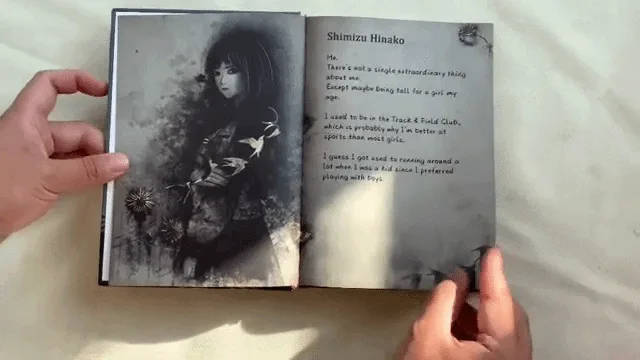
Literature also directly influenced the game’s characters, themes, and storytelling. Silent Hill f was written by Ryukishi07, best known for the When They Cry visual novel series, including Higurashi and Umineko. Several narrative details intentionally reference his earlier works, with characters such as Hinako, Rinko, and Sakuko sharing names with characters from Umineko. During development, one of Hinako’s early character traits; carrying a particular item was even inspired by Higurashi before being rewritten to better suit the story.
Okamoto considered it essential for the team to familiarise themselves with Ryukishi07’s previous works so they could properly understand and preserve his distinctive storytelling style. Beyond these direct influences, the game draws heavily from classic folk horror, Gothic traditions, and religious folklore. Reviewers have noted that the unsettling town of Ebisugaoka echoes the dark atmosphere of Japanese mythology, Slavic folklore, and traditional fairy tales. Ryukishi07’s own experiences working in Japan’s child welfare system also informed the game’s exploration of trauma, fear, and psychological horror, giving its narrative greater emotional depth.
Behind the scenes, much of Silent Hill f’s story evolved organically rather than being fully planned from the beginning. Numerous locations and storylines were expanded or created through ongoing discussions between Konami, NeoBards, and Ryukishi07. NeoBards level designer Kaiyu Chang explained that areas such as the local school were added later because they better supported the atmosphere and strengthened the script. Likewise, the protagonist’s house began as a straightforward labyrinth before repeated revisions introduced memory shifts and multiple timelines that became closely integrated with gameplay. As development progressed, Ryukishi07 continuously wrote additional dialogue, lore, and story content to accommodate new gameplay ideas.
Director Al Yang emphasised that, despite these changes, the team always ensured the finished narrative unmistakably felt like a Ryukishi07 work by preserving its central themes and storytelling style. The game’s complexity was evident even before release, with Hinako’s English voice actress commenting during recording in early 2025 that the branching narrative had become so intricate she sometimes found it confusing to portray scenes where Hinako encountered different versions of herself. After countless rounds of discussion, refinement, and iteration, the developers combined story, gameplay, and setting into the final narrative experience.

Silent Hill f Story, Narrative Inspirations, Research, and Psychological Horror Themes
Silent Hill f’s main story was written by Ryukishi07 (real name: Ryūichirō Higuchi), the acclaimed Japanese author best known for the When They Cry series. He was brought onto the project because of his reputation for psychological horror and mystery storytelling, as well as his long-standing appreciation for the Silent Hill franchise.
Producer Motoi Okamoto selected him not only for his work on Higurashi and Umineko, but also because he was a personal admirer of his writing. During early discussions, Ryukishi07 and Okamoto explored why this Silent Hill entry should take place in Japan, ultimately deciding that Silent Hill should be treated as a supernatural “phenomenon” rather than a single physical location. This concept became the foundation of the game’s narrative.
Ryukishi07 wrote the main script and continued refining it throughout development to accommodate NeoBards Entertainment’s production needs. While Konami’s scenario team contributed additional dialogue and branching endings, Ryukishi07 remained the primary story writer. Unlike earlier entries, no members of the original Team Silent were involved in the project, making Silent Hill f a complete creative reboot led by Okamoto and the new development team.
The game’s story draws heavily from Japanese culture and history, particularly rural life during the 1960s Showa era. This period was chosen because it balances modernisation with lingering traditional beliefs, creating an ideal setting for psychological horror. To accurately portray this era, the developers conducted extensive research in Gifu Prefecture, the real-world inspiration for the fictional town of Ebisugaoka. Team members visited mountain trails, schools, and other local landmarks to study the atmosphere rather than simply copying architecture.
They also recorded environmental sounds and observed period-specific details that influenced the game’s clothing, advertisements, signage, and other environmental elements. According to director Al Yang, the objective was to capture the “atmosphere and aura” of these locations, giving the game’s setting an authentic sense of place. This attention to detail has been widely praised for making the world feel naturally lived-in and deeply rooted in Japanese culture.
Narratively, Silent Hill f moves away from the series’ traditional Western influences by embracing Japanese folklore and social issues. Ryukishi07 incorporates themes of maternal anxiety, societal expectations, and the pressures placed on women, transforming these emotional struggles into horrifying supernatural manifestations. Monsters often represent deeply personal fears, including the fear of pregnancy and the dread of becoming like one’s mother.
Okamoto explained that the cast and narrative were intentionally designed to encourage players to analyse every interaction and theorise about hidden meanings, with nearly every object and clue carrying narrative significance. The result combines Ryukishi07’s signature gothic fairy-tale storytelling with Silent Hill’s emphasis on symbolism and psychological horror, creating a narrative that feels like a Japanese horror folktale adapted into an interactive experience.
Psychological horror lies at the core of Silent Hill f’s storytelling. Rather than relying primarily on jump scares, the game explores themes of identity, memory, trauma, and societal oppression. The story is deliberately fragmented, reflecting protagonist Hinako’s unstable mental state, requiring players to reconstruct events through notes, journal entries, environmental storytelling, and multiple perspectives. Much of the horror stems from the loss of personal agency and the consequences of rigid social expectations. Hinako’s experiences with family abuse and the pressure to conform to predetermined roles are transformed into disturbing monsters and surreal encounters, making the supernatural horror an extension of her emotional suffering.
These themes extend into the gameplay itself. A fading sanity meter represents Hinako’s deteriorating mental focus as she endures increasingly terrifying situations, reinforcing the connection between narrative and mechanics. Instead of focusing solely on grotesque creatures, Silent Hill f builds a persistent sense of unease through the fear of losing autonomy, becoming trapped by tradition, and being unable to escape one’s past. By grounding its supernatural elements in genuine human anxieties and combining them with a meticulously researched historical setting, the game delivers a form of psychological horror that lingers long after individual scares have passed.
Silent Hill f Story, Characters, and Development Philosophy
Silent Hill f reflects a deliberate shift in creative direction for the series while preserving the psychological horror that defines Silent Hill. Under producer Motoi Okamoto, the scenario team adopted a philosophy that placed narrative quality at the heart of development. Writers were encouraged to read extensively beyond the Silent Hill franchise, with Okamoto believing that broad literary exposure was an essential part of creating meaningful stories.
This emphasis on “input” fostered a collaborative environment where the team learned from one another while crafting a narrative designed to be analysed, discussed, and revisited by players. Rather than delivering a straightforward survival-horror experience, the game was built around multiple endings, hidden secrets, and fragmented storytelling that rewards careful exploration and repeated playthroughs.
At CEDEC, Okamoto presented Silent Hill f as a true mainline entry alongside the Silent Hill 2 remake, reinforcing his commitment to reviving the series with ambition rather than relying solely on nostalgia. Although the original Silent Hill creators had largely been replaced by a younger development team, mostly in their twenties, the philosophy remained rooted in psychological storytelling, which Okamoto considers essential to the franchise. The result is a blend of tradition and experimentation, introducing a Japanese setting and expanded combat while maintaining the series’ focus on fear, trauma, and the subconscious.
The game’s writers also drew inspiration from an unusually broad range of literature. Ryukishi07’s own works, particularly the When They Cry series, including Higurashi: When They Cry and Umineko: When They Cry served as direct influences, with references appearing in character names and recurring themes. Beyond these works, the team’s emphasis on extensive reading suggests inspiration from classic Japanese ghost stories, Western horror fiction, mythology, and philosophy.
While Konami has not officially identified additional literary sources, Silent Hill f’s atmosphere evokes the style of horror writers such as Shirley Jackson and Junji Ito, whose stories combine familiar domestic settings with slow-building psychological dread. Its world also resembles dark fairy tales and traditional folklore, both Japanese and Slavic, where ordinary objects and locations often carry symbolic meaning. By drawing from hundreds of books across multiple genres, the writers sought to create a story layered with symbolism, literary allusions, and thematic depth.
The story centres on Hinako Shimizu, a high-school girl growing up in the restrictive countryside of 1960s Japan. She struggles with a troubled family life, including an abusive alcoholic father, while feeling constrained by the rigid expectations placed on women during the era. After a heated confrontation at home, Hinako leaves to meet friends in the nearby town of Ebisugaoka, including Rinko Nishida and Shu Nanjo. Soon afterwards, a mysterious supernatural fog descends upon the town, transforming it into a nightmare inhabited by grotesque monsters. Armed with improvised weapons such as axes and knives, Hinako must fight for survival while exploring both the familiar village and its twisted Otherworld counterpart, where ordinary locations become unsettling and hostile landscapes.
As the story unfolds, Hinako uncovers disturbing secrets surrounding both her family and the town itself. Every major character she encounters including her mother, friends, and other residents plays a role in the game’s branching narrative. A central storytelling mechanic is Hinako’s journal, which records locations, characters, regional lore, and her personal thoughts, allowing players to better understand both the world and her emotional state. The narrative is intentionally fragmented, encouraging players to piece together the full story through notes, environmental details, and repeated exploration. Player choices influence the outcome, leading to multiple endings that reflect how Hinako confronts, or fails to overcome her deepest fears.
At its core, Silent Hill f explores themes of identity, trauma, and personal agency. The restrictive social expectations of 1960s Japan form the foundation of Hinako’s internal conflict, with the supernatural horror acting as a symbolic reflection of societal pressure, emotional repression, and the fear of losing oneself. Everyday life gradually unravels into a psychological nightmare, creating a story where personal struggles and monstrous horrors become inseparable. Hinako is portrayed as an ordinary young woman thrust into extraordinary circumstances, and her journey is ultimately about surviving not only the creatures that stalk Ebisugaoka, but also the emotional scars and human tragedies that define the heart of Silent Hill f.

Silent Hill f’s Reinvention, Development Success, and the Importance of Reading
Silent Hill f demonstrates how broad reading can directly influence stronger video game storytelling while also showcasing how bold creative decisions helped reinvent one of horror gaming’s most iconic franchises. According to producer Motoi Okamoto, reading is an essential part of a game writer’s job because it exposes creators to different storytelling structures, cultures, historical perspectives, and genre techniques. Understanding a writer’s previous works also helps a development team better understand that person’s narrative style.
During Silent Hill f‘s development, the team read extensively not only Ryukishi07’s horror novels to fully understand his writing voice, but also books about 1960s Japan to accurately capture the era’s social environment and the circumstances that shaped Hinako’s fears. The developers viewed books as creative “input” that would generate stronger “output,” helping them produce believable dialogue, richer settings, more layered characters, and meaningful plot twists. Okamoto emphasized that this continuous reading broadened the team’s perspective and became a core source of inspiration while encouraging everyone to improve each other’s storytelling.
This philosophy translated into a game that deliberately reimagined the traditional Silent Hill formula. Rather than returning to the familiar fog-covered American town, Silent Hill f takes place in rural Japan during the 1960s, introducing an entirely different cultural backdrop while preserving the franchise’s atmosphere of psychological horror. The period setting, authentic customs, and era-appropriate music create a distinctly Japanese identity, while the story focuses on a teenage girl confronting themes of motherhood, family pressure, and gender roles subjects the series had never previously explored as its central focus.
Gameplay also modernizes the series without abandoning its survival horror roots. Combat is more responsive and incorporates additional action elements, but Hinako remains vulnerable throughout the game, relying only on basic weapons such as knives and axes while carefully managing health and a sanity meter. The addition of multiple endings and a New Game Plus mode further encourages replayability and gives players greater narrative agency. Okamoto stated that the game’s positive reception, particularly the extensive fan discussions surrounding its story, confirmed that this fresh direction resonated with players.
Behind the scenes, Silent Hill f‘s development included several notable decisions that reflected Konami’s broader vision for the franchise. The game became a major commercial success, selling over 2 million copies and becoming the fastest-selling Silent Hill title following the series’ 13-year hiatus. Okamoto credited much of the game’s continued momentum to post-launch community engagement, as fans created memes, fan art, and detailed story theories that organically promoted the game long after release. The developers intentionally filled the narrative with symbolism and unanswered questions because they believed games remain relevant when players continue analysing and debating them.
The development team also embraced a fresh creative perspective by staffing the scenario team with many younger developers, roughly half of whom were in their twenties, while Okamoto openly moved away from relying primarily on former Team Silent veterans. The story deliberately avoids presenting a single definitive “good” ending, instead offering multiple equally valid conclusions, with a later update introducing an easier difficulty mode so more players could experience every outcome.
The fictional village of Ebisugaoka was partially inspired by Gero City in Japan’s Gifu Prefecture, and after the game’s release, the actors who voiced Hinako’s parents were appointed tourism ambassadors for Gero. Additionally, Silent Hill f was announced alongside the Silent Hill 2 remake, signalling that Konami intended a full-scale revival of the franchise rather than cautiously testing audience interest.
Ultimately, Silent Hill f proved that the series does not need to remain confined to the town of Silent Hill itself. Instead, the franchise can evolve into a broader psychological horror phenomenon that explores new settings, cultures, and perspectives while remaining faithful to its central theme of personal trauma. Although Okamoto has stated that future Silent Hill games will not necessarily follow Silent Hill f‘s exact formula, the game’s success demonstrated that thoughtful reinvention, when grounded in the series’ core identity, can honour its legacy while attracting both longtime fans and newcomers.

Frequently Asked Questions (FAQ)
- Why did the Silent Hill f writers read 100–200 books a year?
Motoi Okamoto explained that the extensive reading program was designed to help the writing team develop stronger storytelling skills and avoid relying on repetitive ideas. By reading 100–200 books each year, including the works of Ryukishi07, the writers gained exposure to different writing styles, themes, and narrative techniques. Okamoto described this practice as both a sign of respect for the craft of writing and a practical way to understand each author’s strengths, quirks, and creative approach so those lessons could influence the game’s story. - Who wrote the story of Silent Hill f?
The story was written by Ryukishi07, the acclaimed horror visual novel writer best known for Higurashi: When They Cry and Umineko: When They Cry. Konami chose him because of his experience with psychological horror and his understanding of the themes that define the Silent Hill series. Throughout development, Ryukishi07 worked closely with producer Motoi Okamoto, and together they developed the idea that Silent Hill is a supernatural phenomenon rather than something tied exclusively to one specific location. - What is the fictional setting of Silent Hill f?
Silent Hill f takes place in Ebisugaoka, a fictional rural Japanese village set during the 1960s. To make the setting feel authentic, the developers researched real Japanese towns, particularly Kanayama in Gifu Prefecture, as inspiration for the village’s appearance and atmosphere. Although the game belongs to the Silent Hill series, this location is not the famous American town. Instead, the village’s supernatural events are shaped by protagonist Hinako’s fears, emotions, and the social pressures surrounding her. - Does Silent Hill f have multiple endings?
Yes. Silent Hill f features multiple endings that reflect different outcomes based on the player’s decisions throughout the story. Rather than treating one ending as the only correct conclusion, each ending offers a different interpretation of Hinako’s journey. A New Game Plus mode was also added after launch, making it easier for players to revisit the game, explore alternate choices, and experience every possible ending without starting entirely from scratch. - Why is there no single ‘good’ ending?
The developers intentionally avoided creating one “true” or “good” ending because they wanted the story to reflect the complexity of real life. Producer Motoi Okamoto explained that people’s struggles rarely have one perfect solution, so every ending represents a valid emotional outcome depending on the player’s choices. Instead of rewarding players for finding a single correct path, the game encourages them to reflect on the meaning behind each ending and the journey that led there. - How did the development team incorporate Ryukishi07’s style?
The team immersed themselves in Ryukishi07’s previous works by reading his novels and visual novels to better understand his writing style, themes, and storytelling techniques. During development, Ryukishi07 continued revising and expanding the script, ensuring that his distinctive approach to psychological horror remained intact. His influence can also be seen in the game’s characters, dialogue, and references, including names and narrative elements inspired by his earlier works such as Umineko. - What are the main horror themes in Silent Hill f?
Silent Hill f focuses on psychological horror by exploring themes such as memory, identity, trauma, and societal expectations. A major part of the story examines rigid gender roles and the pressure placed on Hinako to conform to traditional expectations, making her personal struggles central to the horror. The monsters themselves are symbolic, with disturbing designs like porcelain dolls and damaged mannequins representing emotional pain, repression, and fear. Rather than relying only on frightening creatures, the game builds horror from deeply human issues such as abuse, denial, and psychological suffering. - Did Silent Hill f sell well?
Yes. Silent Hill f had a very successful launch, shipping more than one million copies within its first day and later surpassing two million total sales. These figures made it one of the franchise’s strongest-performing releases in many years. The game’s commercial success also gave Konami enough confidence to announce plans for a steadier release schedule, aiming to launch approximately one new Silent Hill game each year. - Will future Silent Hill games be like Silent Hill f?
Not necessarily. Producer Motoi Okamoto has said that every future Silent Hill game will have its own unique identity rather than following the exact formula established by Silent Hill f. While the setting, gameplay, and themes may differ from one entry to another, the series will continue to focus on psychological horror, emotionally driven storytelling, and deeply personal narratives that have long been central to Silent Hill. - Are the team’s reading efforts an isolated case or common in game development?
This level of reading is unusual, even within the games industry, but it reflects the team’s strong commitment to creating a thoughtful narrative. Okamoto believes that reading extensively is one of the best ways for writers to improve their storytelling skills and broaden their creative perspective. Although many game writers draw inspiration from books, films, and other forms of media, few development teams adopt such a structured reading goal. Silent Hill f stands out as an example of how deliberately studying literature can help create richer characters, stronger themes, and a more immersive story.

Conclusion
Silent Hill f’s development highlights how ambitious storytelling can redefine a beloved horror series. By having its writers consume a vast library of books, guided by producer Motoi Okamoto’s philosophy, the game built a unique narrative rooted in Japanese culture and psychological depth. The collaborative process – from field research in 1960s Japan to iterative script meetings with Ryukishi07 – resulted in a richly detailed setting and story that challenges players to think.
Fans and critics alike praised how Silent Hill f blends the franchise’s signature dread with new themes (such as gender roles and memory) and encourages active theorizing. In short, Silent Hill f shows that video game horror can be both smart and scary when its creators draw on a wide array of literary influences and innovative ideas, setting a high bar for narrative depth in the genre.
Sources and Citations
- That source note belongs to “Silent Hill f Writers Read Up to 200 Books a Year During Development.”
- Game Watch, “Silent Hill Producer Motoi Okamoto Discusses Silent Hill 2 and Silent Hill f Development at CEDEC 2026.” (GAME Watch)
https://game.watch.impress.co.jp/docs/kikaku/2127066.html - AUTOMATON WEST, “The Silent Hill f Scenario Team at Konami Was Encouraged to Read 100 to 200 Books a Year, According to Producer.” (AUTOMATON)
https://automaton-media.com/en/news/the-silent-hill-f-scenario-team-at-konami-was-encouraged-to-read-100-to-200-books-a-year-according-to-producer/ - PC Gamer, “Silent Hill f Producer Says Its Writers Were Pushed ‘to Read at Least 100 to 200 Books a Year.’” (PC Gamer)
https://www.pcgamer.com/games/horror/silent-hill-f-producer-says-its-writers-were-pushed-to-read-at-least-100-to-200-books-a-year/ - Game Watch, “Silent Hill f Development Team Interview.” (GAME Watch)
https://game.watch.impress.co.jp/docs/interview/2034546.html - PlayStation Blog Japan, “Silent Hill f Interview: A New Psychological Horror Set in 1960s Japan.” (PlayStation.Blog 日本語)
https://blog.ja.playstation.com/2025/08/01/20250801-silent-hill-f-2/ - Point’n Think, “A New Bloom With Silent Hill f: Interview With NeoBards.” (Point’n Think)
https://www.pointnthink.fr/en/a-new-bloom-with-silent-hill-f-interview-with-neobards/ - NeoBards Entertainment, “Behind the Scenes of Silent Hill f: The Creative Vision Behind a New Chapter in Horror.” (Neobards)
https://neobards.com/behind-the-scenes-of-silent-hill-f-konami-digital-entertainment-and-neobards-reveal-the-creative-vision-behind-a-new-chapter-in-horror-2/ - GamesRadar+, “A Lot of Silent Hill f’s Japan Town ‘Did Not Exist Initially,’ NeoBards Director Says.” (GamesRadar+)
https://www.gamesradar.com/games/silent-hill/a-lot-of-silent-hill-fs-japan-town-did-not-exist-initially-neobards-director-says-but-the-developer-knew-it-had-to-undoubtedly-feel-like-a-ryukishi07-work/ - GamesRadar+, “‘Silent Hill Is Not Just the Name of a Place, It Is a Phenomenon,’ Silent Hill f Writer Says.” (GamesRadar+)
https://www.gamesradar.com/games/silent-hill/silent-hill-is-not-just-the-name-of-a-place-it-is-a-phenomenon-silent-hill-f-writer-doubles-down-on-theory-from-a-short-message-that-had-the-fanbase-divided/ - Push Square, “‘It’s All About That Unfamiliar Feeling’: How Silent Hill f Puts You on Edge.” (Push Square)
https://www.pushsquare.com/features/interview-its-all-about-that-unfamiliar-feeling-how-silent-hill-f-puts-you-on-edge - AUTOMATON WEST, “Silent Hill f’s Success Was Helped by Memes, Fan Art and Fan Theories, Developers Say.” (AUTOMATON)
https://automaton-media.com/en/news/silent-hill-fs-success-was-helped-greatly-by-memes-fanart-and-theories-it-inspired-devs-say-a-new-approach-to-writing-characters-unlocked-potential-for-virality/ - The Washington Post, “‘Silent Hill f’ Is Social Horror That Works. A Therapist Explains Why.” (The Washington Post)
https://www.washingtonpost.com/entertainment/video-games/2025/10/20/silent-hill-f-hinako-social-horror/
Recommendations
- Square Enix revenues continue to decline over past nine months to $1.3bn: FY2026 Q3 earnings breakdown
- Dirty Hands Official Trailer: Everything We Know About the 2026 Crime Thriller
- Zorro: Exclusive New Trailer for French Series Starring Jean Dujardin, Everything We Know
- Warframe Official Jade Shadows: Constellations Gameplay Launch Trailer Breakdown
- Bungie Reportedly Considered “Destiny Infinity” as a Destiny 2 Relaunch Concept
- WWE 2K26 Ringside Pass Season 3 Is Here: New Superstars, Returning NBA Star, and Persona Outfits
- Ghost in the Shell’s New Adaptation is Surprising Anime Fans but Staying Close to the Manga’s Adult Tone
- MLB the Show Mobile is Out: Release Details, Features, and What’s Different from Console
- What You Need To Know About The New Fortnite Arenas Boxfight Map (Epic’s Official Ranked 1v1 & 2v2 Island)
- Persona Developer Atlus To Increase Salaries & Reduce Fixed Overtime (April 2026 Update)



































































































